Bloomberg

Tesla’s Shanghai Shutdown Threatens to Crimp Car Production

(Bloomberg) —

Last week, Elon Musk hosted a massive party at Tesla’s new plant in Austin, Texas for 15,000 people. The factory, which serves as Tesla’s new corporate headquarters, is the crown jewel of the company’s growing global operations.

My colleague Sean O’Kane got access to what Tesla called the Cyber Rodeo, which doubled as a recruiting event. “Weaving through the heavy machinery, art installations, and the beer and wine stands (where IDs were checked), local engineering students stared in awe at cutaways of the Model Y and stacks of the new 4680 battery cells,” he wrote.

While all eyes have been on Austin, I am wondering about what’s going on in Shanghai. Tesla’s plant outside the city has been dark since March 28, when the region’s strict Covid-19 lockdown began. It’s not clear when it will reopen. Roughly 25 million people are still subject to tight movement restrictions that keep them in their homes. Access to food has become a real issue.

Tesla’s China plant, which makes the Model 3 and the Model Y, is widely seen as being more efficient than the company’s factory in Fremont, California. With China offline and Austin and Berlin just beginning operations, a big number to watch this quarter will be Tesla’s production figure. Tesla made 305,000 vehicles in the fourth quarter globally.

The Shanghai plant, which opened in late 2019, was Tesla’s first factory abroad, and it was built in record time. The government-run Xinhua News Agency reported that it had taken Tesla just 168 working days, about six months, to go from permits to hooking up the electricity to the brand new plant. The Model 3 was the first car produced in China from a factory that is wholly owned by a foreign company, making it a rare showcase of global cooperation.

”We aim to increase our production as quickly as we can, not only through ramping production at new factories in Austin and Berlin, but also by maximizing output from our established factories in Fremont and Shanghai,” Tesla said in its last earnings report. “We believe competitiveness in the EV market will be determined by the ability to add capacity across the supply chain and ramp production.”

Now one of its major plants is offline. And ramping production back up from a shutdown isn’t an instant process.

Tesla has weathered supply chain issues — from the chip shortage to backups at ports — better than most automakers. And opening plants in Berlin and Austin lessens the company’s dependence on Shanghai, which continues to be Tesla’s main export hub. Tesla reports earnings on April 20: put Shanghai on your bingo card.

More stories like this are available on bloomberg.com

©2022 Bloomberg L.P.

Argentina Braces for Fastest Inflation of Fernandez Presidency

(Bloomberg) — Argentina’s annual inflation rate is galloping toward its fastest pace in three decades, and a rift between the nation’s two most powerful politicians threatens to make it even worse. 

The government publishes the March inflation report at 4 p.m. local time, but Economy Minister Martin Guzman already warned everyone to expect bad news. Consumer prices rose more than 6% in March from the previous month, Guzman said Monday, from 4.7% in February. 

That monthly pace would be the highest of Fernandez’s presidency and probably the fastest since September 2018, when it reached 6.5%. Now, many economists forecast prices rising by more than 60% annually this year, which would be the highest level since the nation tamed hyperinflation in the early 1990s.

Meanwhile, a rift between President Alberto Fernandez and Vice President Cristina Fernandez de Kirchner is sowing public doubt over the government’s anti-inflation strategy under its $44 billion accord with the International Monetary Fund. 

Read More: Argentina Launches Two New Price Reference Baskets on Goods

Argentina’s target estimate for inflation this year in the IMF deal — between 38% to 48% — could be changed when the government holds a formal review with the Fund’s staff in May, according to a person with direct knowledge of the inflation strategy, who asked not to be named because the information isn’t public yet. 

Government officials believe that meeting the targets in the IMF program and implementing its policies will gradually help cool expectations on price increases, the person added. 

Policy makers have taken steps to curb price increases, such as raising interest rates, narrowing the fiscal deficit and reducing money printing to finance government spending. But many investors question whether Fernandez’s government has enough support from within its own coalition to continue imposing tough economic measures as inflation heats up.

Read more: Latin America Inflation Shocks Raise Prospect of More Rate Hikes

The split between Fernandez and Kirchner over the IMF deal is challenging Guzman’s ability to implement the agreed policies. Although Argentina’s congress largely approved the agreement in March, lawmakers loyal to Kirchner voted against it. 

Fractured Coalition

The deal calls on the country to take a range of conventional steps to fight inflation, such as further narrowing the fiscal deficit. But some investors doubt that the fractured ruling coalition will let Minister Guzman fully implement the plan. 

Successful inflation strategies “need governments with a lot of credibility,” said Martin Rapetti, executive director of Argentine consulting firm Equilibra, who sees inflation ending this year at 65%. “This government has low credibility because the whole world knows there’s infighting.” 

Guzman this week denied rumors that he’ll be forced to quit. But he hinted at the government’s internal divide, saying that Argentina can’t tackle inflation unless there’s widespread support for the government’s plans under the IMF agreement. 

Peso Devaluation 

Some local economists argue that the IMF plan may even make inflation worse in the short term, since it’ll raise electricity bills by removing subsidies. It also involves devaluing the official peso exchange rate at a faster pace.   

Read More: Cryptocurrencies Prove a Lifeline in Argentina’s Chaotic Economy

The IMF sees Argentina’s faster inflation last month as largely tied to price shocks from Russia’s invasion of Ukraine, according to people with direct knowledge. 

While all nations in Latin America are facing extra price rises from the European conflict, Argentina’s inflation was already above 50% when it started. Plus the government also raised fuel prices nearly 10% last month. 

And while that cocktail of factors is causing inflation to soar, Fernandez’s difficulty in getting Kirchner’s faction to support his policies is raising concerns that temporary price rises could become more lasting.  

“Everything that’s transitory in the world becomes permanent in Argentina,” said Guido Lorenzo, executive director of Argentine consulting firm LCG, who forecasts 65% inflation in Argentina this year.

More stories like this are available on bloomberg.com

©2022 Bloomberg L.P.

Crypto Firm Polygon Seeks to Eliminate Carbon Footprint in 2022

(Bloomberg) — Polygon, a software platform for developers utilizing the Ethereum blockchain, is pledging $20 million as part of a push to fully offset the impact of its carbon-dioxide emissions this year.

Sandeep Nailwal, the founder of Polygon, said more efforts need to be made by blockchain companies to form a “united front” to fund and “leverage technology that helps heal the earth — rather than destroy it.”

The cryptocurrency and blockchain industry has drawn widespread scrutiny for its massive electricity use, driving some measures to use carbon credits to finance environmental projects that mitigate some of the impacts. 

Polygon said it will use data from KlimaDAO to calculate and offset the carbon emissions related to its business and will purchase $400,000 carbon credits through the decentralized autonomous organization. Nailwal said the company will also fund initiatives to create trading in carbon credits on the blockchain.

Emissions released from “checkpointing,” or the process of merging the Polygon transactions into the Ethereum blockchain, and “bridging,” which involves transactions on the Ethereum Mainnet, are responsible for over 99% of Polygon’s emissions, said the blockchain firm.

Polygon’s network emissions in the 12 months to February 2022 amounted to 85,015 tonnes of CO2 emissions. Polygon said it has also commissioned the Crypto Carbon Ratings Institute to provide an audit of its carbon footprint.

(Corrects story published on April 12 to eliminate comment erroneously attributed to company founder.)

More stories like this are available on bloomberg.com

©2022 Bloomberg L.P.

Sweden’s Ruling Party Plans NATO Entry Bid by June, SvD Says 

(Bloomberg) — Swedish Prime Minister Magdalena Andersson said the Nordic nation is still analyzing its security situation, declining to comment on media reports her party has decided to support a NATO entry bid. 

Speaking at a joint press conference Wednesday with her Finnish colleague Sanna Marin, Andersson reiterated the Swedish government is due to present a report in late May on its options following Russia’s full-scale invasion of Ukraine. She also said any future stance will include a continued close security alignment with Finland.

Newspaper Svenska Dagbladet reported earlier on Wednesday Andersson’s Social Democrats have reversed its opposition to NATO membership, seeking to apply for membership in the North Atlantic Treaty Organization by June, citing party sources it didn’t identify.

“We will continue our close coordination and cooperation, and we have to discuss different options, and no option is without risk,” Andersson said. “We want to analyze the situation to see what is best for Sweden’s security.”

Andersson’s party have long been a holdout in the debate on whether Sweden should join the North Atlantic Treaty Organization, officially opposing an entry and arguing that any application should have full or very large support in the parliament. 

Russia’s invasion of Ukraine in February pushed a potential NATO membership to the top of the agenda in Sweden and neighboring Finland. Russia has repeatedly warned both with potential consequences.

While support for a bid by the Social Democrats would secure majority backing for the bid in parliament, Andersson has indicated any application could require a 3/4 backing in the legislature, meaning other parties’ stances also bear weight. The largest opposition party, Moderates, have said they will campaign on that platform ahead of the general election in September and should they win, plan to file an application to join.

The Swedish NATO debate is closely tied to a parallel process in Finland, where political support for an application has also surged following Russia’s invasion. Finland’s government on Wednesday unveiled a white paper, which is likely to kick off an official process to join the alliance later this year.

Finland’s Sanna Marin did not give a timeline at the same news conference for when a Finnish decision on a possible NATO application may be announced, but said it “will be fast” and come “within weeks, not months.”

Andersson’s Social Democrats and several other parties in the parliament have argued Sweden shouldn’t join NATO before or without its Nordic neighbor Finland, as the two countries currently have a very tight defensive cooperation.

More stories like this are available on bloomberg.com

©2022 Bloomberg L.P.

Workers Locked in Idle Shanghai VW Factory Get Movies, Walks

(Bloomberg) — Workers locked in Volkswagen AG’s Shanghai factory are getting movie nights and scheduled exercise to keep them entertained after production was idled by the city’s prolonged lockdown.   

While at least several dozen employees initially volunteered to sleep at the plant to keep it running on a so-called closed loop system, those plans were eventually abandoned as the worsening Covid-19 outbreak saw the lockdown extended. With no way to return home and the supply of required auto parts also disrupted, the workers are still on site.    

To keep them occupied, the company has arranged group activities, starting with a walk around the factory at 10 a.m., according to a screenshot of the schedule seen by Bloomberg News. That’s followed by lunch and rest from 11 a.m. to 1 p.m., movie time and cards in the afternoon, and cardio training at 4 p.m. 

The next two hours are taken up by dinner and showers, followed by movie night. The company has even organized voluntary garbage collecting. All staff are required to take a rapid Covid test each morning.  

A spokesperson for VW in China didn’t immediately respond to a request for comment. 

Automakers have been hard hit by China’s stringent Covid-Zero policy. Tesla Inc.’s Shanghai factory has been closed since March 28, and VW’s venture with FAW Group in Jilin province remains offline. 

The lockdowns are estimated to cost automakers about 20% in lost production, Cui Dongshu, the secretary general of China’s Passenger Car Association, said earlier this week, noting not only manufacturers but also suppliers and dealers have been severely disrupted.

One key automotive parts maker and crucial supplier to VW, Robert Bosch GmbH said Monday it shuttered two of its factories in China and is operating a closed-loop systems at two others where workers live on-site and are tested regularly. It added it was seeing “temporary effects on logistics and supply chain sourcing.” 

Chip giant Semiconductor Manufacturing International Corp., though having been able to keep plants running under a similar system, is now facing a new headache of securing the trucks it will need to get its chips to clients.

(Updates with detail in final paragraphs.)

More stories like this are available on bloomberg.com

©2022 Bloomberg L.P.

WeWork Wants to Be a Tech Company Again, Sort Of

(Bloomberg) — WeWork Inc. is trying to strengthen its technology credentials with a new software product it hopes to sell to employers.

The co-working company will partner with the real estate software maker Yardi Systems Inc. to develop WeWork Workplace, a tool that will let companies manage their employees and their office space the same way WeWork does. The software, which can be used for tasks such as booking conference rooms, coordinating flexible desk usage with hybrid workers and analyzing which spaces are used the most, is set to debut this summer, the company plans to announce Wednesday.

Yardi’s existing tools help landlords and asset managers oversee their property operations and finances. WeWork’s core business is renting out desks and offices, but the company has also worked to expand beyond that in recent years — though not as far afield as the bewildering choices of its co-founder and former chief executive officer, Adam Neumann, who oversaw WeWork’s expansion into an elementary school and residential co-living.

Neumann had pitched WeWork to investors as a technology company, emphasizing a spate of acquisitions that included conference-room booking software, a digital marketing company and a product that used smartphone data to track how groups of employees flowed throughout an office. After WeWork’s failed attempt at an initial public offering in 2019, some of those side businesses were sold off to trim expenses.

WeWork succeeded at its second attempt to go public. When it did so last fall under the current CEO, Sandeep Mathrani, WeWork told investors it was building a three-part business model: renting out office space, providing on-demand options such as renting a desk for a day and selling a newly created software service, WeWork Workplace.

The idea is that even employers who don’t rent space from WeWork might choose to pay for its software tools, especially given the more complex logistics of a workforce that wants to spend some days at the office and other days at home. In January, WeWork said its first customer for this product was pharmaceutical company Organon & Co., which already had leases with WeWork in dozens of locations.

More stories like this are available on bloomberg.com

©2022 Bloomberg L.P.

Here’s How China’s Lockdowns Are Rippling Through the Economy

(Bloomberg) — China’s lockdowns to contain the country’s worst Covid outbreak since early 2020 have battered the economy, stalling production in major cities like Shanghai, and halting spending by millions of people shut in their homes. 

The restrictions are intended to eradicate any trace of the virus in the community, but they’ve also pressured everything from manufacturing and trade to inflation and food prices. 

Premier Li Keqiang has repeatedly warned of risks to economic growth, telling local authorities on Monday they should “add a sense of urgency” when implementing existing policies. The government is holding firm to its Covid Zero approach for now, a strategy economists say will push growth down to 5% this year, below the official target of around 5.5%.

Here’s a deeper look at how the lockdowns are impacting critical sectors across the world’s second-largest economy.


Commodities Hit

China posted sluggish commodities imports in March, as elevated prices due to the war in Ukraine and tightening virus restrictions took their toll on demand. 

Natural gas purchases were worst affected, dropping below 8 million tons to their lowest level since October 2020. Crude and coal purchases were also running well behind last year’s schedule.

Chinese demand for jet fuel is projected to drop by 25,000 barrels per day from a year earlier, a 3.5% fall, according to the International Energy Agency. The IEA previously expected 10,000 barrels per day of growth. The number of daily flights in China, as averaged over seven days, has fallen below the lowest level seen in 2020, with less than 2,700 active flights on Tuesday, according to Airportia, a real-time flight tracker.

China’s domestic metals fabricators are facing hurdles to transport raw materials and finished products, which have led to output cuts. Six out of twelve copper-rod plants in Shanghai’s neighboring provinces surveyed by Shanghai Metals Market earlier said they either have halted or plan to halt output. The researcher also predicted a rise in aluminum inventories.

Meanwhile, Chinese buyers have slashed liquefied natural gas purchases in the world’s biggest LNG importer as prices soar and domestic demand stalls. Imports in the first quarter fell 14% from the same period last year, according to shipping data, and private companies are spurning offers to use once-highly coveted slots at state-owned receiving terminals.

Port Congestion 

Shanghai’s city-wide lockdown has created congestion at the world’s largest port, with queues of vessels building there and at other stops handling diverted shipments. The number of container ships waiting off Shanghai as of April 11 was 15% higher than a month earlier, according to Bloomberg shipping data. 

A shortage of port workers in Shanghai is slowing the delivery of documentation needed for ships to unload cargoes, according to ship owners and traders. Meanwhile, vessels carrying metals like copper and iron ore are left stranded offshore as trucks are unable to send goods from the port to processing mills, they said.

Data on Wednesday also showed the lockdowns having a notable impact on imports, which fell 0.1% on year in March, the first contraction since August 2020.

Manufacturing Woes

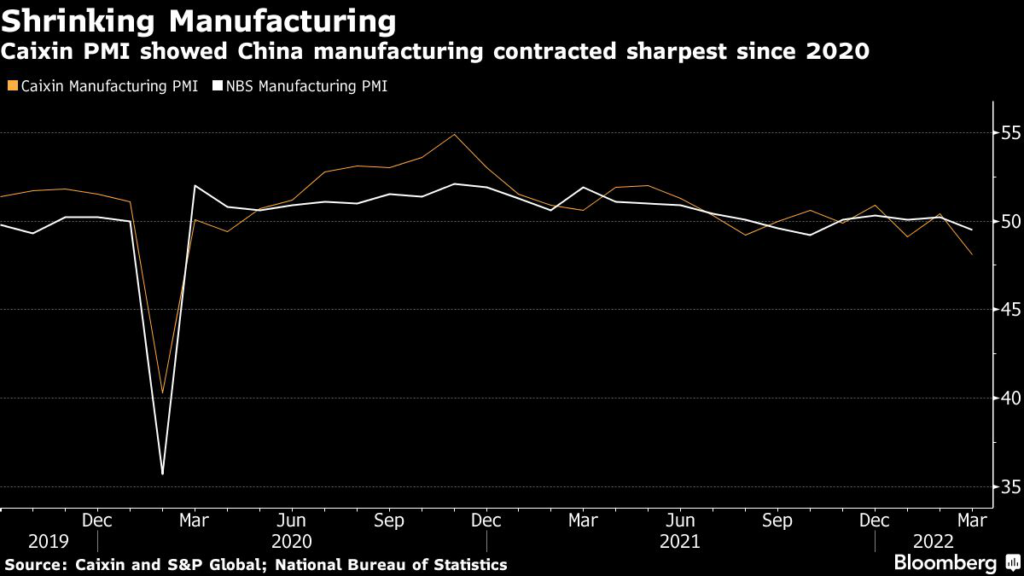
China’s purchasing managers surveys show manufacturing contracted in March, with small and medium-sized firms particularly shaken by operational snags. The Caixin index, based on surveys of smaller, export-oriented businesses, dropped to its worst level since the start of the pandemic two years ago. 

Some large manufacturing firms have been able to keep operations going by adopting a so-called closed loop system, in which employees were kept at factory locations and tested regularly. However, those protocols aren’t perfect: One member of a European Union trade group said last week that work can be “very, very difficult,” even with permission to operate amid restrictions.

Solar companies are seeing a “severe impact” on both panel production and installations, according to a survey conducted by the Shanghai Solar Energy Society. Wafer production has been suspended in some factories in the coastal region close to Shanghai, driving up prices in recent weeks, Jefferies analysts said in a note.

Tech Disrupted

Some technology companies have suspended production as China’s restrictive policies weigh on a sector already contending with a shortage of components.

Most major tech manufacturers — from Semiconductor Manufacturing International Corp. to Taiwan Semiconductor Manufacturing Co. and iPhone maker Foxconn Technology Group — froze operations in the early days of Shanghai’s outbreak. Many have since resumed after setting up closed-loop systems. 

As of Wednesday, more than than 30 Taiwanese companies including Pegatron Corp. and Macbook maker Quanta Computer Inc. had halted production in eastern China’s electronics hubs because of Covid rules. 

Logistics jams are constricting shipments of components, draining inventories to the point where some manufacturers including Pegatron, Wistron Corp. and Compal Electronics Inc. are down to just a few weeks’ stocks, consultancy Trendforce estimates. The ongoing global supply crunch could worsen if local manufacturing is disrupted, constraining stock of computers and gaming consoles to smartphones, servers and electric vehicles.

Automotive Pain 

Overall passenger vehicle sales slid 10.9% last month, suggesting pressure in the massive car market. 

Some automakers are hitting production snags because of lockdowns. Tesla Inc.’s Shanghai factory has been shut down since March 28 because of restrictions in the city. The plant typically produces more than 2,000 cars every day, according to an estimate earlier this month from Dan Ives, an analyst at Wedbush Securities Inc. 

Volkswagen AG was also forced to suspend production in Shanghai this month, while Chinese EV upstart Nio Inc. said Saturday it halted production and delayed deliveries because many suppliers had to close shop. 

Auto parts maker Robert Bosch GmbH said Monday it shuttered two of its factories in China and operated closed-loop systems at two others, adding that it was seeing “temporary effects on logistics and supply chain sourcing.”

Construction Snags

Domestic sales of excavators — a leading indicator for construction — plunged almost 64% in March from a year ago, indicating strain in the sector.

China’s home sales slump also deepened last month: The 100 biggest companies in the debt-ridden property industry saw a 53% drop in sales from a year earlier, according to preliminary data from China Real Estate Information Corp. The decline was the steepest this year.

Steel rebar inventory in China suggests construction activity “may have shifted to a lower gear,” according to analysis published last week by David Qu, an economist covering China for Bloomberg Economics.

Inflation Risks

The lockdowns have driven up food costs and may endanger the nation’s ability to secure enough grains for the year as the curbs complicate China’s important spring planting season. 

Fresh vegetable prices jumped 17.2% on year in March, compared to a drop of 0.1% in February, data from the National Bureau of Statistics showed this week. Chinese farmers in some parts of the northeast, which produces more than a fifth of China’s national grain output, have had to contend with restrictions that prevent them from plowing their fields and sowing seeds.

(Adds details of solar power industry in manufacturing section.)

More stories like this are available on bloomberg.com

©2022 Bloomberg L.P.

On Broadway, Disney Takes Cue From Airlines to Sell More Tickets

(Bloomberg) — On the surface of it, there’s very little in common between Broadway shows and airlines—unless you count the sheer amount of drama that comes with taking to the skies these days.

But in reality, the two businesses rely on a shared economic premise: Getting as many butts in seats as possible.

Enter stage right a new partnership between Disney Theatrical Productions and Volantio Inc., an Atlanta-based startup that helps airlines manage oversold flights and other logistical challenges by reaching out proactively to guests and rewarding them for flexibility. Everyone wins, in theory. Airlines can seamlessly move passengers around to optimize operations, and consumers can get flight upgrades, free miles, or other perks without the schlepping and disappointment of getting rebooked at the airport ticketing counter.

Now they’re doing the same for Disney’s Broadway productions, starting with Aladdin, via a pilot program that quietly launched in early April. Opt in to notifications during your ticket purchase, and you may, for instance, receive a Volantio-powered offer to trade your mezzanine seats on a Saturday night for center orchestra on a Sunday matinee, free of charge.

“Capacity has always been fixed in the history of theater,” says Azim Barodawala, chief executive officer and co-founder of Volantio. “You can’t put a new balcony in for the show just because the demand is there to sell the seats. But we’re enabling Disney to do exactly that on a targeted, as-needed basis.”

Even if such shows as Aladdin and The Lion King, for which the Volantio partnership is not yet live, average roughly 97% occupancy, some days of the week may have slightly lower attendance. “Being able to siphon people from really high-demand performances to, say, a 95%-occupied performance has real material benefit to us,” explains Nicholas Falzon, vice president of sales and analytics at Disney Theatrical.  Previously, the only way to spread out demand was by raising prices as theaters started to sell out. “Now, we don’t have to rely on that as much.”

“For us, a show like Lion King, pre-pandemic, represents over $100 million gross a year. Getting an additional 1% is a financial benefit, but it’s also literally just more people. Without doing something like this, we can only grow our business via price,” Falzon continues. The idea can scale: Including touring companies, Disney Theatrical currently has 10 active productions of The Lion King. 

In a survey of 260 active theatergoers conducted by Volantio and Disney before they formed their partnership, 63% said they “definitely” or “probably” would opt into opportunities to receive upgrades in exchange for flexible show dates, and 48% said they would accept an offer with a minimum of one day’s notice. Just as he does for airline clients, Barodawala will apply machine learning to maximize the odds that consumers will bite.

People buying tickets with billing addresses from beyond the tri-state area, for instance, are likely to receive offers to switch performances for within a few days of their original date—the idea being that it still falls within their vacation period—while locals may be offered opportunities to move from one Saturday night performance to another. For now, there’s no way to indicate in advance what set of conditions you would accept; all offers will consist of free upgrades and will be fully optional. 

Falzon points out a major difference between Broadway and air travel: “There’s no such thing as an oversell in a theater, and ultimately we want people to understand this is nothing more than a net benefit—a free opportunity. Nobody is impacted if they say no.”

From a revenue perspective, the point is only to upgrade ticket-holders whose seats are a hot commodity. “It’s easier to move people into alternate performances with shows that don’t sell out as much because there’s more room to place people, but you have to have performances that you expect to sell out for it to have a benefit,” he explains. 

The change is just one in a series of moves that the Broadway community has adopted to offer and reward flexibility since the pandemic struck.

“The standard on Broadway for years was ‘No exchanges, no refunds, no questions,’” says Falzon. “Institutionally, Broadway had to come back from the pandemic with a full-exchange policy to help guests feel comfortable booking. Now, people expect the flexibility of being able to get refunds or exchanges as their plans shift. It’s not even a ‘nice to have’ now; it’s table stakes.” One might as well find a way to benefit from it in the back of the house, too. 

More stories like this are available on bloomberg.com

©2022 Bloomberg L.P.

Fireblocks Venture With Payments Giant FIS to Bring Institutional Clients to Crypto

(Bloomberg) — Payment giant Fidelity National Information Services Inc. is forming a partnership with crypto custody firm Fireblocks Inc. that aims to alleviate concerns associated with security and regulations that institutional investors have as they seek to access the $2 trillion crypto market. 

Going forward, more than 6,000 capital markets clients of FIS will be able to move, store and issue digital assets through the Fireblocks platform, according to a statement. Clients will also have access to the Fireblocks network that connects users to several exchanges and tokens. And they’ll be able to use decentralized finance applications for trading, lending and staking.  

Many institutional investors in the U.S. want exposure to digital assets in their portfolio, according to a recent study by Fidelity Digital Assets. Apart from being able to spot trade cryptocurrencies, FIS clients wanted access to more complex products such as over-the-counter derivatives, John Avery, head of digital assets at FIS, said in an interview.

“The demand [for cryptocurrency exposure] cuts across all of the segments of the market that we support today in institutional capital markets — buy side, sell side, and corporate treasury,” Avery said. 

But risks around security and regulations are among some of the biggest hurdles for traditional finance institutions who are interested in digital assets beyond Bitcoin. The partnership aims to assuage these concerns.

“The goal is first to allow FIS clients to know they are holding their [crypto] assets in the most secure way,” said Adam Levine, vice president of corporate strategy at Fireblocks.

Fireblocks, in January, helped launch a permissioned DeFi liquidity pool for decentralized lending project Aave’s institution-grade product Aave Arc. The pool is different from a typical DeFi liquidity pool because it’s designed to be compliant with anti-money laundering and know-your-customer rules. 

The crypto custody firm is backed by investors including Sequoia Capital, Coatue, Bank of New York Mellon, DRW Venture Capital and Paradigm. It raised $550 million in a series E funding round in January. 

More stories like this are available on bloomberg.com

©2022 Bloomberg L.P.

Google Bets on Offices With $9.5 Billion U.S. Investment

(Bloomberg) — Google said it will invest $9.5 billion in offices and data centers in the U.S. over 2022, putting money behind its bid to get more workers back in its buildings.

The Alphabet Inc.-owned company based in Mountain View, California will spend on campuses across the country, and is expecting to create 12,000 new jobs as part of the investment, Chief Executive Officer Sundar Pichai said in a statement Wednesday. 

Tech companies have struggled to balance getting workers back to the office without causing unrest among their staff, who are often in high demand.

“It might seem counterintuitive to step up our investment in physical offices even as we embrace more flexibility in how we work,” Pichai said. “Yet we believe it’s more important than ever to invest in our campuses and that doing so will make for better products, a greater quality of life for our employees, and stronger communities.”

In March Google asked its employees in the San Francisco Bay Area to work in their offices three days a week starting this month, which has frustrated some employees who wanted to move outside of the pricey region.

Apple Inc. employees have recently pushed back on the company’s attempt to encourage staff to return to its multi-billion-dollar suite of global offices, including its estimated $5 billion main hub in Cupertino, California.

Apple employees are required back in the office at least once a week by April 11, twice a week by the end of the month, and on Mondays, Tuesdays, and Thursdays by May 23.

In March 2021, Google announced a $7 billion investment in the U.S. that planned to create at least 10,000 new jobs, a drop from the $10 billion it promised it would invest in 2020.

Google’s Plans

  • Investments in existing office developments include Austin, Boulder, Cambridge, Pittsburgh.
  • Opening new office in Atlanta this year.
  • Investing in data centers in Tennessee, Virginia and Oklahoma.
  • Read Google’s 2021 economic impact report here.

(Updates with details from statement from ninth paragraph)

More stories like this are available on bloomberg.com

©2022 Bloomberg L.P.

Close Bitnami banner
Bitnami