Bloomberg

Ex-McKinsey Partner Gets 2 Years for Trading on Goldman Deal

(Bloomberg) — A former McKinsey & Co. partner who led a team that advised Goldman Sachs Group Inc. on its acquisition of a financial technology company was sentenced to two years in prison for insider trading on the deal.

Puneet Dikshit pleaded guilty in December to a single count of securities fraud, admitting he bought short-term GreenSky Inc. options ahead of the bank’s Sept. 15 announcement that it planned to acquire the company for about $2.24 billion.

According to the indictment, Dikshit made about $450,000 from his illegal trades. He used two accounts, one in his wife’s name, and sometimes made trades on his work computer. The day before the deal was announced, Dikshit searched Google for “what happens to options when company is acquired” and “greensky market cap,” prosecutors said. He also checked his broker’s web page for information about $10 GreenSky call options.

‘Basically Unforgivable’

Prosecutors argued in court papers that Dikshit should get up to three years in prison, calling his conduct “shocking, egregious, and brazen.” 

U.S. District Judge Colleen McMahon rejected prosecutors’ proposal, but declined to go along with Dikshit’s request for a sentence of probation.

“There are a few crimes that I consider basically unforgivable,” the judge told Dikshit. “And insider trading is at the top of the list.”

McMahon said Dikshit, an Indian national who’s lived in the U.S. for a decade, will be deported once he serves his term. Because he’s not a U.S. citizen, he won’t be eligible for any early release programs, she said. Dikshit previously agreed to forfeit $455,017.

Googling Gupta

According to prosecutors, Goldman hired McKinsey in late 2019 to consult on its planned acquisition and integration of GreenSky, which sells technology that allows banks and merchants to make “buy-now-pay-later” loans to consumers at the point of sale. Dikshit led McKinsey’s New York unsecured lending practice at the time.

Goldman’s acquisition of GreenSky closed on March 29.

In addition to running Google searches on options and GreenSky, Dikshit also used his work computer to read up on former McKinsey global head Rajat Gupta, who was found guilty in 2012 of using his position as a Goldman board member to pass illegal tips to Galleon Group Inc. co-founder Raj Rajaratnam. Gupta was sentenced to 30 months in prison. 

The case is U.S. v. Dikshit, 21-cr-00760, U.S. District Court Southern District of New York (Manhattan).

(Adds quote from sentencing judge.)

More stories like this are available on bloomberg.com

©2022 Bloomberg L.P.

El Salvador President Bukele Cancels Miami Bitcoin Conference Appearance

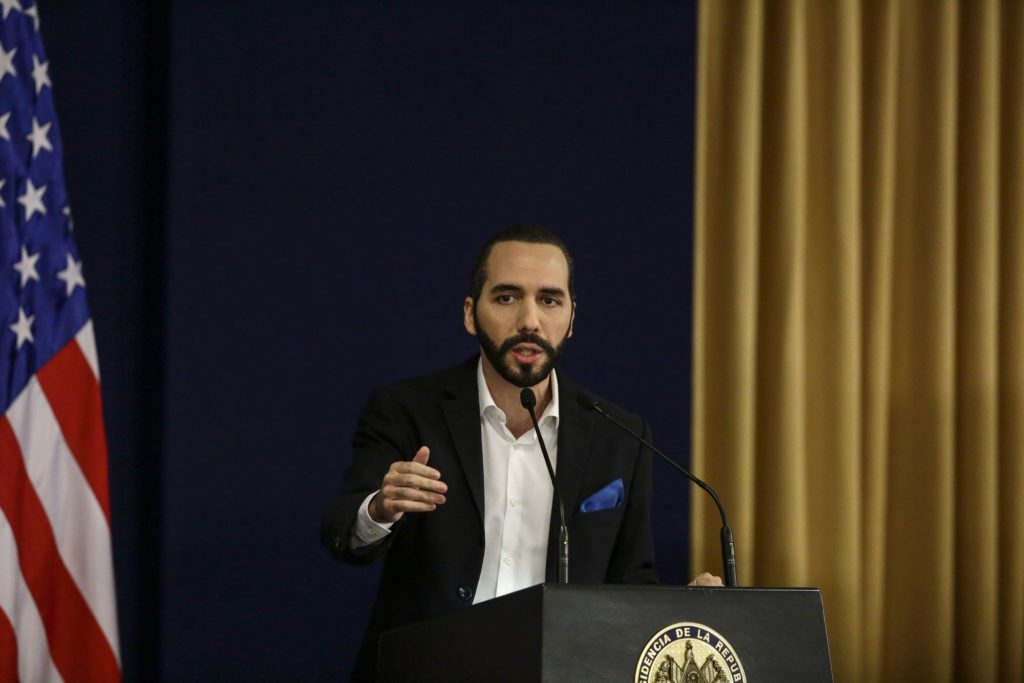
(Bloomberg) — El Salvador President Nayib Bukele, who made Bitcoin legal tender last year, canceled his scheduled visit to a conference in Miami devoted to celebrating the world’s biggest cryptocurrency, he said in a post on Twitter. 

“I have just made the decision of canceling my participation in the conference due to unforeseen circumstances in my home country that require my full attention as president,” Bukele said. 

Bukele was scheduled to speak at the Bitcoin 2022 conference on Thursday afternoon. His government declared a state of emergency on March 27 after a wave of gang-related killings. 

He said this week authorities have since arrested nearly 7,000 alleged gang members and said if the bloodshed continues, prisoners won’t get a single meal. 

More stories like this are available on bloomberg.com

©2022 Bloomberg L.P.

Tech Goes From Haven to Hazard as Investors Fear Recession

(Bloomberg) — Selling is picking up again in the priciest corner of the U.S. stock market — that of fast growth technology shares — as investors whipsaw between seeking higher returns and safety.

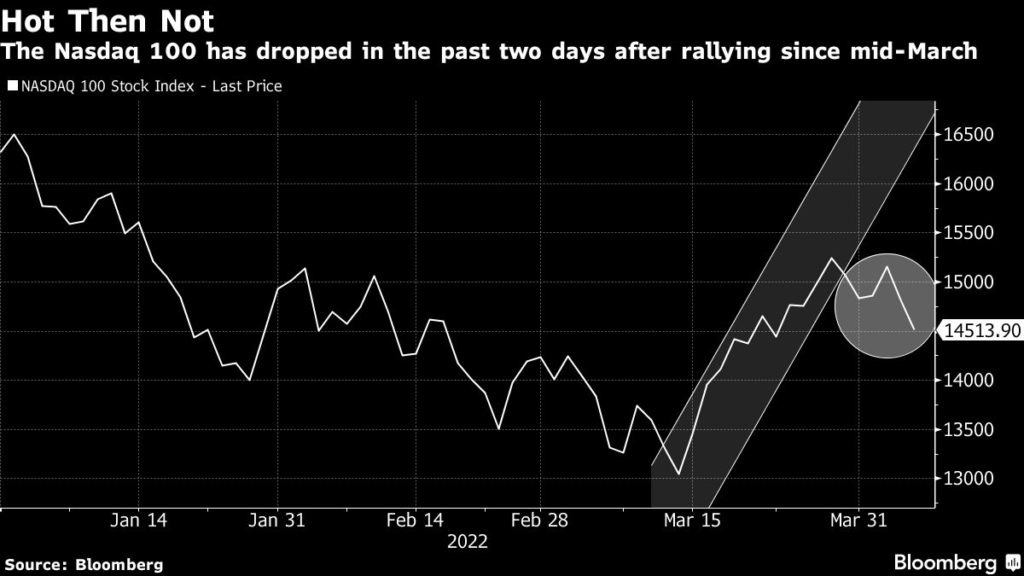
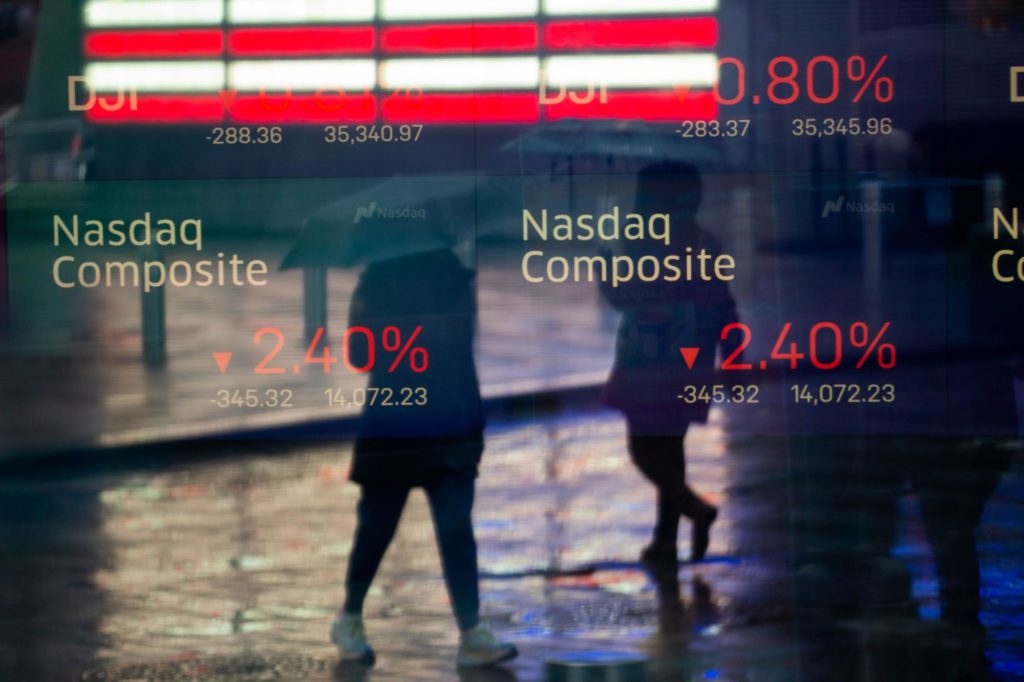
The Nasdaq 100 Stock Index is wrapping up its worst two-day drop in nearly a month as traders that flocked to the tech sector in recent weeks have started to ditch the shares on Tuesday in favor of utilities and consumer staples. Losses mounted on Wednesday, with the 4% decline in the benchmark ensnaring nearly every stock with high valuations, led by Microsoft Corp. and Nvidia Corp. Meanwhile, defensive plays including Southern Co. and Dollar General Corp. rose.   

Concerns about the risks of over-aggressive Federal Reserve tightening were revived by comments from Federal Reserve Governor Lael Brainard on Tuesday suggesting the central bank will rapidly reduce its bond holdings. Combined with high inflation, soaring energy prices and the war in Ukraine, investors are once again seeing a greater risk that the economy tips into recession.

“A recession doesn’t look imminent, but the recipe is there,” said Jason Benowitz, senior portfolio manager at Roosevelt Investment Group. “There are lots of reasons to be concerned and to think that maybe the rally we saw over the last two weeks wasn’t the start of a new market regime and instead more of an oversold bounce.” 

Minutes of the last Fed meeting released on Wednesday did little to assuage jitters even after FOMC members proposed shrinking the central bank’s bond holdings at a maximum pace of $95 billion. 

“Investors have finally come to the realization that the Fed is going to be aggressive even if it causes some pain in the markets,” said Matt Maley, chief market strategist at Miller Tabak + Co. “Their No. 1 priority right now is inflation.”

Minutes Show Fed Willing to ‘Walk the Walk’: Wall Street Reacts

The selling hasn’t been limited to high-multiple growth stocks. Sectors that are more cyclically sensitive like banks, for example, have also been pummeled. The KBW Bank Index is close to sinking to a new low for the year after dropping 9% in 2022.

The rising pessimism was evident in the trading of the biggest technology stocks. Apple and Microsoft, whose strong balance sheet, huge cash flows and broad portfolio of businesses, have made their stocks popular havens in times of uncertainty, have dropped in the past two days. Microsoft has fallen more than 5%, while Apple is down 3.5%. 

“We’re re-embracing these old concerns that growth is going to slow down and we can’t sustain these multiples,” said Daniel Morgan, senior portfolio manager at Synovus Trust. “There’s enough worry that people are going to take profits ahead of the upcoming tech earnings season.”

More stories like this are available on bloomberg.com

©2022 Bloomberg L.P.

U.S. Sends 5,000 SpaceX Starlink Internet Terminals to Ukraine

(Bloomberg) — The U.S. Agency for International Development said it delivered 5,000 of SpaceX’s Starlink terminals to Ukraine, bolstering internet access for residents following the Russian invasion.

“The terminals will allow public officials and critical citizen service providers to continue to communicate within Ukraine and with the outside world,” even if Russia severs other communications infrastructure in the country, the agency said in a statement Tuesday.

Elon Musk’s Space Exploration Technologies Corp. is deploying its Starlink constellation in low-Earth orbit to sell high-speed internet access around the world, focusing initially on consumers in rural and underserved areas with little or no current web access. The company has said it’s also exploring new business in aviation and maritime industries.

SpaceX activated its Starlink service in Ukraine Feb. 26, days after a government minister tweeted at Musk urging him to provide internet access.

“We were close to getting the approvals to offer service but the documents weren’t all signed,” SpaceX President Gwynne Shotwell said last month during a panel discussion at the Satellite 2022 conference in Washington. After the conflict began, “they tweeted at my boss and that was permission to provide capability.”

France and Poland also funded some Starlink terminals for Ukraine, the New York Times reported last month.

More stories like this are available on bloomberg.com

©2022 Bloomberg L.P.

German Coalition Agrees on $166 Million Budget to Arm Drones

(Bloomberg) — Chancellor Olaf Scholz’s ruling coalition sealed a deal to arm German drones, approving a defense ministry request to purchase ammunition worth 152 million euros ($166 million) from Israel’s state-run Rafael Advanced Defense Systems Ltd.

The decision to arm the Israeli-made Heron-TP drones, leased by the German military, is part of a wider shift in Berlin’s defense policy triggered by Russia’s invasion of Ukraine. Scholz in late February announced the creation of a debt-financed special fund worth 100 billion euros to modernize the Bundeswehr armed forces and meet NATO’s annual defense spending goal of 2% of economic output each year.

The Bundeswehr has been demanding armed drones for years to help protect soldiers during missions abroad and back up military convoys in dangerous terrain. Combat drones could also play a role in defending Germany and NATO allies. Until now, the army has only used drones for reconnaissance purposes, including in Mali.

Lawmakers on the lower house of parliament’s defense committee approved the government’s request to purchase 140 rockets to arm the Heron drones, according to people familiar with the decision, who asked not to be identified because the information is confidential.

Sixty rockets will be purchased for training purposes and 80 for possible use in combat, the people said. The meeting was not open to the public.

The lower house’s budget committee approved the move, according to a statement from the defense ministry. A draft resolution for the committee obtained by Bloomberg News says that the drones can only be used in combat if parliament has explicitly approved it.

The Bundestag’s budget committee is also expected on Thursday to give the green light to preliminary plans for spending a first tranche of 2.4 billion euros out of the 100 billion euros from the military fund.

The defense ministry wants to spend the cash on purchasing new gear including more than 305,000 bulletproof vests, 150,000 combat uniforms, 122,000 helmets and 250,000 backpacks.

(Updates for deal approval in sixth paragraph.)

More stories like this are available on bloomberg.com

©2022 Bloomberg L.P.

Big Stock-Picking Hedge Funds Suffer Brutal Reversal in 2022’s Market Tumult

(Bloomberg) — Year after year, the largest hedge funds that sprung from Julian Robertson’s Tiger Management posted stellar results. But in 2022, they’re losing money on both of their favored trades: Technology giants and unicorns. 

Chase Coleman, Philippe Laffont and Andreas Halvorsen — so-called Tiger cubs — all rode long positions in the tech sector as valuations climbed, only to suffer as sentiment shifted amid volatile markets. The change seemed to have caught their funds by surprise, with their short positions not enough to outpace the declines. 

Coleman’s Tiger Global Management saw its hedge fund plunge 34% in the first three months of the year, while Laffont’s Coatue Management and Halvorsen’s Viking Global Investors fell 9.9% and 7.9%, respectively. Another Tiger offshoot, D1 Capital Partners, sank 16% in that time. Unusually, Tiger Global and D1 said they wrote down some of their private investments alongside their public market losses.

Some investors said the megafunds failed to catch the market rotation spurred by inflation worries and a war in Europe, and that their size prevented them from being nimble. As a result, many ended up being stuck on the wrong side of numerous trades.


“The thing that worked extremely well for the largest TMT-focused equity managers historically — betting big on tech companies, both public and private ones — is going to be a big reason why they’re under-performing this year,” said Jon Caplis, chief executive officer of hedge fund consultant and data provider PivotalPath. Its Equity Sector Technology/Media/Telecom Index is down an estimated 8.8% for the first quarter.

The tech-heavy Nasdaq 100 entered a bear-market decline of 20% in the first quarter, though losses were pared at the end of March. The S&P 500 Growth Index fell 8.8% in the first three months. All five FAANGS — Facebook parent Meta Platforms Inc., Apple Inc., Amazon.com Inc., Netflix Inc. and Google-parent Alphabet Inc. — were in the red, and two of them plunged by more than 30%.  

All six of Tiger Global’s biggest stock holdings at year-end, including JD.com Inc. and Microsoft Corp., fell this year, most by double digits. Coatue and D1 were hit by their large holdings in Rivian Automotive Inc., which dropped 52%. As of December, Microsoft and Amazon were among the 10 largest U.S. stock holdings for Viking, D1 and another Tiger cub-run firm, Lone Pine Capital. 

Another tech-focused investor, Gabe Plotkin, also had a rough first quarter, losing 21% in his $10 billion Melvin Capital Management. That followed a disastrous 2021, when the New York-based firm tumbled 39%.

Plotkin worked for billionaire Steve Cohen before founding Melvin in late 2014, and he was one of the best-performing stock pickers until last year, when the fund’s short positions were hammered by a Reddit-inspired short squeeze. Cohen’s Point72 Asset Management and Ken Griffin’s Citadel together invested $2.75 billion in Melvin last January as the fund plunged. The two firms have since asked to withdraw almost all that money.

Private Wagers

Among the losses at D1 Capital — founded by Viking veteran Dan Sundheim — were a markdown of its holdings in Instacart, which last month slashed its own valuation by 40%. 

Instacart’s struggles illustrate the broader issues for the equity hedge fund firms, which in recent years have pushed into venture capital investing and added private wagers as a way to bolster performance. D1’s hedge fund was up 26% in 2021, powered by a 70% gain in its private holdings as its public portfolio fell 8%, while at Tiger Global, the hedge fund’s 7% decline last year compared with a 54% rise in its Private Investment Partners funds.

But the private holdings could prove problematic if investors want to leave and the closely held companies are marked down; Coatue recently told exiting investors they won’t get back their cash that is invested in privates. 

Tiger Global’s managers “adjusted valuations down” for the fund’s private investments to account for pressure on their public-market peers, they said in the letter to clients last week. The fund owns shares of private companies including ByteDance, Stripe, Checkout and Databricks. It’s unclear what those mark downs mean for Tiger Global’s venture business, which had assets of $65 billion at year’s end.

One Tiger offshoot that bucked the trend was Karthik Sarma’s SRS Investment Management. The roughly $8 billion firm ended the quarter up 9.6%, thanks in large part to a monster bet on Avis Budget Group Inc. Sarma worked at Tiger Global for five years before starting his own firm.

More stories like this are available on bloomberg.com

©2022 Bloomberg L.P.

Biden Warns Amazon ‘Here We Come’ After New York Union Vote

(Bloomberg) — President Joe Biden took a shot at Amazon.com Inc. over its battles with employees seeking to unionize. 

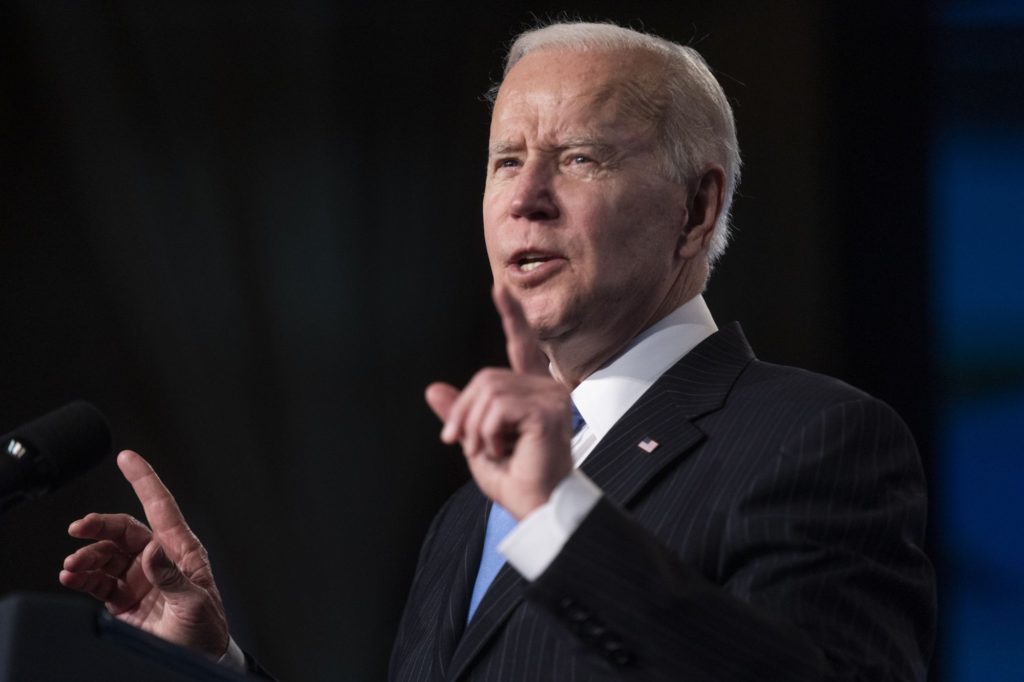
Speaking to members of North America’s Building Trades Unions in Washington on Wednesday, Biden touted his administration’s efforts to make it easier for workers to form labor unions. 

“By the way, Amazon, here we come,” the president said, drawing applause. “Watch. Watch.”

Read More: Amazon Union Win in NYC Holds Potential to Spread Far and Wide

The comments come on the heels of a victory for Staten Island, New York warehouse workers who formed a union in the face of opposition from Amazon. A second vote is expected at another Amazon warehouse in Staten Island, and organizers are eying union pushes at more of the company’s facilities in the region. 

The Retail, Wholesale and Department Store Union is attempting to win another election at an Amazon warehouse in Bessemer, Alabama after losing a vote last year. 

Biden said his White House is intent on empowering organizing workers “to make sure the choice to join a union belongs to workers alone.”

“That’s what unions are about — about providing dignity and respect for people who bust their neck,” Biden said. 

Earlier: Tesla, Who? Biden Can’t Bring Himself to Say It, Irking Musk 

The president has shown antipathy toward employers perceived as anti-union, most notably in his relationship with Tesla Inc. Biden has seldom mentioned the company and has not visited any of its factories, even while celebrating efforts by Ford Motor Co. and General Motors Co. to launch electric models. 

The snubs have irked Tesla co-founder Elon Musk. 

But recently, Musk hosted Labor Secretary Marty Walsh for a tour of Tesla’s new factory in Austin, Texas. Walsh said in an interview with Yahoo Finance Live that Musk told him he’s not opposed to Tesla employees seeking to form a union, if they want.

(Adds Biden remarks, context throughout)

More stories like this are available on bloomberg.com

©2022 Bloomberg L.P.

Meta Scraps 2022 Developers Event as It Focuses on Metaverse

(Bloomberg) — Facebook owner Meta Platforms Inc. is canceling the company’s annual developers conference, saying it needs more time to prepare for its next big project: the metaverse. 

The move marks the second time in three years that the company has scrapped the event. It canceled the show in 2020 over pandemic concerns and then held it virtually in 2021.

Previously, the F8 conference had given developers and businesses a chance to hear about Meta’s latest products and innovations. Last year’s conference included sessions on creating Facebook business apps and other topics. 

But over the past year, the metaverse — a plan for interconnected virtual worlds — has become an increasing focus for the social media giant. The company, previously known as Facebook Inc., changed its name to Meta in October to underscore the shift.

Pausing the developers conference will let Meta focus on “new initiatives that are all tailored toward the next chapter of the internet, and the next chapter of our company too: building the metaverse,” the company said in a blog post Wednesday.

Meta will still be holding its inaugural Conversations conference on May 19, an event for businesses and developers building services on the Menlo Park, California-based company’s messaging platforms.

More stories like this are available on bloomberg.com

©2022 Bloomberg L.P.

Uber to Add Plane, Train and Hotel Bookings in ‘Super App’ Push

(Bloomberg) — Uber Technologies Inc.’s customers will soon be able to book long-distance travel on planes, trains and buses, reflecting the company’s ambitions to become a travel “super app.”

A pilot project being launched in the U.K. will integrate offers from travel partners into Uber’s app “to create a seamless door-to-door travel experience,” Jamie Heywood, Uber’s regional general manager for U.K., Northern and Eastern Europe, said in a statement.

“You have been able to book rides, bikes, boat services and scooters on the Uber app for a number of years, so adding trains and coaches is a natural progression,” he said. Eventually, Uber will also offer hotel bookings.

Uber won’t provide the travel service itself, but will team up with third-party booking agencies to facilitate the sale of tickets. While Uber didn’t disclose which ticketing platforms it will partner with, it could wind up working with major aggregators such as Booking.com and Expedia Inc., where Dara Khosrowshahi served as chief executive officer before assuming the helm at Uber. The company will make money by collecting a service fee from the bookings. 

The pandemic fundamentally changed Uber’s business model when it was forced to pivot heavily into food-delivery to cushion a steep decline in demand that hit its core-ridesharing segment. The travel pilot will significantly bolster Uber’s transportation offerings and illustrates the company is charging forward with Khosrowshahi’s goal of transforming the San Francisco-based ride-hailing giant. 

The U.K. pilot was first reported by the Financial Times. 

Train and bus bookings will be available on the app this summer with flights and hotel reservations potentially launching later in the year. 

Uber recently won permission to operate in London for another 30 months after meeting requirements on drivers’ rights. The decision provides Uber more stability in the U.K., one of its biggest markets, after years of sparring with regulators over worker classification. 

More stories like this are available on bloomberg.com

©2022 Bloomberg L.P.

Alibaba, SoftBank Score First 2022 IPO Windfall With GoTo Sale

(Bloomberg) — GoTo Group, whose business spans ride-hailing, e-commerce and fintech, became one of the world’s biggest listings this year, giving a much needed boost to early backers including China’s Alibaba Group Holding Ltd. and SoftBank Group Corp.’s Vision Fund.

The Jakarta-based company raised $1.1 billion last week, meaning the value of the two investors’ stakes will be almost $5 billion combined following the share sale. That marks their first big windfall from an initial public offering this year after their stocks were both battered in past months.

For GoTo’s top executives, the success of taking the company public isn’t translating into the type of riches recently associated with Asian IPOs.

Chief Executive Officer Andre Soelistyo will have a stake valued at $235 million after the listing, while the holdings of Kevin Aluwi and William Tanuwijaya, who co-founded the startups that later merged to produce Indonesia’s giant, will be worth $213 million and $494 million, respectively, according to Bloomberg calculations based on the IPO prospectus.  

It’s not uncommon that early backers see a huge payday when a startup goes public — that’s the incentive for taking the risk to invest. What’s notable in this case is how much the founders’ ownership got diluted in the various funding rounds that brought in billions of dollars. 

“In the mind of a startup, you need to burn cash to grow and to acquire users,” said Nathan Naidu, an analyst with Bloomberg Intelligence. “So I don’t think the focus for the founders is on wealth. It’s for getting the cash to grow the company.” 

While Tanuwijaya, Soelistyo and Aluwi retain 26% voting power after the share sale, their direct ownership in the internet giant is tiny: Tanuwijaya has a 1.77% stake assuming over-allotment, Soelistyo’s is 0.84% and Aluwi’s 0.77%. Compare that with 8.71% for SoftBank’s Vision Fund and 8.84% for Alibaba. 

GoTo declined to comment on the value of stakes held by its executives. 

But the fund that holds an even bigger proportion of the company is one that allocates stock options to employees in the coming years: The GoTo Peopleverse Fund will have a 9.03% stake after the listing. The firm is also giving away more than $20 million worth of shares to long-serving drivers, part of a broader program that includes merchants, consumers and its workers.

“It’s about the sense of ownership and the badge that they’re part of the big family of GoTo,” Soelistyo said in an interview, referring to the share program. “The best way to sum this up is through one of our internal values, which we call ‘it’s not about you.’ It’s about us. It’s about the communities that we support that have made our success happen.”

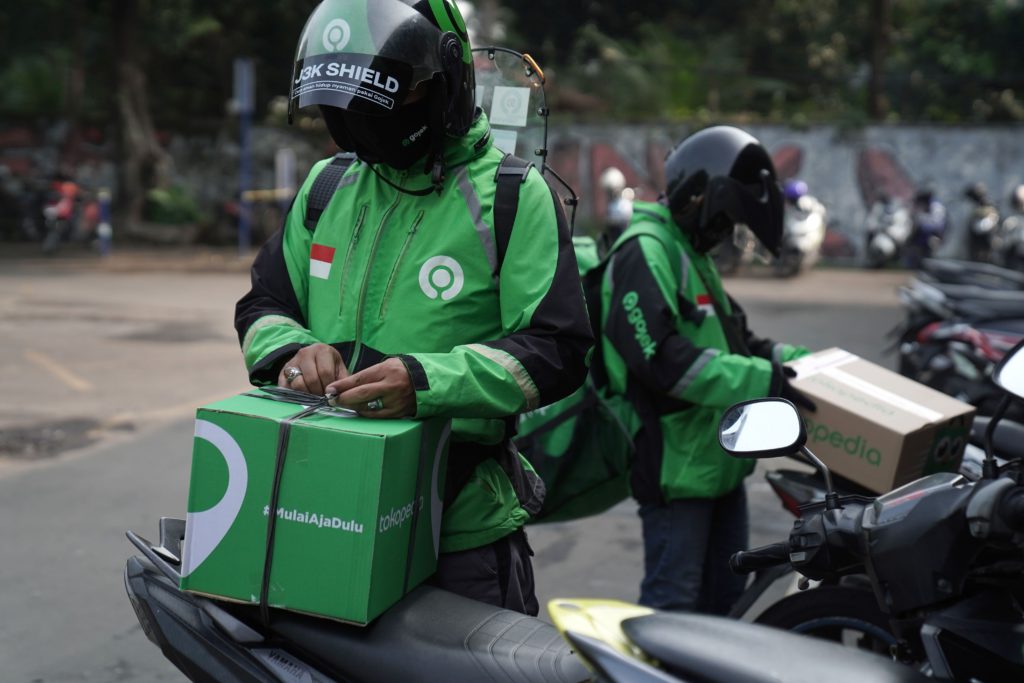
GoTo is the result of last year’s merger between Indonesia’s two most-valuable internet startups — ride-hailing company Gojek and e-commerce firm Tokopedia — to get more firepower against rivals in an increasingly cutthroat market. Over the years, the two amassed a long list of investors, including Google, Tencent Holdings Ltd. and Sequoia Capital India. The latter was an early backer of both Gojek and Tokopedia.

It all started in 2009, when Tanuwijaya, the son of a factory worker, made a bet on Indonesia’s economic and internet boom and founded Tokopedia — the name is a variant of the Indonesian word for “store.” A year later, Nadiem Makarim, a Harvard Business School grad and former McKinsey & Co. consultant, set up Gojek to arrange courier deliveries in Jakarta. 

Soelistyo joined Gojek in 2015 after working as an investor at private-equity firm Northstar Group, which became the first institutional backer of the upstart. He and Aluwi were named co-CEOs of the ride-hailing company in October 2019, when Makarim left to join the government as the nation’s minister for education and culture. 

The IPO is going ahead despite a rout in tech stocks, though it got downsized from its original goal. An index tracking the shares globally has slumped more than 10% this year with rising interest rates and geopolitical tensions weighing on the sector. GoTo’s regional peers have been particularly hit. 

Singapore-based Grab Holdings Ltd., which also operates in Indonesia, has lost two-thirds of its market value since it merged with a blank-check firm in early December. Last month, it reported a wider loss after increasing its spending for incentives to lure drivers and customers — highlighting risks in the highly competitive space. 

Sea Ltd., which at one point minted Singapore’s richest billionaire, has tumbled about 65% from its high in October. The gaming and e-commerce giant forecast its first decline ever in bookings at its digital gaming unit, while political headwinds in India pushed it to shut its main e-commerce operation just months after launching. New Delhi had already banned its most popular mobile game, Free Fire, citing security concerns because of its Chinese links.

While GoTo remains unprofitable — it reported annual deficits for the three years through 2020 and a loss of 8.2 trillion rupiah ($570 million) in the first seven months of 2021 — Soelistyo is optimistic. After all, Indonesia is Southeast Asia’s biggest economy, and the company also has operations in Vietnam and Singapore.

“Our listing will be a great moment for those involved in the success of our ecosystem and for everyone that believes in the ‘Indonesian dream’,” Soelistyo said in the statement announcing the initial share sale. “We hope that our IPO will show the world the tremendous opportunity that exists in our country and throughout the Southeast Asia region.”

More stories like this are available on bloomberg.com

©2022 Bloomberg L.P.

Close Bitnami banner
Bitnami