
Bloomberg

More Than Half of the Working Day Is Spent Kinda, Sorta Working

(Bloomberg) — The pandemic has forever altered many aspects of work, but there’s one thing it hasn’t changed — how much time we spend just shuffling paper around.

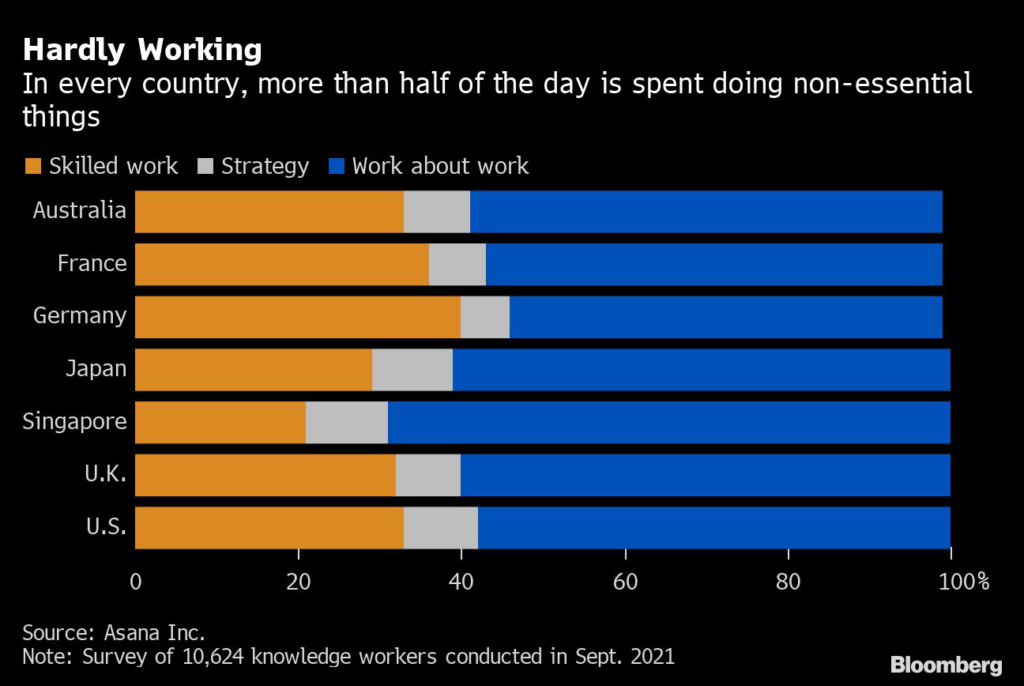
White-collar workers devote more than half their day to “work coordination,” which includes following up on things, searching for information and communicating about work, according to a survey by business software maker Asana Inc. While there are regional differences — Germans devote a bit less of their day to such mundane tasks than Americans — the results are broadly similar across the globe: Only about a third of the workday is spent doing what we were actually hired to do, and that hasn’t changed much since 2019.

“The workday has become complex enough that we have to spend more time just managing work and a host of competing priorities rather than actually doing work,” said Melissa Swift, U.S. transformation solutions leader at workforce consultant Mercer. “Many, many meetings are wholly performative.” 

The global survey of more than 10,600 so-called knowledge workers — data analysts, graphic designers and the like — also found that the amount of time spent on strategy, or planning ahead, declined to 9% last year from 13% in 2019. That’s due in part to the difficulties of getting disparate, often asynchronous teams together at the same time, Asana said.

But it could also be because many companies found long-term forecasting difficult amid a global pandemic and its impact on office life.

“The decline in strategic work was striking,” Anne Raimondi, Asana’s chief operating officer, said in an interview. “Leaders have been much more in reaction mode lately.”

While more than half of the working day is soaked up by nonessential tasks, variations do exist around the globe. Germans devote more of their day to doing their actual job than other nationalities, but they also spend the least amount of time on strategic planning. Workers in Japan and Singapore, meanwhile, led the pack with 10% of their time going to strategy, but those two nations also spent the most time coordinating work.  

Swift, the Mercer consultant, said companies have tried to reduce the amount of time spent on coordination, without much success. The number of meetings, for example, increased by 70% during the pandemic, according to Reclaim.ai Inc., which makes an app that syncs calendar programs. Neither Mercer nor Reclaim.ai was involved in the Asana survey.

“It’s tricky,” Swift said. “Folks are genuinely loath to admit they’re doing performative work with literally zero value.”

More stories like this are available on bloomberg.com

©2022 Bloomberg L.P.

Another Regulator Moves to Crypto World as JST Hires From New York Fed

(Bloomberg) — Yet another regulator is heading off to join the crypto world.

Martin Grant, who served as the Federal Reserve Bank of New York’s chief compliance and ethics officer for more than 15 years, has joined JST Capital, a financial services firm for digital assets.

Grant, who spent more than three decades at the New York Fed, will head regulatory affairs for JST, the company said in a statement. His role will be to navigate the changing regulatory environment, JST said.

Grant is one of the latest in a string of crypto hires from the regulatory world, as the industry prepares for increased interest and oversight from government. At least 235 officials from Congress, the White House, federal agencies, the Federal Reserve and national political campaigns have moved to or from dozens of crypto companies, exchanges or trade associations, according to a February report by the Tech Transparency Project, a watchdog group.

“Clients want to deal with trusted counterparties who understand the evolving regulatory landscape,” said Scott Freeman, co-founder and partner at JST.

JST, which has operations in the U.S. and Singapore, primarily trades its own capital, while also offering separate managed accounts for clients, according to its website. The company says it has tripled its clients since April 2021, and increased gross revenue by about 10-fold in 2021 compared to the previous year. It has also participated in seed funding rounds for companies including non-fungible token firm Recur and digital-asset platform InvestaX in the past 12 months.

Grant isn’t alone in making the switch to crypto this year. In January, Brandon Neal joined decentralized finance firm Euler XYZ as chief operating officer after more than nine years at the New York Fed. The same month, former Fed economist Gordon Liao became head of research for decentralized cryptocurrency exchange developer Uniswap Labs.

It’s broadly acknowledged that “crypto and digital assets are here to stay,” Grant said in emailed comments. “I look forward to working with JST’s clients.”

More stories like this are available on bloomberg.com

©2022 Bloomberg L.P.

Young Black Americans Wary of the Stock Market Are Turning to Crypto

(Bloomberg) — Young Black Americans are embracing cryptocurrency to counter a distrust in stock markets and financial institutions.

About 38% of Black investors under 40 years old own digital tokens, compared with 29% for their White counterparts, according to a survey by Ariel Investments and Charles Schwab Corp. issued Tuesday. Overall, twice as many Black respondents than those who are White ranked crypto as the best investment choice overall.

The embrace of crypto shows the growing influence of social media and the popularity of risky investments among Black investors — and a need for more financial education, the companies said. It also reflects a finding in the survey that Black Americans are more likely to see the stock market as riskier and less than fair than White investors.

“It’s just very worrisome,” said John Rogers, founder and co-chief executive officer of Ariel Investments. “People are just interested in getting rich quickly through this hot, exciting, dynamic new area.”

The risk is that Black investors sacrifice their financial goals, he said. “The worst thing is if you get started and your first investment doesn’t work out well, it’ll take a long time to get comfortable in the markets again,” Rogers said.

Crypto is so popular among Black investors that 23% of those surveyed cited excitement for the asset class as the reason they started investing, Ariel and Schwab said. 

Read more: Black Americans Are Embracing Stocks and Bitcoin to Make Up for Stolen Time

Among the other findings:

  • ESG investing is more attractive to Black investors than White. Forty-four percent of Black respondents said it was “very important” to align their investments with their personal beliefs versus 29% of White respondents
  • Black investors are more than twice as likely to expect annual returns of more than 20% as White investors
  • Black Americans are investing and saving significantly more than they did in 2020 — about $650 per month. That figure was almost $400 in 2020. White investors are now saving about $850 a month

Ariel and Schwab surveyed about 2,000 people age 18 and older, half of whom identified as Black. The average household income of Black and White participants was $99,000 and $106,000, respectively. The survey was conducted from Jan. 4-13 and had a margin of error of 3 percentage points.

More stories like this are available on bloomberg.com

©2022 Bloomberg L.P.
Biden’s Battery Metals Boost Could Ease U.S. Dependence On China

(Bloomberg) —

President Joe Biden fired up mining companies, battery makers and environmentalists last week when he invoked Cold War powers to encourage domestic production of critical battery minerals for electric vehicles.

The president used the Defense Production Act — wielded by Harry Truman to make steel for the Korean War, and by Donald Trump to spur mask production in 2020 — to add lithium, nickel, graphite, cobalt and manganese to the list of items deemed critical for national defense. The move paves the way for companies aiming to mine, process or recycle these minerals in the U.S. to access a $750 million fund administered by the Defense Department.

Mining advocates say three-quarters of a billion dollars is a drop in the bucket when you consider this covers both military and civilian supply chains — everything from airplanes and bomb materials, to rare earth magnets and energy storage. They’re more excited about the symbolic value of Biden’s gesture — that it could mark a shift in U.S. industrial policy and a demonstration of how far he’s willing to go to compete with China and further his climate agenda.

The battery industry is hopeful Biden’s act will lead Congress to earmark larger sums to support the effort, particularly more mining and processing in the U.S., said Abigail Wulf, the director of critical minerals strategy at Securing America’s Future Energy, a Washington think tank that advocates for U.S. energy independence.

“It sends the signal to the entire economy that this is important,” said Wulf, who testified about critical minerals before the Senate Committee on Energy and Natural Resources last week. “When we talk about the auto sector, we’re talking about a trillion dollars to our economy each year — that’s the level of commitment that we need.”

That wouldn’t all come out of Uncle Sam’s pocket, of course, but Congress could further help by signaling to private markets that this is really happening, she told me in an interview.

Reducing the U.S.’s dependence on China for battery materials is a uniquely bipartisan issue, one that could draw support from someone like West Virginia Senator Joe Manchin, who has stymied Biden’s economic and climate agenda but also expressed support for domestic battery manufacturing, said Andrew Gier, an energy analyst at Capstone LLC, which advises companies and investment firms on regulatory risk.

“We think there’s more to be added, if it’s related to these supply chain concerns,” Gier told me. “It’s obviously interesting to Senator Manchin, and very important to the Biden administration.”

Funding could come in the form of tax breaks folded into the federal budget for the production of specific minerals, or even a resurrection of Biden’s Build Back Better legislation, which contained consumer tax credits for EV purchases, Gier said.

This is just the speculation of highly focused observers, and there’s no indication any moves in this direction are actually afoot in Congress. But it’s clear such a push would be a tightrope walk for Biden. In a speech last Thursday, the president took pains to acknowledge the concerns of his fellow Democrats, who have been pushing for an overhaul of the nation’s mining laws to strengthen protections for public land, water and Native communities.

“There’s no situation in which I’m going to feel good about giving even more subsidies to the mining industry,” Raul Grijalva, a Democrat from Arizona who chairs the House committee on natural resources, said in a statement last week. “I’m heartened, however, that the White House recognizes the fundamental flaws in the rules governing mining on public lands and is committed to putting much-needed safeguards in place.”

On the other side of the aisle, Republican Senator Lisa Murkowski told reporters that nothing Biden has done addresses the real bottleneck for the U.S. to produce critical minerals: mining permits.

“They had a climate policy and not much of an energy policy,” she told my colleague Steve Dennis in the halls of Congress last week. “Up to this point in time, it’s been more talk than action.”

More stories like this are available on bloomberg.com

©2022 Bloomberg L.P.
Mailchimp Says It Was Breached and User Accounts Accessed

(Bloomberg) — The email marketing company Mailchimp said its network was breached followed a social engineering attack.

An intruder viewed 319 Mailchimp accounts and audience data was exported from 102 of them, Siobhan Smyth, chief information security officer, said in a statement. Mailchimp software is used by publishers and companies to compose newsletters and send promotional messages to customers. Smyth didn’t identify the clients affected. 

Mailchimp’s security team became aware that a malicious actor had accessed an internal tool used by customer-facing teams for support and account administration, Smyth said. The attacker conducted a successful social engineering attack on Mailchimp employees, resulting in credentials being compromised, she said. 

The hacker on April 2 attempted to send a phishing campaign to a user’s contacts with details they obtained in a March 26 incident, the company said. 

“Our findings show that this was a targeted incident focused on users in industries related to cryptocurrency and finance,” Smyth said.

Mailchimp has since received reports that the hacker was using the information obtained from user accounts to send phishing campaigns to their contacts. 

Intuit Inc., the maker of TurboTax and QuickBooks software, acquired Mailchimp for $12 billion in cash and stock last year. 

(Updated throughout to include details released by Mailchimp.)

More stories like this are available on bloomberg.com

©2022 Bloomberg L.P.
Clarify Health Reaches $1.4 Billion Value in SoftBank-Led Round

(Bloomberg) — Clarify Health, a health-care data and analytics company, has more than tripled its valuation from last year to $1.4 billion with a financing round led by SoftBank Vision Fund 2, according to people familiar with the matter who asked not to be identified. 

The San Francisco-based company raised $150 million in a Series D financing round from new investors including the SoftBank fund, funds managed by BlackRock Inc. and Memorial Hermann Health System, according to a statement reviewed by Bloomberg News. Existing investors KKR & Co., Insight Partners, Spark Capital, Rivas Capital, Aspenwood Ventures and Sigmas Group also participated in the round.

Clarify, which has data on more than 300 million Americans, sells analytics software to health insurers, health-care providers and life sciences companies that it says can provide insights like how to provide better care and reduce costs.

Chief Executive Officer and co-founder Jean Drouin said the company’s platform can enable the shift to a so-called value-based care system in which payments to doctors and hospitals are determined by patient outcomes rather than by the number of procedures performed.

“Clarify provides real-time in-the-moment answers to questions to hospitals, health insurers and life science companies so that they can more quickly make better decisions and do a better job of either delivering better care, getting the right doctors and coverage in place, or more quickly getting at more effective and efficient clinical trials so that we get better and cheaper therapies on the market faster,” Drouin said in an interview.

Clarify plans to use the new financing to increase its growth, both organically and through acquisitions, Drouin said. 

The company plans to at some point go public through an initial public offering, he said.

“The markets willing, we are on that path,” Drouin said. “We’ve heard anecdotally that the markets are much more demanding of software-as-a-service companies, so our view is whenever it is that the option is there then we will consider it.”

More stories like this are available on bloomberg.com

©2022 Bloomberg L.P.
U.K. to Sweeten Channel 4 Deal, Faces Hurdles for Rapid Sale

(Bloomberg) — The U.K.’s planned privatization of Channel Four Television Corp. is unlikely to be quick sale, and faces political and competition hurdles amid a pullback in investor demand for television assets.

The government is considering changes which would make Channel 4 — whose privatization was disclosed to management on Monday — more appealing to investors. The company could be allowed to raise capital and increase its borrowing under a new owner, as well as produce and keep the rights to its own shows, something it’s not currently permitted to do, according to a person familiar with the sale process.

The sale of Channel 4 raises questions about its price and the regulations around its business model. Privatizations are often also drawn-out affairs, with the U.K. government still selling down shares of NatWest Group Plc, which it acquired during the financial crisis. 

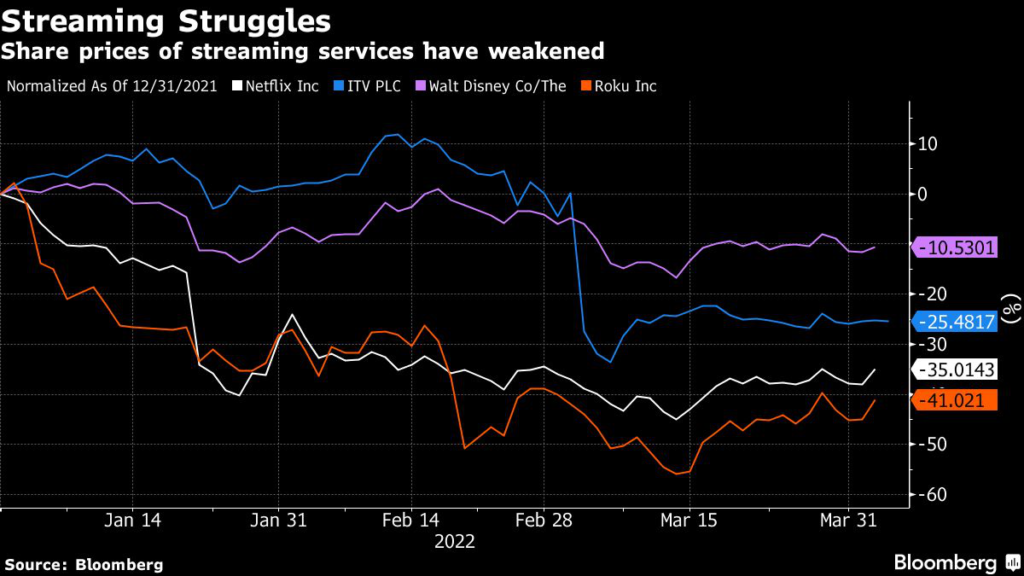
Traditional TV businesses and streaming services have recently seen valuations go into reverse as investors weigh heavy investment, proliferating rival platforms and uncertain growth prospects. The U.K.’s largest free-to-air broadcaster, ITV Plc, has lost a third of its market value in the past 12 months, and even winners from the shift to streaming have plummeted recently, with Netflix Inc. shares down 28% in the same period.

A valuation of 1 billion pounds ($1.3 billion) has been widely discussed for Channel 4, a target that’s “going to be demanding” for the state-owned, self-funding broadcaster, analyst Claire Enders said. The founder of Enders Analysis cited a range between 750 million pounds and 1.2 billion pounds, depending on several variables. 

The price depends on the extent to which a buyer will be forced to continue with Channel 4’s “remit” — state-mandated responsibilities that include innovation and attracting younger, diverse audiences. A new owner would have to continue a commitment to prime time news and contribute to the U.K.’s cultural ecosystem, the person added, who asked not to be named speaking about ongoing discussions.

Unlike nearly all of its rivals, Channel 4 is barred from keeping intellectual property from the shows it commissions, though such rights are fueling mega media mergers like 2021’s $130 billion tie-up between Discovery Inc. and AT&T Inc.’s Warner Media, or Rupert Murdoch’s $71 billion sale of 20th Century Fox to The Walt Disney Co.

Streaming Suitors

Possible suitors could include ITV as well as New York-based Paramount Group, which bought Britain’s Channel 5 in 2014. Other bids could be considered at Discovery Inc. and Comcast Corp., owner of Europe’s largest pay-TV operator Sky.

Before any offers can be made, the sale needs approval in the House of Commons and the upper House of Lords, where it faces resistance. The opposition Labour, Liberal Democrat and Scottish National parties immediately hit out at the privatization on Monday night, as well as senior members of the ruling Conservative Party like Damian Green, who served as deputy to former Prime Minister Theresa May. 

That could mean it’s challenging to finish the process before the next general election, which is expected as soon as next year.

Then, once any deal is proposed, it could face a competition probe, Enders said.

Channel 4’s management has also opposed the government’s approach. It said in a statement Monday that it had presented ministers with “a real alternative to privatization” which had been dismissed, and added it was “disappointing” that the government hadn’t formally recognized “significant public interest concerns”. 

More stories like this are available on bloomberg.com

©2022 Bloomberg L.P.

Indonesia Will Tax Crypto Earnings, Purchases Starting in May

(Bloomberg) — Indonesia will start taxing crypto transactions and assets next month.

The finance ministry has set a 0.1% value-added tax on crypto asset purchases, while earnings and capital gains from such transactions will be subject to a 0.1% final income tax, according to a rule that will be effective on May 1.

Trading on platforms that haven’t been authorized by the local regulator would result in a higher VAT and income tax of 0.2% each.

Crypto trading is picking up in Southeast Asia’s biggest economy, with 11 million market participants conducting $60 billion worth of transactions last year, according to Indonesia’s commodities futures trading agency, known as Bappebti. Such assets are regulated by the trade ministry as commodities and aren’t allowed to be used as legal tender.

The government has already told Indonesians who invest in non-fungible tokens to pay tax, citing a 2008 law.

More stories like this are available on bloomberg.com

©2022 Bloomberg L.P.

The Hottest NFT Marketplace is Mostly Users Selling to Themselves

(Bloomberg) — A closer look at the LooksRare platform that has quickly become the leading NFT marketplace by trading volume shows that most of the activity is actually users selling tokens to themselves to help earn rewards in the form of more coins. 

The platform was launched in January by two anonymous co-founders — who go by Zodd and Guts — as an alternative to market leader OpenSea during the height of the NFT boom. The site had planned to add new features to lure NFT enthusiasts, according to a blog post at the time. Almost all of those initiatives have focused on the incentive program built around the Looks token awarded to active users of the platform.

About $18 billion of the trading volume on the platform, or about 95% of the total activity, can be attributed to what’s often referred to as wash sales, according to data compiled by NFT tracker CryptoSlam. The transactions are seen as one of the many gray areas in crypto when it comes to regulation. In this case, the sales are done to win new tokens rather than to pump up nonfungible token prices to lure unsuspecting buyers. The marketplace benefits from the fees generated by each transaction. 

LooksRare representatives couldn’t be reached for comment. A web page noting the “LooksRare Team” only lists pseudonyms and titles.

At the same time, LooksRare has effectively helped to mask the cooling of demand in the NFT market. Total sales on OpenSea have declined every month since January, according to data from Dune Analytics. The site’s sales volume is down 67% in the last 30 days, according to data from DappRadar. The number of traders has decreased 23%.

The ability to earn tokens, while a prominent aspect of DeFi, is a relatively new feature to NFT platforms. Rarible was among those that pioneered the idea last year. LooksRare’s fees are also distributed to Looks holders. Some legal observers believe wash trading that is driving the volume on the LooksRare platform is illegal. 

“I don’t care if it is stocks, bonds, Bitcoin, NFTs, or baseball cards,” said David Silver, a Coral Springs, Florida-based attorney who works on crypto cases. “Wash trading is a form of market manipulation in which an investor simultaneously sells and buys the same instrument to create misleading, artificial activity in the marketplace.” 

The price of the Looks token more than tripled in January before crashing to just above its debut price, according to data compiled by CoinMarketCap. 

The DeFi-like model is being adapted by an increasing number of sites seeking to take NFT market share away from OpenSea. LooksRare fees are also lower at 2% versus 2.5% for OpenSea.

“It seems that organic trading is indeed increasing in LooksRare,” said Pedro Herrera, a senior data analyst at DappRadar. “The difference between selling expensive NFTs like BAYC on LooksRare rather than OpenSea can become a 1-2 Ether difference that the seller saves. So it appears that the NFT community is slowly adopting other options outside the incumbent.” 

Outside of the Looks token-related trading, LooksRare remains a relatively small marketplace for NFTs compared with OpenSea, which typically has about 10 times more daily active users, per tracker Nansen.     

(Moves that the developers of the platform couldn’t be reached for comment to the fourth paragraph.)

More stories like this are available on bloomberg.com

©2022 Bloomberg L.P.

Amazon Buys Dozens of Rocket Launches for Satellite Business

(Bloomberg) — Amazon.com Inc. is purchasing as many as 83 rocket launches from three different providers to deploy the majority of its planned Project Kuiper satellite constellation for high-speed internet service.

The deals with Arianespace SA, Blue Origin LLC and United Launch Alliance represent the largest commercial procurement of launch vehicles in history, Amazon said Tuesday in a statement. Project Kuiper aims to provide high-speed internet from space, competing with similar offerings from Space Exploration Technologies Corp.’s Starink service and U.K.-based OneWeb.

Amazon’s FCC license requires Project Kuiper to launch at least half of its planned 3,236-satellite constellation by July 2026, and at least 90% of its constellation by July 2029. The company declined to specify the exact number of satellites to be launched with the trio of rocket providers and the overall contract value.

None of the three rockets Amazon has selected in its latest deals have yet been flown. 

Blue Origin, the space firm created by Amazon founder Jeff Bezos, will handle 12 deployments for Kuiper, with an option for 15 additional launches, using its New Glenn rocket. New Glenn has experienced multiple delays, including a recent one that will prevent it from flying this year as previously had been planned, Jarrett Jones, a Blue Origin senior vice president, said last month at the Satellite 2022 conference.

Largest Share

United Launch Alliance won the largest share of the Amazon contract, 38 launches, with its new Vulcan Centaur rocket. ULA, based in Centennial, Colorado, is a joint venture of Boeing Co. and Lockheed Martin Corp. ULA plans a first flight for the Vulcan this year, a spokeswoman said.

Last year, Amazon contracted for nine launches from ULA using its older Atlas V rocket as part of a separate agreement for Project Kuiper satellites.

Under the retail giant’s latest agreements, Arianespace will provide 18 launches with its Ariane 6 rocket, which is still under development. The Paris-based European space consortium plans the first Ariane 6 test flight later this year with commercial service starting in 2023.

Arianespace and ULA are among the industry’s most established launch providers. Blue Origin is a relatively new entrant working to crack into the commercial rocket payload business.

Blue Origin hasn’t said when its New Glenn rocket will begin test flights or commercial service. “We’re making great progress on New Glenn and we’ll fly when we’re ready,” spokeswoman Sara Blask said in an email.

The New Glenn will operate with seven BE-4 liquid oxygen/liquid natural gas engines, the same model ULA has selected to power the first stage of its Vulcan vehicle. Blue Origin has delivered some BE-4 engines to ULA for testing and those have been “working beautifully” on test stands, ULA Chief Executive Officer Tory Bruno said March 22 at the satellite conference.

Project Kuiper announced plans late last year to launch two prototype satellites in 2022 from Florida with ABL Space Systems’ new RS1 rocket.

More stories like this are available on bloomberg.com

©2022 Bloomberg L.P.

Close Bitnami banner
Bitnami
