Bloomberg

India Wealth Fund Drops Investment in TPG-Backed FirstCry

(Bloomberg) — India’s sovereign wealth fund has scrapped plans to invest in FirstCry.com, an e-commerce startup backed by TPG, people familiar with the matter said.

The country’s National Investment & Infrastructure Fund Ltd. pulled out of a deal to buy a stake in online baby marketplace FirstCry.com being sold by an existing investor, the people said, asking not to be identified as the information is not public. PremjiInvest, the family office of Wipro Ltd.’s billionaire founder Azim Premji, is planning to step in and buy the stake, according to the people.  

FirstCry, formally known as BrainBees Solutions Pvt, runs an online store featuring products for children and expecting mothers. Its investors include TPG, Japanese billionaire Masayoshi Son’s SoftBank Group Corp. and local investment firm ChrysCapital.

Representatives for NIIF, FirstCry and PremjiInvest didn’t immediately respond to requests for comment. 

India’s antitrust regulator approved NIIF’s investment in FirstCry in February. Through its funds, NIIF has previously invested in companies including Hindustan Infralog, Ayana Renewable Power and Manipal Hospitals.

More stories like this are available on bloomberg.com

©2022 Bloomberg L.P.

Hackers’ Path Eased as 600,000 U.S. Cybersecurity Jobs Sit Empty

(Bloomberg) — President Joe Biden has urged U.S. companies to “harden your cyber defenses immediately” amid a growing risk of Russian cyberattacks. For many, that won’t be easy. 

The war for talent has been well-telegraphed throughout the country, but it’s particularly acute in cybersecurity. And it’s only worsened as competition in the broader labor market has heated up, heightening both companies’ potential vulnerability to hackers and the urgency to boost the workforce.

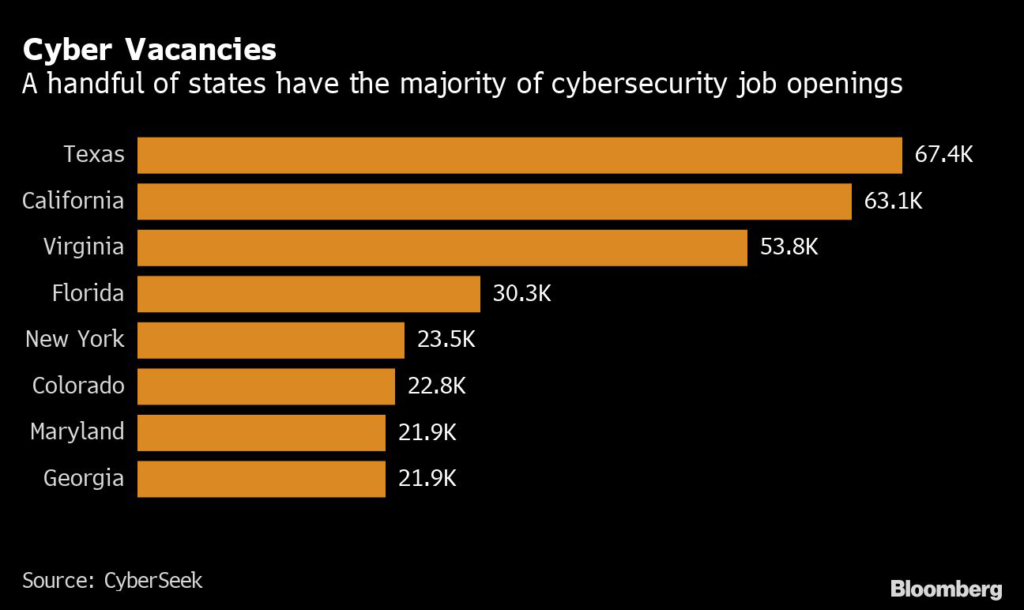
About one million people work in cybersecurity in the U.S., but there are nearly 600,000 unfilled positions, data from CyberSeek shows. Of those, 560,000 are in the private sector. In the last 12 months, job openings have increased 29%, more than double the rate of growth between 2018 and 2019, according to Gartner TalentNeuron, which tracks labor market trends.

“The crunch for cybersecurity talent has definitely gotten a lot worse,” said Jamie Kohn, human resources research director at Gartner Inc., a tech research and consulting firm. “We thought we had five years maybe to get those professionals in the door, and now we’re trying to do it overnight.”

Workers with the technical skills required to respond to cyber threats were already hard to come by before the Covid-19 pandemic forced employees to work from home. But a confluence of events ratcheted up demand even more for positions such as software developers, vulnerability testers, network engineers and cybersecurity analysts.

With so many employees using their home networks and computers, phishing attempts soared, as did ransomware attacks on businesses, schools, hospitals and other organizations. 

A ransomware attack on Colonial Pipeline Co. resulted in Americans’ panic-buying fuel, leading to supply shortages on the East Coast last May, while other high-profile incidents were attributed to hackers supported by U.S. adversaries. In Dec. 2020, for instance, investigators revealed a cyber-espionage campaign in which state-sponsored Russian hackers exploited software made by SolarWinds Corp. to infect some customers. Moscow has denied involvement in the matter. 

“There are times within cybersecurity when the market even grows faster and when the demand is hotter and I believe we kicked off one of those cycles with SolarWinds,” said Bryan Palma, chief executive officer of Trellix Corp. “Now we have the Russia-Ukraine conflict. We’re seeing cybersecurity grow faster than the normal 16% each year, which therefore is driving the need for even more skills and professionals in that area.”

The cyber worker shortage is a particular problem with smaller organizations, everything from municipalities and law firms to hospitals and businesses, that can’t offer high enough pay to attract high-skilled workers, said Max Shuftan, director of mission programs and partnerships at the SANS Institute, a cybersecurity training organization. 

“Most civilian public agencies can’t pay what the public sector can,” Shuftan said. “At the same time, small businesses — companies that aren’t in an industry that you’d normally worry about this — they’re probably not going have the staff and that makes them more vulnerable to attacks”

Last year, ransomware attacks affected the operations of organizations including a San Diego hospital system, a nationwide payroll provider and the office network of the Illinois attorney general. 

“Our critical infrastructure, our way of life is really under cyber assault all the time,” Jen Easterly, director of the U.S. Cybersecurity and Infrastructure Security Agency said during a speech in mid-March. “And our current geopolitical crisis is only exacerbating this threat.”

If Americans don’t do something about it there will be 3.5 million unfilled cybersecurity jobs by 2025, Easterly said, apparently citing a figure from Cybersecurity Ventures, a research organization.

The Department of Homeland Security rolled out a new system for hiring cybersecurity personnel in November that would allow federal cybersecurity workers to make as much as $255,800, equivalent to the salary of Vice President Kamala Harris. The new pay scale system was created to help the DHS compete for talent, according to the DHS. 

The cybersecurity industry also isn’t immune to the broader macroeconomic trends that are upending the labor market, including a desire for remote work, flexible hours and higher pay. Trellix, for instance, will adopt a hybrid model in which employees balance remote work and work from offices.

In 2020, the annual mean wage for information security analysts was $107,580, almost double the mean for all U.S. occupations combined, according to data from the Bureau of Labor Statistics. 

“The competition is real, the great resignation is real, it’s definitely a day-to-day battle.” Palma said. “And compensation is a part of that.” Since the pandemic began, Trellix has grown its overall staff by 5%, but the company is still trying to grow by another 10% or more.

Because cybersecurity skills are in such high demand, workers have room to negotiate and can jump from one company to another relatively easily. But hiring cybersecurity professionals from another company doesn’t address the underlying issue: that there aren’t enough qualified workers, said Stuart Madnick, professor of information technologies at the MIT Sloan School of Management.

Countries like Russia, China and Israel that have compulsory military service have a better talent pipeline of qualified individuals who have been trained in cybersecurity at the government level, according to Palma. He said he’s been communicating with members of Congress to create a AmeriCorps-type program specifically for fostering cybersecurity talent because there aren’t enough Americans being trained via government service.

Other efforts to increase the talent pool include implementing cybersecurity courses in high schools, offering workshops to lower-level IT professionals, running training in rural regions and dropping degree requirements in favor of aptitude tests. Automating some security-related tasks could also be a solution to the hiring problem.

“We have a massive shortage of security experts on the planet, and we want to automate so much of the talent and capability,” Kevin Mandia, CEO of Mandiant Inc., said in a briefing with reporters in early March. “That’s all software’s ever been is the automation of human process.”

But none of those solutions are immediate, and the threats are.

“The worst is yet to come,” said Madnick of MIT. “Not just because things have been getting worse and worse each year, but we’ve concluded that the disruptions we see are nowhere as bad as they could’ve been. We think in many cases these were test runs.”

(Adds mention of Cybersecurity Ventures, a research organization, in thirteeneth paragraph.)

More stories like this are available on bloomberg.com

©2022 Bloomberg L.P.

Congress Seeks Amazon’s Labor-Practice Records After Tornado That Killed Six

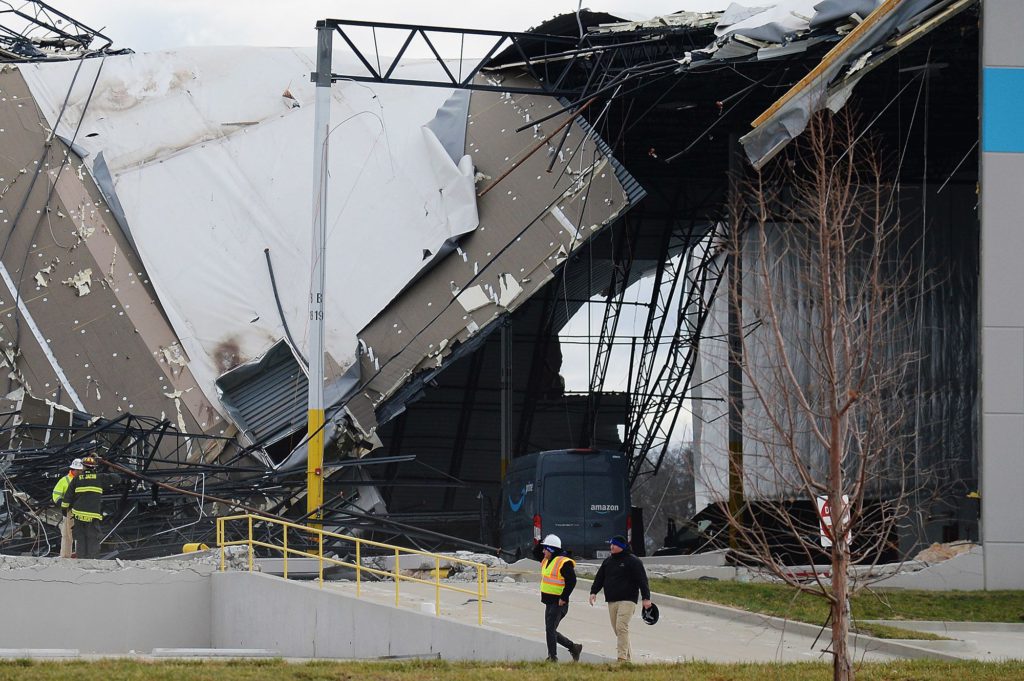
(Bloomberg) — A Congressional committee wants Amazon.com Inc. to share details about its labor practices during extreme weather events, following a tornado that killed six employees in December when it ripped through an Amazon facility in Edwardsville, Illinois.

The letter from the House Oversight Committee to Amazon Chief Executive Officer Andy Jassy asks the online retailer to provide by April 14 records about its emergency preparedness drills as well as communication between managers and front line workers and contractors during the December tornado. The committee also seeks information regarding Amazon facilities during extreme weather events in Florida, New York, California, Alabama and New York from as far back as 2017.

 “We are concerned by recent reports that Amazon may be putting the health and safety of its workers at risk, including by requiring them to work in dangerous conditions during tornadoes, hurricanes, and other extreme weather,” according to the letter, which was signed by committee chair Carolyn Maloney, a New York Democrat, and fellow Democratic committee members Alexandria Ocasio-Cortez of New York and Cori Bush of Missouri. “As one of our country’s largest and most profitable corporations, it is imperative that Amazon protect workers’ safety and refrain from practices that could put them in danger.”

The letter dated March 31 cites several news reports highlighting worker concerns in the aftermath of the deadly tornado, including a Bloomberg News story that exposed a text exchange between an Amazon package delivery driver and her boss, who told the driver she’d be fired if she didn’t continue making deliveries. The driver responded that she feared her van would become her casket.

“Our focus continues to be on supporting our employees and partners, the families who lost loved ones, the surrounding community, and all those affected by the tornadoes,” Amazon spokeswoman Kelly Nantel said in an emailed statement. “We will respond to this letter in due course.”

The committee letter attributes an increase in extreme weather events to global climate change and says it’s considering legislation to strengthen worker protections in hazardous weather conditions.


(Updates with statement from Amazon in fifth paragraph.)

More stories like this are available on bloomberg.com

©2022 Bloomberg L.P.

Bored Ape Yacht Club Warns Users Not to Mint NFTs After Discord Hack

(Bloomberg) — April Fools’ Day came early for fans of the popular Bored Ape Yacht Club nonfungible token collection. 

The company behind the best-selling NFTs warned users around 2 a.m. New York time on Friday that its instant messaging platform Discord was hacked and “briefly compromised,” telling users not to mint — the process of taking a digital asset and converting its to a digital file stored on a blockchain — any Apes on its platform.   

Domain name provider Namecheap said on Twitter than it had suspended the phishing sites used by the hackers soon after users flagged them.

The Bored Apes, acquired by celebrities such as Madonna, Paris Hilton and Justin Bieber, have been at the forefront of the craze for NFTs, as digital collectibles increasingly move into the mainstream. The tokens, which combine the world of cryptocurrencies and blockchain with the realm of creative pursuits, are fodder for both retail traders and professional investors.

The BAYC Discord channel remained closed. The Bored Ape Yacht Club allows users to mint Ape inspired NFTs built on the Ethereum blockchain featuring profiles of cartoon primates. Yuga Labs, the company that created the collection, didn’t immediately respond to a request for comment. 

ApeCoin, an Ethereum token linked to the collection, fell about 9% to $12.64 over the last 24 hours, according to data on CoinMarketCap.   

More stories like this are available on bloomberg.com

©2022 Bloomberg L.P.

Nevada Hydrogen Factory Will Convert Gas From Garbage Into Fuel

(Bloomberg) — The French industrial gas giant Air Liquide SA is opening a factory near Las Vegas this month that will convert methane from landfills into hydrogen to power emission-free cars and trucks. 

The $250 million facility will have capacity to produce up to 30 tons of liquid hydrogen per day, enough for about 40,000 fuel-cell vehicles, Mike Graff, head of Air Liquide’s U.S. operations, said in an interview.

Air Liquide initially plans to ship all of the plant’s output to California, even though there are only about 12,000 hydrogen vehicles registered in the state. Yet the company expects demand for hydrogen as a transportation fuel to surge, particularly in long-haul trucking, as California pushes to decarbonize its economy by 2045. Battery packs big enough for electric trucks add enormous weight, and fuel cells running on hydrogen are far faster than batteries to refuel—a key consideration for truckers.

“Five minutes later, you’ve taken on a full load of hydrogen and you’re back on the road again,” Graff said.

The plant will use landfill gas as its raw material, preventing the methane in the gas from escaping into the atmosphere and contributing to global warming. The landfill gas will be purified into renewable natural gas, then hydrogen will be stripped from it using steam reformation. Although steam reformation releases carbon dioxide—another greenhouse gas—Graff said those emissions will be offset by the benefits of keeping the original methane out of the air.

Air Liquide will supply the hydrogen to FirstElement Fuel Inc., a California company that operates hydrogen fueling stations. Air Liquide invested $12 million in FirstElement in 2019.

More stories like this are available on bloomberg.com

©2022 Bloomberg L.P.

Canada Stocks Beat U.S. by Most in 13 Years and Have Room to Run

(Bloomberg) — The surge in oil prices has fueled a rally in Canadian stocks this year which strategists say still has room to run. 

The S&P/TSX Composite Index has gained 3.1%, outperforming the S&P 500 by more than 8 percentage points. That’s the widest outperformance in a quarter in 13 years. Energy and materials stocks have surged as the war in Ukraine sparked a rush to oil and to haven assets, propelling the natural resource-heavy TSX to fresh highs.  

The nation’s energy index jumped 27%, its strongest quarter in data going back to 1988, led by major corporates such as Canadian Natural Resources Ltd. and Tourmaline Oil Corp, which have soared more than 40%. Large miners like Teck Resources Ltd. and First Quantum Minerals Ltd. have led materials stocks to a 20% gain, while banks have climbed on the prospect of fatter profits from higher interest rates. Those three groups represent about half of the index.

“This is the perfect environment for the TSX and the commodities sectors,” said Greg Taylor, chief investment officer at Purpose Investments. “And it also doesn’t seem like it’s going to end any time soon. Some of these companies that have weathered the bad commodity environment are coming out on the other side and are really going to become incredibly profitable.” 

Investors have another reason to be bullish. Average earnings per share are expected to grow 33% this year for Canadian firms, compared with 20% for U.S. companies, according to data compiled by Bloomberg. Energy producers are expected to drive the profit boom, with analysts forecasting that average EPS will soar 68%.

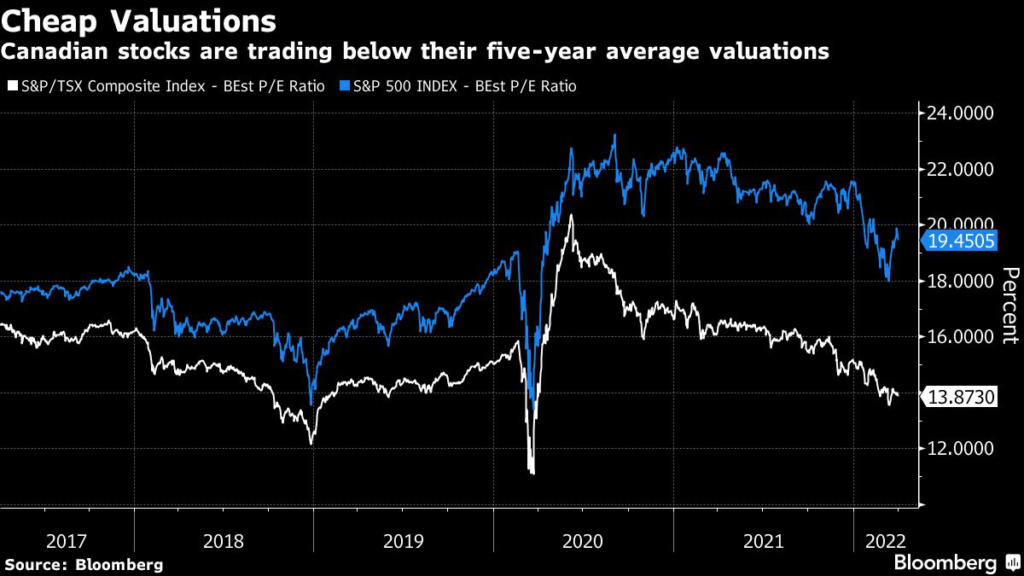
That’s making Canadian stocks look cheap: Companies on the S&P/TSX are trading below their five-year average valuation, at 13.9 times estimated earnings for the next 12 months. Companies on the S&P 500 are flying higher than their average at 19.4 times earnings.

Meanwhile, the S&P 500’s heavy tech stocks weighting pushed the index to its worst quarter since the pandemic shut down global economies.

“We’ve had a rotation into value,” said Ian de Verteuil, head of portfolio strategy at Canadian Imperial Bank of Commerce. “And at any metric, the TSX looks cheaper than the S&P 500.”

While a decline in commodity prices could affect investor sentiment, what’s more important is how companies allocate their capital. 

“A decline in commodity prices would affect sentiment, but it’s not as if the TSX is pricing in $100 crude,” de Verteuil said. “These companies can make a lot of money at $80 per barrel. The thing that we will need to see — and this is the most debatable part of it — is whether the C-suites of these companies have found religion” on capital spending. 

During past commodity booms, Canadian energy companies used their cash flow to increase production. This time, there are signs they’re sticking with dividends and share buybacks, he said. 

More stories like this are available on bloomberg.com

©2022 Bloomberg L.P.

EU Seeks to Speed Up Crypto Rules in Push to Tighten Sanctions

(Bloomberg) — The European Union is seeking to speed up a push for new cryptocurrency rules amid concerns that the digital tokens could be used to circumvent sanctions on Russia following the invasion of Ukraine.

The European Parliament and member states discussed on Thursday the possibility of shortening the two-year implementation period for proposed EU rules known as the markets in cryptoassets (MiCA) during the first round of talks to finalize it, an EU official said.

When EU officials proposed shortening the timeframe to implement new crypto rules earlier this week, countries including Ireland, Spain, Poland and Luxembourg were open to the idea, according to people familiar with the discussion. 

EU countries and Group of Seven allies are concerned that crypto assets could be used by Russian oligarchs to evade sanctions imposed since President Vladimir Putin invaded Ukraine. Although there hasn’t been a significant increase in the volume of transactions, the European Central Bank and governments insist that the proposed MiCA regulation would help to avoid the risk.

EU’s Crypto Lawmaker Calls for New Sanctions-Boosting Measures

EU negotiators are on board with the need for a quick agreement, people familiar with the discussion said. But the sides disagree over some important issues that may prolong the talks, an EU official said.

MiCA was proposed in September 2020 to regulate cryptoassets, with the aim of ensuring financial stability and consumer protection across the bloc with the same rules. The European Commission has said that the current absence of EU regulations on the crypto sector leaves consumers and investors exposed to substantial risks.

One outstanding issue in the current talks is the environmental safeguards that EU lawmakers want to introduce. The European Parliament proposed including cryptoassets in the EU’s taxonomy of “green” activities to monitor whether they have been mined in accordance with the bloc’s sustainable principles. 

Some political groups, including the Greens, wanted to go further and initially proposed banning energy-intensive mechanisms underpinning some tokens that would have led to the exclusion of Bitcoin and other assets from the European market.

Ireland, Sweden, Poland and Spain were open to including some climate-related provisions, people familiar with the discussion said. But an EU official cautioned that it would be harder to convince a majority of member states to take these new safeguards on board as they were not part of the original negotiating mandate.

Crypto Oversight 

Another bone of contention is the supervisory architecture. The original plan offered by the EU’s executive arm, and supported by member states, envisioned EU oversight of significant stablecoins, as well as e-money tokens based on single currency. The European Parliament expanded the scope by adding crypto-asset services providers under the EU umbrella.

The European Commission and member states suggested making the European Banking Authority responsible for the bulk of the supervision, while the Parliament proposed a split: The European Securities and Markets Authority would monitor stablecoins, while the EBA would regulate e-money tokens.

In a parallel debate, two European Parliament panels on Thursday backed a proposal that would require crypto transfers to carry information about the identities of payers and payees. The EU is discussing it as part of an anti-money laundering push to prevent crypto-assets from being used to facilitate criminal transactions. EU lawmakers also proposed the inclusion of these clauses in the MiCA package.

More stories like this are available on bloomberg.com

©2022 Bloomberg L.P.

FTC Should Consider Workers in Activision Merger Review, Warren Says

(Bloomberg) — A group of Democratic senators including Elizabeth Warren warned that Microsoft Corp.’s takeover of Activision Blizzard Inc. could squelch workers’ calls for accountability after years of well-documented sexual harassment at the game giant. 

The Federal Trade Commission, which is conducting an antitrust review of the deal, should consider whether Microsoft’s Activision acquisition could worsen the abuse and oppose the merger if they so determine, the senators wrote in a letter to FTC Chair Lina Khan.

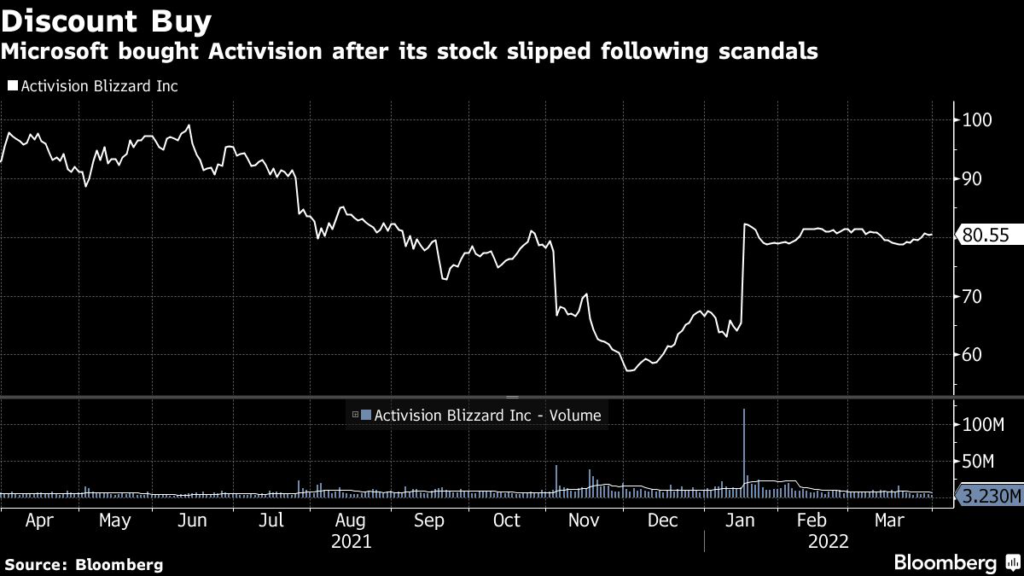
“While Microsoft capitalized on lower stock prices from the sexual misconduct disclosures, they also signaled that they were willing to prioritize profits over entrenched issues of gender-based discrimination in the organization,” wrote the senators, including Sheldon Whitehouse of Rhode Island, Bernie Sanders of Vermont, and Cory Booker of New Jersey.

Microsoft General Counsel Lisa Tanzi said in a statement that the company would “constructively engage on unionization issues and will further discuss all of this with the FTC.” Activision Blizzard said in a statement that the acquisition won’t interrupt any actions the company has taken to improve the workplace and added that Microsoft is supportive of those goals. 

Activision has been shrouded in controversy since last July after a state agency filed a sexual bias lawsuit against the Santa Monica, California-based company, describing its “frat boy culture” and accusing its leadership of failing to take action. The U.S. Securities and Exchange Commission later launched an investigation into how the company handled the reports of misconduct. 

Under terms of the deal, Activision’s embattled Chief Executive Officer Bobby Kotick would remain in his job until at least next year, with a $14.5 million payout if he’s forced to resign. While Microsoft has said it won’t interfere with a union drive at Activision, the statement amounts to “little more than lip service” in the absence of legal assurances, the senators wrote.

“If the FTC determines that the transaction is likely to enhance monopsony power and worsen the negotiating position between workers and the parties to this deal, we urge you to oppose it,” the Senators wrote. 

The Wall Street Journal reported earlier on the letter.

(Updates with Microsoft statement in fourth paragraph)

More stories like this are available on bloomberg.com

©2022 Bloomberg L.P.

Ukraine Update: Talks Resume; Russia Details Gas Payments

(Bloomberg) — Talks between Ukraine and Russia resumed Friday via video link, following meetings earlier in the week in Turkey. Russian Foreign Minister Sergei Lavrov said Moscow is preparing a response to Ukraine’s proposals on ending hostilities.  

Russia said two Ukrainian military helicopters made a rare strike across the border, hitting an oil tank facility in the city of Belgorod. There was no immediate confirmation from Kyiv. In Ukraine, Kyiv said its forces retook several villages in the Kherson region to the south. The United Nations said relief convoys had so far failed to reach Mariupol, with the southern port city devastated by weeks of shelling. Russia said a humanitarian corridor from Mariupol was planned for Friday.

Russian gas continues to flow to Europe as Gazprom begins detailing how customers should pay in rubles. European Union leaders plan to warn Vladimir Putin’s key ally China that it will suffer a blow to its global role if it offers support for the invasion.

(See RSAN on the Bloomberg Terminal for the Russian Sanctions Dashboard.)  

Key Developments

  • Gazprom Starts Telling Clients How to Pay for Gas in Rubles 
  • Mariupol’s Splintering Loyalties May Be Enough for Putin
  • Putin Set for $321 Billion Windfall If Oil, Gas Keep Flowing
  • Biden Embraces Oil as Ukraine War Overwhelms His Climate Agenda
  • EU to Warn China It Will Damage Global Role by Helping Russia
  • Chinese Buyers Given Flexibility to Pay in Yuan for Russian Oil
  • Russians Embrace Putin’s Ukraine War as Kremlin Muzzles Dissent

All times CET:

Premier Says Beijing Promoting Ukraine Peace Talks (2:20 p.m.)

Chinese Premier Li Keqiang told European Union officials via video that Beijing has been promoting peace talks on Ukraine in its own way, and is willing to play a constructive role. Chinese President Xi Jinping addressed the EU-China summit after Li.

European Commission President Ursula von der Leyen said this week China had a “special responsibility” to demand that Russia respect international law.

Refugees May be Able to Swap Hryvnias Into Euros (2:15 p.m.)

Ukrainian refugees in the EU may soon be able to swap some of their banknotes into euros and other currencies. The EU’s executive arm asked member states to set up facilities that allow each person to exchange up to 10,000 hryvnia ($339) free of charge at an official rate set by the Ukrainian central bank. Poland started a similar initiative in March.

Ukraine Refugees in EU Given Hope of Swapping Hryvnia Banknotes

Many of the 4 million people who’ve fled Ukraine invasion — over half of them going initally to Poland — have had trouble swapping hryvnia for local currency because banks haven’t been willing to take risks related to wild exchange-rate swings.

Russia’s Chief Negotiator Says Talks With Ukraine Have Resumed (12:55 p.m.) 

Talks between Russia and Ukraine resumed on Friday via video conference, Russia’s chief negotiator Vladimir Medinsky said on his Telegram channel, adding that his country’s stance on Donbass and Crimea remains unchanged. Makhaylo Podolyak, an advisor to the Ukrainian president’s chief of staff, confirmed that the discussions are continuing.

Gazprom Starts Giving Details on Ruble Payment Plan (12:35 p.m.)

Russia’s Gazprom is starting to tell clients how to pay for their gas after Putin said purchases from “unfriendly” nations including Europe would need to be settled in rubles.

Germany is still pouring over the details before coming to any conclusions, government spokesman Wolfgang Buechner told reporters.

“The federal government is currently examining this decree for its concrete effects,” he said on Friday in Berlin.

Meanwhile the Kremlin signaled that gas would keep flowing, and said payments for April gas weren’t due until late in the month or early May.

Lavrov Says Moscow Working on Response (11:36 a.m.)

Foreign Minister Sergei Lavrov said Russia is preparing a response to Ukraine’s proposals on security guarantees and ending the war. Lavrov made televised comments during a press briefing in New Delhi. 

Russia is ready to discuss Kyiv’s proposals on non-nuclear, neutral status, he said, adding that Ukraine has shown “more understanding” of the realities in Crimea and Donbas. 

Tass cited an unidentified person from the Russian side of negotiations saying talks with Ukraine would resume Friday via video. 

Russia’s Yamal-Europe Gas Pipeline Flows in Reverse (10:29 a.m.)

Russian gas flows via the Yamal-Europe pipeline reversed this morning, with fuel flowing from Germany to Poland — the opposite of the normal direction. That’s been a common occurrence for this pipeline over the past few months, and doesn’t signal a halt in Russian gas flows to Europe. In many cases, it just shows German companies are ordering less gas, while demand in Poland is higher.

Flows via Nord Stream, the direct link to Germany, were near the pipeline’s full capacity. 

Don’t Read Too Much Into Reverse Gas Via Russia Pipeline

Natural Gas Fluctuates as Traders Weigh Putin’s Demand (9:43 a.m.)

Natural gas prices in Europe fluctuated as traders weighed the potential impact on the market by Russia’s decision to shift payment for its supplies to rubles, with colder weather also set to boost demand. 

European stocks and U.S. equity futures rose slightly as investors evaluated the economic outlook amid moderating oil prices, tightening Federal Reserve monetary policy and Russia’s war in Ukraine.

Russian-Linked Containers Pile Up in Rotterdam (9:34 a.m.)

Measures taken against Russia are snarling thousands of steel shipping containers in Rotterdam as each box needs to be carefully inspected to make sure moving it won’t somehow breach sanctions, according to the CEO of the massive port. 

His comments gave unique insights into how the beating heart of Europe’s real economy is being battered by measures taken against Moscow after its invasion of Ukraine.   

Ukrainian Retakes Ground in Kherson, Chernihiv Regions (8:49 a.m.)

Eleven villages in the southern Kherson region and several others in the Chernihiv region northeast of Kyiv have been returned to Ukrainian control, according to the military’s General Staff. Shelling of towns and villages along the contact line in the east continued overnight, with civilian casualties reported after nine apartment buildings and nine private houses were shelled.

The intensity of shelling declined in Chernihiv and Kharkiv, although a missile hit the center of Kharkiv Thursday night. Fighting continues near Chernihiv, Izyum and at the border of Kherson and Mykolayiv regions to the south. 

Refugees Arriving in Poland Now Top 2.4 Million (8:45 a.m.)

Another 23,000 people arrived in Poland from Ukraine on Thursday, and another 3,500 early Friday, taking total refugees since Feb. 24 to 2.415 million, Polish border authorities said.

Over 4 million people have fled Ukraine since the start of the Russian invasion.  

Ukraine Said to Make Rare Strike in Russian Territory (8:30 a.m.)

Moscow said two Ukrainian military helicopters attacked an oil-storage facility in the Russian city of Belgorod, about 50 km (30 miles) north of the border, causing a large fire early Friday.

Tass quoted Belgorod Governor Vyacheslav Gladkov as saying the aircraft flew in at low altitude. Eight oil fuel tanks were burning and authorities said the fire might spread. Two workers were reported to have been injured and nearby residents were being evacuated.

Focused on fighting Russian troops on their own territory since Feb Ukrainian forces haven’t claimed any strikes on the other side of the border since the start of the war on Feb. 24. 

World Underestimating Impact of War, OECD Says (8:00 a.m.) 

Governments aren’t sufficiently aware of the longer-lasting economic fallout from Russia’s invasion of Ukraine, said OECD Chief Economist Laurence Boone. 

“I really believe we’re underestimating the medium-term impact of this war,” Boone told Bloomberg Television’s Francine Lacqua in Cernobbio, Italy, on Friday. “The longer the war will last, the more uncertainty we have, and the more worried we’re getting because uncertainty deters consumer purchases and business investment.”

Russia Redeploying Forces From Georgia, U.K. Says (7:45 a.m.)

Russia is redeploying as many of 2,000 troops from Georgia to reinforce its invasion of Ukraine, the U.K. defense ministry said. The forces are being reorganized into battalion tactical groups. 

“It is highly unlikely that Russia planned to generate reinforcements in this manner and it is indicative of the unexpected losses it has sustained during the invasion,” the U.K. said. 

EU to Warn China Over Russia (6:00 a.m.)

European Union leaders plan to tell President Xi Jinping in a virtual summit that China will hurt its global stature if it hands Russia an economic or military lifeline. That pointed message will test Beijing’s commitment to keeping the war from damaging its ties with Brussels. 

Russia Jamming Jet Navigation, France Says (6:00 a.m.)

Russia’s military has been jamming satellite navigation systems used by commercial aircraft since the invasion of Ukraine, highlighting the need for robust alternatives, according to a French safety regulator.

Airline pilots have reported disruptions in regions around the Black Sea, eastern Finland and the Kaliningrad enclave, said Benoit Roturier, head of satellite navigation at France’s civil aviation authority DGAC. The interference appears to be caused by Russian trucks carrying jamming equipment typically used to protect troops and installations against GPS-guided missiles, he said.

Russia Is Jamming Jet Navigation, French Safety Official Says  

Stocks Mixed as Crude Oil Drops (5:08 a.m.)

U.S. equity futures pushed higher and Asian stocks were mixed as investors evaluated the economic outlook amid moderating oil prices, tightening Federal Reserve policy and the war.

Oil held losses on a move by the U.S. to release roughly a million barrels a day from reserves to tackle rising energy costs. Russia’s invasion has disrupted commodity flows, fanning prices for everything from fuel to food.

China Minister Says No One Can Split G-20 (4:51 a.m.)

All members of the Group of 20 nations have equal status and no one has the power to split the group, Chinese Foreign Minister Wang Yi said, according to a ministry statement. Biden has previously said Russia should be removed from the G-20.

Japan Won’t Exit Sakhalin-1 or 2 (4:00 a.m)

Prime Minister Fumio Kishida said the country won’t withdraw from the Sakhalin-1 or 2 oil and gas project in Russia.

Resource-poor Japan currently gets 3.6% of its imported crude oil from Russia, while roughly 90% of it comes from Middle Eastern countries, according to trade ministry data. Japan procures 9% of its LNG and 13% of its thermal coal imports from Russia. 

UN Aid Convoy Reached Sumy, Mariupol Blocked (10:40 p.m.)

The United Nations said its aid convoy was able to get through to the northeastern city of Sumy, where it delivered food, medicine and other supplies. But it said that the UN and partners have still not been able to deliver aid to other regions, including Mariupol.  

Ukraine Says Russian Forces Exposed to Radiation (9:33 p.m.)

Russian troops began leaving the Chernobyl nuclear plant after soldiers got “significant doses” of radiation from digging trenches at the highly contaminated site, Ukraine’s state power company said. 

The International Atomic Energy Agency said it was unable to confirm the reports of radiation exposure and is “seeking further information.” The IAEA said it was told by Ukrainian officials that Russia has transferred control of the facility, in writing, back to Ukraine.

Ukraine Says Less Than 1,500 People Evacuated Thursday (9:08 p.m.)

Despite guarantees from the International Red Cross and Moscow, Russian troops blocked Ukrainian buses from entering Berdyansk, a port about 90 kilometers (56 miles) from Mariupol, and Melitopol, Vereshchuk said. 

At the requests of French President Emmanuel Macron and German Chancellor Olaf Scholz, Russia will open a humanitarian corridor from Mariupol to Kyiv-controlled territory on Friday as well, Ria Novosti reported, citing the Defense Ministry.

White House Jabs Putin, Again (8:21 p.m.)

Biden said there are signs that Putin has fired or detained key advisers.

“There’s a lot of speculation,” Biden said, adding that Putin “seems self-isolated.” Biden also said it’s an “open question” how misinformed Putin is about the status of his military’s efforts in Ukraine.

“But I don’t want to put too much stock in at this time because we don’t have that much hard evidence,” he added. 

Russian Forces Seen Leaving Chernobyl (7:50 p.m.)

Ukraine’s nuclear regulator said the head of Russian troops at the Chernobyl facility said they are departing after taking the facility infamous for its 1986 meltdown in the early days of the war. 

Leonid Oliynyk, Energoatom’s spokesman, confirmed a letter posted on Telegram announcing the departure. Oliynyk — who isn’t at Chernobyl — said he was told that most Russian troops left the facility in two columns and appeared headed toward Belarus. It didn’t appear that all Russian troops had departed, however. 


More stories like this are available on bloomberg.com

©2022 Bloomberg L.P.

U.K. Won’t Block Chinese Takeover of British Chipmaker

(Bloomberg) — The U.K. government has decided not to intervene in the takeover of Britain’s biggest semiconductor plant by a Chinese-owned company, according to a person familiar with the matter.

Britain’s national security adviser Stephen Lovegrove was asked by Prime Minister Boris Johnson to review the sale of Welsh-based Newport Wafer Fab to Nexperia NV last August to see if there were “real security implications.”

Lovegrove has now concluded that the takeover can go ahead, the person said. The decision was first reported by Politico.

Nexperia Hits Back at U.K. ‘Sneering’ at China Ties in Chip Deal

The move to allow Nexperia to acquire the U.K. chipmaker sparked alarm among lawmakers in Johnson’s ruling Conservative party, who argued it was a national security concern because the Netherlands-based firm is ultimately owned by China-headquartered Wingtech.

The government has not notified Nexperia of any decision, a spokeswoman for the company said by email. It already went ahead with the deal since announcing it in July 2021. 

“Nexperia has brought its proprietary intellectual property into Newport Wafer Fab and continues to invest and expand” the plant, she said in a statement. “Immediately after the acquisition it has approved additional investments of $60 million at NWF to increase production capacity and make NWF profitable. Further significant investments are made to replace obsolescent equipment.”

Both the Department for Business, Energy and Industrial Strategy and Johnson’s office had no immediate comment.

(Updates with Nexperia comment in fifth paragraph)

More stories like this are available on bloomberg.com

©2022 Bloomberg L.P.

Close Bitnami banner
Bitnami