Bloomberg

China Weighs Giving U.S. Full Access to Audits of Most Firms

(Bloomberg) — Chinese authorities are preparing to give U.S. regulators full access to auditing reports of the majority of the 200-plus companies listed in New York as soon as mid-this year, making a rare concession to prevent a further decoupling between the world’s two largest economies. 

The China Securities Regulatory Commission and other national regulators are in the process of drafting a framework that will allow most Chinese firms to keep their listings, people familiar with the process said, asking not to be named discussing a private matter. However, the government is prepared to accept that some state-owned enterprises and private companies that hold sensitive data will be delisted, they said.

The framework is expected to provide clarity on what data may trigger national security concerns, said the people. Regulators are debating whether companies that deal with consumer information, such as Alibaba Group Holding Ltd, would automatically fall into that category, one of the people said, adding that processing large volumes of such information wouldn’t necessarily make a firm a security concern.

China Crushed Covid. But Covid Zero Could Crush China

If the plan proceeds, it would mark an unusual reversal by Beijing, potentially ending a decades-long dispute that escalated when the U.S. mandated a 2024 deadline for kicking non-compliant businesses off the New York Stock Exchange and Nasdaq. The compromise would also show China’s willingness to balance national security concerns with the needs of investors and businesses at a time when its economy faces numerous challenges.

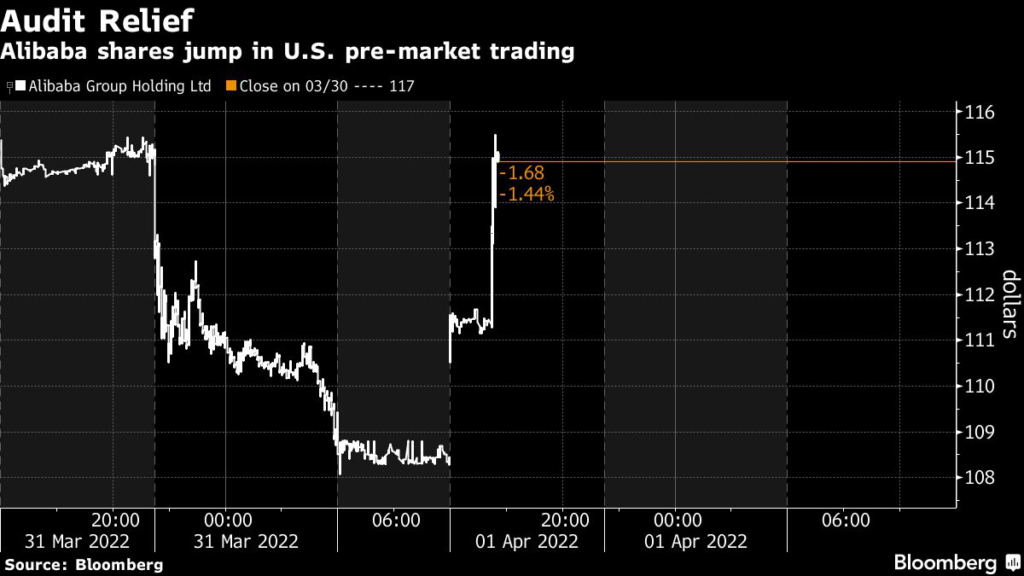
Shares of Chinese firms rallied in pre-market trading in the U.S. Alibaba shares rose 5.8% in premarket trading, JD.com Inc. was up 4%, Pinduoduo Inc. gained 7.9% while Didi Global Inc. jumped more than 18%. The Nasdaq Golden Dragon Index posted its worst first quarter since 2008 on concerns over audit disputes, regulatory crackdowns and economic growth.

Details are still under discussion and may change, said the people, adding that it also needs sign-off from the top leadership. Chinese regulators hope to reach an agreement with the U.S. around summer, one of the people said.

Still, the CSRC has repeatedly struck a more upbeat tone about the possibility of a deal than its U.S. counterpart. Securities and Exchange Commission Chair Gary Gensler this week tamped down speculation that a solution was imminent, signaling that only total compliance with audit inspections will allow the companies to keep trading on U.S. markets.

China could simply move a firm to a non-U.S. bourse if they want to shield financial documents, Gensler said in an interview. He also pointed out that the American law focuses on noncompliant countries rather than specific companies. So if one request is blocked, it means the requirement isn’t being satisfied.

The CSRC said in an emailed statement to Bloomberg News that regulators on the two sides are holding active talks on auditing cooperation and progress has been smooth overall, adding that all details of the negotiation will be subject to the public statements from both parties.

Washington and Beijing have been at odds for two decades over the mandate that all companies that trade publicly in the U.S. grant access to audit work papers. The issue prompted action on Capitol Hill at the end of the Trump administration, when American lawmakers required that non-compliant firms be delisted. The law is particularly threatening to companies based in China and Hong Kong because Beijing has refused to grant access to corporate audits, citing national security concerns. 

China’s government has made overtures over the last few years to allow some U.S. audit reviews but the U.S. has stood firm with demands that American inspectors must be able to go into a foreign accounting firm and demand audits from all corporations that trade in the U.S. 

There are more than 200 Chinese firms listed in the U.S. as American Depository shares, with a combined market capitalization of $2.1 trillion as of May 2021, including eight national-level SOEs, according to a report from the U.S. government. Nasdaq’s Golden Dragon China Index of companies listed in the U.S. has dropped by more than 50% over the past year. 

The SEC last month published a “provisional list” of companies that could face removal. While the move had long been telegraphed, it fueled a sharp decline in U.S. shares of companies based in China and Hong Kong. The latest update to the list included Baidu Inc., Futu Holdings Limited, Nocera Inc., iQIYI Inc. and CASI Pharmaceuticals Inc.  All 200-plus firms are expected to eventually end up on the list unless an agreement is reached between the regulators.

The draft framework would also address the offshore listing approval process, including rules governing so-called variable interested entities, or VIE structure, one of the people said. 

China unveiled sweeping regulations governing overseas share sales by its firms in December, taking one of its biggest steps to tighten scrutiny on international debuts in the wake of a controversial listing by Didi Global Inc. The regulations cast more uncertainty over the prospects for overseas initial public offerings, which had proceeded virtually unchecked for two decades and delivered billions in profits for U.S. investment banks. 

(Updates with CSRC comment in the ninth paragraph.)

More stories like this are available on bloomberg.com

©2022 Bloomberg L.P.

Biden’s New Antitrust Cop Threatens to Slam Brakes on Mergers

(Bloomberg) — To understand how the Justice Department’s new antitrust chief, Jonathan Kanter, is thinking about his job, take a look around his office.

On one wall hangs a painting of the prosecutor who brought the case that crushed John D. Rockefeller’s Standard Oil monopoly. There’s also a picture of a bison with the words “Ass Kicking Is On My Mind.” And then there are the historic posters from an earlier trustbusting era.  

Kanter, an affable 48-year-old with oversized dark-rimmed glasses, is planning an aggressively activist approach to his new job. His mission: to reverse decades of lax enforcement that he said has allowed companies to dominate industries and thwart competition.

“We’re not just bringing a few big cases, we’re changing the way it’s done,” said Kanter in his first interview since taking over in November. 

Sitting around a large conference table with his team, Kanter said they’re “turning the page on a failed experiment,” referring to decades of laissez-faire merger policy.  

In bringing back the trustbusting tenor of the early 20th century, Kanter is carrying out a key part of President Joe Biden’s economic agenda, which aims to increase competition across the economy after decades of consolidation. 

But he faces an array of obstacles — from unfriendly judges to companies like Alphabet Inc. that have the resources to wage years-long legal battles against antitrust watchdogs.

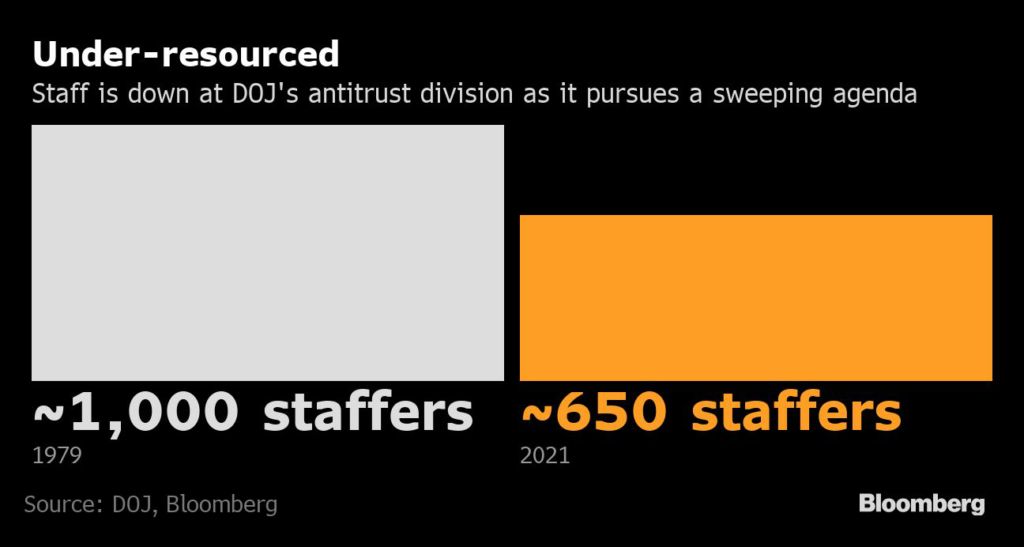
Kanter and Lina Khan, his counterpart at the Federal Trade Commission, which also enforces competition laws, are trying to halt concentration amid a merger avalanche. The agencies reviewed some 3,500 transactions in the fiscal year that ended in September, a record. 

The antitrust division is now juggling five merger challenges and a monopoly lawsuit that accuses Alphabet’s Google of abusing its power in internet search. It’s also investigating Google’s digital advertising business and Apple Inc. over how it runs the App Store, Bloomberg has reported.

The Biden administration is proposing steep jumps in funding for both antitrust agencies in its proposed fiscal 2023 budget as part of its push to make markets more competitive.

One of Kanter’s priorities is to prevent tech platforms from acquiring new, disruptive technologies that threaten their dominance. For years, antitrust cops stood by while tech giants gobbled up smaller companies, a strategy that critics say allowed the platforms to cement their power and conquer new markets. Kanter said he also intends to sue to block more mergers in court rather than accept settlements that allow deals to proceed.

On Tuesday, for example, shipping giants Cargotec Oyj and Konecranes Oyj abandoned a planned merger after Kanter threatened to go to court to block the deal. 

The prospect of tougher merger enforcement is sounding alarm bells. “In every deal, there is a great deal of attention being paid to potential antitrust risks,” said Andrea Basham, a partner at Freshfields Bruckhaus Deringer LLP in New York, whose firm is advising clients to consider remedies such as divesting businesses before going into a review, rather than trying to negotiate one later. Basham said she is seeing “caution in all sectors.”

The son of elementary school teachers, Kanter was born in Queens and is the product of the New York City public-school and university systems. After graduating from Washington University School of Law in 1988, he started his career at the FTC, where he had worked as a student intern. 

Combing through boxes of papers on a pharmaceuticals deal during his internship, Kanter found what appeared to him to be a smoking gun document. It allegedly showed pharmacies coordinating on prices, yet the agency didn’t act, disappointing Kanter. That’s when antitrust theory became real for him. “It’s about being able to get affordable prescription drugs,” he said.

Kanter made his name in private practice a decade ago representing Microsoft Corp. The software company was pushing the FTC to file an antitrust case against Google, an investigation the agency eventually closed without taking action. At the time, arguing that Google was engaged in anticompetitive conduct was seen as a fringe position, he said, but now there’s widespread agreement that the U.S. needs a tougher approach to digital markets. Kanter also represented software companies that complained about Apple’s App Store practices.

Kanter, a music lover who collects guitars and records soundtracks in his basement studio, has an ability to explain in simple terms how complex digital markets work. This was key to laying the groundwork for Google cases brought by the European Union and by state attorneys general in the U.S., according to people familiar with his work.

Kanter’s detractors say his image as an antitrust crusader taking on the establishment is undeserved because he spent much of his career advocating for Microsoft’s efforts to establish Bing as a search rival to Google. 

Google last year pushed the Justice Department to examine whether Kanter is biased and should be recused from cases involving the company. His supporters argue that he has consistently favored vigorous antitrust enforcement, whether in the private sector or in government. Kanter declined to comment, citing department policy.

If Kanter is forced to withdraw from the Google case and a potential Apple case, the division would be left pursuing the biggest antitrust cases since the 1990s without his leadership and expertise.

Antitrust Trio

Kanter, Khan and Tim Wu, Biden’s adviser on technology and competition policy, advocate an activist antitrust agenda known as the New Brandeis School, named after a former Supreme Court justice who warned of the dangers of concentrated economic power. The movement rejects the “consumer welfare standard” ushered in by the so-called Chicago School in the 1970s and 80s, which maintains a narrow focus on prices.

“This really is a swinging back of the pendulum,” said Rick Rule, a former chief of the antitrust division and a former colleague of Kanter’s, now at Rule Garza Howley LLP in Washington. “This is not a flash in the pan.” 

Rule, like many veteran antitrust lawyers, is wary of the new dogma. “There are some people who are going to bristle at the reversal because it comes with the implicit message that the previous status quo has failed,” said Jeff Hauser, founder and director of The Revolving Door Project, which tracks government officials’ corporate ties. 

To some extent, Kanter and Khan are thumbing their noses at the legal establishment. For example, they’re hosting a livestreamed “enforcers summit” on April 4 to give ordinary citizens access to the agencies’ policy objectives. They will be leapfrogging ahead of the American Bar Association’s annual antitrust conference, which takes place two days later and is the customary venue for FTC and DOJ officials to discuss policy. 

It’s not just antitrust tradition at stake. Some lawyers argue that the new leaders’ aggressive stances could result in a big court loss, setting a precedent that makes future enforcement harder. They point to the department’s antitrust case against American Express Co., which went to the Supreme Court and resulted in a 2018 decision that some see as a hurdle to monopoly cases against tech companies.

Kanter said the division has to be ready to lose some cases to move the law in a different direction. 

The antitrust chief is building out his team of deputies to help lead the effort, including bringing over Carol Sipperly, who led the government’s case against mobster John Gotti Jr., to oversee criminal and civil litigation. 

“My biggest challenge is to make sure that this kind of work has the support to address the modern day Standard Oils of the world,” he said. 

More stories like this are available on bloomberg.com

©2022 Bloomberg L.P.

Ukraine Update: Talks to Resume; Russia Details Gas Payments

(Bloomberg) — Talks between Ukraine and Russia are set to resume Friday via video link, following meetings earlier in the week in Turkey. Russian Foreign Minister Sergei Lavrov said Moscow is preparing a response to Ukraine’s proposals on ending hostilities.  

Russia said two Ukrainian military helicopters made a rare strike across the border, hitting an oil tank facility in the city of Belgorod. There was no immediate confirmation from Kyiv. In Ukraine, Kyiv said its forces retook several villages in the Kherson region to the south. The United Nations said relief convoys had so far failed to reach Mariupol, with the southern port city devastated by weeks of shelling. Russia said a humanitarian corridor from Mariupol was planned for Friday.

President Vladimir Putin said Russia would continue supplying gas to Europe even as it demands customers pay in rubles, easing fears the change could lead to damaging disruptions. European Union leaders plan to warn Putin’s key ally China that it will suffer a blow to its global role if it offers support for the invasion.

(See RSAN on the Bloomberg Terminal for the Russian Sanctions Dashboard.)  

Key Developments

  • Mariupol’s Splintering Loyalties May Be Enough for Putin
  • Putin Set for $321 Billion Windfall If Oil, Gas Keep Flowing
  • Biden Embraces Oil as Ukraine War Overwhelms His Climate Agenda
  • EU to Warn China It Will Damage Global Role by Helping Russia
  • Chinese Buyers Given Flexibility to Pay in Yuan for Russian Oil
  • Russians Embrace Putin’s Ukraine War as Kremlin Muzzles Dissent

All times CET:

Gazprom Starts Giving Details on Ruble Payment Plan (12:35 p.m.)

Russia’s Gazprom is starting to tell clients how to pay for their gas after Putin said purchases from “unfriendly” nations including Europe would need to be settled in rubles.

Germany is still pouring over the details before coming to any conclusions, government spokesman Wolfgang Buechner told reporters.

“The federal government is currently examining this decree for its concrete effects,” he said on Friday in Berlin.

Meanwhile the Kremlin signaled that gas would keep flowing, and said payments for April gas weren’t due until late in the month or early May.

Lavrov Says Moscow Working on Response (11:36 a.m.)

Foreign Minister Sergei Lavrov said Russia is preparing a response to Ukraine’s proposals on security guarantees and ending the war. Lavrov made televised comments during a press briefing in New Delhi. 

Russia is ready to discuss Kyiv’s proposals on non-nuclear, neutral status, he said, adding that Ukraine has shown “more understanding” of the realities in Crimea and Donbas. 

Tass cited an unidentified person from the Russian side of negotiations saying talks with Ukraine would resume Friday via video. 

Russia’s Yamal-Europe Gas Pipeline Flows in Reverse (10:29 a.m.)

Russian gas flows via the Yamal-Europe pipeline reversed this morning, with fuel flowing from Germany to Poland — the opposite of the normal direction. That’s been a common occurrence for this pipeline over the past few months, and doesn’t signal a halt in Russian gas flows to Europe. In many cases, it just shows German companies are ordering less gas, while demand in Poland is higher.

Flows via Nord Stream, the direct link to Germany, were near the pipeline’s full capacity. 

Don’t Read Too Much Into Reverse Gas Via Russia Pipeline

Natural Gas Fluctuates as Traders Weigh Putin’s Demand (9:43 a.m.)

Natural gas prices in Europe fluctuated as traders weighed the potential impact on the market by Russia’s decision to shift payment for its supplies to rubles, with colder weather also set to boost demand. 

European stocks and U.S. equity futures rose slightly as investors evaluated the economic outlook amid moderating oil prices, tightening Federal Reserve monetary policy and Russia’s war in Ukraine.

Russian-Linked Containers Pile Up in Rotterdam (9:34 a.m.)

Measures taken against Russia are snarling thousands of steel shipping containers in Rotterdam as each box needs to be carefully inspected to make sure moving it won’t somehow breach sanctions, according to the CEO of the massive port. 

His comments gave unique insights into how the beating heart of Europe’s real economy is being battered by measures taken against Moscow after its invasion of Ukraine.   

Ukrainian Retakes Ground in Kherson, Chernihiv Regions (8:49 a.m.)

Eleven villages in the southern Kherson region and several others in the Chernihiv region northeast of Kyiv have been returned to Ukrainian control, according to the military’s General Staff. Shelling of towns and villages along the contact line in the east continued overnight, with civilian casualties reported after nine apartment buildings and nine private houses were shelled.

The intensity of shelling declined in Chernihiv and Kharkiv, although a missile hit the center of Kharkiv Thursday night. Fighting continues near Chernihiv, Izyum and at the border of Kherson and Mykolayiv regions to the south. 

Refugees Arriving in Poland Now Top 2.4 Million (8:45 a.m.)

Another 23,000 people arrived in Poland from Ukraine on Thursday, and another 3,500 early Friday, taking total refugees since Feb. 24 to 2.415 million, Polish border authorities said.

Over 4 million people have fled Ukraine since the start of the Russian invasion.  

Ukraine Said to Makes Rare Strike in Russian Territory (8:30 a.m.)

Moscow said two Ukrainian military helicopters attacked an oil-storage facility in the Russian city of Belgorod, about 50 km (30 miles) north of the border, causing a large fire early Friday.

Tass quoted Belgorod Governor Vyacheslav Gladkov as saying the aircraft flew in at low altitude. Eight oil fuel tanks were burning and authorities said the fire might spread. Two workers were reported to have been injured and nearby residents were being evacuated.

Focused on fighting Russian troops on their own territory since Feb Ukrainian forces haven’t claimed any strikes on the other side of the border since the start of the war on Feb. 24. 

World Underestimating Impact of War, OECD Says (8:00 a.m.) 

Governments aren’t sufficiently aware of the longer-lasting economic fallout from Russia’s invasion of Ukraine, said OECD Chief Economist Laurence Boone. 

“I really believe we’re underestimating the medium-term impact of this war,” Boone told Bloomberg Television’s Francine Lacqua in Cernobbio, Italy, on Friday. “The longer the war will last, the more uncertainty we have, and the more worried we’re getting because uncertainty deters consumer purchases and business investment.”

Russia Redeploying Forces From Georgia, U.K. Says (7:45 a.m.)

Russia is redeploying as many of 2,000 troops from Georgia to reinforce its invasion of Ukraine, the U.K. defense ministry said. The forces are being reorganized into battalion tactical groups. 

“It is highly unlikely that Russia planned to generate reinforcements in this manner and it is indicative of the unexpected losses it has sustained during the invasion,” the U.K. said. 

EU to Warn China Over Russia (6:00 a.m.)

European Union leaders plan to tell President Xi Jinping in a virtual summit that China will hurt its global stature if it hands Russia an economic or military lifeline. That pointed message will test Beijing’s commitment to keeping the war from damaging its ties with Brussels. 

Russia Jamming Jet Navigation, France Says (6:00 a.m.)

Russia’s military has been jamming satellite navigation systems used by commercial aircraft since the invasion of Ukraine, highlighting the need for robust alternatives, according to a French safety regulator.

Airline pilots have reported disruptions in regions around the Black Sea, eastern Finland and the Kaliningrad enclave, said Benoit Roturier, head of satellite navigation at France’s civil aviation authority DGAC. The interference appears to be caused by Russian trucks carrying jamming equipment typically used to protect troops and installations against GPS-guided missiles, he said.

Russia Is Jamming Jet Navigation, French Safety Official Says

Russia Says Ukraine Struck Oil Facility Near Belgorod (5:20 a.m.)

Russia said two Ukrainian helicopters crossed the border and attacked an oil-storage facility in the city of Belgorod, causing a large fire early Friday.

Tass quoted Belgorod Governor Vyacheslav Gladkov as saying the aircraft flew in at low altitude. Eight oil fuel tanks were burning and authorities said the fire might spread. Two workers were reported injured and nearby residents were being evacuated.

Focused on fighting Russian troops on their own territory, Ukrainian forces haven’t claimed any strikes on the other side of the border since the start of the war. There was no immediate comment from Kyiv on the Belgorod fire.

Stocks Mixed as Crude Oil Drops (5:08 a.m.)

U.S. equity futures pushed higher and Asian stocks were mixed as investors evaluated the economic outlook amid moderating oil prices, tightening Federal Reserve policy and the war.

Oil held losses on a move by the U.S. to release roughly a million barrels a day from reserves to tackle rising energy costs. Russia’s invasion has disrupted commodity flows, fanning prices for everything from fuel to food.

China Minister Says No One Can Split G-20 (4:51 a.m.)

All members of the Group of 20 nations have equal status and no one has the power to split the group, Chinese Foreign Minister Wang Yi said, according to a ministry statement. Biden has previously said Russia should be removed from the G-20.

Japan Won’t Exit Sakhalin-1 or 2 (4:00 a.m)

Prime Minister Fumio Kishida said the country won’t withdraw from the Sakhalin-1 or 2 oil and gas project in Russia.

Resource-poor Japan currently gets 3.6% of its imported crude oil from Russia, while roughly 90% of it comes from Middle Eastern countries, according to trade ministry data. Japan procures 9% of its LNG and 13% of its thermal coal imports from Russia. 

UN Aid Convoy Reached Sumy, Mariupol Blocked (10:40 p.m.)

The United Nations said its aid convoy was able to get through to the northeastern city of Sumy, where it delivered food, medicine and other supplies. But it said that the UN and partners have still not been able to deliver aid to other regions, including Mariupol.  

Ukraine Says Russian Forces Exposed to Radiation (9:33 p.m.)

Russian troops began leaving the Chernobyl nuclear plant after soldiers got “significant doses” of radiation from digging trenches at the highly contaminated site, Ukraine’s state power company said. 

The International Atomic Energy Agency said it was unable to confirm the reports of radiation exposure and is “seeking further information.” The IAEA said it was told by Ukrainian officials that Russia has transferred control of the facility, in writing, back to Ukraine.

Ukraine Says Less Than 1,500 People Evacuated Thursday (9:08 p.m.)

Despite guarantees from the International Red Cross and Moscow, Russian troops blocked Ukrainian buses from entering Berdyansk, a port about 90 kilometers (56 miles) from Mariupol, and Melitopol, Vereshchuk said. 

At the requests of French President Emmanuel Macron and German Chancellor Olaf Scholz, Russia will open a humanitarian corridor from Mariupol to Kyiv-controlled territory on Friday as well, Ria Novosti reported, citing the Defense Ministry.

White House Jabs Putin, Again (8:21 p.m.)

Biden said there are signs that Putin has fired or detained key advisers.

“There’s a lot of speculation,” Biden said, adding that Putin “seems self-isolated.” Biden also said it’s an “open question” how misinformed Putin is about the status of his military’s efforts in Ukraine.

“But I don’t want to put too much stock in at this time because we don’t have that much hard evidence,” he added. 

Russian Forces Seen Leaving Chernobyl (7:50 p.m.)

Ukraine’s nuclear regulator said the head of Russian troops at the Chernobyl facility said they are departing after taking the facility infamous for its 1986 meltdown in the early days of the war. 

Leonid Oliynyk, Energoatom’s spokesman, confirmed a letter posted on Telegram announcing the departure. Oliynyk — who isn’t at Chernobyl — said he was told that most Russian troops left the facility in two columns and appeared headed toward Belarus. It didn’t appear that all Russian troops had departed, however. 


More stories like this are available on bloomberg.com

©2022 Bloomberg L.P.

Google Found to Unfairly Block Rival Payments on India Store

(Bloomberg) — Google’s billing system for app developers is “unfair and discriminatory,” India’s antitrust regulator said in the initial findings of an extensive investigation, paving the way for potential penalties in future.

The Competition Commission of India found Google discriminated against developers in its Play store billing policy, according to documents seen by Bloomberg News. The findings come after a months-long investigation triggered by protests from developers, who’ve complained the U.S. internet giant charges an unfairly high fee in return for using Android app stores and its proprietary payments service.

Alphabet Inc., Google’s parent, and Apple Inc. have come under pressure from regulators around the world who accuse the twin mobile giants of forcing developers to use their payment systems, then taking an outsized cut of revenue. In South Korea, Google was forced to provide an alternative billing system after regulatory action. In that market, Google said it was reducing app makers’ fees by 4%.

“Google is imposing unfair and discriminatory conditions in violation” of regulations, the Indian agency said in its preliminary report dated March 14.

“Google’s conduct is also resulting in denial of market access to competing UPI apps since the market for UPI enabled digital payment apps is multi-sided, and the network effects will lead to a situation where Google Pay’s competitors will be completely excluded from the market in the long run,” it said, referring to the Unified Payments Interface or state-backed payments infrastructure.

Read more: Google Comes Under Fire Abroad as U.S. Prepares Antitrust Case

The response in India has been strident, underscoring how Google’s troubles could undercut future growth. More than 200 startup founders banded together to open discussions with the government to stop it from imposing a fee of as much as 30% on smartphone app purchases — its standard levy around the world. While Google delayed implementation of that rule after an outcry in late 2021, the country’s tech industry remains determined to constrain the colossus.

Representatives for the antitrust agency didn’t immediately respond to requests for comment. “We will continue to engage with the CCI and demonstrate that our practices benefit Indian consumers and developers, without in any way restricting competition,” Google said in a statement.

The backlash in India echoes global opposition to the fee structure imposed by Google and Apple in their online app stores. Fortnite-maker Epic Games Inc. filed a lawsuit in the U.S. against the two companies for how they impose such charges.

India’s authorities have proven willing to go after the largest corporations and take forceful action — when they see a clear, national interest. Companies such as Apple were prohibited for years from opening their own retail stores to protect local operators, while TikTok and more than a hundred other Chinese apps were banned over security concerns.

Last month, Alphabet said it will begin letting some apps bill users directly as an alternative to paying through Google, a concession intended to assuage mounting antitrust concerns. The new system, which Google is framing as an experiment, starts with streaming giant Spotify Technology SA. 

Google generally took a 30% commission on most app store purchases and subscriptions, but lowered the fee in recent years to 15% for media providers like Spotify. Spotify is one of several companies that have complained about the inability to use their own billing systems on mobile app stores.

(Updates with Google’s statement from the 7th paragraph)

More stories like this are available on bloomberg.com

©2022 Bloomberg L.P.
Toyota’s Hybrid Bet Vindicated by Big Gains in U.S. Market Share

(Bloomberg) —

As automakers prepared to roll out their first-quarter sales results, prognosticator Cox Automotive said it expects Toyota to post strong gains and maybe even beat General Motors again for the quarterly U.S. crown. It’s a neck-and-neck race that GM easily won in the past.

One reason for the change is the Japanese automaker has managed to secure better access to semiconductors. More chips means more production, inventory and sales in an economy with low unemployment and widespread vehicle shortages. Another reason is Toyota has hybrid-electric vehicles up and down its lineup at a time of record gasoline prices, now averaging well above $4 a gallon.

Toyota’s strategy to move cautiously into electric vehicles while aggressively wagering on hybrids — which are very efficient but still burn gasoline — is paying off. One thing Russia’s invasion of Ukraine and the resulting spike in energy prices is showing us is that many consumers won’t just tolerate paying big sums at the pump while waiting for EVs to become more available and affordable.

A Prius Prime hybrid gets 54 miles per gallon and starts at under $30,000. A roomier Toyota Venza starts at under $35,000 and gets over 40 mpg. Those are attractive specs to middle-class buyers who want to save on fuel.

This is not to say EVs aren’t drawing more interest with gasoline being so expensive. Tesla is also expected to continue its strong sales growth, and car-sales websites show more consumers are increasingly scoping out EVs. But there are only so many fully electric options on the U.S. market, and they cost a lot more.

Aside from the Chevrolet Bolt electric utility vehicle, which starts at $33,500 and just went back into production after a nasty recall, there aren’t EVs available that come close to Toyota’s hybrid price points. Volkswagen’s cheapest ID.4 costs more than $40,000, as does Kia’s EV6 and Hyundai’s Ioniq 5, and they all get less than 300 miles of range with the base battery option. Tesla’s Model 3 now starts at $47,000. 

Some automakers, seeing Tesla’s growth, have gone headlong into EVs and moved away from hybrids. GM has ditched them altogether. In the long term, that’s the correct move. But if geopolitics continue on the current path and energy prices remain volatile, hybrids will be a popular choice for consumers who can’t yet afford an EV. Last year, hybrids were 7.5% of sales in the U.S., more than double the market share for EVs, according to AutoForecast Solutions. Both segments are all but certain to grow this year.

Toyota took its time shifting to battery-electric vehicles in part based on the judgment most consumers can’t afford them yet. In December, the company earmarked about $35 billion of investment to build 30 EVs by the end of the decade. GM has said it will spend that much by 2025, and Ford has a similar commitment.

Last year, Toyota director Shigeki Terashi said it was too early to focus on just EVs. He may have looked like a luddite then to the company’s critics. Right now, he looks pretty smart.

More stories like this are available on bloomberg.com

©2022 Bloomberg L.P.
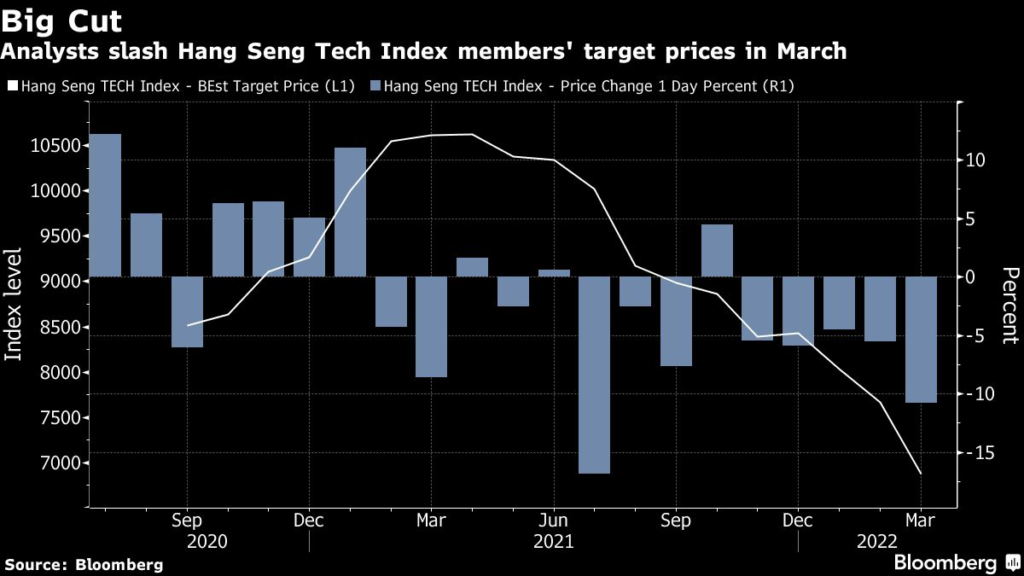
Tencent, China Giants’ Targets Cut Most Since July 

(Bloomberg) — A rapid 30% recovery from the trough for Chinese technology stocks is still far from convincing some market watchers that the worst is over for the sector. 

Analysts slashed their target prices for members of the Hang Seng Tech Index in March by the most since July following a sluggish earnings season, according to data compiled by Bloomberg. 

Price objectives for internet giant Tencent Holdings Ltd. and online retailer JD.com Inc. came down by more than 10%. Smartphone component maker Sunny Optical Technology Group Co. and software company Ming Yuan Cloud Group Holdings Ltd. had the biggest reductions among index members, down 33% and 30%, respectively. 

The Hang Seng Tech Index’s 30% surge since mid-March has lost momentum in the past week. Even as the nation’s top leadership vowed to keep markets stable, Beijing kept rolling out new crackdown measures on the tech sector, including a tax probe and reported tipping limit in the video-streaming industry. 

“It’s hard to say the worst is over,” said Mark Po, analyst at China Galaxy International Financial Holdings Ltd. “We’ve seen a near-term bottom, but that doesn’t mean things won’t get worse.”  

One bullish sign: Chinese authorities are preparing to give U.S. regulators full access to auditing reports of the majority of the 200-plus Chinese companies listed in New York as soon as the middle of this year, according to people familiar with the matter. The move could head off a wave of delistings and prevent a further decoupling between the world’s two largest economies. 

American depositary receipts of Chinese companies rallied in U.S. premarket trading Friday after the report.

To be sure, most analysts remain optimistic on the technology giants despite recent price cuts. For example, only three out of 70 analysts tracked by Bloomberg rate Tencent a sell, and its average target price is still 40% higher than its last close.   

“The internet sector is a megatrend of the past that has already become a mature and competitive industry with relatively limited upside and elevated policy risks,” said Ken Xu, chief investment officer of Strategic Vision Investment.

Tech Chart of the Day

The Nasdaq Golden Dragon China Index, which tracks Chinese stocks that trade in the U.S., is still valued 38% above its 2011 trough, as measured by price-to-book ratio. If China manages to head off delistings of many ADRs, the index may not test that low valuation.

Top Tech Stories

  • The dominance of tech stocks in the S&P 500 index is set to shrink next year after the benchmark index’s overseer announced revisions that will reclassify the sectors of some major shares.
  • Toshiba Corp. shares rose after the Japanese company’s largest shareholder spurred speculation of a takeover bid by U.S. private equity firm Bain Capital.
  • Christian Smalls, who started a labor union after being fired by Amazon.com Inc., was on track to potentially win a historic election to unionize one of the e-commerce giant’s facilities in New York.
  • GameStop Corp. shares surged as much as 22% in extended trading after the gaming retailer said it plans to ask shareholders for approval of a stock split in the form of a dividend.
  • Panasonic Holdings Corp. plans to invest 600 billion yen ($4.9 billion) in fields including automotive batteries and supply chain software that the company sees as core to its growth.
  • Google’s billing system for app developers is “unfair and discriminatory,” India’s antitrust regulator said in the initial findings of an extensive investigation, paving the way for potential penalties in future.

More stories like this are available on bloomberg.com

©2022 Bloomberg L.P.

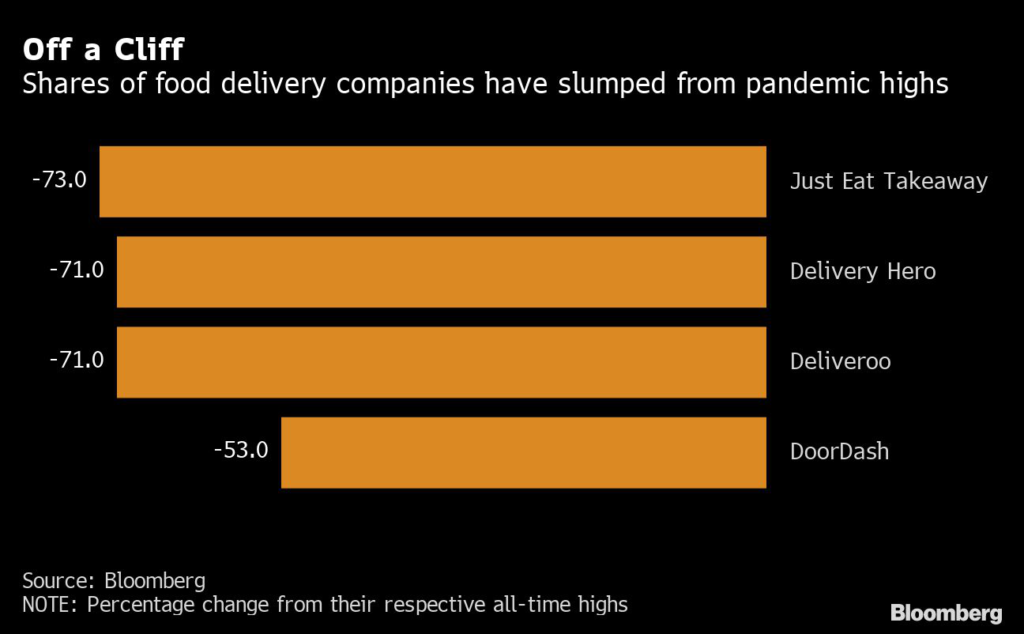
Food Delivery Stocks Lose $24 Billion in Just Three Months

(Bloomberg) — In a market gripped by concerns over rising interest rates and soaring inflation, investors are avoiding European food delivery companies, turned off by their steep losses and determined efforts to expand. 

Shares in Delivery Hero SE plunged 59% last quarter, the second-worst performance in Europe’s Stoxx 600 Index. Peers Just Eat Takeaway.com N.V. and Deliveroo Plc dropped more than 35%. The three stocks wiped out a combined $23.7 billion, more than half their market value.

While it’s no surprise when tech stocks struggle in times of rising borrowing costs, the sharp slump in food delivery shares underscores the penalties markets can impose on companies for prioritizing growth when they are yet to turn a profit.

Companies in the sector have done a bad job of adjusting their strategies to the rising cost of capital, Jefferies analyst Giles Thorne said in an interview. “The cost of capital goes up, you don’t make money and you’ve got debt — then that’s how equity gets crushed.”

The fear of losing market share has driven increased spending, even as sliding equity valuations signaled investor disapproval. Just Eat expanded into the U.K. grocery delivery market in December, after previously saying the category lacked scale. Delivery Hero agreed to buy a majority stake in Glovo in a transaction that valued the Spanish delivery startup at 2.3 billion euros ($2.5 billion).

“The Glovo deal continues to baffle us,” HSBC analysts led by Andrew Porteous said in a March 25 note. Delivery Hero expects Glovo to post a loss of 330 million euros in 2022. 

Volatility in food delivery stocks will remain high until the sector is closer to becoming self-funding, Thorne at Jefferies said. That remains months — or years — away. Deliveroo, for example, aims to reach breakeven on an adjusted Ebitda basis between the second half of 2023 and the first half of 2024.

‘Punch Drunk’

Challenges are coming at food delivery players from all sides. Inflation is squeezing consumer budgets, while competition is as heated as ever with startups like Getir and Gorillas pushing into rapid grocery delivery. Plus, the rapid growth achieved a year ago will be hard to repeat now that the pandemic-generated sales surge has passed.

Some analysts say the worst may be over, given how much the stocks have fallen. HSBC’s Porteous said caution has been baked into a sector that now looks “punch drunk.” That view is shared by Berenberg analyst Sarah Simon. “Yes, you’re going to have a couple of quarters when growth is less exciting, but we would say that’s already priced in,” she said.

Narrowing losses will take time, but consolidation may provide quicker path to relief. 

Signs of thinning competition in some markets may draw back some investors, according to Goodbody analyst David Brohan. The sector is starting to become more rational, he said, with Just Eat ending operations in Norway and Portugal, Deliveroo exiting Spain and Delivery Hero pulling out of Germany for a second time.

“We need to see improving profitability metrics this year,” Brohan said. “We are not just going to continue down this very competitive route where profits are always pushed down the track.”

Food delivery stocks were off to a positive start in the second quarter, with Just Eat rising 7%, Delivery Hero up 6.4% and Deliveroo gaining 2.1% on Friday.

(Adds Friday share price moves in final paragraph, updates chart)

More stories like this are available on bloomberg.com

©2022 Bloomberg L.P.

U.K. Ministers Won’t Block Chinese Takeover of British Chipmaker

(Bloomberg) — The U.K. government has decided not to intervene in the takeover of Britain’s biggest semiconductor plant by a Chinese-owned company, according to a person familiar with the matter.

Britain’s national security adviser Stephen Lovegrove was asked by Prime Minister Boris Johnson to review the sale of Welsh-based Newport Wafer Fab to Nexperia NV last August to see if there were “real security implications.”

Lovegrove has now concluded that the takeover can go ahead, the person said. The decision was first reported by Politico.

Nexperia Hits Back at U.K. ‘Sneering’ at China Ties in Chip Deal

The move to allow Nexperia to acquire the U.K. chipmaker sparked alarm among lawmakers in Johnson’s ruling Conservative party, who argued it was a national security concern because the Netherlands-based firm is ultimately owned by China-headquartered Wingtech.

Both the Department for Business, Energy and Industrial Strategy and Johnson’s office had no immediate comment.

More stories like this are available on bloomberg.com

©2022 Bloomberg L.P.

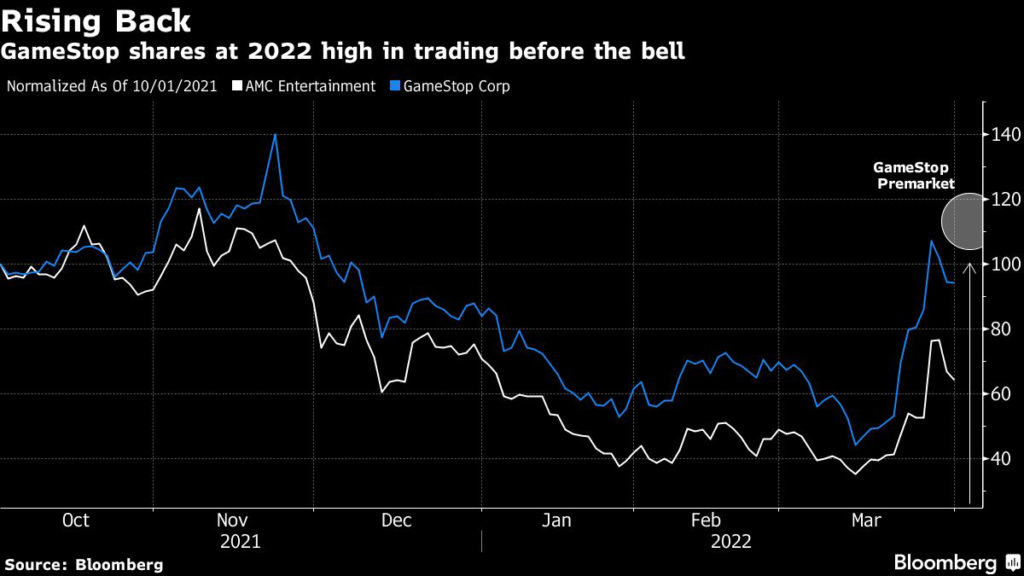
AMC, Other Meme Stocks Rally After GameStop’s Share-Split Plan

(Bloomberg) — GameStop Corp. shares rose 15% in premarket trading and were on course to open at the highest level this year after the video-game retailer announced plans for a stock split, fueling a rally in fellow so-called meme stocks. 

GameStop became the latest high-flying firm to propose a share split after technology giants Alphabet Inc., Amazon.com Inc. and Tesla Inc. laid out similar goals in recent weeks. Retail investors have welcomed the announcements by buying into the stocks in large volumes. 

Meme stocks have seen a pick-up in retail-investor demand this week with individual investors snapping up AMC Entertainment Holdings Inc. and Hycroft Mining Holding Corp. While there seems to have been a revival in meme-stock rallies, they pale in comparison to those in 2021 when stocks such as GameStop almost tripled in a single session. 

Shares of AMC and Hycroft were up more than 5% each in trading before the bell.  

The meme stock frenzy has led to oscillations in GameStop’s shares over the past year as the company became a poster child for the phenomenon that saw retail investors organizing in online forums like Reddit to boost the stock by more than 700% in 2021. 

More stories like this are available on bloomberg.com

©2022 Bloomberg L.P.
Biden’s Russia Trade-Ban Options Include Oil Equipment and Metals

(Bloomberg) — The far-reaching export controls that the U.S. placed on Russia a month ago still leave room for escalation in some key sectors if President Vladimir Putin continues his push forward with the invasion of Ukraine.

At the Commerce Department, Secretary Gina Raimondo’s teams are working on ways to further undermine Putin’s ability to wage war.

While much of that focuses on enforcement — such as recent action to identify more than 100 commercial and private aircraft, including billionaire Roman Abramovich’s Gulfstream business jet, for apparent violations of U.S. law — it also includes planning out the next steps in terms of prohibitions.

“We are doing constant scenario planning,” Raimondo said in an interview last week. “We have a whole menu of escalation.”

Matthew Borman, the deputy assistant secretary for export administration, told reporters on Monday that one option would be to expand restrictions on certain items to all end-users, rather than just having them apply to the military. Currently, many consumer items like smartphones, communications devices, servers and routers are still eligible to be sold to Russian civilians under license exceptions.

The U.S. also could do more to restrict American imports from Russia, take other actions in the financial sector or add more groups from Russia’s defense industrial base to the list of entities that face purchasing restrictions, Borman said.

Read more: Tech Walls Off Russia Like Never Before, Posing Risks for U.S.

While Borman declined to say which specific actions may be taken, the following are some of the most likely possibilities, based on interviews with export-control lawyers and people familiar with the processes at the Bureau of Industry and Security, or BIS, the area of the Commerce Department focused on the issue. 

Asked about these and other potential moves, a Commerce Department spokesman said all options are being considered.

Oil Equipment

Restrictions imposed on drilling equipment for Arctic, deepwater and shale exploration and production over several years by Washington since Russia’s invasion of Crimea in 2014 still allow for the sale of onshore and conventional shallow-water drilling gear from companies like Schlumberger NV and Baker Hughes Co.

The U.S. likely has held off on barring those items in an effort to limit collateral impact on the European Union, which is more dependent than the U.S. on Russian oil and gas imports.

“Comprehensively cutting off the Russian energy sector from U.S.-origin technology or goods and needed capital would further deprive the already-battered Russian economy of needed currency to support its actions in Ukraine,” said Cordell Hull, who led the BIS during the Trump administration and is now a principal at national security advisory firm WestExec.

Mining Industry

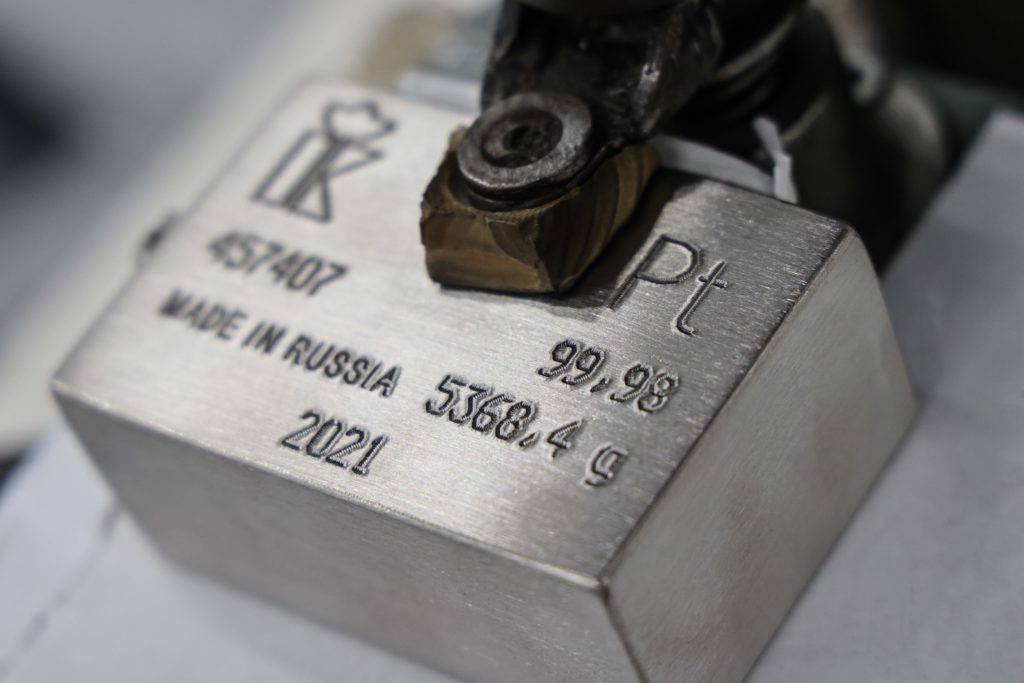
Mining equipment could be added to Commerce’s export controls, and the Treasury Department could impose a ban on imports from Russia’s mining sector. Precious metals and stones, including platinum used in catalytic converters for cars, trucks and buses, ranked as one of the biggest Russian exports to the U.S. in recent years, accounting for more than $2 billion annually.

While Biden has broad-based authority to ban imports, he would need to measure to what extent such a move would hurt U.S. industries that use the commodities as inputs, said Inu Manak, a fellow for trade policy at the Council on Foreign Relations.

“They really have to weigh that carefully,” she said.

Read more: Treasury’s Adeyemo Says U.S., Allies to Add to Russia Sanctions

A Treasury spokeswoman declined to preview potential options.

Export Embargo

The most dramatic escalation would be imposing a full export embargo –- a status currently applied to Cuba, Iran, North Korea and Syria.

Raimondo previously said that the U.S. didn’t initially implement a full ban on exports to Russia out of concern that it could hurt the nation’s people, and that the U.S. goal was to hit the military rather than citizens.

An embargo “gets you into full pariah-nation status,” said Mike Walsh, a partner at law firm Foley & Lardner LLP in Washington who was chief of staff to Commerce Secretary Wilbur Ross during the Trump administration. “If you can’t get anything, there’s really no way for your society to advance in a meaningful way.”

The Biden administration may be holding back on exhausting its options in the hope that the threat of doing more will change Putin’s behavior, Manak said.

“At some point we’re going to run out of things we can do,” Manak said. “Doing everything right away might back Putin into a corner and prevent any solution from being achieved at all.”

More stories like this are available on bloomberg.com

©2022 Bloomberg L.P.
Close Bitnami banner
Bitnami