Bloomberg

Cybersecurity Stock Breakout Has Traders Eyeing More Gains

(Bloomberg) — Investors are betting that increased spending on digital defenses because of Russia’s invasion of Ukraine will fuel further gains in cybersecurity stocks, despite trepidation about valuations that remain historically elevated. 

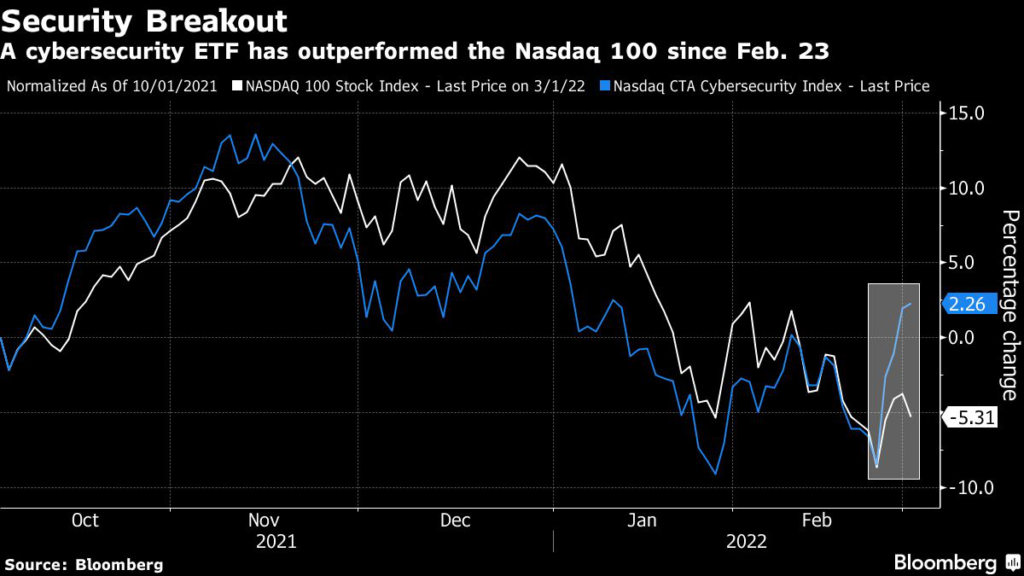
After moving nearly in lockstep with the Nasdaq 100 Index in recent months, a gauge of cybersecurity-related stocks has surged ahead of the broader benchmark since the war began last week. Crowdstrike Holdings Inc. and Tenable Holdings Inc. are among seven stocks in the Nasdaq cybersecurity index that have gained 20% or more since then. 

“Security fundamentals are rock solid and should outperform broader software due to rising threats, defensible budgets and more reasonable valuations,” Morgan Stanley analysts including Hamza Fodderwala wrote in a research note on Monday.

Even after the selloff over the last three months, cybersecurity stocks are by no means cheap, selling for 35.4 times estimated profits, in aggregate. In Bloomberg data going back to October 2017, the average price-earnings multiple is 30.6. The Nasdaq 100, by comparison, is priced at 23.6 times earnings.

Also, analysts for now aren’t raising their earnings estimates because of the threat. Since Bloomberg News first reported on Nov. 12 U.S. warnings that Russia might be planning to invade Ukraine, 2022 predictions for Crowdstrike have gone up by 26%, but analysts have cut their predictions for Tenable, CyberArk and Mandiant Inc.   

Still, the strength of the sector has been on display this week with the Nasdaq cybersecurity index advancing for a fifth-consecutive day on Wednesday. The 35-member index has gained 13% since Feb. 23, while the Nasdaq 100 is up 5.6%. 

The economic sanctions imposed on Russia by the U.S. and its allies have made retaliatory cyberattacks inevitable and the threat will continue to benefit cybersecurity stocks, according to Truist analysts including Joel Fishbein Jr. 

Bets that the economic ramifications of the war will force the Federal Reserve to take a more cautious approach to rate hikes has also provided a lift to other stocks with rapid growth outlooks. Cybersecurity, however, looks particularly attractive due to heavy demand for digital security services, according to Jeremy Schwartz, global chief investment officer at WisdomTree Investments Inc. 

“Fears of accelerated cyber warfare caused a strong bid to these stocks, and we think the major selloff over the last six months and year-to-date represents a timely thematic opportunity for those looking to add more growth stocks to their portfolios,” Schwartz said in an interview.

Tech Chart of the Day

While the Nasdaq 100 has a well-deserved reputation as a benchmark for Big Tech, the index has plenty of stocks from other industries, and without them, this year’s losses would be much bigger. Besides tech-adjacent industries like video games and mobile-phone carriers, the biggest positive contributors to the index in 2022 include ketchup producer Kraft Heinz Co. and drugmaker Vertex Pharmaceuticals Inc.   

Top Tech Stories

  • Salesforce shares gained in premarket trading after the enterprise software company forecast revenue for the first quarter that exceeded the average analyst estimate. The company’s fourth-quarter results and guidance beat Street expectations due to a strong cloud product portfolio, analysts said.
  • SoFi Technologies shares surged in premarket trading after the financial services platform’s fourth-quarter results topped estimates.
  • Netflix Inc. agreed to buy a Finnish mobile games studio that’s making a title based on the former’s hit streaming series “Stranger Things” for 65 million euros ($72 million).
  • Baidu Inc.’s shares surged in Hong Kong after its revenue and profit beat estimates, signaling the Chinese internet giant’s efforts to monetize artificial intelligence technology is paying off.
  • Smart car technology company Ecarx Co., whose backers include Zhejiang Geely Holding Group Co., is considering seeking a U.S. listing via a merger with a blank-check company, according to people with knowledge of the matter.


(Updates to note further gains in a cybersecurity index on Wednesday in the sixth paragraph. An earlier version of the story corrected Schwartz’s job title in the eighth paragraph.)

More stories like this are available on bloomberg.com

©2022 Bloomberg L.P.
SocGen Warns Staff of Increased Cyber Risk Amid Ukraine War

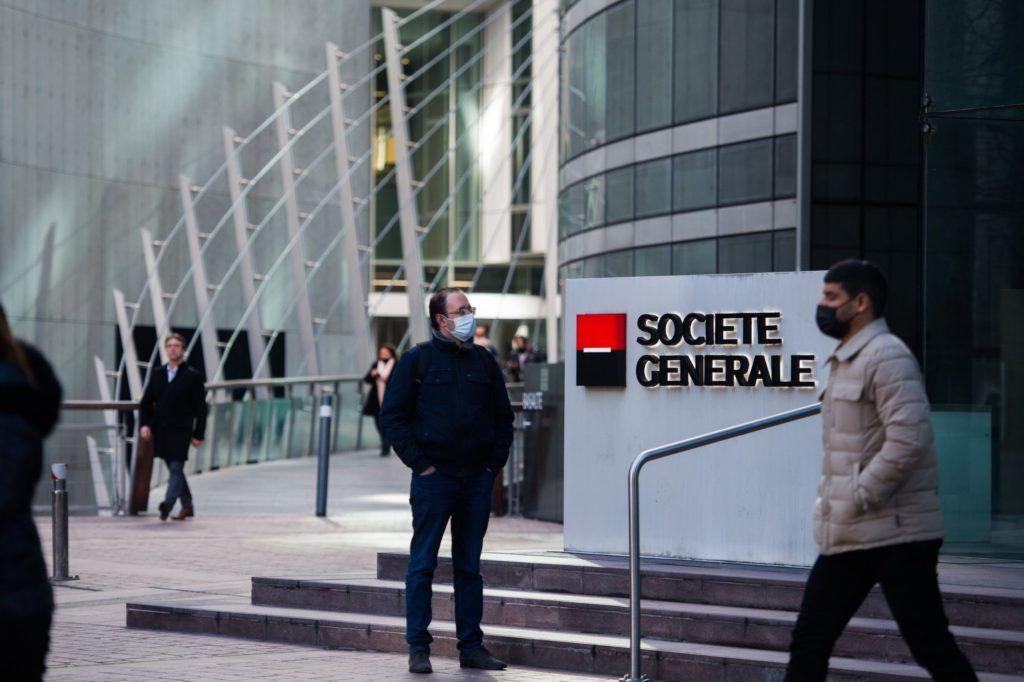
(Bloomberg) — Societe Generale SA is asking staff for extra vigilance in online communications, amid fears that Russia’s war efforts could lead to a spike in cyber attacks.

The Paris-based bank’s security and technical teams are very closely monitoring online attacks, according to a staff memo seen by Bloomberg News. Reminding its staff of the basic rules to avoid phishing, SocGen said that ransomware represents the number one risk of cyber attacks for the company.

“Societe Generale takes information security very seriously in order to protect customer data and its Information System,” the lender said in an emailed statement to Bloomberg News. The bank’s “security and technical teams are always on alert for any evolving threats.” 

“No specific external cyber attack has yet been identified,” the bank said, declining to comment further on the memo.

Prior to the launch of Russia’s military invasion of Ukraine, the European Central Bank had warned banks against increased cyber risk in case of worsening geopolitical tensions, without naming any particular country. Last month, several Ukrainian banks were targeted by cyber attacks.  

SocGen has been particularly hit by an investor sell-off amid concerns over its exposure to Russia via local unit Rosbank, and its stock almost 40% since a multi-year high it touched just last month. Still, the bank’s capital cushions could absorb a potential write-off of its local investment, according to Fitch Ratings.

The war has also led SocGen to wind down some dealings with Russia, amid concern that future sanctions could include energy or a total expulsion of Russia from the SWIFT system of international payments. At the onset of the war, the lender halted the financing of commodities trading flows with the country, Bloomberg reported. 

More stories like this are available on bloomberg.com

©2022 Bloomberg L.P.

Crypto Powerhouse ConsenSys Faces Action by Former Employees

(Bloomberg) — A group of former employees of the ConsenSys AG is alleging “serious irregularities” at the startup incubator that owns a minority interest in the namesake crypto-related software company.

Claiming to represent 35 employees, the group filed for a Swiss court to conduct a special audit, to look at an asset transfer out of ConsenSys AG (Mesh) into a new entity that the group claims “was to the detriment of the minority shareholders.”

Founded by Ethereum co-creator, Joseph Lubin, ConsenSys countered that the property transfer was valued fairly, and that the business environment has changed dramatically since the spin out in mid-2020 — so the assets later ended up having higher valuation. Since then, Ethereum went on a bull run, reaching an all-time high in early November.

“Mesh refutes the allegations underlying the legal action as well as those contained in the factually inaccurate press release that was self-authored by one of the former employees,” the Washington-based company said in a statement. “Mesh looks forward to formally refuting the allegations and accusations in Swiss courts.”  

ConsenSys Mesh focuses on incubation and startup investment, and has a portfolio of more than 150 companies, according to its Website. It also manages a portfolio of equity and tokens, and does its own research and development.  

More stories like this are available on bloomberg.com

©2022 Bloomberg L.P.

Google Tells Employees to Return to Offices Starting in April

(Bloomberg) — Alphabet Inc.’s Google is asking employees in the San Francisco Bay Area to work in their offices three days a week starting in April, marking its first return to campuses since the pandemic began.

John Casey, Google’s vice president of Global Benefits, shared the news with staff in an email on Wednesday. He said the company made the decision after a “steady decline in cases that we continue to see, and the improved safety measures” at its campus in Mountain View, California, and other neighboring sites.

Google is one of the largest companies attempting a “hybrid” model of office and remote work. The technology giant has pushed its return date multiple times, most recently postponing a January start due to omicron. 

Google’s commitment to office work has frustrated some employees who wanted to move outside of the pricey Bay Area. In his email, Casey wrote that “nearly 14,000” employees globally have moved to a new location or been given approval to work remotely.

“We plan to use March to help folks transition to their new routines and aim to be fully functional in our hybrid working approach (in line with Product Area and function guidelines) by April 4,” Casey said in the email. 

More stories like this are available on bloomberg.com

©2022 Bloomberg L.P.

Fanatics Raises $1.5 Billion With $27 Billion Valuation

(Bloomberg) — Fanatics Inc. raised $1.5 billion in a funding round that values the sports merchandise and memorabilia company at $27 billion, according to a person with knowledge of the matter. 

Investors included Fidelity Management & Research Co. and funds operated by BlackRock Inc. and MSD Capital LP, said the person, who asked not to be named because the transaction was private. 

A spokesperson for Fanatics declined to comment. The news was reported earlier by the Wall Street Journal. 

Fanatics has been adding new categories as Chief Executive Officer Michael Rubin looks to extend beyond sports merchandise into several new business lines, including trading cards and sports betting.

More stories like this are available on bloomberg.com

©2022 Bloomberg L.P.
Treasury’s Yellen Urged to Ensure Crypto Isn’t Russia Sanctions Workaround

(Bloomberg) — A group of key Senate Democrats wants to know more about what the Treasury Department is doing to ensure digital currencies aren’t being used to bypass sanctions against Russia.

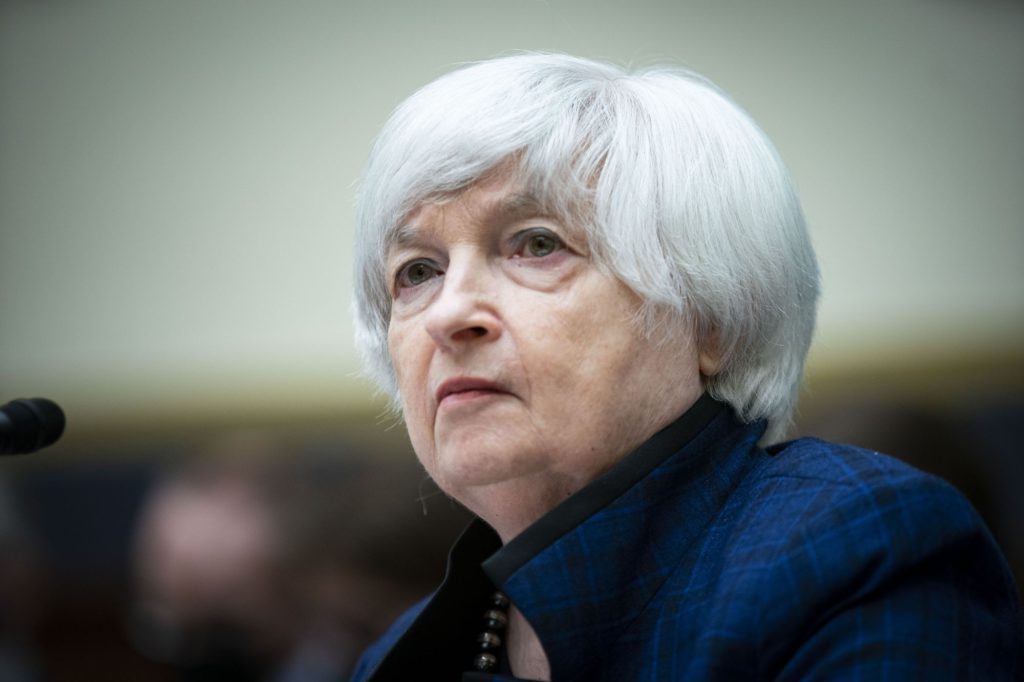
In a letter to Treasury Secretary Janet Yellen, lawmakers including Elizabeth Warren and Senate Banking Committee Chairman Sherrod Brown raised concerns that some crypto firms may not be complying with new rules, and asked for more details about how regulators are monitoring and enforcing restrictions that the U.S. has imposed on Moscow in response to its invasion of Ukraine. 

“There are growing concerns that Russia may use cryptocurrencies to circumvent the broad new sanctions it faces from the Biden administration and foreign governments in response to its invasion of Ukraine,” wrote the group of lawmakers, which also includes Senate Intelligence Committee Chairman Mark Warner and Senate Armed Services Committee Chairman Jack Reed. “We are seeking information on the steps Treasury is taking to enforce sanctions compliance by the cryptocurrency industry.”

Read more: U.S. Prods Exchanges to Thwart Crypto Use by Sanctioned Russians

The U.S. and its allies have put in place steep sanctions in recent days, including cutting some Russian banks off from the SWIFT messaging system that connects thousands of financial institutions around the world. There have been heightened calls, including from former Secretary of State Hillary Clinton, for the Biden administration to crack down on crypto exchanges to ensure they aren’t offering an escape hatch for sanctioned individuals and entities. 

The lawmakers pointed out that crypto trading has spiked since the sanctions were announced. Bitcoin, the largest digital currency, has seen significant gains, jumping more than 16% over the past two days. The senators asked for more information about ways Treasury’s Office of Foreign Assets Control is working with foreign governments to ensure compliance, and what additional tools officials need.

Read more: Crypto World Grapples With Challenge of How to Handle Sanctions

The White House’s National Security Council and the Treasury has already sought help from crypto exchanges on this matter, people with knowledge of the matter previously told Bloomberg. And German Finance Minister Christian Lindner said Wednesday that finance ministers from the Group of Seven and European Union are working together to prevent Russian individuals and organizations from using crypto to circumvent the new restrictions.

Separately, in a hearing before the House Financial Services Committee on Wednesday, lawmakers pressed Federal Reserve Chair Jerome Powell about whether digital assets are being used to dodge sanctions. Powell said he didn’t have any “private information,” but said the issue underscores the need for Congress to create a framework to ensure digital tokens aren’t used for illicit purposes. 

More stories like this are available on bloomberg.com

©2022 Bloomberg L.P.

Airline Ticket-Booking Systems Weigh Russia Exposure After Sanctions

(Bloomberg) — Two of the world’s biggest airline ticket-booking systems said they’re evaluating their exposure to Russian customers including Aeroflot PJSC in light of sanctions on the country after it invaded Ukraine. 

Amadeus IT Group, whose ticketing software is used by Russia’s S7 and Ural Airlines, is weighing the potential impact of measures implemented by a growing group of countries in Europe and the U.S.  

“We are constantly monitoring the situation, which is evolving rapidly,” the Spanish company said in a statement. “We continue to assess and evaluate the potential impact of international sanctions imposed by the U.K., the U.S. and the European Union on Russia and any counter-measures by Russia.”

Southlake, Texas-based Sabre Corp., which provides software for Russian flag carrier Aeroflot, said it was monitoring the situation. “We are complying and will continue to comply with sanctions imposed,” the company said, without providing details of its actions. 

EU sanctions against Russia prohibit “the sale, supply, transfer or export of all goods and technology linked to aircraft, helicopters and spacecraft,” according to Transport Commissioner Adina Valean.

Airspace bans have already severely curtailed the level of flying between Russia and other countries. Being shut out of online booking software could make it difficult for airlines in the country to continue operating domestically.  

While the EU language is sweeping, it doesn’t specifically call out airline reservation systems. The U.S. has banned Russian airlines from its airspace and, along with the EU, has imposed a number of financial sanctions making it harder to conduct business in Russia.

More stories like this are available on bloomberg.com

©2022 Bloomberg L.P.
No Corner of U.S. Stock Market Left Untouched by War in Ukraine

(Bloomberg) — From tech companies to banks to cruise-ship operators, virtually no corner of the U.S. stock market has been left untouched by Russia’s invasion of Ukraine.

The reasons are numerous. Oil prices have surged, boosting energy companies while threatening to fuel inflation already at a four-decade high. The conflict is casting uncertainty over the outlook for global economic growth even as Federal Reserve Chair Jerome Powell says the bank is poised to start raising interest rates this month. And volatility has surged as money-managers rush in and out of havens and industries like utilities and communication-service providers that are seen as relatively insulated from the latest risks. 

“Anxiety is again rippling through global financial markets with the fear of stagflation taking hold, as the Ukraine conflict ratchets up inflationary pressures and threatens to derail global growth,” said Susannah Streeter, senior investment and markets analyst at Hargreaves Lansdown.

Wild Ride

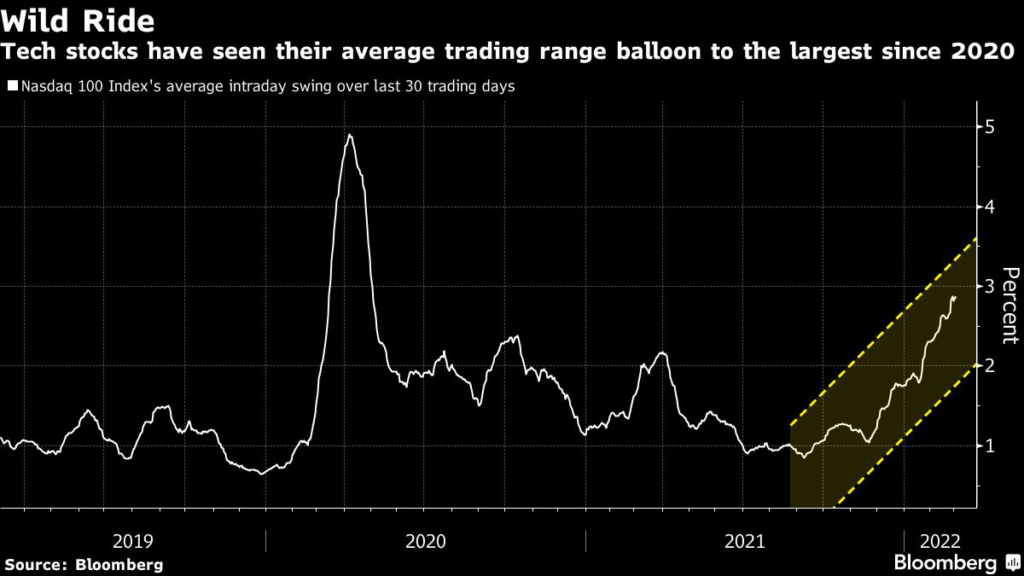
One of the most volatile segments of the market has been tech stocks, whose valuations are highly sensitive to higher interest rates and which serve as a gauge of risk-taking sentiment. The Nasdaq 100 Index’s average intraday swing over the last 30 days has climbed to nearly 3%, its highest since May 2020, early in the pandemic. 

On Feb. 24, the index moved by more than twice that much — with a 7% swing that day — as news of Russia’s invasion was met by a wall of dip buyers. On Wednesday, stocks rebounded, with the S&P 500 erasing this week’s drop, after Powell assured Congress that the economy is strong enough to withstand the pullback of pandemic-era stimulus.  

Volatility Rises

Even so, stocks are still down deeply this year as the war exaggerates already existing pressures. That briefly pushed the S&P 500 Index into correction territory — or a drop of at least 10% from the peak — for the first time since the coronavirus pandemic rocked markets in early 2020. The benchmark has since pared some of the drop and is down about 8% from the record high on Jan. 3. But that’s still the worst start to a year since 2009.  

Winners and Losers

Crude oil’s surge to over $110 a barrel has added to an already strong run for energy companies. The sector remains the only group in the S&P 500 to trade higher this year amid strength for both oil and renewable energy firms. Bank stocks have slumped with interest rates poised to move higher. 

Revenue at Risk

The impact of sanctions may also hurt some well-known American companies such as Philip Morris International Inc. and Carnival Corp. Philip Morris, the cigarette maker, gets 8% of its revenue from Russia and Ukraine, according to data compiled by JPMorgan Chase & Co., while cruise line operator Carnival gets 3.6% of its sales from the two countries. 

The two are among those that have fallen since Russia’s invasion, with food companies like Mondelez International and PepsiCo Inc. also underperforming. 

More stories like this are available on bloomberg.com

©2022 Bloomberg L.P.

Ukraine Stance by U.S. Tech Firm Epam Sparks Internal Dissension

(Bloomberg) — Tension over the conflict in Ukraine — and the role U.S. companies should play in opposing Russia’s invasion — is playing out within Epam Systems Inc., a Pennsylvania-based company with a large work force in Ukraine. 

Dozens of current and former Epam employees sharply criticized a LinkedIn post from the company’s chief executive officer, Arkadiy Dobkin, that vowed support for Ukraine but didn’t mention or condemn Russia’s actions. Dobkin was lambasted on LinkedIn, Facebook and Twitter.

The strife is particularly pronounced at Epam, which employs more than 58,000 people, with 14,000 of them in Ukraine and more than 18,000 staff in Belarus and Russia, according to company filings with the U.S. Securities and Exchange Commission. The internal dissension had added to pressures on management already beset by business problems. On Monday, Epam plunged 46% after the company withdrew its first quarter and 2022 guidance,tow citing “heightened uncertainties” from Russia’s invasion of Ukraine.

And it came as other companies in the U.S. and in Europe took steps to curb business ties with Russia, including BP Plc, Apple Inc. and Boeing Co. 

Among the critics was a contractor for Epam who said he was blocked from accessing company computer systems after calling on top executives to assist Ukraine’s effort to counter Russia’s invasion. Some Epam employees, along with other Ukrainians and tech workers for other companies, urged Epam to take a tougher stance against Russia, such as helping to fund Ukraine’s military.

Maksym Chernikov, a Ukrainian native, said he urged the company’s leadership in an email to condemn Russia’s attack on Ukraine. He said he also encouraged Epam officials to provide resources to support a makeshift Ukrainian “cyber army” that has used cyberattacks to target Russian companies and government agencies. Chernikov said he works as a contract senior software engineer at Epam.

“Now it is extremely important that the company’s management show resoluteness in this initiative,” he wrote in the message, which was reviewed by Bloomberg News. “There is a war going on in Ukraine. And although hostilities are currently taking place on the territory of one country, this war will affect the whole world, everyone, if it is not stopped here and now.”

Within 20 minutes of sending the email, Chernikov said his access to the company’s internal systems was cut off. He said he doesn’t know if he still has a job at the company.

“I was blocked from all Epam internal communication tools — Microsoft Teams, Microsoft Outlook,” he said. 

An Epam representative didn’t respond to requests for comment. Dobkin didn’t respond to a request for comment. He was born in Belarus, obtained a degree from Belarusian National Technical University and started his first private software company in Minsk, according to the company’s website and an article in the Philadelphia Inquirer.

Epam, which specializes in digital product design, has more than 58,000 employees in more than 40 countries, including Ukraine, Belarus and Russia, according to a recent filing with the U.S. Securities and Exchange Commission and the company’s website. “More than half our global delivery, administrative and support personnel are located in Ukraine, Belarus and Russia,” the company said in its latest annual report. 

Dobkin, the CEO, wrote in a post on LinkedIn on Sunday that the company was “doing absolutely everything we can to save, help and support logistically and financially Ukrainian Epamers and their families.”

“Today we stand United in support of the people of Ukraine and against all forms of aggression against them,” he added. “The war must be stopped NOW.” 

But his post was met with a fierce response, with more than 350 comments from employees and others on LinkedIn, many of whom weren’t satisfied with Dobkin’s remarks and criticized him for failing to mention Russia or its president, Vladimir Putin, by name.

Valeriia Nesterova, a systems engineer at Epam in Ukraine, said in a message to Bloomberg that the tensions among employees in Epam started before the invasion. In town hall meetings with employees in Ukraine, Epam managers said they didn’t believe there would be a war and said as a public company it couldn’t openly support Ukraine’s army. Nesterova said she and others were angry because other companies were offering support to Ukraine at the time.

She said that frustration has grown since Dobkin’s LinkedIn post. “There weren’t any encouragements to join Army, or volunteer IN these hard times,” she said. “Instead, they said “If you can work, work. If you can’t, take sick leave.”

Nesterova said the conflict has created tension her Russian colleagues. “I cannot say for everyone, but on my project where I worked, Russians didn’t write a single word of support,” she said.

Yuliya Prach wrote on Facebook that she has worked for Epam for seven years, but “right now I am beyond disappointed, I am furious with the company.”

“You have so much money, influence, power to help us out, but you prefer to just write some empty politically correct words and think that you did everything you could,” wrote Prach, who says she is a software engineer at Epam. “The truth is — you did nothing.” 

Aleksandr Shcherbanyuk, who says he works as a developer for Epam in Ukraine, said he read Dobkin’s post huddled in his basement with his wife and two children, preparing for Russian bombs.

“Tomorrow is a working day at Epam, and I don’t know if I’ll live to see it,” he added. “I  understand that our company is multinational and we need to be politically correct and restrained, but I beg you to help!”


(Updates with additional details throughout)

More stories like this are available on bloomberg.com

©2022 Bloomberg L.P.
Bitcoin Rally Cools as Specter of Crypto Sanctions Raised

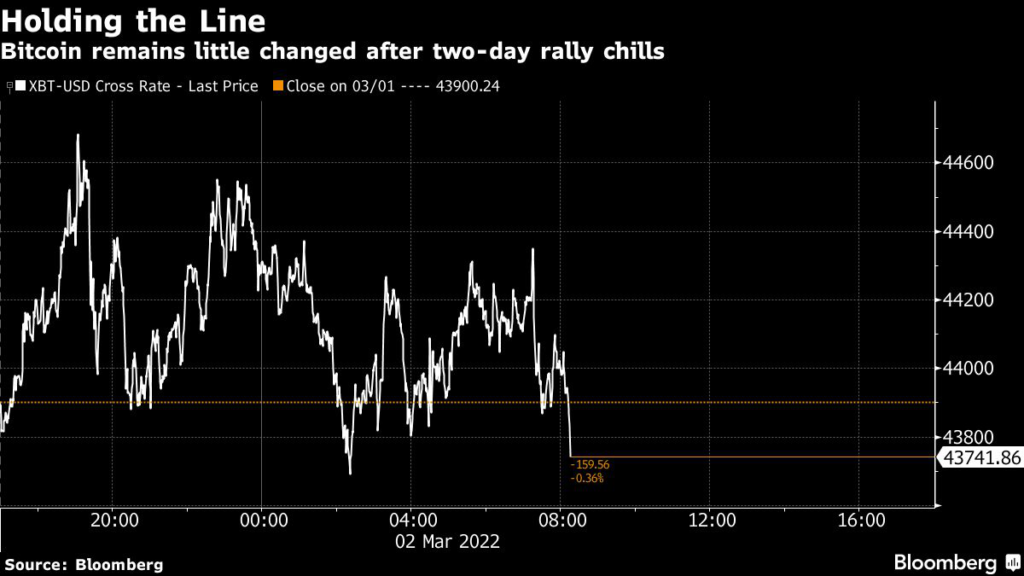
(Bloomberg) — Bitcoin was little changed after rallying more than 16% over the past two days as the possibility of expanding sanctions was raised to prevent Russians from using cryptocurrencies to circumvent restrictions.

The largest digital asset fluctuated between gains and losses and traded at around $43,870 as of 1:02 p.m. in New York. Ether was also little changed, while many altcoins also swung between gains and losses. 

After plunging at the onset of the Russian attack on Ukraine, cryptocurrencies had reasserted themselves as a refuge in recent days. That also increased the focus on them as a potential vehicle for getting around sanctions. Members of the European Union and the Group of Seven are working to block Russians from using digital assets to evade monetary sanctions, German Finance Minister Christian Lindner said during a televised interview Wednesday. 

David Mercer, chief executive officer of London-based LMAX Group, said the crypto market simply is not big enough for all the attention it has received from regulators who question crypto’s role in helping Russians evade sanctions. “I don’t know why Bitcoin or crypto is being singled out,” Mercer said.

Despite calls from politicians, Binance– the biggest crypto exchange in the world– won’t ban Russian users from using its platform, although it will freeze the accounts of those included on international sanction lists, Changpeng Zhao, founder and chief executive officer of Binance, told Bloomberg earlier.  

Noelle Acheson, head of markets insights at Genesis Global Trading Inc., said the kind of large cryptocurrency transactions sanction evaders would be expected to use are relatively easy to track, noting that on-ramps or off-ramps can be held accountable.  

The outperformance by cryptocurrencies compared with stocks and broader market measures had some analysts pointing to a break from the narrative that crypto is just a risk-on asset.

“Certainly, there’s been some buying interest in Bitcoin, but I don’t think it’s significant enough to be moving from S&P to Bitcoin just because of this invasion,”said Mercer. “Bitcoin is still a very small market, so it doesn’t take a lot of buying to support the price.” 

Bitcoin volume growth is often correlated with political instability, according to James Butterfill, head of research at CoinShares. Trading volume in Bitcoin using the ruble have surged to the highest level since May, suggesting Russians are potentially moving their money into crypto as the Russian currency plunges to a record low. 

“Bitcoin will perform well in times of extreme duress,” said Teong Hng, chief executive of Hong Kong-based digital asset trading firm Satori Research. “Bitcoin should continue to trade well and find buyers on dips as it’s ‘anti-fragile’ nature has assert itself.”

More stories like this are available on bloomberg.com

©2022 Bloomberg L.P.

Close Bitnami banner
Bitnami