
Bloomberg

Ford’s CEO Farley Takes a Long Journey to Rebuilding Old Automaker

(Bloomberg) — Ford Motor Co. Chief Executive Officer Jim Farley faced intense investor pressure to spin off his company’s electric-vehicle business to unlock the rich values awarded to pure-play EV outfits like Tesla Inc. Instead, he decided to squeeze more out of Ford’s 118-year-old combustion engine business.

The historic reorganization Farley announced Wednesday cleaves his company’s carmaking in two, creating a “Model e” unit to scale up EV offerings and “Ford Blue” to focus on traditional internal combustion engine vehicles.

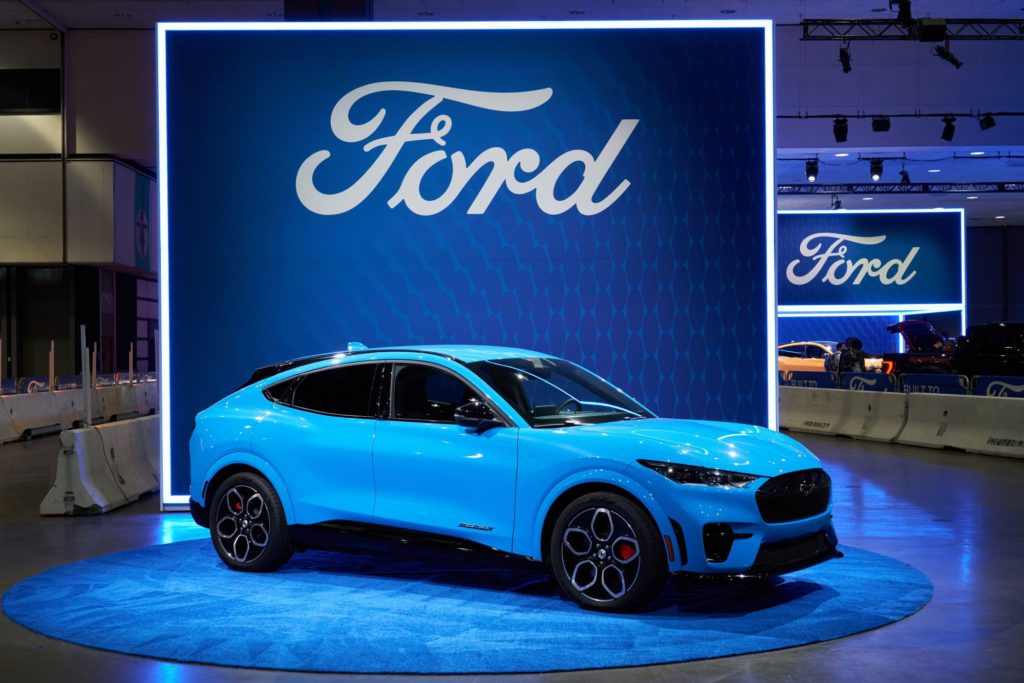
The radical restructuring relies on gas burners to fund Ford’s EV ambitions, which are vast. The automaker now says it will build 2 million EVs a year by 2026, a giant leap from the 27,140 battery-powered Mustang Mach-Es it sold last year. And it raised its margin goal for earnings before interest and taxes to 10%, from a previous target of 8%.

To get there, Ford is planning to boost profit from its traditional business — selling fossil-fuel-powered F-150 pickups and Bronco SUVs — by slashing costs in its legacy operations, which could include layoffs, Farley said. Rather than seek greater access to capital markets through the clean break a spinoff could bring, Farley said Ford will transform its traditional internal combustion business into “a profit and cash engine for the entire enterprise.”

“The most important thing is our core ICE automotive business,” Farley said in an interview with Bloomberg TV. “It needs to be a lot more profitable. We think we’re going to have to take about $3 billion out of our structural cost to make that business fully competitive.”

Farley, 59, has taken a long journey in his short 17 months as Ford’s CEO to reach this point. His moves to accelerate Ford’s plug-in plans reversed a six-year slump in the stock, which is up more than 170% since he took over — including an 8.4% gain Wednesday. The performance has given him personal cachet to try new things, such as radically reshaping the company Henry Ford founded in 1903.

Farley’s family has been part of that story. He joined Ford in 2007 after a successful career at Toyota, where he rose to run the Lexus luxury division, but going to Ford was in some ways a homecoming. Farley’s grandfather, Emmet Tracy, was employee No. 389 when he hired into Ford’s Model T factory in 1914.

Pushing EVs

Farley raised the automaker’s wager on EVs months after taking over as CEO. Bloomberg News first reported last month that the company was contemplating a further increase in expenditures toward EVs, and that Farley had wanted to wall off electric operations from the internal-combustion engine business.

To push the boundaries of what had been considered possible at the old company, Farley in September poached Doug Field from running Apple Inc.’s secretive car project. Prior to Apple, Field had been Tesla’s chief engineer and the man behind its top-selling Model 3 sedan. Farley put him to work reshaping the company.

Together they exhaustively examined ways to spin off either the EV business, the internal combustion business or both to find a way to get Ford — or some of its separated parts — to be viewed in the same league as Tesla, the world’s most valuable automaker.

“We certainly looked at a spinoff,” Farley said at a news conference. “But No. 1, we have enough capital. We can fund this ourselves.”

Farley said he didn’t want to separate his nascent EV business from the industrial expertise of Ford’s century-old combustion engine business, which can efficiently spit out millions of models a year.

“The new startups would love to have the industrial knowhow of this company — why would we spin out Model e and risk that?” Farley said. “We looked at it carefully and this leverage is really the key point.”

Another challenge Farley would have faced in the spinoff scenario would be winning over the founding Ford family, which continues to control the company through a special class of stock. The family, which holds three seats on the board led by Executive Chair Bill Ford, is loath to lose influence of a company they’ve held sway over for five generations.

Separate P&Ls

Keeping the changes internal assuages those concerns, but it also creates a complex corporate construction where one quasi-independent unit — Ford Blue — funds another quasi-independent unit — Model e. Each operation will have its own profit and loss statement starting next year. Farley contends that each semi-independent unit will flourish with more time to home in on the particular task at hand.

“We can’t compete with the very best of the ICE or the BEV world by working on battery-electrics from 9 to 10 in the morning,” Farley said in the interview. “We have to be focused.”

Farley also is boosting Ford’s bet again on EVs, adding another $20 billion to take the total tab up to $50 billion by 2026, as Bloomberg previously reported. And that cash will come from the legacy business, where the F-Series pickup alone generates $42 billion a year in revenue, making it larger by that measure than McDonald’s Corp., Coca-Cola Co. or Starbucks Corp.

“We just raised our volume essentially by a million units” to 2 million EVs a year, Farley said. “With that comes lots of capital” for battery plants, new vehicles and platforms, tooling, and raw material for batteries, he said. And those demands meant that Ford needed to keep its “profit engine” traditional business yoked to the upstart EV operations.

Market Reaction

And so far investors like what they see, driving shares up Wednesday by the most since Jan. 4.

“We are positive on the change as we do believe it better aligns internal Ford stakeholders to drive towards being more competitive,” Joe Spak, an analyst with RBC Capital Markets. “We wouldn’t be surprised to see other OEMs follow a similar template.”

Ford’s split represents a “better allocation of dollar and human capital,” BofA Securities analyst John Murphy wrote in a note to clients. The move will also allow Ford to attract more EV talent and gain access to a lower cost of capital including through green bonds, said Murphy, who has a buy rating on the stock.

What Bloomberg Intelligence Says

“We assume that a potential separation wouldn’t happen until after 2026, making longer-dated issues at Ford Motor the most exposed. But Ford could consider a variety of mechanisms, including another debt tender or raising debt at the new company, as a tool eliminate longer-term debt.”

— Joel Levington, BI credit analyst

Under the new structure, Farley will also assume the role of president of Ford Model e, while Field will be the unit’s chief EV and digital systems officer. Kumar Galhotra will serve as president of the Ford Blue business and Hau Thai-Tang will lead product development, supply chain and manufacturing engineering as chief industrial platform officer.

“Is this about winning? 100%,” Farley said on a call with journalists Wednesday. “We want to beat the old players. We want to beat the new players.”


More stories like this are available on bloomberg.com

©2022 Bloomberg L.P.
SEC Scrutinizes NFT Market Over Illegal Crypto Token Offerings

(Bloomberg) — The U.S. Securities and Exchange Commission is scrutinizing creators of NFTs and the crypto exchanges where they trade to determine if some of the assets run afoul of the agency’s rules, according to people familiar with the matter.

A focus of the probe is on whether certain nonfungible tokens, digital assets that can be used to denote ownership of things like a painting or sports memorabilia, are being utilized to raise money like traditional securities, said the people. Over the past several months, attorneys in the SEC’s enforcement unit have sent subpoenas demanding information about the token offerings.

The inquiry is the latest attempt by the SEC under Chair Gary Gensler to ensure the crypto market adheres to its regulations. In February, the commission and state regulators levied a record $100 million fine against BlockFi, a popular virtual-currency exchange, for failing to register products that pay customers high interest rates to lend out their digital tokens.

As part of its review, the SEC is seeking information on so-called fractional NFTs, which involve breaking down the assets into units that can be easily bought and sold, said the people, who asked not to be named as the probe hasn’t been disclosed publicly. 

The SEC declined to comment. Information requests from the regulator don’t always lead to enforcement actions.  

The NFT market exploded last year, drawing attention for multi-million dollar sales and buy-in from celebrities, whom some of the assets depict. In addition to serving as representations of physical collectibles, backers of the tokens often tout their value as digital certificates of authenticity that can’t be replicated. 

About $44 billion worth of crypto was sent to smart contracts on the Ethereum blockchain tied to NFTs during 2021, up from $106 million the year before, according to data from Chainalysis. As the market has boomed, some NFT marketplaces have taken steps to remove projects that might put them in regulators’ crosshairs, such as those that offer royalties or that involve raising funds for a business.

A key legal question is whether digital assets including NFTs are securities, and therefore subject to the same rules as stocks. While the SEC has said that many tokens fall under its purview, some crypto enthusiasts argue regulations meant to police the equity markets shouldn’t also apply to virtual currencies.

The SEC applies the so-called Howey test, which comes from a 1946 U.S. Supreme Court decision, to decide if something is a security. Under that framework, an asset generally falls under the agency’s remit when it involves investors kicking in money to fund a company with the intention of profiting from the efforts of the organization’s leadership. 

As far as NFTs, even the SEC’s most crypto-friendly commissioner, Hester Peirce, has raised the specter that some could meet that standard. “Given the breadth of the NFT landscape, certain pieces of it might fall within our jurisdiction,” Peirce, a Republican, said in December on CoinDesk TV’s “First Mover.” “People need to be thinking about potential places where NFTs might run into the securities regulatory regime.”

More stories like this are available on bloomberg.com

©2022 Bloomberg L.P.
DOJ’s ‘KleptoCapture’ Unit Will Target Russian Oligarchs

(Bloomberg) — The Justice Department announced details of a new inter-agency task force designed to enforce sanctions and export restrictions and to seize luxury assets belonging to Russia’s wealthiest citizens as the U.S. and its allies step up pressure over the invasion of Ukraine. 

The “KleptoCapture” task force will gather experts in sanctions and export control enforcement, anti-corruption, asset forfeiture, anti-money laundering, tax enforcement, national security investigations, and foreign evidence collection, DOJ said in a statement on Wednesday. It will be led by a veteran corruption prosecutor from the U.S. Attorney’s Office for the Southern District of New York.

“What we’re doing with this task force is to send a very clear and unmistakable message to those who seek to use corruptly gathered money and who seek to evade sanctions: that we’re coming for you,” Deputy Attorney General Lisa Monaco said in an interview with Emily Chang on “Bloomberg Technology.” “We’re coming for your yacht. We’re coming for your jet. We’re coming for your ledger. That’s the key message.”

The group’s creation is the latest sign of how the U.S. and its allies are seeking to isolate Russia from the international financial system as President Vladimir Putin’s military presses forward in its war on Ukraine. President Joe Biden announced the task force during his State of the Union address on Tuesday. 

Amid international outrage over the war, pressure has been rising to seize the superyachts, jets, properties and other luxury assets of Russian oligarchs who are seen as lending support to Putin. 

“We will leave no stone unturned in our efforts to investigate, arrest, and prosecute those whose criminal acts enable the Russian government to continue this unjust war,” Attorney General Merrick Garland said. “Let me be clear: If you violate our laws, we will hold you accountable.”

Rich Russians Spend Big on Luxury to Stop Savings Melting Away

Along with prosecuting sanctions violations and efforts to undermine restrictions against Russian banks, the task force will target “efforts to use cryptocurrency to evade U.S. sanctions, launder proceeds of foreign corruption or evade U.S. responses to Russian military aggression,” according to the statement.

The way the task force is organized means it’s likely to benefit from increased support from U.S. intelligence agencies and cooperation from other countries that have pledged to counter Russia’s aggression, said Drew Hruska, a former Justice Department official and federal prosecutor.

“This appears to be a paradigm shift for law enforcement,” said Hruska, who’s now a partner at the law firm King & Spalding LLP.

Hidden Assets

Challenges for the task force, however, include finding hidden assets and some legal limitations that other countries have when it comes to sharing information, he said.

“People tend to know where large ships and large airplanes are,” Hruska said. “The more difficult question will be what the U.S. and its allies will do to identify and deal with previously unidentified assets.

A group of Democratic U.S. senators, including Elizabeth Warren and Mark Warner, called on the Treasury Department Wednesday to provide more information on steps it’s taking to enforce sanctions compliance by the cryptocurrency industry. 

“Strong enforcement of sanctions compliance in the cryptocurrency industry is critical given that digital assets, which allow entities to bypass the traditional financial system, may increasingly be used as a tool for sanctions evasion,” the senators wrote.

There were some early signs that the global sanctions crackdown was having an impact on Russia’s wealthiest, many of whom are seen as backing Putin’s rule. A growing number of superyachts belonging to Russian tycoons have made their way to the Indian Ocean, cruising around the Maldives and Seychelles.

In the U.K., Russian billionaire Roman Abramovich is selling his London properties, according to British MP Chris Bryant, and a Swiss billionaire said he’s been approached about buying Abramovich’s Chelsea Football Club. Ambramovich isn’t on the U.K.’s sanctions list but has been under increasing pressure from the nation’s politicians. 

The U.S. didn’t identify by name who will head the new task force, but it will include agents and analysts from other law enforcement agencies, including the FBI, U.S. Marshals Service, U.S. Secret Service, Department of Homeland Security and the Internal Revenue Service.

According to the department, the task force also will:

  • Investigate and prosecute violations of new and future sanctions, as well as those imposed for prior instances of Russian aggression and corruption.
  • Combat unlawful efforts to undermine restrictions taken against Russian financial institutions, including the prosecution of those who try to evade customer requirements and anti-money laundering measures.

(Updates with video of Lisa Monaco interview)

More stories like this are available on bloomberg.com

©2022 Bloomberg L.P.
No Corner of U.S. Stock Market Left Untouched by Ukraine War

(Bloomberg) — From tech companies to banks to cruise-ship operators, virtually no corner of the U.S. stock market has been left untouched by Russia’s invasion of Ukraine.

The reasons are numerous. Oil prices have surged, boosting energy companies while threatening to fuel inflation already at a four-decade high. The conflict is casting uncertainty over the outlook for global economic growth even as Federal Reserve Chair Jerome Powell says the bank is poised to start raising interest rates this month. And volatility has surged as money-managers rush in and out of havens and industries like utilities and communication-service providers that are seen as relatively insulated from the latest risks. 

“Anxiety is again rippling through global financial markets with the fear of stagflation taking hold, as the Ukraine conflict ratchets up inflationary pressures and threatens to derail global growth,” said Susannah Streeter, senior investment and markets analyst at Hargreaves Lansdown.

Wild Ride

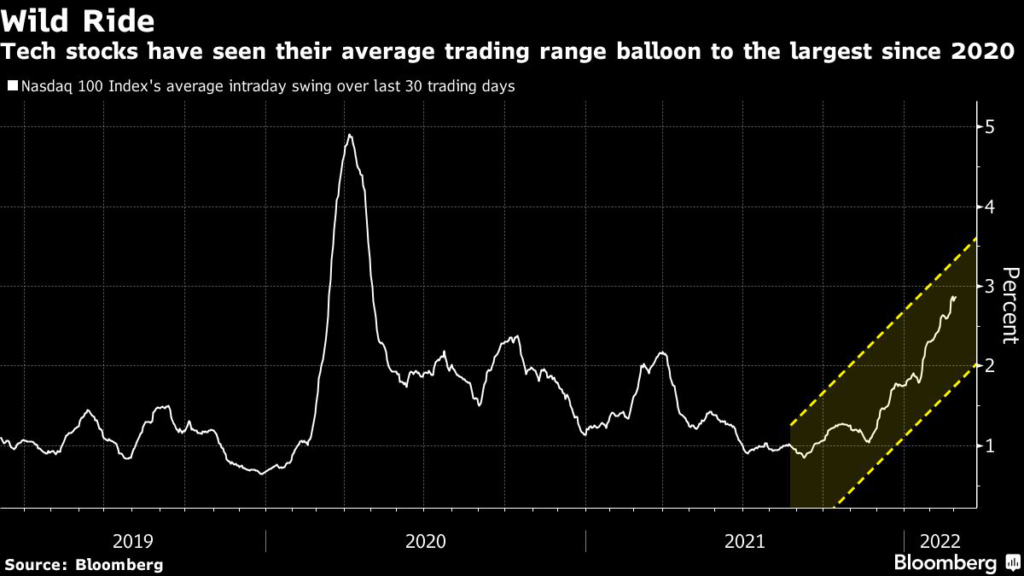
One of the most volatile segments of the market has been tech stocks, whose valuations are highly sensitive to higher interest rates and which serve as a gauge of risk-taking sentiment. The Nasdaq 100 Index’s average intraday swing over the last 30 days has climbed to nearly 3%, its highest since May 2020, early in the pandemic. 

On Feb. 24, the index moved by more than twice that much — with a 7% swing that day — as news of Russia’s invasion was met by a wall of dip buyers. On Wednesday, stocks rebounded, with the S&P 500 erasing this week’s drop, after Powell assured Congress that the economy is strong enough to withstand the pullback of pandemic-era stimulus.

Volatility Rises

Even so, stocks are still down deeply this year as the war exaggerates already existing pressures. That briefly pushed the S&P 500 Index into correction territory — or a drop of at least 10% from the peak — for the first time since the coronavirus pandemic rocked markets in early 2020. The benchmark has since pared some of the drop and is down about 8.6% from the record high on Jan. 3. But that’s still the worst start to a year since 2009.

Winners and Losers

Crude’s surge to more than $110 a barrel has added to an already strong run for energy companies. The sector remains the only group in the S&P 500 to trade higher this year amid strength in both oil and renewable energy firms. Bank stocks have slumped with interest rates poised to move higher.

Revenue at Risk

The impact of sanctions may also hurt some well-known American companies such as Philip Morris International Inc. and Carnival Corp. Philip Morris, the cigarette maker, gets 8% of its revenue from Russia and Ukraine, according to data compiled by JPMorgan Chase & Co., while cruise line operator Carnival gets 3.6% of its sales from the two countries. 

The two are among those that have fallen since Russia’s invasion, with food companies like Mondelez International and PepsiCo Inc. also underperforming. 

(Updates pricing throughout.)

More stories like this are available on bloomberg.com

©2022 Bloomberg L.P.
Yellen Pushes for Repackaged Biden Plan to Boost Economy

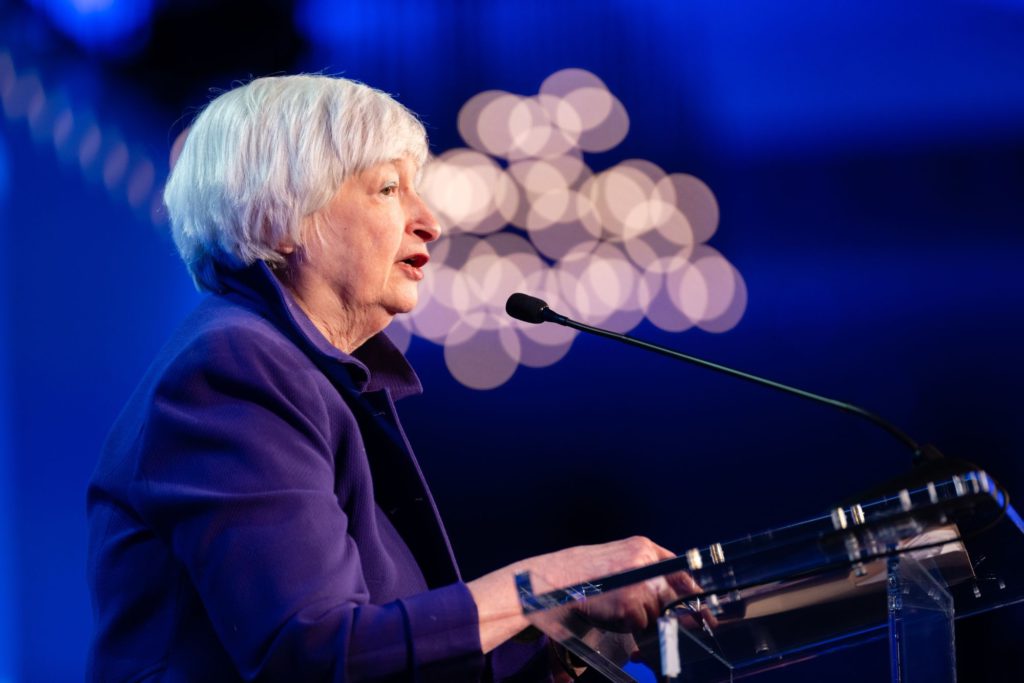
(Bloomberg) — U.S. Treasury Secretary Janet Yellen said Congress can boost long-term growth in the economy if it finds a way to pass the remainder of the Biden administration’s economic policy proposals.

“It’s an economic policy that aims to expand our nation’s economic potential through productivity-enhancing investments along with policies to encourage more people to join the labor market,” Yellen said in remarks Wednesday at an event in Chicago.

The comments echo some of President Joe Biden’s State of the Union address from Tuesday evening, in which he called on lawmakers to reconsider parts of the Build Back Better legislation that collapsed in December in the face of opposition from Republicans and key moderate Democrat Joe Manchin of West Virginia. 

No new legislation has yet emerged repackaging portions of the failed bill. Biden rebranded his economic agenda as “Building a Better America” during his address.

Asked after her remarks about the implications for the U.S. from the war in Ukraine, Yellen said, “There will be some impact on commodity prices, and there will be a lot of uncertainty as this evolves, but I don’t expect a major impact on the U.S. trajectory.”

Eyeing Crypto

With regard to further expansion of sanctions on Russia, she said, “Nothing is off the table. But in the process of doing this, we’ve tried to spare Americans and our European and other allies with punishing consequences.”

“We will continue to look at how the sanctions work and evaluate whether or not there are liquid leakages. And we’ll have the possibility to address them,” Yellen also said. Cryptocurrency “is a channel to be watched,” she added.

Yellen once again applied the label “modern supply-side economics” to define Biden’s long-run strategy.

“Modern supply-side economics makes targeted public investments in areas like education and infrastructure, directs resources to under-served communities and workers and introduces incentives for people to enter workforce,” she said.

The Treasury chief made the remarks at the University of Illinois Chicago Innovation Center, a teaching and research facility, and was joined by Illinois Governor J.B. Pritzker and Chicago Mayor Lori Lightfoot, both Democrats.

Yellen also highlighted several steps taken by the Biden administration and other countries to punish Russia for its invasion of Ukraine.

“Russia is increasingly on an economic island,” she said.

(Updates with comments on U.S. impact of Ukraine war and other responses to questions, starting in fifth paragraph.)

More stories like this are available on bloomberg.com

©2022 Bloomberg L.P.
TikTok Facing Probe by States Over How Platform Markets to Kids

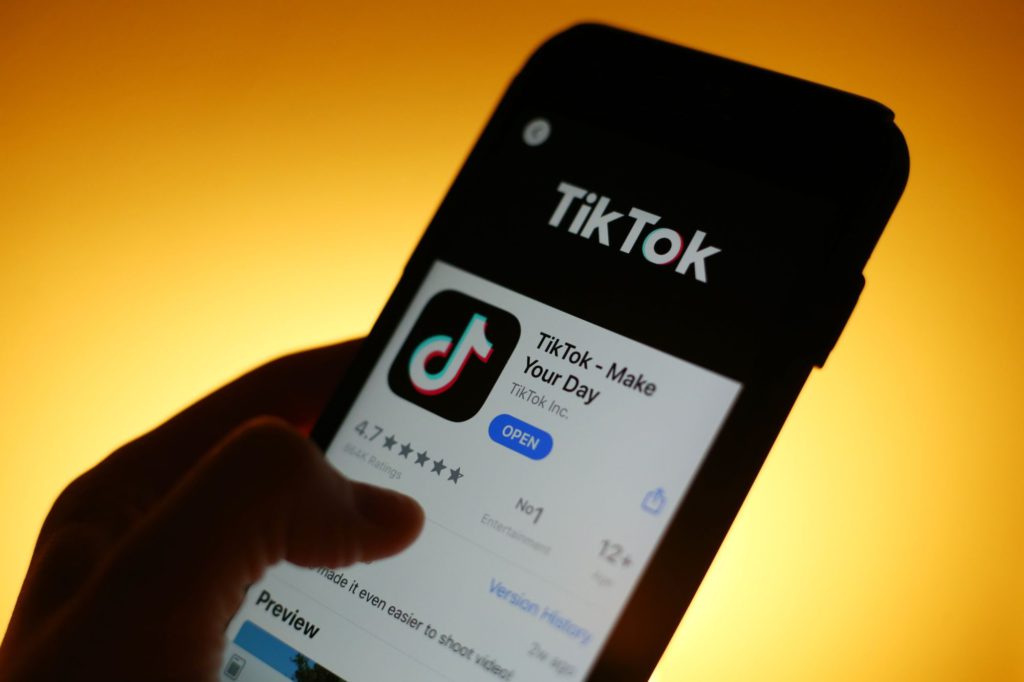
(Bloomberg) — ByteDance Ltd.’s TikTok is being targeted by a group of states seeking to determine whether the social media platform is being improperly marketed to children.

The states are investigating how TikTok promotes itself to younger users, including techniques to increase time spent on the platform and frequency of use, Massachusetts Attorney General Maura Healey said Wednesday. She is co-leading the probe with California, Florida, Kentucky, Massachusetts, Nebraska, New Jersey, Tennessee and Vermont.

“As children and teens already grapple with issues of anxiety, social pressure, and depression, we cannot allow social media to further harm their physical health and mental wellbeing,” Healey said in a statement. “State attorneys general have an imperative to protect young people and seek more information about how companies like TikTok are influencing their daily lives.”

TikTok issued a statement saying, “We care deeply about building an experience that helps to protect and support the well-being of our community, and appreciate that the state attorneys general are focusing on the safety of younger users. We look forward to providing information on the many safety and privacy protections we have for teens.” 

The probe was announced less than four months after a group of U.S. state attorneys general said they are investigating Meta Platforms Inc.’s Instagram photo-sharing app over its efforts to engage children and young adults. In May, 44 attorneys general urged Chief Executive Officer Mark Zuckerberg to drop the project. The company paused work on its Instagram Kids site in September after the Wall Street Journal reported that Facebook consistently played down its own research that the app can harm the mental well-being of its youngest users.

Texas Attorney General Ken Paxton said last month that he is probing TikTok for “potential facilitation of human trafficking and child privacy violations” as well as other possibly unlawful conduct.

More stories like this are available on bloomberg.com

©2022 Bloomberg L.P.
China’s Xi Engulfed in Crises Just When He Wanted Stability Most

(Bloomberg) — Chinese President Xi Jinping has spent much of the past decade focused on stability. But as he lays the ground for a likely third term as leader, he’s facing more crises than ever, both at home and abroad.

The economy is being dragged down to its weakest growth in more than three decades, barring 2020’s pandemic year. The housing market is in crisis, with mounting defaults. A crackdown on the country’s biggest technology companies has scared off investors. And now Russia’s invasion of Ukraine is forcing China to reassess its support for Vladimir Putin, while managing increasingly fraught ties with the U.S.

Those threats are overshadowing Xi’s successes, like keeping the pandemic largely under control after the initial outbreak in Wuhan and declaring an end to absolute poverty. For a Communist Party highly sensitive to signs of social unrest linked to any economic downturn, the Chinese leader will be pushed to do more to stabilize growth as he makes a bid to stay in power. 

China Leadership Gathers as Economic Challenges Mount: Q&A

Those policy signs may come during the National People’s Congress, when around 3,000 delegates meet in Beijing from Saturday for China’s annual legislative meetings. It’s the biggest political event before a twice-a-decade party leadership reshuffle slated for the second half of the year.

“Xi will do all that it takes this year to prevent economic or financial crises from derailing his preparations to secure a norm-defying third term as Chinese leader at the 20th Party Congress,” said Neil Thomas, a Chinese politics and foreign policy analyst at Eurasia Group. “But there’s always a tail risk that an external shock could put events beyond Beijing’s control, which is why China has urged a quick and peaceful conclusion to the Ukraine crisis.”

Here’s a look at some of Xi’s biggest challenges:

Housing Slump

The downturn in the crucial property market has been deeper and more enduring than many had expected, causing developers to default, housing prices to slump and home buyers to hold back on purchases. 

Housing sales fell in the second half of last year and that decline continued through February, turning the economically vital construction industry into a drag on growth and hurting developers and suppliers of steel, cement, paint and everything else needed to build apartments. It’s also put local governments under strain, since sales of land to developers are a major source of income for regional authorities. 

In an effort to turn the situation around, banks are now being pushed to lower interest rates and cut down payments for home buyers to boost sales. At the same time though, officials are sticking to their mantra that “houses are for living in, not for speculation,” suggesting the government doesn’t want to see another surge in home prices. 

Economic Slowdown

The housing crisis has contributed to weaker growth, forcing the central bank to change direction by restarting monetary easing. The People’s Bank of China has cut interest rates and promised to open its toolbox wider, the government has pledged tax cuts, and the Politburo has signaled more support is coming. 

The dilemma for policy makers is how to boost stimulus without using their old play book of wasteful spending and ratcheting up debt.  

Xi’s desire to make sure he gets to the Party Congress without any “major disruption” could push him to pursue the short-term goals of quickly boosting growth and employment, said Trey McArver, co-founder of research firm Trivium China. “He’s going to be willing to err on the side of perhaps making sure that there’s not large economic dislocations or problems in the run up to the Congress, at the expense of maybe having to clean those up in the years to come.”

Xi’s Biggest Wins and Losses After Nearly a Decade in Power

How much the government is focusing on short-term goals will become clearer on Saturday, when Premier Li Keqiang delivers what will be his ninth and likely final report outlining the government’s plans for the year. That report usually includes a target for overall GDP growth, as well as industrial policies and spending and tax plans. 

Economists said in December the growth target this year would be at least 5%, but with the slowdown since then and promises of stimulus, the leadership may set a more ambitious goal.

Ukraine Crisis

Russia’s invasion of Ukraine has thrown another wild card into China’s efforts to maintain stability, with commodities and oil prices surging. On the diplomatic front, Xi faces international pressure to support sanctions against Russia, a key strategic partner. China’s decision not to sign onto the sanctions puts the focus on Beijing and any financial assistance it could provide Russia.

Considering that more than a third of China’s $3.2 trillion in reserves are in U.S. treasuries, the almost unprecedented decision to freeze Russia’s access to much of its reserves only underlines how vulnerable China would be if faced with a similar situation. The fallout from the Russia-Ukraine war for China could end up being an accelerated effort to decouple financially from the U.S., which would be destabilizing to capital markets and foreign investment.  

Inflation 

Inflation is another concern for the government, and one that could quickly get worse due to the war in Europe. While consumer-price growth slowed in January and is well below target, the sudden jump in energy prices due to the Russian invasion will likely boost the cost of oil and natural gas imports, especially if there are also disruptions from sanctions to the $5 billion in energy China buys from Russia each month.

“The specter of inflation keeps policy makers in Beijing up at night,” Trivium’s McArver said, noting that Chinese people have historically been very sensitive to the issue of inflation, including before the 1989 Tiananmen Square protests.  

Covid Zero

Sporadic outbreaks have been quashed by strict virus control measures, which have curbed both travel and already-weak consumer spending.

China’s policy of extended quarantines at the border means it is increasingly isolated from the rest of the world, and the success against the virus has come at great cost to government budgets. Local authorities often have to pay the cost of repeated rounds of mass testing or isolation, as well as providing support during quarantines and lockdowns such as in Xian recently.

Why China Is Sticking With Its Covid Zero Strategy: QuickTake  

With the large outbreak in Hong Kong providing an example of what happens if the virus gets out of control, there is likely to be no let up in the ongoing Covid Zero approach this year, meaning the costs will continue to build for the government and economy.  

“The party faces potential crises relating to the Covid-19 pandemic,” said Jane Duckett, director of the Scottish Centre for China Research at the University of Glasgow. “Should the omicron, or another variant, spread across China, we might see the same outcome as in Hong Kong including rising deaths and pressure on hospitals.”

Falling Births

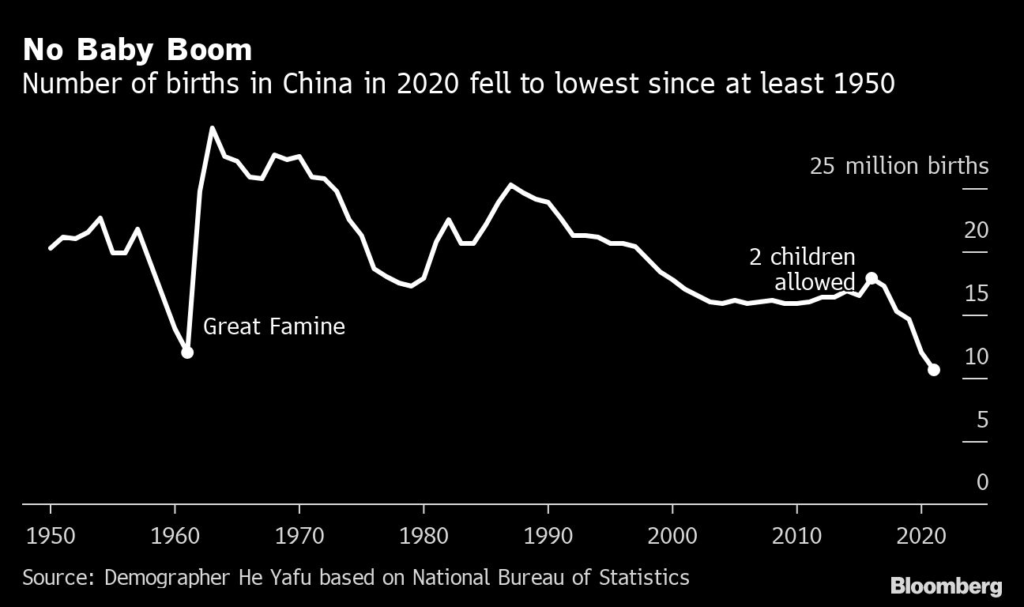
China’s population crisis is not a short-term problem, but the gradual relaxation of the one-child policy and recent policies to encourage women to have more children haven’t been enough to stop the precipitous drop in births. If that continues, it means the population will start shrinking even earlier than expected.

Despite the drop in births and the even faster fall in the number of people of working age, the government has so far been unable or unwilling to raise the national retirement age, an unpopular policy idea that it’s been talking about for years. China will also need to increase the amount of money it sets aside for pensions and healthcare for the rapidly growing population of elderly people.

More stories like this are available on bloomberg.com

©2022 Bloomberg L.P.
Biden’s State of the Union Address Draws 32 Million Viewers

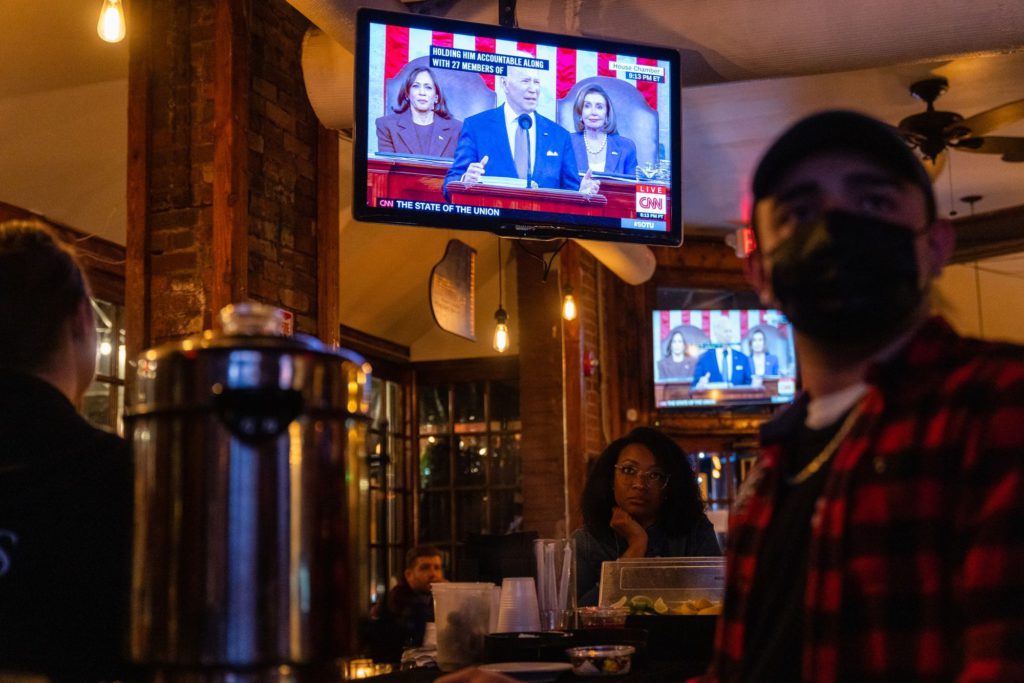
(Bloomberg) — President Joe Biden’s state of the union address drew a total of 32.3 million viewers on the major broadcast and cable news networks Tuesday night.

Fox News led with an audience of 6.9 million, according to preliminary Nielsen numbers released by that network. ABC came in second with 5.9 million viewers. CNN and MSNBC had 4.5 million and and just under 4 million watching, respectively.

While bigger than last year’s 26.9 million viewers, the audience was down from previous highs, including the nearly 70 million who watched Bill Clinton’s address in 1993, according to Statista.com. Regularly-scheduled TV has struggled to compete with on-demand viewing on services such as Netflix in recent years.

More stories like this are available on bloomberg.com

©2022 Bloomberg L.P.
Electronic Arts Removes Russian Teams From FIFA, NHL Games

(Bloomberg) — Electronic Arts Inc. will remove Russian teams from several of its video game sports franchises in response to the country’s invasion of Ukraine.

The game publisher said it will expunge all of Russia’s teams from its NHL 22 hockey game and three of its FIFA football games. EA’s actions follow the banning of actual Russian sports teams from international competitions, product boycotts by U.S. companies from Apple Inc., Nike Inc. and others, and the removal of Russian news and entertainment from social media platforms.  

“EA Sports stands in solidarity with the Ukrainian people and like so many voices across the world of football, calls for peace and an end to the invasion of Ukraine,” the Redwood City, California-based company tweeted Wednesday. 

EA’s actions came as Ukrainian Deputy Prime Minister Mykhailo Fedorov addressed Microsoft Corp. and Sony Group Corp. on Twitter, urging them to leave the Russian market. 

In a statement attached to the tweet, he asked that gaming and esports companies temporarily block all Russian and Belorussian accounts and halt any participation by those countries’ teams in international esports events. Fedorov also requested the cancellation of any such events held in Russia and Belarus.

“We are sure that such actions will motivate the citizens of Russia to proactively stop the disgraceful military aggression,” Fedorov wrote.

Neither Microsoft nor Sony responded to a request for comment.

Fedorov also appealed to Riot Games, Ubisoft Entertainment SA, Gameloft SE and Wargaming to “close your offices in Russia.” Paris-based Ubisoft, the developer of the Assassin’s Creed franchise and one of the biggest game publishers, last week said it was providing staff in Ukraine with funding and housing assistance.

Separately, esports tournament organizer ESL said it was banning organizations with ties to the Russian government from its upcoming season, set to start March 9. ESL identified two entities that will be banned, Virtus.pro and Gambit. The organizer said it recognizes that players are “not complicit with this situation” and it isn’t sanctioning individual players who may compete under a neutral name without representing their country. 

FIFA, football’s international governing body, announced Monday that it was suspending Russian teams from all competitions including the World Cup indefinitely. The National Hockey League also said Monday that it had halted its relationship with Russian business partners and paused their Russian language sites. The NHL will also no longer host competitions in Russia.

Other prominent tech companies have also pulled their services from the Russian market. In addition to Apple, Google Maps has temporarily disabled live traffic data in Ukraine to protect users. Twitter Inc. has paused ads in Russia and labeled links from Russian state media. Meta Platform Inc.’s Facebook has also taken steps to remove and limit disinformation about the invasion.

More stories like this are available on bloomberg.com

©2022 Bloomberg L.P.

Amazon Closing Bookstores and Shops to Focus on Grocery Sector

(Bloomberg) — Amazon.com Inc. is closing its physical bookstores, “Amazon 4-Star” locations and mall pop-up kiosks as the world’s largest online retailer narrows its brick-and-mortar push to the grocery sector.

The company plans to “focus more on our Amazon Fresh, Whole Foods Market, Amazon Go and Amazon Style stores and our Just Walk Out technology,” Amazon said Wednesday in an emailed statement. “We remain committed to building great, long-term physical retail experiences and technologies, and we’re working closely with our affected employees to help them find new roles within Amazon.”

Amazon began pushing into physical retail in 2015 when it opened a bookstore in Seattle and pledged to use technology to redefine the shopping experience. But the first location resembled a small-scale Barnes & Noble without coffee. Three years later, the company opened Amazon 4-Star stores to highlight products that were popular on the web store. The assortment resembled the random products sold for decades by retailers such as Brookstone, and 4-Star stores failed to stand out.

Amazon has 24 bookstores, 33 4-Stars and nine mall pop-up kiosks. The company planned to open another 16 4-Stars locations, indicating the decision to shutter the operation was abrupt.

The Seattle-based company made its biggest move into physical retail in 2017 with the $13 billion acquisition of Whole Foods Market, which has about 450 locations. Since then, the company has also launched its own Amazon Fresh supermarkets and now has 24 locations in California, Illinois and the mid-Atlantic region.

Amazon generated $4.69 billion in revenue from its physical stores, mostly from Whole Foods, in the quarter ending Dec. 31, or about 3% of sales.

Reuters reported the closures earlier.

(Updates with context, starting in the third paragraph.)

More stories like this are available on bloomberg.com

©2022 Bloomberg L.P.

Close Bitnami banner
Bitnami
