
Bloomberg

War Shocks Ripple Across One of World’s Busiest Trade Lanes

(Bloomberg) — Supply Lines is a daily newsletter that tracks Covid-19’s impact on trade. Sign up here.

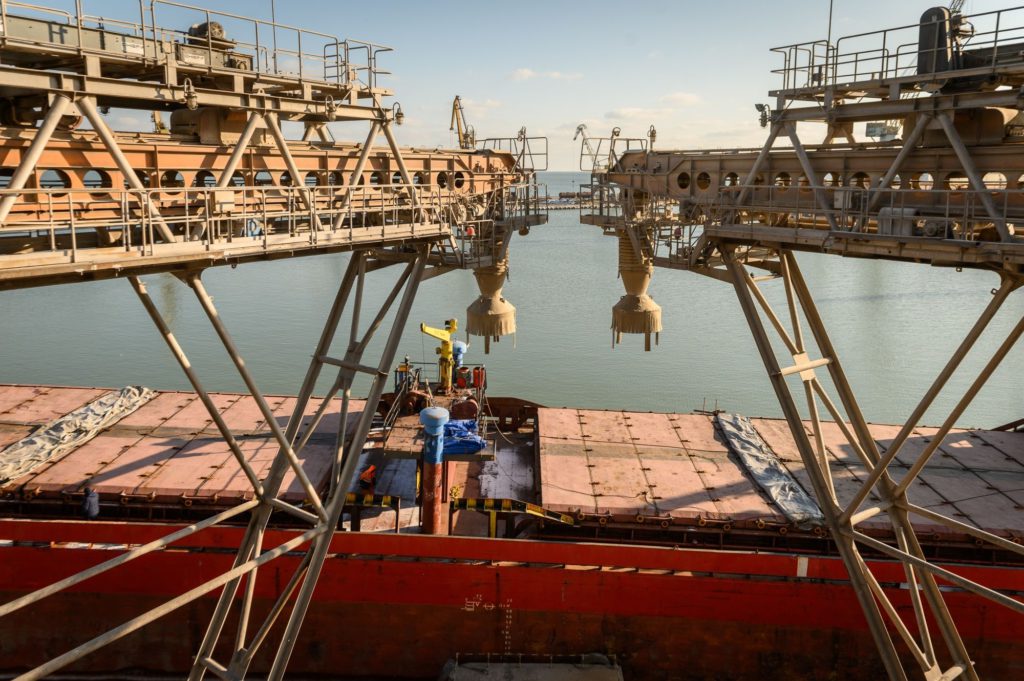
Importers from London to Warsaw will soon face higher shipping costs, longer delays and an obstacle course of sanctions to navigate as Russia’s widening assault on Ukraine complicates the movement of cargo between Europe and Asia.

President Vladimir Putin’s invasion, and retaliatory steps designed to paralyze the Russian economy, are heaping new disruptions on supply chains that never recovered from unprecedented shocks caused by the pandemic. Beyond the devastating human toll, the war threatens higher costs for fuel, grain, industrial metals, and other raw materials used in Asian-made consumer goods headed for Europe and beyond.

Mediterranean Shipping Co. and A.P. Moller-Maersk A/S, the world’s biggest container carriers, halted bookings for Russian freight, with Maersk on Wednesday warning customers, “this is a global impact, and not only limited to trade with Russia.” Not a good signal for European economies already facing energy spikes, product shortages, clogged ports and the highest inflation since the inception of the common currency more than two decades ago.

“There is still substantial disruption in the supply chain,” said Jennifer Hillman, a Georgetown University professor and a former U.S. trade official. “There is an effort to build resilience but that will take time. With Russia invading Ukraine, we don’t have time.”

Aside from their commodity exports, Russia and Ukraine aren’t big global traders. Russia is the world’s 16th-largest goods exporter, led by petroleum, coal and gas. Ukraine ranks 48th, led by shipments of grain and iron ore, according to 2020 data from the World Trade Organization.

But they are situated along one of the world’s oldest trade lanes, one that China has sought to use for its Belt-and-Road initiative and a route where much of the airspace is now restricted. Meanwhile, container ships can’t access Ukrainian ports and many are trying to avoid Russia’s.

Currently, there’s little if any spare ocean freight capacity to move globally traded goods to absorb even an isolated, regional shock, said Jan Hoffmann, the head of trade logistics at the United Nations Conference on Trade and Development.

“There is no slack in the system so anything that holds up ships anywhere will lead to less capacity,” Hoffmann said.

For cargo between Asia to Europe, that leaves Russia’s rail network — behind only the U.S. and China with its 54,000 miles (87,000 kilometers) of track — as another possible option.

Both Maersk and DB Schenker, the logistics unit of German national railway operator Deutsche Bahn, offer intermodal services — by sea from Asia, then on Russian rail lines to Europe — but even those are coming under new restrictions and sanctions concerns.

“Shying away from sanctions is a key risk,” said Peter Sand, a chief analyst at Oslo-based Xeneta, a freight market-analytics platform. “That means higher prices for bulk shipping, which will make it more expensive to trade and ship around the world.”

There’s anecdotal evidence of train disruptions already. Networking equipment maker Zyxel Communications Corp. has stopped shipping from China to Europe by rail as the conflict threatens to snarl a key land route.

Zyxel, a maker of routers and switches controlled by Taiwan’s Unizyx Holding Corp., suspended freight through the link operated by China Railway about three days ago, President Karsten Gewecke said.

In Asia, some international shipping companies are adjusting their schedules and the conflict means disruption to the delivery of goods is inevitable, according to Gary Lau, chairman of the Hong Kong Association of Freight Forwarding and Logistics.

“The longer the tension lasts, the greater the impact on the entire European logistics chain,” Lau said.

Manufacturing executives such as Ricky Chan, whose Hong Kong-based company makes automotive parts including door handles and mirror shells for global clients, said the crisis may add to transportation constraints that the company was already juggling before the crisis began.

“For our business in Europe, we may face a longer lead time for our logistics,” said Chan, chief executive officer of Jing Mei Automotive, whose manufacturing facilities are based in Guangdong and Hebei.

Even before the crisis began, Bloomberg Economics estimated logistics constraints for China’s manufacturers appeared to be the most severe on record. The United Nations estimates around 41% of global exports are sourced from Asia, making it the world economy’s factory floor.

“This is a moment when corporations will stop taking their supply chains for granted and consumers will begin to understand the costs and inconvenience to satisfying their demands,” said Chris Rogers, a supply chain economist with Flexport Inc. in London.

Transporeon, a logistics platform with offices in nine European capitals, said a protracted war would mean that flights between the Far East and Europe might be rerouted via the U.S., ramping up delays and costs. The pain will be especially acute for U.K. importers, which would suffer more than those in other European countries due to limited capacity at cargo hubs.

Still, the disruptions in air freight may be less than the diversions and congestion on the ground. Though the average flight time has increased compared with the previous two months by about 3%-4% on average, that only translates to about a 20-minute delay, according to Flexport data. On one route, the time rose 8% or about 45 minutes. 

“That’s more jet fuel, more carbon emissions and backups at either end at airports in Asia and Europe,” Rogers said. “The rough conclusion is that there’s an impact but it’s not transformative to how air freight is working.” 

(Adds Maersk comment in third paragraph)

More stories like this are available on bloomberg.com

©2022 Bloomberg L.P.
RT, Sputnik Content Officially Banned Across European Union

(Bloomberg) —

Russian-backed media RT and Sputnik are officially banned in the European Union as of today, as the bloc hardens its stance against Russia’s invasion of Ukraine. 

The restrictions prohibit broadcasting content from the two television channels and their subsidiaries, downloading their apps and sharing their output on social media platforms, according to documents published by the European Commission today. 

“In order to justify and support its aggression of Ukraine, the Russian Federation has engaged in continuous and concerted propaganda actions targeted at EU and neighboring civil society members, gravely distorting and manipulating facts,” the Commission wrote. 

State-controlled media “are essential and instrumental in bringing forward and supporting the aggression against Ukraine and for the destabilization of its neighboring countries,” according to the Commission. “It is necessary to urgently suspend the activities of such media outlets in the EU, until the aggression to Ukraine is put to an end.”

Tech Companies

YouTube, Facebook, Instagram and TikTok all blocked RT and Sputnik from sharing content on the platforms earlier this week. Twitter added warning labels to content from the Russian state media, while Snapchat stopped running ads on their content. Now, the tech companies will be responsible for stopping this content from spreading across their networks.

European Commission President Ursula von der Leyen said Sunday the measures, part of a broader package of sanctions, were needed to stop the state from spreading “their lies to justify Putin’s war and to sow division in our union.”

The rules have raised concerns that Russia will retaliate against European media. After Berlin banned RT’s German operation last month, Russia responded by revoking Deutsche Welle’s accreditation, prompting its Moscow bureau to shut.

The EU also faces criticism that the measures restrict freedom of information and expression. An EU official said the restrictions are justified given the context is a war being waged by a country outside the bloc.

“This is not a normal situation, and that’s what makes this case so entirely different from any other restriction on freedom of information,” the official said.

More stories like this are available on bloomberg.com

©2022 Bloomberg L.P.
Binance CEO Says Blocking All Russians From Crypto Exchange Is ‘Unethical’

(Bloomberg) —

Russians seeking ways around financial sanctions is not a “crypto-specific issue,” Binance Holdings Ltd.’s chief executive said, refuting calls to restrict all Russians from using the world’s largest cryptocurrency exchange. 

Changpeng ‘CZ’ Zhao said Binance has complied with international government mandates to restrict sanctioned individuals, but that to expand that further would be “unethical for us to do.” The crypto industry follows the “same rules” as banks, he said.

“Binance follows sanctions rules very strictly. Whoever is on the sanctions list, they won’t be able to use our platform, for whoever is not, they can,” Zhao told Bloomberg TV in an interview Wednesday. 

Crypto exchanges have come under intense scrutiny since Russia’s invasion of Ukraine for their potential as financial conduits for Russians seeking a place to park assets. But other large exchanges like Kraken and Coinbase have also refused to block Russians who aren’t targeted by sanctions.

Read more: U.S. Prods Exchanges to Thwart Crypto Use by Sanctioned Russians

The billionaire said he spends most of his time in Dubai and added that Binance has registered corporate headquarters, declining to reveal the location before an official announcement.

The crypto exchange industry is largely unregulated, though lawmakers in the U.S. and European Union are pushing to strengthen the guardrails as Russia steps up its assault on Ukraine. Zhao said Binance conducts full user verification checks to ensure sanctioned addresses cannot transact on its platform. 

“It’s not our decision to make to freeze user accounts. Facebook hasn’t banned Russian users. Google has not blocked off Russia. The U.S. hasn’t done that,” Zhao said. “Also, on an ethical point of view, many Russians don’t support the war, so we should separate the politicians from the normal people.”

Binance rapidly increased hiring in its compliance division after regulators globally issued multiple warnings to consumers about its activities last year. Markets authorities in the U.S. expanded investigations into Binance in September to include possible insider trading and market manipulation, while the U.K.’s Financial Conduct Authority deemed Binance “not suitable” for regulation given the decentralized structure of its business.

(Updates with additional context about Binance in final paragraph)

More stories like this are available on bloomberg.com

©2022 Bloomberg L.P.
Cascading Russia Risks Stir Market Correlations That Can’t Last

(Bloomberg) — Global markets are throwing up a jumble of unusual correlations as commodity flows and the world economic outlook are upended by the war in Ukraine and the ostracism of Russia. 

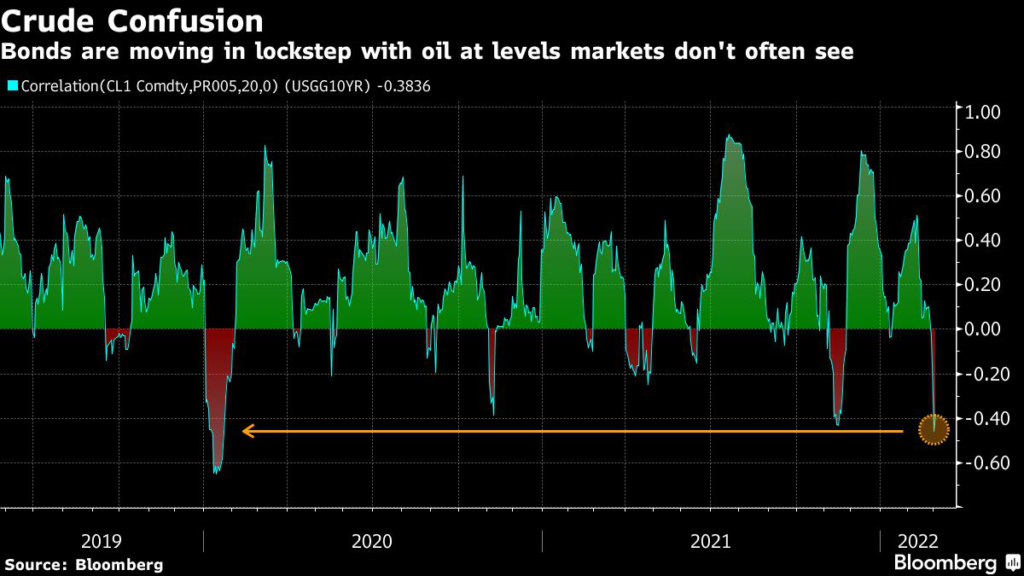
Examples include oil soaring alongside Treasuries and gold bursting higher with the dollar. The former was evident in the past 24 hours amid a jump in Brent crude to as high as $113 a barrel and a plunge in the U.S. 10-year yield to below 1.70%, compared with a level of 2% before Russia invaded its neighbor.

Quite how long such unexpected tandem moves can last is moot. Winning trades lie ahead for those who figure out when and how they will unravel.

The “big one” for analyst Kyle Rodda at IG Markets Ltd. is the Gordian knot of bonds and commodities: a stampede for havens is crushing yields but a commodity surge on fears of conflict-related supply disruptions threatens to stoke already historic levels of inflation.

“Eventually something has got to give,” Rodda said. “I reckon its bonds when markets have to price in higher inflation. For the time being, this is a sign of a discombobulated market trying to discount the almost unpredictable.”

The charts below capture some changing short-term, 20-day cross-asset correlation coefficients, with 1 being the highest possible reading.

Bonds, Oil

Soaring oil has stoked worries about global growth and driven haven flows to Treasuries. But if costlier energy brings inflation back into the vanguard of investor concerns, bonds could be in the firing line.

Gold, Dollar

Bullion prices and the dollar typically move in opposite directions but the flight to safety has bolstered both assets of late. That serves to highlight the key question of whether gold has seen the best of its recent rally.

Bitcoin, Stocks

The expulsion of some Russian banks from established global payment networks triggered bets on Bitcoin and other digital tokens as potentially filling some of that gap. That’s weakened the strong recent tie between Bitcoin and global stocks. Critics who view the largest cryptocurrency as fundamentally highly speculative might be skeptical of its breakout.

More stories like this are available on bloomberg.com

©2022 Bloomberg L.P.
Gulf IPOs Plow Ahead as Other Regions Go Quiet Amid Volatility

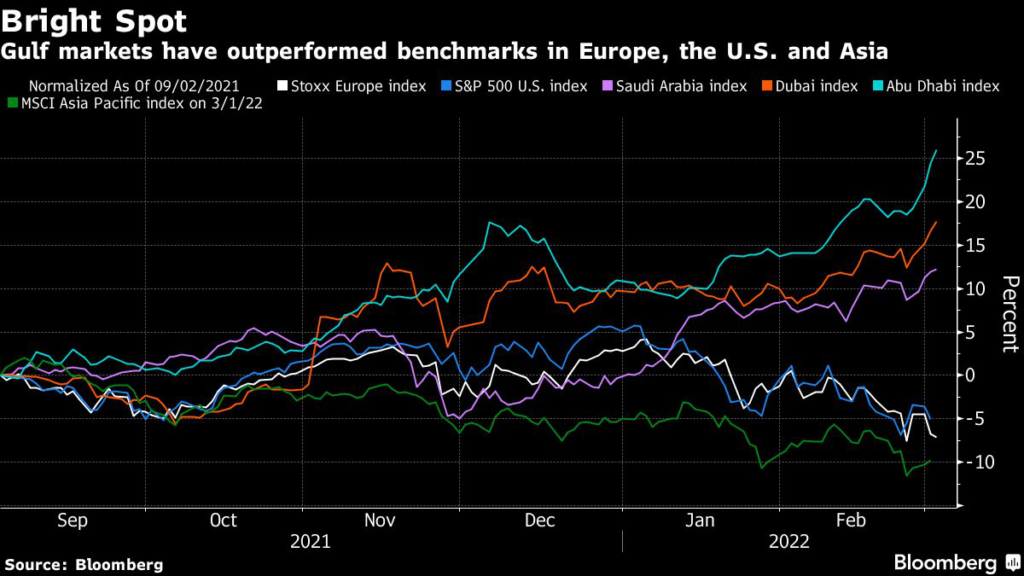
(Bloomberg) — Initial public offerings in the Gulf are proving resilient to the volatility hurting deals in other markets, as high oil prices, stable economies and abundant liquidity fuel activity.

Pharmacy retail chain Nahdi Medical Co. gathered enough demand to cover what is set to be Saudi Arabia’s biggest IPO since oil giant Aramco within hours of opening its books, Bloomberg News reported. In Dubai, the road-toll collection system and utility Dubai Electricity & Water Authority are also gearing up for large listings. 

No IPO plans in the region have been derailed by market volatility so far, while appetite for listings in Europe, the U.S. and Asia has all but dried up.

Read More: IPO Market Grinds to a Halt Amid Ukraine Invasion Volatility

Russia’s invasion of Ukraine has effectively shut IPO markets, exacerbating an already slow start to the year. Several companies pulled deals, while those that went ahead had to temper valuation expectations as equity benchmarks in Europe, Asia and the U.S. sagged. The Gulf is a rare exception, as surging local stock markets on the back of soaring oil prices support dealflow.

“We don’t have any indications yet that regional investors’ interest has changed,” said Samer Deghaili, head of capital markets for the Middle East, North Africa and Turkey at HSBC Holdings Plc. High oil prices, economic recovery and reforms in the region are attracting international and local buyers alike, he said. “It’s music to their ears.”

Bets on Middle Eastern IPOs this year are paying off, gaining on average 29% compared with Europe’s returns of 17% so far, according to data compiled by Bloomberg. Saudi digital security firm Elm Co., which drew orders from institutional investors for almost 70 times the shares on offer, has surged 54% since listing last month.

Still, there’s a risk the volatility stoked by war in Ukraine and the scope for tougher sanctions on Russia could bleed into the Gulf. Souring sentiment along with supply chain constraints may affect investor demand for IPOs in the Middle East. 

“All of this poses a risk to the global economic outlook as countries recover from the pandemic,” said Salah Shamma, Franklin Templeton’s Dubai-based head of equity investment for the Middle East and North Africa, noting that direct economic impact for the Gulf will likely be contained given the limited exposure to Russia and Ukraine.

And not all of the region’s IPOs have been slam dunks, either. Its biggest deal, Abu Dhabi Ports Co PJSC, has given up nearly all of its gains since its February debut, while Saudi stock East Pipes Integrated Co for Industry has shed 7.9% of its value since listing.

More stories like this are available on bloomberg.com

©2022 Bloomberg L.P.
Boeing Halts Moscow Operations, Restricts Data Access

(Bloomberg) — Boeing Co. is suspending major operations in Moscow and temporarily restricting employees and partners in Russia from accessing sensitive technical data until it can secure export licenses from the U.S. government. 

The Chicago-based planemaker said in an email late Tuesday that it has suspended providing spare parts, maintenance and technical services to Russian customers as it navigates deteriorating relations between the U.S. and Russia. 

European planemaker Airbus SE separately said that it would take similar action, citing a growing list of international sanctions following Russia’s invasion of Ukraine.

Effective immediately, Boeing is now required to obtain U.S. export licenses before Russia-based workers can access “most technologies and data,” Sergey Kravchenko, the president of Boeing’s local operations said in a separate memo to employees viewed by Bloomberg News.

“Boeing needs to restrict access to any export-controlled data to Boeing and partner organizations’ engineering employees in Russia,” Kravchenko wrote in a Monday email.

The company said it will seek to find new assignments for some employees and also explore job rotations, business trips and possible days off for employees in Russia while it awaits the new licenses.

On Monday, Boeing said it had closed its office in Kyiv, Ukraine and “paused” operations at its Moscow training campus.

“Airbus has suspended support services to Russian airlines, as well as the supply of spare parts to the country,” the planemaker said in a statement on Wednesday. 

The company has a support center in Moscow that provides technical assistance to customers, offers seminars and other support services, according to its website.

An engineering center formed in 2003 employs 200 Russian engineers. The facility, a joint venture between Airbus, Systema Invest and Kaskol Group, has been closed temporarily, a spokesman confirmed, citing “export control regulations and applicable laws.”

(Updates with Airbus move from third paragraph)

More stories like this are available on bloomberg.com

©2022 Bloomberg L.P.
Salomon Brothers Has to Rebrand Its Revival as Citigroup Clings to Domain Name

(Bloomberg) — Salomon Brothers, a newly-formed investment bank intended as a revival of the storied Wall Street firm, is re-branding after Citigroup Inc. declined to give up the salomonbrothers.com web domain name.

The firm will call itself Salomon Encore and use the web address salomonencore.com, the company said in a statement Wednesday. Citigroup doesn’t own the Salomon Brothers trademark, but still holds the salomonbrothers.com domain name and refuses to relinquish it, a person familiar with the matter said, asking not to be identified discussing non-public information.

Citigroup declined to comment. A database run by the non-profit Internet Corporation for Assigned Names and Numbers shows salomonbrothers.com is registered with a Citigroup subsidiary.

“Our new name, Salomon Encore, conveys both our modern approach — driven by innovation — and a demand for a return to a legacy of client service dating back to 1910,” Salomon Encore President R. Adam Smith said in the statement.

The original incarnation of Salomon Brothers became synonymous with Wall Street’s wealth and excesses in the 1980s thanks to books including “Liar’s Poker.” A series of deals in the late 1990s resulted in Salomon Brothers being absorbed into what eventually became modern-day Citigroup.

More stories like this are available on bloomberg.com

©2022 Bloomberg L.P.
Bitcoin Keeps Pulling Away From Stocks Roiled by Ukraine War

(Bloomberg) —

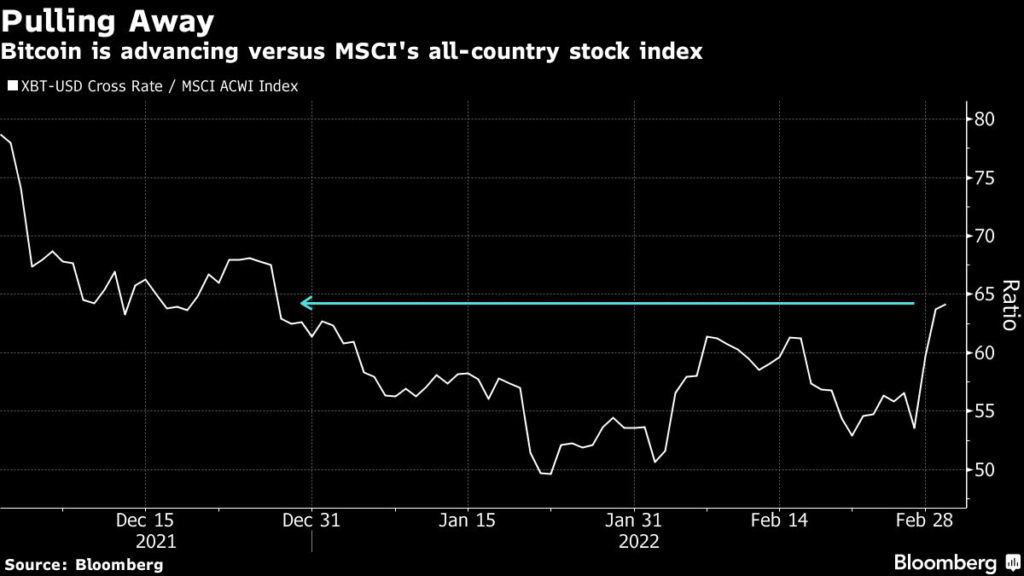
Cryptocurrencies continued to pull away from stocks as the intensifying war in Ukraine prompts investors to look for safe havens. 

Bitcoin advanced as much as 2% to $44,767 in early trading in Hong Kong before giving up some gains. It has jumped 18% over the past three days — a period during which President Vladimir Putin stepped up shelling of Ukrainian cities and other nations responded with additional sanctions against Russia. The MSCI AC World Index has fallen in nine of the past 10 sessions, including the last three.  

“This geopolitical environment is certainly a tailwind for crypto,” said Jonathan Cheesman, head of over-the-counter and institutional sales at crypto-derivatives exchange FTX, in a note Tuesday. “This situation highlights the use case for a decentralized, neutral, algorithmic safe haven.”

The Bloomberg Galaxy Crypto Index rose 4.5% on Tuesday, the fifth straight day of gains. Ether was up 17% to $3,004 at 5:50 p.m. in Hong Kong on Wednesday. 

Bitcoin proponents have for years touted its virtues as a hedge against conflict and inflation, citing its borderless nature and fixed supply. That image was dented by a crypto rout that started in November and sent Bitcoin tumbling as much as 52% amid concerns about central bank tightening. Other so-called alt-coins suffered even steeper declines. 

But the past few days of broad gains in digital tokens have kindled the notion that, at least, they offer protection from governments that can seize other types of assets, as some have recently vowed to do to Russian oligarcs. 

‘Why Bitcoin Was Created’: Novogratz Sees War Blunting Dollar

It’s “fascinating that, after a week into geopolitical uncertainty, Bitcoin is outperforming gold, which is known as a safe-haven asset,” said Marcus Sotiriou, an analyst at U.K.-based digital asset broker GlobalBlock. Gold slipped 0.2% on Wednesday after rallying since late January.  

As evidence mounts of a crypto rebound, retail investors appear to be piling in. Most of the accumulation in Bitcoin over the last week came from smaller investors, according to data from Glassnode. The researcher cited significant buying increases in wallets with less than 1,000 Bitcoins — with those with less than one Bitcoin being the most aggressive. 

Noelle Acheson, head of markets insight at Genesis Trading, said that while this metric can be unreliable as large holders spread their holdings over multiple wallets, it may hint at who’s driving Bitcoin’s recent rally.

“This does not necessarily mean that retail is piling in, but it does hint that retail investors, who have largely stayed away for at least the past year, are coming back and bringing new investors with them,” Acheson said in a tweet. “The case for accumulation seems to have acquired a large group of new believers.”

(Updates with comment from Acheson in final paragraph.)

More stories like this are available on bloomberg.com

©2022 Bloomberg L.P.

Honda Suspends Motorcycle, Vehicle Sales to Russia

(Bloomberg) — Honda Motor Co. is halting exports of cars and motorcycles to Russia, joining a growing number of global companies choosing not to do business in the country after its invasion of Ukraine.

The Japanese carmaker made the decision due to challenges around distribution and finances, Misako Saka, a spokeswoman for Honda, said. It will resume shipments once the situation returns to normal, she added.

Apple Inc. and Nike Inc. both announced plans Tuesday to halt product sales in Russia, joining Exxon Mobil Corp. while United Airlines Holdings Inc. said it will stop flying over Russia for its daily flights to India. From concerns over human rights to logistical snarls, companies across the globe are withdrawing from the Russian market after its invasion of neighboring Ukraine.

Mazda Motor Corp. is also suspending shipments of parts to a plant in Russia, the Nikkei newspaper reported. 

Read more: Foreign Companies From Shell to Daimler Abandon Russia

NHK reported earlier on Honda’s halt, citing complications with its distribution networks because of the war, and concerns over its ability to settle and collect payments because of the sanctions against Russia.

While Honda doesn’t have a factory in Russia, it exports about 1,500 SUVs annually to the country from plants in the U.S., NHK said.

(Updates with Honda confirmation, Mazda report.)

More stories like this are available on bloomberg.com

©2022 Bloomberg L.P.
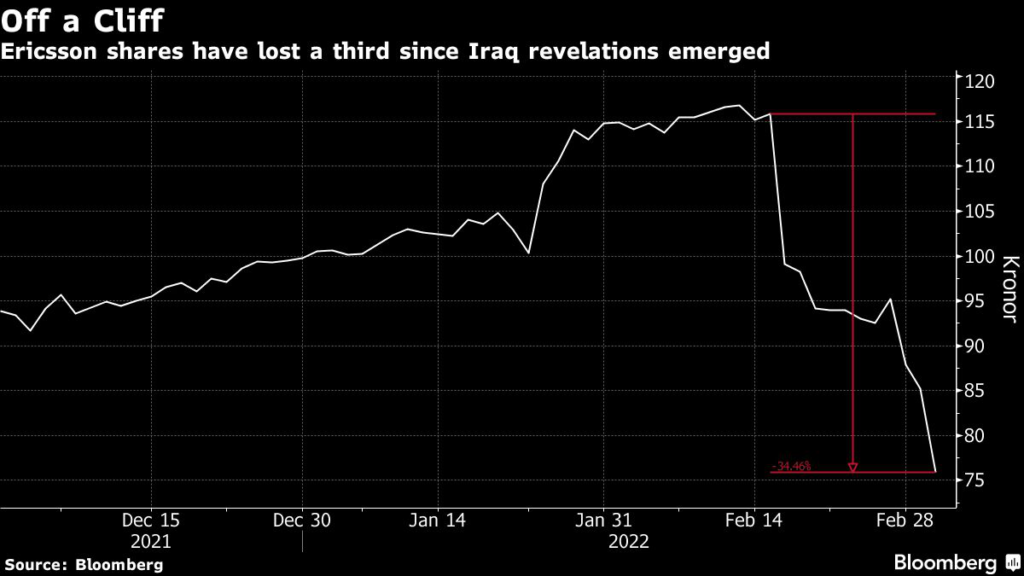
Ericsson Slumps After DOJ Faults Disclosure Over Iraq Probe

(Bloomberg) — Ericsson, mired in a scandal over potential payments to the terrorist organization ISIS, slumped after the U.S. Department of Justice said it failed to make adequate disclosures about its operations in Iraq before entering a deferred prosecution agreement in 2019.

The DOJ also determined that Ericsson also breached the agreement by “failing to make subsequent disclosure” after signing it, according to a statement by the company on Wednesday. Ericsson shares fell more than 12% at the start of trading in Stockholm.

Ericsson’s dealings in Iraq came to the fore in mid-February, when the company said that it had received questions from the media regarding past compliance-related matters in the country. Chief Executive Officer Borje Ekholm said in an interview with local media that Ericsson had identified “unusual expenses dating back to 2018” but the company hasn’t yet determined who the final recipient of the money was.

New reports on Sunday detailed Ericsson’s involvement in payments likely to have been made to gain access to transport routes, with information originating from an internal report commissioned by Ericsson and obtained by the International Consortium of Investigative Journalists.

The deferred prosecution agreement remains in effect with Ericsson placed under compliance monitorship. Ericsson is committed to co-operating with the DOJ to resolve the matter, it said and it would be “premature to predict the outcome.”

Ericsson said it believes the descriptions in the media reports about the conduct of its employees, vendors and suppliers in Iraq are covered by its internal investigation from 2019. The probe could not identify that any Ericsson employee was directly involved in financing terrorist organizations, and “based on our current assessment of the media reports, we do not believe they change this conclusion,” the company said on Wednesday.

The investigation had led to the exit of several employees from the company, and “multiple other disciplinary and other remedial action were taken,” it said.

In October, Ericsson was already accused by the DOJ of breaching a $1 billion agreement it made with prosecutors in 2019 to end a long-running corruption probe.

(Updates with shares from first paragraph)

More stories like this are available on bloomberg.com

©2022 Bloomberg L.P.

Close Bitnami banner
Bitnami
