Bloomberg

Direct Lenders Prep Record $5 Billion Loan for Zendesk Deal

(Bloomberg) — Direct lenders are working on a roughly $5 billion unitranche loan to partially finance a private equity consortium’s refreshed leveraged buyout offer for Zendesk Inc., according to people with knowledge of the matter.

A loan of that size would set a record for biggest private-credit deal. HPS Investment Partners is among lenders that may participate, said the people, who asked not to be identified discussing a private matter. Terms of the loan, including its size, haven’t been finalized and could still change.

Zendesk’s stock closed Tuesday at $116.80, giving the company a market capitalization of $14.2 billion.

Zendesk, an enterprise software company, last month fielded a takeover offer from private equity firms including Hellman & Friedman, Advent International Corp. and Permira Advisers, people familiar with the matter told Bloomberg News. Zendesk said it had received and rejected an unsolicited proposal from private equity firms that valued it at $127 to $132 a share.

A Permira spokesperson didn’t immediately respond to a request for comment. Representatives for Hellman & Friedman, Advent and HPS declined to comment. A Zendesk representative wasn’t immediately available for comment.

The decision by the consortium to solicit financing from direct lenders means they can borrow more than they’d be able to in the high-yield bond or leveraged-loan markets. Banks that arrange syndicated loans don’t typically underwrite deals that give borrowers debt loads of eight times a gauge of earnings called Ebitda, in part because they don’t want to run afoul of regulators.

In December, Apollo Global Management agreed to lend SoftBank Group Corp. $4 billion, the current record for a private-lender deal. That broke the $2.6 billion private loan that helped finance Thoma Bravo’s buyout of Stamps.com, and another $2.6 billion unitranche that was part of a broader $3.4 billion debt financing provided to Galway Insurance to fund in part its takeover of MAI Capital Management.

(Updates with Hellman & Friedman declining to comment in fifth paragraph.)

More stories like this are available on bloomberg.com

©2022 Bloomberg L.P.

War Shocks Ripple Across One of the World’s Busiest Trade Lanes

(Bloomberg) — Supply Lines is a daily newsletter that tracks Covid-19’s impact on trade. Sign up here.

Importers from London to Warsaw will soon face higher shipping costs, longer delays and an obstacle course of sanctions to navigate as Russia’s widening assault on Ukraine complicates the movement of cargo between Europe and Asia.

President Vladimir Putin’s invasion, and retaliatory steps designed to paralyze the Russian economy, are heaping new disruptions on supply chains that never recovered from unprecedented shocks caused by the pandemic. Beyond the devastating human toll, the war threatens higher costs for fuel, grain, industrial metals, and other raw materials used in Asian-made consumer goods headed for Europe and beyond.

Mediterranean Shipping Co. and A.P. Moller-Maersk A/S, the world’s biggest container carriers, on Tuesday halted bookings for Russian freight, with Maersk seeing “ripple effects” and “significant delays” across the region. Not a good signal for European economies already facing energy spikes, product shortages, clogged ports and the highest inflation since the inception of the common currency more than two decades ago.

“There is still substantial disruption in the supply chain,” said Jennifer Hillman, a Georgetown University professor and a former U.S. trade official. “There is an effort to build resilience but that will take time. With Russia invading Ukraine, we don’t have time.”

Aside from their commodity exports, Russia and Ukraine aren’t big global traders. Russia is the world’s 16th-largest goods exporter, led by petroleum, coal and gas. Ukraine ranks 48th, led by shipments of grain and iron ore, according to 2020 data from the World Trade Organization.

But they are situated along one of the world’s oldest trade lanes, one that China has sought to use for its Belt-and-Road initiative and a route where much of the airspace is now restricted. Meanwhile, container ships can’t access Ukrainian ports and many are trying to avoid Russia’s.

Currently, there’s little if any spare ocean freight capacity to move globally traded goods to absorb even an isolated, regional shock, said Jan Hoffmann, the head of trade logistics at the United Nations Conference on Trade and Development.

“There is no slack in the system so anything that holds up ships anywhere will lead to less capacity,” Hoffmann said.

For cargo between Asia to Europe, that leaves Russia’s rail network — behind only the U.S. and China with its 54,000 miles (87,000 kilometers) of track — as another possible option.

Both Maersk and DB Schenker, the logistics unit of German national railway operator Deutsche Bahn, offer intermodal services — by sea from Asia, then on Russian rail lines to Europe — but even those are coming under new restrictions and sanctions concerns.

“Shying away from sanctions is a key risk,” said Peter Sand, a chief analyst at Oslo-based Xeneta, a freight market-analytics platform. “That means higher prices for bulk shipping, which will make it more expensive to trade and ship around the world.”

There’s anecdotal evidence of train disruptions already. Networking equipment maker Zyxel Communications Corp. has stopped shipping from China to Europe by rail as the conflict threatens to snarl a key land route.

Zyxel, a maker of routers and switches controlled by Taiwan’s Unizyx Holding Corp., suspended freight through the link operated by China Railway about three days ago, President Karsten Gewecke said.

In Asia, some international shipping companies are adjusting their schedules and the conflict means disruption to the delivery of goods is inevitable, according to Gary Lau, chairman of the Hong Kong Association of Freight Forwarding and Logistics.

“The longer the tension lasts, the greater the impact on the entire European logistics chain,” Lau said.

Manufacturing executives such as Ricky Chan, whose Hong Kong-based company makes automotive parts including door handles and mirror shells for global clients, said the crisis may add to transportation constraints that the company was already juggling before the crisis began.

“For our business in Europe, we may face a longer lead time for our logistics,” said Chan, chief executive officer of Jing Mei Automotive, whose manufacturing facilities are based in Guangdong and Hebei.

Even before the crisis began, Bloomberg Economics estimated logistics constraints for China’s manufacturers appeared to be the most severe on record. The United Nations estimates around 41% of global exports are sourced from Asia, making it the world economy’s factory floor.

“This is a moment when corporations will stop taking their supply chains for granted and consumers will begin to understand the costs and inconvenience to satisfying their demands,” said Chris Rogers, a supply chain economist with Flexport Inc. in London.

Transporeon, a logistics platform with offices in nine European capitals, said a protracted war would mean that flights between the Far East and Europe might be rerouted via the U.S., ramping up delays and costs. The pain will be especially acute for U.K. importers, which would suffer more than those in other European countries due to limited capacity at cargo hubs.

Still, the disruptions in air freight may be less than the diversions and congestion on the ground. Though the average flight time has increased compared with the previous two months by about 3%-4% on average, that only translates to about a 20-minute delay, according to Flexport data. On one route, the time rose 8% or about 45 minutes. 

“That’s more jet fuel, more carbon emissions and backups at either end at airports in Asia and Europe,” Rogers said. “The rough conclusion is that there’s an impact but it’s not transformative to how air freight is working.” 

More stories like this are available on bloomberg.com

©2022 Bloomberg L.P.

Billionaire Novogratz Sees War Blunting Dollar, Boosting Crypto

(Bloomberg) — Russia’s invasion of Ukraine could prompt more people to turn away from the dollar in a potential boost for cryptocurrencies and local fiat, according to billionaire Mike Novogratz, a long-time crypto bull.

The recent surge in Bitcoin trading using the Russian ruble and Ukrainian hryvnia has bolstered advocates’ case that a decentralized currency can offer refuge when access to traditional banking breaks down. The invasion and sanctions against Russia could push more regular people toward crypto, Novogratz said while making clear that doesn’t imply Bitcoin is being used to avoid sanctions.

“We’ve never had a group of nations in essence confiscate real estate from Russian tycoons,” the founder of Galaxy Digital Holdings said in an interview. “This sends a message: I want to have money that lives outside of traditional power. That’s why Bitcoin was created, because people don’t trust governments.” In contrast, blockchain ledgers are transparent.

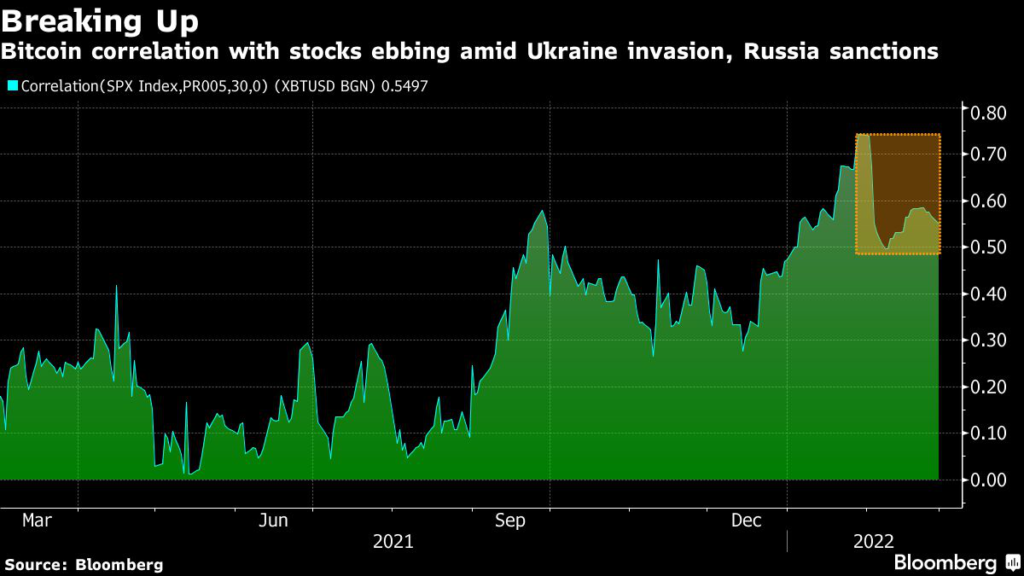
The world’s largest cryptocurrency has decoupled from risk-on assets in the past two days, aiding narratives the coin could be viewed as a store of value, uncorrelated to the broader market. While still elevated at 0.55, Bitcoin’s correlation with the S&P 500 has backed down from a high of 0.7 earlier this year, data compiled by Bloomberg show.

Some analysts have attributed sanctions against Russian banks, companies and wealthy elites — and the subsequent economic fallout — as driving a rush into digital assets. For onlookers like China, there are lessons to be learned in relying on the U.S. dollar, Novogratz said.

“I’ll tell you one thing, you are going to sell your reserves before you invade Taiwan,” he said. “This is a big deal, in a lot of ways. This is starting the acceleration of de-dollarization of the world.”

More stories like this are available on bloomberg.com

©2022 Bloomberg L.P.
Rivian Raises Prices of Electric Vehicles, Citing Higher Costs for Parts

(Bloomberg) — Rivian Automotive Inc. is raising prices on its debut vehicles for retail buyers, citing a shortage of semiconductors and higher costs for other components.

The sticker price of Rivian’s battery-electric pickup, called the R1T, will rise 17% and the price of its R1S sport utility vehicle model will increase 20%, the company said Tuesday. 

“Like most manufacturers, Rivian is being confronted with inflationary pressure, increasing component costs, and unprecedented supply-chain shortages and delays for parts” including semiconductors, Rivian’s Chief Growth Officer Jiten Behl said in a statement.

The automotive industry globally is facing higher input costs while also experiencing greater leeway to increase prices. Average transaction prices hit a record $47,243 in December and Truecar.com, an auto pricing and marketing website, projects they rose 15% in February from a year ago.

Irvine, California-based Rivian, a closely followed upstart, is seen as a potential competitor to industry leader Tesla. While the company has delivered relatively few vehicles — 920 as of Dec. 31  — its listing in November was the sixth biggest in U.S. history. Rivian is backed by big names like Amazon.com Inc. And T. Rowe Price.

Debut versions of the R1T with a quad-motor, all-wheel drive and a large battery pack, giving around 310 miles of range, started at $67,500. That vehicle will now cost around $79,500. The R1S with the same specifications will rise from around $70,000 to around $84,500.

Rivian only started production and deliveries of the pickup in September after having delayed its release several times due to supply chain challenges. The SUV went in to limited production in December.

Starting 2024, Rivian plans to offer a dual-motor version of the R1T with a “standard” sized battery pack, that allows around 260 miles of range, for $67,500 — the same starting price that Rivian launched its vehicles at last year.

(Updated with details on prices.)

More stories like this are available on bloomberg.com

©2022 Bloomberg L.P.
Airbnb’s Chesky Says Russia Penalties Curb Its Operations in Country

(Bloomberg) — Airbnb Inc. Chief Executive Officer Brian Chesky said that U.S. sanctions on Russian banks have affected its ability to operate within the country and that “all things are on the table right now” with regard to voluntarily limiting Airbnb’s Russian operations.

“As a practical matter, a lot of our business is probably going to be on pause just from the inability to be able to pay,” Chesky said in an interview Tuesday on Bloomberg Technology. “But we are looking at other steps. As you can imagine, we are just triaging right now.”

The U.S. has implemented a number of sanctions against Russia, including penalties on financial institutions such as the Russian central bank. Uber Technologies Inc. and Apple Inc. are among the U.S. businesses cutting ties with Russian companies and stopping sales of their products within the country.

Airbnb announced Monday that it would provide free short-term housing for as many as 100,000 Ukrainian refugees who are crossing into neighboring European countries. So far, the company has reached out to 14 different countries and the United Nations estimated that 4 million people could flee Ukraine. 

“These governments need to find a way to house them and we can provide an infrastructure,” Chesky said. “I think we’re being viewed, I hope, as a solution to a problem that they have.” 

More stories like this are available on bloomberg.com

©2022 Bloomberg L.P.

Apple Halts Product Sales in Russia After Ukraine Invasion

(Bloomberg) — Apple Inc. halted sales of the iPhone and its other highly prized technology products in Russia following the country’s invasion of Ukraine, saying the company stands “with all of the people who are suffering as a result of the violence.”

The tech giant said Tuesday that it stopped exporting products into the country’s sales channel last week, ahead of pausing sales. It’s also removing the RT News and Sputnik News applications from App Stores outside of Russia and has disabled traffic and live-incident features in Ukraine as a “safety and precautionary measure” for citizens there.

“We are deeply concerned about the Russian invasion of Ukraine,” Apple said in a statement. “We are supporting humanitarian efforts, providing aid for the unfolding refugee crisis, and doing all we can to support our teams in the region.”

The action followed pleas for Apple to stop selling products in Russia, with Ukraine Vice Prime Minister Mykhailo Fedorov saying the move could help turn Russian youth against the invasion. He also called on the company to shutter its local App Store — a step it hasn’t yet taken. Apple has operated an online store specific to Russia for the last several years, as well as an App Store tailored to the country.

This isn’t the first time Apple has cut off a country. Apple stopped sales briefly in Turkey last year because of economic turmoil and currency fluctuation. But it’s a rare step by the world’s most valuable company and will further isolate a nation of about 145 million people.

Apple shares dipped to session lows following news of the move, before recouping some of the losses. The stock fell 1.2% for the day, closing at $163.20.

The Cupertino, California-based company also began limiting its Apple Pay service and other online offerings in Russia during recent days. 

The shuttered online store sold iPhones, Macs, iPads, AirPods and other products directly to consumers. In recent months, the company also registered a business office in Russia and this month posted job listings for about half-a-dozen positions in Moscow. 

Nike Inc., another iconic U.S. brand, halted sales in Russia as well, saying Tuesday that it “cannot guarantee delivery of goods to customers.” HP Inc., the largest supplier of personal computers to Russia, also stopped exports to the country this week. 

Russia launched a full-scale invasion of Ukraine last week, attacking from the north, east and south of the country. Russian troops have shelled Ukrainian cities, aiming to seize the capital, Kyiv.

Apple said it will continue to evaluate the situation and that it is in communication with governments on the actions that it’s taking. “We join all those around the world who are calling for peace,” the company said.

Chief Executive Officer Tim Cook expressed his concern last week about the “situation in Ukraine,” without naming Russia. “I am thinking of the people who are right now in harm’s way and joining all those calling for peace,” he tweeted.

(Updates with history of Russian store in eighth paragraph.)

More stories like this are available on bloomberg.com

©2022 Bloomberg L.P.

Salesforce Raises Revenue Forecast on Slack, Product Expansion

(Bloomberg) — Salesforce.com Inc. gave a forecast for quarterly and annual revenue that exceeded analysts’ estimates, as the leader in customer relations software further integrates Slack and expands its product line. 

Revenue will be as much as $7.38 billion in the period ending in April, San Francisco-based Salesforce said Tuesday in a statement. Analysts, on average, projected $7.26 billion, according to data compiled by Bloomberg. For the full year, sales will be as much as $32.1 billion, compared with the average estimate of $31.8 billion. 

“With our customers’ success driving our financial success, we’re generating disciplined, profitable growth at scale quarter after quarter,” co-Chief Executive Officer Bret Taylor said in the statement.

Salesforce has been working to integrate Slack after its $27.7 billion purchase of the instant messaging platform, as well as adding products in a bid to sell more tools to existing customers. Even without that expansion, analysts see a lot of room to increase sales of the company’s flagship software that lets businesses manage and interact with customers, known as CRM.

However, Salesforce also faces competition from large companies such as Microsoft Corp. and up-and-comers like Freshworks Inc. Relative upstarts such as ZoomInfo Technologies Inc. also are finding success by offering tools that can be deployed on top of data stored in a CRM system to help improve sales activity, capabilities that Salesforce has been working to add through its artificial intelligence-backed Einstein product. 

“We believe the sales software market can grow double digits over the next several years,” BMO Capital Market analysts wrote in a note published before earnings. “We think that Salesforce is well-positioned to capture the highest growth areas of the market such as revenue management and planning.” 

The shares increased about 4% in extended trading after closing at $208.89 in New York. Like other software vendors, Salesforce’s stock has been on a downhill ride the past several months, falling more than 30% from its November record high through Tuesday’s close.

In the fiscal fourth quarter, Salesforce reported revenue increased 26% to $7.33 billion, topping Wall Street’s average projection of $7.23 billion. Profit, excluding some items, was 84 cents a share, compared with analysts’ estimate of 74 cents. 

In December, the company alarmed investors when it reported a slowdown in sales in its MuleSoft division, which helps customers connect their software across the internet. Former employees attributed the dip to an exodus of top talent and difficulty in hiring as a result of an early decision to fold MuleSoft’s recruitment team into Salesforce’s human resources department. However, MuleSoft’s revenue has begun to bounce back, gaining 24% to $467 million in the quarter. While not yet returning to the almost 50% growth reported last May, the results indicate the company is quickly addressing the issues that led to the decline in sales.

“We didn’t think this would be fixed in one quarter,” Chief Revenue Officer Gavin Patterson said in an interview. It will “probably take until the back of FY23 to fully work through all the transformation that we need to put in place” to fix MuleSoft, he said.

Patterson said the global sanctions against Russia arising out of the war with Ukraine will have “minimal impact” on Salesforce’s business and haven’t forced the company to take any actions yet.

“As sanctions are put in place, then we reflect that in who we do business with,” he said.

(Updates with MuleSoft revenue in the eighth paragraph.)

More stories like this are available on bloomberg.com

©2022 Bloomberg L.P.

Salesforce Is Holding Employee ‘Listening Sessions’ Amid NFT Blowback

(Bloomberg) — Salesforce.com Inc. is holding “listening sessions” with employees who are opposed to the software giant’s reported efforts to launch a new cloud-based service to support the creation and release of non-fungible tokens, or NFTs, according to a top executive. 

The San Francisco-based company is building a competitor to NFT marketplaces like OpenSea, CNBC reported last month. The decision elicited push back from some employees who believe the effort violates Salesforce’s broader commitment to sustainability. Leadership is holding sessions with those workers who have concerns to understand their reservations, according to Chief Revenue Officer Gavin Patterson. 

“We take what our employees feel about things very seriously,” Patterson said Tuesday in an interview. “It is something we’ve been looking at and we are currently undertaking a series of listening sessions. We’ll take that into account as we continue to develop the proposition from here.” 

On Tuesday, Salesforce reported fourth-quarter results that exceeded Wall Street’s expectations. The company also increased its annual revenue forecast on strong demand for its product suite. 

“The fundamentals of the business are stronger than they ever have been,” Patterson said. “This is a truly stellar year, one of the best in the 23-year history of the company.”

More stories like this are available on bloomberg.com

©2022 Bloomberg L.P.

Animoca Breaks With Crypto Peers by Cutting Off Russian Users

(Bloomberg) — Animoca Brands Corp. Ltd, one of the biggest and most visible blockchain gaming companies, is cutting its service to Russian customers in response to the invasion of Ukraine. 

The company’s move makes it a standout among major crypto-related businesses, which have largely continued to serve Russian users even as sanctions mount and other industries pull back on investments there. 

Animoca co-founder Yat Siu said in an interview that the decision will affect subsidiaries such as Gamee and Lympo, though he said the number of Russian users isn’t large enough to have a material impact on the company’s results.

“The legal advice we’ve been receiving is we now have to impose some restrictions,” Siu said. “It’s a sanctioned country on par with North Korea. The moment we end up doing business in those areas, we might ourselves become financially excluded from the financial system.”

The move is part of a widening retreat from Russia amid broad international condemnation of President Vladimir Putin’s decision to wage war in Ukraine. The U.S. Treasury Department has imposed economic measures targeting Russia’s largest financial institutions and banking assets, while the European Union excluded certain Russian banks from the SWIFT messaging system, among other things. 

Despite calls by Ukraine Vice Prime Minister Mykhailo Fedorov for cryptocurrency exchanges to block addresses of Russian users, major crypto exchanges have resisted such an action, seeing it as contrary to the libertarian ethos of an industry that caters to those seeking to shelter assets beyond government reach. 

But the Hong Kong-based Animoca will stop selling shares to Russian investors, Siu said, in addition to blocking Russian users. Gamee already announced on Twitter on Feb. 24 that it’s closing its services to Russia while Lympo said it would stop publishing Russian athlete NFTs and halt negotiations with the nation’s athletes to join the Lympo NFT Ecosystem. 

Animoca’s products use intellectual property from popular global brands like Formula 1 and Walt Disney Co. It has also invested in more than 150 companies, including Axie Infinity maker Sky Mavis, game-maker Dapper Labs and nonfungible marketplace OpenSea, though Siu said it will be up to those companies to decide their approach to Russia.  

Animoca doesn’t break out its users by geography. For the period of January to September, Animoca reported bookings of about $140 million. Other income, which included gains on investments and digital assets, reached $529.6 million. 

More stories like this are available on bloomberg.com

©2022 Bloomberg L.P.
Bitcoin Surges for Second Day With Crypto in Demand as a Haven

(Bloomberg) — Bitcoin extended a two-day rally, leading broad-based gains in cryptocurrencies as digital assets reasserted themselves as haven assets — and emerged as a potential vehicle for getting around sanctions — amid the intensifying war between Russia and Ukraine.

The largest digital coin by market value rose as much as 8% Tuesday to $44,964 in New York trading hours, with its rally over the past two sessions adding 20% to its market value at one point and its total market capitalization crossing above $840 billion once again. Other cryptocurrencies also advanced, with Ether crossing above $3,000. It also broke above its average price over the last 50 days, typically seen as a bullish development. 

Analysts watching the market say the stunning breakthrough can be ascribed to the idea that cryptocurrencies could act as a type of refuge as the war in Ukraine intensifies. Its appeal lies with the fact, the argument goes, that cryptocurrencies are detached from governmental control and therefore not beholden to any of their actions. 

Bitcoin “has gold-like properties in that if you hold it you directly control the assets as opposed to governments and banks being in between,” said Stéphane Ouellette, chief executive of FRNT Financial Inc. “In a period where banking is destabilized in a region, which is obviously happening in Europe right now, it would make sense to see some flows into BTC as people diversify away from the banking system,” he said, adding that speculators can get in front of such trends, which can drive prices higher.


A fresh wave of turbulence hit global markets on Tuesday as the war in Ukraine intensified amid mounting penalties against Russia. Russian troops continued to shell military and civilian facilities alike, Bloomberg News reported, as Ukraine’s President Volodymyr Zelenskiy accused Russian forces of committing acts of terror, and as the Kremlin stepped up its offensive despite a barrage of sanctions directed at Moscow. 

The rally is about “the utility of these assets to serve as a potential workaround for Russia sanctions and also a point of proof that virtual currencies are viable alternatives to fiat currencies like the Russian ruble,” said Nicholas Colas, co-founder of DataTrek Research.

Stocks in Europe fell along with U.S. equities, with the S&P 500 declining for the second straight day. Wall Street’s fear gauge, the VIX, also spiked.

Many analysts have long posited that Bitcoin can be a useful asset during geopolitical turmoil. Its outperformance amid the volatility has some bulls pointing to a break from the narrative that crypto is just another risk asset. Adam Farthing, chief risk officer for Japan at crypto trading firm B2C2, said Bitcoin could “de-link from risk” and start trading more like a hedge to geopolitical instability and inflation.

“Bitcoin saw a significant upward move today as it appears to have slightly regained its safe haven status while the Russia-Ukraine conflict continues to intensify,” said Walid Koudmani, an analyst at XTB Market.


Other influences may also be at play. 

“We’ve never had a group of nations in essence confiscate real estate from Russian tycoons, taking a country’s money,” said Mike Novogratz, CEO and founder of crypto platform Galaxy Digital. “That’s why Bitcoin was created, because people don’t trust governments. This is a big deal — in a lot of ways, this is starting the acceleration of de-dollarization of the world.”

Trading volumes in Bitcoin using the ruble have surged to the highest level since May, suggesting Russians are potentially moving their money into crypto as the ruble plunges to a record low. Meanwhile, trading volumes overall for Bitcoin and Ether, the second-largest cryptocurrency by market value, have dropped even as their prices rose over the last month, according to a report from CryptoCompare. Average daily aggregate trading volume on crypto products stood around $353 million, down more than 24% from January. 

Read more: Bitcoin Volume Spikes in Russia and Ukraine as Sanctions Hit

Because Bitcoin’s fundamental and intrinsic value can be elusive, “technicals, a map of market psychology, may be critical,” said Marc Chandler, chief market strategist at Bannockburn Global Forex. He notes that some technicians point to a break above February’s highs potentially being key and possibly signaling a move above $50,000. 

While still elevated at 0.55, Bitcoin’s correlation with the S&P 500 has come off after surpassing 0.7 earlier this year, data compiled by Bloomberg show. A correlation of 1 means two assets move perfectly in tandem, while a zero correlation displays their fluctuations are wholly independent.  

“It seems the link to risk assets has temporarily been broken,” said Craig Erlam, a senior markets analyst at Oanda. Still, he says any evidence of crypto use as a way to skirt sanctions could drive policy makers to crack down with more regulations. 

Amid the price spike, Bitcoin’s 90-day volatility has been trending high as well, Bloomberg data show. 

Adam Phillips, managing director of portfolio strategy at EP Wealth Advisors, urges caution, saying that its volatility is the reason he’s being wary. 

“It is going to behave somewhat radically,” he said in an interview. “Let’s remember, it hasn’t been around for that long, and we kind of view it as a teenager in a world full of mature assets. And so teenagers are going to behave erratically from of time and you can’t really understand their behavior, and this is really one of those days.”

(Updates with prices, new commentary throughout.)

More stories like this are available on bloomberg.com

©2022 Bloomberg L.P.

Close Bitnami banner
Bitnami