
Bloomberg

BitConnect’s Indicted Founder Kumbhani Vanished, SEC Says

(Bloomberg) — BitConnect founder Satish Kumbhani, charged in the U.S. last week with a $2.4 billion Ponzi scheme, has vanished from his native India, officials told a New York judge.

In September, before the criminal charges were filed, the U.S. Securities and Exchange Commission had sued Kumbhani, claiming he fraudulently raised more than $2 billion from investors in his cryptocurrency exchange platform. But the SEC didn’t know where he was and couldn’t serve him with the lawsuit.  

The mystery deepened a bit Monday. 

Kumbhani, 36, “has likely relocated from India to an unknown address in a foreign country,” SEC attorney Richard Primoff said in a filing in federal court in Manhattan. “Since November, the commission has been consulting with that country’s financial regulatory authorities in an attempt to locate Kumbhani’s address. At present, however, Kumbhani’s location remains unknown.” Primoff said the SEC couldn’t say “when its efforts to locate him will be successful, if at all.” 

Primoff asked U.S. District Judge John Koeltl for an extension until May 30. The SEC said it wants to look for Kumbhani and, if it finds him in the U.S., serve him with the complaint. On Tuesday, Koeltl granted the SEC request. He previously halted the civil case while the criminal investigation proceeds.

Of course, if Kumbhani comes to the U.S., he could be arrested and potentially go to prison if he’s convicted of charges in the indictment filed Friday in San Diego. Prosecutors said he created BitConnect in 2016 and the digital token, BitConnect Coin.

Kumbhani touted BitConnect’s “lending program” based on proprietary “trading bot” and “volatility software” that would trade on the global crypto markets. But in reality, the lending program was a massive Ponzi scheme that raised $2.4 billion from investors around the world before shutting down in January 2018, prosecutors said.

The next day, one of Kumbhani’s promoters based in South Korea warned that “some people here are talking about committing suicide” and that “lots of [Korean investors] invested everything they have,” according to the indictment. A promoter in Australia also wrote that “we are getting death threats…[and] the coin will be useless!!!!!”

BitConnect used money from new investors to pay earlier ones, the U.S. said. He is charged with wire fraud, operating an unlicensed money transmitting business, and three conspiracies: to commit wire fraud; commodity price manipulation; and international money laundering.

Read More: SEC Sues Five BitConnect Promoters Over $2 Billion Scheme

Last September, BitConnect’s top promoter in North America, Glenn Arcaro, pleaded guilty. In November, prosecutors said they would sell about $57 million in cryptocurrency seized from Arcaro. This month, a judge approved an amended order for the sale. 

The indictment of Kumbhani seeks the forfeiture of $2.4 billion attributable to his actions. 

The criminal case is USA v. Kumbhani, 22-cr-00395, U.S. District Court, Southern District of California (San Diego); the civil case is SEC v. BitConnect, 21-cv-7349, U.S. District Court, Southern District of New York (Manhattan).

(Updates with judge granting SEC request.)

More stories like this are available on bloomberg.com

©2022 Bloomberg L.P.
Big Tech Triggers Late Rush for Exits as Ukraine Fears Kick In

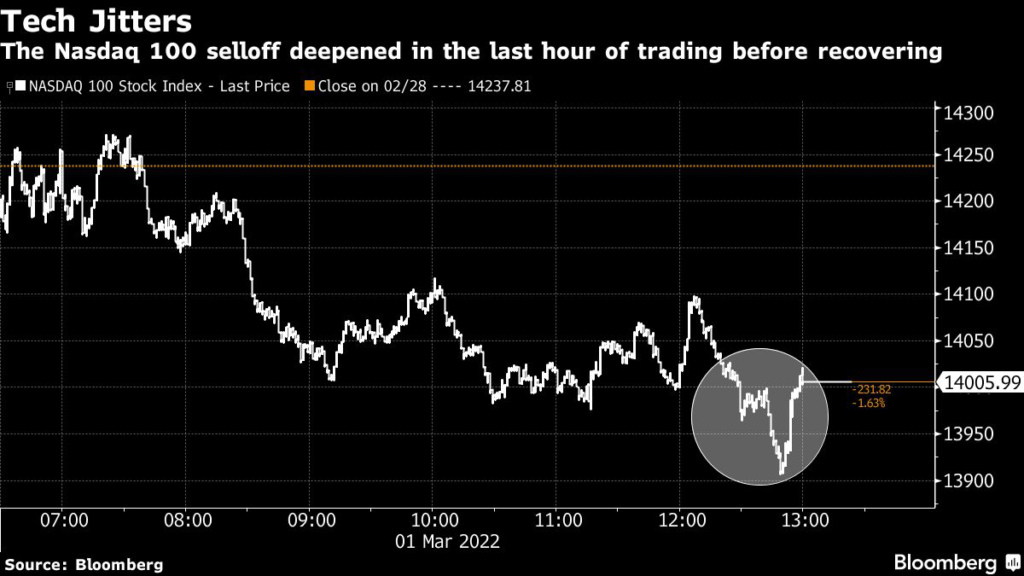
(Bloomberg) — A selloff in technology stocks accelerated in the last hour of trading in New York as concerns mount about the economic fallout from escalation of the Russian assault on Ukraine. 

Tuesday saw broad declines in stocks but the selling accelerated in the late afternoon with the Nasdaq 100 Stock Index shedding nearly 100 points in a matter of minutes as Apple Inc. said it halted sales in Russia. The tech-heavy benchmark later pared some of the losses and closed at 14,005.99 for a decline of 1.6%. 

The selloff capped a dour session that put a halt to a three-day advance for the Nasdaq 100 as some investors bet that the war is reducing the likelihood that the Federal Reserve will raise interest rates aggressively this month to combat inflation. But a spike in crude oil to as high as $106 on Tuesday and the prospect of higher consumer prices overshadowed that outlook.  

Read More: Growth Angst Shakes Markets Already Obsessed With Inflation Risk

“Traders are trying to reduce their exposure to anything that has exposure to Russia and some are getting concerned that a prolonged economic slowdown is here,” said Edward Moya, senior market analyst with Oanda.  

Apple Inc. ended the session 1.2% lower, while Facebook parent Meta Platforms Inc. fell 3.6% and Amazon.com Inc. lost 1.6%. Semiconductor stocks were also among the biggest decliners on Tuesday with Advanced Micro Devices Inc. sinking 7.7% and Marvell Technology Inc. down 5%. The Philadelphia semiconductor index dropped 3.6%, the most in nearly two weeks. 

(Adds comment in fourth paragraph and stock moves in last paragraph.)

More stories like this are available on bloomberg.com

©2022 Bloomberg L.P.

Hollywood Pauses Film Releases in Russia Including ‘The Batman’

(Bloomberg) — Major Hollywood entertainment companies including Walt Disney Co. and WarnerMedia are pausing the releases of new films in Russia in response to the country’s invasion of Ukraine. 

Disney has put on hold the debut of the new Pixar movie “Turning Red,” about a girl who turns into a giant panda, citing the “unprovoked invasion of Ukraine and the tragic humanitarian crisis”. The film will make its debut in the U.S. on the Disney+ streaming service March 11.

“We will make future business decisions based on the evolving situation,” the company said in a statement. Disney also said it would also work with international relief organizations to provide aid to refugees.

WarnerMedia, a division of AT&T Inc., said it would delay the introduction of “The Batman,” a installment of the DC Comics franchise starring Robert Pattinson as the titular superhero. It comes out March 4 in the U.S. and is expected to be one of the year’s highest-grossing pictures.

Sony Pictures Entertainment said it paused planned theatrical releases in Russia, including that of “Morbius,” a Spider-Man spinoff starring Jared Leto. Paramount Pictures said Tuesday morning that it would delay the debuts of its films “The Lost City” and “Sonic the Hedgehog 2” in Russia. Universal Pictures, a unit of Comcast Corp., joined them later Tuesday afternoon.

Hollywood, like many other industries, is struggling with how to react to the invasion of Ukraine. Russia was the ninth-largest foreign market for U.S. films in 2019 and many new releases are scheduled to open there.  “Avengers: End Game,” the top-grossing film of 2019, earned $46 million in the country, according to Box Office Mojo.

A senior manager at Disney’s music group said in a message to music publishers that banking sanctions against Russia were preventing the company from receiving payments associated with its hit soundtrack “Encanto,” according to a copy of the message which was posted by a third party on Twitter.

Songs from “Encanto” have been translated into Russian and Ukrainian, and were being downloaded frequently on YouTube. Disney said the manager’s views were not reflective of the company as a whole.


(Updates with Universal in fifth paragraph.)

More stories like this are available on bloomberg.com

©2022 Bloomberg L.P.
HP Enterprise Bolsters Profit Forecast on Strong Demand

(Bloomberg) — Hewlett Packard Enterprise Co. increased its annual profit forecast amid strong demand for the hardware maker’s products, especially tools to process data at the point of origination. 

Fiscal-year earnings, excluding some items, will be as much as $2.17 a share, the Spring, Texas-based company said Tuesday in a statement. Analysts, on average, projected $2.03 a share, according to data compiled by Bloomberg. Profit will be 41 cents to 49 cents a share in the current quarter ending in April, with the midpoint meeting analysts’ average estimate.

“We are also delivering a better quality of earnings demonstrated by our improved gross margin despite ongoing supply chain constraints that enabled us to deliver Q1 EPS well above our outlook range and raise our outlook for the full year,” Chief Financial Officer Tarek Robbiati said in the statement.

HPE is trying to reduce its reliance on sales of hardware such as data-center servers by encouraging customers to pay for additional services with subscriptions. The company said its annualized revenue run-rate, which reflects future payments under the subscription software-as-a-service model, jumped 23% to $798 million in the period ended Jan. 31. Order growth gained 20% from a year earlier, the third consecutive quarter with at least a 20% increase.

Total revenue increased 1.8% to $6.96 billion in the fiscal first quarter, narrowly missing analysts’ projection of $7.02 billion. Profit, excluding some items, was 53 cents a share, compared with the average estimate of 46 cents.

Sales in the Intelligent Edge division, which covers products that allow companies to gather and process data where it is generated instead of transferring it to an external storage center, grew 11% to $901 million, exceeding Wall Street’s expectations. Sales at HPE’s biggest unit, Compute, rose 1% to $3.02 billion, which was below estimates. Data storage revenue declined 3% to $1.16 billion.

“Obviously the edge was probably the shining star,” Chief Executive Officer Antonio Neri said in an interview. “The first step to drive digital transformation is connectivity. And that’s why you see tremendous amounts of connectivity at the edge.”

More stories like this are available on bloomberg.com

©2022 Bloomberg L.P.
Fed Looks to Streamline Path to Payment System Amid Raskin Fight

(Bloomberg) — The Federal Reserve Board is taking a fresh look at how financial firms get coveted access to the U.S. central bank’s payment system — a controversial question that’s weighing on President Joe Biden’s pick to be Wall Street’s top bank regulator.

The Fed on Tuesday proposed a plan that it said would help ensure the fairness of the process for evaluating new requests. The framework, which builds on a proposal from last May, would set up a tiered system that’d make it easier for federally-insured lenders, while asks from entities not already supervised by Washington regulators would face more scrutiny.

“With technology driving rapid change in the payments landscape, the proposed guidelines would ensure novel requests for access to Federal Reserve accounts and payment services are evaluated consistently and transparently to ensure a safe and innovative payment system,” Fed Governor Lael Brainard said in statement.

Access to the Fed’s payment system, particularly for non-traditional financial firms, through so-called master accounts has morphed from a weedy financial regulatory question to a political lightning rod during Sarah Bloom Raskin’s bid to become the central bank’s new vice chair for supervision. 

Raskin has faced dogged opposition from Republicans, who most recently have questioned her previous role as a director of Reserve Trust, a fintech company that obtained access to the payment system. 

Wyoming Republican Cynthia Lummis has been particularly critical, questioning during a Senate Banking Committee hearing last month whether Raskin used her influence to help the firm. For her part, Raskin has said she’s confident her communications satisfied all applicable ethics rules and would agree to recuse herself for longer than required to avoid any potential conflicts.

The Fed said it would take public comments on the proposal for 45 days. 

More stories like this are available on bloomberg.com

©2022 Bloomberg L.P.

Minerd Sounds Alarm on Risk of Russia Cyber Hack After SWIFT Ban

(Bloomberg) — Scott Minerd, chief investment officer of Guggenheim Investments, cautioned about the risk of Russia retaliating against economic sanctions through cyber warfare on the financial system.

“The likelihood of a cyber attack on our payments system is high,” said Minerd, who last year warned about the sustainability of the global payment system and threats from hackers. “If they cripple the payments system it’s going to seize up markets,” he said.  

Read more: Wall Street Titans Warn of the Next Big Risks for Investors

The European Union has agreed to cut off seven Russian banks from the SWIFT network as part of the sanctions imposed on the country after its invasion of Ukraine. The financial-messaging system ties more than 11,000 entities across the world and enables trillions of dollars of transactions. 

Read more: Plans for SWIFT Ban Spares Banks With Energy Ties

Minerd acknowledged that Russia hasn’t yet conducted a major cyber attack of this sort and any attack would cause temporary dislocation, but he cautioned that Ukraine would be the primary target. 

Even with his broader concerns, Minerd expressed some optimism about the prospect for markets amid the turmoil. 

Guggenheim has been purchasing preferred stocks and equity indexes, but hasn’t been able to capitalize on some debt investments. 

“We’re trying to buy high-yield bonds and bank loans, but the trading is so thin,” he said. 

Since Guggenheim doesn’t typically buy individual stocks, Minerd has been acquiring beaten-down payments stocks in the Americas through his personal account. “These were the darlings of the Covid-era, and they’ve been beat up, they’re cash flow positive and have very reasonable multiples,” he said. “These are growth stocks.”

More stories like this are available on bloomberg.com

©2022 Bloomberg L.P.
Hackers Stole Nvidia Data, Posted It Online After Breach

(Bloomberg) — Officials at Nvidia Corp. said hackers stole proprietary information when they breached the company’s networks and have been leaking the data online.

“We are aware that the threat actor took employee credentials and some Nvidia proprietary information from our systems and has begun leaking it online,” the Santa Clara, California-based company said in a statement. “Our team is working to analyze that information. We do not anticipate any disruption to our business or our ability to serve our customers as a result of the incident.”

Nvidia said it became aware of the compromise on Feb. 23. 

A cybercriminal group has been publicly extorting the company on its Telegram channel. Cybersecurity experts have speculated that the hacking group, called LAPSU$, may have members located in South America and Western Europe. 

Bloomberg, citing a person familiar with the incident, initially reported that attack appeared to be a ransomware attack. In such attacks, hackers deploy malware that encrypt computer networks, and then demand a ransom.

But company officials said no malicious malware was deployed. Instead, the hackers stole data and publicly threatened the company with releasing it, unless they removed limits that impeded cryptocurrency mining on a series of Nvidia graphics cards.

After Nvidia declined to engage, the hackers began posting data online. 

More stories like this are available on bloomberg.com

©2022 Bloomberg L.P.

Biden Invites Ukranian Ambassador to State of the Union Speech

(Bloomberg) — Ukraine’s envoy to the U.S. will attend President Joe Biden’s State of the Union Address on Tuesday night as a guest of the White House, offering a high-profile display of solidarity amid the Russian invasion.

Ambassador Oksana Markarova will join first lady Jill Biden and second gentleman Douglas Emhoff in a box traditionally reserved for individuals likely to be recognized by the president during the speech because they represent policies or themes the White House is seeking to advance.

Biden is expected to lay out efforts the U.S. has taken “to rally the world to stand up for democracy and against Russian aggression,” White House Press Secretary Jen Psaki said Monday.

“He will talk about the steps we’ve taken to not only support the Ukrainian people with military and economic assistance, but also the steps he’s taken to build a global coalition imposing crippling financial sanctions on President Putin, his inner circle and the Russian economy,” Psaki said.

Markarova will be joined by eight Americans who embody elements of the president’s legislative agenda.

Biden Steps to Mic Under Shadow of Inflation, Putin’s War 

That group includes Intel Corp. Chief Executive Pat Gelsinger — who recently announced plans to construct a $20 billion semiconductor facility in Ohio — as Biden is expected to push Congress to complete work on legislation that would provide more than $50 billion in subsidies to the industry to return manufacturing to the U.S.

Biden has also invited Frances Haugen, the former Facebook Inc. employee who disclosed thousands of internal documents to the Securities and Exchange Commission revealing how the social media giant was grappling with pervasive disinformation and bullying on its platforms. White House officials have said Biden is expected to call on lawmakers to ban advertisements targeting children on social media platforms during the speech.

Other guests are expected to highlight progress Biden has made during his first year in office. 

Biden plans to recognize the Ohio widow of a National Guard veteran who developed lung cancer and died after being exposed to burn pits, used by the military to destroy waste. Lawmakers have banned the military’s use of the pits, and Biden last year announced a new effort to better treat medical conditions stemming from exposure to them.

Other attendees include: a New Jersey mother whose children are enrolled in a free child-care program funded by pandemic recovery legislation; a member of the Saginaw Chippewa Indian Tribe who received a federal grant to support student mental health; and an Ohio nurse who treats coronavirus patients. 

Biden is likely to highlight his infrastructure legislation that cleared Congress last year by mentioning a Pittsburgh-area steelworker and union member invited to the address, and push for a prescription drug overhaul by highlighting the plight of a 13-year-old from Virginia who suffers from Type-1 diabetes.

More stories like this are available on bloomberg.com

©2022 Bloomberg L.P.
Bitcoin’s Stock-Defying Rally Powers Up the Narrative Engines

(Bloomberg) — The crypto sector goes from one conundrum to the next as it matures. This week’s surge is the latest example.

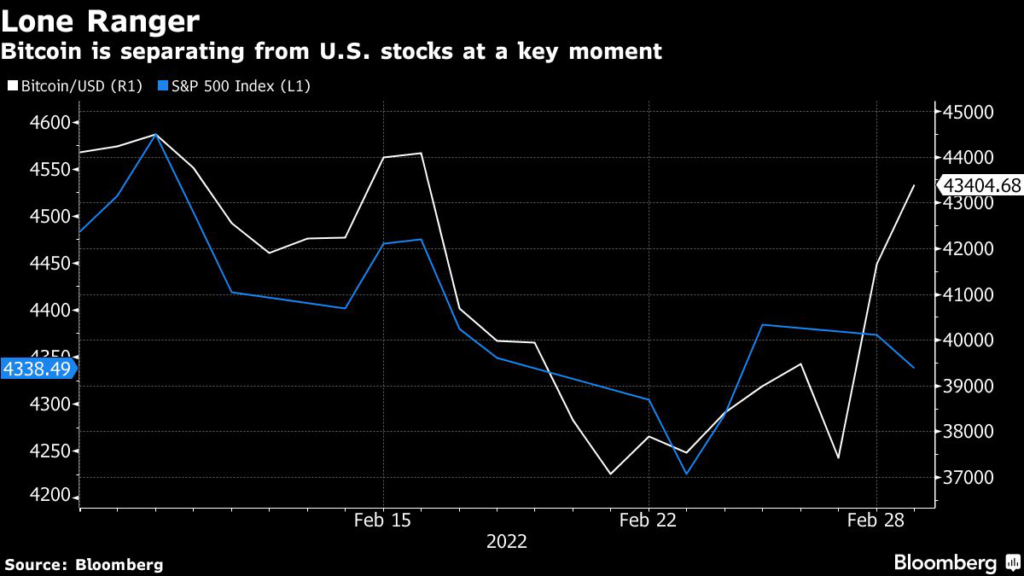
Why is it rallying? It’s not because stocks are, for once: The S&P 500 plunged almost 2% Tuesday. Another explanation is that digital assets will gain favor amid sanctions in Russia, perhaps as an alternate currency. Yet another is that after weeks of tracking equities, it has suddenly caught on again as an inflation hedge.

The fact that Bitcoin can perform in line with equities on one day and be impervious to them the next might be logically difficult, but it’s nothing new for anyone who has tried to predict its path. As always with constructing such narratives in a market this young, confidence is a liability, and humility the key.

From what we can tell about crypto’s usefulness in the current environment, there are two stories at play, one led by Russia and the other by Ukraine. 

Amid strict sanctions from the U.S. and its allies, the Russian government has restricted citizens’ access to foreign money, forcing them to consider other options to the ruble, dollar or euro for keeping their savings safe. Crypto might be a way around that, some traders are betting, sending Bitcoin’s market value up as much as 20% across the last two days. Interestingly, those that appeared to profit the most from such moves on Monday were “privacy coins” such as Monero and ZCash — digital tokens that obscure the flow of money across their underlying blockchain networks to maintain the anonymity of their users. They rose even faster than mainstream coins as untraceable crypto ecosystems seemed set for a sanctions bounce.

Meanwhile, the Ukrainian government and volunteer organizations have accepted more than $30 million worth of crypto donations so far, according to data from Elliptic. While the likelihood is that these acts of charity aren’t behind the crypto boom — the regular person on the street doesn’t need to go to the effort of converting cash into crypto to donate when there are many other traditional routes available — it’s demonstrative of the sector’s ability to act as a force for good.

As for the speculation that crypto will be a useful vehicle for sanctions evasion, that’s a chicken-and-egg situation. For starters, digital assets are heavily reliant on exchanges to act as middlemen for buying and selling, despite the crypto community’s professed decentralization. Executives at firms like Kraken and Binance have said that freezing Russian accounts, as some in Ukraine would prefer, would go against the spirit of crypto, which has long been positioned as a way to circumvent the censorship that banks and governments can apply. And they’ve said this even as many have contributed to the Ukrainian effort.

But that argument won’t fly for long with regulators. The European Union may speed up crypto regulation so that digital coins can’t be used as a sanctions workaround, and the Biden administration has petitioned exchanges to comply with the sanctions they’ve slapped on Russian individuals and entities. 

The path to crypto rules has been a rocky one, but it’s something that companies like Coinbase Global Inc. have seen coming and are increasingly prepared for. Now, as we near the implementation of potentially restrictive guidelines and increased oversight of the industry, crypto firms have a decision to make: grow up and be regulated while dishonoring Bitcoin’s anti-censorship ethos, or continue to rebel and face the consequences.

For those on the ground in Moscow or Kyiv, crypto might look appetizing right now while traditional markets are in turmoil. But as the above — and indeed, the market’s history to date — shows, there’s no guarantee it’s going to stay that way.

More stories like this are available on bloomberg.com

©2022 Bloomberg L.P.
Uber Plans to Expand German Delivery Business After Early Gains

(Bloomberg) — Uber Technologies Inc. plans to grow its food delivery business in Germany to around 70 cities by the end of this year, up from the current 14 in Europe’s largest economy.

Eve Henrikson, Uber’s regional general manager for delivery in Europe, the Middle East and Africa, said the investment was the result of “lots of demand.”

“That gives the confidence to push and expand,” she said in an interview. 

Germany’s food delivery market has been dominated by Just Eat Takeaway.com NV until last year. Companies including Uber and DoorDash Inc. broadened the market when they started local operations during the pandemic, while Berlin-based Delivery Hero SE announced in December it was exiting the country.

Henrikson said Uber Eats had the advantage of being able to offer restaurants a network of couriers, whether or not they already had a fleet. Just Eat relies on a premises having its own riders. 

Read more: Uber, Just Eat Takeaway CEOs Spar on Twitter Over Tax and Shares

Food delivery stocks have sunk in recent months as investors shift their focus to profit rather than fast-growing technology companies. Uber’s delivery business weathered a selloff better than others and recorded adjusted profits for the first time last quarter, driven in part by its European business more than tripling since the start of the pandemic.

The San Francisco-based company has also been investing in new business areas in Europe, such as a partnership with French grocery chain Carrefour SA to offer rapid delivery starting in Paris last October. That service is now in nine cities across France, Henrikson said.  

Read more: Food Delivery Giants Enter Year Jockeying for Deals and Turf 

More stories like this are available on bloomberg.com

©2022 Bloomberg L.P.

Close Bitnami banner
Bitnami
