

Bloomberg

Singapore Tech Salaries Jump 22% in Chase for Skilled Coders

(Bloomberg) — Salaries for software engineers in Singapore increased by an average of 22% last year, highlighting the need for qualified talent to sustain the city-state’s burgeoning tech ecosystem, according to a report published this month.

Some experienced roles, like lead software engineers, commanded average increases up to 32% during the period, NodeFlair and Quest Ventures found. 

Singapore has attracted several fast-growing startups while also hosting the Asia-Pacific hubs of operation for global companies like Meta Platforms Inc. and Alphabet Inc.’s Google. The two U.S. giants announced plans last year for several undersea cable projects to link Singapore and the wider Southeast Asia region to the U.S. West Coast.

The competition for highly qualified engineers has produced a wide variance in pay, according to the researchers, who verified payslips and offer letters as part of procuring their figures. The highest-paid roles came with compensation as much as three times higher than more junior positions. Sea Ltd.’s Shopee, ByteDance Inc. and Grab Holdings Ltd. were among the most searched-for employers in the tech sector, joined by big U.S. firms like Amazon.com Inc. and Visa Inc. as well as Google and Meta.

Other factors driving Singapore salaries up include the rising cost of living in the city-state, which saw rents rise to the highest in six years in the third quarter last year. Tightening conditions for worker visas have also made it harder to bring in less senior workers. Singapore announced at its annual budget last week that it will raise minimum salary requirements for most so-called employment pass holders to S$5,000 ($3,700) from S$4,500, after an earlier increase in 2020.

The further tightening is likely to worsen an already severe staffing shortage, and smaller firms and local startups may find it unfeasible to sustain aggressive salary increases for junior professionals, said Yu Liuqing, a Singapore-based country analyst for Asia at the Economist Intelligence Unit.

More stories like this are available on bloomberg.com

©2022 Bloomberg L.P.

Uber and Lyft Accord With Labor Advances in Washington State

(Bloomberg) — A bill that would extend new benefits to Uber Technologies Inc. and Lyft Inc. drivers, while also designating them non-employees, passed the Washington State House, marking a step forward for a compromise that has won support from both a major union and the industry. 

The legislation, backed by the local Teamsters union and both companies, has elements meant to appease drivers and the corporations, which have long opposed treating drivers as full-fledged employees. For drivers, it would guarantee perks, such as paid sick leave and a minimum pay rate for the time they spend transporting passengers, and fund a “driver resource center,” which could represent workers in contesting their terminations.

The bill also fulfills long-sought goals of the companies. It would preempt cities from regulating the ride-hailing companies themselves, and specify that the firms aren’t employers of their drivers, as long as they meet conditions — such as not unilaterally setting their workers’ schedules. At a hearing last month on a prior version of the bill, Representative Liz Berry, a Democrat and one of the legislation’s sponsors, described it as a “culmination” of years of negotiations between Uber, Lyft and union representatives.

“Thousands of Uber and Lyft drivers — predominantly immigrants and people of color — will benefit from this long overdue expansion of pay raises, benefits and protections statewide,” Peter Kuel, president of the Teamsters-affiliated Drivers Union, said in an emailed statement. He praised the legislation for making Washington “a national leader winning the highest labor standards in the gig economy.” Uber and Lyft spokespeople both confirmed that they support the current bill. Spokespeople for the national AFL-CIO and Washington Governor Jay Inslee didn’t immediately respond to inquiries.

The legislation’s fate now rides on the state Senate. Similar efforts in states such as New York, California and Connecticut have been derailed by concerns among some labor advocates that the compromises would deprive workers of the full workplace protections to which they’d be entitled if they were classified as employees, such as an hourly minimum wage that includes their time waiting between passengers.

University of California Hastings law professor Veena Dubal said Wednesday that the Washington bill’s approach echoes Proposition 22, the ballot measure that gig companies spent $200 million passing in California to designate their workers as non-employees, while providing them a set of alternative perks.

“It is a sad compromise,” Dubal said in an email. “The labor institutions involved on behalf of workers must demand more.”

(Updates with company response in fourth paragraph.)

More stories like this are available on bloomberg.com

©2022 Bloomberg L.P.

Bitcoin Tumbles as Putin Orders Military Into Eastern Ukraine

(Bloomberg) — Cryptocurrencies dropped as Vladimir Putin decided to conduct military operations in eastern Ukraine, with Bitcoin slumping to a one-month low.

The largest token fell as much as 7.4% to $34,783 after an initial Tass report on Russia’s decision. Second-ranked Ether declined as much as 8.7% to $2,390.61. Other coins like XRP, Cardano and Solana were down as well.

Bitcoin’s swings during the past weeks of escalating geopolitical tensions have served to undermine the argument that cryptocurrencies offer a hedge in times of trouble. The traditional safe haven gold, meanwhile, surged to the highest level since early 2021 on Thursday. 


“Risk assets continue to be weighed down by the Russia-Ukraine conflict and tensions. This includes Bitcoin and cryptocurrencies which are currently still very much viewed as a high-risk asset class,” said Vijay Ayyar, vice president of corporate development at Luno, a crypto platform. 

The next key level to watch for Bitcoin will be $28,000 to $29,000, he said. If that treshold gets breached, “we could be looking at much lower levels in the low $20,000s and below.”

More stories like this are available on bloomberg.com

©2022 Bloomberg L.P.

China to Demand Ride-Hailing Fee Caps, Transparency This Year

(Bloomberg) — Ride-hailing firms and online trucking platforms in China will have to set reasonable caps on their fees and make their pricing rules public this year, according to Wang Xiuchun, a senior official at the Ministry of Transportation.

The plan to rein in commissions and offer more transparency was signaled in guidelines issued in November by several government agencies and mirrors Friday’s request for food-delivery services to also cut fees. President Xi Jinping’s “common prosperity” agenda has prioritized helping small businesses and individual operators, such as ride-hailing drivers, to navigate the challenges of the pandemic, which has increasingly come at the cost of big internet service operators.

Didi Global Inc. and Full Truck Alliance Co. will likely be the two companies most immediately impacted by the move, as the domestic leaders in their respective spheres. Both were listed on U.S. markets in the summer, though Didi is now working on a Hong Kong listing because of government concerns about the security of its user data.

Worries about a revival of China’s broad regulatory crackdown has in recent days wiped billions off the value of the country’s biggest tech companies, such as Alibaba Group Holding Ltd. and Tencent Holdings Ltd. Investors remain wary about the depth and extent of Beijing’s latest push to rein in private enterprise and profits. 

China Crackdown Risk Roars Back in Probe of Jack Ma’s Empire

More stories like this are available on bloomberg.com

©2022 Bloomberg L.P.
Amazon Union Organizer Arrested Outside of NYC Warehouse

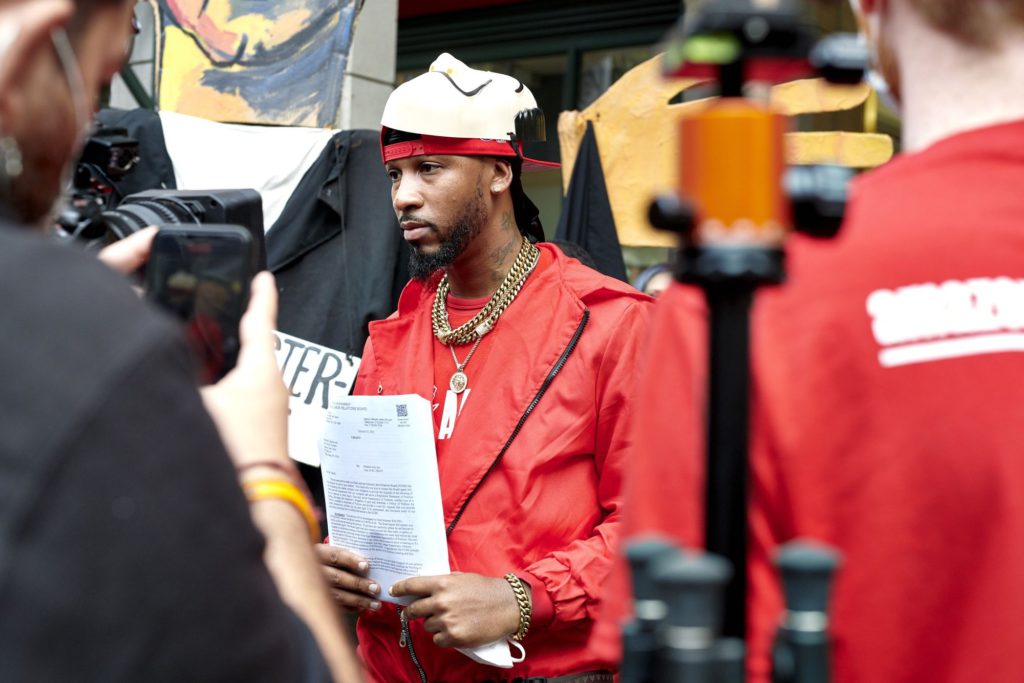
(Bloomberg) — A union organizer and two workers were arrested Wednesday outside an Amazon.com Inc. warehouse in New York, the latest sign of escalating tension between the e-commerce giant and labor groups. 

Christian Smalls, president of the fledgling Amazon Labor Union, was charged with trespassing, resisting arrest and obstructing governmental administration, a New York Police Department official said in an interview. The Amazon employees arrested by police were Brett Daniels and Jason Anthony, two members of the Amazon Labor Union. Smalls tweeted around 9:30 p.m. Wednesday that he had been released: “I’m free !! and I’m not stopping.”

Earlier this month, the ALU and Amazon reached an agreement to hold a union election at the JFK8 fulfillment center, where the arrests occurred. The in-person vote will be held from March 25 to March 30. 

Smalls had driven into the parking lot to deliver food and union literature for employees to share with co-workers, according to Connor Spence, a union vice president who said he witnessed the incident.

“I think it started off as a scare tactic that completely went off the rails,” said Spence, who accused the company of calling the police in an effort to intimidate employees in the lead-up to the election.

Amazon said that it called the police on Smalls, but “did not call the police on employees.” Spokesperson Kelly Nantel said that “Smalls — who is not employed by Amazon — has repeatedly trespassed despite multiple warnings. Today, when police officers asked Mr. Smalls to leave, he instead chose to escalate the situation and the police made their own decision on how to respond.”

The union’s attorney, Seth Goldstein, said that by bringing in police the company had violated the terms of a settlement reached with the National Labor Relations Board restricting anti-union tactics. Smalls didn’t respond to requests for comment.

An Amazon spokesperson said that the settlement involves the rights of current employees to solicit co-workers on the property, not non-employees.

Smalls worked at Amazon for more than four years before being fired in 2020 for what the company said was a violation of safety guidelines. Smalls said he was protesting Amazon’s inadequate Covid-19 policies. 

(Updates with Smalls’s tweet in second paragraph.)

More stories like this are available on bloomberg.com

©2022 Bloomberg L.P.
Chip Supplier to Apple, Intel Warns of Tight Capacity Till 2027

(Bloomberg) — Unimicron Technology Corp., an obscure but critical player in making semiconductors, said that demand for high-performance computing chips is so strong that its production capacity will be strained for the next five years. 

The Taiwanese company makes Ajinomoto build-up film (ABF) substrate, a key part required for the packaging that protects the handful of chips needed to power computers or servers. Its customers include Intel Corp., Apple Inc., Advanced Micro Devices Inc. and Nvidia Corp. and its materials go into CPUs and GPUs for computers, servers and gaming consoles.

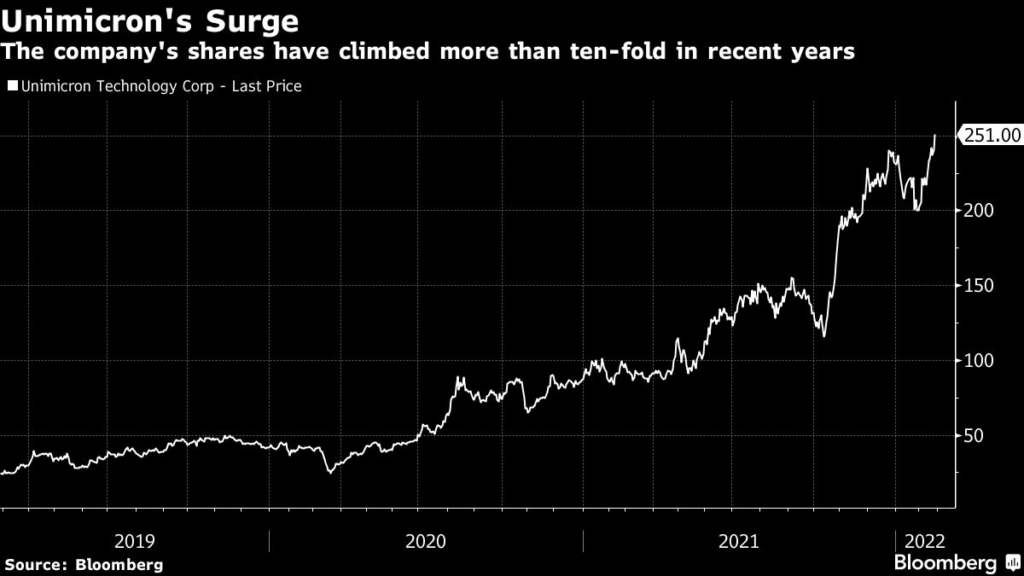
In a call after earnings, Unimicron President Michael Shen told analysts that its capacity is full until at least 2027. It shares climbed as much as 4.6% in Taipei on Thursday to a record high.

“Customers are now talking to us about orders for 2027, 2028, 2029 and 2030,” Shen said. “Lead time for new equipment now can be two to three years.”  

Major semiconductors companies like Intel, Nvidia and AMD now all depend on ABF substrates to produce the most powerful chips in the world. That means that even as chipmakers and governments around the world spend hundreds of billions of dollars to attract and build fabrication capacity, the lack of that key component could hinder overall production for years.

Shen said existing customers have locked in the company’s ABF substrate capacity for the long term, suggesting new customers or new entrants may struggle to get the supplies they need. 


ABF substrate makers have long been reluctant to invest aggressively in capacity because of money-losing slumps in the past and that has led to a tight supply of the component. 

Unimicron’s shares have soared more than ten-fold over the past three years.

More stories like this are available on bloomberg.com

©2022 Bloomberg L.P.

Imax Theaters to Stream as Many as 25 Live Events This Year

(Bloomberg) — Imax Corp. is looking to host anywhere from 10 to 25 live events that will be streamed in its theaters this year, testing a new strategy as it copes with a still challenging market for cinemas. 

Richard Gelfond, the company’s chief executive officer, said he’s looking at events such as concerts, stand-up comedy shows and e-sports tournaments to play on Imax screens. Two concerts by rapper Kanye West were featured in dozens of Imax theaters this week and in December, with tickets nearly sold out.

“I think there’s an explosion in the experiential economy, people seeking out live events,” Gelfond said during a phone interview Wednesday. “There’s tremendous audience demand.”

The Mississauga, Canada-based company reported fourth-quarter revenue that beat analysts’ estimates Wednesday. That was in part spurred by the success of Sony Group’s “Spider-Man: No Way Home,” the top-grossing film of the pandemic. The quarter was Imax’s strongest since 2019. Shares were up about 3% in late trading. 

Imax is planning other interactive audience experiences, with stars and filmmakers participating in live question-and-answer sessions. Director Peter Jackson, for example, received queries in real time from audiences attending the Imax-only release of his Disney+ documentary, “The Beatles: Get Back” in January and February. The company earned more than $2 million in box office sales from that run. 

The Imax theater network has nearly 1,700 locations in 87 countries and territories. About 70 theaters, or the equivalent of about 25,000 seats, have been upgraded with instant-simulcast technology. Imax plans to significantly expand that technology to other theaters. Doing so would not require large capital expenditures, according to Gelfond, because the technology is mostly internet-based.  

Imax has tried other strategies to expand beyond films. In 2016 the company unsuccessfully tried to build virtual reality arcades before shutting that business down. 

More stories like this are available on bloomberg.com

©2022 Bloomberg L.P.
Gold Holds Advance on Rising Haven Demand Amid Ukraine Tensions

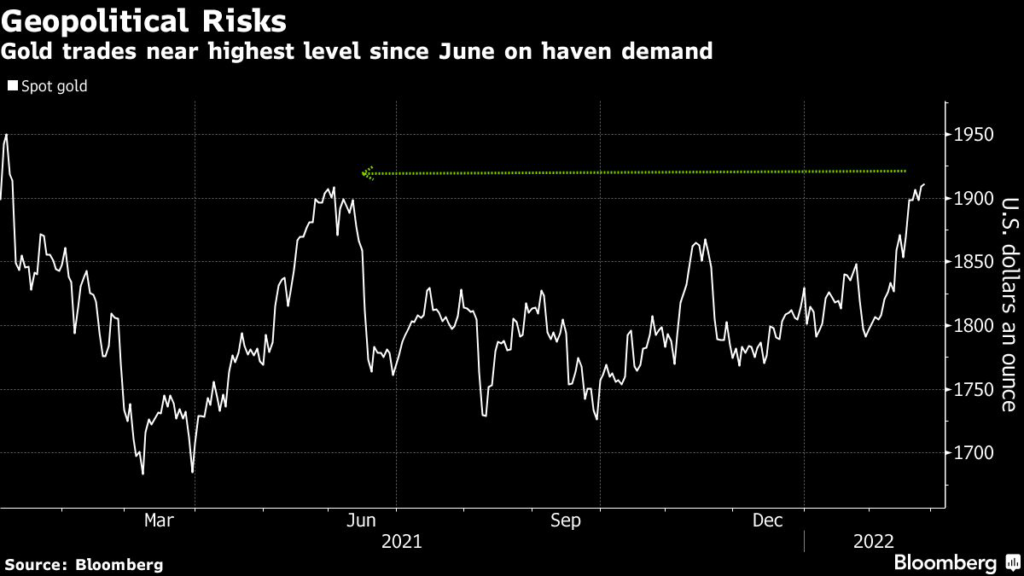
(Bloomberg) — Gold traded near its highest level in more than eight months as tensions around Ukraine intensified, boosting demand for the haven asset.

Separatist leaders in eastern Ukraine appealed to Russia for help fighting Ukrainian forces, the Kremlin said, a dramatic step that could be catalyst for Moscow to deploy troops there. The U.S. earlier expanded sanctions against Russia.

Bullion has got support from the growing crisis in Eastern Europe, with prices pushing higher despite expectations that the Federal Reserve will raise interest rates in March. 

On Wednesday, President Joe Biden added new U.S. penalties, hitting the builder of the Nord Stream 2 gas pipeline and its corporate leadership. This is on top of a package announced a day earlier by the White House after Russian President Vladimir Putin moved to recognize breakaway territories in Ukraine as independent states.

The request for Moscow’s help from two breakaway regions comes as Putin sustains a large troop buildup on the Ukraine border. The U.S. estimates that around 150,000 soldiers are in the area, plus significant military equipment. Russia has repeatedly rejected claims that he intends to invade.

“The market has yet to see the kind of news that would galvanize the gold price to a new high,” said Nicholas Frappell, global general manager at Sydney-based ABC Bullion. “Putin’s recognition of the two breakaway regions has kept a bid under gold and the market is trading risk off with equities lower. If prices rise above $1,915, the emphasis is bullish, and expectations would tend toward the $1,935-$1,960 level.”

Spot gold rose 0.1% to $1,910.90 an ounce at 8:29 a.m. in Singapore, after climbing 0.6% Wednesday. Prices had touched $1,914.25 on Tuesday, the highest intra-day level since June 1. The Bloomberg Dollar Spot Index was little changed. Silver and platinum were steady, while palladium rose.

More stories like this are available on bloomberg.com

©2022 Bloomberg L.P.

Don’t Judge Us on Our Fines, Meta’s EU Data Watchdog Pleads

(Bloomberg) — Europe’s groundbreaking privacy law risks being damaged if massive fines for Silicon Valley are the only yardstick for success, Ireland’s beleaguered data protection chief warned.

Without agreed standards, “a narrative has emerged in which the number of cases, and the quantity and size of the administrative fines levied, are treated as the sole measure of success,” said Helen Dixon, whose under-fire Irish agency oversees the many U.S. tech firms that made her nation their EU base. 

Complex cases involving some of the world’s biggest companies “impacting on millions of people” can’t be measured “side by side with a two-line treatment of a comparatively simple issue that has minimal ramifications,” she added.

The EU’s General Data Protection Regulation, or GDPR, empowers EU data regulators to levy penalties of as much as 4% of a company’s annual revenue for the most serious violations. 

Apple Prefers Fine to Obeying Antitrust Order, Vestager Says

The rules put the Irish Data Protection Commission in charge of some of the world’s biggest tech firms, including Meta Platforms Inc. and Apple Inc. But tensions have been building in recent years over the amount of time the authority is taking to complete probes.

The Irish watchdog had 30 EU-wide probes open at the end of last year, targeting the likes of Apple, Alphabet Inc.’s Google and Twitter Inc., as well as Meta’s Facebook, WhatsApp and Instagram. It also opened two investigations into ByteDance Ltd.’s TikTok last year.

The two biggest fines under GDPR so far included a 225 million-euro ($255 million) penalty for WhatsApp by the Irish authority last year, and a record 746 million-euro fine for Amazon.com Inc. by its lead privacy watchdog in Luxembourg.

Europe’s Data Law Is Broken, Departing Privacy Chief Warns

Dixon’s warnings come as her office is finalizing a potentially landmark decision that could paralyze transatlantic data flows and risk billions in revenue for Big Tech as well as thousands of other companies. 

At issue are the legality of so-called standard contractual clauses that emerged as the main workaround after the EU’s top court banned an EU-U.S. privacy pact. 

Judges said that the accord didn’t stop American agencies from gaining access to private information about European citizens, a problem that wasn’t fully solved by the alternative of using contractual clauses.

With no other legal data transfer tool available in the immediate future, Meta warned in its latest annual report that it will “likely be unable” to offer services including Facebook and Instagram in the EU. 

More stories like this are available on bloomberg.com

©2022 Bloomberg L.P.

SoftBank Leads $230 Million Funding for U.K. Retailer Gousto

(Bloomberg) — Gousto, a U.K. meal-kit company, has secured $230 million in funding from investors led by SoftBank Vision Fund 2, the second stake taken this year by the equity arm of the Japanese tech giant. 

The Vision Fund invested $100 million in the online food subscription service last month in a round that valued Gousto at $1.7 billion. 

Known for its red recipe boxes delivered to customers’ front doors, Gousto was well positioned for the pandemic, reporting its first profit in 2020 and selling 53 million meals. Grocery deliveries are becoming more and more popular with dozens of startups aiming to deliver food in less than 30 minutes.

Gousto has “succeeded in disrupting the traditional grocery channel when it comes to how we consume the evening meal,” Max Ohrstrand of SoftBank Investment Advisers, said Thursday in a statement announcing the investment. 

Other investors in the latest funding round include Fidelity International, Grosvenor Food & AgTech and Railpen, the U.K.’s seventh-largest pension fund, Gousto said in the statement. 

Gousto said it wants to double the number of workers in its tech team by the end of 2022.

“I’m thrilled that following on from their initial investment, SoftBank has increased its stake, which speaks volumes for where they see the business heading,” Gousto founder and Chief Executive Officer Timo Boldt said in the statement.

More stories like this are available on bloomberg.com

©2022 Bloomberg L.P.

Close Bitnami banner
Bitnami
