Bloomberg

Startup NayaPay Raises Pakistan’s Biggest Fintech Funding Round

(Bloomberg) — Pakistan’s NayaPay Pvt. has raised $13 million in early stage funding as it seeks to capture millions of users in one of the world’s largest under banked nations.

The Karachi-based startup’s seed round was led by Zayn Capital, MSA Novo and Silicon Valley early-stage investor Graph Ventures, Chief Executive Officer Danish Lakhani said in an interview. NayaPay became the first startup to offer financial services after receiving a license from the State Bank of Pakistan in August. The fintech’s chat-led payments app started by targeting students and freelancers. 

Fintech startups in developing nations are drawing increasing investor interest as more people embraced the convenience of digital payments during the pandemic. In Pakistan, only 1% of almost $4 trillion of payments are made digitally. The country has the third-largest population globally of people without access to banking services, according to the World Bank.

“Fintech is a tremendous opportunity in Pakistan,” said Lakhani, who previously led the country’s largest fiber-broadband service, StormFiber.

NayaPay is now building a payment platform for small and medium enterprises similar to Square, WeChat Pay and Venmo. The company is targeting five million customers and 300,000 merchants in five years, said Lakhani.

Saison Capital, Lakson Group, Waleed Saigol’s Maple Leaf Capital and Warren Hogarth of Empower Finance also participated in the round.  

“While just beginning to emerge, Pakistani fintechs have the advantage of learning from peers and making better-informed strategic bets,” said Faisal Aftab, co-founder at Zayn Capital. 

More stories like this are available on bloomberg.com

©2022 Bloomberg L.P.

The $200 Billion Club Loses Last Member as Elon Musk’s Wealth Tumbles

(Bloomberg) — No person on the planet has a fortune of more than $200 billion — at least for now. 

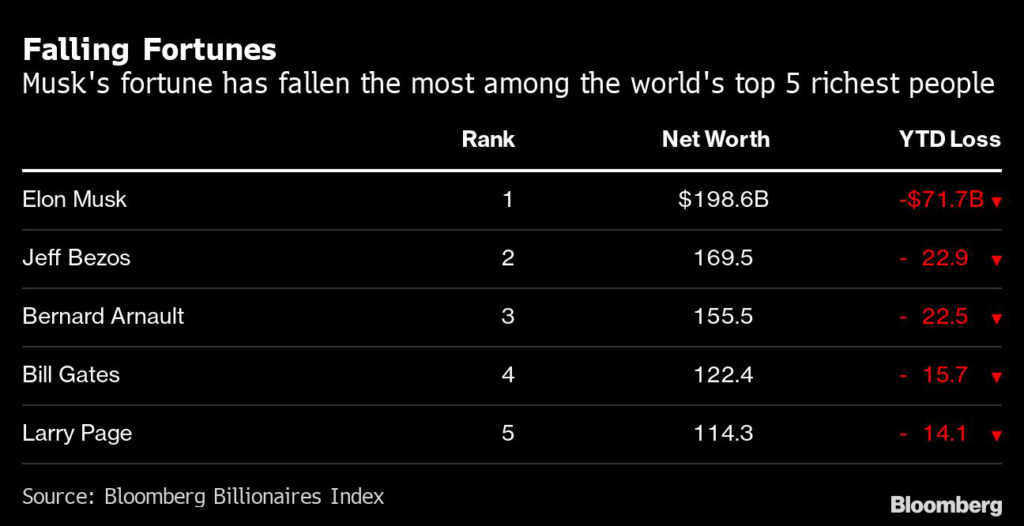
Elon Musk, the only billionaire who still exceeded that threshold heading into this week, saw his wealth tumble by $13.3 billion on Wednesday to $198.6 billion. Tesla Inc. shares fell for the fourth-straight day to the lowest level since September amid a broad decline in stock markets around the globe.

Tesla’s 50-year-old chief executive officer remains the richest person in the world, according to the Bloomberg Billionaires Index. Still, Musk has seen $71.7 billion wiped out from his fortune so far this year, more than the next three wealthiest people combined, as markets grapple with geopolitical tensions around Ukraine and more hawkish central banks.

Musk’s wealth peaked at $340.4 billion on Nov. 4, when Tesla shares reached a record high. Days later, he asked his Twitter followers if he should sell part of his stake, sparking a sharp decline in the company’s stock that erased $35 billion from his net worth in a day — a nearly unprecedented sum. He eventually completed a series of stock sales worth more than $16 billion and also donated $5.7 billion of shares to charity.

Amazon.com Inc. founder Jeff Bezos is the only other person whose wealth has ever exceeded the $200 billion mark, first reaching that milestone in April. His fortune fluctuated around that level for most of last year before dropping below it for good in December.

More stories like this are available on bloomberg.com

©2022 Bloomberg L.P.

Booking Falls After Pace of Travel Revival Disappoints

(Bloomberg) — Booking Holdings Inc. reported gross bookings in line with estimates, but room night reservations on the online travel company’s platforms fell far short of expectations during the holiday period as the omicron variant continued to disrupt global travel.

The shares, which initially rose after the report, gave back those gains and dropped as much as 8.9% in extended trading.

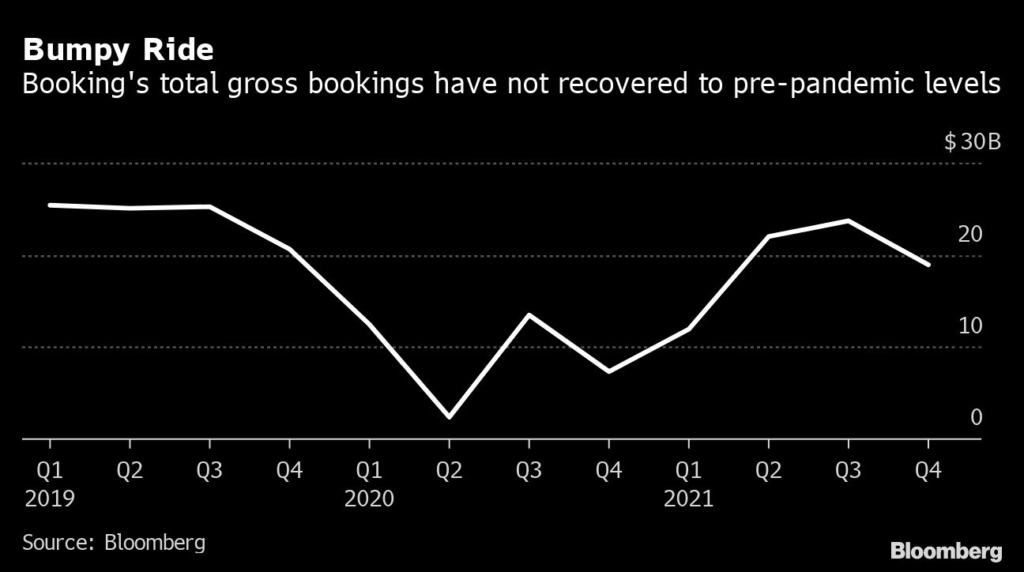
The company’s gross bookings, which represent all travel services excluding cancellations, increased 160% to $19 billion, according to a statement Wednesday. Revenue more than doubled to $2.98 billion. Analysts, on average, projected gross bookings of $19 billion and sales of $2.88 billion, according to data compiled by Bloomberg. 

While meeting Wall Street’s estimates, gross bookings are still lagging behind pre-pandemic levels. The metric hit almost $21 billion in the fourth quarter of 2019. Room nights booked were 151 million in the period ended Dec. 31, compared with analysts’ estimates of 165.9 million. The company reported 191 million room nights booked in the fourth quarter of 2019. 

Still, Chief Executive Officer Glenn Fogel expressed cautious optimism about the year ahead.

“I am encouraged by the meaningful improvement in bookings we have seen so far in the first quarter,” Fogel said in the statement. “I believe we are well positioned as travel demand recovers, however, we do expect there will still be periods where Covid negatively impacts travel trends as we move through the year.”

Profit, excluding certain costs, was $15.83 a share, compared with the analyst estimate of $13.50 a share. 

Most travel companies outperformed expectations for the fourth quarter even with the uncertainty and flight disruptions caused by omicron. Expedia Group Inc. and Airbnb Inc. said the shocks of the virus had become less severe. Airbnb has found a niche in providing short-term rentals that let employees “work and live from anywhere,” which made 2021 the “best year” in the company’s history, CEO Brian Chesky said. 

Booking has a strong global presence, with close to 90% of 2020 revenue coming from its international segments. Travel slowed down in December for both international and domestic travel, with cancellation rates above fourth quarter 2019 levels, Chief Financial Officer David Goulden said on a conference call after the results were released.

However, Goulden also said the company is seeing stronger signs of a recovery underway this month. Room nights for the first half of February were close to 2019 levels, with particularly strong growth in the U.S., he said. Cross-border travel is also recovering in Europe, with average stays increasing and shorter booking windows compared with 2019.

Goulden’s view echoed a note earlier Wednesday from Kevin Kopelman, an analyst at Cowen Inc, who wrote that European travel appeared to be improving despite a hit in January. Low-priced airline Ryanair said it expected pre-pandemic passenger levels to recover by March, Kopelman wrote. 

Norwalk, Connecticut-based Booking owns flight aggregator Kayak and travel booking site Priceline, as well as an alternative accommodations platform. The stock had increased 2.9% this year after closing at $2,469.83 in New York.

(Updates with shares in the second paragraph.)

More stories like this are available on bloomberg.com

©2022 Bloomberg L.P.

Twitter Is Selling $1 Billion of Junk Bonds to Fund Share Buyback

(Bloomberg) — Twitter Inc. sold $1 billion of notes in the U.S junk-bond market Wednesday in part to help finance a share buyback, helping to revive the new-issue landscape that had been frozen for almost two weeks.

JPMorgan Chase & Co. led the sale of the unsecured debt, which is due in 2030. The bonds priced with a 5% yield, according to a person with knowledge of the matter, after earlier pricing discussions in the range of 5%. In addition to share repurchases, proceeds will be used for general corporate purposes, which could also include capital expenditures, investments and working capital, Twitter said in a statement.

The San Francisco-based company made its high-yield debut in 2019, raising $700 million after receiving more than $6 billion in orders. The deal was sold at a yield of just 3.875% — one of the lowest ever seen in the junk market — and is currently trading at about 4.2%, according to Trace data. 

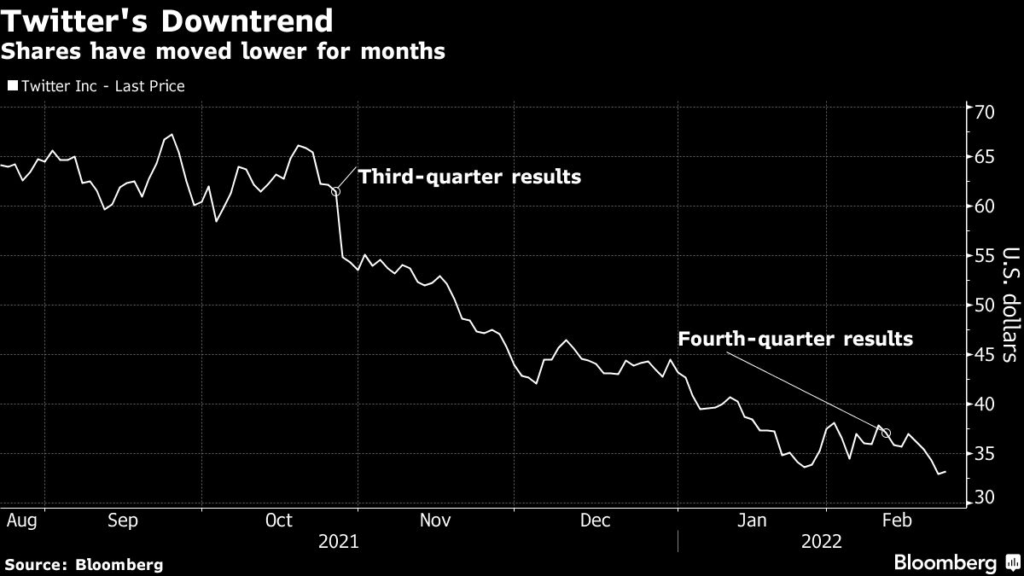
Twitter shares have dropped more than 10% since the company announced a $4 billion stock buyback in conjunction with its quarterly earnings report on Feb. 10, while the tech-heavy Nasdaq 100 Index has declined about 5% in the same period. The stock has fallen about 23% this year and closed Wednesday at $32.76.

Newly installed Twitter Chief Executive Officer Parag Agrawal has vowed to increase accountability, make decisions faster and to improve product execution. The company set ambitious goals for growth including increasing annual revenue to $7.5 billion and getting to 315 million daily users by the end of 2023.

End of Hiatus

Twitter’s latest offering, along with a sale announced Tuesday from protein shake maker BellRing Brands, reopened the U.S. junk-bond new issue market. The last deal to price was on Feb. 10, when Norwegian Cruise Line Holdings Ltd. raised $1.6 billion, according to data compiled by Bloomberg.

Moody’s Investors Service described Twitter’s debt sale and share buyback as a “credit negative” in a Wednesday statement but added that there will be no immediate effect on the company’s credit rating. The credit grader said the transaction further “increases gross leverage above Moody’s downgrade threshold of 3.5x,” but that the company has a substantial amount of cash on hand. 

Though the debt will in part be used to fund potential acquisitions, Twitter isn’t actively engaged in any deals at this time, according to the company’s statement.

“From time to time Twitter evaluates potential strategic transactions and acquisitions of businesses, technologies or products,” according to the statement. “Currently, however, Twitter does not have any agreements with respect to any such material strategic transactions or acquisitions.”

(Adds final pricing details.)

More stories like this are available on bloomberg.com

©2022 Bloomberg L.P.

Rout Across Tech-Stock Complex Sends Nasdaq to Bear Market Brink

(Bloomberg) — In a stock market hit from every direction, from the Russia-Ukraine conflict to surging oil and its impact on Federal Reserve policy, it’s been all but impossible to get a grip on minute-to-minute market swings. 

One consistent trend, however, is tech speculators getting burned.

The ARK Innovation exchange-traded fund, known by its ticker ARKK, fell for the fifth straight day and lost near 4% on Wednesday alone. Shares of Tesla Inc. retreated for the fourth consecutive session, having shed more than 27% in value since 2022 started. Meanwhile, a Goldman Sachs basket of non-profitable tech companies, which is trading near its lowest levels since July 2020, lost 4.6%, and a fund tracking newly public firms lost 3.8%. 

Tech stocks of all stripes are leading the market selloff, with the Nasdaq Composite Index near a 20% fall from November records after a 2.6% slide Wednesday.

The ARKK fund, the epitome of risk taking, has lost more than 35% since the start of the year, with short interest as a percentage of shares outstanding sitting near records at 11%, according to data from IHS Markit Ltd. 

“This market is made up of whipsaw moves — ‘buying the dip’ has not worked for the past two months,” said Michael O’Rourke, chief market strategist at JonesTrading. “Thus, investors are stepping back from the more speculative areas of the market because they are not being rewarded for the higher risk that accompanies such volatile names.”

Erratic swings have been prevalent all year as investors struggle to price in a host of factors, including red-hot inflation readings and a Fed that’s on the verge of raising interest rates. On top of that, investors are also weighing escalating geopolitical tensions in Europe. The White House expanded sanctions against Russia Wednesday, with new U.S. penalties hitting Nord Stream 2 AG and its corporate officers. 

A day after closing in correction territory — a 10% drop from recent highs — the S&P 500 reversed Wednesday morning gains to fall 1.8%. The small-cap Russell 2000 index dropped a similar amount, while the Nasdaq 100 lost 2.6%.

“We’re going to see a lot of volatility in the weeks ahead because clearly the situation is by no means clear,” said Aoifinn Devitt, chief investment officer at Moneta, referring to the geopolitical tensions. 

Wednesday’s action is consistent with a pattern that’s been seen for weeks — morning rallies give way to afternoon selloffs one day, only to exhibit the reverse again the next. 

“Equities saw some relief premarket but were quickly sold on the open as investor debate whether 10% is enough or whether we need a final flush to really reset,” wrote Chris Murphy, co-head of derivatives strategy at Susquehanna. 

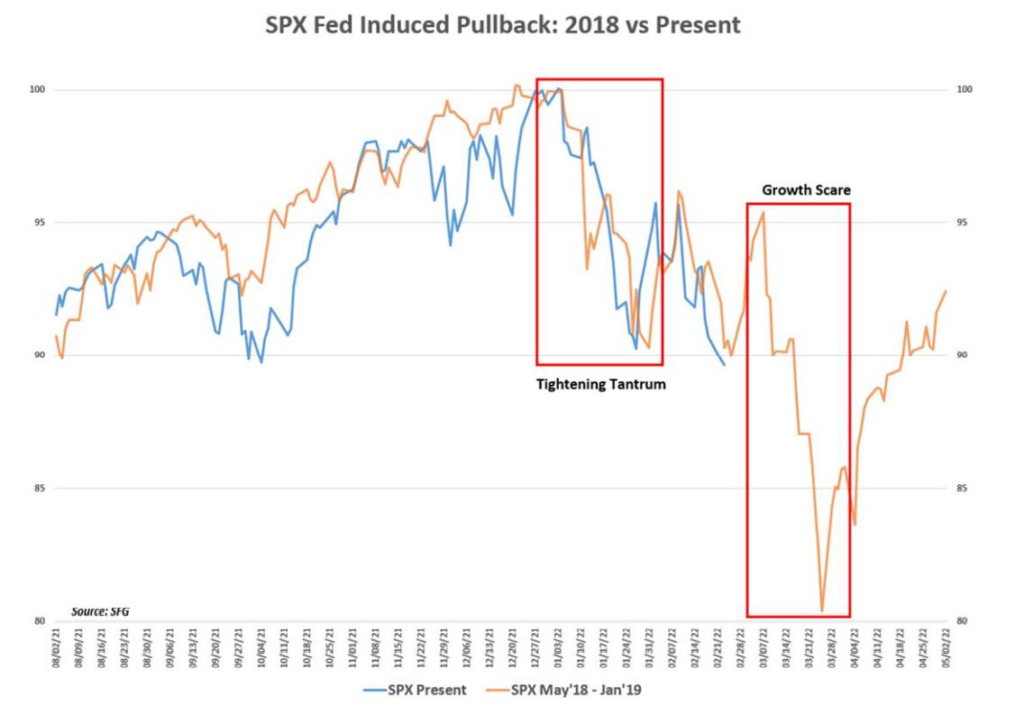
Still, Murphy says that should 2018-esque moves repeat — when stocks also declined on Fed developments — the market could be due for a short-term rally.

“However, after a bounce, the 2018 analogy has a lot more downside,” he added. 

Some of the wildest moves Wednesday were in the energy space, which is sensitive to any escalation in the conflict between Russia and Ukraine. The price of oil resumed its upward stretch — with Brent crude reaching $97 a barrel — after JPMorgan Chase & Co. said prices are likely to average $110 in the second quarter.

Risk sentiment is now taking a beating given the uncertainty over how inflation-fueling commodity prices will change the monetary-tightening game, said Anastasia Amoroso, chief investment strategist at iCapital. 

“All of that is now kind of a confluence of really negative factors that’s weighing on the markets here,” she said on Bloomberg TV. 

Meanwhile, strategists at Morgan Stanley led by Michael Wilson say that though investors have been focused on Russia-Ukraine tensions over the past few weeks, signs of slowing economic growth are no-less ominous. The bank’s earnings model projects “a meaningful deceleration in EPS growth in the coming months,” they wrote in a note, adding that earnings revisions breath trends have also been slowing. 

All the same, still-contained credit spreads are giving bulls comfort. For that reason, Erin Browne, portfolio manager at Pacific Investment Management Co., is staying broadly optimistic. 

“I think over a medium-term perspective you’d do well buying here, but the next couple of weeks are going to continue to be choppy and certainly we could see downside risk from here,” she said on Bloomberg TV.

(Updates prices throughout)

More stories like this are available on bloomberg.com

©2022 Bloomberg L.P.

Cloudflare to Buy Area 1 Security in Push to Protect Against Phishing Emails

(Bloomberg) — Cloudflare Inc. said it has agreed to buy email protection provider Area 1 Security Inc. for $162 million, the security vendor’s largest acquisition to date as it looks to tackle a significant area of potential cyber vulnerabilities for businesses.  

The cash-and-stock deal is expected to close in the second quarter, Cloudflare said Wednesday. Closely held Area 1 Security, founded in 2014, had less than $10 million in annual revenue last year, and is “growing quickly,”said Cloudflare co-founder and Chief Executive Officer Matthew Prince. In January, the startup said its “growth rate more than doubled” last year. 

“Email is still by far the No. 1 place where security threats come from,” Prince said. “And while we are not getting fake diplomas or fake Viagra spam in our in boxes, the targeted phishing scams have gone through the roof.” 

Cloudflare, along with companies such as Palo Alto Networks Inc. and Zscaler Inc., is a “zero trust” vendor that aims to limit cyberthreats by putting on additional access controls, authentication services and other measures as a security verification layer over every application and employee within a company. 

The acquisition comes as Cloudflare faces skepticism from investors over the value of the company. It has surpassed earnings projections for the past several quarters, including a better-than-expected $194 million in sales in the three months through December. But Cloudflare’s stock has fallen more than 55% from an all-time high of $217.25 in mid-November. 

The San Francisco-based company released its own email security tool in 2021, joining technology providers like Apple Inc. and 1Password in providing services to help individuals and businesses bolster their defenses as phishing attacks skyrocket. The resulting robust demand from customers led Prince to shun Cloudflare’s penchant for internal development and survey the market for potential partners or an acquisition. 

“Whenever you are launching a new area, there are quirks in the technology and things that you have to learn,” Prince said. Area 1 Security has “got a great product. I think their sales efforts were more nascent, which is what you would expect in a startup.”

Cloudflare expects the acquisition to lead to “a significant uptick in both adoption and in the revenue that will generate,” Prince said, predicting that rival providers will follow suit with their own deals.  

More stories like this are available on bloomberg.com

©2022 Bloomberg L.P.

EBay Warns Investors It’s Still Losing Customers

(Bloomberg) — EBay Inc. warned investors that first-quarter sales will miss estimates as shoppers return to pre-pandemic spending habits. 

The shares fell about 12% in extended trading.

Sales will be $2.43 billion to $2.48 billion in the period ending in March, the San Jose, California-based company said Wednesday in a statement. Analysts, on average, estimated $2.6 billion, according to data compiled by Bloomberg. Earnings, excluding some items, will be $1.01 to $1.05 per share, missing estimates of $1.07.

The momentum EBay gained during the pandemic when people abandoned stores for websites has been fading as shoppers return to in-person browsing and buying. Chief Executive Officer Jamie Iannone maintains the company’s advertising and payments businesses can boost profits even if total spending on the site falls. 

The shares fell to a low of $47.72 in extended trading after closing at $54.59 in New York. The stock has dropped more than 11% over the past 12 months.

EBay ended the quarter with 147 million active buyers, down 9% from a year earlier. Gross merchandise volume, which is the value of all goods sold on the site, fell 10% to $20.73 billion in the period ended Dec. 31.

EBay has been divesting pieces of itself to appease activist investors discouraged by slow growth. In November, EBay said it completed the sale of just more than 80% of its South Korean online marketplace to local retailer E-Mart Inc. for $3 billion. 

More stories like this are available on bloomberg.com

©2022 Bloomberg L.P.

Video Game Addiction, Now a Globally Recognized Illness, Seeks a Treatment

(Bloomberg) — Arcadia Kim devoted her career to video games, until one hit her in the face. The incident happened several years ago when Kim, a former studio operating chief at Electronic Arts Inc., was trying to peel away her then 10-year-old son from a game of Minecraft. He threw the iPad at her in frustration.

Kim, 48, said the experience inspired her to start a business in 2019 advising parents on forming healthy relationships between their kids and their screens. The work took on greater urgency this year when the World Health Organization began formally recognizing video game addiction as an illness for the first time.

Among gamers and parents and even within the medical community, there’s disagreement about whether gaming addiction is real. Either way, the WHO’s designation could provide a boon to Kim and other businesses like hers. Dozens of consultants operate in the U.S. alone, as well as an assortment of apps, camps, self-help books and treatment centers.

A diagnosis of addiction is based on a series of symptoms, according to the WHO. They include a lack of control over the impulse to play video games, a tendency to prioritize it at the expense of other interests or obligations and continued or escalated involvement despite experiencing negative consequences.

Studies offer varying conclusions, in part due to disagreements over how to define addiction, but they typically show the illness in 2% to 3% of people who play games. A similar condition called gaming disorder is more prevalent in the population than compulsive gambling but less than compulsive shopping, estimated Matthew Stevens of the University of Adelaide in Australia.

Achieving recognition was a years-long process. WHO member states voted in 2018 to add it to the organization’s disease classification list, which helps standardize health reporting and tracking worldwide. The change didn’t go into effect until last month, a lag designed to give the health care industry time to prepare.

Yet, the debate rages on among behavioral scientists. Some therapists argue the American Psychiatric Association should follow the WHO and acknowledge gaming addiction. The effort would require proposals and academic papers. The last time the association classified a new addiction was in 2013, when it added gambling, said Paul Appelbaum, chair of the APA committee in charge of making such designations. Changes come slowly and “really need to be backed up by data if they’re going to be widely accepted,” he said.

A broad recognition of the disorder would have legal ramifications. “It would make it more difficult for courts to exclude experts who testify on video gaming addiction,” said Matt Bergman, an Oregon lawyer who has filed lawsuits against social media companies on behalf of teenagers.

In Kim’s line of work, she often deals with people who overindulge in games, but she’s reluctant to use the word addiction. “It has a very specific meaning,” said Kim, who advises parents through her consultancy Infinite Screentime. “Let’s not turn it into something it’s not.”

Before her son hit her in the face with an iPad, Kim spent almost a decade at Electronic Arts, the publisher of Apex Legends, FIFA and Madden. She was COO of the Los Angeles studio, where she helped publish a Lord of the Rings game, oversaw development of the war games Medal of Honor Airborne and Command and Conquer 3 and worked on the Sims 2. She’s proud of her time there.

But there are aspects of Kim’s work that she still contemplates to this day. She compares part of her job to a novelist crafting a suspenseful plot or a television writer creating a cliffhanger for the end of an episode. The goal was to ensure the games were hard to put down. “The more I was able to hook people, bring them into the world, bring something people could escape to—the better I was at that, the more successful I was at my job,” she said.

EA said it offers various parental control options to facilitate healthy habits for kids and ran an ad campaign in the U.K. to raise awareness of these tools. “Game play must be balanced with responsible play, and we take seriously our role in ensuring parents are empowered and aware of all the resources available to help them make the right decisions for their families,” Chris Bruzzo, the company’s chief experience officer, said in an emailed statement.

Developers at EA also spent considerable amounts of time strengthening what’s known as the compulsion loop, Kim said. Fine-tuning certain techniques can help draw players back, using such tools as a point system, character upgrades, extra lives and ample surprises. Many of the principles were laid out in a 2001 essay, Behavioral Game Design, by one of the industry’s most renowned researchers, John Hopson, whose credits include Microsoft Corp.’s Halo 3.

Kim left Los Angeles in 2006 for South Korea and consulted for an EA studio there for two years. She now lives in Hong Kong. The iPad incident took place on a trip back to LA in 2017. The family was staying with Kim’s brother, Bernard Kim, the president of Zynga Inc., itself the creator of many enthralling games such as FarmVille. (He said he supports his sister’s work.) Kim had rounded up her two young daughters for an outing but couldn’t find her son. She suspected he was in active violation of the family rule limiting daily screen time to 20 minutes. Then she discovered him in a guest bedroom, a screen’s glow gently illuminating the covers he was hiding under. The ensuing outburst left her in tears, face stinging, slumped on the floor of a nearby bathroom.

Kim concluded that her limits were unreasonably tight, borne out of a sense of guilt about her prior professional work on games and fear over their power. She was unintentionally creating an association of shame with her son’s interest in the medium. Now Kim tries to embrace her children’s hobby. “My son gets so excited when he talks about his Minecraft world,” she said.

For clients of Infinite Screentime, Kim advises parents to play video games with their children and encourages kids to decide how long a game session should last before it starts and plan for intermissions. Kim also tells clients about the compulsion loop and how to recognize the hooks. People dislike being manipulated, she said, and simple awareness of the strategy helps control the impulse to overdo it.

(Updates with details on the APA debate in the seventh paragraph. A previous version corrected the name of the association.)

More stories like this are available on bloomberg.com

©2022 Bloomberg L.P.

National Guard to Bolster Cops as Washington Trucker-Convoy Buzz Builds

(Bloomberg) — The Pentagon is making as many as 700 National Guard troops available to Washington law enforcement to keep traffic flowing if a threatened protest convoy of trucks clogs the already congested Beltway in coming days.

Social media users opposed to vaccine mandates have posted frequently about the so-called People’s Convoy, inspired by recent protests in Canada. But there is no official organization sponsoring it, and the viability of an 11 day cross-country convoy is unclear and proposals for it have varied. The most prevalent suggests it would arrive near the nation’s capital March 5. 

A website touting the event says it will not enter the District of Columbia proper. Rather, the final leg convoy will end on the Beltway in an effort to stop commerce in and out of Washington.

Guard members won’t be armed or authorized to make arrests, Defense Department spokesman John Kirby said in a statement. The assistance was requested by U.S. Capitol Police, which is preparing for any disruption when Congress returns next week and President Joe Biden delivers his State of the Union address on March 1.

Through a multi-pronged Internet and social media presence — ranging from mainstream platforms like Facebook and Instagram to right-leaning sites like Gab and Gettr — organizers have released convoy routes, a trucker registration center and links for email updates. A live-stream of the convoy will be available online.

Regional social media groups from the Southeast, Midwest and Northeast have established their own Facebook pages to coordinate. On many of those pages the encrypted messaging app Telegram is set as a backup in case the convoy’s main Facebook page, currently with 154,000 members, is removed by the platform. 

The group has raised more than $464,000 in donations and is accepting cryptocurrency to pay for fuel and other costs for truckers, according to the website. 

In Canada, the government invoked emergency powers last week to end protests by truckers who blocked much of downtown Ottawa around the parliament for weeks, with blockades also spreading to a number of border crossings. 

More stories like this are available on bloomberg.com

©2022 Bloomberg L.P.

Last Great ETF Holdout Caves as Capital Group Launches Funds

(Bloomberg) — Capital Group, one of the last major holdouts to the ETF revolution, is wading in after sitting on the sidelines for over a decade. 

The company is launching six actively managed exchange-traded funds that are set to debut on the New York Stock Exchange Thursday. One will focus on fixed income, three will invest primarily in U.S. equities, and two will be devoted to global stocks. The funds’ expense ratios range from 0.33% to 0.54%. 

The move marks a shift for the Los Angeles-based company, which had over $2.7 trillion in assets as of December and is the last major money-management firm to launch its first ETF.

But Holly Framsted, Capital Group’s director of ETFs, said the active ETF space doesn’t yet have a “standout winner” and Capital Group will fill a void by providing funds that can sit at the core of an investor’s portfolio. 

“I actually don’t think we’re that late,” said Framsted. “We’ve seen a lot of niche products come to market that really aren’t serving those core needs of our clients.”

The launch is the culmination of a months-long effort by Capital Group, which filed regulatory documents for the ETFs in August.

It signals that Capital Group is seeking to directly challenge rivals like Vanguard Group Inc. and BlackRock Inc. by making the case that an active fund can be at the center of a portfolio, rather than a complement, according to Bloomberg Intelligence’s Eric Balchunas, who tracks the ETF industry. He said most of the flows into active funds go into ETFs that have highly concentrated, thematic strategies, like Cathie Wood’s Ark funds. 

Read more: Capital Group Takes on Vanguard Instead of ARK With ETF Launch

“Going through the mutual fund world to the ETF world is a little bit like going from a country club into the Amazon jungle,” he said. “You have to sell to these very picky cost-obsessed advisers. You have to battle Vanguard who has basically everything now for under five basis points. And then you have to sort of sell against these shiny objects like Ark and Bitcoin.”

Capital Group’s Framsted said that before the Securities and Exchange Commission’s 2019 regulatory changes a lot of advantages of ETFs were constrained to index or passive funds, with the new regime since opening an opportunity for active strategies. 

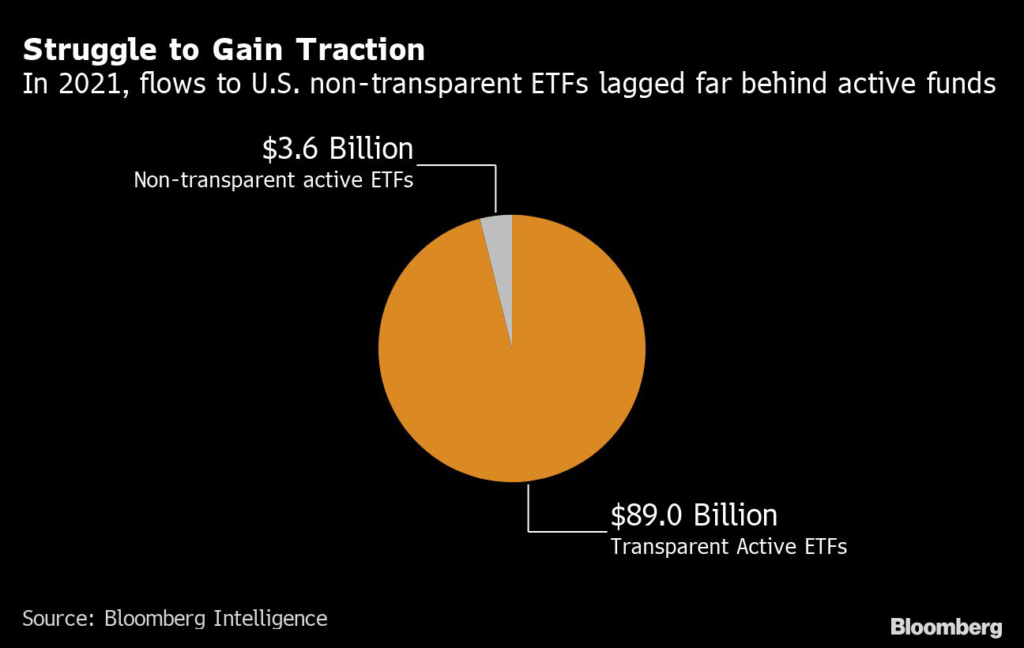
As so-called fully transparent ETFs, all the holdings of each Capital Group fund will be revealed each day. Other mutual fund giants like Fidelity and T. Rowe Price Group Inc. have entered the ETF market using active non-transparent funds, only to see those struggle to gain traction.

“Unlike some of its peers’ active equity ETFs, Capital Group’s offerings will be fully transparent and have the flexibility to invest outside of the U.S., which should help the ETFs differentiate from benchmark based funds,” said Todd Rosenbluth, an ETF analyst at CFRA who anticipates Capital Group will become a “top-tier ETF provider” in the next few years. 

Framsted said at the moment, Capital Group is not planning on converting any of its mutual funds into ETFs. 

(An earlier version of this article corrected the lowest expense ratio in the price range.) 

(Updates to add chart)

More stories like this are available on bloomberg.com

©2022 Bloomberg L.P.
Close Bitnami banner
Bitnami