Bloomberg

China Actions Spark Canada Review of Rules on Foreign Investment

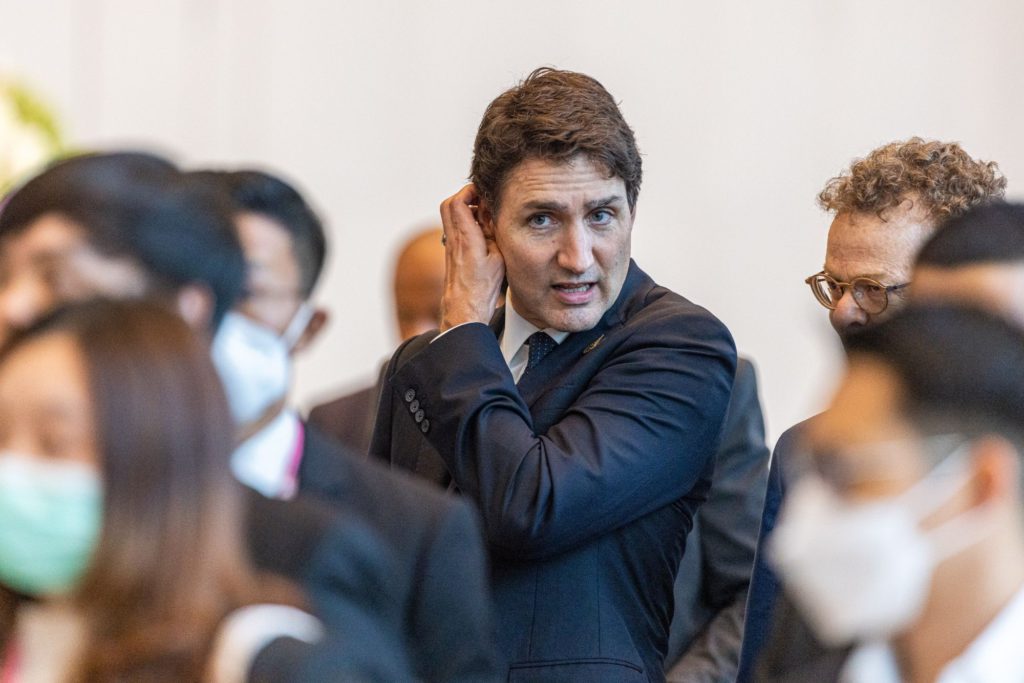
(Bloomberg) — Canada’s new Indo-Pacific strategy calls for changes to foreign investment screening as a result of concerns about Chinese state-owned enterprises, a development that comes less than two weeks after China’s Xi Jinping lectured Prime Minister Justin Trudeau on the sidelines of a Group of 20 summit. 

Trudeau’s government will revise the Investment Canada Act, a key law governing foreign investment, to add new provisions to protect the country’s infrastructure, resources, technology, supply chains and intellectual property, according to a strategy document to be released Sunday.

Canada to Increase Military and Economic Ties in Indo-Pacific

The document, an advance copy of which was seen by Bloomberg, doesn’t outline specific amendments to the law, but says Canada will act “decisively when investments from state-owned enterprises and other foreign entities threaten our national security.” It’s part of a section on the country’s new approach toward China, which Trudeau’s government describes as an “increasingly disruptive global power” that disregards international rules and norms.  

“We need to make sure we protect our national security, period,” Melanie Joly, Canada’s foreign minister, said in an interview at Bloomberg’s offices in Montreal. “The goal of reopening this act is really to make sure that we have an approach that is much more transparent and that brings predictability.”

Lithium Decision

Canada has already moved to limit Chinese investment in some critical minerals, ordering Chinese firms to divest from three junior lithium explorers in early November.

Also this month, police arrested a former Hydro-Quebec employee and charged him with espionage for allegedly obtaining trade secrets for China. The man was a researcher on battery materials. 

Read more: China’s Ties to Canada Miners Face Chill in Key Metals Crackdown

Chinese foreign direct investment in Canada reached C$21 billion ($15.7 billion) in 2021 while Canadian direct investments in China were above C$14 billion, according to Statistics Canada.

Joly, who characterized herself as pragmatic, said the business community should know the geopolitical risks of dealing with China. 

“My job is to highlight that,” she said, adding that diplomacy comes with “what we stand for,” even if it may harden relationships.

Xi confronted Trudeau at the Group of 20 summit, accusing him of leaking details of a private meeting to news media in a candid exchange that was caught on camera. 

More stories like this are available on bloomberg.com

©2022 Bloomberg L.P.

Nigeria SEC to Avoid Cryptocurrencies in Digital Assets Push

(Bloomberg) — Nigeria’s Securities and Exchange Commission does not plan to include cryptocurrencies in a plan to improve trading in digital assets until regulators agree on standards that protect investors. 

The commission is avoiding the digital currency as crypto exchanges do not have access to the banking platform that is needed to drive their trades in Nigeria yet, Director-General Lamido Yuguda told reporters in Lagos, the nation’s commercial hub. “We are looking at digital assets that really protect investors,” not necessarily crypto, Yuguda said. 

The position of the SEC clears the air on whether its rule on digital assets trading enacted in May covered crypto. While young Nigerians account for the largest volume of cryptocurrency transactions outside the US, according to Paxful, a peer-to-peer crypto trading platform, the central bank banned lenders from facilitating crypto trades to forestall threats to the financial system.

The SEC will promote investment in “sensible digital assets,” with investment protection and also explore blockchain technology to advance virtual and traditional investment products, Yuguda said. “The commission is in the business of protecting investors, not in the business of speculation,” he said, alluding to volatility concern in cryptocurrencies.

Nigerians showed more interest in cryptocurrencies than any other country since the digital assets began to decline in April, according to a study by price tracker CoinGecko. As the digital assets market undergoes development, crypto may be promoted by the SEC in the future, the DG said, adding “now any asset that is traded in the Nigerian capital market requires the joint approach of different regulators.”


More stories like this are available on bloomberg.com

©2022 Bloomberg L.P.

Pakistan Halts Overseas Payments for Online Gaming, Other Apps

(Bloomberg) — Pakistan has halted payments for in-app purchases including online video games bought by local customers using airtime from telecommunications companies, the latest sign of distress caused by the country’s depleted foreign-exchange reserves.

Telecom service providers were violating regulations by allowing payments to be made for customers under an arrangement with the government that permitted the phone companies to pay for IT-related services for their own use, State Bank of Pakistan said in a statement. The regulator has stopped the transactions and telecom operators to resubmit their requests.

The South Asian country’s economy is dealing with various pressures including a dollar shortage and a downgrade by rating agencies further into junk. The nation’s foreign-exchange reserves cover about one month of imports, less than the three-month benchmark.

Pakistan has been restricting overseas payments and imports to deal with its shortage of the US currency. Automobile companies including local units of Honda Motor Co. and Toyota Motor Co. have had multiple weeks-long shutdowns this year because have been unable to import parts.

The central bank issued the statement in response to a report in The News that it revoked payments to international service providers including Alphabet Inc.’s Google, Amazon.com Inc. and Meta Platforms, Inc. The central bank denied it had withheld any payments related to Google.

More stories like this are available on bloomberg.com

©2022 Bloomberg L.P.

FTX Chaos Prompts Reckoning on Dubai’s Embrace of Crypto Giants

(Bloomberg) —

On Oct. 26, days before the collapse of his crypto exchange FTX, Sam Bankman-Fried sat for lunch at an upscale Dubai restaurant, subtly testing the waters for funding at a table of founders, bankers and financiers, including Anthony Scaramucci. 

It turned out to be a final hurrah before the former billionaire’s troubles were exposed to the world. The implosion of FTX, which went from a $32 billion valuation to bankruptcy in the ensuing weeks, sent crypto markets into a tailspin, driving billions of dollars in outflows from some of the biggest global exchanges.

The aftershocks have reverberated particularly hard in the United Arab Emirates — especially in Dubai, which has been working to lure the world’s largest firms with its crypto-friendly policies. While some financial centers tightened regulations, many UAE officials promoted virtual assets as a gold mine for economic growth and pivotal in the nation’s diversification strategy beyond fossil fuels.

That helped the Gulf state position itself as a crypto hub, attracting industry heavyweights while also prompting bankers, lawyers and tech executives to switch jobs. Property brokers were reporting an infusion of crypto funds into luxury real estate. Yet the end of the bull market has some expressing regret at the turn of events. 

Local exchanges Rain Financial Inc. and BitOasis have trimmed headcount in Dubai. Among those rethinking their foray into the sector is Hazem Shish, a former Barclays Plc banker who recently set up a crypto hedge fund in Abu Dhabi. While it performed well in its early months, challenges in raising institutional money amid the market turmoil prompted him to step back from the main fund’s management, according to people familiar with the matter, who requested anonymity as the information is private.

Shish declined to comment.

Sam Bankman-Fried Fooled the Crypto World and Maybe Even Himself

FTX was one of the first firms granted a license by Dubai’s Virtual Asset​s Regulatory Authority as part of the push to lure business, and the exchange set up its regional headquarters in the city. 

At the time, Helal Al Marri, director general of the Dubai World Trade Centre Authority that houses VARA, praised the move and said it followed a rigorous evaluation — months before the firm went bust. 

With FTX and Bankman-Fried now facing investigations from the US to the Bahamas, officials have distanced themselves from that decision, even scrubbing its license details from the regulator’s website. 

Some links were harder to erase from view. 

Banners touting an FTX-sponsored party during the Abu Dhabi Grand Prix lined one of Dubai’s most exclusive beachfront drives. At the race track, spectators donned Formula One hats decorated with the FTX logo.

Twin Blows

The firm’s collapse was the second significant blow to Dubai’s efforts within a matter of months. In June, hedge fund Three Arrows Capital imploded in one of the biggest-ever crypto trading busts, weeks after obtaining a provisional license in the city. 

The drama has extended to other asset managers. 

Multiple crypto hedge funds that recently set up in the UAE had put all their client money on FTX, forcing a mad scramble to exit the platform before withdrawals were halted in order to avert their own collapse, according to people familiar with the matter. 

Some 4% of FTX’s global customers are based in the UAE, according to court filings in the firm’s bankruptcy case, making it one of the top 10 jurisdictions impacted by the fallout. 

FTX and Three Arrows Capital didn’t have full-scale licenses, limiting the local fallout to an extent. The Dubai virtual assets regulator’s structure is aimed at opening the doors for the biggest firms to operate but initial licenses only allow a narrow range of services. 

Still, the incidents have prompted a debate over whether authorities were too nimble in their push to lure crypto firms, lending legitimacy to companies that have since gone bust.

“As a regulator, there’s always the risk that if things go wrong it looks really bad,” said Dapo Ako, a former compliance specialist at UBS Group AG, whose firm J. Awan & Partners is helping crypto firms set up in the UAE. “But it’s also a chance to rethink the framework. If Lehman didn’t fail, we wouldn’t have new banking regulations.”

The Collapse of Three Arrows Capital Became a Crypto Contagion 

An official at VARA said FTX hadn’t cleared the approval process to onboard any clients or start operations. In a July statement, they said the license would allow FTX to deploy crypto derivatives products and trading services to qualified institutional investors. 

Regarding Three Arrows Capital, the VARA representative said a provisional permit is an “approval of concept” factoring in the credibility of other licensing jurisdictions but that steps for a more complete license didn’t progress. 

In response to questions, a UAE official said there’s a commitment to enable mass economic empowerment with a focus on consumer protection, cross-border financial security and economic stability.

A spokesperson at FTX declined to comment. 

‘Walking Time Bomb’

Much of the UAE’s bet on crypto has centered around Binance Holdings Ltd. and its Chief Executive Officer Changpeng “CZ” Zhao. 

The world’s largest crypto exchange has found a more receptive audience in the country, so much so that the 45-year-old executive made Dubai his home base and soon made inroads with the nation’s power brokers. The UAE granted Binance multiple licenses, and more than 500 of the firm’s employees settled in the Gulf state. 

After FTX’s demise, Binance’s share of global crypto trading volumes increased to almost 50%, according to data from CryptoCompare. Yet the speed of FTX’s unraveling has sparked a debate about the health of centralized crypto exchanges, and traders have pulled funds from such venues.

At a summit in Abu Dhabi on Nov. 16, the economist Nouriel Roubini, a crypto critic who’s been referred to as “Dr. Doom,” called Binance a “walking time bomb,” blamed regulators for granting the firm licenses and urged officials to remove Zhao from the UAE. 

A day later, the Binance CEO responded on stage at the Milken Institute’s conference in Abu Dhabi: “What’s a word for unimportant people?” he said. “We don’t care.” The dust-up came as the exchange got more approvals from Abu Dhabi Global Market. 

Tighter Regulation?

Since Zhao’s arrival last year, influential players from Kraken to OKX, Bybit and Crypto.com have built up their UAE presence, aligning with the nation’s ambitions for a digital economy that creates more non-oil sector jobs. Yet UAE officials privately have expressed concerns over the pace of regulatory approvals — that they may have proceeded too quickly and failed to identify the blowups of Three Arrows Capital and FTX, people familiar with the matter said.

Dubai Multi Commodities Centre, which has come under particular scrutiny from the US Treasury Department for its looser regulations, is attracting the lion’s share of crypto companies — more than 500, according to a DMCC spokesman. 

“I’d expect that overall regulators will be more careful and conservative as a result of the latest developments,” said Gabriele Dunker, the Vienna-based founding partner of Financial Transparency Advisors GmbH, which has previously advised the UAE government.

World’s Biggest Crypto Fortune Began With a Friendly Poker Game

UAE crypto players are now on alert for updates from the regulators.

Dubai’s VARA plans to announce its CEO in the coming weeks and intends to hold further consultations with key stakeholders before year-end, people familiar with the matter said. 

Meantime, Abu Dhabi’s efforts to finalize federal legislation for crypto have been delayed as authorities navigate a lobbying push from industry insiders as well as scrutiny from international bodies over money laundering and consumer protection concerns. 

The Binance CEO, for his part, has initiated a proof of reserves system to support “full transparency.” However, his firm has declined to disclose the full details of its corporate structure. 

“We have the largest offices in Dubai and Paris so you can view those two as global hubs,” Zhao told Bloomberg TV on Thursday.

A Binance spokesperson said the exchange is growing its UAE team and is in the midst of a corporate restructuring aimed at giving regulators further clarity about the organization.

Close Calls

For now the UAE, like some financial centers, is sticking to its conviction of becoming a crypto hub. Hong Kong has reiterated its desire to lure virtual-asset firms, while Japan has proposed easing token-listing rules. Singapore, on the other hand, has stated its preference for use-case based blockchain technology while warning against retail crypto trading. 

Abu Dhabi funds including Mubadala Investment Co. had set up committees to study investments in the crypto ecosystem. They’ve felt vindicated for proceeding cautiously and plan to tread carefully in the coming months, people familiar with the matter said. 

A Mubadala spokesperson declined to comment.

But other entities controlled by UAE National Security Adviser Sheikh Tahnoon Bin Zayed have maintained a more aggressive approach, plowing ahead with investment plans in the space. Zhao and his team met with potential backers, including entities affiliated with Sheikh Tahnoon, who oversees a large financial empire in Abu Dhabi, Bloomberg reported on Tuesday. 

And earlier this month, just as Bankman-Fried tried to close a rescue deal with Binance, Zhao’s colleague Dominic Longman was in Abu Dhabi, launching the Middle East, Africa & Asia Crypto & Blockchain Association alongside UAE officials, who were pushing ahead with their embrace of the industry.

“Abu Dhabi, and the UAE, is a leader in the development of innovative and compliant crypto and blockchain businesses,” Ahmed Jasim Al Zaabi, chairman of ADGM, said. “We are pleased to be able to support MEAACBA, which will contribute towards developing this dynamic sector.”

–With assistance from Nicolas Parasie, Leen Al-Rashdan, Suvashree Ghosh and Philip Lagerkranser.

More stories like this are available on bloomberg.com

©2022 Bloomberg L.P.

Musk’s Twitter Slides Say ‘We’re Recruiting’ Following Job Cuts

(Bloomberg) — Twitter Inc. is hiring, according to slides from a company talk tweeted by owner Elon Musk, following sweeping job reductions in a cost-cutting drive since the billionaire took over the social network.

The first slide had the words “We’re recruiting” with no further details. Musk, who didn’t say when he gave the talk, has undertaken a dramatic restructuring that initially cut the firm’s headcount in half.

Hate speech impressions on the social network are lower and reported impersonations have fallen, according to the slides which cited data with mid-November dates.

Read: Twitter’s Musk Fires More Sales Staff After ‘Hardcore’ Purge 

New user signups are at an all-time high, averaging over 2 million a day for the seven days to Nov. 16, the slides also showed. In a follow-up tweet, Musk said he sees a path to Twitter having more than 1 billion monthly users in 12 to 18 months.

Musk has said Twitter will relaunch its paid Verified services Friday, after a series of delays and mishaps over fake accounts. Twitter Verified is his attempt to distinguish between different classes of users, and increase revenue.

Read: Musk Celebrates New Twitter Usage High as Engineers Flee Company

More stories like this are available on bloomberg.com

©2022 Bloomberg L.P.

A Great Rotation Is Brewing in Asia as Investors Head North

(Bloomberg) — The nascent revival in North Asian equities is being touted as the start of a potential bull run as bets for China’s gradual reopening as well as the bottoming out of the chip industry intensify.

Strategists at Goldman Sachs Group Inc. expect Asia’s equity leadership to shift from Southeast Asia and India to markets like China and Korea next year, while Societe Generale SA says Taiwan’s tech-heavy market is also at an inflection point. Jefferies Financial Group Inc. has echoed similar views.

Stocks listed in Hong Kong as well as Korea and Taiwan have languished for most of the year owing to their heavy reliance on China’s economy, which has been crimped by stringent Covid controls and a property crisis. Meanwhile, domestic-demand driven southern markets of Indonesia and India boasted resilience. The tables have turned this month after a slew of positive policy moves by Beijing.

“Of concern to us is that Southeast Asia is beginning to underperform in the last few weeks, as investors rotate back into North Asia,” said Alexander Redman, chief equity strategist at CLSA. “Indonesia, as a defensive, domestically-orientated commodity exporter, was a logical refuge to ride out the equity storm,” he said, adding that the market will be “less favored as investors reengage some deep value cyclical exposure in North Asia.”

Key equity gauges in Hong Kong have rallied about 20% in November, easily topping the rest of Asia and major global peers, as China urged more targeted Covid restrictions and boosted policy support for the real estate sector. 

Foreigners have piled $5.8 billion into Taiwan stocks this month, on track for the first inflows in six months and the biggest in 15 years. Net purchases of Korean shares are set to exceed $2 billion for a second straight month. 

In contrast, Indonesia’s market — once investors’ favorite as an inflation hedge — is flat in November, and poised to see monthly flows turn negative for the first time since July. Investors are also more wary about valuations in India, where benchmarks recently hit record highs, with Goldman Sachs expecting the market to relatively underperform in 2023.

“Any positive catalysts such as a potential China re-opening and policy support, lowering of geopolitical tensions or tech cycle bottoming is likely to drive a sharp rerating” of North Asian markets, Jefferies strategists led by Desh Peramunetilleke wrote in a note. The brokerage is overweight Hong Kong, China, Korea and Taiwan, neutral on Indonesia and underweight India.

READ: Recovery in North Asian Equities May Hurt India’s Appeal: BNP

Chips, China  

The bullish case for South Korea and Taiwan is also built on their chip dominance, as the markets are home to industry heavyweights such as Samsung Electronics Co. and Taiwan Semiconductor Manufacturing Co. They also have China as their largest trading partner.  

SocGen and Lombard Odier Private Bank this month joined Morgan Stanley in saying that investors should tip-toe back into Asia’s semiconductor stocks. 

“Share prices typically bottom out two-to-three quarters ahead of the bottom of the semiconductor cycle,” SocGen strategists led by Alain Bokobza wrote in a note last week. “We may be at this point.”

Chinese shares in Hong Kong are poised for their best monthly showing since 2006, as asset managers from M&G Investments and Eastspring Investments to Franklin Templeton Investments buy into the rally.

On the mainland, foreign funds have snapped up about 49 billion yuan ($6.8 billion) worth of stocks via trading links with Hong Kong.

Risks Remain 

That’s not to say the road uphill for North Asia will be smooth.

With their heavy export dependence, the markets are vulnerable to the risk of a global recession and are often at the center of geopolitical tensions that involve the US and China. Further, a jump in virus cases in China to a record is also tempering the positive market momentum.

“There are ongoing concerns from the geopolitical side of the consideration,” said Vivian Lin Thurston, portfolio manager at William Blair Investment Management. And even though the industry cycle is turning, “if the global economy is getting into a slowdown, I think we have to reevaluate the cycle and the thesis,” she added.

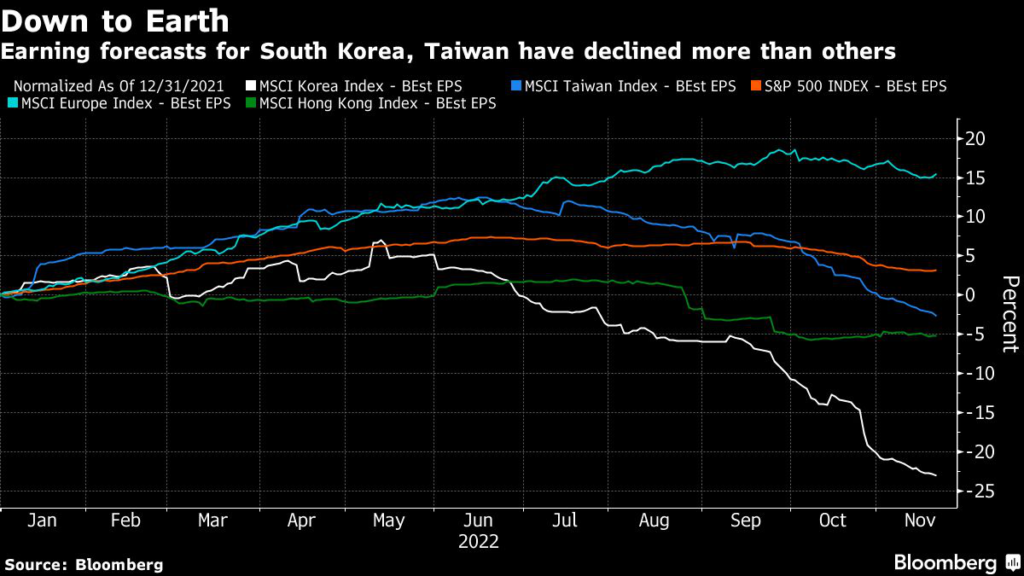
Nonetheless, with earnings forecasts having already fallen deeply across the northern economies, the markets may have more upside potential. Equity benchmarks in China, Korea and Taiwan are still down more than 15% year-to-date, while those in Indonesia and India are up about 7% each.

For China watchers, a Politburo meeting in early December, followed soon after by the annual Central Economic Work Conference, may offer useful signals.

“If we use the metaphor of a train leaving the station, the leading locomotive is Korea and that’s already well out of the station,” Jonathan Garner, chief Asia and EM equity strategist at Morgan Stanley, said in an interview earlier this month. “Now the Taiwan engine is leaving the station too. And then we get more to the middle of the train, which is China.” 

–With assistance from John Cheng.

More stories like this are available on bloomberg.com

©2022 Bloomberg L.P.

Copper’s Biggest Mystery Is Finally Cracking

(Bloomberg) — The warnings keep getting louder: the world is hurtling toward a desperate shortage of copper. Humans are more dependent than ever on a metal we’ve used for 10,000 years; new deposits are drying up, and the type of breakthrough technologies that transformed other commodities have failed to materialize for copper.

Until now.

In what could prove a game changer for global supply, a US startup says it’s solved a puzzle that has frustrated the mining world for decades. If successful, the discovery by Jetti Resources could unlock millions of tons of new copper to feed power grids, building sites and car fleets around the globe, narrowing and possibly even closing the deficit.

At its simplest, Jetti’s technology is focused on a common type of ore that traps copper behind a thin film, making it too costly and difficult to extract. The result is that vast quantities of metal have been left stranded over the decades in mine-waste piles on the surface, as well as in untapped deposits. To crack the code, Jetti has developed a specialized catalyst to disrupt the layer, allowing rock-eating microbes to go to work at releasing the trapped copper.

The technology still needs to be proven on a large scale. But the riches at stake are pulling in some of the industry’s most powerful players.

BHP Group, the biggest mining company, is already an investor and has now spent months negotiating for a trial plant at its crown jewel copper mine, Escondida in Chile, according to people familiar with the matter. US miner Freeport-McMoRan Inc. began implementing Jetti’s technology at an Arizona mine this year, while rival Rio Tinto Group is planning to roll out a competing but similar process.

The miners are responding to an increasingly urgent problem. Copper is ubiquitous in the modern world, used in everything from phones and computers to water pipes and cables. And while the global drive to decarbonize is based on phasing out dirty natural resources like oil and coal, an electrified future will need more copper than ever before.

Despite its importance, the world is facing a growing threat of shortages in the coming decades. The best mines are getting old and the few new discoveries are either in difficult places to operate, or face years of opposition to development.

The history of commodity markets shows that looming deficits tend to spur new discoveries and technologies. The US shale boom in the 2010s turned the oil market on its head, while breakthroughs in nickel processing upended supply forecasts.

But new discoveries in copper are increasingly unlikely, given the long history of mining – evidence of copper usage has been traced back to at least 8,000 BC in what is now Turkey and Iraq. That means most of the world’s great deposits have already been found and exploited; more than half the world’s 20 biggest copper mines were discovered more than a century ago.

Waste Dumps

Yet the long history of copper mining also means there are massive amounts of metal sitting on the surface in waste dumps. 

The reason is a principle as old as mining itself: ore is pulled up from the earth, the easiest metal is extracted, and anything too difficult or expensive to process is tossed aside as waste. Over the past decade alone, an estimated 43 million tons of copper have been mined but never processed, worth more than $2 trillion at current prices, creating huge opportunities for anyone who can successfully recover those riches.

To be sure, it’s not a new concept to reprocess mine waste when technology improves or prices rise. But that just hasn’t been feasible for certain types of ore. And the breakthrough has opportunities far beyond waste dumps – there are millions more tons still underground that haven’t been viable to mine.

Much depends on mining companies’ willingness to install Jetti’s plants. But if the technology becomes fully embraced by the industry, the company estimates that as much as 8 million tons of additional copper could be produced each year by the 2040s – more than one third of last year’s total global mine production. 

“The industry has accumulated this waste material forever,” said Jetti’s founder and chief executive officer, Mike Outwin. “They’ve been trying to come up with an answer for it on their own for a couple of decades and haven’t been able to.”

So far Jetti’s process has been running on just one mine, at Pinto Valley in Arizona. But the results have been so promising three of the world’s biggest copper miners — including BHP — have bought stakes in the company. Its latest fundraising was at a valuation of $2.5 billion.

Copper giant Freeport says it has also “initiated a commercial implementation this year at our Bagdad mine in Arizona to trial the technology and will assess the results and continue to dialogue with Jetti on other opportunities to work together.”

Copper Ores

So what is the problem that Jetti is seeking to solve?

There are two main kinds of copper-bearing rock. The most common type, sulfide ores, are typically crushed, concentrated, and then turned into pure copper in a fire-refining process. But that method isn’t suitable for oxidic ores, and the industry’s last big innovation came in the mid-1980s when it adapted an electro-chemical process to extract copper from oxide ores, providing a major boost to supply.

Now, Jetti aims to apply its technology to recover copper from a common type of sulfide ore that couldn’t be economically processed via either route — the copper content is too low to justify the cost of refining, while the hard, non-reactive coating prevented the copper from being extracted in the lower-cost electro-chemical or “leaching” process.

Jetti worked with the University of British Columbia to develop a chemical catalyst that breaks through the layer, so that the copper can be released using leaching without the need for high temperatures.

While Jetti’s process is the most advanced, Rio Tinto says it’s also cracked the challenge in lab trials. Rio has been offering its Nuton technology as a sweetener to junior mining companies that it invests in: if the smaller firms successfully develop their mining projects, then Rio will deploy the Nuton process to boost profitability. It’s signed three such deals already this year.

“When you look at the size of the prize, the potential is enormous,” said Adam Burley, who runs the Rio project. “It’s too big to leave on the table.”

Rio wants Nuton to have produced a total of about 500,000 tons of copper by the end of this decade, with hopes that the business may one day produce the annual equivalent of one of the world’s top-five copper mines.

Other major miners including Freeport, Codelco and Antofagasta Plc have all been working on in-house solutions at their own mines, though so far there has been little disclosed information on how successful these projects have been.

And there are limitations to how much can be achieved. The focus is on North and South America, and the progress will depend on whether the technology can be deployed across the major mines.

Yet for BHP, the fact that it is even discussing the future of Escondida, the world’s single biggest source of copper, with a small upstart is telling.

Negotiations have been underway for months, although one of the sticking points in the talks has been Jetti’s insistence that it installs and runs its own plant at the host mine, according to the people familiar with the matter. There are also negotiations about how to split the profits.

Meanwhile, Rio, which is BHP’s junior partner at Escondida, is arguing that it wants the Nuton technology to also be considered, according to people familiar with the matter.

Jetti and BHP declined to comment on the specific negotiations or deals.“Jetti is very real. It’s not lab tests or pilot plants. Jetti has been deployed commercially,’’ said Outwin. “Our partners will make extraordinary profits from being able to utilize our process, and Jetti will do well.’’

–With assistance from James Attwood and Mark Burton.

More stories like this are available on bloomberg.com

©2022 Bloomberg L.P.

US Shoppers Kick Off Holiday Season With a Muted Black Friday

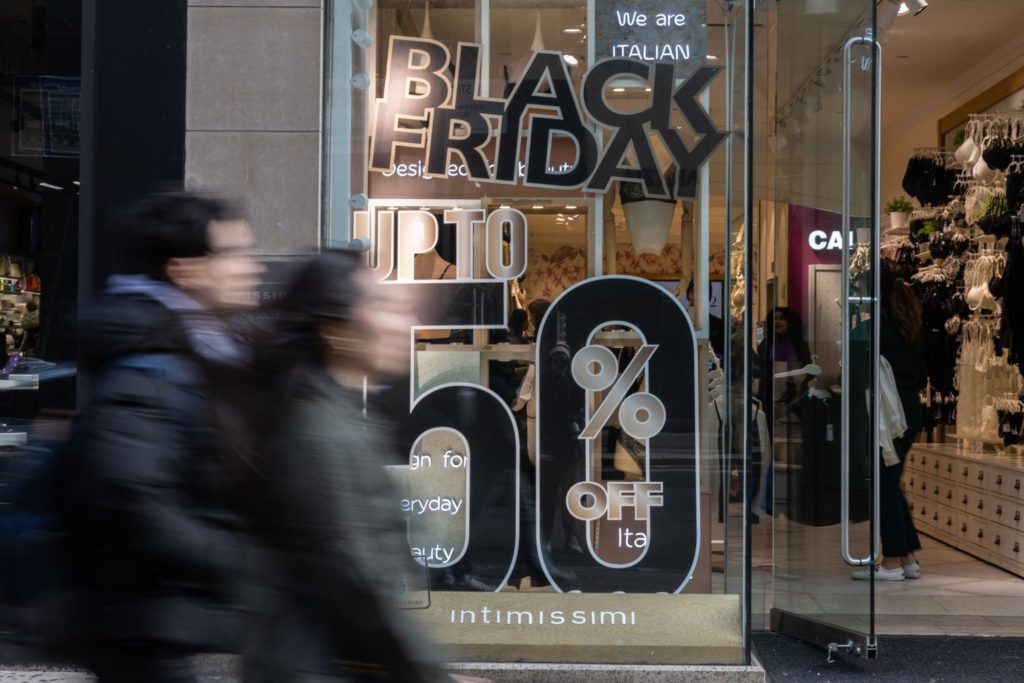
(Bloomberg) — US retailers discounted heavily on Black Friday to clear out bloated inventories but customers responded with only modest traffic, leaving profitability in doubt for many chains. 

Crowds were thin in the late morning at Connecticut’s Stamford Town Center mall, with few shoppers at Kay Jewelers and just a small line at Forever 21. A couple at a Walmart Inc. supercenter near Dallas reveled in the lack of crowds as they bought presents for their grandchildren. At the Stonestown mall in San Francisco, shoppers were few and far between. 

“It feels like a normal day,” said Miguel Martinez, 35, a warehouse supervisor walking through a Target Corp. store on Chicago’s North Side with his 12-year-old daughter, Jaylen. Martinez said he’s been cutting back on cable TV and Netflix to afford presents for his four children. He described the Black Friday discounts as “pretty good” as he picked up a couple of Amazon Echo Dot speakers, Nerf guns and a Disney Encanto doll.

Brick-and-mortar retailers, which were hit hard by Covid-19 closures and shoppers seeking to avoid the virus, saw in-store traffic tick up 2.9% this Black Friday compared to 2021, according to preliminary data compiled by Sensormatic Solutions. 

US consumers are still spending, but they’re growing more cautious after contending this year with the highest inflation rates in four decades. They’re also keeping a sharper lookout for deals, and retailers — many of them still heavy with inventory after misjudging an erosion in demand — are trying to stand out by dangling the deepest discounts since before the pandemic.

Modest Growth

The US holiday shopping season is likely to see modest to break-even growth in annual sales, said Melissa Minkow, director of retail strategy at digital consultancy CI&T. “That’s still a win,” she said, contrasting the outlook with the UK, where high inflation has caused consumers to pull back noticeably on spending. Still, the steep Black Friday discounts are likely to squeeze retailers.

“Profits will not be where retailers want them to be,” Minkow said. That’s in part because they “couldn’t pass all of the inflationary costs off to consumers.”

Read more: Bloomberg tracks Black Friday across the country

E-commerce spending on Black Friday rose 2.3% to $9.12 billion, according to Adobe Analytics. 

That’s far less than the US inflation rate of almost 8% during the 12 months ended in October. Salesforce Inc. said the average consumer discount on Black Friday was expected to be greater than 30%, up from 28% last year and close to the 33% rate in 2019. The biggest discounts were in home appliances, apparel and health and beauty.

Shoppers are cutting back in reaction to higher prices, said Rob Garf, Salesforce’s vice president of retail. 

“People are just plainly buying less products because their dollar isn’t going as far as it used to,” Garf said.

Lonely Middle

At Crossgates Mall in Albany, New York, low-cost brands and higher-end buzzy retailers had the most foot traffic, while the middle-market stores were desolate. 

Gap Inc.’s Old Navy, which was offering 60% off most items, had a line so long that some shoppers turned around as soon as they entered the store. 

Drawing big crowds at the higher end were athleisure favorite Lululemon Athletica Inc., which had only a few racks of discounted merchandise, and American Eagle Outfitters Inc.’s Aerie, a popular intimates brand among Gen Z shoppers. Meanwhile, stores like Gap’s Banana Republic, Macy’s Inc. and Urban Outfitters Inc. had no lines at all, and only a handful of shoppers. 

The healthy traffic at some retailers shows that many US consumers are still spending at a robust clip. US retail sales on Friday were up 12% year-over-year, excluding automotive, according to Mastercard SpendingPulse, which measures in-store and online purchases across all forms of payment. The spending increase is not adjusted for inflation. 

At a crowded Best Buy Co. store near Dallas-Fort Worth International Airport had half a dozen cars pulled up by the door to pick up large televisions and other electronic goods. Grapevine Mills, a nearby discount mall, was so crowded that Shawanda Miller threw up her hands and left. 

“I don’t even want to talk about it, it was so crowded in there,” said Miller, 43. “I’m going to come back another day.”

No Wait

But crowds like that appeared to be an exception. The checkout line at the toy section at a Macy’s in Stamford, Connecticut, had no wait and the cashier said the store had prepared for more shoppers. A Walmart in suburban Dallas also had cashiers standing at the ready with no lines, which was just fine with Veronica Gonzalez and Carlos Garcia, a couple visiting from Corpus Christi, Texas. 

“What’s good about it is you don’t have to come in at 5 o’clock in the morning, and everything is here that we’re looking for,” Gonzalez said. Garcia said “everything’s for the grandkids” as he pushed a shopping cart full of bed sheets, suitcases and toys. 

The era of Black Friday crowds came to a halt with the pandemic, and it probably isn’t coming back as more consumers shop online and spread their spending out over a longer period. “The historic raucous atmosphere of Black Friday may be in the past,” Edward Yruma, a retail analyst at Piper Sandler, said in a report.

Behind the moderate crowds are people such as Therese Pociask, 60, who was shopping at Target in Chicago for her small day-care center. She was also looking for gifts for her nieces and nephews. In her cart were an Epsom-salt gift pack, Fujifilm Instax camera film, three stuffed dinosaurs and a puzzle.

Pociask said she’s planning to spend about $2,000 during the holidays — about the same as last year. But with inflation high, her money isn’t going as far as it did. 

“I’m trying to stay within my budget, but I’m finding I have to spend more for it to look the same,” she said.

–With assistance from Leslie Patton, Deena Shanker, Martine Paris, Tiffany Kary and Victoria Cavaliere.

(Adds foot traffic data in fourth graph, Mastercard spending in 15th graph)

More stories like this are available on bloomberg.com

©2022 Bloomberg L.P.

In-Person Shopping Increased 2.9%: Black Friday Update

(Bloomberg) — US retailers experienced what appears to have been a muted Black Friday as high inflation and sagging consumer sentiment erode demand for material goods.

Online sales rose 2.3% to a record this year, with consumers shelling out for electronics and smart-home items, Adobe Analytics said, as retailers offer steep discounts to clear out bloated inventories. Hot items included toys such as Fortnite, Roblox and Bluey.

In-person shopping increased this year compared to last by 2.9%, as shoppers moved on from the coronavirus pandemic, according to data compiled by Sensormatic Solutions.

Key Developments:

  • Shoppers Kick Off Season With Muted Black Friday
  • How to Resist the Siren Song: Teresa Ghilarducci
  • Blowout Bargains Smell Musty: Felsted & Miranda
  • Toy Discounts Typically Peak on Black Friday: BI

Bloomberg News is following the latest developments as information becomes available throughout the day. All time stamps reflect the US East Coast.

Shoppers Return to Malls and Stores: Sensormatic (1 p.m.)

Brick-and-mortar retailers, who for the last two Black Fridays contended with Covid-19 outbreaks and restrictions, saw in-store visits tick up this year by 2.9% compared to 2021, according to preliminary data compiled by Sensormatic Solutions. Visits to physical stores on Thanksgiving Day increased by 19.7% compared to last year.

Enclosed mall traffic increased 1.2% and traffic to non-malls, such as strip centers and standalone stores, increased 4.7% compared to Black Friday 2021, the data show.

“The pandemic-driven trend of shopping in unenclosed shopping centers has endured and malls are seeing resurgence as well. Our data shows consumers continue to enjoy the benefits of the brick-and-mortar shopping,” said Brian Field, global leader of retail consulting and analytics at Sensormatic Solutions.

US Black Friday Sales Rise 12%: Mastercard SpendingPulse (12:06 p.m.)

Both in-store and online sales were up 12% this year compared to 2021, excluding the purchase of cars, according to Mastercard SpendingPulse, which tracks all payment types across the Mastercard Inc. payments network. Apparel, electronics and restaurants were strong performers, the company said. The 12% figure is not adjusted for inflation.

“Retailers delivered on Black Friday with deals that enticed consumers to fill their carts despite the inflationary environment,” said Michelle Meyer, the North America Chief Economist at the Mastercard Economics Institute. 

Adobe Reports Record $9.12 Billion in E-Commerce (8:30 a.m.)

Online sales during the US’s biggest shopping day of the year rose 2.3% to $9.12 billion, Adobe Analytics said Saturday. That was slightly ahead of the company’s initial projection of $9 billion, although the percentage increase lagged far behind the country’s inflation rate, which is running at almost 8%.

Shoppers spent their money primarily on electronics, smart-home items and audio equipment, while toys and sporting goods also performed well, Adobe said. Hot items included toys such as Fortnite, Roblox and Bluey. Shoppers also bought up Xbox Series X and PlayStation 5 devices, as well as drones and Apple MacBooks, Adobe said.

E-commerce purchases are expected to total more than $9 billion on a combined basis Saturday and Sunday.


Shopify’s Black Friday Sales Hit a Record (8:30 a.m.)

Canadian e-commerce firm Shopify Inc. said its Black Friday sales hit a record of $3.36 billion this year, marking a 17% growth from the 2021 edition, with apparels & accessories featuring among the categories most sought by consumers.

“The weekend that started it all is still one of the biggest commerce events of the year, and our merchants have broken Black Friday sales records again,” the company’s president Harley Finkelstein said in a statement.

Merchants saw sales peak at $3.5 million per minute, with cross-border orders representing 15% of total sales, Shopify added, citing London, New York and Canada as top-selling cities.

Cyber Monday Poised to Be Biggest Online Shopping Day (8:30 a.m.)

Some consumers are hoping for even better deals on Nov. 28 — or Cyber Monday. The biggest online shopping day of the year is poised to generate $11.2 billion, up 5.1% from last year, Adobe said.

“Cyber Monday will offer the best deals for computers (27%), as well as furniture (11%). Those looking to buy an appliance should consider waiting until Thursday (Dec. 1), when discounts are set to peak at 18% on average,” it said.

In-Person Shopping Appears Muted (Saturday, 7 p.m.)

While consumers shopped from their computers and phones on Friday, foot traffic at tradition brick-and-mortar retail establishments appeared muted. But deals were steep, including at Gap Inc.’s Old Navy, which was offering 60% off most items. Big box electronics chain Best Buy had Chromebooks as low as $79. Walmart Inc. offered deals on everything from televisions to apparel.

Even still, the overall outlook for the holiday is cautious amid a cost-of-living crunch. Overall spending this holiday season is expected to rise 2.5% from a year ago, compared with 8.6% last year and a whopping 32% in 2020, according to Adobe data.

For those who did venture out to shop, the crowds might have been thinner but some shoppers experienced longer wait times, likely due to the ongoing shortage of retail workers — one slice of the larger labor-supply issues that have been hitting the country since the pandemic, said Shannon Warner of consulting firm Kearney.

Retailers just “don’t have enough people to staff the full hours that they have historically had,” Warner said. She said she is encouraging retail clients to consider automation and other efficiency moves, rather than waiting for the possibility of a solution to the retail labor shortage.

Deals Sweeter This Year Than Last: Salesforce (Saturday, 12:30 p.m.)

Consumers are finding better deals this shopping season than last year, according to data from Salesforce Inc.

The average consumer discount rate for Thanksgiving Day shoppers online in the US was 31%, Salesforce says. That’s 7% higher than 2021, when retailers didn’t have to put as many items on sale because demand was strong and a lot of merchandise was held up at snarled ports.

But this year’s discounts are still slightly lower than 2019 levels, when the average rate was 33%, according to Salesforce.

Last year, US consumers shopped relatively earlier on concerns that supply-chain problems would lead to a lack of merchandise.

(Updates top, adds foot traffic increase and Mastercard spending)

More stories like this are available on bloomberg.com

©2022 Bloomberg L.P.

Ukraine Latest: Belarusian Foreign Minister Makei Dies Suddenly

(Bloomberg) — Vladimir Makei, Belarus foreign minister since 2012 and a former chief of staff to President Alexander Lukashenko, died suddenly at the age of 64. No cause of death or further details were provided by the foreign ministry.   

European officials pledged renewed support for Ukraine on the 90th anniversary of the Holomodor, the famine orchestrated by Soviet leader Joseph Stalin that killed millions of Ukrainians. Several traveled to Kyiv for a “Grain from Ukraine” meeting, while others offered messages backing Ukraine and pledged funds for grain shipments to needy countries. 

President Volodymyr Zelenskiy and other top Ukrainian officials drew a direct line between the 1930s famine and Russia’s month-long campaign to wreck Ukraine’s electricity and power operations. “Once they wanted to destroy us with hunger, now — with darkness and cold,” he said in a video posted on social media. “We cannot be broken. Our fire will not go out.”   

(See RSAN on the Bloomberg Terminal for the Russian Sanctions Dashboard.)

Key Developments

  • EU Postpones Talks on Oil Price Cap as Divisions Stick 
  • Russia Drafts Decree Banning Oil Sales to Price-Cap Participants
  • Team of ‘17 and a Dog’ Stands Between Moldova and Energy Chaos 
  • Germany Rejects Polish Call to Send Patriot Missiles to Ukraine
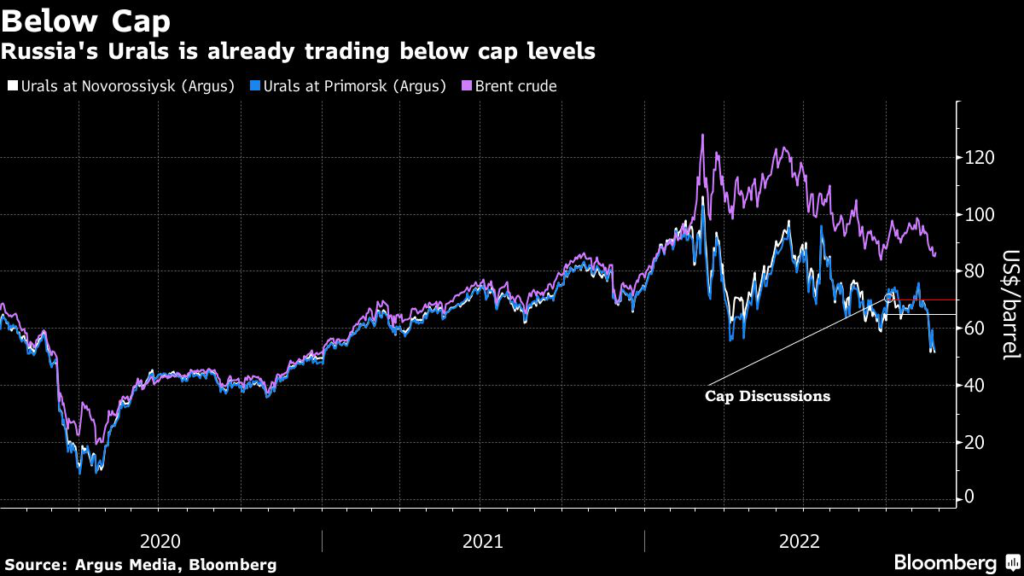
  • Russian Oil Is Already Trading Far Below Europe’s Proposed Cap

On the Ground

Russian forces launched two missile attacks on Dnipro city, as well as four attacks with multiple launch rocket systems on Ukrainian positions and civilian areaas elsewhere, according to Ukraine’s General Staff in an evening update. Seven residential buildings were damaged and at least 13 people injured in Dnipro, the regional governor said. Russia fired 11 missiles and conducted seven air strikes and multiple rounds of shelling in the past day, primarily in the Kharkiv, Donetsk and Zaporizhzhia regions, according to Ukraine’s General Staff. Russian forces continue to establish defenses south of the Dnipro River in Kherson Oblast and around critical ground lines of communication connecting Kherson to Crimea, the Institute for the Study of War. 

(All times CET)

Belarus Foreign Minister, Ally of Lukashenko, Dies Suddenly (4:30 p.m.)

Vladimir Makei, Belarusian foreign minister since 2012 and one of the longest-service officials in the circle of authoritarian President Alexander Lukashenko, died suddenly at the age of 64, the ministry said in social media posts with no further detail. 

Makei was shown receiving Vatican envoy Ante Jozic in Minsk on Friday. Earlier in the week he attended the Moscow-led Collective Security Treaty Organization meeting in Armenia. Makei and Lukashenko had been scheduled to meet Russian Foreign Minister Sergei Lavrov in Minsk on Monday. 

Makei presided over the foreign ministry during unprecedented repression in 2020 and as Belarus became a staging ground for Russia’s invasion of Ukraine this year. Russian foreign ministry spokeswoman Maria Zakharova expressed “deep shock” at Makei’s death. 

EC Commits to Fund Two Ships Under Ukraine Grain Initiative (4 p.m.)

The European Commission will pay to transport a total of 40,000 tons of grain under Ukraine’s new humanitarian initiative, President Ursula von der Leyen said in a statement.  

France will provide 6 million euros ($6.2 million) to help Ukraine ship food to Yemen and Sudan under a World Food Programme, plan, President Emmanuel Macron said, saying that Russia “threatens the world with a food crisis.” 

More Power Back On, With Rationing Continuing (2:30 p.m.)

Power output was back up to 75% of the nation’s needs on Saturday morning, said the grid operator Ukrenergo. Supplies will continue to be rationed for now. Kyiv Mayor Vitali Klitschko, after a scolding from Zelenskiy, said the heat was on in more than 90% of residential buildings and that water is running again. Some 73% of Ukraine’s mobile networks are back in operation.

Ukraine Formally Launches Food Initiative for Poorest Countries (2 p.m.)

“Grain From Ukraine. Bravery Feeds the Planet” aims to send grain and agrarian products to the poorest nations of Africa and Asia. It’s already attracted funding of about $150 million and support from over 20 countries.

Zelenskiy hosted an international food summit in Kyiv on Saturday attended by the prime ministers of Belgium, Lithuania and Poland, as well as the president of Hungary. Several other leaders joined via video. 

“Food security is one of the elements of the Ukrainian peace formula”, Zelenskiy said. Among the countries that will receive Ukrainian cargoes are Ethiopia, Sudan, South Sudan, Somalia, Congo, Kenya and Yemen, he said, helping more than one million people. 

Russia, Ukraine Make Another Prisoner Swap (1:30 p.m.)

Another 12 Ukrainian service members were released by Russia, Andriy Yermak, a top presidential aide, said on Twitter. 

The soldiers included those who served in Mariupol, at the Chernobyl nuclear plant, and on Snake Island, he said. Over the past week, 98 Ukrainian POWs were returned, Yermak said. 

The Russian defense ministry said nine of its servicemen were released, according to Interfax. No further details were offered. 

Russia Hastens ‘Demographic Change’ in Occupied Areas, ISW Says (11 a.m.)

Russian officials are continuing efforts to “stimulate demographic change” in illegally annexed areas by forcibly deporting Ukrainians, including children, and importing Russians to replace them, according to the Institute for the Study of War, citing various sources. 

The US-based military analysts said Moscow is offering Russian students free education on the condition that they complete their training in institutions in occupied territories. Separately, children from Ukraine’s Donbas region have been sent to Dagestan, about 1,000 kilometers away, for “rehabilitation.” 

All apartment buildings in Mariupol in Ukraine’s south are now “subject to evacuation and resettlement with Russian citizens and occupation-affiliated elements,” ISW said, citing comments this week by city officials. 

Russia Likely Firing ‘Unarmed’ Nuclear Missiles at Ukraine, UK Says (10:50 a.m.)

Russia is “likely removing the nuclear warheads from aging nuclear cruise missiles and firing the unarmed munitions at Ukraine,” the UK defense ministry said, citing a review of open source imagery of missiles that had been shot down. 

“Whatever Russia’s intent, this improvisation highlights the level of depletion in Russia’s stock of long-range missiles,” the ministry said in a Twitter thread, adding that the projectiles are “unlikely to achieve reliable effects against intended targets.” 

Zelenskiy Meets With Belgium PM (10:30 a.m.)

Ukraine’s president met with Belgium Prime Minister Alexander De Croo in Kyiv to discuss issues including the continuation of Belgium military support, provision of energy equipment and financing of the “Grain from Ukraine” initiative to provide food for the most vulnerable nations. 

The pair also signed a declaration confirming Belgium’s support for Ukraine’s move toward membership of the EU and NATO. 

Ukraine Prime Minister Meets with Lithuanian, Polish Counterparts (10 a.m.) 

Denys Shmyhal met early Saturday with the prime ministers of Poland and Lithuania, and expressed gratitude “for their readiness to intensify discussion on inviting Ukraine to negotiate its joining NATO,” he said on Twitter. 

Polish Prime Minister Mateusz Morawiecki “honored the memory of the Holomodor victims” while in Kyiv, Ukraine’s border guard service said. 

Top Officials Flock to Kyiv on Holomodor Anniversary (9 a.m.)

The Belgian prime minister, Alexander De Croo, and Foreign Minister Hadja Lahbib have arrived in Kyiv, their first visit to Ukraine since Russia’s invasion, now into its tenth month. 

They’re just the first of a stream of dignitaries expected in Ukraine’s capital on Saturday, including the presidents of Poland and Lithuania, and Hungary’s prime minister. 

Saturday is Ukraine’s remembrance day for the Holomodor, the brutal famine orchestrated by the Soviet Union under Joseph Stalin in the 1930s. More countries, including Germany, Ireland, Moldova and Romany, have officially recognized the Holomodor as a genocide. 

Zelenskiy Expects ‘Quality Work’ From Kyiv Mayor (8:30 a.m.)

Ukraine’s president rapped the government in Kyiv for not doing enough to help citizens during ongoing power outages, saying that he expects “quality work from the mayor’s office.” 

In a nightly video address, Zelenskiy said that “unfortunately, not in all cities the local government has done a good job. In particular, there are many complaints in Kyiv.”

So-called “points of invincibility” deployed in the capital “need to be improved, to put it mildly. Please pay attention. Kyiv residents need more protection.” 

EU Promises Another 500 Million Euros, Zelenskiy Says (9:35 p.m.)

Ukraine’s President Volodymyr Zelenskiy said in his nightly address that he agreed in a conversation with European Commission President Ursula von der Leyen on an additional 500 million euros ($520 million) in EU aid for the remainder of this year. 

He said they also discussed a support package for 2023 as well as more steps to support his country’s energy sector as it’s under attack by Russia.  

Zelenskiy once again asked citizens to conserve electricity, saying that usage “spikes” are being recorded every evening: “Please, if you have electricity, this does not mean that you can turn on several powerful electrical appliances at once.”

EU Postpones Talks on Oil Price Cap to Monday (6:20 p.m.)

European Union diplomats won’t meet on Friday or over the weekend to discuss the oil-price cap as divisions within the bloc remain entrenched, according to people familiar with the matter. 

The bloc has been locked in a fight over how strict the Group of Seven-led price cap should be. Countries like Poland objected to the EU executive arm’s proposal to set a $65 per barrel limit, saying it was too generous to Russia. Other nations, including Greece, don’t want to go below that level.

“If you put the price cap too high, it doesn’t really bite,” European Commission Vice President Valdis Dombrovskis said in an interview on Bloomberg TV. “Oil is the biggest source of revenue for Russian budget, so it’s very important get this right so it really has an impact on Russia’s ability to finance this war.”

Read more: Russian Oil Is Already Trading Far Below Europe’s Proposed Cap

More Power Equipment Pledged for Ukraine, Von Der Leyen Says (5 p.m.)

The EU’s Emergency Response Coordination Center is preparing to help Ukraine “restore and maintain power and heating,” EC President von der Leyen said in a statement after speaking with President Zelenskiy. 

The latest pledges include 200 medium-sized transformers and a large autotransformer from Lithuania; a medium-sized autotransformer from Latvia; and 40 heavy generators — each capable of powering a small- to medium-sized hospital — from the rescEU reserve in Romania.  The US also pledged more generators.

Ukraine continues to suffer widespread blackouts after more than a month of Russian missile attacks on critical civilian infrastructure. Zelenskiy tweeted his response to the call:

Read more: Kremlin Faces Rising Ire From Wives, Mothers of Mobilized Troops    

More stories like this are available on bloomberg.com

©2022 Bloomberg L.P.

Close Bitnami banner
Bitnami