Bloomberg

Over 40% of West Coast Tech Job Listings Are Outside West Coast

(Bloomberg) — When West Coast tech firms are hiring, they’re increasingly posting jobs in Texas, Virginia and Georgia.

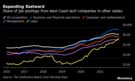
More than four in ten listings for higher educated white-collar occupations at technology companies based in California, Oregon and Washington are outside of the region, according to an analysis by the Conference Board.

Texas is by far the top state destination, including in Austin, where Tesla Inc. just moved its headquarters. Among metro areas, Washington, D.C., comes on top, followed by New York City.

While East Coast cities like Boston have long been tech hubs, the findings point to a pandemic-era shift inland. Denver and Nashville, Tennessee, have seen some of the biggest increases in job postings.

The trend, which began before the Covid-19 crisis, has greatly accelerated since as companies went fully or partially remote — and many workers fled California. Tech firms are also expanding — Amazon.com Inc. in Arlington, Virginia, and Google in Manhattan, for instance — and seeking local talent.

The percentage of job postings outside of the West Coast, 43%, has jumped from about 30% at the beginning of 2019, according to research from the Conference Board.

Faced with a tight labor market, companies across the country have bid up wages and offered increased flexibility to attract and retain workers. In places where the cost of living is cheaper, West Coast tech firms are able to pay more than the local market — but still less than in California, according to Agron Nicaj, the Conference Board economist who conducted the analysis.

By state, Texas is the biggest winner, with 7.3% of job postings from West Coast tech companies in 2020 to 2021 — up from 4.6% before the pandemic.

Austin captures almost 4% of the listings analyzed by the Conference Board. And while transplants have made the city one of the fastest growing metro areas in the country, the influx of high-paid tech workers have also sent home prices soaring.

Another winner is Virginia, which caught up with New York during the pandemic.

Georgia and North Carolina are also attracting tech companies, with Atlanta and Durham getting a larger share of the pie of the listings.   

More stories like this are available on bloomberg.com

©2022 Bloomberg L.P.

Bitcoin Losing Out to Gold Has Analysts Eyeing $30,000 Level

(Bloomberg) — Bitcoin traded near a more than two-week low as fears of a possible Russian invasion of Ukraine prompted some analysts to predict the largest cryptocurrency could slide toward the key $30,000 level.  

Bitcoin was little changed after touching a low of $36,372 on Tuesday after Russian President Vladimir Putin said he’s recognizing two self-proclaimed separatist republics in eastern Ukraine and ordering troops there. Other cryptocurrencies also fluctuated amid the political uncertainty, with Ether off as much as 3% before edging higher and XRP down as much as 6.7%. 

Bitcoin dipped below $40,000 level over the weekend and kept weakening as the Ukraine crisis deepened, undermining the argument that cryptocurrencies are a haven in times of geopolitical turmoil. At the same time, gold has reached its highest level since June.

“In the globe’s latest maelstrom — U.S./Russia/Ukraine — Bitcoin, the asset purported to be the answer to every question, has quietly weakened and is notably underperforming its arch-enemy, gold,” said John Roque of 22V Research in a note on Monday.

Read more: Putin Orders Forces to Separatist Ukraine Areas in Escalation

Roque predicted Bitcoin may fall below $30,000 — a level it hasn’t seen since July — as traders increasingly favor gold, potentially pushing bullion to an all-time high. 

“Bitcoin’s inability to hold $40,000 amid heightened Ukraine tensions means $30,000 is back in play,” Nexo co-founder and managing partner Antoni Trenchev said in an email. “Geopolitics has, for now, replaced inflation as the primary driver of both traditional and crypto markets.”

Trenchev sees last summer’s lows of around $29,000 as a “last line in the sand” but expects Bitcoin to hold at $30,000, with significant buying interest at that level.

Katie Stockton, founder of Fairlead Strategies, said technical analysis isn’t in Bitcoin’s favor either. The token, which is already trading below a long-term support level of around $37,400, would face its next key technical test at $27,200, she said.

More stories like this are available on bloomberg.com

©2022 Bloomberg L.P.

Etsy, Wayfair in Tough Spot as Pandemic Gains Wane

(Bloomberg) — Investors who valued e-commerce stocks as if the pandemic boom would never end are struggling in some cases to accept that the days of rapid growth are over. 

EBay Inc., Etsy Inc. and Wayfair Inc. deliver results this week at the tail end of an earnings season that’s already shown that customer gains accrued during the pandemic are proving difficult to hold on to. That’s led to a series of stock blowups from former high flyers like Shopify Inc. and Roku Inc. after disappointing reports.

Analysts predict that online marketplace EBay and furniture retailer Wayfair will report declines in quarterly sales, while Etsy is projected to announce the slowest growth in at least six years, according to data compiled by Bloomberg. 

Yet Etsy at 31 times estimated earnings and Wayfair at a multiple of 97 times are still priced for rapid revenue expansion, even after their stocks have plunged. Of the three, only EBay is cheaper than the S&P 500’s price-earnings ratio of 19.

“Not only is growth decelerating, but many investors have over-extrapolated the growth they could see over the next few years,” Chad Morganlander, a senior portfolio manager at Washington Crossing Advisors, said in an interview. “If you don’t have additional businesses or silos of revenue growth outside of retail, that will certainly be an impediment.”

Shopify’s report of slowing growth sent its stock down a record 23% last week. Roku lost almost a third of its value after the streaming-video platform company’s forecast disappointed investors.

Some investors may be looking hopefully to Amazon.com Inc., which surged in the wake of earnings this month. However, those gains were fueled more by strong performance in its cloud computing and advertising units than its core e-commerce business, where growth has stagnated. Other e-commerce companies don’t have that luxury.

Etsy, a marketplace for crafts and vintage items, appears vulnerable if its results on Thursday don’t live up to expectations. While the stock has fallen 57% from a November record, it is nearly three times higher than it was at the end of 2019. The options market is implying a move of about 12% on the day after earnings, according to Bloomberg data.

Etsy’s future growth is likely to be driven by higher spending per customer as user growth slows, according to UBS Group AG analyst Kunal Madhukar, who raised the stock to neutral from sell this month, citing a valuation that Friday hit the lowest since April 2020 relative to projected profits.

EBay, which is down 31% from its October record, reports after the market closes Wednesday. Wayfair’s announcement is due Thursday before trading starts; the stock has fallen 63% from a high in March.

Given the big drops that the stocks have already endured, they could bounce if there’s any sign that the business is slowing less than feared. That may be what analysts are counting on: Their average price targets imply a gain of 86% for Etsy over the next year, 61% for Wayfair and 38% for EBay.

Tech Chart of the Day

The Nasdaq 100 Index is swinging like a small-cap tech stock in 2022 as investors weigh slowing earnings growth, rising interest rates and simmering geopolitical tensions. The index has seen 13 moves of 2% or more in less than two months of 2022, and is poised to decline another 0.5% on Tuesday.

Top Tech Stories

  • From Alibaba to Tencent, China’s largest companies are once again at the center of a market storm, spurred by speculation that Beijing is readying another assault on the world’s biggest internet arena. Chinese technology stocks dropped for a third straight session.
  • M-DAQ, a fintech startup backed by Jack Ma’s Ant Group, agreed to buy e-wallet operator Wallex to expand its reach in Southeast Asia and pave the way for a possible public listing
  • Cohere Technologies, which works with phone companies to send more data through existing communications infrastructure, raised $46 million. The funding values the startup at about $500 million
  • Apple supplier Luxshare Precision is seeking to raise up to $2.1 billion through a private share placement to fund a series of projects from intelligent wearable device manufacturing upgrade to electric vehicle component production

More stories like this are available on bloomberg.com

©2022 Bloomberg L.P.

China Crackdown Risk Roars Back With Probe of Jack Ma’s Empire

(Bloomberg) — From Alibaba to Tencent, China’s largest companies are once again at the center of a market storm, spurred by speculation that Beijing is readying another assault on the world’s biggest internet arena.

Three of China’s most valuable businesses — Alibaba Group Holding Ltd., Tencent Holdings Ltd. and Meituan — have shed more than $100 billion in the span of three turbulent days. It’s a remarkable reversal from just a week ago, as investors like Charlie Munger spotted bargains among China Tech Inc. after a $1.5 trillion selloff in 2021. Macquarie issued a report this month headlined “peak crackdown.” 

Now, investors are frantically attempting to parse a series of events that suggest Beijing is once more preparing to rein in its giant private sector. When Alibaba reports earnings Thursday, its executives will again face questions about Beijing’s intentions for a sector subjected last year to unprecedented regulatory curbs and punishments, after Xi Jinping’s administration launched a “common prosperity” campaign to curb tech-sector excesses and force them to share the wealth.

The bloodletting began Friday, when the top state economic planner demanded Meituan and its peers lower the fees they charge restaurants in pandemic-hit regions. On Monday, a pair of unverified online posts that went viral suggested Tencent — which weathered 2021’s onslaught better than most — was facing a major regulatory crackdown, forcing its public relations chief into an unusually aggressive denial.

Later that day, Bloomberg reported that Beijing had ordered state-run firms to report their exposure to Jack Ma’s Ant Group Co. — the hardest-hit firm in a year-long government campaign against “disorderly capital.” 

“The events of the past 48 hours are a wake-up call that regulation isn’t finished,” said Michael Norris, an analyst with Shanghai-based consultancy AgencyChina. “We are going to be in a situation where the regulation and the slowdown in China’s economy happen side by side. It’s going to be challenging for businesses that rely on consumers and merchant advertising to be able to make this year’s numbers.”

Read more: Chinese Tech Stocks Drop to New Crackdown Lows, Led by Alibaba

While many investors were counting on an end to the relentless regulatory pressure, fundamental questions remained about the ability of China’s tech giants to resume the growth they had enjoyed during a decade of near-unfettered expansion. Alibaba and Tencent had already been expected to record their slowest pace of quarterly revenue rises since listing.

The shell-shocked industry had been expected to tread more cautiously this year than ever before — curtailing the hiring and acquisition sprees of years past, for one.  Didi Global Inc. is preparing to reduce headcount by as much as 20% ahead of its Hong Kong IPO, Bloomberg News reported last week. Twitter-like Weibo Inc. has started to readjust its businesses since the start of the year, allocating some staff to new roles before letting them go, the company said in a statement last week, in response to online posts alleging the firm is firing a wave of people.

“The golden period of Chinese internet is probably already behind us,” said Jessica Tea of BNP Paribas Asset Management. “That said, we believe the peak of the regulatory intensity is probably behind us in this cycle, as we move from policy normalization to growth normalization.”

The Message Behind China’s Big Tech Wipeout: Shuli Ren

Now, the latest demands placed on Meituan and food delivery peers like Alibaba’s Ele.me suggest they’re also getting pressed into national service, with uncertain longer-term implications. The move to cut food delivery fees shows Beijing will enlist wealthy private firms to relieve the burden of smaller businesses hard-hit by China’s economic slowdown and its Covid-Zero strategy, Goldman Sachs analysts led by Ronald Keung wrote this week.

It’s intended “to help companies in affected industries overcome the impact of COVID-related challenges by lowering their costs,” they said. While it may impact short-term profitability for Meituan and Alibaba’s loss-making Ele.me, the analysts “see no long-term impact on Meituan’s business.”

The risks to growth are especially prominent at Alibaba, which last year swallowed a record $2.8 billion fine after regulators forced it to end certain merchant exclusivity practices that allegedly helped it one-up rivals. The regulatory assault has cut the company’s market value from $858 billion in October of 2020 to roughly $310 billion.

Its outlook is already challenging. Analysts forecast that revenue rose just 11% in the December quarter, by far the slowest rate of growth since it went public in 2014. Alibaba’s operating margin has slipped from 30.4% in 2017 to 10.7% in the twelve months ended September, pressured by new competitors and softening economic growth. The firm has seen video-streaming platforms Douyin — the domestic sibling to ByteDance Ltd.’s TikTok — and Kuaishou Technology draw business away from its Taobao and Tmall marketplaces. To make matters worse, its top online influencer-merchant, Viya, got caught up in a tax evasion scandal.

What Bloomberg Intelligence Says

The dimming macroeconomic picture and overall challenging environment for global equities remain headwinds to Tencent and China internet peers seeking a rebound from 2021’s rout, but trends could brighten as 2H22 approaches. Chinese economic stimulus, along with easing year-ago comparables, could be enough to stir a pickup after June.

— Matthew Kanterman and Tiffany Tam, BI analysts

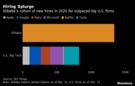
In 2020, Alibaba hired more people than Silicon Valley giants Alphabet Inc., Meta Platforms Inc., Microsoft Corp., Netflix Inc. and Tesla Inc. combined. It more than doubled its number of employees in the year ending March 2021 to 251,462, but then added only another 7,000 in the following six months. Tencent’s most recent report in June also showed its hiring pace slowing.

Read more: Tencent Quashes Talk of New Crackdown as Tech Wipeout Deepens

The waning fortunes of China’s internet giants coincide with a re-assessment now underway in Silicon Valley, as the pandemic fades and takes the Covid-driven surge of internet activity with it. Facebook’s parent posted its first-ever decline in user numbers, while Shopify Inc. is warning of a slowdown.

At Tencent, revenue is expected to grow 9% for the fourth quarter, the slowest pace since its 2004 listing. That’s after appetite for ads was dented by stricter privacy rules and a suspension of new game approvals that has dragged on for more than six months. The company’s margins are already under pressure as the WeChat operator is now counting on overseas markets to spur gaming growth while devoting more resources into arenas like the cloud and fintech.

“Bottom line, this policy pivot is real,” said Wai Ho Leong, strategist at Modular Asset Management in Singapore, “and unlikely to soften anytime soon.”

FROM THE ARCHIVE: Why China Is Cracking Down on Its Technology Giants: QuickTake

More stories like this are available on bloomberg.com

©2022 Bloomberg L.P.

Elon Musk Laughed at the Idea of Tesla Using Too Much Water. Now It’s a Real Problem

(Bloomberg) — When Elon Musk was asked last year whether the factory Tesla Inc. was constructing in Germany would deplete the area’s water supply, he broke out in bellowing laughter and called the notion “completely wrong.”

Six months later, water is one of the primary reasons the plant still isn’t producing vehicles.

While Musk in August flippantly pointed to water “everywhere” around Berlin, the region is suffering from falling groundwater levels and prolonged droughts due to climate change. That’s sparked a legal challenge that will go to court next week and an acknowledgment from local authorities that supply will be insufficient once Tesla ramps up the plant. The issue has the potential to further delay or even stop the 5 billion-euro ($5.7 billion) project in what could turn into a costly setback to the carmaker’s expansion.

“Tesla will increase the problem for sure,” said Irina Engelhardt, who heads the hydrogeology department at Berlin’s Technical University. “There might not be enough water for everyone.”

Ramping up the factory in the eastern state of Brandenburg is key to Tesla’s global ambitions. The carmaker needs a manufacturing base in Europe to supply the region’s fast-growing electric-vehicle market, which is expected to remain much bigger and more competitive than the U.S. for years to come. While Tesla has erected the plant at breakneck speed, it’s still waiting for final approval from local authorities just as Volkswagen AG, Mercedes-Benz AG and Stellantis NV broaden their own EV lineups.

“The current water supply is sufficient for the first stage of the factory,” Brandenburg Economy Minister Joerg Steinbach said in an interview. Once Tesla expands the site, “we’ll need more.”

Musk, 50, has been on a charm offensive to promote the plant Tesla has said will eventually produce batteries and as many as 500,000 cars annually. He has tweeted in German, rubbed shoulders with local politicians and threw an Oktoberfest-style county fair at the construction site in October. But he’s also frustrated authorities with several last-minute changes to the factory and sparked outrage in Germany last week for posting a meme evoking Adolf Hitler. The country’s vehicle regulator said this week it’s investigating one of Tesla’s driver-assistance features.

Much of the optimism about Tesla’s growth prospects this year rests on the company’s ability to get the factories it’s been constructing near Berlin and Austin, Texas, up and running. When Credit Suisse analysts raised their share-price target to $1,025 from $830 last month, the first factor cited was capacity expansion. The Berlin plant “arguably serves as Tesla’s most critical incremental source of capacity,” the analysts led by Dan Levy wrote in the Jan. 18 report. Ramping it up should bolster supply in a market that’s been “ground zero for the global EV inflection.”

Tesla shares fell 3.1% to $830 as of 5 a.m. New York time Tuesday. The stock has slid 19% this year.

German politicians have backed the investment because it promises thousands of new jobs in a region that has little heavy industry. Yet progress at the site in the small town of Gruenheide has been slower than hoped, with the pandemic, red tape and backlash from locals over water usage delaying the start of production by several months.

The Nabu and Gruene Liga groups sued Brandenburg’s environment office last year, saying it failed to take into account the impact of climate change when approving a 30-year permit to pump more groundwater for Tesla’s factory. Authorities say the issue is manageable and that they’re already looking for additional supply. A decision in favor of the environmentalists would likely delay the plant’s opening and could derail it altogether. A first court hearing is scheduled for March 4.

Tesla and Brandenburg’s environment ministry, which is in charge of the office, didn’t respond to requests for comment.

Experts say some of the environmentalists’ concerns are valid. Brandenburg’s water table has been dropping for the past three decades. Droughts in each of the past four years have resulted in wildfires and crop failures. Meteorologists are predicting more frequent heat waves, further weakening the ability of local soil to store rainfall.

Tesla’s factory would roughly double the amount of water consumed in the Gruenheide area, according to Axel Bronstert, a hydrology professor at the University of Potsdam. He said it’s “naive” to think reserves would suffice for both the factory and residents, and called the groundwater situation in Brandenburg “serious.”

Regardless of how judges rule in the case, the local water works will have to invest in new infrastructure including a wastewater treatment plant to ensure adequate supply — major engineering projects that authorities admit could take years.

“There are considerable delays in the processing of the necessary measures,” Andre Baehler, the head of the local WSE water works, said earlier this month during a Brandenburg parliamentary environment committee hearing.

Tesla flagged in its impact report last year that water is becoming increasingly scarce due to climate change. The company said it withdraws less water per vehicle produced than the majority of established carmakers, and that it’s taking steps at the German plant to further reduce usage.

As per a contract with local authorities, the Gruenheide site would get 1.4 million cubic meters of water annually — enough for a city of around 40,000 people. Steinbach said that while he’s taking the environmental concerns very seriously, the large majority of the local population is in favor of the factory. Brandenburg authorities are backing efforts to drill for more water in the area and supply could also be sourced from further away if necessary, he said.

But digging new wells probably won’t make the concerns disappear. Manuela Hoyer, who lives just a few miles from the factory, says Tesla is getting preferential treatment from local politicians even though it would make an already serious environmental issue worse.

“We’ve been told for years that we shouldn’t water our lawns,” Hoyer, who is active in a citizen’s initiative monitoring the project, said in an interview. “Then the world’s richest man comes along and gets everything he wants.”

(Updates with share trading in the ninth paragraph.)

More stories like this are available on bloomberg.com

©2022 Bloomberg L.P.

Startup That Squeezes 5G Airwaves Valued at About $500 Million

(Bloomberg) — Cohere Technologies Inc., which works with phone companies to send more data through existing communications infrastructure, raised $46 million valuing the startup at about $500 million.

Airwaves or “spectrum” rights are the scarcest resource in wireless technology, akin to land in construction. With data usage skyrocketing, limited airwave access can act as a bottleneck, making them extremely valuable. Carriers have paid the U.S. government almost $100 billion for the rights to use certain 5G frequencies.

Santa Clara, California-based Cohere says it adds software to mobile radio equipment that uses spectrum more efficiently by directing transmissions in a more targeted way.

Chief Executive Officer Ray Dolan likened the technology to using spotlights in a theater instead of lighting up the whole stage at once. Last year Vodafone Group Plc said Cohere’s “spectrum multiplier” boosted network capacity in a trial.

“One of the main targets companies like to target is to be a unicorn,” Dolan said in an interview with Bloomberg. “We’re not there, but we’re halfway there.” 

Cohere’s funding round was led by Koch Industries Inc, alongside existing investors including Lightspeed Ventures and Telstra Corp Ltd. The company has yet to make money but hopes to convert its trials into major contracts soon.

“This is most likely our last need for financing before we go public, assuming that’s the outcome,” said Dolan. “We’re not thinking too far down the road.”

The company is also launching a new product Tuesday, which will allow companies to use its software on any kind of standard, be it 4G, 5G, Wi-Fi, or future 6G networks.

More stories like this are available on bloomberg.com

©2022 Bloomberg L.P.

Crypto Companies Build Lobbying Army to Influence New York’s Rules

(Bloomberg) — New York is trying to become the U.S.’s “crypto capital.” Major cryptocurrency companies are hiring an army of lobbyists to influence that outcome.

New filings show that Digital Currency Group, Blockchain.com, and roughly a dozen other firms are spending upwards of $100,000 a month in a $1.5 million Albany lobbying blitz aimed at helping to write the rules governing the $2 billion crypto industry, which remains mostly unregulated at the federal level. 

Even firms like eToro, which don’t yet operate in New York, are staffing up in Albany because laws written there could impact legislation across the U.S.

New York is home to some of the toughest financial watchdogs in the world and crypto companies are conscious of the lessons learned by technology companies like Airbnb Inc. and Uber Technologies Inc., which have tussled with New York regulators over the years. They’re also mindful of New York’s already onerous crypto licensing requirements and fear that states with fewer regulations, such as Texas, could lure companies there instead.

On New York’s cutthroat political stage, “we have to have a seat at the table,” said Lane Kasselman, chief business officer at crypto trading platform Blockchain.com.

That’s especially important as New York and other states ramp up efforts to write new rules around crypto, Kasselman said, noting that among the crypto legislation that Blockchain.com is tracking, 96 bills were introduced in the U.S. in the first six weeks of 2022. “In 2021, there were 13 bills introduced in the U.S. related to crypto,” Kasselman said.

‘Crypto Capital’

New York lawmakers are publicly embracing crypto technology as a way to boost an economy still reeling from the pandemic and Wall Street’s shrinking footprint. “Does New York want to be the center of the next great financial system or give it up to Miami or San Francisco?” Kasselman said. “What’s at stake? The best and brightest are leaving.”

New York City Mayor Eric Adams, who declared before he took office in January 2022 that he’d take his first three paychecks in cryptocurrency, has staked a claim at making the city “the center of the cryptocurrency industry.” Adams has since partied with crypto billionaire and Galaxy Investments CEO Mike Novogratz and hitched a ride to Puerto Rico on the jet of crypto entrepreneur Brock Pierce. He’s appeared at industry devotees’ meet-ups and explained the intricacies of Ethereum and Bitcoin.

The enthusiasm has been contagious. “There’s so much investment, activity and scrutiny in the industry recently that a lot of firms are realizing it’s time to get off the sidelines,” said Eric Soufer, who launched a new fintech and crypto lobbying practice in January for Tusk Strategies.

Read more: New York City Leads Crypto-VC Funding Race Over Silicon Valley

Tusk Strategies is owned by Bradley Tusk, a longtime political strategist who ran campaigns for former New York mayoral candidate Andrew Yang and former Mayor Michael Bloomberg, the founder and majority owner of Bloomberg LP, the parent company of Bloomberg News.

Tusk Strategies also represented Uber when the car-sharing service launched in New York City in 2011, and Soufer said the parallels are clear: “If you want to have a role in shaping the trajectory of crypto regulation — not just on the state level, but also on the federal level — you need to engage and demystify the space.”

Energy Use

There’s been little indication on where New York Governor Kathy Hochul stands on crypto — whether it be front-office cryptocurrency operations or bitcoin mining. Crypto businesses say one potential bright spot is Adrienne Harris, the former Obama Administration official that Hochul named as the state’s new superintendent of the Department of Financial Services, New York’s top regulator for the industry. Harris served as a board member for the Digital Dollar Foundation, a group advocating for a U.S. central bank digital currency.

So far, most of the attention in Albany has focused on the environmental impact of bitcoin mining, an energy-consuming, lightly regulated practice that has boomed on U.S. shores since China’s 2021 crypto-mining ban. 

In a closely watched case seen as a bellwether for how strictly the state might regulate crypto mining, New York’s Department of Environmental Conservation is expected to issue a key decision in March on whether  to continue to allow mining operations at the formerly decommissioned power plant operated by Greenidge Generation Holdings Inc.

Located on Seneca Lake in New York’s Finger Lakes region, Greenidge is a coal power plant bought by private equity firm Atlas Holdings LLC that was turned into a natural gas-burning plant. By 2020, it became a 24-hour Bitcoin-mining operation. The plant has applied to renew an air-emissions permit and environmental activists and the cryptocurrency industry have been monitoring the public debate. 

This “relatively new, little understood industry is destroying our climate because it’s so energy intensive,” said Yvonne Taylor, vice president of Seneca Lake Guardian, an environmental activist group.  “Outside speculators are flocking to New York because it’s like the Wild West here without any oversight,” she said.

Read More: N.Y. Delays Permit Decision for Bitcoin Miner’s Power Plant 

There’s also been extensive lobbying on legislation that would impose a moratorium on all crypto-mining operations statewide, as well as more than 20 bills introduced as of mid-February related to the industry on topics ranging from fraud to the use of blockchain technology in elections.  There were 16 crypto-related bills introduced in New York in all of 2021.

In a sign of the divergence of political support, Mayor Adams this month proclaimed that “I support cryptocurrency, not crypto mining,” in an appearance in front of state lawmakers. And businesses without direct mining operations are concerned the conflicts over mining will spill over into other parts of the business, such as trading and other front-office businesses.

“Mining sucks up all the oxygen and crypto gets defined by mining,” said Soufer, of Tusk Strategies.

Charm Offensive

Crypto businesses outside of mining say they view their lobbying efforts as a pre-emptive strike. “It is for us to be involved as regulation continues to be developed and created,” said Lule Demmissie, chief executive officer of eToro USA, an Israel-based company that’s set to go public through a SPAC merger with Betsy Cohen-backed FinTech Acquisition Corp. V.

It’s also a way to avoid the fate tech companies like Facebook and Google have faced, where televised congressional hearings show lawmakers baffled by some of the most basic tech jargon. 

Read more:  Crypto Firms Gear Up for Battles Over New Rules in Washington

“The technology is hard,” said Dan Burstein, U.S. general counsel at Paxos, a regulated blockchain infrastructure platform. Teaching politicians and policy makers about crypto is one way to influence future legislation. It’s also a way to ensure that their companies don’t get inadvertently swept up into legislation in case the language being used to craft bills isn’t precise enough.

“They see what’s in the market now, but not what’s coming and they may not be considering future risks to the financial system,” Burstein said.

For instance, some companies have hired lobbyists to push for changes to New York’s BitLicense, which was created in 2014 and regulates crypto companies that reside in — or have customers in — the state. Some companies want the state to relax the licensing requirements to make it easier for smaller crypto companies to comply.

Exchanges aren’t allowed to operate in New York without a BitLicense and only licensed companies can offer certain approved coins in the state. Roughly half of the 157 coins supported by Coinbase, for example, are not available to New Yorkers to trade.

“If you’re a younger, newer cryptocurrency project — it takes a while to get on those exchanges,” said Gene Hoffman, chief operating officer at Chia Network, a blockchain network founded by BitTorrent creator Bram Cohen. The crypto industry is “radically different” than when the BitLicense was originally created and “it’s time to take a fresh look and modify it,” Hoffman said.

More stories like this are available on bloomberg.com

©2022 Bloomberg L.P.

China Fines Another Live-Streamer After Tax Evasion Probe Widens

(Bloomberg) — China has fined another live-streaming personality for tax evasion, expanding a probe that’s ensnared some of the country’s most popular influencers and disrupted e-commerce at Alibaba Group Holding Ltd.

Ping Rong, a Guangzhou-based live-streamer, was fined 62 million yuan ($9.8 million) for evading taxes in 2019 and 2020, the State Taxation Administration said in a statement. The influencer commanded a following of about 24 million fans on the video platform Kuaishou Technology. As of Tuesday afternoon, Ping didn’t show up on in-app searches.

The crackdown on China’s booming live-streaming sector marks an escalation in President Xi Jinping’s campaign against illegal sources of income, part of a “common prosperity” drive that aims to narrow the wealth gap. Celebrities have been targeted by tax authorities, as the drive to redistribute income dovetails with a broader clampdown on the entertainment industry for promoting “improper” idol culture. A Kuaishou spokesperson didn’t respond to a request for comment.

“We will strengthen analyzing big data in tax collection and improve tax regulations targeting live-streamers,” said the local taxation bureau of Guangzhou, a city in the country’s south.

Live-streaming has in past years become key to enticing and retaining buyers on online platforms from Alibaba’s Taobao to Kuaishou. 

The latest penalty came after the watchdog fined top live-streamer Viya a record $210 million in December, accusing her of concealing personal income and making false declarations. A month prior, authorities fined two live-streamers in Hangzhou nearly $15 million in total for illegally booking employment income as business income. All three have suspended their work and haven’t re-appeared in live-streaming studios since.

Tax authorities asked celebrities to voluntarily report wrongdoing in exchange for lighter punishment in September, after announcing a new round of tax checks. More than 1,000 live-streamers and workers in other fledgling industries have voluntarily paid back taxes since.

More stories like this are available on bloomberg.com

©2022 Bloomberg L.P.
Russian Stocks Extend Slump as Ukraine Tensions Ratchet Higher

(Bloomberg) — Russian stocks extended their declines on Tuesday as investors weighed the potential for fresh sanctions after President Vladimir Putin recognized two separatist republics in eastern Ukraine and ordered forces to the breakaway regions. The benchmark MOEX index fell 6.9%, extending its steepest slump since the annexation of Crimea in March 2014 on Monday. …

Russian Stocks Extend Slump as Ukraine Tensions Ratchet Higher Read More »

Oil, Gold Advance as Putin Orders Forces to Regions of Ukraine

(Bloomberg) — Oil and gold led a broad rally in commodities after Russian President Vladimir Putin announced that he’s recognizing two self-proclaimed separatist republics in eastern Ukraine and plans to send “peacekeeping forces” to the region in a dramatic escalation of the conflict.  West Texas Intermediate crude climbed about 3% from Friday, after not closing …

Oil, Gold Advance as Putin Orders Forces to Regions of Ukraine Read More »

Close Bitnami banner
Bitnami