Bloomberg

Chinese Tech Stocks Drop to New Crackdown Lows, Led by Alibaba

(Bloomberg) — Chinese technology stocks dropped for a third straight session amid fresh worries over Beijing’s regulatory plans for the sector. 

The Hang Seng Tech Index fell 1.9% on Tuesday to the lowest close since its inception in 2020. Alibaba Group Holding Ltd. was among the biggest losers following a Bloomberg report that authorities have begun another round of checks on its fintech business arm. 

The rout weighed on the broader Hong Kong market, with the Hang Seng Index slipping 2.7%, struggling to shake off the impact of China’s sweeping crackdown on private enterprise. The gauge was also dragged lower as HSBC Holdings Plc reported a charge relating to its Chinese commercial real estate exposure, while global equities face pressure from escalating Ukraine tensions. 

President Xi Jinping’s “common prosperity” campaign has put the business models of many tech titans in the firing line. Food delivery giant Meituan declined another 5.1% on Tuesday after Beijing on Friday ordered it to cut fees. Tencent Holdings Ltd. erased losses to trade little changed after denying it is facing a new scrutiny of its core businesses. 

The Hang Seng Index has more than halved from last year’s February peak with Beijing’s anti-monopoly campaign now into its second year.

The question is “how much large internet companies’ earnings will be impacted in the long-term if they are required to take increasing social responsibility,” said Jian Shi Cortesi, a portfolio manager at GAM Investment Management. There are not enough details currently to make a conclusion yet, she added.

The technology sector’s bullish run had lasted for decades before the “common prosperity” push brought it to an abrupt halt. The clampdown that began in late 2020 has hit almost every corner in the industry, from data security, digital business to online games and overseas listings. 

Members of the Hang Seng Tech Index have lost a combined $1.6 trillion since the February peak last year, Bloomberg data show. 

The impact on tech earnings will be on show again on Thursday, when Alibaba is due to report an estimated 60% drop in quarterly profit. 

Global funds and analysts, including at Goldman Sachs Group Inc. and UBS Group AG, had turned more optimistic on the sector in late 2021, citing easing policy concerns and cheap valuations. But stocks have extended losses in 2022 and the slew of new measures recently are making global funds more cautious. 

The recent announcements “might make investors a bit more reluctant to invest in Chinese internet names,” said Herald van der Linde, head of Asia Pacific equity strategy at HSBC Holdings Plc., adding that the regulatory measures pose a risk to his overweight position in China. 

“We are still cautious on China internet and have been very selective when it comes to picking exposure to this sector,” he said. 

(Updates details and prices throughout.)

More stories like this are available on bloomberg.com

©2022 Bloomberg L.P.

Asos Shares Drop as They Start Trading on London’s Main Market

(Bloomberg) —

Asos Plc shares fell 3.1% as they started trading on the London stock exchange’s main market. Today’s decline — coming amid a broader market selloff — extends a slump that has seen the U.K. online fashion retailer lose almost two-thirds of its market value in less than a year.

After 20 years on London’s junior AIM market — during which the stock surged nearly 10,000% — Asos made the change in order to access a broader group of global institutional shareholders and to “enhance the company’s corporate profile and recognition,” according to a statement last month. The company’s market capitalization of just under 2 billion pounds ($2.7 billion) meant it was among the top five AIM-listed companies as it departed the junior venue.

“Asos’s decision to subject itself to the stricter reporting requirements of the main market may be one way of reassuring shareholders and stakeholders that the company is living up to the increasingly high ESG standards” now required, said Russ Mould, investment director at AJ Bell. 

The fast-fashion company will likely be eligible to join the FTSE 250 midcap index, while missing out on the bluechip FTSE 100, Mould said.

AIM — once seen as a stepping stone for small companies wanting to list on the exchange’s main market — has been retaining companies for longer, even as their market valuations have ballooned. The venue has worked to attract a broader base of companies and improve its formerly volatile reputation. Now, it counts cancer drug developer Hutchmed (China) Ltd., airline Jet2 Plc and high-end tonic maker Fevertree Drinks Plc among its biggest members.

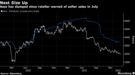
Asos shares have been on a downward trajectory since July, when the retailer warned of softening sales caused by supply chain pressures and continued uncertainty over Covid-19. That was followed by a profit warning in October which was accompanied by the firm’s chief executive officer stepping down after six years in the job.

The move to the main market comes during a difficult time for online retailers that thrived during lockdowns, with shifting consumer-spending habits coinciding with logistics issues that have made moving inventory around the world more difficult since the pandemic and Brexit.

Still, analysts covering Asos are largely positive, with 13 rating the stock a buy, 15 rating it a hold, and none of the 28 tracked by Bloomberg recommending selling. That’s in contrast to short interest data, which has been creeping higher for the past five months and is hovering at around 8% of shares outstanding, according to IHS Markit data.

AJ Bell’s Mould said much will now depend on how the company manages high inflation and its impact on the company’s profit margins. “Ultimately, it is the fundamentals of profits, cash flow and valuation which will determine the long-term valuation and share price trajectory of the stock,” he said.

More stories like this are available on bloomberg.com

©2022 Bloomberg L.P.

Myanmar Upheaval Prompts Axiata to Delay Listing Towers Unit

(Bloomberg) — Axiata Group Bhd., Malaysia’s largest mobile-phone carrier by market value, has put on hold the planned listing of its telecommunications infrastructure unit because of the political unrest in Myanmar. 

“What we’ve been advised is so long we have Myanmar as part of our portfolio, that can be a bit of a challenge if we were try to list edotco,” Axiata President and Group CEO Izzaddin Idris said in a virtual briefing on Tuesday. “When a company is listed, you want to make sure that you have a good investment base and good valuation.”

edotco Group Sdn. manages more than 32,750 towers across Southeast Asian nations including Malaysia, Sri Lanka, Bangladesh and Cambodia, according to a press release on its website. In Myanmar, the company runs over 1,800 towers and managed sites.

Axiata isn’t the only company suffering from the heightened investment risks after a military coup in Myanmar. Amata Corp., one of Thailand’s biggest industrial land developers, had said the change in government would impact its investment in the country, while Japanese brewer Kirin Holdings Co. ended its joint-venture partnership with the nation’s largest brewer Myanma Economic Holdings Pcl, which has ties to the military.

Read More: EU Sanctions Myanmar Oil Firm for Providing Junta Resources

Axiata owns about 62.4% of edotco through the special purpose vehicle, according to a 2017 statement on edotco’s website. Other shareholders include Malaysia’s sovereign wealth fund Khazanah Nasional Bhd., Innovation Network Corp. of Japan and pension fund Kumpulan Wang Persaraan (Diperbadankan).

“Currently, edotco is in good place to be able to raise capital to do its acquisitions and expansion,” Izzaddin said. “The bigger issue for me, and the edtoco team, is Myanmar if we were to seek a listing in any of the markets.”

More stories like this are available on bloomberg.com

©2022 Bloomberg L.P.

Klarna Rolls Out ‘Pay Now’ and Rewards Programs to New Markets

(Bloomberg) — Klarna Bank AB is adding the option for customers to pay immediately at checkout in nine new markets while expanding its rewards program, as it targets becoming a one-stop lender for consumers.

The company grew to a $46 billion valuation and 100 million users on the back of allowing customers to pay for purchases in installments, fueling a rise in buy-now-pay-later startups. After launching ‘Pay Now’ in the U.S. and U.K. last year, Klarna is now rolling out the service to Australia, Ireland, France, Italy, Spain, Portugal, Poland, Canada and New Zealand, according to a statement. 

The company’s rewards program — which sees consumers earn points every time they pay immediately or make an on-time repayment — is also expanding to several new countries, including the U.K., France and Canada. Members earn points for every payment made on time and have 50% higher engagement with Klarna’s app. 

Changing the company’s product offering will also allow it to better service sectors like mobility and groceries, Chief Expansion Officer Camilla Giesecke said in an interview. “A lot of our more global partners really want to grow with us into new markets.” 

Read more: Klarna Adds ‘Pay Now’ Option in U.K. Amid Regulatory Scrutiny

The expansion comes as Klarna weighs plans to raise new money in a funding round, Bloomberg News reported earlier this month. That would cement its status as Europe’s most valuable startup even as it faces a challenge to its funding model as interest rates rise.

More stories like this are available on bloomberg.com

©2022 Bloomberg L.P.

U.S. Condemns Russian Move at UN, Reassures Kyiv: Ukraine Update

(Bloomberg) — The U.S. led condemnation of Russia’s actions at the United Nations, after President Vladimir Putin’s decision to officially recognize two self-proclaimed separatist republics in eastern Ukraine escalated tensions with the West. 

The U.S. and the U.K. said they would place additional sanctions on Russia in response to the move, which torpedoed European-mediated peace talks and prompted the State Department to temporarily evacuate personnel. The ruble tumbled its most in about two years, while the Biden administration reaffirmed its “unwavering” support for Ukraine.

Putin also ordered the Defense Ministry to send what he called “peacekeeping forces” to the separatist regions. Moscow continues to deny it plans to invade and the question now becomes what the U.S. and its allies would define as an invasion, and what will trigger the bigger sanctions.

Key Developments 

  • U.S. Orders Personnel Out of Ukraine on Threat From Russia
  • Putin Orders Forces to Separatist Areas of Ukraine After Decree
  • Stocks to Extend Drop on Deepening Ukraine Tension: Markets Wrap
  • U.S. Warns That Russia May Target Multiple Cities in Ukraine
  • Explainer: Why Minsk Accords Are Murky Path for Ukraine Peace
  • Why Donetsk and Luhansk Matter to Putin and Global Security: Q&A

All times CET:

Blinken Reassures Kuleba in Call (5:40 a.m.)

Secretary of State Antony Blinken spoke with Ukrainian Foreign Minister Dmytro Kuleba by telephone “to reaffirm unwavering U.S. support,” the State Department said in a statement. The two discussed recent U.S. measures taken to punish Russia and additional steps that would be on the way. 

Blinken and Kuleba are due to meet in Washington on Tuesday for further talks, it said.

Russia Isolated at UN Security Council (4:35 a.m.) 

Russia’s international isolation was made clear at an emergency meeting of the UN Security Council on Monday night in New York. While some countries called for both sides in the dispute to ease tensions, Russia’s move was roundly condemned by nearly all the members of the council.

Putin “wants to demonstrate that through force he can make a farce of the UN,” U.S. Ambassador Linda Thomas-Greenfield said, later adding that the Biden administration plans additional sanctions against Russia on Tuesday. The U.K. ambassador, Barbara Woodward, said Russia has brought us to the brink. We urge Russia to step back.”

Russia’s UN envoy, Vassily Nebenzia, had the dual role of serving as the Security Council’s president, calling on the speakers, and as his nation’s representative. He criticized what he called Ukraine’s poor treatment toward its citizens in the eastern regions where Moscow has said it is now sending troops and said the West had pressed the country to be more aggressive and militaristic.

China Urges Restraint (4:06 a.m.) 

China’s ambassador to the UN, Zhang Jun, made only brief remarks to the Security Council, calling on all sides to exercise restraint. “We believe that all countries should solve international disputes by peaceful means in line with the purposes and principles of the UN charter,” Zhang said. 

Meanwhile, Chinese Foreign Minister Wang Yi spoke by phone with Secretary of State Antony Blinken, who the State Department said “underscored the need to preserve Ukraine’s sovereignty and territorial integrity.”

U.S. Plans New Russia Sanctions Tuesday (3:38 a.m.)

The U.S. plans to announce new sanctions Tuesday in response to Russian actions on Ukraine, according to a Biden administration official. The U.S. is coordinating with allies and partners on that announcement. 

Thomas-Greenfield separately told emergency Security Council meeting that the U.S. would “take further measures to hold Russia accountable for this clear violation of international law.” The U.K. also plans to impose additional measures. 

U.S. Diplomats Head to Poland (3:35 a.m.)

Blinken said in a statement that his department’s personnel currently in Lviv would spend the night in Poland, citing safety and security reasons. He said they will regularly return to continue their diplomatic work in Ukraine and provide emergency consular services. 

“The fact that we are taking prudent precautions for the sake of the safety of U.S. government personnel and U.S. citizens, as we do regularly worldwide, in no way undermines our support for, or our commitment to, Ukraine,” he said.  

Ruble Sinks as Putin Speaks (3:12 a.m.) 

The ruble tumbled the most since March 2020 after Putin recognized the self-declared separatist republics in east Ukraine. The currency weakened beyond 80 per dollar during Putin’s televised address to Russians late Monday and stocks slumped as much as 18% in evening trading. 

Ukraine Leader Urges Calm (12:51 a.m.)

Ukraine will stick to a peaceful and diplomatic path. That is the message from president Volodymyr Zelenskiy in his late-night address to the nation. Putin has in practice merely “legalized” troops already present in self-proclaimed republics since 2014, he said.

Zelenskiy praised Ukrainians for their calm stance and assured them that the country’s borders are safely guarded. “There are no reasons for your sleepless night,” Zelenskiy said.

UN Security Council Holds Emergency Meeting (12:15 a.m.)

The decision-making body of the United Nations, the UN Security Council, will hold an emergency meeting on Monday night at 9 p.m. New York time. The session will be open, meaning people will be allowed to listen in on the discussion. Expect a lively debate but not much more. 

There are five countries that hold veto power — China, France, Russia, the U.K. and the U.S. — and that has essentially led to gridlock on major geopolitical discussions and meant things like sanctions are non-starters. This month, Russia holds the rotating presidency and that means it chairs meetings and set the agenda.

Congress Chimes In After Putin Nods to Separatists (11:38 p.m.)

Congress’s bipartisan delegation to the Munich Security Conference said lawmakers would work together on any emergency supplemental legislation to support NATO and Ukraine. The group including Senators Lindsey Graham, a South Carolina Republican, and Dick Durbin, an Illinois Democrat, said Putin must be held accountable should Russia invade Ukraine.

House Speaker Nancy Pelosi, leading a separate congressional delegation, met U.K. Prime Minister Boris Johnson on Monday. She said they discussed deterrence strategies including the “threat” of preventing Russian companies from accessing U.S. dollars and the British pound.

Putin Orders Russian Troops to East Ukraine Separatist Zones (11:04 p.m.)

Putin ordered Russian armed forces to carry out “peacekeeping” duties in the separatist regions of Ukraine, according to the text of the decrees he signed on Monday. While Russia will argue Putin’s recognition of the separatist regions gives a legal basis for the presence of its troops, the move will likely fuel U.S. and European concerns that Moscow is moving to take control of territory internationally recognized as part of Ukraine.

The orders potentially move Russian forces closer to direct confrontation with Ukrainian troops at the line of separation with the separatist regions. There was no immediate detail on how many troops might go in, or when. 

Macron Calls Putin’s Move a Violation of Commitments (10:25 p.m.)

Macron rebuked Putin’s decree as an encroachment of Ukraine’s sovereignty, his office said in a statement. The French leader is calling for an emergency meeting of the UN Security Council and the adoption of targeted European sanctions.

Macron had engaged in an intense diplomatic marathon to try and solve the crisis, acting as an intermediary between Putin and Biden and seeking to develop a rapport with Putin.

U.K. Set to Impose Sanctions On Russia Tuesday (9:50 p.m.)

The move comes after new rules introduced in London last week that allow ministers to punish Russian businesses and individuals in a wide range of sectors including financial services, chemicals, construction, defense, electronics, energy, mining, transport and communications and digital. There will be further sanctions if an actual incursion into Ukraine happened, Foreign Secretary Liz Truss said.

Truss took to Twitter Monday night to condemn Putin’s recognition of the separatists. “It demonstrates Russia’s decision to choose a path of confrontation over dialog,” she wrote.

Biden Plans Order Barring U.S. Trade With Separatist Regions (9:34 p.m.)

The U.S. President will issue an executive order Monday prohibiting U.S. investment, trade, and financing to separatist regions of Ukraine after Putin’s move to officially recognize the breakaway territories.

The executive order will allow the U.S. to sanction individuals operating in the area, and the U.S. will also “soon” announce additional measures “related to today’s blatant violation of Russia’s international commitments,” White House press secretary Jen Psaki said. Trade and investment has already plummeted since Russian-backed separatists took control of the regions eight years ago.

Secretary of State Antony Blinken made no direct mention of sanctions, but said “appropriate steps” would be taken to “this unprovoked and unacceptable action by Russia.” Blinken said Biden’s actions will only prohibit new — rather than existing — U.S. investment, trade, and financing in the breakaway regions, and that the restrictions would not impact the Ukrainian people, government, or humanitarian organizations.

EU to React With New Sanctions Over Russian Decree (9:20 p.m.)

EU ambassadors will meet Tuesday to discuss a plan for sanctions in response to Putin’s decree, according to multiple diplomats familiar with the talks. Member states are expected to make a swift decision on a package in the following days, the officials said.

EU chiefs Ursula von der Leyen and Charles Michel said earlier in a joint statement that Putin’s move was “a blatant violation of international law as well as of the Minsk agreements,” referring to the agreement where Russia had recognized the two regions as part of Ukraine.

Any sanctions would have to be unanimously adopted and the bloc has yet to agree which specific measures to take in response. Polish Prime Minister Mateusz Morawiecki said the European Council should call an urgent meeting to impose “immediate sanctions” against Russia.


Germany, U.K., Romania Among Those Condemning Putin’s Order (8:58 p.m.)

Scholz condemned the move to recognize the territories, which is in stark contrast to the push by Germany and France to implement the Minsk peace accords aimed at ending a separatist conflict that’s smoldered since 2014. U.K. Prime Minister Boris Johnson called it an “ill omen” and “flagrant violation” of the sovereignty and integrity of Ukraine.

“I don’t know what is in his mind,” Johnson added at a Downing Street press conference. “There’s a chance he could row back from this.”

Czech Defense Minister Jana Cernochova said on Twitter that the world can’t tolerate Putin’s move as it’s “not just Ukraine on Putin’s chessboard, we’re there.’

EU Warns on Russian Cyber Actions in Any Ukraine Attack (7:26 p.m.)

The European Union warned it is highly likely Russia would launch cyberattacks to interfere with electronic payments and online services systems if it launches a military attack against Ukraine.

The EU’s computer emergency response team warned the bloc’s institutions that cyberattacks could also be aimed at damaging critical infrastructure, as well as targeting and manipulating news sources. The aim of the operations would be to hamper financial transactions, impede access to key services and sow divisions among the population.

The internal document seen by Bloomberg said Russia is unlikely to attempt to take down Ukraine’s entire Internet. Moscow has denied it was behind recent cyberattacks on Ukraine.

EU Yet to Agree Potential Sanctions for Separatist Recognition (5:15 p.m.)

Several EU leaders had already called for sanctions should Putin opt to recognize the separatist territories in eastern Ukraine. Still, countries have yet to agree on what sanctions would be imposed in such circumstances, according to diplomats and officials who asked not to be identified discussing confidential matters.

“If there is an annexation, there will be sanctions,” EU foreign policy chief Josep Borrell told reporters after a meeting of foreign ministers in Brussels. “And if there is a recognition, I will put the sanctions on the table and the ministers will decide. I will certainly put on the table the sanctions package that has been prepared if such a thing happens.”

Russia Security Council Members Argue for Separatists (4:43 p.m.)

The televised meeting of the Security Council on Monday showed member after member arguing in favor of recognizing two self-proclaimed republics in eastern Ukraine’s Donbas region. Only a few suggested giving the West more time to address Russia’s security demands. 

When Sergei Naryshkin, the head of Russia’s Foreign Intelligence Service, suggested annexing the territories, Putin corrected him and said that wasn’t on the agenda, a sign they could remain frozen conflicts similar to two largely unrecognized Russian protectorates that split from Georgia after a 2008 war.

“We see the threats and blackmail from our Western colleagues, we understand what such a step entails, but we also understand the situation that has developed,” Putin said at the start of the meeting.

The leaders of the so-called Donetsk People’s Republic and Luhansk People’s Republic earlier appealed to Putin to recognize their independence from Ukraine and conclude a treaty on defense.

Ukraine Denies Attack on Russian Forces (3 p.m.)

Foreign minister Dmytro Kuleba denied Russian allegations that Kyiv sent “saboteurs” and armed personal carriers into Russia’s Rostov region early Monday.

Russia Says It Killed 5 ‘Saboteurs’ From Ukraine (2:15 p.m.)

Russian forces killed five “saboteurs” and destroyed two Ukrainian armored personnel carriers that crossed into Russian territory in the Rostov region early Monday, state-run Tass news service reported, citing a statement from the Southern Military District.

The alleged strike comes as tensions have escalated between the Ukrainian army and separatists in the two breakaway republics in the east, with both sides accusing the other of increased shelling in recent days.

Unlike the firing along the contact line between Ukraine and the separatists, Russia alleged this incident took place over the international border.

Ukraine Says Russian-Backed Separatists Shelling Villages (12:48 p.m.)

Vrubivka and Shchastya, in Ukraine’s eastern Luhansk region, are being shelled by Russian-backed separatists, regional government head Serhiy Hayday said on Facebook. Vrubivka has seen electricity and gas supplies cut while Shchastya is without power or water, he said. Meanwhile officials in Kyiv said shelling on Monday by separatists killed two troops and one civilian, and wounded four soldiers.

Separatists in turn accused Ukrainian forces of what they said were massive attacks with artillery and other weapons. Both sides have traded accusations of violence amid a surge in violations along the contact line in Ukraine’s Donbas over the past week. 

More stories like this are available on bloomberg.com

©2022 Bloomberg L.P.

Fintech Entrepreneurs Aim to Spur Green Bond Issuance in Africa

(Bloomberg) — The need to finance more environmental projects in Africa is driving two entrepreneurs to start the first exchange dedicated to green bonds.

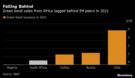
The Green Exchange, to be based in Ghana’s capital Accra, aims to enable companies to issue billions in green bonds and for investors to trade the debt in a secondary market, said Orla Enright, its chief executive officer. So far Africa has missed out on a global boom in borrowing to fund projects that help mitigate climate change.

“The reaction from companies in the region to the opportunity to issue a corporate green bond has been highly positive,” Enright said in an interview in Accra. “They’ve seen the potential of green bonds and that the time is now.”

Sub-Saharan Africa urgently needs to mobilize $50 billion annually to address climate adaptation in agriculture, power and urban infrastructure, and green bonds offer part of the solution, the Overseas Development Institute said in a research note. The continent is among the most at risk from climate change yet suffers from a high cost of finance.

That was one of the key issues at the United Nations climate summit in Glasgow last year, which was criticized for not doing enough to raise financial support from rich countries. Discussions on financing will resume at the next UN gathering in Egypt later this year.

So far there’s only been limited green issuance from Egypt, Nigeria and South Africa, though in other regions China and Chile have been major sellers.

Green Markets Put World’s Poor at Mercy of Higher Funding Costs

“While global investment in green bonds is expected to reach $1 trillion by the end of 2022, the African market contributes only 0.4% of the global market base for green bonds,” said Enright, who was previously a partner at fintech-focused venture capital firm GOODsoil.

Issuers could get borrowing rates of between 4% and 6% to raise debt in hard currency, she said, which compares to an average local-currency lending rate in Ghana of about 20%. The exchange plans to provide the tools required to issue a green bond, including third-party verification. That in effect means it’s replacing the usual role of banks.

“In emerging markets, there is a knowledge gap in the financial ecosystem,” said Esohe Denise Odaro, head of investor relations at the International Finance Corp. and chair of green, social and sustainability-linked bond principles at the International Capital Markets Association. “Banks need to be enabled to support new issuers.”

Enright’s Ghanaian co-founder Diana Boadu Amoatin also has experience in the fintech industry, including the development of a digitized premium renewal platform for the country’s National Health Insurance Scheme. The duo are raising $2 million to build the virtual marketplace by July for both debt and equity fundraising, through crowdfunding on the equity side and green bonds on the debt side.

Their target is to spur $5 billion in green bond sales within five years, including from Kenya, Nigeria and Ghana to fund wind turbines, electric vehicle charging stations, sustainable housing and solar panel installations. They see no shortage of investor demand.

“We will be targeting an increasing number of North American and Scandinavian institutional funds incorporating ESG as one of their main criterion of investment,” Enright said, pointing to greater U.S. interest following Joe Biden’s focus on the climate and funds such as the Investment Fund for Developing Countries already investing in Africa.

More stories like this are available on bloomberg.com

©2022 Bloomberg L.P.
Africa-Focused Investors Lead $40 Million Raise for MarketForce

(Bloomberg) — A Kenyan technology company, MarketForce, raised $40 million in a funding round led by V8 Capital Partners of Nigeria to expand its digital retail-distribution business.

The round of equity and debt financing was concluded with participation from other investors, including Ten13 VC and SOSV Select Fund, according to the company which operates a digital retail-distribution platform. Ken Njoroge, co-founder of Africa payments firm Cellulant, invested in MarketForce too and joins the company’s board as its chairman.

Investors have shown more interest in African technology enterprises since last year when startups on the continent raised a record $5 billion. While most of the funding by far comes from offshore sources, Africa-focused companies like V8 Capital Partners are increasing their investments in the region.  

MarketForce, founded in 2018, operates a business-to-business commerce platform dubbed RejaReja, Swahili for retail. Merchants can use it to source, order and pay for inventory, access finance and collect payments.

“Our goal is to be the ultimate partner for informal merchants, empowering them to maximize their profits and grow in a digital age,” co-founder and chief executive officer of MarketForce, Tesh Mbaabu, said in an interview.

The new funds will be used to expand into fresh markets and products. After entering Nigeria in November, MarketForce is now moving into Uganda, Tanzania and Rwanda as well as two other markets in West Africa. 

“We are targeting to serve over 1 million active merchants on our platform in Sub-Saharan Africa by 2025,” Mbaabu said. The startup plans to double its workforce before the end of the year from the current 400, he said.

“We are proud to partner and build the future of retail in Africa by helping to optimize supply chains and catalyze the digitization of the African retail ecosystem,” said Tobi Oke, general partner at V8 Capital. The business “holds a lot of untapped potential to improve incomes and enable millions of African merchants to grow.”

More stories like this are available on bloomberg.com

©2022 Bloomberg L.P.
Narrow Window to Clear Clogged U.S. Port Hinges on Demand Waning

(Bloomberg) — The bottlenecked ports in Los Angeles face a narrow window between now and midyear to clear container backlogs before another import surge and union-contract talks threaten to stall progress moving record volumes of cargo through the busiest U.S. gateway for trade.

There are good operational reasons for optimism that L.A. and Long Beach will catch enough of a breather in the next four months. The number of inbound ships has fallen by about one-third since hitting an early-January peak of 109, stacks of long-dwelling containers are shrinking and omicron cases among dockworkers are fading.

There’s also scope for caution, given the economic tide the ports are swimming against. Consumers have shrugged off inflation so far and kept spending. Companies are still ordering more and earlier than usual, turning the past 18 months into one long peak season for shipping. Another incentive to stock up: a potentially disruptive contract renewal for West Coast longshoremen.

“It’s these surges in demand that create the challenge,” said Julie Gerdeman, CEO of supply-chain risk analytics firm Everstream Analytics. She called it a dance between “just in time” and “just in case” inventory management brought on by the pandemic that’s rewiring global trade.

On the front lines are the union workers who load and unload dozens of ships every week in Southern California. Though negotiations are expected to start as soon as next month, the current six-year contract between the International Longshore and Warehouse Union and their employers, represented by the Pacific Maritime Association, expires July 1.

It could get contentious and stakeholders at every link in supply chain are taking notice.

In the last round of contract talks that began in 2014, disagreements dragged on for nine months, creating an economic headwind across the country, a long line of waiting vessels and shortages for some consumer goods. According to an analysis by Copenhagen-based Sea-Intelligence, it took the shipping industry eight to nine months after a deal was reached in February 2015 to return to normal service.

Now flush with cash, shipping lines want to invest in productivity enhancements at their terminals — like software, artificial intelligence and autonomous equipment that often replace people. With labor scarce nationwide, issues such as automation, pay and benefits could be more contentious than ever to work out. Add to that the relatively pro-labor stance of the Biden administration and the record profits of foreign-owned shipping companies, and the leverage could tip toward the union.

‘Don’t Get Caught’

Retailers want to make sure they don’t get caught up in delays again, said Jonathan Gold, the National Retail Federation’s vice president for supply chain and customs policy. “So they’re going to start to shift and mitigate the risk of potential slowdown disruptions,” he said.

Walmart Inc., reporting a positive outlook for business this year, showed last week that big retailers are able to navigate scarce transportation capacity, higher wages and rising fuel costs. Meanwhile, Bed Bath & Beyond Inc. said it increased some prices and adjusted its discount strategy due to “pervasive freight and supply-chain headwinds.”

This year some purchasing managers are already ordering goods early to try to get ahead of the contract expiration, and by considering routes through ports on the Gulf Coast or East Coast, or even air freight where possible. Ports in Houston and Charleston, South Carolina, have also been overrun with container ships in recent weeks so options are limited.

Gerdeman said her customers are monitoring choke points and risks that could impact their ability to get products to market. They’re ordering safety or buffer stockpiles ahead of the next peak, or considering diverting to ports in other regions or other modes all together. “We have customers that, even in the face of profitability hits, are making decisions to build up inventory.”

Gene Seroka, executive director of L.A.’s port, sees retailers spending in the second quarter to restock the lowest inventories in a decade. He said stores that stocked up earlier than usual last year were rewarded with solid holiday sales — a pattern that might happen again this year. “We have to make up ground now and be prepared for that summer peak,” he said last week at an event announcing L.A.’s strongest January volume on record.

Seroka is urging steps to boost trucking and rail capacity so containers don’t sit dockside for long.

Brent Hutto, Truckstop.com’s chief relationship officer, said it’ll be a while before the excessive pressure on the various modes of freight transportation gets worked out. “It’s likely going to be the end of this year, the beginning of next year for all freight to come out of this overflow,” Hutto said.

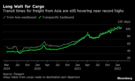
Still, some factors are out of port operators’ control and have more to do with the broader health of American consumers. Flexport Inc. Chief Economist Phil Levy is tracking the personal consumption expenditures on goods versus services as a gauge of “normal.” 

“For a number of years prior to the pandemic, this is a really flat boring graph and it stayed almost constant,” Levy said. “And then in the pandemic, this just shot up.”

The latest reading of Flexport’s Post-Covid Indicator showed American consumers’ preference for goods over services will continue at close to summer 2020 levels throughout the first quarter. And while the PCI showed the ratio of consumer goods versus total spending dipped in December to 99% of pre-pandemic levels, the new reading estimated it at 106% for January. 

Such strong demand only makes the ports’ efforts tougher. A separate Flexport index showed cargo is still spending close to record amounts of time — more than 100 days — in transit to the U.S. and Europe from Asia. 

More stories like this are available on bloomberg.com

©2022 Bloomberg L.P.
Bitcoin’s Allure as the New Gold Fizzles During Ukraine Tensions

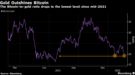
(Bloomberg) — Bitcoin’s price relative to gold has dropped to the lowest level since the middle of 2021. The standoff between the West and Russia over Ukraine is stoking risk aversion, hurting so-called digital gold as cryptocurrencies slide but supporting the traditional haven of bullion. One Bitcoin is now equivalent to about 19 ounces of the yellow metal, down from a peak of some 37 ounces in October.

More stories like this are available on bloomberg.com

©2022 Bloomberg L.P.

China Tells Banks, State Firms to Report Exposure to Jack Ma’s Ant

(Bloomberg) — Chinese authorities told the nation’s biggest state-owned firms and banks to start a fresh round of checks on their financial exposure and other links to Ant Group Co., renewing scrutiny of billionaire Jack Ma’s financial empire, according to people familiar with the matter.

Multiple regulators, including the banking watchdog, recently told institutions under their oversight to closely examine all exposure they had to Ant, its subsidiaries and even its shareholders up to January, said the people, asking not to be identified as the matter is private. Those people described this as by far the most thorough and wide-ranging look into deals with Ant and said institutions were told they must report findings back as soon as possible.

Alibaba Group Holding Ltd., which owns a third of Ant, slumped 5.1% at open in Hong Kong on Tuesday, nearing a fresh now since its listing in the city in 2019.

It was unclear what triggered the new scrutiny or whether it will lead to any actions or conclusions by regulators, the people said. The National Audit Office is leading the initiative, two of the people said. The China Banking and Insurance Regulatory Commission and the top auditor didn’t immediately respond to requests seeking comment. Ant declined to comment.

More than a year after the Chinese government snuffed out the biggest initial public offering in history by Ant, Beijing has showed no letup in a crackdown that has snowballed into an assault on every corner of China’s technosphere. Officials have handed out billions of dollars in antitrust fines to end the domination of a few heavyweights as President Xi Jinping pushes for more “common prosperity.”  

Chinese technology shares slumped for a second session Monday, with Tencent Holdings Ltd. sinking 5.2% on Monday due to renewed fears Beijing may roll out more restrictions for private enterprise. Meituan lost $26 billion of market value on Friday after China issued new guidelines asking for food delivery platforms to cut fees, underscoring that investor angst over the nation’s tech giants remains high. 

The regulations and probes have pummeled the shares of firms such as Tencent, as well as dented their profits and growth and forced some to shelve listing plans. The Hang Seng Tech Index is trading near its lowest level versus its 12-month forward earnings and sales forecasts.

Ant was hit the hardest among them all. Beijing scuttled the fintech giant’s $35 billion IPO in November 2020, ordering it to overhaul businesses including lending, insurance and wealth management, and set up a financial holding company so it could be regulated like a bank. 

As part of the restructuring, Ant has ramped up its capital base to 35 billion yuan ($5.5 billion) and moved to build firewalls in an ecosystem that once allowed it to direct traffic from Alipay, with a billion users, to services like wealth management, consumer lending and delivery. Consumer loans jointly made with banks were split from its “Jiebei” and “Huabei” brands. Assets under management at its money-market fund Yu’ebao — once the world’s largest — dropped by more than a third last year to 765 billion yuan by December.

The process was delayed last month, however, after state-owned bad-debt manager China Cinda Asset Management Co. surprisingly backed out of a plan to take a major stake in Ant’s consumer finance unit. The fintech firm has yet to apply for a financial holding company license. 

A least a dozen Chinese banks have been paring their years-long cooperation with Ant on consumer lending since the clampdown.

Meanwhile, the nation’s top anti-graft group in January made rooting out corruption tied to “disorderly expansion of capital” one of its priorities. A month later it arrested a former party chief of Hangzhou — the home city of Ant and Alibaba — on corruption charges, including using his influence to help his younger brother’s businesses. One of those companies had received investment from a firm controlled by Ma’s Ant, according to a local media report in August. Neither Ant nor Ma have been accused of wrongdoing related to the case.

What Bloomberg Intelligence Says:

“Beijing’s call for China’s banks to check their exposures to Jack Ma’s unlisted Ant Group may jeopardize the company’s ties with financiers for its online-loan business, with our scenario analysis suggesting its valuation could plunge to $63 billion vs. the $320 billion level targeted in the 2020 IPO.”

–Francis Chan, banking & fintech analyst

Click here for the research 

The myriad restrictions mean Ant is worth a fraction of its former self as its growth prospects wane, according to some of its early Wall Street backers. Fidelity Investments slashed its valuation estimate for at least the second time last year to about $78 billion as of June 30. Others are more optimistic: BlackRock Inc. values the company at $174 billion and T Rowe Price Group Inc. views it at $189 billion. 

(Updates Alibaba share move in third paragraph)

More stories like this are available on bloomberg.com

©2022 Bloomberg L.P.

Close Bitnami banner
Bitnami