Bloomberg

Surging U.S. Share Buybacks Offer Support to Sputtering Market

(Bloomberg) — U.S. companies are stepping up share buybacks, supporting a struggling stock market in the face of mounting geopolitical tension and fears that earnings growth will wane once the Federal Reserve raises interest rates.

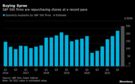
The 10 biggest repurchases for S&P 500 Index companies last quarter totaled $86 billion, up almost 30% from a year earlier, led by Apple Inc., Meta Platforms Inc. and Google parent Alphabet Inc., data compiled by Bloomberg show. The list isn’t complete, with nearly 20% of index members scheduled to report data in the coming weeks.

Buybacks are surging as companies tap cash hoards amassed during the pandemic. While some investors argue the funds are better spent on the businesses, many cheer the efforts to boost per-share earnings and potentially stock prices. The trend is expected to continue in 2022, providing a market tailwind with stocks sputtering below all-time highs.

“Buybacks are back,” said Josh Jamner, an investment-strategy analyst at ClearBridge Investments. “In this period of market volatility, companies do have dry powder that they should be able to deploy.”

Many companies suspended dividends and buybacks during the pandemic to bolster balance sheets, and then seized on historically low interest rates to borrow and boost reserves. Now they’re using that cash to appease shareholders, who are pressuring executives to improve their stock prices. The S&P 500 has lost 8.8% to start 2022.

Most of last quarter’s buybacks were concentrated in a small group of companies. The technology and communication services sectors, which typically have the biggest cash flows, are leading the way. Major banks, which ratcheted up repurchases in the last year, will likely join the top spenders when they publish their numbers in the coming weeks.

Record Pace

S&P 500 firms are expected to have bought back at least $265 billion in stock in the fourth quarter. That exceeds the third quarter’s all-time high of about $235 billion, according to data from S&P Dow Jones Indices, which uses a different methodology than Bloomberg.   

“Buybacks are important since they’re adding support for the market,” said Howard Silverblatt, senior index analyst at S&P Dow Jones Indices. “It still looks like it’ll be another strong year for buybacks, particularly in the first quarter.” 

All told, buybacks may exceed $870 billion for 2021, according to Silverblatt’s data. That would eclipse the record of $806 billion from three years earlier, when companies used repatriated funds from the federal tax overhaul.

While this is helping stocks, the impact may be diminished because high valuations mean the purchases are hoovering up fewer shares, Silverblatt says. In addition, the expenditures aren’t necessarily so large when measured against the companies’ earnings and market values, he says.

Ramping Up 

Still, buybacks show no sign of slowing. Walmart just announced plans to spend at least $10 billion on repurchases in fiscal 2023, while Twitter Inc. unveiled a $4 billion program and Exxon Mobil Corp. said it will accelerate a $10 billion plan. 

For some companies, the timing hasn’t been great. 

Meta, formerly Facebook, spent around $20 billion on stock repurchases in the fourth quarter, when its shares were above $300. Then it saw about $251 billion of market value erased Feb. 3, the biggest wipeout for any U.S. company ever, following disappointing earnings. It closed Friday at $206.16.

But the beat goes on. Alphabet authorized a $50 billion repurchase program last year, and then this month announced a 20-to-1 stock split, a sign management is becoming more shareholder-friendly, analysts said. 

“The most important thing is the health of the company, and corporations are still in a very strong financial position with near-record cash balances,” ClearBridge’s Jamner said. “So we’ll likely continue to see greater return of capital to shareholders.”

More stories like this are available on bloomberg.com

©2022 Bloomberg L.P.

India Gets $20 Billion in Investment Proposals for Chip Production

(Bloomberg) — India has received proposals worth $20.5 billion from five companies to manufacture semiconductor fabs and display fabs locally, according to a government statement.

Companies including Vedanta in joint venture with Foxconn, Singapore-based IGSS Ventures pte, and ISMC have proposed $13.6 billion investments for manufacturing the chips, which are used in a wide array of products ranging from 5G devices to electric cars. The three companies have sought support of $5.6 billion from the federal government under its incentive plan. 

“Despite aggressive timelines for submission of applications in this greenfield segment of semiconductor and display manufacturing, the scheme has elicited good response,” the Ministry of Electronics and Information Technology said in the statement.

India Cabinet Approves $10 Billion Incentives for Semiconductors

Further, two companies — Vedanta and Elest — have submitted proposals worth $6.7 billion to manufacture display fabs and have sought incentives of $2.7 billion from the government, according to the statement.

The South Asian nation’s semiconductor market is estimated to reach $63 billion by 2026 compared with $15 billion in 2020. The incentive program is an effort by Prime Minister Narendra Modi to boost the share of manufacturing in the economy and reverse the pandemic induced slowdown. The incentives were announced amid a prediction that a global chip shortage is likely to extend until early 2023 and demand may remain above the long-term expectation in 2022.

More stories like this are available on bloomberg.com

©2022 Bloomberg L.P.

China Plans to Feed 80 Million People With ‘Seawater Rice’

(Bloomberg) —

Jinghai district in northern China is hardly a rice-growing paradise. Located along the coast of the Bohai Sea, over half of the region’s land is made of salty, alkaline soil where crops can’t survive. Yet, last autumn, Jinghai produced 100 hectares of rice.

The secret to the bountiful harvest is new salt-tolerant rice strains developed by Chinese scientists in the hope of ensuring food security that’s been threatened by rising sea levels, increasing grain demand and supply chain disruptions.

Known as “seawater rice” because it’s grown in salty soil near the sea, the strains were created by over-expressing a gene from selected wild rice that’s more resistant to saline and alkali. Test fields in Tianjin—the municipality that encompasses Jinghai—recorded a yield of 4.6 metric tons per acre last year, higher than the national average for production of standard rice varieties. 

The breakthrough comes as China searches for ways to secure domestic food and energy supplies as global warming and geopolitical tensions make imports less reliable. The nation has one-fifth of the world’s population, and that many mouths to feed, with less than 10% of the Earth’s arable land. Meanwhile, grain consumption is rising quickly as the country grows more wealthy. 

“Seeds are the ‘chips’ of agriculture,” said Wan Jili, a manager at Qingdao Saline-Alkali Tolerant Rice Research and Development Center, drawing a parallel between the crucial role semiconductors play in the development of new technologies and their role in the ongoing trade war between the U.S. and China. Seawater rice could help improve China’s grain production in the face of an “extremely complicated situation regarding climate change and global food security,” she said.

China has been studying salt-tolerant rice since at least the 1950s. But the term “seawater rice” only started to gain mainstream attention in recent years after the late Yuan Longping, once the nation’s top agricultural scientist, began researching the idea in 2012. 

Yuan, known as the “father of hybrid rice,” is considered a national hero for boosting grain harvests and saving millions from hunger thanks to his work on high-yielding hybrid rice varieties in the 1970s. In 2016, he selected six locations across the country with different soil conditions that were turned into testing fields for salt-tolerant rice. The following year, China established the research center in Qingdao where Wan works. The institute’s goal is to harvest 30 million tons of rice using 6.7 million hectares of barren land.

“We could feed 80 million more people” with salt-tolerant rice, Yuan said in a documentary broadcast in 2020. “Agricultural researchers like us should shoulder the responsibility to safeguard food security,” he told a local newspaper in 2018.

Climate change has made the task more urgent. China’s coastal waters have risen faster than the global average over the last 40 years, a worrying trend given the country’s deep reliance on its long and low eastern coast for grain production. Successfully growing salt-tolerant rice on a large scale would allow the country to utilize more of the increasingly salty land in the area.

According to the Intergovernmental Panel on Climate Change, sea levels around the world could rise as much as 59 centimeters by the end of the century if the planet warms by 2 degrees Celsius. Oceans surrounding the U.S. will swell faster within the next three decades than they did in the past century, according to a report this week led by the National Oceanic and Atmospheric Administration.

President Xi Jinping has stressed in several recent meetings with top government officials that ensuring the supply of primary goods is a “major strategic issue” given climate and geopolitical pressures. “The food of the Chinese people must be made by and remain in the hands of the Chinese,” he said at a gathering of the Politburo Standing Committee meeting in December.

Chinese scientists are betting that land once dismissed as barren can be turned into productive grain-producing plots. About 100 million hectares of land in the country, about the size of Egypt, is high in saline and alkaline. Meanwhile arable land has decreased 6% from 2009 to 2019 because of urbanization, pollution and overuse of fertilizers.

To make use of salty soil, farmers traditionally dilute their fields with large amounts of fresh water. The approach is still commonly used in some coastal regions. But the method requires vast amounts of water and often doesn’t improve yields enough to make sense economically.

“China is looking at another method now, to develop grain varieties that can withstand the soil’s saltiness,” said Zhang Zhaoxin, a researcher with China’s agricultural ministry. While seawater rice has mostly been planted on trial fields so far, Zhang said he believes commercial cultivation will soon take off with the government’s support.

The research team in Qingdao said last October that it can meet the goal of growing 6.7 million hectares of seawater rice within ten years. In 2021, the group was put in charge of 400,000 hectares of land to expand production of seawater rice.

“If China can be more self-sufficient in staple foods, it would be a contribution to the world’s food security too,” said Zhang. “The less China imports, the more other countries will have.”

More stories like this are available on bloomberg.com

©2022 Bloomberg L.P.

SEC Fight Over XRP Tokens Turns to Ripple Legal Memos From 2012

(Bloomberg) — A pair of legal memos Ripple Labs Inc. received a decade ago about XRP tokens are fresh fodder for federal regulators in their fight with the company over whether the digital asset is a security that needs to be registered.

Court filings unsealed Friday show that in a February 2012 memo, Perkins Coie LLP attorneys advised Ripple not to sell the proposed coins, as various conditions could subject them to being regulated as securities or commodities. A second memo by the same firm, dated in October of that year, suggested that XRP may not be considered to be a security under federal law, but cautioned there was a risk the Securities and Exchange Commission would see things differently.

Eight years later, the SEC sued Ripple, along with co-founder Christian Larsen and Chief Executive Officer Bradley Garlinghouse. The agency alleged the two men sold the virtual tokens without registering them and personally profited by about $600 million while ignoring legal advice that the cryptocurrency could be considered an investment contract and therefore a security.

Some analysts view the case as particularly important in defining SEC’s regulatory authority over crypto assets, “and we think the agency will win,” Bloomberg Intelligence Senior Litigation Analyst Elliott Stein said in a recent note. A ruling could impact dozens of other digital coins. 

Read More: Ripple Wants to Limit SEC’s Crypto Sway as Legal Fight Rages

Ripple General Counsel Stu Alderoty said the company is pleased the 2012 memos are now public. 

“The documents show a ‘compelling’ legal analysis that Ripple received in 2012 that XRP is not a security,” he said in a statement. “The fact that Ripple sought such advice in 2012 should be applauded. That fact that it took the SEC eight years to suggest they disagreed with that analysis — while XRP traded in a massive global market — is baffling.”

XRP’s price rose 2.34% in the last 24 hours, per tracker CoinMarketCap.com.

The case is Securities and Exchange Commission v. Ripple Labs Inc., 20-cv-10832, U.S. District Court, Southern District of New York (Manhattan).

More stories like this are available on bloomberg.com

©2022 Bloomberg L.P.

Crypto Lender Nexo Halts Interest on New Deposits

(Bloomberg) — Crypto platform Nexo appears to be changing the terms for U.S. customers to a product that offers the ability to earn high interest rates on crypto deposits. The decision follows the U.S. Securities and Exchange Commission’s recent settlement with BlockFi Inc. over a similar product. 

In a statement posted to its official subreddit Friday by a moderator who isn’t an employee with the company but says he works “closely” with them, Nexo said the changes are an effort to voluntarily comply in light of BlockFi’s agreement to pay $100 million to federal and state securities regulators to settle allegations that it illegally offered a product that pays customers high rates to lend out their digital tokens. 

BlockFi is now planning to register its offerings with the regulator — a path that Nexo on the subreddit platform said it also intends to follow. Nexo’s current U.S. customers won’t be able to earn interest on new deposits, though they’ll be able to continue earning on existing digital-asset balances, the statement said. New clients won’t be able to access the product at all. 

The firm said it eventually intends to make a new offering available that is compliant with the securities laws. The recently announced changes will be in place “until the restructuring of the Earn Interest Product and the registration process with the relevant regulatory bodies are finalized,” according to the statement. Nexo didn’t immediately return a request for comment.

Nexo on its website touts its interest-bearing product as offering up to 20% in annual interest for investors. The firm said non-U.S. clients will remain unaffected by the recent updates. 

Bloomberg reported in January that SEC is scrutinizing Celsius Network, Gemini Trust Co., and Voyager Digital Ltd. over issues similar to the ones raised in the BlockFi settlement.

More stories like this are available on bloomberg.com

©2022 Bloomberg L.P.

Crisis in China’s Property Industry Deepens With No End in Sight

(Bloomberg) — Almost exactly a year after China’s property-market debt squeeze sparked the first in a wave of defaults by developers, the industry is fighting for survival. 

Home sales continue to plunge and elevated borrowing costs mean offshore refinancing is off the table for many developers. Global agencies are pulling their ratings on property bonds, while a string of auditor resignations is adding to doubts over financial transparency only weeks before earnings season. An 81% stock plunge in Zhenro Properties Group Ltd. highlighted the risks of margin calls as companies struggle to repay debt.

Yu Liang, chairman of China Vanke Co. — one of the country’s largest developers — urged staff to prepare for a battle that could make or break the firm, according to the South China Morning Post, which cited an internal document from last month. “We are on our last legs, which means there are no other options,” he said.

A Bloomberg index of Chinese junk dollar debt fell every day this week through Thursday, driving yields above 20%. A gauge of Chinese property shares is down 3.4% this week, taking its losses over the past 12 months to 28%, even after rallying on Friday.

As the cash crunch for developers worsens, so does the housing slowdown that’s become one of the biggest drags on China’s economy. Attempting to deflate a speculative market is a risky strategy that — if uncontrolled — could threaten Beijing’s pledge to prioritize economic stability this year. Regulators have quietly tweaked some rules to engineer a soft landing for the property industry, such as encouraging mergers and acquisitions, but so far officials have refrained from any substantive easing of curbs.  

“While the government has become more supportive, measures have remained marginal and have not solved the liquidity crisis,” said Paul Lukaszewski, head of corporate debt for Asia Pacific at abrdn Plc in Singapore, which has portfolios with exposure to developers. “The market turmoil and ongoing uncertainty have pushed traditional investors to the sidelines.”

China Fortune Land Development Co. failed to repay a $530 million dollar bond due Feb. 28., 2021, becoming the nation’s first real estate firm to default since Beijing drafted new financing limits for the sector in 2020. Since then, at least 11 developers defaulted, according to a Feb. 3 report by Standard Chartered Plc.

More may follow. Property firms have to find almost $100 billion to repay debt this year, even as their income streams shrink. Sales at China’s 100 biggest developers fell about 40% in January from a year earlier, compared with a 35% decline in December, according to preliminary data by China Real Estate Information Corp. 

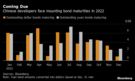
Developers are selling more onshore bonds to fund project construction, but not enough to cover maturing debt. Onshore issuance by Chinese developers fell 53% in January to 23 billion yuan ($3.6 billion), while dollar note sales were down 90% from a year earlier to just $1.6 billion, according to China International Capital Corp. Net financing, which subtracts maturities from issuance, was a negative $7.3 billion, CICC analysts led by Eric Yu Zhang wrote in a Friday note.

Investors also need to worry about off-balance sheet debt. Fallen angel Shimao Group Holdings Ltd. recently proposed delaying repayment of about 6 billion yuan of high-yield trust products due between this month and August, people with the matter said this week. Its bonds sank on concern the company will prioritize these liabilities over money owed to offshore creditors.

Auditor resignations are sowing further doubt about the financial health of property firms. Auditors for Hopson Development Holdings Ltd. and China Aoyuan Group Ltd. resigned in late January, citing insufficient information and a disagreement over fees, respectively. Shimao’s onshore unit changed its auditor for the first time in 27 years. Failure to publish results before the Hong Kong stock exchange’s March 31 deadline may lead to long trading halts.

“Changing accounting firms just ahead of year-end results raises questions about the quality of a firm’s governance,” S&P Global Ratings analysts wrote in a Feb. 16 report.

Investor distrust of management is becoming entrenched. Rumors about Zhenro’s ability to repay a perpetual bond sent the note from near par to drop below 23 cents in a matter of days, while its shares sank amid reports holder Ou Zongrong had been forced to liquidate. The stock didn’t recover even as the company said such speculation was “untrue and fictitious.” 

Zhenro said late Friday it may be unable to repay debt due in March, including its perpetual bond. The company had earlier pledged to redeem the securities.

Authorities are taking steps to ease funding restrictions for the sector, although these measures are largely targeted and incremental, rather than broad-based. The government recently issued rules to standardize the use of presale funding, banks extended more loans to the sector and some lenders in several cities have cut mortgage downpayments, according to multiple local media reports in the past week.

A Bloomberg Intelligence index of Chinese property stocks rose as much as 3% on Friday following the mortgage report, while high-yield dollar bonds halted their decline.

Even so, credit stress remains “acute” and funding channels aren’t showing much of an improvement, according to Goldman Sachs Group Inc. analysts.

That means defaults are likely to pile up for developers that struggle to sell assets fast enough. State-owned companies have emerged as potential buyers, though the pace of deals so far has been slow.

Any distressed-debt investor buying defaulted bonds now is likely to face a lengthy wait before recovery. Among the past year’s defaulters, only Fortune Land has released a preliminary restructuring framework for its debt. An estimated $48.9 billion is outstanding pending debt resolution, according to Standard Chartered.

While Chinese authorities have told state-owned bad-debt managers to participate in the restructuring of weak developers, it’s unclear what such support might mean for bondholders. In China’s property sector, court-led restructurings are rare, data compiled by Bloomberg show. Since 2018, 27 firms have failed to honor their bonds, and only two entered such a process.

“Price volatility in the sector is unlikely to subside,” wrote Citigroup Inc. strategists including Dirk Willer in a Friday note. “Even the recent rebound in new real estate loans did not provide much relief to the deteriorating sentiment.”

(Updates to add Zhenro statement on likely non-payment in 14th paragraph.)

More stories like this are available on bloomberg.com

©2022 Bloomberg L.P.

China’s New Crackdown Shows $1.5 Trillion Tech Rout Not Over Yet

(Bloomberg) — Just as a growing number of investors believe China may ease its private-sector crackdown to focus on growth, they were reminded on Friday it may be too soon to make that call. 

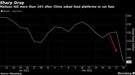
Within less than an hour, food-delivery giant Meituan sank as much as 18% in its worst loss in nearly seven months after China issued new guidelines asking food-delivery platforms to cut fees they charge restaurants. Hong Kong’s Hang Seng Tech Index, which tracks mainland’s biggest tech companies, also tumbled the most in three weeks. 

The sudden slump shows buying the dip still proves a risky move for some market watchers even as valuations for China technology firms have plunged to historical lows. And the brutal selloff that wiped out more than $1.5 trillion from the sector may have yet to hit a bottom.  

“This new rule has come as a surprise and in the short term, fears can run stronger than reasons,” said Hao Hong, chief strategist at Bocom International in Hong Kong said, referring to the fee policy for delivery companies. “So for now, we would not try to stand in front of a runaway train.” 

What once seemed an unstoppable ascent of China’s Big Tech started to crumble a year ago, as Beijing’s crackdown in pursuit of “common prosperity” upended the fortunes of the likes of Didi Global Inc. and Alibaba Group Holding Ltd. The Hang Seng Tech Index has halved from its February 2021 peak. The Nasdaq Golden Dragon Index, a measure of U.S.-listed Chinese names, has slumped about 60%.

Investor hesitation lies with the unpredictability of Chinese regulation. The nation’s education stocks took a renewed dip in recent weeks following last year’s plunge as speculation swirled over intensified crackdowns. And while the bullish chorus on China — ranging from strategists at Goldman Sachs Group Inc. to those at Jefferies Financial Group Inc. — emerged from the last quarter of 2021, shares have yet to stage a major turnaround.

To be sure, the Hang Seng Tech Index is trading near its lowest level versus its 12-month forward earnings and sales forecasts. E-commerce giant Alibaba and smartphone maker Xiaomi Corp. are cheaper than utility stock CLP Holdings Ltd. in Hong Kong — which typically has lower growth potential. The Hang Seng Tech Index is set to outperform the Nasdaq 100 Index for a second month in a row. 

For some analysts, valuation may come down further as tech companies implement the suite of new regulations and face higher costs of doing business. 

“We haven’t yet seen a large enough catalyst to shift the valuation regime back towards prior levels,” said Bloomberg Intelligence analyst Matthew Kanterman. For regulation, “there still remains implementation risk as large companies like Tencent adopt these measures across their businesses.”

Just how far-reaching China’s continued clampdown has been on the profitability of some of the biggest tech firms will be on full display in the coming weeks as they release earnings. Alibaba will report next Thursday. 

“The knee-jerk reaction shows market fears over China’s regulatory tightening haven’t been completely eradicated,” said Daniel So, a strategist at CMB International Securities. “Overall, the market is expecting more granular regulatory measures to be rolled out this year even though the worst of crackdowns should be over.”

More stories like this are available on bloomberg.com

©2022 Bloomberg L.P.

Russian Media Reports Fire at Gas Pipeline: Ukraine Update

(Bloomberg) — President Joe Biden said he believes that President Vladimir Putin has decided to attack Ukraine and that an invasion — including a strike on Kyiv — could come within days. 

The U.S. said Russia has massed as many as 190,000 personnel – including troops, National Guard units and Russian-backed separatists – in and around Ukraine in what it has been called the most significant military mobilization since World War II.  

Russia told the U.S. this week it has no plans to attack, and its officials have repeatedly dismissed U.S. warnings about a possible invasion as “hysteria” and propaganda. 

Citing escalations in the breakaway Donbas region of Ukraine, Putin called on Kyiv to “sit down at the negotiating table” with separatist leaders “and agree on political, military, economic and humanitarian measures to end the conflict.” The government in Kyiv refuses to negotiate with the Russia-backed separatists, saying they are proxies for Moscow.

Key Developments

  • Why Minsk Accords Are Murky Path for Ukraine Peace: QuickTake
  • Lithuania President Sees Peaceful Resolution in Ukraine
  • Oil Heads for Weekly Loss With Bumper Rally Starting to Ease Off
  • Stocks Fall for Second Straight Week on Geopolitical Tensions
  • Where Military Forces Are Assembling Around Russia and Ukraine

All times CET:

Russian Media Reports Fire at Gas Pipeline (12:20 a.m.)

Russia state media reported a fire at a gas pipeline that followed an explosion in the separatist-held areas of eastern Ukraine late Friday night.

Some media reports and commentators on social media said the explosion targeted the Druzhba “gas pipeline,” though Druzhba is a major oil pipeline servicing Europe and also does not actually run near the breakaway Luhansk area. A gas pipeline that is in the vicinity has previously been hit, with no impact on Russian gas exports.

The state company that manages gas pipelines in Luhansk said a fire had been quickly extinguished. In recent days, the OSCE, which monitors the shaky cease-fire between the separatists and the Ukrainian military, has reported an increase in actions along the line of contact.

French Tone Grows Darker on Risk of Attack (11:25 p.m.)

A top official of President Emmanuel Macron’s government said all the participants in a call among leaders from Europe, the U.S. and Canada see the risk of an invasion rising. The trans-Atlantic allies agreed they must be prepared to act at any moment, according to the official, who added that a worst case scenario can still be prevented.

The readout from France reflects a notable change of tone. French officials have generally kept their distance from alarming warnings that have emerged from the Biden administration.

The official urged all parties involved to remain extremely cautious regarding disinformation and inaccurate reports coming the region. The person said Macron will speak with Zelenskiy on Saturday and with Putin on Sunday.

Biden Says Putin Attack Likely Coming in Days (11:06 p.m.)

Biden said U.S. intelligence had prompted him to believe that Putin has decided to attack Ukraine and that an invasion — including a strike on Kyiv — could come within days. 

“We believe that they will target Ukraine’s capital Kyiv, a city of 2.8 million innocent people,” Biden told reporters at the White House, without detailing the intelligence behind his statement. “We’re calling out Russia’s plans loudly repeatedly, not because we want a conflict but because we’re doing everything in our power to remove any reason that Russia may give to justify invading Ukraine and prevent them from moving.”

Speaking after he hosted a call with European allies, Biden also said that claims by Russia and its separatist allies in eastern Ukraine that the Kiev government has provoked fresh violence in the region aren’t plausible.

“There’s simply no evidence for these assertions and it defies basic logic,” he said. He repeated his own assertion that the Kremlin is trying to stage a “false flag” operation to create a fake pretense for its invasion.

U.S. Says Russia Was Behind Cyber Attacks (9:03 p.m.)

The U.S. believes Russia was responsible for a widescale cyber attack on Ukrainian banks and government websites earlier this week, deputy National Security Advisor Anne Neuberger told reporters at the White House.

Russia has denied having anything to do with the distributed denial-of-service, or DDoS, attacks early this week. 

Without providing details, Neuberger said the U.S. has technical information that showed infrastructure linked to Russia’s military intelligence services “transmitting high volumes of communication to Ukraine-based IP addresses and domains.”

The U.S. has shared that underlying intelligence with Ukraine and European partners. While the attack ultimately had little impact on Ukrainian banking operations, the White House is concerned the attack may be laying the groundwork for more disruptive cyber attacks that could proceed a potential invasion.

Draghi Says Any Russia Sanctions Should Avoid Energy (7:24 p.m.)

Italian Prime Minister Mario Draghi said on Friday that any European Union sanctions on Russia should be “limited” and not include energy, given the impact on countries that rely on gas imports, including Italy. “Sanctions should be focused on as limited a number of sectors as possible without including energy,” he said at a press conference in Rome, adding penalties should be applied proportionally to “the type of attack.”

Draghi plans to go to Moscow and meet with Putin but no date has been announced. He said Putin had reassured him in recent phone calls that Russia is ready to increase gas supplies to the country if needed, and Italy is also looking at other potential energy sources.

The EU and U.S. are discussing a package of sanctions to be imposed on Russia in the event it invaded Ukraine, though European nations have been cautious about the potential fallout on their own economies, including the energy and financial sectors.

Separatists Say Car Blown Up in Donetsk: Interfax (5:53 p.m.)

Separatist officials said a car blew up outside the main government building in Donetsk in eastern Ukraine on Friday evening but there were no immediate reports of injuries. The local police chief said the vehicle belonged to him and he was not hurt, Russia’s Interfax reported.

Putin Orders Aid For Those Who Leave Donbas: Interfax (5:45 p.m.)

Putin ordered his government to provide assistance for people leaving the Russian-backed separatist regions of Donbas in eastern Ukraine, Interfax reported. He told officials to help the Rostov Region, where people would arrive, to accommodate them. Each resident of the separatist areas who comes will get a one-time payment of 10,000 rubles ($130), Tass reported.

It comes after authorities in the separatist regions called on civilians to leave, citing what they said was heightened risk of attack by the Ukrainian military. Officials in Kyiv said they had no intention to use force in the areas. Each side has blamed the other for a surge in cease-fire violations near the line of contact in recent days.

Russian President Says He Ignores U.S. Claims (4:36 p.m.)

Putin said he “didn’t pay attention” to accusations by the U.S. and its allies that Russia was preparing to invade Ukraine as soon as this week. “We’re doing what we think we should be doing and we’ll continue to do that,” he said at a Moscow news conference with Belarusian President Alexander Lukashenko. 

Russia isn’t opposed to continuing talks on security proposals put forward by the U.S., but Washington is still ignoring Moscow’s key demands on NATO, he said. At the least the dialogue for now is set to continue, with Russian Foreign Minister Sergei Lavrov agreeing to meet U.S. Secretary of State Antony Blinken in Europe next week.

Ukraine Separatists to Send Women, Children to Russia (4:10 p.m.)

Children, women and elderly people will start to leave for Russia due to an escalation in fighting along the line of contact with Ukrainian forces, the leader of the self-proclaimed Donetsk People’s Republic said.

The separatists have an agreement with the government of the neighboring Russian region of Rostov to host people, Denis Pushilin said in remarks posted on the separatists’ Donetsk News Agency website. Leonid Pasechnik in Luhansk, another self-proclaimed republic, also urged non-fighters to leave the region for Russia.

Ukraine’s military chief Valeriy Zaluzhnyi said the army doesn’t plan any offensive operations and that its actions have been defensive. Kyiv has repeatedly said it doesn’t intend to attack separatist-controlled areas.

The Organization for Security and Co-operation in Europe has observed a spike in violence in the Donbas region this week, recording about three times the average number of cease-fire violations on Wednesday.

Harris in Munich Vows to Stay Close to Allies (1:55 p.m.)

U.S. Vice President Kamala Harris called the situation in Ukraine “a dynamic moment in time” and vowed to stay close to allies, checking in hourly, if necessary.

In her first public remarks since arriving in Germany for the Munich Security Conference, Harris stressed support for NATO in a meeting with Secretary General Jens Stoltenberg.

Harris said the U.S. backs diplomacy with Russia, “but we are also committed to taking corrective actions to ensure there will be severe consequences” if Putin decided to invade Ukraine. Moscow denies any intention to attack.

U.S. Sees Biggest Military Mobilization in Europe Since WWII (12:50 p.m.)

The U.S. estimates Russia has massed between 169,000 and 190,000 personnel in and around Ukraine, including separatists in breakaway regions in Donbas, the head of its mission to the OSCE said at a meeting in Vienna.   

The number of personnel has risen from 100,000 on Jan. 30, according to Ambassador Michael Carpenter. The count includes forces in Crimea, which Russia annexed in 2014. Russia did not attend the meeting and maintains it is free to deploy troops on its territory as it sees fit. Moscow denies arming the separatist regions. 

Scholz to Host G-7 Talks Next Week (11:35 a.m.)

German Chancellor Olaf Scholz will host virtual talks with his Group of Seven counterparts on Thursday and discuss issues including the situation on Ukraine’s eastern border. Germany currently holds the group’s presidency and next week’s talks are also part of preparations for June’s summit in Bavaria, spokesman Wolfgang Buechner said. 

Putin to Monitor Missile Launches on Saturday (10:55 a.m.)

Putin will observe drills of Russia’s strategic nuclear forces on Saturday that include launches of ballistic and cruise missiles, the Russian Defense Ministry said. 

Kremlin spokesman Dmitry Peskov called the drills routine and said they don’t fuel tensions. Belarusian President Alexander Lukashenko, who is in Moscow for talks, may accompany Putin to the Defense Ministry command center to watch the launches, Peskov said. 

Russia is also planning live-fire exercises Saturday as part of the biggest joint maneuvers with Belarus in years. The drills are being closely watched by Ukraine and the West amid fears of an invasion.

Lithuanian Leader Says Peaceful Resolution Possible (10:45 a.m.)

“I still believe in the peaceful solution of this conflict,” Lithuanian President Gitanas Nauseda said in an interview with Bloomberg TV, referring to the tensions between Russia and Ukraine. “There are a lot of rumors, we should probably stay calm.”

The Russian buildup of forces near Ukraine is likely part of a plan by Putin to “get a better, stronger negotiating position,” he said. 

The U.S. has ramped up warnings of a possible Russian attack, although Ukraine’s Defense Minister Oleksii Reznikov said Friday that the risk of a full-scale invasion is low. 


Germany Regrets Russia to Skip Munich Conference (7 a.m.)

German Foreign Minister Annalena Baerbock said it’s regrettable that no Russian representatives will attend the Munich Security Conference that starts Friday. 

The Munich conference is an annual event to discuss transatlantic security issues. The U.S. delegation includes Harris and Blinken, who will take part in a Q&A with Baerbock on Friday afternoon. Ukraine’s President Volodymyr Zelenskiy is scheduled to speak on Saturday.

More stories like this are available on bloomberg.com

©2022 Bloomberg L.P.

Ecommerce Firm Zazzle Is Said to Tap Citi, Barclays for IPO

(Bloomberg) — Zazzle Inc., an online marketplace for customized items, has hired Citigroup Inc. and Barclays Plc to prepare for an initial public offering this year, according to people familiar with the matter.

The company is seeking to go public as soon as this summer, said the people, who asked not to be identified because the matter is private. Zazzle’s plans including the timing of a listing could change, the people said.

Zazzle could be valued at around $1 billion to $2 billion, the people said.

A representative for Zazzle didn’t respond to a request for comment. Representatives for Citigroup and Barclays declined to comment. 

Zazzle was launched in 2005 as a platform for people to buy and sell custom art and products. Goods offered on the site include items as varied as T-shirts, stuffed animals and wedding invitations.

The company has received $63 million in private backing, dating back to 2005, according to data provider PitchBook. Its investors include Kleiner Perkins, Industry Ventures and Northgate Capital. 

Market volatility, particularly in the technology sector, has spurred many companies to delay IPOs. Those still expecting to go public this year include Reddit Inc., StockX LLC and GoPuff, Bloomberg News has reported.

More stories like this are available on bloomberg.com

©2022 Bloomberg L.P.
Embattled Crypto Lender Celsius Network Names Rod Bolger as CFO

(Bloomberg) — Crypto lender Celsius Network, which has been a subject of state and federal scrutiny, has named Rod Bolger as chief financial officer.

Celsius Chief Executive Alex Mashinsky confirmed the hiring in a post sent over Twitter after the Wall Street Journal reported it earlier. Representatives of Hoboken, New Jersey-based Celsius didn’t reply to requests for comment from Bloomberg. 

Bolger spent more than 10 years at the Royal Bank of Canada, Canada’s largest bank, most recently as its chief financial officer. Before that, he was chief financial officer of Bank of America’s global technology and operations unit.

Celsius’s previous CFO, Yaron Shalem, is reportedly being investigated in Israel over his connections to a different startup. In November, the company announced it suspended an unnamed employee who is under investigation in Israel. Shalem is no longer listed on Celsius’s team page. 

As of Feb. 11, Celsius said it had $20.4 billion in assets and more than 1.6 million users. The company offers yields of as much as 17%. 

Companies offering digital-asset lending have attracted tens of billions of dollars in deposits by promising yields that far exceed those available through traditional savings accounts. The SEC under Chair Gary Gensler has frequently warned crypto platforms that they likely need to be registered with the agency or face the prospect of sanctions by the regulator. 

Competitor BlockFi Inc. agreed earlier this week to pay record $100 million to the Securities and Exchange Commission and state regulators over allegations it illegally offered a product that pays customers high interest rates to lend out their digital tokens.

More stories like this are available on bloomberg.com

©2022 Bloomberg L.P.

Close Bitnami banner
Bitnami