Bloomberg

Florida Says Methane Cloud Seen From Space Came From Pipeline

(Bloomberg) — A powerful cloud of the super-warming greenhouse gas methane spotted by satellite this month over Florida was caused by a planned release from a natural gas pipeline operated by Energy Transfer LP, according to a state official.The emissions are the latest traced back to scheduled and intentional releases by pipeline operators in North America that appear to contravene emissions reduction goals outlined by the International Energy Agency, which has said that routine venting of natural gas must be significantly mitigated or eliminated to keep global temperatures from rising more than 1.5° Celsius.

A release observed by satellite and described by Bloomberg in an email was caused by planned emissions Feb. 1 from a pipeline run by Florida Gas Transmission Co., a joint venture between Kinder Morgan Inc. and Energy Transfer, a spokeswoman for the Florida Department of Environmental Protection said. The event was also reported separately to the Federal Aviation Administration, she said.Energy Transfer, co-founded by billionaire Kelcy Warren, said it was  “performing some scheduled work on our pipeline at that time’’ and declined to say how much natural gas it released, or if it employed any mitigation approaches that can significantly reduce releases during maintenance.The FAA issued temporary flight restrictions for Feb. 1 within 1 nautical mile and 2,000 feet (610 meters) elevation of a point in Branford, Florida, citing “gas venting.” Methane, which is the primary component of natural gas, is highly flammable. It also has 84 times the warming power of carbon dioxide in the short-term if released directly into the atmosphere.“Aside from rare over-pressurization events there is almost always a mitigation method that can reduce methane released into the atmosphere as much as 90% during pipeline work,’’ Pipeline Safety Trust Executive Director Bill Caram said. “There is no financial incentive for pipeline operators to minimize these methane releases since operators are compensated for this gas through provisions in regulated rates. Ultimately, consumers are the ones paying for these climate-wrecking gas releases.’’The Pipeline and Hazardous Materials Safety Administration, which regulates the Florida Gas Transmission pipeline said it hasn’t “received reports of a release from any regulated entity in the areas identified.’’ The agency also said its working on rules that would require regulators to take steps to minimize emissions.The plume originated within 2.5 miles (4 kilometers) of the Florida Gas Transmission pipeline, according to an estimate from Kayrros SAS, which analyzed European Space Agency satellite data. The geoanalytics firm estimated an emissions rate of 40 metric tons of methane an hour would have been needed to generate the cloud of gas.If the event lasted for an hour at that rate it would have roughly the same short-term climate warming impact as the annual emissions from 730 U.S. cars.

More stories like this are available on bloomberg.com

©2022 Bloomberg L.P.

‘No Cash, No Problem’: Jamaica Picks Tagline for New E-Currency

(Bloomberg) — Jamaica is naming its soon-to-be-launched central bank digital currency the Jam-Dex — short for Jamaica Digital Exchange — as governments around the world weigh the benefits of introducing sovereign e-cash.

The Bank of Jamaica said in a statement that it combed through hundreds of entries to find the right name and tag line: “No Cash, No Problem.” The phrase is a play off a cultural motto of being content in the face of worry.

The tag line “is a phrase that instantly evokes Jamaica, and moreover, speaks to exactly the mood we want consumers and businesses to have when they are using Jam-Dex,” the bank said.

The logo for the Jam-Dex is a stylized image of Jamaica’s national fruit, the ackee.

After piloting the e-currency in 2021, Prime Minister Andrew Holness has said it will be released nationally this year.

If it does so, Jamaica will join the Bahamas and the Eastern Caribbean Central Bank in rolling out a CBDC. 

The Bank of Jamaica has a track-record of whimsy. The bank’s logo is a crocodile holding a key, and it regularly produces reggae songs about inflation targets and economic policy. 

Read More: How the Tiny Bahamas Beat Global Giants in the E-Currency Race

More stories like this are available on bloomberg.com

©2022 Bloomberg L.P.

Thousands of Cars Including Audis, Porsches Adrift on Burning Cargo Ship

(Bloomberg) — The Felicity Ace, a massive cargo ship carrying thousands of Volkswagen Group vehicles, caught fire near the Azores islands in the Atlantic Ocean Wednesday afternoon.

The Panama-flagged ship’s 22 crewmembers were evacuated and taken to a local hotel by the Portuguese Navy and Air Force, who were deployed to help with the rescue effort, according to a statement from the Navy. The ship itself was left unmanned and adrift.

An internal email from Volkswagen AG’s U.S. operations revealed there were 3,965 vehicles aboard the ship. Headquartered in Wolfsburg, Germany, the group manufactures cars under brands including VW, Porsche, Audi and Lamborghini — all of which were in tow when the vessel set ablaze.

More than 100 of those cars were headed for the Port of Houston in Texas, with VW GTI, Golf R, and ID.4 models deemed to be at risk, according to the email. The auto industry is already struggling with supply issues, including pandemic-related staffing woes and the global chip shortage.

Luke Vandezande, a spokesperson for Porsche, said the company estimates around 1,100 of its vehicles were among those on board Felicity Ace at the time of the fire. He said customers affected by the incident are being contacted by their dealers. “Our immediate thoughts are of relief that the 22 crew of the merchant ship Felicity Ace are safe and well,” Vandezande said.

A spokesperson for Lamborghini’s U.S. operation declined to comment on the number of cars the company had on board or which models were affected, but said that they are in contact with the shipping company to get more information about the incident.

Some customers expressed their disappointment on social media. One Twitter user reported his custom spec’d Porsche Boxter Spyder was on board the ship. Standard models of the vehicle start around $99,650.

Felicity Ace is roughly the size of three football fields and was on its way to a port in Davisville, Rhode Island, when a distress signal was issued due to a fire on one of its cargo decks.

Mitsui OSK Lines Ltd, the operator of Felicity Ace, said it has commissioned a salvage company to assess the situation. An initial team arrived in the Azores and was expected to reach the ship later Friday. “Further salvage assets are being readied to attend the vessel,” the company said in a statement. “MOL will make every effort to contain the damage and resolve the situation as the main priorities.”

The registered owner of the vessel is Snowscape Car Carriers SA, and the protection and indemnity insurer is Britannia Steam Ship, according to data compiled by Bloomberg.

It’s not the first time the VW group has lost vehicles at sea. When the Grande America caught fire and sank in 2019, more than 2,000 luxury cars, including Audis and Porsches, sank with it.

More stories like this are available on bloomberg.com

©2022 Bloomberg L.P.

Roku’s Record Collapse Expands List of Fallen Pandemic Favorites

(Bloomberg) — Roku Inc. shares tumbled Friday, with the streaming-video platform company the latest example of a one-time pandemic favorite to see a precipitous decline as investors look past an era where consumers are no longer stuck indoors.

The shares tumbled as much as 27%, their biggest one-day drop on record, in the wake of fourth-quarter results that missed expectations and an outlook that was seen as weak, prompting at least one analyst downgrade. The stock is now down more than 75% off a peak hit in July, trading at its lowest since June 2020.

It’s a sharp reversal for Roku, which was among the stay-at-home winners amid the Covid-19 pandemic that shuttered cities for months on end. The stock gained nearly 150% in 2020 as the coronavirus accelerated a shift toward streaming video among consumers. Investors are now reassessing the valuation it had received, as they rotate out of high-growth tech names.

“At a time when interest rates were near zero and retail money poured into the equity markets, Roku was a perfect stock to own,” wrote Michael Nathanson, an analyst at MoffettNathanson, who has a sell rating on the stock. He noted that Roku had some blockbuster quarterly reports in the pandemic era, helped by growth in streaming video. “As the enterprise value pushed higher and higher, it just became harder and harder to justify that valuation.” 

The collapse in Roku reflects what has become a familiar theme this earnings season, as other pandemic favorites have swiftly fallen out of favor. Netflix Inc., which also benefitted from the boon in at-home entertainment, collapsed more than 20% after it gave a disappointing forecast for new customers in January. Peloton Interactive Inc., which briefly skyrocketed as closed gyms pushed people to work out from home, is now struggling with slowing demand. Netflix shares are down more than 40% from their peak, while Peloton has collapsed more than 80% off a peak from January 2021.

Other one-time winners, including video-game platform Roblox Corp. and the Canadian e-commerce company Shopify Inc., have also seen rallies come to a shuddering halt. Both are down more than 60% from their peaks.

There are few other pandemic favorites that are yet to report. Etsy Inc., the e-commerce company that saw strong pandemic demand for face masks and other products, is due to report next week. Results from Zoom Video Communications Inc. are scheduled for later in the month, while e-signature company DocuSign Inc. reports in March.

More stories like this are available on bloomberg.com

©2022 Bloomberg L.P.

Meta’s Stock-Market Wipeout Is Unmatched in the Megacap Era

(Bloomberg) — Over its life as a publicly traded company, Facebook parent Meta Platforms Inc. has repeatedly demonstrated an ability to rebound after earnings disappointments or various controversies have weighed on the stock. Not this time.

The shares are coming off their lowest close since May 2020, and are down more than 45% from a September peak, a decline that’s unmatched among big U.S. tech stocks in recent years. The slump has pushed Meta out of the top 10 of largest global companies by market value, yet also left it trading at its cheapest on record.

The stock has seen a drumbeat of bad news, including Google’s announcement this week that it would bring a privacy initiative to Android phones. While the company said the move is ad-friendly, it’s reminiscent of Apple Inc.’s changed privacy policy, which dented digital advertising and was a factor behind Meta’s catastrophic earnings report this month. The results called its growth prospects into doubt and spurred the biggest selloff in Wall Street history in terms of value erased. 

“The management team needs to show investors over the next few quarters a path to growth,” said David Wagner, portfolio manager at Aptus Capital Advisors. He added that the stock, which he owns, is “in purgatory,” and that sentiment “couldn’t be lower.”

Meta’s growth woes stand in stark contrast to other technology behemoths, which reported strong results this season, helping limit declines in their stocks amid a mostly negative start to 2022. Its shares fluctuated between gains and losses in early trading Friday.

Investors have long been quick to buy big tech on weakness, as they bet that the group will continue to see robust growth. As a result, declines of the magnitude that Meta has seen haven’t happened in the era of trillion-dollar market caps for the companies. 

Apple hasn’t had a 40% drawdown since 2013, according to data compiled by Bloomberg. For Microsoft Corp., Amazon.com Inc., or Alphabet Inc., the last time they had a peak-to-trough drop of this scale was around the financial crisis.

Meta “is the company people love to hate, and Alphabet is an easy alternative if you want exposure to online advertising,” said Bill Stone, chief investment officer at the Glenview Trust Co. “You don’t get tough questions from clients for owning Alphabet, which is doing well and not nearly so hairy as a company.”

The weakness in Meta’s stock has made it attractive in terms of traditional valuation metrics. The stock’s forward price-to-earnings ratio is under 14, its lowest on record, and well below its five-year average of 20.9. The forward price-to-sales ratio is about 4.2, also a record low. Meta is trading at its biggest-ever discount to the Nasdaq 100 Index.

In part because of the valuation, Meta continues to have fans on Wall Street. Nearly three-fourths of the analysts who cover the stock recommend buying it, according to data compiled by Bloomberg, while the average analyst price target points to upside of more than 60%.

Glenview’s Stone, who owns the stock, is among those betting on a rebound, though he admits a turnaround may be a long-term process. 

“How cheap it is right now outweighs all the issues facing it,” he said in an interview. “If it can grow anywhere near where it was growing before, then it’s a steal. It will be too cheap to resist.” 

Tech Chart of the Day

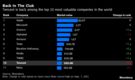
Tencent Holdings Ltd. has once again found itself among the world’s 10 largest companies by market value thanks to Meta Platforms Inc.’s tumble and a rebound in shares of the Chinese tech giant. Tencent had dropped from the list in mid-September amid Beijing’s sweeping regulatory crackdown of private enterprises. Its Hong Kong-listed shares have risen about 8% this year as receding regulatory concerns lured back investors, putting its value at about $590 billion. 

Top Tech Stories

  • Intel expects revenue to rise by just under 2% this year, with growth picking up in later years as Chief Executive Officer Pat Gelsinger pursues a turnaround of the once-dominant chipmaker
  • The U.S. added Chinese messaging platform WeChat and online marketplace AliExpress to its list of notorious markets for counterfeiting and piracy, an annual compilation of the worst intellectual-property abusers and counterfeiters
  • Sony releases the highly anticipated new entry in its Horizon video game franchise on Friday, and early reviews suggest it’s primed to be another big PlayStation hit
  • Roku tumbled in premarket trading Friday after its fourth-quarter revenues and first-quarter sales forecast fell short of analyst expectations
  • Meta Platforms’ stark warning of a retreat from Europe may just be the start, as one of the region’s top privacy watchdogs prepares a decision that could paralyze transatlantic data flows and risk billions in revenue for tech giants


(Updates share price moves throughout.)

More stories like this are available on bloomberg.com

©2022 Bloomberg L.P.

DraftKings Sinks as Forecast, Customer Growth Disappoint

(Bloomberg) — DraftKings Inc. shares fell their most in almost two years after the company added fewer new customers in the fourth quarter and projected a wider loss this year than Wall Street had expected.

The company said Friday that an average of 2 million monthly unique paying customers engaged with DraftKings during the fourth quarter. Analysts were looking for 2.1 million monthly payers, according to estimates compiled by Bloomberg. The company also forecast an adjusted loss excluding some items in the range of $825 million to $925 million this year, steeper than analysts expected.

“In the present environment where tech investors have displayed zero tolerance for large losses, the 2022 Ebitda guidance is going to be a disappointment,” Vital Knowledge analyst Adam Crisafulli said.

Shares of the Boston-based company sank as much as 19% in New York, their biggest drop since March 2020. The stock had fallen 63% over the past year through Thursday’s close.

Sports betting has spread to an increasing number of U.S. states since the Supreme Court struck down a federal ban in 2018. That’s led to a free-for-all of introductory offers as DraftKings, FanDuel and others try to persuade people to use their phone to place wagers for the first time. DraftKings has entered the New York and Louisiana markets, and said Friday there are new potential opportunities in Maryland, Puerto Rico and Ohio.

Building relationships with new customers — and sports leagues — costs money. DraftKings spent nearly $1 billion on sales and marketing last year, almost double its allocation in 2020.

Chief Executive Officer Jason Robins is also trying to accelerate the company’s growth through acquisitions, including the purchase of Golden Nugget Online Gaming that is expected to close this quarter. Investors are eager to see what’s next after DraftKings walked away from a potential $22 billion deal with Entain Plc in October.

With mobile sports betting starting last month in New York and Louisiana, the company raised its revenue forecast for this year to a range of $1.85 billion to $2 billion. Analysts had estimated $1.9 billion, on average. 

On an earnings call Friday, Robins said he expects DraftKings to be profitable by the fourth quarter of 2023. The company will continue to spend on advertising and promotions to lure new users as more states legalize sports betting, he said.

For more on DraftKings Fourth-Quarter Earnings, click here for our TOPLive blog.

(Updates shares in first and fourth paragraphs.)

More stories like this are available on bloomberg.com

©2022 Bloomberg L.P.

Lordstown Motors and Its Post-SPAC Peers Keep Losing Executives

(Bloomberg) —

The past month has been a rough one for some of the electric vehicle startups that went public by merging with special purpose acquisition companies, or SPACs. Lordstown Motors, Canoo and Electric Last Mile Solutions all have seen key personnel leave, and all three are under investigation by the U.S. Securities and Exchange Commission.

Lordstown lost Chuan Vo, a former Tesla engineer who was head of propulsion. That’s a pretty big job for an EV company. He was the one overseeing development of the electric drive system for the Endurance pickup that is supposed to go into production in the third quarter of this year.

EV startups are notoriously volatile, but at least in Lordstown’s case, the company is firming up a management team under Chief Executive Officer Dan Ninivaggi, a former Carl Icahn associate who joined in August after playing a role in the Chapter 11 restructuring of Hertz. Ninivaggi told me the turnover is part of a series of steps he’s taking as the company abandons founder Steve Burns’ vision of making EVs largely on its own.

“The team is totally different,” Ninivaggi said during a short interview when Vo left. “We’re bringing in new talent and we’re pivoting from a manufacturing company to a product-engineering company.”

The plan is to approach carmaking more like Apple makes phones. Lordstown will have Taiwan’s Foxconn build the commercial vehicles Ninivaggi’s team develops. Lordstown will design and engineer vehicles, while Foxconn owns the plants and pays the assemblers. For a startup in a capital-intensive business, getting someone with deep pockets and expertise in supply chains and manufacturing to do the heavy lifting makes sense.

The company agreed in September to sell its Lordstown, Ohio, factory — the one it bought from General Motors in 2019 — to Foxconn. The iPhone assembler will make the trucks while Lordstown develops future commercial vehicles, perhaps delivery vans, from an office in suburban Detroit.

In November, Ninivaggi hired former GM and Ford Motor executive Edward Hightower as president, replacing Rich Schmidt. Hightower led development of GM’s crossover SUV business, including the Cadillac XT5 and Chevy Blazer. Schmidt had been in manufacturing for Tesla and Toyota.

As for Vo, he sold stock in February of last year, then bought more shares that month at a lower price. Under trading rules, he had to refund the company the roughly $400,000 he netted by buying the shares after the value of the stock tanked. A spokeswoman for Lordstown said that’s not why he left — Vo wanted to return home to California. Plus, with the Endurance battery finished and any future products coming from Foxconn’s MIH EV platform, the company doesn’t really need someone to develop propulsion. Vo didn’t respond to an email seeking comment.

Other EV startups have seen executives depart amid SEC probes. Van maker Electric Last Mile Solutions’ CEO Jim Taylor and Chairman Jason Luo left after the board determined they bought company stock before its merger at a discount to market value. Four Canoo executives parted ways this month. Both companies’ stocks are trading below the $10-a-share price investors in the SPACs paid to get in on the respective deals.

That’s true for Lordstown, too. Its shares have traded below $4. That’s the market’s way of saying investors want more proof that Ninivaggi’s plans, however sensible, will pan out.

More stories like this are available on bloomberg.com

©2022 Bloomberg L.P.

How China Beat Out the U.S. to Dominate South America

(Bloomberg Markets) — In the hinterland of Argentina, Mario Pizarro’s office looks like a shrine to China. There’s the framed photo of a Chinese peasant with Pizarro’s face superimposed beneath the conical farmer hat. There’s the blue-robed smiling Buddha statue. And there’s the model wind turbine from a Chinese company with an inscription in English …

How China Beat Out the U.S. to Dominate South America Read More »

Billions in Climate Funds Face Uncertain Future in South Africa

(Bloomberg) — One of the biggest announcements from last year’s COP26 climate talks was a pledge by some rich countries to provide $8.5 billion to help South Africa transition away from coal. Now different interests within the country are tussling over how that money should be distributed. Eskom Holdings SOC Ltd., the embattled state-owned utility, …

Billions in Climate Funds Face Uncertain Future in South Africa Read More »

Close Bitnami banner
Bitnami