Bloomberg

Mandiant Executive Cautions Against Russia-Cyberattack Panic

(Bloomberg) — Fears of “scorched-earth” cyberattacks stemming from a standoff between Russia and the West over Ukraine may be overblown, and could give undue influence to the Kremlin, according to a senior executive at cybersecurity firm Mandiant Inc.

Sandra Joyce, Mandiant’s executive vice president of global intelligence and a lieutenant colonel in the U.S. Air Force reserve, said that unfounded concerns about Russia’s cyber power threaten to hamper diplomacy.

“We’ve had a lot more death and destruction from real kinetic war than we’ve had from the cyber domain, and I think that people just need to slow down and realize that,” Joyce said in an interview. “I’ve seen a lot of headlines that make me think, ‘You know, we need to just get a grip. We need to calm down.’”

Ukrainian banks and government agencies suffered cyberattacks on Tuesday, sparking fresh anxiety about state-sponsored hacking. A “strong” distributed denial-of-service, or DDoS, attack targeted the Ukrainian government’s website for Diia, a service that citizens can use to store everything from passports, driver’s licenses and vaccination certificates, said Mykhailo Fedorov, Ukraine’s minister of digital transformation.

Ukraine’s defense ministry and two state-run Ukrainian lenders, Privatbank and Oschadbank, also suffered DDoS attacks, which interrupted access to some of their services. The banks said the attacks on their systems lasted several hours, but that most functions have since been restored. The government did not attribute the malicious activity to any specific attacker or foreign entity. DDoS attacks typically occur when attackers direct inauthentic web traffic to a single site, aiming to knock the service offline.

The attacks came as President Joe Biden said Russian troops remained in a “threatening position” near Ukraine’s border. Russia’s defense ministry signaled it would withdraw some of its troops, though Biden said an invasion remained “distinctly possible.” 

Ukrainian government websites were breached and defaced last month, with Ukrainian investigators initially blaming Russian hackers. Suspected Kremlin-backed perpetrators were responsible for intrusions that affected Ukraine’s power grid in 2016, according to U.S. Department of Justice charges.  

Moscow has denied involvement in malicious cyber activity, and Russian President Vladimir Putin has denied that he intends to invade Ukraine.

Mandiant, which works closely with the U.S. government, has deep insight into global cyber threats and nation-state activity. Its employees monitor state-sponsored hackers in real time, while its consultants are often called by companies that have been breached by foreign entities. Microsoft Corp. has been in talks to acquire Mandiant in recent weeks. 

In recent days, the U.S. Cybersecurity and Infrastructure Security Agency has warned American companies to put “shields up” to prepare for potential hacking that may come as a result of Russia’s military presence near Ukraine’s border. 

If the U.S. responds with new sanctions on Russia, cyberattacks on U.S. businesses or critical infrastructure could follow, the thinking goes. Joyce notes that these concerns are reasonable, and says that attackers have shown a willingness to use some of their most aggressive tactics against the U.S.

“Every organization in the U.S. is at risk from cyber threats that can disrupt essential services,” CISA Director Jen Easterly said in a tweet. “As we know, the Russians have used cyber as a key component of their force projection, to include disabling or destroying critical infrastructure.” 

Easterly said there is no specific credible threat to the U.S.

Recent events have led to overheated rhetoric, Joyce said. “A lot of the wording that’s used can conjure up these scorched-earth cyber outcomes,” she said.

Concerns about Russian hacking affecting Ukraine and the West are real and valid, she said, but organizations should focus on preparing their defenses and recognize that Russians are seeking to spread fear about their hacking abilities.

“We can restore networks — we are resilient when it comes to that,” she said. “We can take preparatory action. We can do something about it on the front end and then we can recover. Some of the terminology can kind of make it seem like there isn’t that type of resilience.” 

(Updates with detail on earlier cyberattacks starting in fourth paragraph.)

More stories like this are available on bloomberg.com

©2022 Bloomberg L.P.

Roblox Tumbles as Results Show Growth Slowing After Pandemic

(Bloomberg) — Roblox Corp. reported bookings that missed analysts’ estimates in the fourth quarter, reflecting a retreat from the pandemic-inspired boost over the last two years as Chief Executive Officer David Baszucki urged investors to “take the long view” on the game platform company. The shares tumbled 14% in extended trading.

Bookings, which include revenue and deferred revenue and other adjustments, rose 20% from a year earlier to $770.1 million, the company said in a statement on Tuesday. Analysts were estimating $786.2 million, according to data compiled by Bloomberg. 

Average daily active users increased 33% to 49.5 million, slightly less than the 50.5 million analysts were expecting. Much of that growth comes from countries in Asia, Latin America and Europe. And, in a shift, more than half of Roblox’s user base is now over age 13.

The results mark Roblox’s first full-year report since it went public in March 2021. Baszucki acknowledged that over the course of two years of the pandemic, “our numbers have been affected in several ways.” 

The gaming industry had a banner year in 2020 at the height of the pandemic. Roblox, a social platform that enables players to create their own online games and worlds, captured the undivided attention of as much as two-thirds of U.S. kids ages 9 to12. That success also made the company vulnerable when tweens were called back to classrooms, sports and other activities.

“As parts of the world began to return to a more normal way of life, our absolute numbers have continued to grow,” Baszucki said, but “growth rates have declined as we are comparing, in some cases, to quarters last year in which certain key metrics doubled or even nearly tripled.”

As the pandemic fades, Roblox is looking to the future in the metaverse, envisioned as an immersive version of the internet where people will be able to interact, play games or work using a digital avatar. While many companies are touting the benefits and growth potential of the metaverse, Roblox has a head start because its users are already able to make their own video games and virtual worlds using its technology. In 2021, users spent more than 1 million hours inside 1,900 of its “experiences,” the company said. 

At the same time, Meta Platforms Inc. recently experienced a harsh reality check after announcing a full-force push into the metaverse. Bloomberg Intelligence analyst Amine Bensaid said the two companies “have completely different business goals. I don’t think any company is better-positioned than Roblox on the vision many have on the metaverse.” 

Roblox Chief Business Officer Craig Donato said that the fallout of Meta’s metaverse push has given Roblox “no second thoughts. We’re very, very consistent on where we want to go. I think more and more time will be spent in these digital spaces.” Donato said the company sees the metaverse as a “long-term trend we need to work on and we’ve been working on it for 15 years.” He added that it’s a matter of “if, not when” the company integrates blockchain technology. 

The ability to operate across platforms is key to traditional definitions for the metaverse, and right now, Roblox is accessible only on PC, mobile devices and Microsoft Corp.’s Xbox One console. In an interview, Donato said the company is “actively looking at all platforms but we wouldn’t announce anything we’re working on until we’re demoing it live.”

Roblox’s shares surged 130% last year, but are down 29% so far this year. Matthew Ball, managing partner of venture capital firm Epyllion Co., said Roblox’s ebb and flow is in line with other metaverse-themed equities, like game-tech company Unity Software Inc. Ball expects Roblox to continue to grow.

“It has the most powerful flywheel in gaming today, and there are billions yet to join socially focused virtual worlds,” he said. “There are likely to be hitches along the way, and Roblox may end up replaced by a newer competitor, but right now Roblox looks like the virtual world platform of the West.”

One of those hitches bas been content moderation. Over 2021, several investigations by news outlets described an epidemic of inappropriate content on the platform, including sex clubs and fascist or white supremacist role-play. In November, when Roblox introduced a new spatial voice feature, The Washington Post reported that users made lewd noises and said slurs. To participate, users were asked to prove they were over 13 with a photo and government ID.

Roblox employs human moderators, about 80% of whom are outsourced, and sophisticated artificial intelligence and machine learning technology to review content. Baszucki implied that some headlines around inappropriate content in Roblox were exaggerated, telling Bloomberg that “we’re constantly improving AI and filtering and we’re optimistic about the direction we’re going in.” He added that Roblox has a “zero tolerance policy” on content that violates the platform’s guidelines.

(Updates with executive comments on metaverse and content moderation from ninth paragraph.)

More stories like this are available on bloomberg.com

©2022 Bloomberg L.P.

U.S. Offers Support After Banks Face Cyber Hit: Ukraine Update

(Bloomberg) — President Joe Biden said that a Russian attack on Ukraine is “still very much a possibility” but said diplomacy should continue. 

Earlier, German Chancellor Olaf Scholz met with President Vladimir Putin in Moscow while Western allies reacted cautiously to a Russian statement that it was beginning to pull back troops from the Ukrainian border. Putin told reporters that the talks with Scholz were businesslike and that U.S. and NATO offers on limits to missile deployments and confidence-building measures could be the basis for further discussions.

Russian officials have repeatedly denied that an incursion is planned.

Key Developments

  • Biden Cranks Up Volume on Ukraine With Public Pressure on Putin
  • Sarcasm in Ukraine Roils Markets Swinging Between War, Peace
  • Senators Weigh Non-Binding Resolution as Russia Sanctions Stall
  • Where Military Forces Are Assembling Around Russia and Ukraine
  • What Conflict in Ukraine Would Mean for Oil, Gas and Food

All times CET

U.S. Offers Support After Denial-of-Service Hit (10:52 p.m.)

The U.S. has offered to help Ukraine investigate and respond to the distributed denial-of-service, or DDoS, attacks that some Ukrainian banks, the defense ministry and other websites suffered on Tuesday. 

After the initial reports on the attacks emerged, Mykhailo Fedorov, Ukraine’s minister of digital transformation, said that the government website Dia was also hit by a “strong DDos attack.” Dia is a popular app that citizens use to store everything from passports to driver’s licenses and vaccination certifications. 

Separately, an executive at online-security firm Mandiant Inc. cautioned against over-hyping Russia’s ability to wreak havoc in the digital realm. 

Russia Sanctions Wouldn’t Be ‘Painless’ for U.S.: Biden (9:40 p.m)

Biden said sanctions envisioned by his administration against Moscow if it attacks Ukraine wouldn’t be “painless” for the U.S. 

“We are taking active steps to alleviate the pressure on our own energy markets and offset rising prices,” Biden said. “We’re coordinating with major energy, energy consumers and producers are prepared to deploy all the tools and authority at our disposal to provide relief at the gas pump.” 

He said the penalties the U.S. would inflict with allies “will impose long-term consequences that will undermine Russia’s ability to compete economically and strategically” and reiterated vows that the Nord Stream 2 pipeline from Russia to Germany will remain shut if hostilities break out. 

Biden Says Attack Possible, No Sign of Drawdown (9:35 p.m.)

Biden said a Russian attack is still a possibility and that the U.S. is “prepared, no matter what happens.” 

“The Russian defense minister reported today that some military units are leaving their positions near Ukraine,” Biden said in an address at the White House. “That would be good, but we have not yet verified that.” He went on to say that Russian forces remain “very much in a threatening position.” 

Biden said Russia has about 150,000 troops are deployed near Ukraine. And he reached out to the Russian people, citing the cooperation with the U.S. in World War II. 

“We’re not targeting the people of Russia. We do not seek to destabilize Russia. To the citizens of Russia: You are not our enemy. And I do not believe you want a bloody destructive war against Ukraine.”

Key Senate Republican Plans Sanctions Bill (9:00 p.m.)

Senator Jim Risch, the top Republican on the Foreign Relations Committee, has drafted his own Russia sanctions bill, the latest sign that bipartisan talks remain at an impasse.

Risch’s bill is aimed at halting construction of the Nord Stream 2 gas pipeline and would mandate sanctions on the project should Russia invade Ukraine. Prior to any invasion, the bill would suspend sanctions for as long as the German government continues to suspend the certification process for the conduit. It would also provide $500 million in Foreign Military Financing for Ukraine, including $250 million in emergency funding, with $100 million of that for lethal assistance.

Risch and Foreign Relations Chairman Bob Menendez have been trying to reach consensus on a sanctions package, but the Senate plans to leave Washington for a week-long recess at the end of this week, giving lawmakers just a few days to strike a deal that has eluded them for weeks. 

Russia Moves Don’t Suggest Force Posture Change, RUSI Says (8:40 p.m.)

Judging by units the Russian defense ministry has shown as withdrawing, it’s doubtful a meaningful de-escalation has begun, according to Samuel Cranny-Evans, a military analyst at the Royal United Services Institute in London. The units were from two motor rifle brigades that were stationed in the southern part of Crimea, Russia’s Interfax news agency reported.

“It does not really change Russian force posture at all,” Cranny-Evans said, because they were positioned too far from the provisional border. At the same time, he noted that open source videos purport to show tanks from the 1st Guards Tank Army driving at night close to the Ukrainian border, which would send a very different signal.

Not only is driving tanks at night risky and certain to tear up roads, so generally not done lightly, but if open source identifications are correct the 1st Guards are a spearhead division, according to Cranny-Evans. “If that kind of unit were withdrawn from that kind of location, it would be a much more definitive indication of de-escalation.”

West Watches Where Russian Troops and Equipment Might Move (7:38 p.m.)

As Western diplomats seek to parse Russia’s announcement of a partial withdrawal of some of the estimated 130,000 troops near Ukraine’s borders, it’s what-gets-moved-where that will indicate the Kremlin’s intentions.

To be meaningful, any withdrawal must be substantial and include heavy land equipment such as tanks, according to Henry Boyd, a research fellow for defense and military analysis at the International Institute for Strategic Studies. The troops would need to return to home barracks across Russia, rather than the closer makeshift bases they were in recently until moving up near the border, Boyd said.

“There has to be equipment, it is too quick and easy to move personnel backward and forwards,” said Boyd. “Otherwise, you are just shifting from the potential for invasion within a couple of days to within a week.” Any semi-withdrawal could also be part of a deception operation: “yes, it could be genuine, or yes it could be false and in essence the two things wouldn’t look too different at this point in time.”

Ukraine Defense Ministry, Banks See Websites Hit (6:46 p.m.)

Ukraine’s defense ministry and two state-run Ukrainian lenders, Privatbank and Oschadbank, said they suffered distributed denial-of-service, or DDoS, attacks which interrupted access to some of their services. 

The ministry’s website still appears to be down. The banks said the attacks on their systems lasted several hours but that most functions have since been restored.

Over 70 government websites came under massive cyberattacks on Jan. 14. Ukrainian investigators said last month that all evidence pointed to Russia being behind them, charges Moscow rejected. 

Biden to Speak on Russia-Ukraine Crisis (6:28 p.m.)

Biden will discuss the Russia-Ukraine situation in public remarks at the White House at 3:30 p.m. 

The president “will reiterate that the United States remains open to high-level diplomacy in close coordination with our allies, building on the multiple diplomatic off-ramps we and our allies and partners have offered Russia in recent months. The United States continues to believe diplomacy and de-escalation are the best path forward, but is prepared for every scenario,” the White House said in a statement. 

Oil Plummets Amid Signs of Tensions Easing (4:40 p.m.)

Oil dropped from its highest since 2014 after Russia said some troops are starting to return to their permanent bases after completing drills, even as Western officials expressed reservations over the claims. 

Futures in New York fell close to $5 a barrel after touching $95 on Monday. Crude has swung wildly this week amid a flurry of reports about the tensions over Ukraine.

Putin Says Russia Committed to Minsk Accords (3:56 p.m.)

Putin on Tuesday called for efforts to resolve the conflict in Ukraine’s Donbas to continue on the basis of the Minsk accords. Putin, speaking to reporters in Moscow following talks with Scholz, urged France and Germany to pressure Kyiv to implement the stalled 2015 peace agreement.

The Russian leader was responding to a question on a vote by Russian lawmakers asking him to immediately recognize separatist Kremlin-backed regions in Ukraine. Putin didn’t specify how he’d respond to the request. 

Scholz warned that such a move would risk scuppering the Minsk peace process, adding that failure of those discussions would be a catastrophe and that all parties needed to make contributions. 

Western Officials Seek to Clarify Russian Claims (3:07 p.m.)

German Foreign Minister Annalena Baerbock joined a chorus of Western voices expressing skepticism over Moscow’s statement that it was beginning to pull back troops from the Ukrainian border. “Every step of de-escalation would be reason for hope. But so far there are only words, which now have to be followed by actions,” she said on Tuesday.

U.S. Ambassador to NATO Julianne Smith told reporters that they would need to verify Russia’s claims, adding that Moscow made similar statements in December that couldn’t be supported by the facts.

Russia has rotated troops before and would need to demonstrate a significant reduction for a proper rollback, according to a NATO diplomat familiar with the alliance’s thinking. A mass movement of troops would also take time, the diplomat cautioned, so the situation would need to be monitored for a while to ensure it’s not a tactical ploy.

Ukraine’s Top Diplomat Wants to See ‘Real Withdrawal’ (2:40 p.m.)

Foreign Minister Dmytro Kuleba said he would need to see action before believing Moscow’s statement that it was beginning to pull troops back from Ukraine’s border. Kuleba wrote on Twitter that he would believe a de-escalation was in progress if “a real withdrawal follows these statements.” 

U.K.’s Johnson Sees ‘Mixed Signals’ in Russian Position (2:26 p.m.) 

Prime Minister Boris Johnson said Russia’s declaration that it was moving troops away from the Ukrainian border was a sign of a “diplomatic opening,” but added that U.K. intelligence “is still not encouraging.” 

“You’ve got more battalion tactical groups being brought closer to the border,” Johnson told reporters on Tuesday after being briefed by intelligence officials. “So, mixed signals, I think, at the moment.”

Johnson added that the U.K. will take steps to stop Russian companies from raising capital on London financial markets as part of a broad range of sanctions if Russia invades.

Euro Area at Risk From Gas-Supply Shock, ECB Finds (1:18 p.m.)

A potential reduction of gas supplies to the euro area would diminish economic activity in the region and worsen the hit from already-high energy prices, European Central Bank researchers said. 

Slovakia, Austria and Portugal would take the biggest hit, while the Netherlands, Luxembourg and Belgium would be relatively immune, the researchers said. 

NATO Says No Sign Yet of Russian Pullback (1:08 p.m.)

NATO has yet to see any signs of a reduced Russian presence on its border with Ukraine, Secretary General Jens Stoltenberg told reporters in Brussels, although he said Moscow’s announcement offered “reason for cautious optimism.” 

“So far we haven’t seen any sign of de-escalation on the ground,” he said. “Everything is in place for a new attack. Russia still has time to step back from the brink.”


Estonian Spies See Long-Term Risk From Russia (1:00 p.m.)

NATO and its allies must be prepared for “sustained military pressure” from Russia and a continued military presence in Belarus that will pose a threat to Baltic nations, Estonia’s intelligence agency said in its annual report.

“Russia may continue to maintain a rotating force group on Belarusian territory,” the report said. “This would harm the wider security situation in the Baltic Sea region and for NATO, reducing the preparation time for an attack against the Baltic states.”

Russia’s military would only be a “political decision” away from a full-scale attack on Ukraine from the second half of February, according to the report. But even if current tensions de-escalate, the military pressure wielded by the Kremlin has become an “integral part of the foreign policy of Putin’s Russia” in recent years.

Russia’s Lavrov Says Security Deal Possible With U.S., NATO (12:10 p.m.)

Foreign Minister Sergei Lavrov said Tuesday that Russia is confident that diplomatic efforts aimed at resolving a tense stand-off with the U.S. and Europe will succeed.

Lavrov said his country will pursue talks on its demands for sweeping security guarantees including a halt to the expansion of the North Atlantic Treaty Organization that the U.S. and its allies have rejected. At the same time, Russia is ready to start talks at an expert level on proposals made by the U.S. on missile restrictions and confidence-building measures, he said, adding that Moscow would publish its response to the U.S. soon.

“Thanks to efforts on all these fronts, overall we can work out a fairly good package solution,” Lavrov told reporters in Moscow.

Duma Asks Putin to Recognize Ukraine Separatists (11:32 a.m.)

The Russian State Duma voted Tuesday to appeal to Putin to immediately grant formal recognition to separatist entities in east Ukraine. The Kremlin so far hasn’t publicly stated its position on the proposal. 

The U.S. has warned allies that Russia could try to create a pretext to move against Ukraine by causing a provocation in the eastern Donbas region, where Ukraine’s military has been fighting for years against separatists backed by Moscow, officials familiar with the matter said. 

Russia Shows Video of Troops Preparing to Pull Back (11:11 a.m.)

Units of the Western and Southern military districts are already loading equipment onto road and rail transport after completing their drills and will begin returning to their permanent bases Tuesday, Defense Ministry spokesman Igor Konashenkov said in a video posted on its website.

It remains unclear how many troops may be pulled back and how significant the process might become.

Some of the troops on exercise in Belarus have moved closer to the border than expected, according to Western intelligence officials. They added their intelligence showed there were currently 100 Russian battalion tactical groups massed near Ukraine’s borders and 14 more in transit. The officials did not provide the evidence behind their assessments.

More stories like this are available on bloomberg.com

©2022 Bloomberg L.P.

U.S. Sea Levels to Rise at a Faster Pace Than in Past 100 Years

(Bloomberg) — Oceans along the U.S. coastline will rise faster within the next three decades than they did in the past 100 years, bringing more flooding to coastal cities such as New York and Miami, according to the latest projections.

Sea levels are expected to rise as much as 12 inches (30 centimeters) by 2050, according to a report led by the National Oceanic and Atmospheric Administration. While the amounts vary according to region, the inundation will lead to more coastal flooding and make tidal and storm surge more severe, the multi-agency report said.

“Sea levels are continuing to rise at a very alarming rate,” Bill Nelson, administrator of the National Aeronautics and Space Administration, said Tuesday in a conference call with reporters. “And it’s endangering communities around the world.”

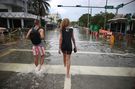
Rising waters are threatening coastal cities including New York, Boston and Miami, which already commonly experience flooding during high tides that occur with full and new moons. Homes, businesses, highways and other infrastructure along coastlines are vulnerable to damage from flooding and rising sea levels. Nearly 8 million homes, with a reconstruction cost of $1.9 trillion, are at risk of storm surges, according to a 2021 CoreLogic report.

Sea levels in Manhattan could rise by 2 feet as early as 2055 or as late as 2078, depending on the impacts of climate change, according to NOAA estimates. About 7,895 people in Manhattan live in low-lying areas that would flood with less than 2 feet of sea level rise.

High-tide flooding has more than doubled in New York since 2000 and now occurs 10 to 15 times a year, the report said. The annual frequency of flooding in Miami and Charleston, South Carolina, has grown from zero to two days in 2000 to about five to 10 days as of last year.

“These increases will continue, further accelerate, and spread to more locations over the next couple of decades,” said the report, which updates a sea-level projection from 2017. The U.S. uses satellites to measure ice thickness and the levels oceans are rising.“This new data on sea rise is the latest reconfirmation that our climate crisis – as the President has said – is blinking ‘code red’,” White House National Climate Advisor Gina McCarthy said in a statement. “We must redouble our efforts to cut the greenhouse gases that cause climate change while, at the same time, help our coastal communities become more resilient in the face of rising seas.”

By trapping heat that melts ice sheets, greenhouse gas emissions will likely contribute about 2 feet of global sea level rise by 2100, according to the report. Failing to curb future emissions could cause sea levels to rise an additional 18 inches by the end of the century to reach 5 feet. The U.S. coast from around North Carolina up to Maine is a global sea-level rise hotspot.

Global warming above 5.5 degrees Fahrenheit (3 degrees Celsius) would spur on rapid melting of Greenland and Antarctic ice sheets, releasing that water into oceans. The exact damage is difficult to model because of “ice sheet instability,” the report said.

In addition to NOAA, researchers from NASA, the Environmental Protection Agency, the U.S. Geological Survey, the Department of Defense, the Army Corps of Engineers and the Federal Emergency Management Agency all contributed to the 111-page report.

More stories like this are available on bloomberg.com

©2022 Bloomberg L.P.

There’s a Portrait of Jamie Dimon Hanging in JPMorgan’s Metaverse Lounge

(Bloomberg) — JPMorgan Chase & Co. has a lounge in the metaverse: Visitors are greeted by a digital portrait of Jamie Dimon and a roaming tiger. Walk upstairs and you’ll see an executive’s presentation on the crypto economy.

The lounge is located at the Metajuku mall in Decentraland, a browser-based metaverse backed by the Digital Currency Group. Onyx, JPMorgan’s blockchain unit formed in 2020, set up the lounge as it released a paper on how businesses can explore opportunities in the metaverse. 

JPMorgan is the first Wall Street bank to launch a presence in the metaverse, joining a diverse group of brands to do so including Samsung and the Barbados embassy. The bank has been a proponent of blockchain technology and its use in financial transactions, as evidenced by its own JPM Coin. The metaverse effort represents a further step in its investment in building out infrastructure in the crypto and blockchain ecosystem. Decentraland allows users to explore its metaverse by creating avatars and buying goods including land with its native currency MANA. 

The early part of JPMorgan’s blockchain efforts was “analyzing the internal use cases,” said Christine Moy, Onyx global head of Liink, crypto and the metaverse, in an interview. “Now we are focused on driving value externally by providing infrastructure” including blockchain and payments technology to clients such as game publishers. 

In the paper, the bank said the success of the metaverse is dependent on having a “robust and flexible financial ecosystem” and its core competencies in cross-border payments, foreign exchange, financial assets creation, trading and safekeeping can play a “major role in the metaverse.” 

Similar to JPMorgan’s role in the real world, “we are well positioned to bring together global trade and commerce” across digital universes, said Moy. “I would expect we would have a presence in all the major ones.”

For clients thinking about entering the metaverse, JPMorgan can provide an “integrated payments hub” with full solutions such as ledgering and wallets, said Adit Gadgil, head of e-commerce and TMT at JPMorgan Payments. 

(Adds quotes from bank executives)

More stories like this are available on bloomberg.com

©2022 Bloomberg L.P.

California’s Largest Battery Storage Shut Down by Smoke, Again

(Bloomberg) — Vistra Corp. was once again forced to shut down part of California’s biggest battery storage system after some components malfunctioned.  

The company took offline its 100-megawatt Moss Landing battery facility after a safety system activated late on Sunday, according to a statement. It’s the second incident at the plant in less than six months. 

In September, Vistra closed the plant’s 300-megawatt facility after some battery modules overheated. An investigation found that smoke from a failed bearing in an air-handling unit in the building triggered a heat suppression system to improperly spray water on battery racks, causing damage and some to overheat, according to a statement from Vistra last month.  

Early findings from the most recent incident indicate that water hoses leaked and some batteries shorted, causing smoke in the building, similar to what was observed with the prior issue, Vistra said. 

The cause of the latest outage is under investigation, the company said. No injuries were reported. 

Vistra said it will now pause bringing its 300-megawatt facility back online because of the latest issues at the plant, located nearly 100 miles (161 kilometers) south of San Francisco. 

Last month, Vistra announced plans to nearly double the capacity of its Moss Landing energy storage site by adding 350 megawatts in an agreement with PG&E Corp. The expansion is expected to be completed by June 2023. 

More stories like this are available on bloomberg.com

©2022 Bloomberg L.P.

Meta Closes $1 Billion Kustomer Deal After Regulatory Review

(Bloomberg) — Meta Platforms Inc. was finally allowed to complete its acquisition of Kustomer, a customer service software company, after more than a year of antitrust scrutiny.

Meta, which owns Facebook, announced that the deal “complied with all regulatory requirements” in a blog update Tuesday. Meta first announced the acquisition, valued at more than $1 billion, in November 2020, but the company was sued by the Federal Trade Commission shortly after for “illegal monopolization,” raising questions about whether the Kustomer acquisition would be approved by regulators. 

What followed was a lengthy review process, showing that Meta can still complete big acquisitions, just not quickly. The company passed an FTC review and a separate approval by antitrust authorities in the U.K.

Kustomer builds software so that businesses can manage customer messages from multiple services on one central dashboard. That’s central to Meta’s plan to make money off of its two messaging apps, WhatsApp and Messenger. Meta hopes businesses will use WhatsApp, which has more than 2 billion monthly users, in lieu of other forms of customer communication, like email or 1-800 numbers. 

WhatsApp has signed deals with commerce partners in international markets like Indonesia and India, and is also building an option for transferring money within the app in hopes users won’t switch to another platform to conduct business. 

Meta has been under intense regulatory scrutiny in recent years. An FTC lawsuit seeks to break up Meta by requiring the company to spin off its WhatsApp and Instagram purchases. The ongoing lawsuit has raised concerns that Meta, which has arguably made some of the best acquisitions in tech history, will struggle to complete future deals. 

More stories like this are available on bloomberg.com

©2022 Bloomberg L.P.
Trudeau Trucker Crackdown Has Banks Guessing on Enforcement

(Bloomberg) — A day after Prime Minister Justin Trudeau invoked emergency powers to choke off funding to protests against Covid-19 restrictions, Canada’s banks were still waiting Tuesday for details on how they’re supposed to enforce the government’s orders.

Finance Minister Chrystia Freeland said Monday that banks would be required to report relationships with people involved in blockades and would be given the authority to freeze accounts without a court order, among other measures.

The banks still had numerous questions about how to implement the measures as of Tuesday morning, according to people familiar with the matter. Outstanding questions include which types of accounts the order covers, what recourse customers will have to make the banks reconsider account closures and how the banks will be indemnified, the people said.

Chief executive officers of Canada’s major banks have held two calls with government officials about the orders: one over the weekend, while the policy was being considered, and one on Monday evening, after it was announced, the people said. Public statements about the crackdown by public officials have been consistent with what the banks have been told, one of the people said.

The legal text of the government order was made public on Tuesday, but it didn’t clarify many of the banks’ questions. It says only that the government will require payment processors to report certain transactions to regulators and will require financial-services providers to “determine whether they have in their possession or control property that belongs to a person who participates in the blockade.”

Protests that began with a trucker convoy to Ottawa last month have gridlocked Canada’s capital city and closed border crossings. Although the bridge that carries a quarter of Canada’s commerce with the U.S. was reopened Sunday night, two major border crossings in Western Canada were blocked on Monday by semi-trailers and farm equipment.

As part of the financial crackdown, the government is also broadening its anti-money-laundering rules to cover cryptocurrency trading platforms and crowdfunding sites such as GoFundMe, both of which have been used to funnel donations to protesters. 

Even before the government announced the emergency measures, Toronto-Dominion Bank last week froze accounts containing C$1.4 million ($1.1 million) that was donated to the protests and asked a court to take control of the funds.

Some of the additional measures — including the crowdfunding rules — are already in place in other countries’ banking systems and have been in the works in Canada, said Sue-Ling Yip, a partner in KPMG’s risk consulting and financial crimes practice.

Communication between the government and the banks will be key in implementing the order correctly and preventing problems like freezing the wrong accounts, she said. The government may also need to allow the banks time to make the appropriate operational changes, she said.

“For them to start monitoring for additional things and add additional criteria to what is deemed suspicious — it doesn’t happen overnight,” she said in an interview. “We have to be mindful that it’s not something that banks can snap their fingers and make it happen. There’s a lot of work involved.”

Because of their experience in anti-money-laundering procedures, the banks may be most effective in cutting off the flows of funds from outside the country or from specific accounts, said Andreas Park, a professor of finance at the University of Toronto. Other channels that largely bypass the banks, such as cryptocurrency credit cards and marketplaces, may be harder to police, he said.

‘Some Disruption’

The banks may be concerned about running afoul of the government if they don’t do the job well and some transaction “slips through that later on bites them,” he said. That concern could prompt them to overreact.  

“The banks are risk-averse and don’t want to get in trouble,” Park said in an interview Tuesday. “They may very well catch a lot of normal people in the process, like international students and snowbirds. We’re going to see some disruption probably.” 

While he said he has “zero sympathy” for the protesters who have been blocking Canada’s infrastructure, he has concerns about the precedent the act sets in limiting people’s ability to use their money and going outside normal law-enforcement channels to target protesters.

“Essentially what we’re doing now is deputizing the private sector to do monitoring of citizens on behalf of the government and act on the basis of suspicions without due process,” he said.

(Updates with consultant’s comments starting in ninth paragraph)

More stories like this are available on bloomberg.com

©2022 Bloomberg L.P.

Coinbase Eyes Challenge to Western Union With Crypto Remittances

(Bloomberg) — Coinbase Global Inc., the biggest U.S. cryptocurrency exchange, is wading into the international money-transfer business, seeking to tap into a huge market dominated by firms like Western Union Co.

Coinbase said it has launched a free pilot program for sending crypto funds to friends and family in Mexico. Receivers can convert the tokens into pesos at participating locations across the country or invest the funds into a Coinbase account. The service will become fee-based after March 31.

Coinbase didn’t disclose the cost but said in a blog post it will be “still 25-50% cheaper” than traditional cross-border transfers. 

“We recognize this is a global issue. And while we’re starting in Mexico, over time we’ll consider other regions where customers face similar challenges,” Coinbase said in the blog post.

The push into remittances is part of Coinbase’s strategy to diversify its revenue amid a rocky period for cryptocurrencies that has sent trading volumes on exchanges plummeting. Coinbase is working to launch a marketplace for non-fungible tokens and is rolling out additional services in the area of decentralized finance.

The global-remittances market reached about $700 billion in 2020 and is expected to grow to $1.2 trillion by 2030, according to Allied Market Research. 

Last year, Facebook’s parent, Meta Platforms Inc., began piloting a program for sending remittances from the U.S. to Guatemala using its cryptocurrency digital wallet.

For the Mexican venture, Coinbase said it partnered with Remitly, which has relationships with more than 37,000 retail outlets, including Bansefi, BanCoppel, Oxxo, Soriana and Telecomm Telegrafos.

(Updates with Meta’s pilot in the seventh paragraph.)

More stories like this are available on bloomberg.com

©2022 Bloomberg L.P.

Tyson Foods, Massachusetts Loosen Mask Guidance: Virus Update

(Bloomberg) — Tyson Foods Inc., one of the first big U.S. employers to mandate vaccines for its workers, is easing mask requirements for some fully vaccinated employees. The state of Massachusetts also loosened its mask guidance.

Germany is set to join other European countries in phasing out Covid-19 restrictions over the coming weeks, even though infections are only slightly below recent records. France is planning to ease some mask rules, and the Dutch government revealed its road map toward a full reopening.

Hong Kong is trying to ride out the omicron wave without a total lockdown like those in mainland Chinese cities. Tennis star Novak Djokovic said he’s willing to forgo trophies and the Wimbledon tournament if that’s the price for not getting a vaccine.

Key Developments:

  • Virus Tracker: Cases pass 413.7 million; deaths top 5.8 million
  • Vaccine Tracker: More than 10.4 billion doses administered
  • Here’s what the pandemic has in store for the world next
  • Hong Kong tries to end Covid without nightmare-scenario lockdown

Netherlands Eases as Cases Fall From Record (3:38 p.m. NY)

The Dutch government revealed its road map toward a full reopening as infections start to fall from record levels.

Cultural venues, bars and restaurants will have their daily closing time extended to 1 a.m. from 10 p.m. starting Friday, Dutch Health Minister Ernst Kuipers said on Tuesday in the Hague. The second step of easing the country’s restrictions will take place on Feb. 25, with all venues returning to normal hours of operation.

Massachusetts Eases Mask Recommendations (2:17 p.m. NY)

Massachusetts officials loosened their recommendation on masks indoors, saying they’re necessary only for those who are at high risk of being infected with Covid-19.

People should continue to protect themselves if they have a weakened immune system, underlying medical conditions or are unvaccinated, according to an updated advisory by the state Department of Public Health. Masks are still required on public transit and in health-care facilities. Previously, the state had asked all residents to wear a mask indoors no matter their vaccination status.

The recommendation came as the number of new Covid cases eased. In Massachusetts, the seven-day moving average of daily infections dropped to 1,755 on Monday, compared with nearly 25,000 during the peak of the omicron surge in early January, according to data from Johns Hopkins University.

Ecuador Vaccinating 3-, 4-Year-Olds (2:10 p.m. NY)

Ecuador started inoculating children ages 3 and 4 against Covid-19 with the Chinese Sinovac vaccines, the Health Ministry said in a statement. Vaccination started in Quito, Loja, Zamora and Machala, with a nationwide rollout to begin Feb. 21. The government hopes to stave off development of so-called long Covid in very young children where the disease often goes undetected, Health Minister Ximena Garzon said. Children will receive two doses with an interval of 28 to 42 days between shots.

Tyson to Ease Mask Mandates for Some (12:05 p.m. NY)

Tyson Foods Inc., one of the first national employers to mandate vaccines for its workers, is moving to ease mask requirements for some employees, a decision that comes as the number of coronavirus cases in the U.S. falls.

The meatpacking giant said in a memo to employees on Tuesday that fully vaccinated workers at “some facilities” could begin to remove their masks at work.

Vaccines Help Prevent Long Covid, U.K. Says (10:40 a.m. NY)

People vaccinated against the coronavirus are less likely to develop long Covid symptoms compared with those who are unvaccinated, a U.K. review of various studies on the condition has shown.

Following an examination of 15 studies, the U.K. Health Security concluded that getting two doses of a vaccine offered protection against severe illness and reduced the longer-term impact of the infection. The agency also found that getting vaccinated after a Covid infection helped reduce the duration of long Covid symptoms, which include fatigue, shortness of breath, and muscle or joint pain.

Japan May End Quarantine for Some: Nikkei(9:14 a.m. NY)

The Japanese government is weighing plans to end quarantine and self-isolation requirements in March for fully vaccinated travelers coming from countries where Covid-19 cases are not rising rapidly, Nikkei reported.

Marriott Beats as Vacationers Shrug Off Virus (8:02 a.m. NY)

Marriott International Inc. reported fourth-quarter earnings that beat expectations as demand for leisure travel powered the hotel recovery. 

The company reported adjusted earnings per share of $1.30, according to a statement Tuesday. That beat the average analyst estimate of 99 cents.

France to Drop Mask Mandate (7:14 a.m. NY)

France plans to drop the mask requirement in public spaces where a proof of vaccine is required, such as cinemas, government spokesman Gabriel Attal said on Tuesday. He confirmed that clubs will reopen on Wednesday.

Yet the vaccine requirement is here to stay for now. It will be lifted only when all postponed surgeries are rescheduled and no surgeries are postponed to treat Covid patients, he said.

Cyprus to Start Easing Curbs (6:44 a.m. NY)

Cyprus will begin relaxing coronavirus measures following a significant reduction in pressure on the country’s health system and stabilizing epidemiological indicators, Health Minister Michalis Hadjipantela said Tuesday. 

From Feb. 21, people who haven’t completed their vaccination programs and who take a rapid test will be re-allowed to enter restaurants, nightclubs, stadiums, theaters, cinemas and hotels. Other moves include an increase in the number of people allowed to attend weddings and entertainment venues, while the number of company staff required to work from home will be reduced to 25% of a company’s workforce from 50%.

Indonesia Exceeds Delta Peak (6:49 p.m. HK)

Indonesia added the most Covid-19 cases since the pandemic started, as the virus’s spread driven by the omicron variant outpaces the previous delta wave.

The government reported 57,049 new infections on Tuesday, with 134 people dying from the disease. Fatalities are lower than during the peak of the delta wave, when more than 2,000 people died in a day, leading the government to ease some restrictions in cities while still warning people against gathering.

Hong Kong Doesn’t Plan Full Lockdown (5:47 p.m. HK)

Hong Kong Chief Executive Carrie Lam said the city had no plans for a citywide lockdown to help bring cases back to zero, even as she acknowledged that a growing omicron outbreak has exceeded its capacity to respond.

“The scale and speed of the spread of the virus has overwhelmed our capacity in the fight against the pandemic,” Lam said. “The situation is very serious.”

She added that Hong Kong will continue with district-based lockdowns of specific buildings or neighborhoods to launch targeted Covid testing blitzes. Hong Kong reported 1,619 new infections on Tuesday.

Indian Carrier Rebounds From Covid Hit (5:11 p.m. HK)

SpiceJet Ltd. delivered a surprise profit after making losses for seven straight quarters as ebbing Covid cases boosted domestic travel. 

Chairman Ajay Singh in October flagged that the no-frills carrier had a “reasonable chance” of returning to profit in the December quarter. The company has cut costs and renegotiated aircraft leases to prune expenses. 

Germany Set to Ease Curbs (5 p.m. HK)

German Health Minister Karl Lauterbach backed a plan that would see most pandemic restrictions lifted by March 20, justifying the rollback by saying the peak of the latest coronavirus wave has now passed. 

Chancellor Olaf Scholz will hold talks with regional leaders on Wednesday. The draft prepared for the meeting includes immediately removing the requirement for people to be vaccinated or recovered to enter non-essential stores and allowing private gatherings of as many as 20 people, German public broadcaster ARD and other media reported.

In a second step from March 4, nightclubs will be allowed to reopen for those who are vaccinated or recovered or have a valid negative test, and major events will be allowed to host more people. In the third phase, employers would no longer be required to allow employees to work from home, while mask-wearing would remain compulsory on public transport and in most indoor public spaces.

Djokovic Ready to Skip Wimbledon (3:23 p.m. HK) 

The world’s top tennis player said he’s willing to sacrifice trophies and skip Wimbledon in order to avoid a Covid-19 shot. Djokovic is at the heart of a contentious global debate over vaccine mandates. Last month, the 20-time Grand Slam winner was deported from Australia after a protracted dispute over his vaccine status.

“The principles of decision-making on my body are more important than any title, or anything else,” Djokovic said in an interview with the BBC.

Protesters Defy Trudeau’s Emergency Powers (2 p.m. HK)

Demonstrators against vaccine mandates halted traffic at two major border crossings in Western Canada and some vowed to stay even as Prime Minister Justin Trudeau used a law giving his government emergency powers to end blockades. 

The main border posts in Alberta and Manitoba were closed Monday, with commercial traffic to the U.S. blocked by semi-trailers and farm equipment driven there by people opposed to Covid-19 vaccine rules.

One Chinese City Locks Down, Another Lifts (9:45 a.m. HK) 

China continues to battle Covid flareups as Manzhouli, a city of 300,000 people in Inner Mongolia bordering Russia, said it would enter lockdown after five people tested positive for Covid.

Suzhou, a city near Shanghai in eastern China, also found 12 Covid infections, mostly at the city’s industrial park. A wafer factory run by Taiwan’s United Microelectronics Corp. had to suspend production in the city after employees tested positive. 

Meanwhile, the southwestern border city of Baise started to lift lockdown restrictions Tuesday after its omicron-led cluster outbreak appeared to come under control. The city of 3.6 million residents near Vietnam entered lockdown last week. China reported 47 Covid infections overall on Tuesday, with 28 of them in the northeastern coastal city of Huludao.

Biden’s Global Vaccine Push Falters (9:20 a.m. HK)

U.S. President Joe Biden’s effort to vaccinate the world against Covid-19 is falling short, with the globe not on pace to meet a 2021 goal of vaccinating 70% of the world population by later this year, Secretary of State Antony Blinken acknowledged at a virtual meeting with other countries. Only about 54% of the global population is vaccinated so far. 

Singapore Eyes Easing, Commits to Reopening (8:24 a.m. HK)

Singapore will be able to ease virus restrictions more once the current omicron wave has peaked and starts to subside, Health Minister Ong Ye Kung said Monday in a response to questions in parliament. 

Separately, the South East Asian nation remains committed to reopening its borders and extending its vaccinated travel lane arrangements with other countries, deputy prime minister Heng Swee Keat said Monday at the Singapore Airshow.

More stories like this are available on bloomberg.com

©2022 Bloomberg L.P.

Close Bitnami banner
Bitnami