Bloomberg

SoftBank Leads $294 Million Fundraising for Singapore Lender

(Bloomberg) — Funding Societies, Southeast Asia’s biggest digital financing platform for small and medium-sized firms, has raised $294 million in its latest funding round to finance expansion plans.

The Singapore-headquartered lending platform raised $144 million in a Series C+ equity round led by SoftBank Vision Fund 2, according to a statement. New investors include Vietnamese tech giant VNG Corp., Rapyd Ventures, EDBI, Indies Capital, K3 Ventures, and Ascend Vietnam Ventures. Existing investors such as Sequoia Capital India and BRI Ventures also participated in this round, according to the statement.

Funding Societies also secured $150 million in lines of credit from financial institutions in Europe, the U.S, and Asia.

READ: Harvard Student’s E-Mailed Pitch to CEO Wins in Fintech Race

Non-bank lending platforms that link investors to borrowers are growing in Southeast Asia, where small firms have limited access to financing from traditional sources due to lack of a credit track record or collateral to pledge. The company, which is also present in Indonesia, Malaysia, Thailand and Vietnam, has disbursed over $2 billion to date in loans to micro, small and medium enterprises, according to the statement.

Funding Societies was founded in 2015 by Harvard Business School alumni Kelvin Teo and Reynold Wijaya. The latest funding round comes on the back of the company’s $45 million Series C raised between 2020 and 2021, the statement shows.

(A previous version of this story corrected the founding year in final paragraph.)

(Updates with details on participation by existing shareholders)

More stories like this are available on bloomberg.com

©2022 Bloomberg L.P.

California Should Pause ID.me Software Deal, Advisor Says

(Bloomberg) — California should not continue contracting with identity-verification software vendor ID.me, the state’s nonpartisan legislative adviser recommended Tuesday, noting concerns about the company’s use of facial recognition software. 

The California Legislative Analyst’s Office, providing advice on Governor Gavin Newsom’s proposal of six new deals with vendors to prevent unemployment insurance fraud, recommended withholding action on the ID.me contract. The state began working with ID.me on an automated  verification service during a pandemic boom in unemployment and increased fraud in temporary federal benefits. 

“Now that this critical period has passed, we recommend the Legislature pause and consider the implications of using third-party facial recognition software that has come under scrutiny in recent days,” wrote the office in an emailed summary of recent actions.

If California doesn’t continue with ID.me it would represent the end of one of the software vendor’s earliest and most significant state deals. California represented a quarter of all unemployment funds paid out in pandemic and was one of ID.me’s first five contracts.

But a log of complaints for California’s Employment Development Department (EDD), which signed up with ID.me in September 2020, details issues ranging from a transgender person being blocked from accessing benefits because the gender on their driver’s license didn’t match their passport to an applicant who went through ID.me’s verification process only to find their claim still on hold six weeks later.  And the contract had faced scrutiny from state legislators who complained they were inundated with complaints from constituents who were unfairly flagged for fraud or unable to verify their identities using ID.me. 

Read More:  How Did ID.me Get Between You and Your Identity?

ID.me has faced criticism for reports that legitimate unemployment insurance applicants were tied up by its software, delaying much needed payments for weeks and months. More recently, after being awarded a contract with the Internal Revenue Service, ID.me has had to correct previous statements about its use of facial recognition software and the IRS has said it will look for alternatives. 

The company has previously deflected questions about its use of facial recognition technology by saying it only uses so-called one-to-one technology. That process compares a selfie taken by a user to their likeness on a driver’s license or passport. The company disclosed last month that it actually also used much more controversial one-to-many technology to compare selfies to a bigger database of images that it collected. Research has shown that AI-driven facial recognition software often makes mistakes with darker-skinned people. That identified bias in the technology has prompted activists to call for law enforcement agencies to abandon using it altogether. The U.S. Department of Veterans Affairs is also considering dropping ID.me.

The Legislative Analyst Office recommended against all but one of the governor’s proposed contracts, amounting to $29.8 million in spending. That’s because the fraud California saw largely targeted the special pandemic federal unemployment insurance programs, which the group said lacked fraud safeguards that California’s regular programs have. The targeted federal program ended in 2021, making this spending unnecessary, the group said, except for one contract with Akamai that deals with preventing attacks by automated bots. 

“Going forward with these proposals would prioritize fraud elimination at the expense of prompt and straightforward payments,” the group wrote. 

More stories like this are available on bloomberg.com

©2022 Bloomberg L.P.

IPO Mania Gets Reality Check in India After a Series of Flops

(Bloomberg) — A boom in technology initial public offerings in India risks grinding to a halt after several of the country’s highest-profile startups tanked soon after listing.

A raft of prominent tech startups, including Oyo Hotels and logistics provider Delhivery, are pushing back their public debuts and preparing to reappraise target valuations, according to people familiar with the situation. The duo, both backed by SoftBank Group Corp., had been among the country’s highly anticipated offerings.

India’s burgeoning startup ecosystem faces a reckoning just weeks after it closed out a record year for IPOs. Investors have soured on new tech offerings after the calamitous public debut of fintech firm Paytm, as well as the battering received by newly listed e-commerce operators Zomato Ltd. and Nykaa. Regulators have stepped up scrutiny of IPO candidates after investors got burned, contributing to the delays. 

“Investors are no longer enamored of the household name startups; they want a path to profitability and returns, not hype and hoopla,” said Anup Jain, a managing partner at early-stage investor Orios Venture Partners. 

An Oyo spokesman said by e-mail that it is standard procedure for the regulator to ask for clarifications of a preliminary IPO filing, adding “our bankers are actively engaged with them. We can’t comment on specifics.” Delhivery declined to respond.

The owners of Delhivery have pushed back its approximately $1 billion IPO to the fiscal year starting in April, said some of the people, asking not to be named because the details are private. Delhivery is also reviewing its listing plan after the stock market regulator frowned on a planned sale of a substantial amount of shares by investors in the IPO, the people said. The logistics startup, backed by Carlyle Group Inc. as well as SoftBank, had previously planned to list by March.

Oyo, which came under scrutiny for its ownership structure and heavy losses after filing preliminary IPO documents last year, is now facing regulatory questions too. India’s watchdog has made queries about Oyo’s ongoing litigation with hostel operator Zostel Hospitality Pvt., which is claiming a stake in the company after a failed merger in 2016. 

The approval for the draft prospectus of Oyo’s planned $1.2 billion IPO has been pending for almost five months. Its investors include Sequoia Capital and Lightspeed Venture Partners, as well as SoftBank.

The management and bankers of Oyo, formally called Oravel Stays Ltd., are not in a rush, however, said one of the people. They are taking their time to respond to the regulator’s queries to slow down the listing process on purpose, the person said.

Also up in the air are the IPO timings of Pharmeasy, which goes by API Holdings Ltd., and automobile marketplace Droom Technology Ltd., which filed initial IPO documents in November. Pharmeasy’s investors include Prosus Ventures and TPG, while Droom is backed by Beenext and Lightbox Ventures.

Spokespeople for Pharmeasy and Droom declined to comment. 

India’s first-ever tech IPO rush marked a monumental year of exits for global investors in 2021. Paytm’s parent company, One 97 Communications Ltd., raised a record $2.5 billion when it went public in November. But its shares have plummeted 60% from their IPO price, infuriating investors and fueling concerns among regulators. A broader decline in tech stocks in India and beyond has only added to the gloom. 

Even the U.S. IPOs of startups Druva Inc., InMobi Pte. and Pine Labs Pvt. have been put off or deferred to the second half of 2022 or later, some of the people said. Sunnyvale, California-based software-as-a-service provider Druva, Singapore-based mobile solutions startup InMobi and fintech Pine Labs were all founded in India, where they still have the bulk of their operations.

A Druva spokesperson said by email that “the company will continue to monitor market and industry conditions and will do what best positions Druva for future growth and success.”

InMobi and Pine Labs did not respond to requests for comment.

Hanging over the Indian listings is a big unknown: the fate of the massive public share sale of state-owned Life Insurance Corp. of India, which filed its draft prospectus over the weekend. The final valuation and investor interest in what’s being called the “mother of all Indian IPOs” could dictate the course of technology companies’ listing plans, multiple people said.

Sandeep Murthy, a Mumbai-based partner at Lightbox, said concerns among public market investors are intensifying after two years of “rocketing” growth.

“Last year was all about greed and, short of an alien invasion, the market was ready to accept anything,” Murthy said. “Right now, fear is creeping up but give it some time, greed will be right back.”

More stories like this are available on bloomberg.com

©2022 Bloomberg L.P.

CNN’s Chief Marketing Officer Resigns After Cuomo Investigation

(Bloomberg) — CNN said its chief marketing officer, Allison Gollust, resigned Tuesday following the conclusion of an investigation of issues surrounding former anchor Chris Cuomo and his brother, the former governor of New York, Andrew Cuomo.

The network said a comprehensive investigation performed by a former federal judge and an independent law firm concluded that Gollust, Chris Cuomo and the network’s former president, Jeff Zucker, violated news division standards.

Chris Cuomo left the company last year after the network concluded he’d played a larger-than-disclosed role in helping his brother, who was dealing with sexual misconduct allegations. Zucker stepped down earlier this month for failing to disclose a consensual relationship with Gollust. 

CNN, part of AT&T Inc.’s WarnerMedia division, said it based its investigation on interviews with more than 40 people and a review of over 100,000 texts and emails.

“We have the highest standards of journalistic integrity at CNN, and those rules must apply to everyone equally,” WarnerMedia Chief Executive Officer Jason Kilar said in a memo to staff.

More stories like this are available on bloomberg.com

©2022 Bloomberg L.P.

Toyota, Denso Jump After Supplier Joins Japan Chip Fab Project

(Bloomberg) — Toyota Motor Corp. and supplier Denso Corp. rose Wednesday after the latter announced it is investing in a venture to build a semiconductor plant in Japan, easing concerns about the supply of key vehicle components. 

Toyota and Denso jumped as much as 2% and 3.2% in Tokyo, respectively, the most in a week for both. 

Denso said Tuesday it will invest $350 million in a joint venture with Taiwan Semiconductor Manufacturing Co. and Sony Group Corp. overseeing a chip factory that will be built in Japan’s southwestern Kumamoto prefecture.

Global shortages of semiconductors and other parts have been restricting automakers’ ability to produce cars. The disruptions will weigh on vehicle production worldwide through the end of this year and push a broader market recovery into 2023, according to a recent report by Fitch Solutions.

For Toyota, Denso’s move will help mitigate the risk of supply-chain disruptions and help it produce cars in a more stable fashion, Bloomberg Intelligence analyst Tatsuo Yoshida said. “It’s a positive sign for other automakers too that parts supply from Denso will stabilize.”

Denso earlier this month cut its operating profit forecast for the fiscal year through March, citing the revenue hit from automobile production cuts.

Denso will take a stake of more than 10% in the chip-making venture. Construction of the factory is slated to begin this year and production will start by the end of 2024.  

More stories like this are available on bloomberg.com

©2022 Bloomberg L.P.

Mainland Traders Lift Tencent, Meituan Stakes to 7-Month Highs

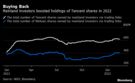
(Bloomberg) — Investors in mainland China boosted their stakes in beaten-down Tencent Holdings Ltd. and Meituan to the highest level in more than seven months, drawn by attractive valuations and easing concerns over government crackdowns. 

Chinese investors net purchased about 30 million Tencent shares so far this year via trading links between the mainland and Hong Kong, lifting their combined ownership to the highest level since June, according to calculations by Bloomberg of exchange data as of Monday. That’s near a record set earlier in 2021.

A similar trend occurred in delivery giant Meituan, with the traders adding more than 56 million shares this year, the data show.  

“Mainland investor sentiment on big tech may be turning as Tencent, Meituan and Kuaishou led a normalization in southbound flows to start 2022,” Marvin Chen, an analyst at Bloomberg Intelligence wrote in note. 

Tencent and Meituan were among the stocks dumped most by Chinese traders last year amid Beijing’s clampdown on the technology sector. Tencent’s online-game business was squeezed by new limits on the number of hours children could play. Meanwhile, Meituan saw costs rise as the government revised rules to boost the welfare of delivery workers. 

Bridgewater Boosts Stakes in Alibaba, JD.com, Pinduoduo in 4Q

The renewed buying interest could signal a reversal of fortunes for these firms following the year-long selloff. It also comes as a number of Wall Street firms and brokers turn more positive toward China tech firms amid increased policy clarity and after the steep share declines. 

Tencent is still down 36% from a February 2021 peak despite a 6% rebound this year, and its forward price-to-earnings ratio remains 13% below the 10-year average. Meanwhile Meituan remains down by more than 50% from a top a year ago, including a 5% decline this year.

More stories like this are available on bloomberg.com

©2022 Bloomberg L.P.

Paramount+ Streaming Service Nears 33 Million Subscribers

(Bloomberg) — Paramount+, the streaming service that ViacomCBS Inc. is using to compete with rivals Netflix and Disney+, ended last year with 32.8 million subscribers, a sign that the media company’s investment in streaming is starting to pay off. 

ViacomCBS, which said it’s changing its name to Paramount Global in a separate announcement, broke out Paramount+’s subscriber number for the first time while reporting its results for the final quarter of 2021. The company had previously reported a total streaming number that included Paramount+, Showtime and BET+. 

Paramount+ added more than 7 million subscribers in the final three months of the year, its best quarter to date. ViacomCBS now has 56 million subscribers across all of its services. The company is confident enough in its streaming services that it upped its guidance, projecting 100 million subscribers by 2024. 

Paramount+ still has a fraction of the customers of major rivals, but it has picked up its pace over the last year and a half and is now one of the fastest-growing streaming services in the U.S. It added more customers than HBO Max last quarter, and almost as many as Netflix despite operating in far fewer countries.

“We want you to take note of the extraordinary progress we have made over the last two years, and all the momentum we have gathered,” Shari Redstone, the chairman of the company’s board, said during a presentation to investors. 

Investors aren’t as confident. The shares slipped as much as 7% to $33.40 in late trading after the company reported earnings, excluding some items, of 26 cents a share. That was below the 45-cent estimate from analysts. 

The growth of Paramount+ is vital for ViacomCBS, a company built on cable TV networks that have hemorrhaged viewers over the last decade. Total sales jumped 16% in the final quarter of 2021, driven almost entirely by streaming. The company generated $1.3 billion in revenue from its streaming business, up 48% from the year before. Advertising and affiliate sales were flat.

In-Demand Titles

ViacomCBS owns a film and TV show library that is the second-most in-demand of any major media company, according to Parrot Analytics. But it has licensed hit shows such as “Yellowstone” and “South Park” to rival services, and ViacomCBS still splits its original programming between Showtime and Paramount+.

“If ViacomCBS wants to be a leading player in streaming, they must exclusively place this highly in-demand content catalog onto Paramount+,” Parrot Analytics wrote in a note Tuesday.

ViacomCBS is starting to ramp up its output for streaming, and Paramount+ in particular. The company commissioned “Yellowstone” creator Taylor Sheridan to make a spinoff, “1883,” and has paid “South Park” creators Trey Parker and Matt Stone to make original movies for its streaming service.

The company announced dozens of new project for Paramount+ during its presentation to investors Tuesday, including a reboot of “Beavis and Butt-Head” and a spin-off of “NCIS” for Australia. Paramount+ will also be the exclusive streaming home of new movies from Paramount Pictures starting in 2024.

ViacomCBS differs from Netflix and Disney in that it owns Pluto TV, a free, advertising-supported service that offers dozens of live channels. Pluto has more than 60 million users and generated more than $1 billion in sales last year. 

“Pluto is the service that continues to not get respect,” ViacomCBS Chief Executive Officer Bob Bakish said in an interview. “It’s a total home run.”

(Updates with comments from CEO in last paragraph.)

More stories like this are available on bloomberg.com

©2022 Bloomberg L.P.

U.K. Carmakers Seek New Regulator to Bolster EV Charging Push

(Bloomberg) — Carmakers in the U.K. are calling for the creation of an independent regulator to oversee the country’s electric-vehicle infrastructure push amid concerns that long lines at charging stations will put off buyers.

The new body would enforce standards and monitor price levels, the Society of Motor Manufacturers and Traders said Wednesday. The group also seeks binding targets to ensure that enough public chargers are built across the country.

Manufacturers including Stellantis NV, Bentley Motors Ltd. and Aston Martin Lagonda Global Holdings Plc have announced plans to electrify their lineups in response to the U.K.’s decision to ban sales of new combustion-engine cars from 2030.

Yet while EV penetration in the U.K. more than tripled between 2019 and 2021, charging points only increased 70%, the SMMT said. The group expects pressure on infrastructure to rise in the coming years as more people trade in their gasoline and diesel cars for battery-powered models.

READ MORE: Europe Will Need 65 Million Electric Vehicle Chargers by 2035

“With clear, equivalent targets and support for operators and local authorities that match consumer needs, government can ensure the U.K. has a chargepoint network that makes electric mobility a reality for all,” SMMT Chief Executive Officer Mike Hawes said in a statement.

More stories like this are available on bloomberg.com

©2022 Bloomberg L.P.
Online Travel Portal GoZayaan Enters Pakistan With Acquisition

(Bloomberg) — Singapore-based travel startup GoZayaan, which operates in Bangladesh, has now entered Pakistan by acquiring adventure tourism portal FindMyAdventure.

The Pakistan unit of GoZayaan will offer online travel and ticketing as well as adventure tourism, said Muhammad Komail Abbas, managing director for the country. GoZayaan has initially invested $3.5 million as part of the deal, according to two people familiar with the matter.

This comes as Pakistan, one of the world’s last big untapped markets, is seeing a funding frenzy in its startups. The South Asian nation has raised more than $350 million last year, greater than the amount raised in at least the past six years combined. 

Startup Fever Grips Pakistan, World’s Last Big Untapped Nation

GoZayaan is the largest online platform in Bangladesh with over 700,000 monthly active users since starting in 2017. It sees similarities in both markets including user behavior, internet penetration and travel landscape.

Pakistan’s travel market is estimated to increase by a third to $12 billion in 2024, according to Abbas. The company will compete with Bookme, Pakistan’s largest online travel and ticketing platform, that raised $7.5 million in December.

More stories like this are available on bloomberg.com

©2022 Bloomberg L.P.

NYSE Wants to Be Marketplace for NFTs Just Like With Stocks

(Bloomberg) — The New York Stock Exchange is stepping into the nonfungible tokens market with plans to do for digital assets what it does for stocks.

The NYSE said in a regulatory filing with the U.S. Patent and Trademark Office that it wants to be a financial exchange for cryptocurrencies and NFTs that would compete with the likes of OpenSea and Rarible Inc. The filing, dated Feb. 10, indicated plans for a NYSE-branded cryptocurrency and a marketplace to buy, sell and trade NFTs. 

In a statement, the NYSE said it has no immediate plans to launch cryptocurrency or NFT trading but “regularly considers new products and their impact on our trademarks and protects our intellectual property rights accordingly.”

The exchange last year minted its first NFTs, memorializing noteworthy initial public offerings including that of Spotify Technology SA, Snowflake Inc., Unity Software Inc. and Roblox Corp. 


(Updates with NYSE statement in third paragraph)

More stories like this are available on bloomberg.com

©2022 Bloomberg L.P.

Close Bitnami banner
Bitnami