
Bloomberg

Ethanol Less Green Than Gas, Study Funded by Biofuel Critics Says

(Bloomberg) — A U.S. program requiring the use of corn-based ethanol in the nation’s gasoline supply hasn’t curbed greenhouse gas emissions, according to a study from the University of Wisconsin-Madison published Monday.

The federal Renewable Fuel Standard has spurred American farmers to escalate land use for corn plantings, leading to more pollution from increased fertilizer use and degraded water quality, according to the report. All of that contributes to carbon emissions from the biofuel that are likely at least 24% higher than gasoline, the study said. 

The study was funded in part by the National Wildlife Federation, a conservation nonprofit that has been a vocal critic of the Renewable Fuel Standard.

The Renewable Fuels Association, an industry trade group, disagreed with the findings. Chief Executive Officer Geoff Cooper called its methodology “fundamentally flawed,” citing the research team’s use of satellite imaging. A U.S. Department of Agriculture report in 2019 said greenhouse gas emissions from corn-based ethanol were 39% lower than gasoline over the entire life cycle, from initial production of raw materials to eventual combustion in vehicles.

The study comes amid a political debate between biofuel supporters on the one hand and an unlikely alliance between oil refiners and some environmentalists who support an overhaul of the federal standard on the other. The Environmental Protection Agency is expected this year to propose new biofuel targets for 2023 and beyond. 

More stories like this are available on bloomberg.com

©2022 Bloomberg L.P.
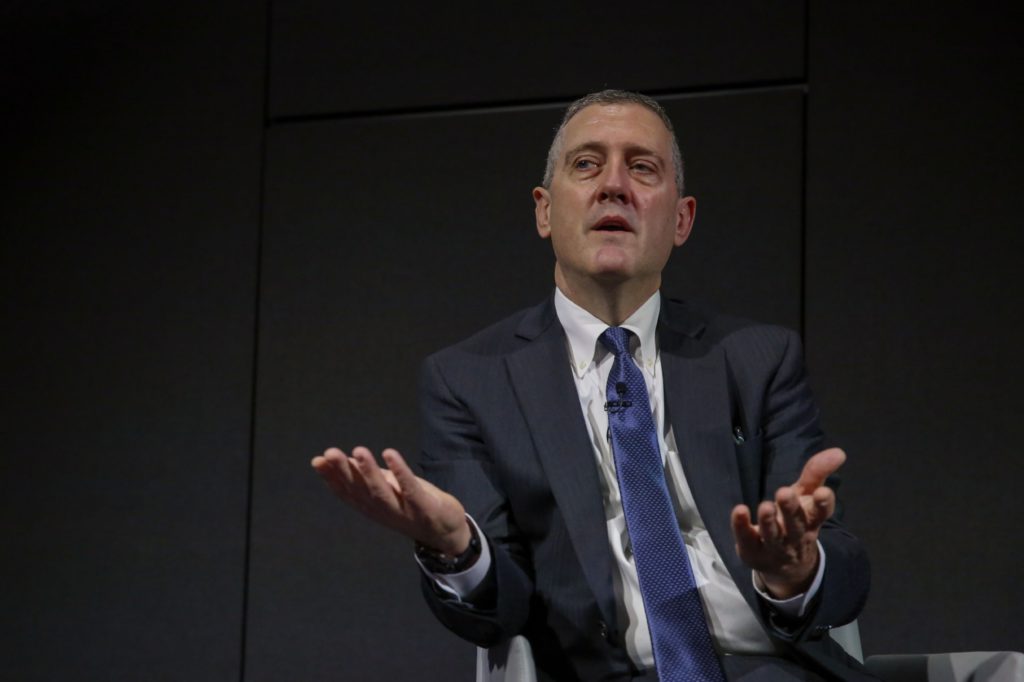
Fed’s Bullard Urges Front-Loading Hikes to Ensure Inflation Credibility

(Bloomberg) — Federal Reserve Bank of St. Louis President James Bullard said the U.S. central bank needs to move forward its plans to raise interest rates to underline the Fed’s inflation-fighting credibility. “I do think we need to front-load more of our planned removal of accommodation than we would have previously,” Bullard, who votes on …

Fed’s Bullard Urges Front-Loading Hikes to Ensure Inflation Credibility Read More »

Gold Approaches Three-Month High as Ukraine Tension Lifts Havens

(Bloomberg) — Gold advanced to the highest price since mid-November amid renewed investor demand as geopolitical tensions persist over Ukraine. Russian President Vladimir Putin countered U.S. warnings that Russia may invade Ukraine within days by staging televised meetings with his foreign and defense ministers that emphasized de-escalation of tensions and continued efforts to find a …

Gold Approaches Three-Month High as Ukraine Tension Lifts Havens Read More »

Better’s U.S. Zoom Firings Leave 1,000 More Workers in India

(Bloomberg) — When Better.com Chief Executive Officer Vishal Garg fired 900 staffers on Zoom late last year, the cuts essentially moved a larger portion of its workforce offshore.

The online mortgage lender had been aggressively hiring in both India and the U.S. for most of 2021 to try and keep pace with a wave of refinancing. But a recent regulatory filing shows that Garg’s infamous Zoom cuts — which followed the U.S. Federal Reserve’s sudden switch on interest rates — fell much harder stateside than in lower-wage India.

The geographic shift, which effectively added 1,000 employees in India, could help Better.com stave off a downturn that’s left the company with declining revenue and higher expenses as it prepares to go public. Better.com, in the same U.S. Securities and Exchange Commission filing, disclosed that its fourth-quarter net loss may reach $182 million and that revenue fell as much as 22% from the previous quarter.

Factors including the workforce reduction and negative media coverage “detrimentally affected Better’s productivity and financial results,” the company said, as did rising interest rates and increased competition among lenders.

Garg has apologized for how the firings were handled and took a short hiatus from the company.

Garg didn’t immediately respond to a request for comment left on his cellphone and at his office. A spokeswoman for the New York-based firm didn’t immediately return a telephone call and email seeking comment. 

Before the job cuts, Better.com was on a hiring spree as it sought to capitalize on a wave of home mortgage refinancings driven by record-low interest rates. Its workforce roughly doubled during the year to more than 10,000 by November, according to the filing. 

By year-end, after Garg’s staff reduction, the company said it had 9,300 staffers. While that was lower than in November, it was still higher than the 8,100 workers it employed as of June 30, SEC documents show.

What mainly changed was the geographic mix. As of June 30, the company had 5,000 employees in the U.S. and 3,100 in India. At year-end, it had about 5,200 in the U.S. and about 4,100 in India, according to the filing. The proportion working in India had increased to 44% at Dec. 31 from 38% at June 30.

More stories like this are available on bloomberg.com

©2022 Bloomberg L.P.

Tesla May Be ‘Losing Faith’ in How Soon Self-Driving Will Arrive

(Bloomberg) — Tesla Inc.’s expectation for the amount of revenue it will recognize from automated-driving software appears to have slipped, according to an analyst.

The carmaker said in a filing last week that it anticipates recognizing $962 million of deferred revenue this year, some of which is related to Full Self-Driving, a set of features Tesla sells that still require attentive human drivers. Alexander Potter, a Piper Sandler analyst, points out that the amount was down from a projection made three months ago for $1.39 billion and inconsistent with comments Chief Executive Officer Elon Musk made during a Jan. 26 earnings call.

“Margins will jump when FSD revenue is unlocked, but Tesla may be losing faith in its forecast,” Potter wrote in a note Sunday while nevertheless raising his price target for the stock. “Musk is bullish re: the prospects for FSD in 2022, but don’t get too excited just yet.”

Musk said on last month’s earnings call that Tesla thinks FSD will become its most important source of profit over time and repeated a prediction that the wide release of the capability will lead to one of the biggest asset-value increases in history.

“We are completely confident at this point that it will be achieved,” Musk said. “My personal guess is that we will achieve Full Self-Driving this year, at a safety level significantly greater than a person.”

Tesla started taking orders for FSD in late 2016, charging a total of $8,000 for the promised benefit of removing human input from driving at an unspecified future date. The company has gradually raised the price since then, bumping it up to $12,000 in January.

Chief Financial Officer Zachary Kirkhorn has said Tesla immediately recognizes roughly half the revenue collected from customers who buy FSD, with the rest going to the company’s deferred revenue balance. As more features are released, Tesla makes determinations about their associated value and has released certain amounts from deferred revenue accordingly.

Musk has repeatedly been overly optimistic about how soon Teslas will be autonomous. In January 2016, he said he was highly confident fully self-driving vehicles would work anywhere in the country within 24 to 36 months. In April 2019, he predicted 1 million Teslas fully capable of driving themselves would be on the road by mid-2020.

Potter said in his report that Piper is unconcerned about the software-related disclosures Tesla made in its 10-K filing last week. The analyst, who rates the shares the equivalent of a buy, bumped up his price target to $1,350. The stock rose as much as 4.5% to $898.88 intraday Monday in New York.

“It’s worth waiting a few more quarters (or years) for 90%+ margin revenue,” Potter wrote.

More stories like this are available on bloomberg.com

©2022 Bloomberg L.P.

Microsoft Returning to the Office on Feb. 28 as Covid Cases Decline

(Bloomberg) — Microsoft Corp. told many U.S. employees to begin returning to their offices starting Feb. 28, making a fresh attempt to get the software maker’s operations back to normal as Covid-19 cases abate. Unless they have a special arrangement, workers should begin a 30-day transition period on that date “to make adjustments to their routines and adopt the working preferences they’ve agreed upon with their managers,” Chief Marketing Officer Chris Capossela said in a blog post Monday.Microsoft and other tech giants have struggled with how soon to bring employees back to offices, and previous deadlines were pushed back. In September, Microsoft scrapped a goal of reopening on Oct. 4 because Covid-19’s delta variant was raging. That was followed by the even-more-contagious omicron variant. 

The Redmond, Washington-based company, which has said it will remain a flexible workplace, has told employees that they’ll be able to work from home up to half the week without discussing it with managers. Those who want to work remotely more often will have to seek approval. As part of the reopening, Microsoft will begin admitting visitors and guests to its campuses and restart services like its shuttle buses and ride-sharing options, Capossela said.Local vaccination rates have helped. In King County, where Microsoft’s main campus is located, nearly 84% of eligible residents are fully vaccinated. 

More stories like this are available on bloomberg.com

©2022 Bloomberg L.P.

Elon Musk’s SpaceX to Fly 3 More Missions Financed by Billionaire Jared Isaacman

(Bloomberg) — SpaceX will fly as many as three private missions in coming years, including its first spacewalk outside a Dragon crew vessel, financed in part by the same technology billionaire who flew in space for three days last year with the company.

The launches will also include the first people to ride aboard SpaceX’s newest Starship rocket on the third flight, Jared Isaacman said Monday in a statement. The new mission’s first flight aboard SpaceX’s Falcon 9 rocket and Dragon capsule, Polaris Dawn, may occur as soon as November and last up to five days, Isaacman said, without giving a time frame for the full series.

The 39-year-old founder and chief executive officer of payment processor Shift4 Payments Inc. declined to say how much he and SpaceX are spending for the research trips. He and SpaceX also wouldn’t offer any time schedule for the second or third flights during a briefing call with reporters.

The Polaris flights are designed to test new SpaceX-designed spacesuits, which will allow activities outside the Dragon, and to help the company’s research on suits, an area of space technology where hardware development has lagged, Isaacman said. The company has begun early work on the type of suits that will be required for longer missions on Mars and the moon. 

The Polaris crew also will be the first to test laser-based communications for SpaceX’s Starlink satellite constellation, which will be key to the company’s plans for longer missions in deep space. The crew also plan to fly at the highest altitudes for U.S. astronauts since the Apollo lunar missions, more than 400 miles (640 km), and to study radiation exposure from the Van Allen belts within Earth’s magnetic field. 

Isaacman plans to use the flights, which he’s calling the Polaris Program, to again help raise money and awareness for St. Jude Children’s Research Hospital. 

Elon Musk’s Space Exploration Technologies Corp., as the company is formally known, is targeting its first Starship orbital test flight this year, with plans for multiple tests and satellite-deployment missions before it’s ready to carry people.


Isaacman will be joined on the missions by two SpaceX engineers — Sarah Gillis and Anna Menon — and a former Air Force test pilot, Scott “Kidd” Poteet. All four worked closely together for the Inspiration4 flight that Isaacman led in September 2021. That effort raised more than $240 million for St. Jude.

Read more: SpaceX private spaceflight splashes down off Florida

Isaacman told the Washington Post on Monday that he paid less than a widely reported $200 million price for the 2021 Crew Dragon flight, although he has declined to reveal the cost.

Isaacman said he plans to remain in his current position with Shift4 and can balance his “day job” with his space activities. 

(Updates paragraphs 2-5 with comments from SpaceX call, and adds new last paragraph on CEO role.)

More stories like this are available on bloomberg.com

©2022 Bloomberg L.P.

BlockFi to Pay $100 Million to SEC, States on Crypto Lending

(Bloomberg) — BlockFi Inc., a popular crypto platform, agreed to pay $100 million to the Securities and Exchange Commission and state regulators over allegations it illegally offered a product that pays customers high interest rates to lend out their digital tokens.

The company sold the accounts to U.S. investors without registering them with the SEC as securities, the agency said in a Monday statement. As part of the agreement, current BlockFi customers can continue to earn interest on their existing investments, but the company must not sell the products to new American clients. The company has 60 days to seek to comply with SEC regulations and it’s also seeking to register a new crypto-lending product that will satisfy the agency’s rules. 

“Today’s settlement makes clear that crypto markets must comply with time-tested securities laws,” SEC Chair Gary Gensler, who has frequently warned trading platforms for digital assets that they likely need to be registered with the federal watchdog, said in a statement. “It further demonstrates the commission’s willingness to work with crypto platforms to determine how they can come into compliance with those laws.” 

BlockFi, which didn’t admit or deny the regulator’s findings, will pay $50 million to the SEC and another $50 million to 32 states. The penalty is the largest ever by the SEC against a crypto company. 

As part of the allegations, the SEC said the Jersey City, New Jersey-based firm had a misleading statement on multiple website posts by stating institutional loans were “typically” over-collateralized, when most were not. 

Hester Peirce, a Republican commissioner, said in a statement that she voted against the settlement because $100 million in combined penalties was “disproportionate” to the allegations. “Rather than forcing transparency around retail crypto lending products, today’s settlement may stop them from being offered to retail customers in the United States,” she added.

Meanwhile, Zac Prince, chief executive officer of BlockFi, said the company would work with the regulator to comply with its rules. “We intend for BlockFi Yield to be a new, SEC-registered crypto interest-bearing security, which will allow clients to earn interest on their crypto assets,” he said in a statement.

BlockFi would be the first platform to register a crypto interest-bearing security, a move that could add pressure on other firms with similar products to follow suit. Companies offering digital-asset lending have attracted tens of billions of dollars in deposits by promising yields that far exceed those available through traditional savings accounts. 

As of March 2021, BlockFi and its affiliates held about $14.7 billion in BlockFi Interest Accounts, according to the SEC. That same month the firm raised $350 million from investors including Bain Capital Ventures and Tiger Global in a round that valued the company at $3 billion. 

(Updates with comment from SEC commissioner opposing settlement in sixth paragraph)

More stories like this are available on bloomberg.com

©2022 Bloomberg L.P.

Canoo Loses More Executives as EV Startup Suffers Talent Drain

(Bloomberg) — Electric-vehicle startup Canoo Inc. has lost several key executives in recent weeks, deepening a talent drain as it faces an investigation by securities regulators.

Among the recent departures is Mike de Jung, an early employee and close associate of Canoo’s chief designer; Nicolas Leblanc, vehicle program lead; and Richard Walker, who oversaw software controls, according to people familiar with the matter who asked not to be identified. Steven Offutt, one of Canoo’s earliest employees and the head of powertrain and battery manufacturing engineering, is also stepping down, the people said.

“When you have smart, talented people, this sometimes happens,” a Canoo spokesperson said in a statement that didn’t directly address the departures. De Jung and Offutt didn’t respond to requests for comment, while Walker declined to comment. Leblanc confirmed his exit in a LinkedIn message.

The losses complicate Canoo’s efforts to start manufacturing commercially focused electric vans later this year. The company has been under investigation by the U.S. Securities and Exchange Commission over its 2020 merger with a blank-check firm and subsequent “departures of certain of the company’s officers,” Canoo said in a regulatory filing. The company also faced pushback following a strategic shift last year away from contract engineering services.

EV startups have been under pressure recently as investor sentiment has shifted following a wave of buzzy mergers and stock offerings last year. Companies such as Nikola Corp., Faraday Future Intelligent Electric Inc. and Electric Last Mile Solutions Inc. have struggled with executive resignations and other stumbles in the competition to take on EV market leader Tesla Inc. 

Read more: EV startups are wilting in the public eye

Canoo early last year lost its chief executive officer, Ulrich Kranz, who took a job at Apple working on the company’s secretive car project, as well as its chief financial officer, general counsel and powertrain division lead. By the end of the year, Canoo’s chief technology officer and several other executives left.

The departures have continued more recently, with the chief marketing officer and vice presidents of manufacturing and investor relations stepping down, Insider reported last week.

Canoo’s shares fell 24% this year through Friday’s close.

More stories like this are available on bloomberg.com

©2022 Bloomberg L.P.

Close Bitnami banner
Bitnami