Bloomberg

Didi Shares Climb as Tencent Boosts Stake in Chinese Ride-Hailing Giant

(Bloomberg) — Tencent Holdings Ltd. added 1.8 million Class A ordinary shares of Didi Global Inc. during the initial public offering of the ride-hailing company.

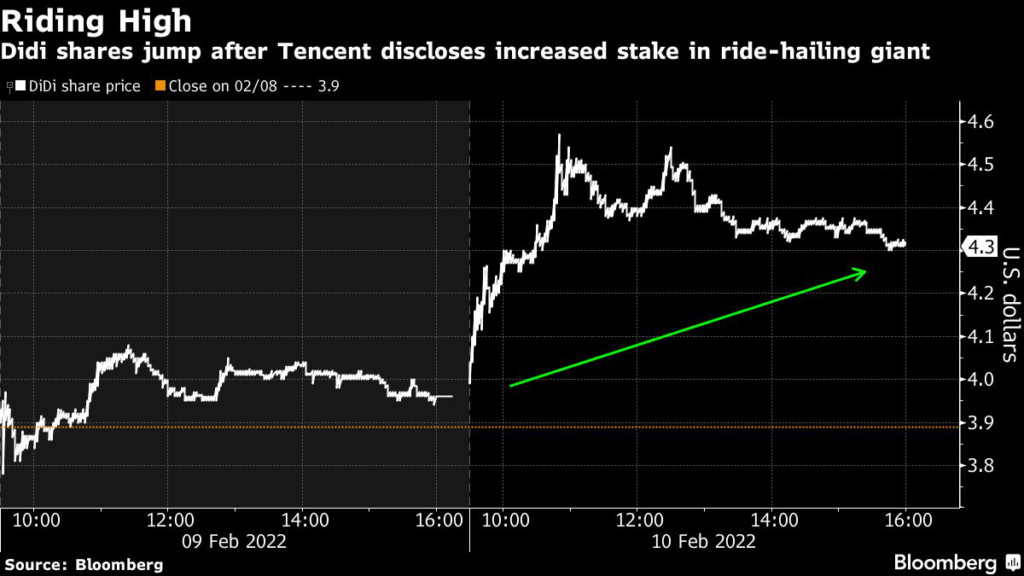
The Chinese company owned 78.85 million of Didi’s Class A shares as of Dec. 31, up from 77.07 million shares disclosed at the time of the IPO, a U.S. regulatory filing showed on Thursday. The move raises Tencent’s total ownership of Didi’s Class A shares to 7.4% as of Dec. 31. Didi’s shares listed in the U.S. closed 8.8% higher Thursday. 

The social media giant subscribed to the additional stock during Didi’s initial public offering, which was not previously disclosed, a Tencent spokeswoman said in an email Friday. Tencent, which operates the WeChat messaging platform, has not acquired more stock in Didi since its debut in June and owned a total stake of about 6.67% as of September, she said.

The ride-hailing giant has seen its market value plunge by $47 billion in the span of less than eight months after authorities in China raised concerns about its data security. Didi said in December that it has begun making preparations to withdraw from U.S. stock exchanges and pursue a listing in Hong Kong.

Tencent has made some changes to its holdings in recent months. In early January the e-commerce firm cut its holdings of Singapore’s Sea Ltd., fueling speculation that it was planning to pare back its ownership in other Chinese tech firms. That came less than a month after Tencent told investors it planned to divest more of its stake in JD.com Inc. by handing out more than $16 billion of shares as a one-time dividend.

Didi’s four-day rally comes in the wake of news that Chinese state-backed funds had intervened in domestic stock markets Tuesday, rekindling hope that a bottom is near for the nation’s battered equities. Didi’s winning streak is its longest since October and has seen the stock jump 26%. Its shares fell as much as 6.3% in premarket trading Friday.

(Corrects to show Tencent’s ownership of Class A Didi shares was 7.4%.)

More stories like this are available on bloomberg.com

©2022 Bloomberg L.P.

Mercedes Cars Are More Profitable Than Ever Amid Chip Shortage

(Bloomberg) —

Mercedes-Benz AG vehicles are more profitable than ever after the chip crisis sparked a worldwide shortage of cars, boosting the selling prices for models such as the flagship S-Class.

The automaker exceeded its profitability target last year and the return on sales in the final quarter was the highest on record, a spokesman said Friday. 

The global dearth of high-tech components has weighed on the industry, prompting production shutdowns and backlogs. Volkswagen Group on Friday reported that worldwide deliveries declined by 15% in January, and Volvo Car AB said supply chain strains will continue to disrupt deliveries this year.

Still, Mercedes-Benz — which lost the luxury-vehicle sales crown to rival BMW AG for the first time since 2015 — said lower sales volumes were more than offset by rising prices last year as the company benefited from a shortage of finished vehicles and a strategy that steered scarce chips to higher-value models.

The chip shortage has led to dramatic price inversions whereby some used models cost significantly more than ordering new ones, with the latter subject to lengthy delays. Used versions of the iconic Mercedes G-Wagon are selling for around a third more than new ones in the U.S., according to market research firm iSeeCars.

Mercedes-Benz’s management is intensifying efforts to transform one of the most storied names in automobile manufacturing into an all-electric rival to market leader Tesla Inc. The company aims to have battery-powered models in all its segments this year, a staging post for its ambition to only sell electric cars by 2030.

The company formerly known as Daimler AG spun off its truck division in December, ending more than a century of the businesses running under one roof. The move is intended to allow the companies to intensify focus on the sweeping technology changes buffeting their respective segments.

The company said adjusted returns on sales at its cars and vans segment hit 12.7%, exceeding guidance for a result in a 10% to 12% range. Strong new and used-vehicle pricing helped achieve the result, the company said.

Adjusted earnings before interest and taxes at the division came to around 14 billion euros ($16 billion) for the full year. Shares gained as much as 3.4% on the news. 

Mercedes-Benz said it now expects the restructuring move to boost group Ebit by about 9 billion to 10 billion euros. This one-time effect has no impact on cash flow and no material impact on taxes, the automaker said, adding it would be excluded from determining the dividend to shareholders.

More stories like this are available on bloomberg.com

©2022 Bloomberg L.P.

UAE Firm Sitting on Millions Eyes Bargains in ‘Buyer’s Market’

(Bloomberg) — An Abu Dhabi firm with investments ranging from Getty Images to Rihanna’s lingerie company is scouting for opportunities to deploy an $817 million warchest.

“It’s a buyer’s market. It’s a good time to be sitting on a pile of cash,” Multiply Group Chief Executive Officer Samia Bouazza said in an interview. “We’re in a very active acquisitive mode looking for the right opportunities.”

The tech-focused holding company plans to spend more than 3 billion dirhams ($817 million) on investments in sectors including media, wellness and beauty, and the digital economy. Through its ventures arm, it will target investments in sectors benefiting from a post-Covid boom, including software and e-commerce. 

“We believe we will find a lot of opportunities globally,” Bouazza said, adding that the firm would like the allocation to be fairly distributed across its verticals.

Multiply went public in December, raising 3.1 billion dirhams. Its parent company, International Holding Company, is led by Sheikh Tahnoon Bin Zayed Al Nahyan — the United Arab Emirates’s national security adviser and brother to Abu Dhabi’s de-facto ruler.

Multiply shares have risen 40% since listing, while profit for the year has surged to 225 million dirhams from just under 4 million in 2020. Its other investments include PAL Cooling and Emirates Driving Company in the UAE, and digital media platform Firefly in the U.S.

 “We are very growth-oriented,” Bouazza said. “The money that we have to deploy in 2022 and beyond is geared toward resilient companies that are profitable.”

More stories like this are available on bloomberg.com

©2022 Bloomberg L.P.

Graticule’s Levinson Crafts Anti-Portfolio as Inflation Rips

(Bloomberg) — Assets that have outperformed in the past decade are likely to see their fortunes fade as previous laggards take over, according to Adam Levinson, founder and chief investment officer at Graticule Asset Management Asia.

There’s “tremendous value” in emerging markets and value stocks, some of which have been “left for dead” over the past 10 years, Levinson said in an interview on Bloomberg Television. Graticule has been taking bearish bets on developed-market bonds that have short maturities left and is long on such notes in China, he said.

“Our portfolio is basically the anti-portfolio of what was in the last 10 years,” Levinson said. “All of the flows have been into the U.S. at the expense of the rest of the world, and essentially into U.S. tech — that’s what is obviously vulnerable,” as the environment changes to a higher-inflation regime.

Levinson said he would bet against some equities in the U.S. through short positions, and invest in value markets such as Japan or Europe as well as in segments of emerging markets. 

“Everywhere from Brazil, to Kazakhstan to Greece, you are finding domestic franchises that are so cheap, that you can’t manufacture them in the private equity market at anything close to where they trade,” he said. Value stocks in value markets are so cheap because they “have been left for dead essentially over the last 10 years.”

The big U.S. tech companies have outshined the rest of the market over the past decade, with the Nasdaq 100 gaining 477% compared with the S&P 500’s 235% increase and 124% for the MSCI all-country index. 

Those returns came in an era with low inflation, punctuated recently by a Covid-19 pandemic that spurred business models from the likes of Amazon.com Inc. and Alphabet inc. However, more and more strategists see an end to the gains as valuations become loftier and inflation accelerates.

READ: A Boon for Crypto Depends on Growth Stocks’ Fate, Graticule Says

One trade Graticule is involved in is Chinese oil field and services companies, which “are very cheap” because the strategic rivalry between China and the U.S. will prevent American companies from ever getting fresh drilling contracts from Beijing, he said.  

While investors should have China as part of their emerging-markets basket, they should not be concentrated there because problems related to credit are far from resolved, he said.  

The fund manager said has been very encouraged by the currency market’s performance over the past day, as even with the sharp move in rates, the dollar hasn’t responded much. 

“That’s again a reflection of this shift in flows from the embedded portfolio in U.S. growth,” he said. As capital exporting countries such as South Korea, Thailand and Europe get some of the capital flows back, their currencies will appreciate, he said. 

Levinson’s firm oversees a portfolio of about $3 billion. He led a team of people that spun out of Fortress Investment Group LLC in 2015. Fortress Asia Macro Fund, which began trading in 2011, was the predecessor to Graticule.

Other points Levinson made in the interview:

  • There’s an argument to be made that we’re in a long-term inflationary paradigm; the move toward green energy, plus demographics and other factors lead to a higher inflationary floor.
  • It makes sense to be short the dollar.
  • The decision to allocate to crypto has been made by many traditional institutions, but many haven’t yet implemented the decision or have been slow to do so; it may take until growth stocks stabilize before big investors do jump in more.

(Updates with comments about emerging markets and currencies from fifth paragraph.)

More stories like this are available on bloomberg.com

©2022 Bloomberg L.P.

Taliban to Press UN For Recognition as Economic Woes Fester

(Bloomberg) — The Taliban-appointed permanent representative to the United Nations says the new Afghan government is pressing the international body for recognition and a member’s seat as the lack of legitimacy hurts the country’s economy and diplomacy.

“Why the world is not recognizing us when we have met their conditions,” Suhail Shaheen said in an interview from Doha, Qatar. He said  his government has already allowed women and girls to attend universities, one of the international community’s main concerns, and are in talks with the UN.  

The lack of international recognition has hurt the Taliban — who took over power last year as U.S. and NATO troops in Afghanistan exited — shuttering it’s aid-reliant economy and closing it off from the world.

The new regime is unable to appoint new envoys overseas and representatives of the American-backed former Afghan government are either stepping away from their jobs or refusing to represent the Taliban, citing lack of international recognition as a key factor.

The ambassador to China Javid Qaem, a holdover from the previous government, quit his job last month. The envoy in New Delhi, Farid Mamundzai, has also said he would continue to represent the values of the previous government.

Foreign assistance accounted for as much as 40% of the country’s gross domestic product during two decades of U.S. occupation. That foreign aid was abruptly halted after the Taliban took over the country last year. Washington also moved to block the militant group from getting access to some $9 billion of Afghan assets in American and European banks.

The UN, which has recently made a funding plea of a record $5 billion in aid, estimates more than half of the country’s nearly 40 million people face acute hunger, with a million children at risk of dying amid a harsh winter.

While some aid has since come into the country, it’s far from enough to meet the every increasing needs as the country’s economy has all but collapsed.

“In the long term we shouldn’t have to rely on the world to help us,” Shaheen said. Investors from other countries including the U.S. and China have been invited to invest in mineral resources estimated to be around $3 trillion, he added. 

The militant group is looking at all options to revive the economy — including weighing the pros and cons of crypto or digital currencies.

The country does have some minimal cryptocurrency transactions carried out by forex traders who currently operate outside of any legal framework.

“This is a new thing for Afghanistan, Shaheen said, adding that the matter “should be studied by our economists or religious scholars” before deciding if they are allowed under Islamic financial practices.

More stories like this are available on bloomberg.com

©2022 Bloomberg L.P.

Tencent Says Hasn’t Bought More Didi Shares Since U.S. IPO

(Bloomberg) — Tencent Holdings Ltd. said it hasn’t bought shares in Didi Global Inc. since it went public, after a U.S. regulatory filing showing an increased stake sent shares of the Chinese ride-hailing company soaring almost 9%.

Tencent said in a filing Thursday it had added about 1.8 million Didi Class A ordinary shares to its last-known holdings. The social media giant subscribed to the additional stock during Didi’s initial public offering, which was not previously disclosed, a Tencent spokeswoman said Friday in an email. Tencent, which operates the WeChat messaging platform, had not acquired more stock in Didi since its debut in June, the spokesperson added.

Didi’s shares fell more than 5% in pre-market trading in New York. The Chinese company owned 78.85 million of Didi’s Class A shares as of Dec. 31, up from 77.07 million shares disclosed at the time of the IPO, the filing showed. Tencent’s Class A shareholding stood at 7.4% as of the end of December.

Didi has shed $47 billion of market value since Chinese regulators launched an investigation in July, citing data security concerns. Since then, Beijing has ordered the removal of more than two dozen Didi applications from app stores, initiated probes into its business practices and pressured the company to delist from New York.

Didi said in December that it has begun making preparations to withdraw from U.S. stock exchanges and pursue a listing in Hong Kong. It’s now aiming to file for a listing in the city around March, Bloomberg News has reported.

Read more: Didi Begins Plan for U.S. Delisting, Hong Kong Share Sale

(Updates with Didi’s share fall in the third paragraph. A previous version was corrected to specify Tencent’s previous shareholding.)

More stories like this are available on bloomberg.com

©2022 Bloomberg L.P.

China’s Edutech Crackdown Expands to High-School Tutoring

(Bloomberg) — China’s government banned online tutoring firms from offering high-school curriculum classes during a current holiday, expanding a crackdown that has decimated a large portion of the country’s $100 billion private edutech industry.

Regulators in Beijing told companies recently that they aren’t allowed to provide tutoring for school curriculum classes over the break, which lasts until the second half of February, said people familiar with the matter. The ban may last even longer and companies are required to wait for clearance before resuming such courses, the people said, asking not to be identified discussing private conversations.

This is the first time for officials to spell out that high-school tutoring is included in President Xi Jinping’s crackdown on the private education sector, part of a bigger campaign to rein in what his government deems a “disorderly expansion of capital.”

Back in July, China’s cabinet unveiled a sweeping overhaul that bans companies that teach the school curriculum from making profits, raising capital or going public. The regulations focus on the so-called compulsory education, which refers to schools from kindergarten to ninth grade, or K-9, without laying out a clear set of limits on high schools.

The enormous education industry has undergone a regulatory storm over the past year as Beijing zeroes in on a booming sector increasingly blamed for preying on anxious parents, placing undue pressure on children, stretching household budgets and even depressing the national birth rate.

Education companies like TAL Education Group and New Oriental Education & Technology Group Inc. have adapted to survive, including by expanding non-academic curricula and providing some after-school classes for free, laying off thousands of teachers and employees in the process.

Regulators have stepped up their oversight in recent weeks as students prepare for a new semester that starts around Feb. 21. On Tuesday, the Ministry of Education said it will guide local authorities to regulate high-school curriculum tutoring like they did with the K-9 tutoring, without offering details, part of key areas of work it laid out for 2022.

The ministry didn’t respond to a faxed request for comment.

As of Friday morning, high-school classes had disappeared on online tutoring platforms run by TAL, Gaotu Techedu Inc., Youdao Inc. and Alibaba-backed Zuoyebang, according to a news report by the Beijing Business Today. In a Jan. 26 online post, Zuoyebang notified users that all live-streaming courses on school subjects will be canceled for the winter holiday, and that the startup will arrange refunds.

Outside after-school tutoring, shares of regular school operators including China Education Group Holdings Ltd. and Hope Education Group Co. also had wild swings this year as investors and traders tried to parse a plethora of regulatory documents including ones on tuition fees.

More stories like this are available on bloomberg.com

©2022 Bloomberg L.P.

Builders Rise on Easing Reports; Zhenro Sinks: Evergrande Update

(Bloomberg) — Chinese developers’ bonds and stocks rallied following reports on new regulations that would make it easier to tap cash from home presales, potentially easing a liquidity crunch. Zhenro Properties Group Ltd. plunged on bond-redemption worries.

The new regulation would replace legions of local rules across the country and allow builders to withdraw and use such proceeds after setting aside the amount required for project building, according to the reports. A Bloomberg Intelligence gauge of developer shares surged as much as 3.5%, while Chinese high-yield dollar bonds saw morning gains pared to 1 to 3 cents on the dollar, credit traders said. 

Zhenro’s shares and notes plunged Friday, with traders citing concern that the builder won’t redeem a $200 million bond next month as planned. Liquidity challenges remain for the nation’s builders, with bond and trust fundraising plunging 70% in January from a year earlier, according to data analysis provider China Index Holdings. 

Key Developments:

  • China Developer Zhenro Plunges 66% on Bond Redemption Concern
  • Record Loans Mask Bleak Economic Outlook: What to Watch in China
  • China Developers Jump After Reports on Presale Fund Use
  • China Dollar-Bond Demand Muted as Supply of Fresh Deals Dries Up
  • Debt Fears Swirl Around Logan as China Property Woes Deepen
  • China Bad-Debt Managers Move to Support Stressed Developers
  • China Credit Investors Brace for More Surprises From Hidden Debt

China High-Yield Dollar Bonds Pare Gains Amid Zhenro’s Plunge (5:05 p.m. HK)

Notes were 1-3 cents higher Friday afternoon, according to credit traders, as a rout in Zhenro’s dollar bonds helped cool morning gains of as much as 5 cents. The broader market was boosted by local media reports that the government issued a nationwide regulation to standardize cash use from presold properties.

China Developer Zhenro Plunges 66% on Bond Redemption Concern (4:30 p.m. HK)

The 10.25% perpetual note in question slumped to 35 cents on the dollar from 93 cents Thursday, according to data compiled by Bloomberg. Zhenro shares ended down a record 66% in Hong Kong. 

The Shanghai-based developer — China’s 30th largest builder by contracted sales last year according to China Real Estate Information Corp. —  said last month it would redeem the note on March 5. One bondholder of the firm’s other notes spoke to a company official on Friday and was told Zhenro plans to redeem the perpetual bond, the investor said, asking not to be named citing private information about their holdings.

Developers’ Bond, Trust Fundraising Down 70% in January: CIH (12:15 p.m. HK)

The data from China Index Holdings underscore continuing funding challenges faced by developers amid a spreading liquidity crisis. 

Capital raised through selling onshore and offshore notes, trust and asset-backed securities totaled 79 billion yuan ($12.4 billion) last month, according to CIH, as fragile sentiment extended into the new year. The financing slowdown was mainly driven by muted offshore bond issuance and lackluster trust product sales.

China City Mulls Measures to Encourage Home Purchase: Report (9:04 a.m. HK)

A district in the southern Chinese city of Huizhou plans to encourage home purchases with measures including subsidies, sales discounts and convenience for school admission, Securities Times reports, citing a government document circulating online.

Record Loans Mask Bleak Economic Outlook (8:57 a.m. HK)

China’s blowout lending figures suggest the central bank’s pivot toward easier policy is making its way into the real economy. But a deeper look suggests the picture is far less optimistic. 

Much of the growth in credit came from state and corporate bond issuance, with lending mainly benefiting the government. Local authorities are borrowing to shore up infrastructure projects, while state-owned enterprises need the credit to fund acquisitions in the property sector, according to Craig Botham, chief China economist at Pantheon Macroeconomics.

China Issues Property Presale Rule to Ease Cash Crunch: Reports (8:30 a.m.)

China has issued a nationwide regulation to standardize the use of cash from presold properties, a move likely to ease liquidity pressures for some developers, according to local media reports.

The move is the latest effort by authorities to arrest a worsening slowdown in the property sector, which is hurting growth in the world’s second-largest economy. Bloomberg reported last month that regulators are considering lifting some restrictions on developers’ access to cash from presold properties tied up in escrow accounts.

Debt Fears Swirl Around Logan as China Property Woes Deepen (6:00 a.m. HK)

Concerns over the financial health of Logan Group Co. have shaken investor confidence in what was seen as one of China’s stronger developers, deepening the turmoil faced by the crisis-hit industry.  

Fitch Ratings downgraded the firm this week, citing a “recent disclosure of a private debt arrangement that is off its balance sheet.” Questions about the possible scale of Logan’s undisclosed debt had swirled in the weeks prior, pushing its dollar bonds to record declines and sending its shares to the lowest since 2017.

China Dollar-Bond Demand Muted as Supply of Fresh Deals Dries Up (5:00 a.m. HK)

Chinese dollar-bond sales have had their weakest start to the year since 2019 as the credit crisis in the nation’s property sector rolls on. Stress levels in the offshore market remained at their highest level last month, with returns on dollar notes the worst since March 2020, according to Bloomberg’s China Credit Tracker. 

Orders for Chinese offerings were 3.6 times their issuance size in January, below the average ratio for the previous 12 months, according to Bloomberg-compiled data of available deal statistics. 

More stories like this are available on bloomberg.com

©2022 Bloomberg L.P.

A $6 Billion Wipeout Was an Omen for Food Delivery Stocks

(Bloomberg) — Europe’s food delivery firms are finding out the hard way that investors are no longer willing to look past continual losses and rising costs.

Delivery Hero SE’s shares shed close to a third of their value on Thursday, or about 5.1 billion euros ($5.8 billion), in a record rout as analysts lamented elusive profitability. The bleeding continued into Friday with a further 13% slump as analysts slashed price targets for the stock. Peers Just Eat Takeaway.com NV and Deliveroo Plc also tumbled on both days, adding to this year’s heavy losses.

Investors have been reassessing their love for technology stocks in the face of rising bond yields and higher interest rates. But while there’s a broader shift afoot, food delivery companies are plunging disproportionately to their tech peers. 

Analysts point to the unpredictable nature of the business after a pandemic-driven surge, regulatory hurdles to their business models, incessant competition from startups and untested new businesses for why they are trailing peers. 

“It feels to me that fundamentally the agenda has changed,” said David Reynolds, an analyst for Davy. And yet, Thursday’s outsized move “just feels crazy.”

Food delivery companies saw their order rates soar during lockdowns, when restaurant closures forced housebound consumers to turn to ordering online. The comedown has been swift since economies in western Europe began to reopen. All three European food delivery companies have seen their shares more than halve since reaching record highs over the course of the pandemic.

“It’s a reality check going on in the market in many respects that these businesses are not simplistically scalable in the way that technology often is,” Neil Campling, head of TMT Research at Mirabaud Securities, said by phone, adding that capital is the greatest barrier to entry in the industry.

Furthermore, new rules from the European Commission could mean millions of gig economy workers soon find themselves being designated as employees, while some cities in the U.S. have instituted regulations including commission fee caps.

And while companies like Deliveroo and Delivery Hero are leaning into new offerings around rapid delivery of consumer goods, they are relatively untested, said Ioannis Pontikis, an analyst for Morningstar.

And these delivery firms remain committed to expanding their businesses even as market sentiment shifts and investors demand profits. Pontikis said growth was the right priority for a business driven by network effects. 

Yet not only do food delivery companies need to spend big to ward of competition and invest in new initiatives such as dark stores, but inflation is set to bite as wages and the cost of raw materials rise. Investors will be holding their breath when Just Eat and Deliveroo are set to update the market next month.

Then there’s also the matter of rising competition from newcomers such as rapid grocery delivery startups Getir, Gorillas, Zapp and Gopuff. Delivery Hero had to invest in Turkey last quarter to fend off Getir, while Deliveroo is building out its own speedy grocery service to compete with the upstarts.

Signs of experimentation persist in the sector even as investors demand a focus on profitability. On Thursday, Gorillas announced it was launching a music label to help employees enter the music industry. 

“We’re still growth, we’ve always been growth and we’ll probably always be growth and we probably even double down a little bit harder on some areas in these days as others have to pull back,” Delivery Hero Chief Executive Officer Niklas Oestberg said in an interview Thursday.

(Updates to add Friday’s share-price losses and analyst comments.)

More stories like this are available on bloomberg.com

©2022 Bloomberg L.P.
A Boon for Crypto Depends on Growth Stocks’ Fate, Graticule Says

(Bloomberg) — Growth stock volatility amid rising interest rates is temporarily slowing institutional investors’ planned forays into cryptocurrencies, according to the founder of a closely-watched hedge fund.

The decision to allocate in crypto has already been made by many traditional institutions, but most have been slow to actually invest, Adam Levinson, chief investment officer at Graticule Asset Management Asia, said in an interview with Bloomberg Television. 

“They don’t want their first foray into the space to be a money-losing proposition quickly, so I think it will be a situation where crypto trades better than growth equities over the middle of the year,” Levinson said. “Institutional allocations will wait until the global equity markets, particularly growth equities, have stabilized.”

WATCH: Graticule AM Asia CIO Levinson on Fed, Markets, Crypto (Video)

Institutional adoption has been a major part of the narrative about maturation and price gains in crypto markets. While some participants say they’ve seen significant buy-in from high-profile funds, others have cautioned that most of the heavyweight managers are still not entering yet in a significant way.

“What has happened this year is that you move to an environment where the Fed is being forced to raise rates, as are other central banks,” he said. “And you are seeing a change in the extremely abundant liquidity environment. Crypto suffered. Crypto is basically traded as a risk asset, looking like a growth equity.”

Levinson’s firm now oversees a portfolio of about $3 billion, led a team of people that spun out of Fortress Investment Group LLC in 2015. Fortress Asia Macro Fund, which began trading in 2011, was the predecessor to Graticule.

“We have been involved in crypto materially since 2013,” he said. 

More stories like this are available on bloomberg.com

©2022 Bloomberg L.P.

Close Bitnami banner
Bitnami
