
Bloomberg

Europe Aims to Build Space-Threat Defense Pact in New Strategy

(Bloomberg) — The European Union wants to establish a new crisis response system to defend against threats in space as well boost its capabilities to ward off hybrid and cyber attacks.

By the end of the year, the EU will explore the possibility of activating “solidarity, mutual assistance, and crisis response mechanisms in case of attacks originating from space or threats to space based assets,” according to a draft European Commission document seen by Bloomberg. The paper, due to be unveiled next week, could still change. 

The document outlines ways the EU’s executive can contribute to the bloc’s so-called Strategic Compass, which sketches out defense priorities and aims to establish a joint military force by 2025. Leaders are due to endorse a final version of the plan in March but efforts to boost military capability have already met opposition from some countries wary of any move that could conflict with NATO’s remit.

The EU initiative comes as tension between Russia and the West has reinvigorated the North Atlantic Treaty Organization, officials say. Both sides are clashing over Moscow’s military build-up at Ukraine’s borders, even as Russia continues to deny any intention to invade.

A commission spokesperson declined to comment on the draft before it becomes public. 

As part of its defense plans, the commission said it would enlarge an existing threat response mechanism under its Galileo geopositioning system to incorporate the EU’s space program.

The EU also wants to establish new platforms to share cyber threat intelligence as well as identify gaps to address hybrid threats and boost investments in defense research, according to the document. In addition, the commission calls on European countries not to restrict each other from exporting abroad any military equipment and technology that was developed in cooperation.

More stories like this are available on bloomberg.com

©2022 Bloomberg L.P.
Apple Boosts Privacy of AirTags After Stalking Reports

(Bloomberg) — Apple Inc. is increasing the privacy of its AirTag tracking devices after several people in recent months reported that the product was used to stalk them. 

The AirTag, introduced in April 2021, has wireless sensors and can connect to surrounding Apple devices to pinpoint the location of an attached item, such as keys or a purse. But in some cases, they’ve been used to track people or cars without consent. The company said Thursday that it’s working with law enforcement to address those concerns. 

The company also said it has received reports of users getting notifications that someone could be tracking them with an AirTag or another Apple device — only for the tracker to actually be a family member’s AirPods nearby.

“We’ve become aware that individuals can receive unwanted tracking alerts for benign reasons, such as when borrowing someone’s keys with an AirTag attached, or when traveling in a car with a family member’s AirPods left inside,” Apple said. “We also have seen reports of bad actors attempting to misuse AirTag for malicious or criminal purposes.”

The company warned perpetrators that each AirTag has a unique identifier that could be used to find them. Apple said it has provided such information to law enforcement and that those efforts have traced an AirTag back to a suspect who was caught and charged.

In response to the stalking concerns, Apple is adding a warning to the iPhone when a user sets up an AirTag that the device is meant to track items, not people without consent. And it will fix issues with notifications that have falsely alarmed users and post new material on its website to discourage people from misusing the $29 accessory. 

Apple also is working on a new feature called Precision Finding that will let iPhone users find an AirTag that may be used to stalk them. The company will play a sound on a customer’s iPhone to let them know about a possibly unwanted AirTag nearby and enhance its system so it can send alerts more quickly. It will also improve sound on the AirTag so the notifications can be more easily heard. 

More stories like this are available on bloomberg.com

©2022 Bloomberg L.P.

Tech Storm Hits Smaller Stocks as Rate-Hike Concern Builds

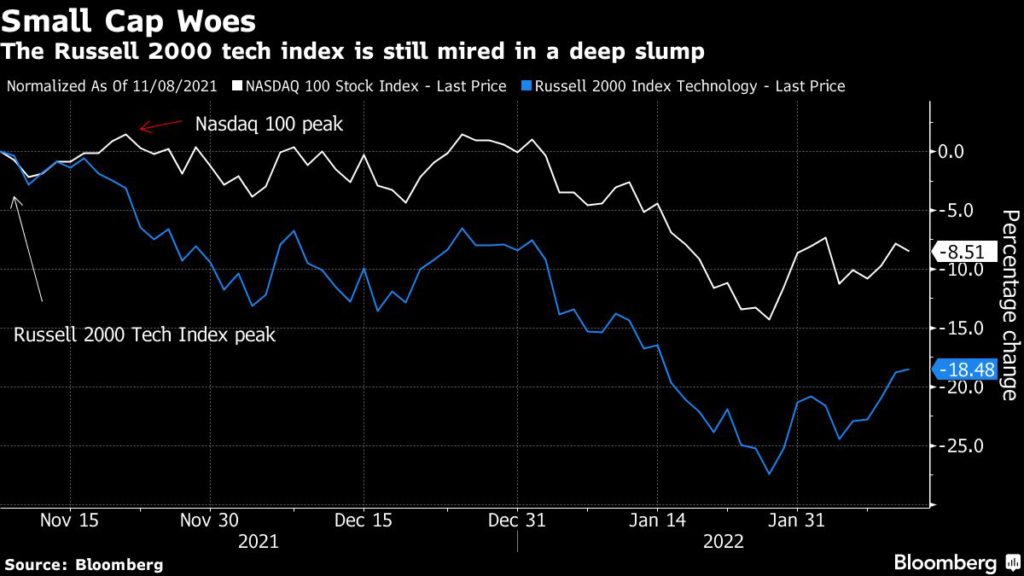
(Bloomberg) — While investors focus on the recent rebound in big tech stocks like Apple Inc. and Amazon.com Inc., shares of smaller technology companies remain in a deep hole. 

The Russell 2000 Technology Index is down 19% from a November record, compared with a drop of almost 11% for the Nasdaq 100 Stock Index from its own peak 11 days later. Some software makers, like Asana Inc., run by Facebook co-founder Dustin Moskovitz, are down more than 50% from their all-time highs. 

The threat of higher interest rates is taking a huge toll on smaller companies, many of which are barely profitable, because it reduces the current value of cash flows anticipated down the road. And then there’s the prospect of higher borrowing costs. With the Federal Reserve expected to raise interest rates next month for the first time in more than three years, investment professionals see plenty of reasons to avoid the group.

“Some of these newer companies that don’t have much profits, we don’t know if they’re going to make it through the storm,” said Daniel Morgan, senior portfolio manager with Synovus Trust Co. “I’m putting money on companies that have proven results.”

Despite the selloff, valuations in the Russell 2000 Tech Index remain elevated. At 2.3 times sales projected over the next 12 months, the benchmark is priced nearly 50% above its average over the past 10 years, according to data compiled by Bloomberg.  

Meanwhile, some of the biggest technology companies are headed in the opposite direction as they recover much of the losses from last month. Apple has rallied to within 5% of a record after delivering quarterly profits and revenues that beat Wall Street estimates. And Google-parent Alphabet Inc. is down just 6.4% from a November record.  

The tech sector’s flight to quality is creating an increasingly narrow group of winners, according to Steve Sosnick, chief strategist at Interactive Brokers.

“Investors are becoming more discerning in terms of wanting actual earnings and cash flow, they’re less willing to invest in hype alone,” he said in an interview. “This is why you’re seeing people clamor into Apple, Alphabet and Amazon. You can actually point to big numbers on their income statements.”

More stories like this are available on bloomberg.com

©2022 Bloomberg L.P.

Uber’s Ambitious Outlook for 2024 Leaves Market Skeptical

(Bloomberg) — Uber Technologies Inc. said it expects $5 billion of adjusted earnings by fiscal 2024, signaling that the ride-hailing giant’s recent profitability milestone will persist over the long-term.

“We now have the musculature and the data structures where we are effectively able to cross our audience through a number of different experiences,” Chief Executive Officer Dara Khosrowshahi said at an investor day on Thursday.

The shares fell about 2.5% Thursday in New York, reversing gains made in late trading Wednesday after the company reported quarterly earnings. 

Uber sees gross bookings reaching $165 billion to $175 billion by 2024 and expects to be cash flow positive by the end of this year, Chief Financial Officer Nelson Chai said.  

The company also said its advertising business is still in its “early days” but projected that the segment would reach $1 billion in gross bookings by 2024.

Atlantic Equities analyst James Cordwell said Uber’s guidance was basically in line with analysts’ estimates and “the lack of upside is maybe what is disappointing the market.” What’s more, long-term targets don’t tend to be a “good idea in a sector as volatile and unpredictable as tech.”

Like its rival Lyft Inc., Uber’s progress toward reaching pre-pandemic ridership was thwarted by omicron, which kept people away from offices, schools and social events. The companies’ fortunes have ebbed and flowed along with Covid-19 infection rates and restrictions, which affect demand for rides as well as meal delivery. Lyft reported fewer riders than analysts expected in the fourth quarter, but also recorded its highest-ever revenue per rider. 

On Wednesday, Uber reported revenue rose 83% to $5.8 billion in the fourth quarter, topping analysts’ estimates. The company also recorded the most active users in its history. Uber was profitable on an adjusted Ebitda basis in the third and fourth quarters of 2021. 

(Updates with analyst comment in sixth paragraph.)

More stories like this are available on bloomberg.com

©2022 Bloomberg L.P.

Twilio and Datadog Are Reminder of Software’s Growth Bona Fides

(Bloomberg) — Two software companies are reminding investors what they’ve long liked about the high-flying sector lashed in the rate-spurred market rotation. 

Both Twilio Inc. and Datadog Inc. are soaring Thursday after beats on corporate earnings that underly the industry’s promise of growth in an ever-more digital world. The results land in the wake of similarly strong prints from both the big and small players, including Microsoft Corp. ServiceNow Inc. and Atlassian Corp.

Twilio, which specializes in communications software, gained as much as 16% and is on track for its highest close in about a month with analysts widely positive on the stock. Datadog jumped as much as 19%, and is now up more than 40% off a low hit late last month. The cloud-security software company’s report was seen as strong, pointing to an acceleration in profits.

Both reports “should bring buyers and greater confidence back into the SMID cap growth software sector,” wrote Jordan Klein, a managing director and tech analyst at Mizuho Securities.

The iShares Expanded Tech-Software Sector ETF has risen about 11% off a low hit in late January, though it remains 18% below a peak hit in November. The exchange-traded fund dipped 0.2% on Thursday, with the positive results offset by a higher-than-expected read on inflation. That inflation report contributed to the yield on the 10-year Treasury topping 2%, its highest since 2019. Concerns over higher interest rates have pressured the group in recent weeks.

Software reports have not been uniformly strong this season. Earlier this week, Avaya Holdings plummeted after its forecast was below expectations, as did New Relic in the wake of its own guidance. Overall, however, nearly 82% of software companies in the S&P 500 index have have reported so far this season have beaten earnings expectations, according to data compiled by Bloomberg. More than 70% have beaten the consensus in terms of revenue.

According to Bloomberg Intelligence, software and services companies are expected to grow revenue by 13.9% in their 2022 fiscal year, compared with 10.9% growth for the tech sector overall, and 8.8% for the S&P 500 Index. 

Earnings for the group are expected to grow 14.6%, compared with 6.9% growth for the tech sector and 7.1% growth for the S&P.

More stories like this are available on bloomberg.com

©2022 Bloomberg L.P.

Binance to Invest $200 Million in News Publisher Forbes

(Bloomberg) — Binance Holdings Ltd., parent of the world’s largest cryptocurrency exchange, is making a strategic investment of $200 million into the more than 100 year-old news publisher Forbes.

Patrick Hillmann, Binance’s chief communications officer, and Bill Chin, head of Binance Labs, its venture capital arm, will join the Forbes board when the transaction closes. 

Forbes agreed to go public last year through a merger with blank-check firm Magnum Opus Acquisition Ltd. The business combination is expected to close in the first quarter of 2022, with the company trading under the New York Stock Exchange ticker FRBS. 

Forbes’ editorial operation will continue to be “very independent,” Changpeng Zhao, founder and chief executive of Binance, said during a CNBC interview. Binance will help the organization with its crypto and blockchain strategies, such as exploring issuing nonfungible tokens, introducing read-to-earn and accepting Bitcoins for subscriptions, he said. The deal is part of Binance’s broader strategy to work with companies across traditional industries and bring them into what’s known as web3.  

Forbes is “already a resource for people interested in the emerging world of digital assets,” Mike Federle, chief executive of Forbes, said in a statement. “With Binance’s investment in Forbes, we now have the experience, network and resources of the world’s leading crypto exchange.”

The investment from Binance, the world’s largest crypto exchange by trading volume, is part of a $400 million private investment in public equity (PIPE) deal. 

Bloomberg LP, the parent of Bloomberg News, competes with Forbes in providing news and financial information. 

(Adds Binance CEO’s comments in the fourth paragraph.)

More stories like this are available on bloomberg.com

©2022 Bloomberg L.P.

Vodafone Rejects $13 Billion Italy Bid From Iliad, Apax

(Bloomberg) — Vodafone Group Plc has rejected an 11.25 billion-euro ($12.9 billion) offer for its Italian unit from a consortium backed by billionaire Xavier Niel’s Iliad SA. 

The approach was “not in the best interests of shareholders,” Vodafone said in a statement Thursday, which confirmed an early Bloomberg News report it was leaning toward spurning the proposal. It also revealed that Iliad’s approach involved private equity firm Apax Partners LLP as a co-bidder.  

“Vodafone continues to pragmatically pursue several value accretive in-market consolidation opportunities to deliver sustainable market structures in its major European markets, including Italy,” the British carrier said.

Vodafone viewed the proposal as too low, people familiar with the matter said earlier. While Vodafone is keen to participate in any Italian consolidation, it believes the potential synergies that Iliad could extract from a combination would warrant a higher price, according to the people. 

Iliad said it would “pursue its standalone strategy” in a responding statement, a suggestion it won’t increase its bid. The statement also confirmed its offer value, after Bloomberg first reported the approach on Monday. Paris-based Iliad said it was a “very high premium” of 100% cash, and it had strong financial support from a top European bank. 

Shares of Newbury, England-based Vodafone were down 1.4% at 4:26 p.m. in London, shedding earlier gains after Iliad’s statement and giving it a market value of about 37.2 billion pounds ($50.7 billion). 

Fierce Competition

Vodafone is looking for merger opportunities in the U.K., Spain, Italy and Portugal, Chief Executive Officer Nick Read said last week. His comments came after activist investor Cevian Capital AB built up a stake in the telecom operator and began lobbying for changes. 

Options to boost value at Vodafone could include consolidating its presence in key markets, selling some operations or pursuing stock buybacks, people with knowledge of the matter have said.

“Iliad’s reported 11 billion-euro offer for Vodafone’s Italian operation is too low, we think, to convince the carrier to exit a key market that accounts for 11% of sales,” said Bloomberg Intelligence analyst Erhan Gurses. “The price equates to 6.4x EV/Ebitda after leases vs. Vodafone’s 6.5x trading multiple and doesn’t reflect a fair share of significant synergy and consolidation benefits.”

Europe’s major telecoms firms are racing to consolidate after years of low margins and increased pressure from investors. Iliad moved into the Italian mobile services market in 2018 as a no-frills challenger, sparking a price war that last year led to three profit warnings by former monopoly Telecom Italia SpA. 

Italy is also one among the world’s most competitive markets for mobile services, with rivals including CK Hutchison Holdings Ltd.’s Wind Tre SpA venture already active.

(Updates with Iliad statement in fifth paragraph)

More stories like this are available on bloomberg.com

©2022 Bloomberg L.P.

Deliveroo Partners With Waitrose for 10-Minute Hummus Delivery

(Bloomberg) — Deliveroo Plc is partnering with upmarket grocer Waitrose to deliver groceries such as organic hummus, fresh sourdough bread and Belgian butter waffles, in as little as 10 minutes.

The two companies have soft-launched in the southern London neighborhood of Bermondsey, cutting the time it will take customers to receive free-range pork sausages, eucalyptus candles and other goods in half.

Waitrose and Deliveroo announced a two-year partnership last year to make deliveries in about 20 minutes from 150 of the grocer’s stores across the U.K. 

The Bermondsey trial builds on Deliveroo’s “hop” offering, which it launched with Waitrose rival Wm Morrison Supermarkets Plc in September, using a network of small urban fulfillment centers.

“It’s important that we continue to evolve along with shopping behavior,” James Bailey, Waitrose executive director, said in a statement. He described the 10-minute service as a trial, but one built on the current “successful partnership” with Deliveroo.

The service will be available from 8 a.m. to midnight and offers more than 1,000 Waitrose lines on the Deliveroo app, according to the statement.

When Bloomberg News tested the service Thursday, an order of Scottish oak smoked salmon and orange juice arrived from Waitrose in about eight minutes.

It’s the latest development by established firms to embrace the new business of rapid grocery delivery, a sector which has netted billions in investment and produced several startups. 

For Deliveroo, on-demand grocery is an area of growth — with the segment gaining to represent 8% of gross transaction value in the second half of last year, up from 7% in the first half. 

Other rivals like Just Eat Takeaway.com NV are also entering partnerships to offer grocery delivery. 

John Lewis Partnership Plc, the operator of Waitrose, is working to turn around its business after recording its first-ever annual loss in March. Waitrose’s like-for-like sales rose 4% in the first-half of 2021 compared to the previous year, largely driven by increased demand for online shopping. 


(Updates with Waitrose comment from fifth paragraph.)

More stories like this are available on bloomberg.com

©2022 Bloomberg L.P.

Many Remote Workers Secretly Juggle Two Full-Time Jobs—or More

(Bloomberg) — With the pandemic’s turbocharged acceleration of remote-work options, many employees have sought to capitalize on the lack of personal supervision by secretly working two (or more) full-time jobs at once. But while there’s more money to be made, the strategy can bring with it significant tradeoffs, namely to mental health.On this episode of Bloomberg’s Future of Work, we meet a man who claims to work two jobs at once while also helping others looking to accomplish the same, lucrative feat. Many people who don’t have the luxury of working from home have long had multiple jobs—often with low-pay and no benefits—just to make ends meet. But for so-called knowledge workers, the “overemployment” phenomenon allows them to double what are often already high salaries.

More stories like this are available on bloomberg.com

©2022 Bloomberg L.P.

Dassault Extends Rafale Warplane Blitz With Indonesia Order

(Bloomberg) — Dassault Aviation SA won an $8.1 billion order from Indonesia for 42 Rafale fighter planes and weapons, extending a successful run for the French defense supplier as it stakes a claim to lead Europe’s next warplane program.

The Asian nation signed a contract for the jets at a ceremony in Jakarta Thursday, Dassault said in a statement, finalizing a deal that the manufacturer has been seeking to pin down for years.

The value of the contract was confirmed by the French defense ministry.  

Shares of Dassault rose as much as 5.5% in Paris, where the company is based. They traded 4.5% higher at 115.10 euros as of 4:19 p.m., taking gains this year to 21%.

Securing the purchase marks another coup for Dassault, after it inked a bumper order for 80 Rafales from the United Arab Emirates in December following earlier deals for the model from Greece and Croatia and a follow-on purchase from Egypt earlier in 2021.

The order for the Indonesian National Army Air Force also covers aircrew training, logistical support for several air bases and a training center equipped with two full-mission simulators, according to the statement.

France and Indonesia also signed a memorandum of understanding for a broader defense pact that could include submarine development and satellite procurement.

Dassault booked 49 Rafale orders last year, including a dozen for the French military. That doesn’t include the UAE’s 80-jet purchase, valued at 14 billion euros ($16 billion). The emirates also ordered weaponry and helicopters for about 3 billion euros.

The Rafale entered service in 2004, but the first order outside France came only in 2015 with an initial contract with Egypt for 24 jets, to which another 30 were added last year.

Next Fighter

The spate of contracts may have strengthened Dassault’s hand in a Franco-German battle for supremacy in the development of the New Generation Fighter, slated to enter service in about 2040, on which it’s seeking to cooperate with the German arm of Airbus SE.

Read more: Franco-German Dispute Stalls New European Fighter-Jet Plans

Dassault Chief Executive Officer Eric Trappier said last month that the project has become bogged down over the division of labor, and that Airbus must accept that for the development phase of the aircraft “the expertise will be in France” and that “Dassault will be the leader.”

The impasse comes nearly five years after French and German heads of state agreed on an air-combat alliance that included the new jet.

That left Britain — currently partnered with Airbus on the Eurofighter, which competes with the Rafale — out in the cold in the wake of the country’s decision to leave the European Union. 

London-based BAE Systems Plc, Europe’s biggest defense firm, has gone on to develop a rival warplane, the Tempest, and recruited Italy’s Leonardo SpA and Sweden’s Saab AB to its camp.

(Adds value of plane order in first paragraph.)

More stories like this are available on bloomberg.com

©2022 Bloomberg L.P.

Close Bitnami banner
Bitnami