Bloomberg

Europe Fintech Giant Klarna Considers Raising Fresh Funds

(Bloomberg) — Swedish payments firm Klarna Bank AB is weighing plans to raise new money in a funding round that would cement its status as Europe’s most valuable startup, people familiar with the matter said.

The Stockholm-based company is likely to attract sovereign wealth and pension funds as new investors, the people said, asking not to be identified discussing confidential information. Klarna could potentially fetch a valuation of roughly $50 billion to $60 billion based on preliminary estimates, though it hasn’t finalized a precise target, the people said. 

It’s considering allowing existing backers to sell some of their holdings as part of any fundraising, the people said. Klarna is separately exploring raising debt financing from banks to help fund its expansion plans, the people said.

The startup raised $639 million in June from investors including SoftBank Group Corp., Sequoia Capital and Permira. That round valued the company at $45.6 billion.

Deliberations are in the early stages, and details of the potential fundraising could change, the people said. A representative for Klarna declined to comment.

Read more: Nexi Said to Weigh Sale of $1.1 Billion Buy Now, Pay Later Unit

As a rival to the likes of PayPal Holdings Inc., as well as traditional credit card companies, Klarna lets its customers “buy now and pay later” in interest-free installments when they shop online or in store with brands including Calvin Klein, H&M, Ray-Ban and Lululemon. The service has become a go-to method for Millennials and Gen Zers who want to buy big-ticket items and spread the costs. Klarna says it has 90 million active customers and processes 2 million transactions a day. 

The company also offers conventional bank accounts in Sweden and Germany and uses a mix of customer deposits and short-term debt to fund its loans. In a financial report last October, Klarna said that loans to consumers totaled about 52 billion krona ($5.7 billion). Deposits stood at 45 billion krona and debt securities at 8.1 billion krona, about 15% of the mix.

The rapid growth of Klarna since its founding in 2005 has led it to be viewed as a strong candidate for an initial public offering. Klarna said last year that it was considering a listing in London as soon as 2022 but had made no firm decisions on a venue. 

Other investors in Klarna include Adit Ventures, Honeycomb Asset Management, WestCap Group, Silver Lake and Dragoneer.

Read more: Market Downturn Rattles Venture Investors Despite Funding Surge

(Updates with Klarna customer numbers in sixth paragraph.)

More stories like this are available on bloomberg.com

©2022 Bloomberg L.P.

Twitter’s New CEO Aims to Move Faster, Not Change Course

(Bloomberg) — Twitter Inc.’s new Chief Executive Officer Parag Agrawal promised to push projects through faster, but told investors they shouldn’t expect major changes to the company’s product or business growth strategy now that co-founder Jack Dorsey has stepped aside. 

Maintaining the status quo seemed to be the theme of Twitter’s fourth-quarter earnings call Thursday, during which the company reported holiday sales and user growth that mostly met Wall Street expectations, but didn’t go much beyond that. Twitter also announced a $4 billion stock buyback, which helped buoy shares. The stock was up about 1% as the market opened in New York.

Revenue in the holiday quarter rose 22% to $1.57 billion, slightly less than analysts had predicted but suggesting the company has weathered recent changes by Apple Inc. on data privacy better than some larger rivals. Sales in the current period will be as much as $1.27 billion, Twitter said Thursday in a statement, while the average analyst projection was $1.26 billion. The company added 6 million new users in the fourth quarter, bringing average daily active users to 217 million. 

San Francisco-based Twitter is entering a new chapter in its history, following Dorsey’s unexpected resignation in November, and Agrawal, a former chief technology officer, taking the top job. Pressure is on Twitter to move faster in building new products, and the company set ambitious revenue and user growth goals at an analyst day last year to convince skeptical investors that it was serious about expanding its business. While Twitter has grown steadily for years, its stock gains have lagged behind industry peers.

Speaking on a call with analysts, Agrawal said he felt an “urgency” to execute on the company’s strategy. Agrawal and Chief Financial Officer Ned Segal said the company is sticking to the goals set last year, including increasing annual revenue to $7.5 billion and getting to 315 million daily users by the end of 2023. 

What’s changing is the pace, Agrawal said. He vowed to increase accountability, make decisions faster and to improve product execution. “One of the the things we’ve constantly been focused on is how we go faster,” he said. “My focus has been on improving our execution. I bring a strong amount of urgency to this role.”

The lackluster revenue forecast for the first quarter is due in part to Twitter’s recent sale of ad platform MoPub, Segal said. MoPub brought in $281 million in revenue last year, including $51 million during the first quarter. Twitter sold MoPub to AppLovin Corp. for $1.05 billion in cash in a deal that closed on Jan. 1. Employees who were working on MoPub have started developing other advertising products, Segal said. 

“We think we can make up some of that in 2022,” he said in an interview, referring to the revenue hit. “But we should be able to make up all of it in 2023.” Twitter said it expects full-year revenue growth in the low- to mid-20% range in 2022 excluding MoPub sales. Wall Street analysts on average estimate Twitter’s revenue will increase by 20% in 2022.

In order to reach its user growth goal of 315 million daily users by the end of 2023, Twitter will need to grow its audience by 45% over the next two years. In 2021, Twitter’s user base grew just 13%. 

Executives say they are confident they can still hit that user growth goal by making it easier to sign up to Twitter, and increasing the relevancy of its algorithm to show people better tweets. Segal said the company saw a 25% increase in the fourth quarter in the number of people who came to Twitter each day to create an account or resurrect an old one, a sign there’s a lot of interest from people in joining Twitter. 

The social network also said that recent Apple privacy rule changes, which now require companies like Twitter to explicitly ask for permission before collecting data from users on Apple devices, will have a “modest” impact on business moving forward. Twitter, Meta Platforms Inc.’s Facebook and other online platforms use information collected from mobile devices like iPhones to target users with advertising.

Unlike social media competitors Meta and Snap Inc., Twitter makes most of its money from brand advertising, which requires less targeting data than other types of online ads, known as direct response ads, that aim for a specific outcome — like the installation of an app. Meta, which also owns Instagram, estimated last week that the privacy changes will cost the company $10 billion in advertising revenue this year.

While Twitter’s focus on brand advertising may be helping to avoid a major disruption, the company is also trying to build more demand for direct response ads, which can be more lucrative. Eventually, the company hopes that 50% of its advertising revenue will come from those kinds of highly targeted ads. Today, just 15% of Twitter ads are considered direct response.

The $4 billion share repurchase authorization will replace a $2 billion plan approved a few years ago, which was a little more than halfway complete. In the new plan $2 billion will be an “accelerated share repurchase,” according to a letter to shareholders. 

Bloomberg Intelligence analyst Mandeep Singh said the accelerated buyback is likely due to pressure from activists, which also drove the CEO change. “The buyback seems timely given the valuation multiple compression we have seen in social media names since January,” Singh said.


More stories like this are available on bloomberg.com

©2022 Bloomberg L.P.

Coca-Cola Sales Top Estimates as Pandemic Recovery Continues

(Bloomberg) — Coca-Cola Co.’s fourth-quarter sales exceeded Wall Street’s expectations in a sign that the beverage giant is benefiting from a return to normalcy despite the lingering pandemic.

Strong consumer demand in North America contributed to a 9% jump in organic revenue last quarter, which excludes the impact of items like currency and acquisitions, Coca-Cola said on Thursday. Analysts were looking for a 5% increase on average. Pricing and product mix were also better than expected.

Comparable earnings per share beat estimates for the ninth consecutive quarter, according to data compiled by Bloomberg, but Coca-Cola said last quarter marked the first time since the pandemic began in which away-from-home volume was ahead of 2019 levels. Strength in at-home channels also continued.

“Mobility has been the single most important variable for us to piggyback off,” Chief Financial Officer John Murphy said in an interview. “And as soon as people are able to move around, they will.”

Coca-Cola shares rose 0.8% to $61.52 at 9:42 a.m. in New York. Through Wednesday, the stock had risen 3.1% to start the year, outperforming a 3.8% decline in the S&P 500 index.

The company said Thursday that its size and targeted investments are helping it adapt to the “asynchronous recovery in many markets” as Covid-19 variants and subsequent virus-related restrictions ebb and flow around the world.

For the full year, Coca-Cola expects organic revenue growth to be in the 7% to 8% range. The average of four estimates compiled by Bloomberg called for 8.4% growth, but some analysts were looking for a forecast around 6.5%.

Investors have been watching whether Coca-Cola’s price increases and product mix can overcome inflationary pressures in commodities, transportation and labor. In fact, it was a “significant increase in marketing investments” that compressed operating margins last year, rather than supply-chain costs.

The owner of the Minute Maid, Simply, Dasani and Schweppes brands expects inflated commodity costs to continue this year, adding a mid-single-digit percentage to the adjusted cost of goods sold on a comparable basis. Murphy said the labor picture also remains uncertain, both in terms of costs and availability.

For 2022, the company expects profit excluding some items to increase 5% to 6% from $2.32 in 2021. Analysts had estimated $2.43, on average.

(Adds CFO comment in fourth and ninth paragraphs.)

More stories like this are available on bloomberg.com

©2022 Bloomberg L.P.

Disney’s Stock Streams Past Netflix in Growth Race

(Bloomberg) — Investors looking for racy growth in streaming video these days are turning to a 98-year-old entertainment company rather than long-time darling Netflix Inc. 

Walt Disney Co. added 11.8 million subscribers for its Disney+ service in the quarter ended Jan. 1, far above the 8.17 million that Wall Street had projected. Netflix, by contrast, said last month it would add only 2.5 million new customers this quarter.

With business picking up at Disney’s theme parks as the pandemic eases, its shares are starting to recover from their slump from the record set in March and are set to rally on Thursday. They’re also at a growth-stock multiple of 33.6 times estimated earnings, about the same as Netflix, and analysts rate Disney more highly than the upstart.

“Confidence in Disney+ awakens on this print,” Wells Fargo analyst Steven Cahall wrote in a note, calling it his top growth idea. “Disney+ cleared a high bar.” He has buy ratings on both Disney and Netflix.

Netflix, which went public in 2002, and Disney had similar stock market values as recently as late December, at about $275 billion. Disney shares rose 5% Thursday morning in New York, moving closer to $300 billion while Netflix is below $180 billion. 

Disney shares are close to erasing their loss for the year, while Netflix is down 32%.  

Since its launch in November 2019, Disney+ has added almost 130 million subscribers, a pace at which it could overtake Netflix’s 220 million-plus user base in the next few years.

The Disney-Netflix contrast illustrates the problem for tech stocks more broadly: Analyst expect big tech earnings growth to slow sharply. Deutsche Bank strategists said growth at the likes of Apple Inc., Google owner Alphabet Inc. and Amazon.com Inc. aren’t likely to beat the rest of the S&P 500 companies in 2022, undermining one of the core rationales for owning the stocks.

Disney’s price-earnings multiple is well above that of the NYSE FANG+ Index, home to those and other tech stocks that have long been favored by growth investors. It’s also emerging as a clear winner with Wall Street analysts: The stock is more highly rated than Netflix and Apple, based on a Bloomberg system for buys, sells and holds. 

Tech Chart of the Day

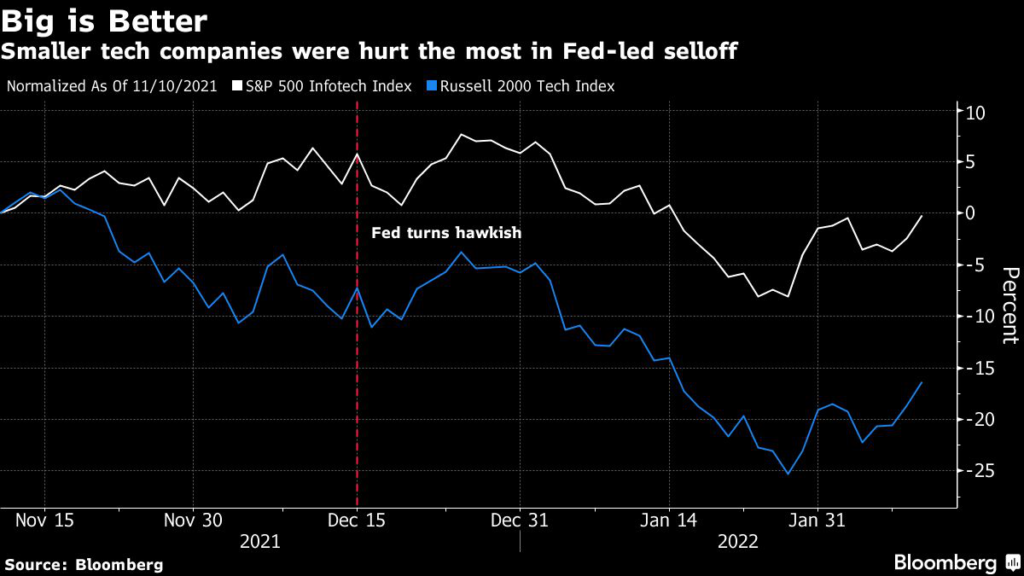
The Russell 2000 Technology Index is down 16% in the past three months, compared with almost an unchanged S&P 500 Information Technology Index. The Federal Reserve’s hawkish turn hurt pricier technology stocks that are valued on future growth expectations. Most of the small companies are unprofitable and investors tend to dump those risky names during a rate-hike cycle.

Top Tech Stories

  • Hon Hai, the biggest assembler of iPhones, said component shortages that have plagued electronics production for more than a year are showing signs of easing
  • Samsung plans to discontinue its Note lineup of stylus-equipped phones and instead distribute that capability across its portfolio while pushing premium foldables in its challenge to Apple
  • Twilio said it will make money on an operating basis beginning next year, gave a bullish sales forecast and reported fourth-quarter revenue that topped analysts’ estimates. The results addressed Wall Street concerns about its lack of profitability as it ramps up competition with Salesforce.com and Adobe
  • Uber reported revenue in the fourth quarter that beat analysts’ estimates as it recorded the most active users in its history, helping mute disruptions from omicron in ride sharing and boosting gains in delivery
  • China accused the U.S. of not taking responsibility for problems caused by satellites launched by Elon Musk-backed SpaceX
  • Chipmaker SMIC reported revenue for the fourth quarter that met the average analyst estimate

(Updates share price in fifth and sixth paragraph)

More stories like this are available on bloomberg.com

©2022 Bloomberg L.P.
Peloton’s Wild Stock Ride Makes M&A Bit More Tricky

(Bloomberg) — Wild swings in Peloton Interactive Inc.’s stock price and a “factory reset” of the exercise-bike maker’s business have left investors scratching their heads over how much the stock is worth and what price a prospective buyer would need to pay to acquire the one-time pandemic star.

The unprofitable maker of $2,000-plus, web-connected stationary bikes saw its shares soar nearly 50% this week, fired up by reports of takeover interest and Tuesday’s wholesale changes at its organization. The overhaul left analysts divided over whether Barry McCarthy’s appointment as chief executive officer will increase or decrease the likelihood of a sale, with Barclays Plc analysts saying Peloton shares were at “day 0 of factory reset.”

The deal most comparable to Peloton is Lululemon Athletica Inc.’s $500 million deal for Mirror in 2020, according to special situations research firm United First Partners, which was priced at 3.9 times Lululemon’s projection of the target’s 2021 revenue. At that multiple, Peloton would fetch about $51 per share, United First said Tuesday. That’s 37% above Tuesday’s close of $37.27 and more than double the price Friday before the reports of M&A interest.

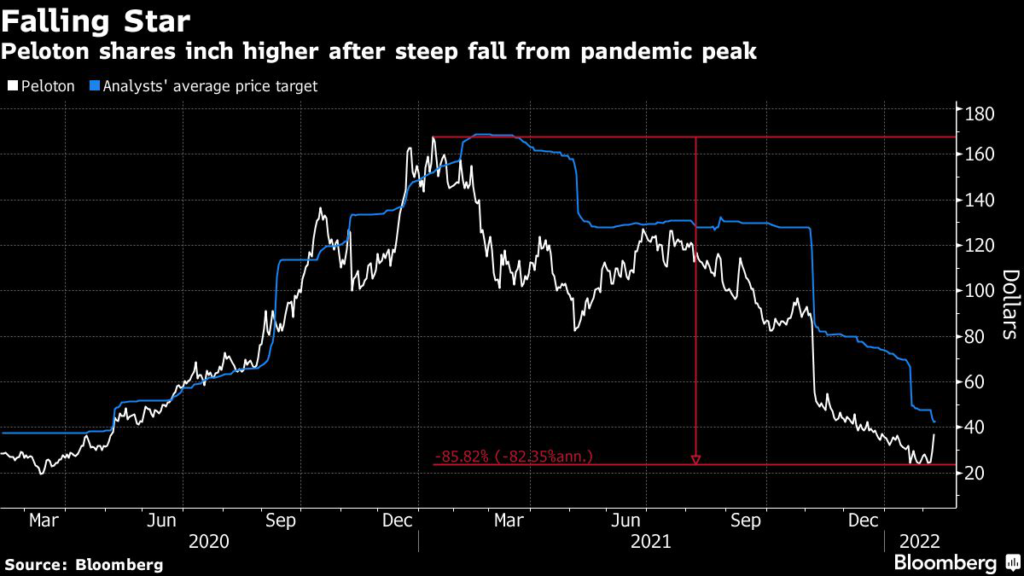
Still, that would be a big comedown from the stock’s 2021 high above $167. Peloton was a darling of investors during the pandemic when fitness fans, cooped up at home, flocked to its sleek gadgets and subscription services. The shares tumbled 86% from the peak as the outbreak eased, sending customers back to their reopened gyms. The stock recovered some ground this week after reports that Amazon.com Inc. and Nike Inc. were interested in a potential acquisition. 

“You think you know what things look like, but then that will change on a dime with the latest headline,” said Matt Miskin, co-chief investment strategist at John Hancock Investment Management. “How do you invest on that?”

In another similar deal, Google parent Alphabet Inc. paid a roughly 70% premium for Fitbit, which would imply a price of more than $40 a share for Peloton based on Friday’s closing price.

The rally of the past two days probably was driven in part by short sellers buying back stock after the reports of M&A interest. Almost 13% of the shares available for trading had been sold short as of Monday, according to IHS Markit Ltd. 

Peloton now sells at less than 3 times estimated sales, cheaper than the Nasdaq 100 Index’s 4.6 times. A majority on Wall Street still remain bullish on the stock, with more than half of analysts tracked by Bloombeg rating the company a buy and the average price target of $44.08 implying a 21% gain from current levels.

Still, price targets are all over the place. Mario Lu at Barclays lowered his forecast Wednesday to $60 from $90, while Telsey Advisory Group’s Dana Telsey raised hers to $40 from $30. Peloton’s second-quarter revenue missed estimates and the company again lowered its forecast for 2022.

The stock fell 3.1% to $36.10 on Wednesday as of 9:42 a.m. in New York.

Tech Chart of the Day 

The recent underperformance of the tech-heavy Nasdaq 100 Index has supressed the valuation premium of the index relative to the S&P 500 Index. Still, the Nasdaq 100 remains pricey trading at a 27% premium to the S&P 500, well above its five-year average. 

Top Tech Stories

  • ASML has warned that an affiliate of a China company it previously accused of stealing its trade secrets has begun marketing products that could infringe on its intellectual property rights
  • Alibaba shares jumped in Hong Kong as SoftBank said it wasn’t involved in the Chinese tech giant’s registration of American depositary shares for possible sale
  • GlobalFoundries gave a bullish forecast for the current quarter, indicating the rush to get chips continues amid industry-wide shortages
  • Lyft reported fewer riders than analysts’ expected in the fourth quarter as omicron damped travel, sending the shares lower in premarket trading
  • A $300 billion plunge in Meta Platforms market capitalization this month, including the worst one-day wipeout in history, may soon cost the firm its place among the world’s 10 most valuable companies
  • Mandiant Inc. surged 18% on Tuesday after Bloomberg News reported that Microsoft is in talks to buy the cybersecurity company, a deal that would bolster efforts to protect customers from hacks and breaches

(Update share price in the last paragraph)

More stories like this are available on bloomberg.com

©2022 Bloomberg L.P.

Zambia Explores Digital Currency, But Warns Against Crypto

(Bloomberg) — Sign up for the New Economy Daily newsletter, follow us @economics and subscribe to our podcast.

Zambia’s central bank expects to complete research on forming a digital currency that could cut transaction costs and boost participation in the formal financial system by the fourth quarter.  

“The results of the research will form part of the input in the policy considerations on whether to introduce a central bank digital currency in Zambia,” Nkatya Kabwe, acting assistant director of communications at the regulator, said in response to emailed questions.

CBDCs are government-backed digital currencies developed by central banks after the rise of cryptocurrencies such as Bitcoin and Ethereum. Cryptocurrencies are not legal tender in Zambia, the central bank said earlier this month and “people who want to deal in them should have a clear understanding of all the risks that come with such payment and investment instruments.”

The Bank of Zambia is researching CBDCs as they have the potential to expand financial inclusion, improve traceability, safety and efficiency of payment systems, Kabwe said.

Analysts at the Bank of America Corp. have warned that central banks that don’t introduce their own digital money risk losing monetary control and seeing the demand for their currencies drop as their citizens start using another country’s digital cash.

Zambia joins nations such as Israel, Ghana, the Bahamas, Nigeria, China and the U.S. that are considering or have introduced CBDCs.

(Provides clarity on CBDCs in paragraph three)

More stories like this are available on bloomberg.com

©2022 Bloomberg L.P.
Judge Grants Bail to Crypto Couple in $4.5 Billion Hack

(Bloomberg) — A Washington judge halted a decision to grant bail to two people charged with trying to launder billions of dollars worth of Bitcoin stolen in a 2016 hack of the Bitfinex currency exchange.

Late Tuesday, the judge granted an emergency request by the U.S. government to continue to hold Ilya Lichtenstein and Heather Morgan in jail while the bail decision is reviewed. “The defendants are sophisticated cyber criminals and money launderers who present a serious risk of flight,” prosecutors said in their filing. The government said that while the majority of the stolen funds have been seized, there are several other virtual currency addresses that the government believes the couple control that hold about 7,506 Bitcoin, valued at more than $328 million.

Lichtenstein and Morgan had been granted bail by a judge in lower Manhattan Tuesday night, after being arrested at 7 a.m. in New York. They face trial in Washington. The U.S. government said it seized about $3.6 billion worth of cryptocurrency from the married couple, the largest financial seizure ever. The two allegedly conspired to launder 119,754 Bitcoin, currently valued at about $4.5 billion, stolen after a hacker breached Bitfinex’s systems. 

U.S. Magistrate Judge Debra C. Freeman had set bail at $5 million for Lichtenstein and $3 million for Morgan. Both bonds were to be secured by their parents’ homes. But prosecutors asked a judge in Washington for an emergency delay to allow that court to consider whether Lichtenstein and Morgan should be released. Chief Judge Beryl Howell agreed with the government Tuesday night in a one-page order.

The government had initially asked the judge in New York not to allow them to be released on bail. Each defendant is facing the possibility of a 20-year prison sentence, so they have the motivation to run, a prosecutor told the judge in court. When the judge indicated she would set a bond, the government requested it be set at $100 million, an amount one of the defense lawyers called “laughable.”

Lichtenstein, 34, holds dual U.S. and Russian citizenship. He wore jeans and a gray shirt in the courtroom, his brown hair was slightly messy and he sported a paunch. Morgan, 31, appeared in court wearing a white hooded sweatshirt, her long hair down. They both wore masks, as did everyone else in the room, per court requirements.

They looked at the magistrate judge as she read them their rights. Neither of them spoke publicly during the initial appearance. Their lawyers — they have retained separate counsel — did the talking in court.

Morgan, who was born in Oregon and grew up in California, has foreign ties, the prosecutor said in court. She has lived in Hong Kong and Egypt and is studying Russian, according to her social media. She’s a journalist and economist and travels internationally for work, according to the government. Her father is a retired U.S. government biologist and her mother worked as a librarian. Morgan’s parents were in the courtroom Tuesday.

Lichtenstein moved to the U.S. at the age of 6 to escape religious prosecution. He grew up in the suburbs of Chicago, where his mother was a biochemist at Northwestern University. His father worked for Cook County. His parents were also willing to put up their home as bond. 

They have been a couple since 2015, the government said. 

Lichtenstein’s lawyer told the New York judge that his client didn’t flee despite being fully aware of the investigation for months, after being informed in November by an Internet service provider. His lawyer also said there was no proof against Morgan.

But prosecutors argued they shouldn’t be freed, noting that the defendants used false identities in their crimes. Lichtenstein had a folder named “personas,” and there was a file on a computer with the name “Passport_ideas” with links to phony identification and passports, the government alleged. A search of their apartment found a plastic baggie under the bed labeled “burner phones,” according to a prosecutor.

A lawyer for the defendants, Anirudh Bansal, declined to comment on the case outside the Manhattan courtroom.

Read More: DOJ Seizes $3.6 Billion in Bitcoin Stolen in Bitfinex Hack

More stories like this are available on bloomberg.com

©2022 Bloomberg L.P.

IMF Chief Sees No Universal Case for Central-Bank Digital Money

(Bloomberg) — Sign up for the New Economy Daily newsletter, follow us @economics and subscribe to our podcast.

There’s no universal case for central-bank digital currencies, according to International Monetary Fund Managing Director Kristalina Georgieva, who urged policy makers to carefully weigh trade-offs as financial innovation enters a new phase.

So-called CBDCs could boost financial inclusion in some countries, while providing a secure backup for payment systems in others, Georgieva said. But she cautioned that their design must also take financial-stability and privacy considerations into account to avoid a potential legislative “deal breaker.”

“Policy makers will need to resolve many open questions, technical obstacles, and policy trade-offs,” Georgieva said Wednesday. “If CBDCs are designed prudently, they can potentially offer more resilience, more safety, greater availability, and lower costs than private forms of digital money” such as “unbacked crypto assets.”

The remarks come alongside the publication of an IMF report on digital currencies, which are being looked at by about 100 countries. Pioneers like the Bahamas and Nigeria have already started allowing the public to use CBDCs, while China is expanding an experiment that already includes more than a hundred million users.

One common strand, she said, is central banks’ commitment to minimizing the impact of CBDCs on the financial system. Active projects studied by her staff — in the Bahamas, China, and the Eastern Caribbean Currency Union — involve CBDCs that aren’t interest-bearing, making them less attractive for savings than traditional bank deposits. They also place limits on holdings.

More stories like this are available on bloomberg.com

©2022 Bloomberg L.P.

DoorDash Starts Financing Arm to Offer Restaurants Cash Advances

(Bloomberg) — DoorDash Inc., the U.S.’s biggest meal-delivery service, is launching a financing arm to offer business loans to restaurants on its app.  

With DoorDash Capital, merchants will be able to apply for financing to fund business operations such as purchasing equipment, paying rent, hiring and payroll, the San Francisco-based company said on Wednesday. 

“As we continue to listen to our partners and adapt our services and offerings to meet their needs, one key area where they have asked for support is quick and easy access to capital,” Chief Revenue Officer Tom Pickett wrote in a blog post. 

DoorDash Capital will determine a repayment structure based on a restaurant’s revenue. Eligible merchants can view cash advance offers within the app and can accept terms without additional paperwork or an impact to their credit scores. Funds will be disbursed in as little as one to two business days. 

The financing venture is the latest effort by DoorDash, which commanded 58% of the market for meal-delivery in the U.S. as of December, to expand into new revenue streams. In October, it introduced sponsored listings to bolster its advertising business. 

DoorDash also follows restaurant-software company Toast Inc., which launched a credit product in 2019, and payment processing firms like PayPal Holdings Inc., Stripe Inc. and Block Inc., (formerly Square) which have financing arms of their own. 

More stories like this are available on bloomberg.com

©2022 Bloomberg L.P.

Close Bitnami banner
Bitnami