Bloomberg

Manila Online Casinos Vacate Half of Their Office in Pandemic

(Bloomberg) — China-centric online casinos vacated half of their offices in the Philippine capital during the pandemic, as travel restrictions, taxes and precarious relations between the two countries throttled their operations. 

They occupied 677,000 square meters of Metro Manila office space in the fourth quarter of last year, down from 1.3 million square meters at the start of 2020, according to Colliers International. Their share of Metro Manila’s office stock fell to 5% from 11%. 

Some online gaming operators left because of travel restrictions, new taxes and uncertainty over Philippine-China relations as the Southeast Asian nation is set to elect a new president in May, Dom Fredrick Andaya, senior director at Colliers in Manila, said in a briefing Wednesday. 

Pandemic Threatens to Burst Philippines’ Online Gaming Bubble

Pre-pandemic, the $8-billion industry and its tens of thousands of migrant workers boosted property prices across Metro Manila and surrounds. Operators employ mostly mainland Chinese to answer queries and process payments for clients who place bets on live-streamed games of baccarat and Fantan. 

Andaya said 18.9% of Manila’s workspace may end up vacant this year and the next, as nearly 1.5 million square meters of office space will be added through 2023. Vacancy may ease should online casinos return and add to demand from outsourcing companies, he said. 

As travel restrictions ease, “it’s really up to Philippine-China relations, with respect to the level of tolerance in allowing the industry to prosper,” he said. 

More stories like this are available on bloomberg.com

©2022 Bloomberg L.P.

JPMorgan Estimates Bitcoin’s ‘Fair Value’ at $38,000, 12% Below Current Price

(Bloomberg) —

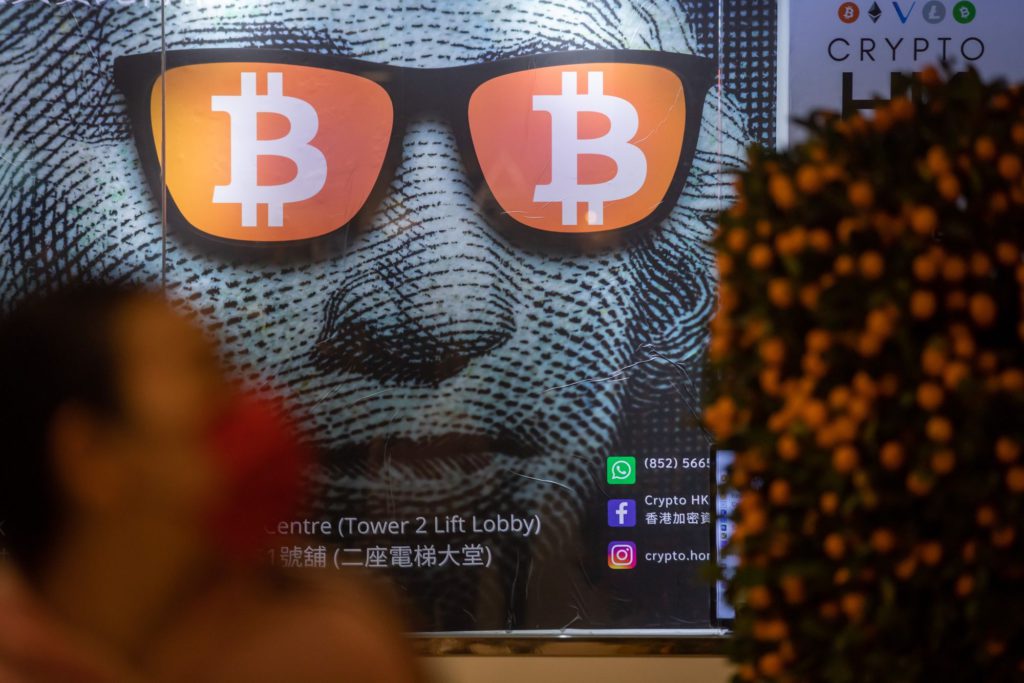
Bitcoin’s “fair value” is around 12% below the current price, based on its volatility in comparison with gold, according to JPMorgan Chase & Co. strategists led by Nikolaos Panigirtzoglou.

The strategists calculated the fair-value level at around $38,000 based on Bitcoin being roughly four times as volatile as gold, they wrote in a note published Tuesday. In a scenario where the volatility differential narrows to three times, the fair value rises to $50,000, they estimated. Bitcoin was trading at around $43,400 as of 11:20 a.m. in Hong Kong. 

“The biggest challenge for Bitcoin going forward is its volatility and the boom and bust cycles that hinder further institutional adoption,” the strategists wrote. 

Panigirtzoglou’s long-term theoretical target for Bitcoin — a level that would put its total market value on par with that of all gold held privately for investment purposes — sits at $150,000, up from $146,000 a year ago.

The strategists also said January’s price correction looks less like a capitulation than the one last May, which saw Bitcoin tumble as much as 50%. Still, metrics like futures open interest and reserves on exchanges are now pointing to a “more long-standing and thus more worrisome position reduction trend” that started in November, they noted.

More stories like this are available on bloomberg.com

©2022 Bloomberg L.P.

China PBOC Official Calls Cross-Border Brokers ‘Illegal’

(Bloomberg) — A senior Chinese central bank official blasted the nation’s brokers for providing “illegal” cross-border securities trading services to mainland investors, just three months after he questioned the legitimacy of some online trading apps.

Offshore units of some brokers are working with overseas branches of Chinese banks to help individual mainland investors wire their money across the border, often under false claims that the foreign exchange is used for personal travel, Sun Tianqi, head of the financial stability bureau at People’s Bank of China, wrote in an article published Tuesday in the central bank’s bi-weekly China Finance magazine.

While their parent firms are licensed to conduct brokerage business in China, cross-border securities trading is still off limits and such activities should be labeled “illegal,” he said.

Sun first raised concerns on the issue in late October, saying online brokers have no “driving licenses” to operate in China. While no names were given, the criticism prompted a plunge in shares of Tencent Holdings Ltd.-backed Futu Holdings Ltd. and Xiaomi Corp.-backed Up Fintech Holding Ltd. In his latest article, Sun said cross-border online brokers are suspected of conducting illegal financial activities.

Futu’s Hong Kong unit has been operating in compliance with existing laws and regulations since its inception in Hong Kong, the company said in a statement. Up Fintech declined to comment. Haitong International Securities Group Ltd. and TF International Securities Group Ltd. didn’t immediately respond to requests for a comment.

China has been tightening controls over broad swathes of its economy, in particular cracking down on firms that collect data from consumers such as ride-hailing apps and other technology giants. Futu and Up Fintech, as well as some Chinese brokers’ Hong Kong units, have been operating in a grey area, allowing millions of Chinese investors to evade capital controls to trade shares in markets such as Hong Kong and New York. The country currently bars individuals from using their $50,000 annual forex quota for direct offshore investments. 

While internet platforms and related technology enhanced financial institutions’ ability to attract customers and deepen their services, some “issues and latent risks” have also emerged during the process, Sun wrote. Financial licenses are confined to national boundaries and even though opening up the financial sector is inevitable, foreign institutions must abide by domestic regulations while operating in China, he said.

(Adds Futu, Up Fintech response in fourth paragraph.)

More stories like this are available on bloomberg.com

©2022 Bloomberg L.P.

KKR, Bain Capital and BPEA Vie for Hitachi Transport Stake

(Bloomberg) — Buyout firms including KKR & Co., Bain Capital and Baring Private Equity Asia are among shortlisted bidders for Hitachi Ltd.’s minority stake in its transportation unit, according to people familiar with the matter.

Others that have made it to the next stage of bidding include Blackstone Inc., the people said, asking not to be identified discussing confidential information. The Japanese industrial conglomerate has been working with a financial adviser to field interest for its 40% stake in Hitachi Transport System Ltd., Bloomberg News has reported.

Shares of Hitachi Transport jumped as much as 5.8% in Tokyo on Wednesday, the biggest intraday gain in two months. They have rallied 69% in the past year, giving the company a market value of about $4.1 billion.

The next round of bidding is due in the coming weeks, the people said, adding a stake sale could also lead to a potential takeover offer for the whole business. Deliberations are still ongoing, no final decision has been made and there’s no certainty the process will result in a transaction, they said.  

A Hitachi spokesman declined to comment on individual deals. Representatives for KKR, Bain Capital, BPEA and Blackstone declined to comment. 

Hitachi’s $18 Billion Divestment Drive Kept Activists at Bay

Hitachi has been overhauling its portfolio of assets, which extends from kitchen appliances to power grids, as part of its efforts to focus on its higher-margin digitalization business. Last month, it announced plans to sell about half of its stake in its construction machinery unit to a group including Itochu Corp. for 182.5 billion yen ($1.6 billion). 

Founded in 1950, Hitachi Transport’s logistics services include heavy equipment and business relocation as well as air and ocean freight and cross-border transport, according to its website.

(Updates with shares in third paragraph.)

More stories like this are available on bloomberg.com

©2022 Bloomberg L.P.

Goldman Alum’s Grocery App Seeking $1 Billion in Korea IPO, Sources Say

(Bloomberg) — Kurly Corp., the maker of a Korean mobile app for delivering fresh groceries created by a former Goldman Sachs Group Inc. banker, is seeking to raise about $1 billion in its initial public offering, people familiar with the matter said. 

The Seoul-based company behind the Market Kurly app could be valued at about $4 billion to $6 billion in a listing, the people said, asking not to be identified as the information is private. Kurly aims to submit an application for preliminary approval to the Korea Exchange as soon as the first quarter, and could start trading on the Kospi this year, one of the people said. 

Kurly has attracted a total of nearly 1 trillion won ($834 million) in private fundraising ahead of its IPO, one of the people said. Its backers include Millennium Management, Sequoia Capital China and Hillhouse Capital, according to a statement in July.

The startup is spending aggressively on hiring data scientists and engineers to analyze consumer and inventory data, one of the people said. A quarter of its 800 employees are engineers, including 40 data scientists, the person said.

Deliberations are ongoing and details such as size and valuation could change, the people said. A representative for Kurly declined to comment.

South Korea’s IPO market saw 19.7 trillion won raised in 2021, according to the Financial Supervisory Service. It was the strongest year for debuts in the country in at least a decade, data compiled by Bloomberg show, amid a global surge in listings. The world’s largest IPO in the year to date took place in Seoul, when LG Energy Solution, a lithium-ion battery maker for electric vehicles, raised $10.8 billion on the Kospi last month.

Founded in 2015 by Sophie Kim, who previously worked at Goldman and Bain Capital, Market Kurly lets shoppers order fresh vegetables, eggs and other perishable foods via its app. The company promises delivery before 7 a.m. for orders made before 11 p.m.

“Kurly has a clear strategy on premium fresh foods and wants to enter the non-food market,” said Yu Jung-Hyun, analyst at Daishin Securities in Seoul. Its rival in fresh food delivery, SoftBank Group Corp.-backed Coupang Inc., is taking a different approach. “Kurly is increasing sales and prices at the same time, while Coupang is more focused on increasing the quantities only.”

The company’s listing plans come after global investors sold technology stocks in anticipation of rising rates and fears of increasing attention from regulators, with Coupang slumping 40% since its IPO in March 2021. In November, a top regulatory body in South Korea expressed concerns over the alleged “abuse of market dominance” of online retailers in the country. 

Kurly is not like other startups seeking IPOs that have little meaningful business, said An Hyungjin, chief executive officer at Billionfold Asset Management, a Seoul-based hedge fund. While investors were taken aback at the $4 billion market value of K-pop agency Hybe Co. when it debuted in 2020, An said, it has reached close to $9 billion today.

“Kurly can be like that if it keeps showing strong growth,” An said. 

(Updates with IPO data in sixth paragraph. An earlier version of this story misstated the company name of an analyst in the seventh paragraph.)

More stories like this are available on bloomberg.com

©2022 Bloomberg L.P.

U.S. Solar Firm Seeks Tariff Action Against Key Asian Nations

(Bloomberg) — Auxin Solar Inc. is asking the U.S. Commerce Department to investigate possible efforts to circumvent tariffs with the imports of equipment from Malaysia, Thailand, Vietnam and Cambodia.  

The company alleges the solar imports use parts or components from China, and that producers are assembling equipment in the Southeast Asian nations as a way of skirting duties, according to a filing made to the department in Washington, D.C. It follows the department’s decision in November not to investigate related allegations.

Tariffs on Chinese solar products were first imposed in 2012, while President Joe Biden’s administration last year banned solar equipment using raw materials originally from China-based Hoshine Silicon Industry Co. in an effort to confront alleged human-rights abuses in the Xinjiang region. 

Biden’s measure has led to blocks on imports of solar modules from key global producers including Longi Green Energy Technology Co.

Read more: Top Solar Firm Longi Says U.S Customs Has Detained Modules

U.S. renewable power advocates have warned that expanded trade barriers threaten to slow the energy transition and solar installations inside the country, particularly new curbs on equipment produced in Malaysia, Thailand and Vietnam. Those countries account for most solar imports by the U.S.

“This is yet a new risk for the U.S. solar industry,” analysts at Roth Capital Partners said in a note Tuesday. A decision by the Commerce Department on whether to initiate an investigation could likely take months. 

Chinese firms dominate the manufacture of photovoltaic panels, which is a multi-step process often done in separate factories that can be located in different provinces or even countries. Several suppliers have opened plants in other nations in recent years for the last stage, assembling the solar modules.

More stories like this are available on bloomberg.com

©2022 Bloomberg L.P.

Asia Deepens Regional Ties as Disruptions Roil Global Trade

(Bloomberg) — Sign up for the New Economy Daily newsletter, follow us @economics and subscribe to our podcast.

Countries in Asia-Pacific have strengthened their regional integration during the pandemic, which helped to insulate their economies as supply-chain bottlenecks and restrictions to restrain the virus choked trade elsewhere.

Intra-regional trade grew more than 31% in the first three quarters of 2021, after contracting 3% in the same period the year before, according to a report Wednesday from the Asian Development Bank. Trade within Asia made up 58.5% of the region’s total trade in 2020, its highest share in three decades.

Successful virus containment and swift vaccination in Asia’s major economies allowed them to become hubs for medical and consumer goods, boosting exports as other countries reopened and demand recovered, the ADB said. The new Regional Comprehensive Economic Partnership trade agreement is expected to boost trade prospects further. 

“Asia supply chains have been more resilient compared to those in advanced countries,” ADB Principal Economist Jong Woo Kang told Bloomberg Television on Wednesday. This has helped keep any widespread inflation pressures at bay in the region, save for sporadic spikes in food prices, he said.

Foreign direct investment into the region also remained resilient, slipping only 1.3% in 2020 compared to a decline of nearly 35% globally. Digital services — driven recently by fintech, payments, data processing and cloud computing — are emerging as a key sector, accounting for nearly one-quarter of the region’s FDI on average since 2003.

“The strengthening trade and value-chain linkages among economies in Asia and the Pacific are an encouraging sign for a resilient recovery from Covid-19,” ADB Chief Economist Albert Park said in a separate statement, adding that the pandemic reversed hard-won gains in reducing poverty.

Mobility remains a concern, as continued virus outbreaks curb the flow of migrant workers and tourists. Still, remittances are estimated to have grown by 2.5% last year, supported by increased use of digital channels and currency depreciation in their home economies, the ADB said.

(Updates to add Bloomberg Television interview with ADB economist in fourth paragraph.)

More stories like this are available on bloomberg.com

©2022 Bloomberg L.P.

BMW’s Super Bowl Pick for Selling EVs: Schwarzenegger

(Bloomberg) — If electric vehicle commercials were 1980s action films, Arnold Schwarzenegger would be, well, Arnold Schwarzenegger. 

The former governor/Terminator will be at it again this weekend, plugging BMW’s new plug-in, the iX SUV, during the Super Bowl. In the 60-second spot, Schwarzenegger plays a grumpy Zeus (“the God of Lightning”), wiling away retirement in Palm Springs, occasionally charging the neighbors’ golf carts and hedge trimmers. Hera, played by Salma Hayek, surprises him with the BMW and — spoiler alert — his mood improves. 

“I always said ‘We have to create a movement,’” Schwarzenegger told Bloomberg Green. “So I would push alternative fuel vehicles from here to eternity.”

Electric vehicles are swiftly moving beyond early adopters to the mass market. As carmakers pour resources into battery-powered machines, auto marketing teams are hustling to shake the stigma of electric vehicles being earnest, often wimpy vehicles. Enter Schwarzenegger. 

“Somebody put that name out there and everybody was like, ‘Yeah, let’s stop the discussion right here,’” BMW North America Chief Executive Officer Sebastian Mackensen said.

Schwarzenegger has taken a winding road to his status as EV pitchman. Thirty years ago, he was pushing for the introduction of gas-guzzling civilian Hummers. He started building his reputation as an eco-warrior in the California statehouse where he signed a law to cap emissions on utilities and factories. He also was an early champion for making the Los Angeles Auto Show a showcase for alternative technology. In 2019, the actor played a smarmy car dealer in a series of videos for Veloz, a nonprofit consortium of companies and agencies trying to accelerate EV adoption.

BMW Chief Marketing Officer Jens Thiemer has known Schwarzenegger for a few years and the two have talked about the company’s pipeline of electric products. “That kind of authentic involvement played a role,” Thiemer explained, “though I also say he’s the perfect Zeus.”

The actor, however, has not been overly impressed with electric offerings. Rather than tool around in a Tesla or Nissan Leaf, he had bigger, brawnier vehicles converted: one of his Hummers ran hydrogen, another burned biodiesel and his Mercedes G-Class SUV was converted to battery power. 

“In the last 20 years … an electric car (from) any car company, those cars always looked somewhat stupid,” he explained.

Recently, Schwarzenegger has been driving a Karma. However, he’s here for the iX and the parade of similarly swollen electric SUVs and trucks that will hit the market this year. “Now, my friends in the gym … these hardcore bodybuilders, they’re finally getting it,” Schwarzenegger explained. “No one can say anymore, ‘This electric stuff, I’m not into that.’”

Hayek said she was drawn to the project for two main reasons: her father and sons are into football and her daughter is active on climate issues. “She’s kind of hardcore,” Hayek said.

To be sure, the iX will have plenty of competition. The number of electric vehicles in the U.S. alone will double to about 60 this year. The debuts include GMC’s Hummer. Sunday’s game will be a major scrum for attention.

“This is the biggest thing I ever worked on,” said Rich Silverstein, a founding partner at Goodby Silverstein & Partners who has helped craft about 10 Super Bowl commercials over the years. “You have the biggest stage and you want to show off your best product.”

Kia also is using the game to tout its EV6 sedan, the first of 11 electric vehicles it plans to produce by 2026. Hyundai, its corporate sibling, won’t have an ad in the Super Bowl this year, but the Korean brand used the NFL playoffs to tout the Ioniq 5, its latest EV, with a 60-second spot. In the commercial, Jason Bateman also aims to convince viewers that EVs have evolved beyond puny, poky and dull.

“We didn’t want to be left out,” says Angela Zepeda, chief marketing officer for Hyundai Motor America. “The brief we gave the agency was to stand out during the time of the Super Bowl without actually being in the Super Bowl.”

By abstaining, Hyundai had money left over for spots during NBA and college basketball games, as well as other primetime programming, over the spring and summer. 

Schwarzenegger no doubt wasn’t cheap for BMW. But he said he wouldn’t have taken the job if the commercial touted a gas-powered car: “I don’t need the money.”

More stories like this are available on bloomberg.com

©2022 Bloomberg L.P.

Canadian Bridge Blockade Stretches Fragile Auto Supply Chain

(Bloomberg) — Protestors blocking traffic between the U.S. and Canada to oppose vaccine rules are further stretching an auto supply chain already worn thin by pandemic-related labor shortages and a scarcity of chips.

Protesters halted traffic Monday night at the Ambassador Bridge that connects Windsor, Ontario, to Detroit, the busiest border link for goods moving between Canada and the U.S. and a crucial artery for the automotive supply chain. Traffic to Canada appeared to be largely blocked as of Tuesday afternoon though it was moving again, slowly, on lanes headed to the U.S.

Read more: Trucker protest jams key Detroit bridge as tensions rise

It’s the latest obstacle for an auto industry that has been struggling to navigate a pandemic and global semiconductor shortage that have made vehicle production erratic. Smaller suppliers that have run out of Covid-relief loans and suffered shutdowns because of virus outbreaks are particularly vulnerable, said Alex Calderone, president of Calderone Advisory Group, a Detroit-area consultancy that works with distressed suppliers.

“The supply chain has been destabilized” during the pandemic, he said by phone. “The smaller suppliers in particular are just not in a position to be able to withstand this type of a blow.”

Calderone spent Tuesday morning with a Michigan-based client that needed to send plastic parts to a supplier in Canada this week in order to make payroll, he said. They were planning an alternate route to avoid the bridge.

‘Screeching Halt’

Most of the vehicles blocking the road coming from the bridge into Windsor were pickup trucks, some with names of construction companies on them.

Ford Motor Co., which has an engine plant in Windsor, said Tuesday afternoon that it hadn’t seen an impact from the blockade. Stellantis NV, which operates a minivan assembly factory in Windsor, said it was watching the situation. General Motors Co. also said it has not faced disruptions so far, but is paying close attention to developments.

“We’ve seen no impact. We’re monitoring the situation,” said GM spokesman David Barnas.

While the effects have yet to hit those major auto manufacturers, the impact could be felt quickly if the blockade drags on.

“Basically if there’s a shutdown of transportation routes, the auto industry comes to a screeching halt in about two days,” Robert Wildeboer, executive chairman of parts supplier Martinrea International Inc., said on BNN Bloomberg Television.

About 1.4 million trucks entered the U.S. through Detroit last year, almost all of them via the bridge.

Vaccine Requirement

Canada imposed a vaccine requirement on all truckers entering from the U.S. last month despite worries it could undermine supply chains and damage the economy. The move ignited protests among truckers, farmers and hangers-on that have taken aim at vaccine requirements, lockdown measures and Canadian Prime Minister Justin Trudeau.

The disruption has extended beyond the auto industry. Henry Ford Health System, one of the largest hospital chains in Detroit, said its staff has experienced some minor delays and inconveniences due to re-reouting. Restaurant supplier Sysco Corp. said it had slight problems getting orders from Canadian distribution centers to local restaurants.

“It’s taking longer to deliver. We think it’s a short-term situation,” Sysco Chief Executive Officer Kevin Hourican said in an interview. “I think what you’re seeing is a reaction to some of the decisions the government made, which were very strict.”


(Updates with GM comment from seventh paragraph. An earlier version of this story corrected the company description in third paragraph.)

More stories like this are available on bloomberg.com

©2022 Bloomberg L.P.
GlobalFoundries Gives Bullish Outlook on Strong Chip Demand

(Bloomberg) — GlobalFoundries Inc., the biggest U.S.-based provider of made-to-order semiconductors, gave a bullish forecast for the current quarter, indicating the rush to get chips continues amid industrywide shortages. 

Sales will be $1.88 billion to $1.92 billion in the period ending in March, the Malta, New York-based company said Tuesday in a statement. Profit, excluding certain items, will be 21 to 27 cents a share. Those predictions compare with analysts’ average estimates of $1.84 billion and 14 cents a share.

GlobalFoundries, majority owned by the government of Abu Dhabi, began life as a publicly traded company last October. The chipmaker, which is a fraction of the size of market leader Taiwan Semiconductor Manufacturing Co., is trying to carve out a larger slice of the market for outsourced semiconductor production. 

Chief Executive Officer Tom Caulfield and his counterparts at other chipmakers are trying to convert the demand spike into long-term commitments from customers with the aim of stabilizing their growth and profitability. They also hope to increase capacity by using proposed government incentives to build facilities in the U.S. and Europe. 

Investors should have confidence that the industry is going to avoid past cycles of boom followed by gluts if sales double as projected to $1 trillion in 10 years, Caulfield said in an interview. Current plans for factory expansion still won’t keep up with that pace of growth, he said. Furthermore, GlobalFoundries is only adding capacity when it gets financial commitments from customers who are seeking guaranteed supply. Chipmakers are no longer building plants based on forecasts hoping orders will show up, he said. 

GlobalFoundries shares have increased 19% to $56.05 since October when a slice of the company began trading on the public markets, beating overall gains by chip stocks. They rose about 3.5% in extended trading following the report. 

Fourth-quarter revenue jumped 74% to $1.85 billion. Profit was 18 cents a share, excluding certain items. Analysts, on average, projected $1.81 billion and 9 cents, according to data compiled by Bloomberg.

(Updates with comments from CEO in the fifth paragraph.)

More stories like this are available on bloomberg.com

©2022 Bloomberg L.P.

Close Bitnami banner
Bitnami
