Bloomberg

Meta User Slowdown Bolsters Blame-It-on-TikTok Antitrust Defense

(Bloomberg) — Meta Platforms Inc.’s dismal earnings report had one potential silver lining for Chief Executive Officer Mark Zuckerberg: the more challenging competitive landscape adds ammunition to fight a pending government lawsuit against the social media giant.

Since Meta’s revenue forecast miss and user-growth flop Wednesday, Zuckerberg has repeatedly cited competition from video-sharing app TikTok as a threat. That claim goes to the heart of the U.S. Federal Trade Commission’s antitrust lawsuit against Meta. Is the company a monopoly with no true competition, as the FTC alleges, or is it battling for users’ attention against legions of rival apps?

The FTC’s lawsuit, which seeks to break up Meta by splitting off its popular apps Instagram and WhatsApp, specifically excludes TikTok as a competitor in the market, which the commission defines as “personal social networking.” TikTok, by contrast, is a “content broadcasting and consumption service,” according to the FTC, where users share content to an audience they don’t personally know.

“It starts to get hard to prove that, if you show Facebook is losing users to TikTok,” said Jennifer Rie, an antitrust litigation analyst at Bloomberg Intelligence. If Facebook users are flocking to TikTok, then the viral video app is a substitute and should be considered a competitor, she added. “There will be a big fight over what the market is and who’s in it.”

While the judge overseeing the case has allowed the FTC’s case to proceed, he has yet to resolve that question.

Meta has disputed how the FTC has drawn the boundaries of the market, saying in court papers that the regulator has defined a “contorted market” that is “at odds with the commercial reality of intense competition with surging rivals like TikTok.” 

Now, with Facebook’s average monthly users in the fourth quarter flat compared with the prior period, and daily active users in North America — the company’s most lucrative market — down slightly, that claim may have more merit.

Mentioning TikTok, which is owned by Beijing-based ByteDance Ltd., as a strong competitor also bolsters another one of Facebook’s arguments: that weakening Facebook’s business through antitrust suits or regulation would only serve to strengthen Chinese rivals. Zuckerberg has framed Meta as an American success story, focused on spreading open, free-speech ideals around the world, setting up a contrast with what a Chinese-led internet would look like.

More stories like this are available on bloomberg.com

©2022 Bloomberg L.P.

Bitcoin, Ether Advance as Amazon Results Buoy Technology Stocks

(Bloomberg) — The top cryptocurrencies gained on Friday as strong earnings from Amazon.com Inc. bolstered confidence in technology stocks, which digital tokens have largely tracked over the past months.

Bitcoin rose as much as 2.9% to $38,043, while Ether rallied as much as 5.6% to $2,810. Both tokens jumped in Asia’s early afternoon after trading sideways for the last few days.

The major cryptocurrencies have been largely trapped in a range over the past couple of weeks. Their struggle to break out came as growth stocks and other riskier assets faltered amid concern about the impact of imminent Federal Reserve rate hikes and a trend toward tightening of monetary policy globally.

At the same time, the range-bound trading offered some relief for crypto bulls who see it as a sign that the sharp selloff that began in November may be mostly over. The Nasdaq 100 Index, by comparison, tumbled 4.2% Thursday on dismal results from Facebook parent Meta Platforms Inc.

“Bitcoin continues to consolidate below the $40,000 level,” said Edward Moya, senior market analyst at Oanda, in a note Thursday. “Bitcoin is forming a base and considering the selloff in tech stocks crypto investors should be feeling a bit more optimistic that the bottom is in.”

Read more: Meta Erases $251 Billion in Value, Biggest Wipeout in History

More stories like this are available on bloomberg.com

©2022 Bloomberg L.P.

U.S. Futures Jump on Amazon as Hong Kong Aids Asia: Markets Wrap

(Bloomberg) — U.S. equity futures rose Friday as Amazon.com Inc. earnings soothed nerves about the technology sector, while a rally in Hong Kong shares boosted Asia. A hawkish chorus from key central banks hurt bonds.

Contracts on the tech-heavy Nasdaq 100 were up about 2% after e-commerce titan Amazon and Snap Inc. soared in late trading on strong earnings. An Asia-Pacific equity gauge pushed higher partly on a 3% jump in Hong Kong, which was catching up with global markets after reopening from a holiday.

Amazon could add nearly $200 billion in market value if the stock’s 14% gain in after-hours trading holds to Friday’s Wall Street close. That brightened the mood after a historic, $251 billion wipeout for Facebook owner Meta Platforms Inc. on Thursday consigned the Nasdaq 100 to its worst drop since 2020.

Hawkish comments from European Central Bank President Christine Lagarde and a Bank of England interest-rate hike underlined risks from inflation. Investors dumped bonds: Japan’s five-year sovereign yield increased to zero for the first time since 2016, after an increase in European yields and selling in Treasuries.

The euro strengthened and the dollar retreated. West Texas Intermediate oil flirted with $91 a barrel in an ongoing rally.

Volatility has become the hallmark of global markets this year. Investors are trying to come to grips with less favorable monetary conditions and a moderating global recovery but hoping company earnings will underpin stocks.

“The first half this year we are now experiencing a rates shock,” Tracy Chen, portfolio manager at Brandywine Global Investment Management, said on Bloomberg Television. “If the Fed and BOE and other EM central banks are too aggressive in hiking interest rates, potentially we are going to face kind of a recession risk in the second half, or at least more slowdown in the economy.”

The latest data showed U.S. service-sector growth pulled back in January to the slowest pace in nearly a year. Meanwhile, U.S. initial jobless claims fell more than expected last week to 238,000 ahead of data on payrolls Friday. 

The looming jobs report “is a reminder that expectations for Fed policy are the key influence on this market right now,” wrote Tom Essaye, a former Merrill Lynch trader who founded The Sevens Report newsletter. A hot inflation print next week would “rekindle hawkish Fed concerns,” he added.

In Europe, a slew of U.K. Prime Minister Boris Johnson’s top aides quit, deepening the crisis engulfing his government. The pound was steady. European equity contracts rose.

For more market analysis, read our MLIV blog.

What to watch this week:

  • U.S. payrolls report for January, Friday
  • Winter Olympics kick off in China, Russia’s President Vladimir Putin due to attend opening ceremony, Friday

Some of the main moves in markets:

Stocks

  • S&P 500 futures rose 1.3% as of 6:50 a.m. in London. The S&P 500 fell 2.4%
  • Nasdaq 100 futures rose 2.1%. The Nasdaq 100 fell 4.2%
  • Japan’s Topix index rose 0.6%
  • Australia’s S&P/ASX 200 index increased 0.6%
  • South Korea’s Kospi index climbed 1.6%
  • Hong Kong’s Hang Seng index rose 3.3%
  • Euro Stoxx 50 futures rose 0.6%

Currencies

  • The Bloomberg Dollar Spot Index fell 0.1%
  • The euro was at $1.1458, up 0.2%
  • The Japanese yen was at 115.00 per dollar
  • The offshore yuan was at 6.3542 per dollar

Bonds

  • The yield on 10-year Treasuries was at 1.84%
  • Australia’s 10-year bond yield rose nine basis points to 1.96%

Commodities

  • West Texas Intermediate crude was at $90.77 a barrel, up 0.6%
  • Gold was at $1,807.09 an ounce, up 0.1%

More stories like this are available on bloomberg.com

©2022 Bloomberg L.P.

Germany Reports Record Cases; Korea Extends Curbs: Virus Update

(Bloomberg) — Hong Kong will report record new infections on Friday, according to local media, setting the stage for additional restrictions. South Korea will extend limits on gatherings and dining out for two weeks after unprecedented case numbers.

Japan will unveil relaxed border controls as soon as next week, broadcaster TBS said, after some of the toughest curbs in the developed world failed to contain the omicron variant. Indonesian President Joko Widodo ordered an immediate review of Covid-19 restrictions after a spike in infections. 

Germany reported a third consecutive day of record cases. In South Africa, omicron sub-variant BA.2 has become more prominent, accounting for almost a quarter of new infections in January.

Key Developments:

  • Virus Tracker: Cases top 388 million; deaths pass 5.7 million
  • Vaccine Tracker: More than 10.1 billion shots administered
  • Covid’s endemic shift means slowdown for virus-product makers
  • New virus research will speed NIH’s next outbreak response
  • What we know about omicron and its subvariant BA.2: QuickTake
  • Sign up for the free Coronavirus Daily newsletter here

Sub-Variant Grows in S. Africa (2:27 p.m. HK)

The omicron sub-variant BA.2 accounted for 23% of cases in South Africa in January compared with 4% in December, Michelle Groome, head of public health surveillance and response at the National Institute for Communicable Diseases said on an online press conference on Friday.

Germany’s Record Cases (1:53 p.m. HK)

Europe’s biggest economy reported 248,838 new Covid-19 cases as of Friday morning, compared with 236,120 the day before, according to the country’s public health authority RKI. 

It’s the third straight day of record infections. The 7-day incidence rate, which has been steadily climbing since the start of the year, also rose to a record 1,349.5 per 100,000 people.

Japan to Relax Border Controls: TBS (12:36 p.m. HK)

Japan’s government will unveil relaxed border control measures as soon as next week, broadcaster TBS reported, with elaborating on how or when measures would be eased.

Daishiro Yamagiwa, minister in charge of the nation’s coronavirus response, was quoted as saying that while the government will be “flexible” about border controls that will be kept in place until the end of this month, it wants to eventually open up the country to “essential” foreigners.

China Reports 9 Olympic Cases (11:22 a.m. HK)

China reported nine infections among Olympic athletes and officials arriving at the airport and in a “closed-loop” system Thursday.

According to a statement from the Beijing Organizing Committee for the Olympics, there were 12 other infections involving “stakeholders,” which include include broadcasting staffers, members of international federations and the media. There have been 308 cases among people involved with the Games since the count began Jan. 23.

S. Korea to Keep Distancing (9:02 a.m. HK)

South Korea will extend current social-distancing curbs, including limiting private gatherings to up to six people and 9 p.m. closing hours for restaurants and cafes, for another two weeks, Prime Minister Kim Boo-kyum said.

The steps will be effective through Feb. 20. South Korea has been reporting unprecedented numbers of new cases. Daily infections hit a new record of 27,443 on Friday.

Indonesia to Review Restrictions (8:54 a.m. HK)

President Joko Widodo has ordered ministers responsible for overseeing the pandemic response to immediately review restrictions after a spike in cases.

Indonesia added the highest number of Covid-19 cases in almost six months as the more transmissible omicron variant spreads throughout the country.

Hong Kong Sees Record Cases: HK01 (8:29 a.m. HK)

Hong Kong will report at least 207 new Covid-19 cases on Friday, HK01 reported, citing unidentified people. That would be the highest daily total since the beginning of the pandemic.

N.Z. Welcomes Slow Spread of Omicron (7:54 a.m. HK)

The slow spread is giving more people the opportunity to receive boosters, New Zealand Prime Minister Jacinda Ardern said. The strategy has to ensure the health system isn’t overwhelmed, she said. 

“Taken as a whole there is a range of factors that are making a difference to New Zealand’s experience of omicron versus other countries,” she said. “That’s a sign of success.”

Iowa, Maryland End Health Emergencies (5:57 p.m. NY)

Governor Kim Reynolds said she would allow Iowa’s public health emergency declaration, first issued near the start of the pandemic in March 2020, to expire on Feb. 15. 

“The flu and other infectious illnesses are part of our everyday lives, and coronavirus can be managed similarly,” the Republican governor said in a statement.

Health emergencies were declared at the start of the pandemic in all 50 states, and the expanded power of governors proved contentious in many of them. Roughly half of U.S. states have revoked them, and more are expected to do so as the surge caused by the omicron variant eases. Maryland, which includes part of the Washington metro area, allowed a 30-day state of emergency to expire on Thursday.  

Colorado Hopeful on Omicron Immunity (4:36 p.m. NY)

Public health modeling suggests 80% of Colorado residents could be “immune to infection” from the current omicron variant by mid-February, Rachel Herlihy, state epidemiologist, said during a Thursday briefing. At the same time, the number of omicron cases remains elevated “and we have a long way to come down,” said Scott Bookman, Covid-19 incident commander at the Colorado Department of Public Health and Environment. Johns Hopkins researchers estimate 70.1% of Coloradans are fully vaccinated.

Amex Tells NYC, U.K. Staff to Start Returning (2:15 p.m. NY)

American Express Co. is encouraging staffers in New York and the U.K. to start returning to the office early next month as Covid-19 cases recede globally.

AmEx has previously said most colleagues will work remotely at least part of the time even after the pandemic subsides. The firm asked New York staffers in those hybrid roles to begin coming back one day a week starting March 1 before a wider return on March 15, Chief Executive Officer Steve Squeri said in an internal memo Thursday seen by Bloomberg News.

Kids’ Vaccinations Plummet (1:53 p.m. NY)

Covid-19 vaccinations among children ages 5-11 have fallen to the lowest levels since the shots were first approved, a sign that parental enthusiasm for the shots may be running low even as authorities consider expanding the shots to even younger children.

The seven-day average of first doses fell to about 37,062 on Jan. 28, marking the slowest one-week period since the government approved the vaccines for those children on Nov. 2, according to U.S. Centers for Disease Control and Prevention data. Just 31% of kids 5-11 have gotten a shot, compared with 75% of the total population.

Subvariant Has Spread Across Africa (8:50 a.m. NY)

The omicron subvariant known as BA.2 has been found across Africa, and countries should sequence more samples so the extent of its spread can be determined, the World Health Organization said. 

So far, the strain has been found in Senegal in West Africa, Kenya in East Africa and Malawi, Botswana and South Africa in southern Africa, Nicksy Gumede-Moeletsi, a virologist with the WHO, said Thursday on a conference call.

Subvariant Dominant in Denmark (8:22 a.m. NY)

The omicron subvariant BA.2 makes up 69% of confirmed cases in Denmark and will reach 100% by mid-February, according to a study from the Danish virus watchdog SSI. BA.2 is about 30% more contagious than the original omicron, known as BA.1, the study found.

While unvaccinated people have a bigger risk of contamination overall, those who have been vaccinated are more likely to catch the new strain than BA.1. Denmark lifted all its Covid restrictions on Tuesday despite record daily cases, as hospitalizations and the number of people with severe disease are gradually declining.

More stories like this are available on bloomberg.com

©2022 Bloomberg L.P.

The Volvo XC40 Recharge Electric SUV Is Fast, if Unfulfilling

(Bloomberg) — Volvo is doing everything it can to switch to electric vehicles as soon as possible. By 2025, it says, half of its vehicles will be fully electric; more than a quarter of the vehicles it sold last year were rechargeable, either as hybrids or full-electrics.  

The brand’s first all-electric vehicle, the 2022 Volvo XC40 Recharge, led the group. Those 2021 electric sales will be bolstered even more this year with the arrival of the all-electric C40 Recharge.

A week with the $55,300 SUV in Los Angeles showed me why. The XC40 is more stylish than the Ford Mustang Mach-E SUV, better designed inside than the Tesla Model Y, and a better value than the $70,000 Jaguar I-Pace.

But the XC40 Recharge has a baffling operation system and lacks any feeling of true luxury, so I gave it back to Volvo feeling unfulfilled. I find myself eagerly anticipating a drive in a (I hope) better electric Volvo, the fully electric version of, and successor to, the exceptional XC90. There is a hybrid version of it called the XC90 Recharge available for sale now and an upcoming ell-electric version at some point soon, if you believe most insider car blogs. (A Volvo spokesperson declined to comment on future product.)

Outside and In

The XC40 Recharge name needs improvement, no? It’s … long. This isn’t the best-looking Volvo, either. To my eye, the XC90 is statelier, the V90 sleeker. Still, it’s not horrible to look at. It’s nowhere near as bad as something like a Toyota Scion or Honda Element—even though over-emphasized rear pillars swaddle its behind in a most unfortunate way. It could even be considered mildly sporty, thanks to the cool, rapier-shaped bright-white daytime running headlights and just-barely arched hood.

As this is an all-electric vehicle, there are no tailpipes to be found. An unnecessary but well-integrated grill comes in the same color of the body of the car, swathed by the Volvo badge crossing it like a seat belt.

I am no fan of the two-tone look on anything, especially on SUVs. It’s disappointing to report that the gloss black roof and side mirrors of the XC40 Recharge come standard, whether you get the car in glacier silver, sage green, or any other color. (You could get it in sharp black stone to avoid the two-tone look, I suppose.) But I, like everyone, have grown accustomed to large wheels, so I was happy to see 20-inch ones (standard on the higher trim versions, or an $800 extra) on the model I test-drove rather than the standard 19-inch ones. They added to the car’s lighthearted exterior look.

The interior of the Volvo XC40 Recharge matches the exterior’s spare, Scandinavian styling. It is subtle inside—aside from vertical air vents that arrest the eye the moment you enter the cabin. (They are placed like sentries on either side of the touchscreen centered between the steering wheel and the dashboard.) The screen can show a “Home View,” “Camera View,” or “App View,” as required. You interact with it by alternately dragging, swiping, or tapping it, each of which provokes a different reaction to the command. Wearing gloves while doing so, it must be said, provokes no reaction.

The XC40 I drove came in “charcoal” leather with charcoal carpets and headlining, which added to the simple, calming atmosphere, as did the concave and illuminated “metal deco” detail along the dash and the spacious storage caverns in each door. (Volvo does well with smart storage here, offering spaces for phones, cups, and bags throughout the car, from the front trunk to the rear seats.)

Challenging Technologies

I loved the ease of using the wireless phone charger and ovoid 12.3-inch driver digital display behind the steering wheel. Heated power-adjustable front seats and steering wheel added to the comfort inside; rain-sensing wipers, auto-dimming mirrors, and the hands-free tailgate (available on some of the more expensive trim lines of the XC40 Recharge) did, too.

I did not love how it all creaked when the car hit speeds above 50 mph. Cruising Interstate 405 for an interview down south revealed loud road noise (the tires and thin cabin sealing contributed) punctuated by repetitive squeaks along the A-pillars and dashboard. It made the car seem cheaply made. (It’s worth noting that the rumble of a combustion engine covers a multitude of auditory sins; I’m simply reporting what I heard above the low whir of this motorized rig.)  

The car’s Google-based operating system also proved challenging to embrace. It required multiple layers of steps to sync Bluetooth and navigate through interior controls. It included built-in maps that would lead to plug-in chargers and a virtual assistant that proved more quirky than intuitive to use. Perhaps I should cut Volvo some slack, since they were the first to partner with Google to bring its automotive services like Maps and Assistant into the car space. That’s great. But it’s small comfort when you’re distracted on the road trying to work it all out. (Note to self and everyone else: Pull over when working with emerging automotive technologies, please!)

Even the mechanism that opened and closed the vehicle’s sunroof proved finicky, halfway opening or closing the roof or the sunshade—inevitably whichever one I didn’t want to move—since it was of the touchpad variety and didn’t give tactile feedback.

Most surreal, the XC40 Recharge is instantly ready to drive when you sit in the drivers’ seat; you just put it in Drive and go. Which took me more time than I’d like to admit to figure out; I was looking for a “Start” button. After driving, when you put the vehicle in park, it remains “ready to drive” but will shut down other systems like infotainment and climate once the front door opens and the driver exits. The car is never automatically “on” or “off” in a traditional sense, one Volvo spokesperson told me, although you can in fact power it down while in the driver’s seat via a button in the center screen settings, another one clarified. I think that means it’s kind of like my laptop, which is sometimes sleeping or charging these days but never really “off,” unless I force it. 

At any rate, it took me several times getting in and out of the car just to get used to walking away without being concerned that it would roll or just keep running. As for passengers who decide they want to sit in the car and not lose heating or radio after the driver leaves, they can click the climate menu in the car and select a “parking” option—that will keep the car active for an additional 30 minutes.

I would not reduce that function to “just a gimmick,” as some have suggested, but it does straddle the line between introducing useful new technologies vs. implementing technology just for technology’s sake. 

Fast and Furious-ish

From behind the wheel, the XC40 proved a great refresher, even with those squeaks and creaks. Surprisingly so, since its nearly 5,000-pound curb weight tends toward the heavier side of things. With a 402-horsepower motor and 486.7 pound-feet of torque, it actually felt fast to drive.

It ducked and dove along the interstate with the power and agility of much more expensive, sexier-looking cars. In my own neighborhood, I was able to crawl through traffic using just the one pedal to advance, saving myself precious energy on the battery and smoothly navigating urban sprawl. Permanent all-wheel drive and a towing capacity to 2,000 pounds comes with the XC40 Recharge as well.

But I am much more likely to brag about the zero to 60 mph sprint of 4.7 seconds. It’s a decent figure for a humble compact SUV that feels much faster than it may look on paper, thanks to the instant torque that electric motors provide. The low center of gravity that results from the battery being located beneath the floor of the vehicle undoubtedly helped it feel more balanced and agile as well.

Did I mention that the XC40 Recharge will charge to 80% in roughly 40 minutes on a DC fast charger, or to 100% in eight hours on a typical home (220v) outlet? It will. This is about equal to the going rate these days. Total range is 223 miles, according to Volvo, slightly less than those professed by the competitors I mention above, although I admit I forgot to monitor that range as closely as one might wish. Maybe I was lulled away from my range anxiety by the calm cabin and plucky performance. I drove the XC40 Recharge as I would normally drive any car on sundry errands for a week—and didn’t reach the end of its single charge.

More stories like this are available on bloomberg.com

©2022 Bloomberg L.P.
Philippine Banks Want More Laws as Cybercrime Losses Mount

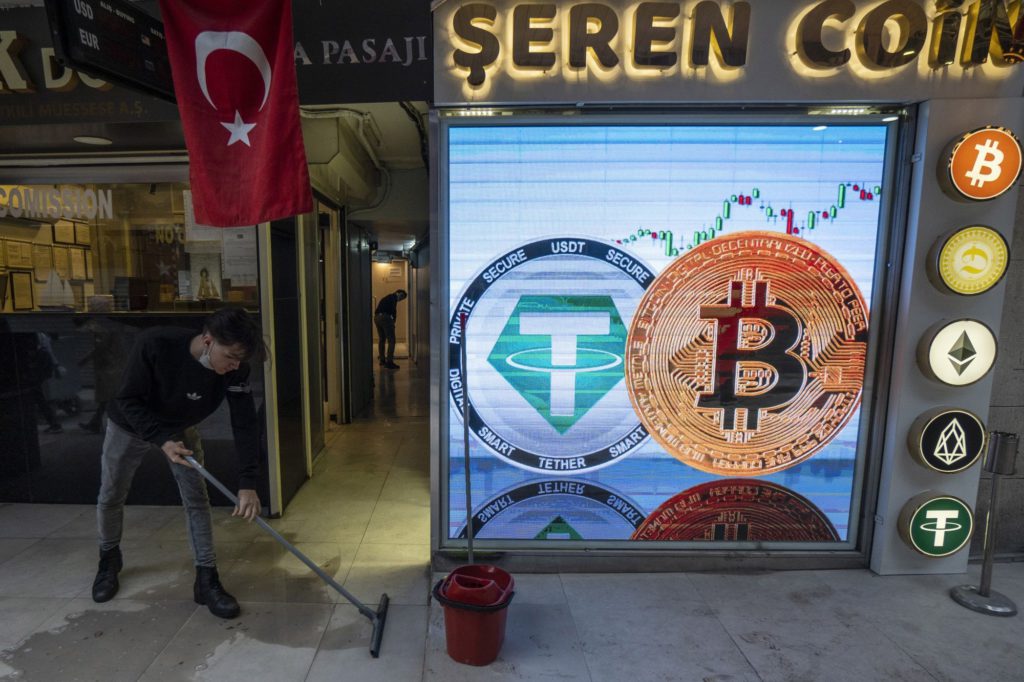
(Bloomberg) — The Philippines’ biggest bankers’ group boosted cooperation with the government and sought new laws against cybercrime, as losses due to these illicit activities hit 1 billion pesos ($19.6 million) during the pandemic. 

The Bankers Association of the Philippines signed on Friday a memorandum with the Department of Justice to bolster information-sharing and collaboration against cybercrimes. The bankers’ group will also organize more information campaigns on cybersecurity.

Ramon Jocson, vice chairman of the BAP’s cybersecurity committee, said the money lost to cybercriminals continued to rise, and banks do not shoulder all losses as some incidents involve clients who gave away personal identification or one-time passwords.

The bankers’ group is pushing to update a decade-old cybercrime law, enacted when most crimes involved stolen automated teller machine cards in contrast to the now prevalent phishing, Jocson said. It’s also seeking the enactment of a bill against so-called mule accounts, he said.

Banks Warn ‘Money Mule’ Scams Are Rising in The Philippines

“As banking and financial transactions are made more convenient and accessible to millions of Filipinos, so has it led to the increased sophistication on how crimes are perpetrated,” BAP President Wick Veloso said. “To us in the banking industry, this means that we always have to be one step ahead.”

More stories like this are available on bloomberg.com

©2022 Bloomberg L.P.
Putin’s Financial Fortress Blunts Impact of Threatened Sanctions

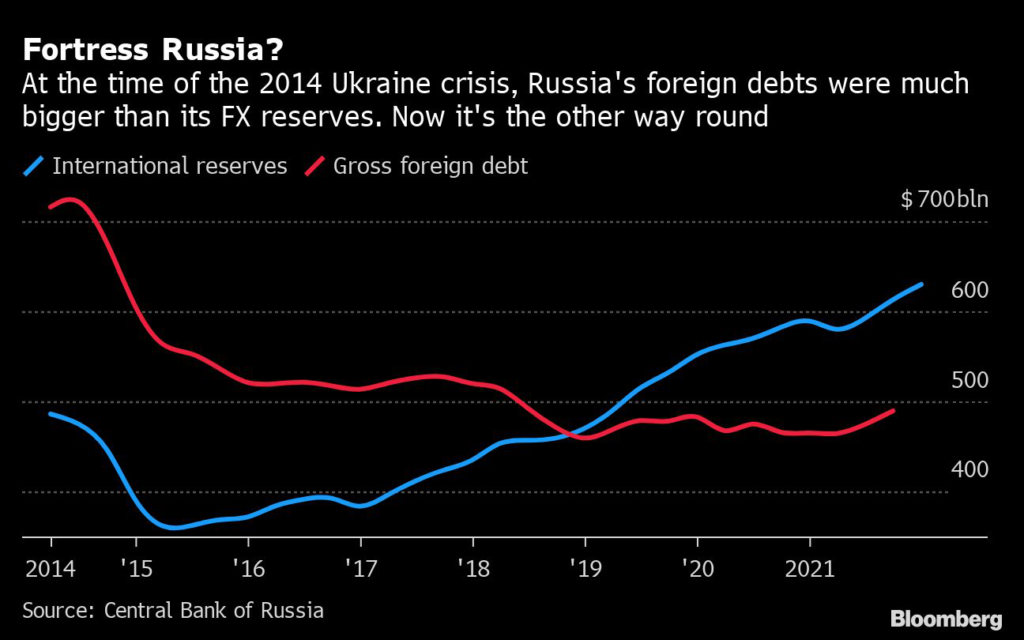
(Bloomberg) — U.S. President Joe Biden says planned sanctions if Russia invades Ukraine would have “a devastating impact” on its economy. But after the Kremlin spent the last eight years preparing for more penalties, economists say the pain may not be as bad as some fear.

The measures under consideration, which include limits on big banks’ ability to use dollars and euros, as well as restrictions on government debt and access to U.S. technology, would be the most severe since the first wave of limits slapped on Russia in 2014 following the annexation of Crimea, according to U.S. and European officials.

Back then, Russia spiraled into a financial crisis. The ruble lost half its value as the central bank saw its reserves plunge by $130 billion and the economy swung into a recession. 

This time around, economists say, the moves under discussion by the U.S. and its allies would hit the currency, fuel inflation and send investors fleeing, but might not be enough to trigger the same kind of turmoil. In addition to Kremlin preparations, a big difference is that prices for oil, Russia’s main export, are rising now, not plunging as they did in 2014. 


“Russia is much better prepared for sanctions than it was in 2014 at least on its macro-indicators,” said Natalia Lavrova, chief economist at BCS Financial Group in Moscow. “The state sector is ready and the financial cushion is big,” she said. In all but the most extreme of scenarios, the economy would continue growing, though at a slower rate and with higher inflation, she said.

READ: How Russia Risks New Wave of Sanctions Over Ukraine: QuickTake

Russian officials say they have no plan to invade, but Moscow has rejected western demands that it reverse a buildup of more than 130,000 troops on the border with Ukraine. With President Vladimir Putin expressing hope this week of a diplomatic solution, investors have started cautiously moving back into Russian assets.

Publicly, the Kremlin says it’s concerned about the risk of sanctions and has taken steps to limit their possible impact. Putin has repeatedly vowed that the threat of new restrictions won’t change his foreign policy. For the moment, the Kremlin seems confident that limits hitting Russia’s energy sector or other key exports would be too disruptive to global markets to be a realistic threat. 

What Bloomberg Economics says…

“The most likely sanctions on investment, banking and trade would inflict severe financial pain but limited economic disruption, as long as oil and gas keep flowing. In the more extreme scenarios, Russia would bear a much heavier cost, at a prohibitively high price for Europe.” 

— Scott Johnson, Bloomberg Economics. Read latest report here.

Still, western officials say the risk of sanctions remains. Just what the response would look like if Russia moved on Ukraine in a less dramatic way than an all-out invasion isn’t clear. 

READ: What We Know So Far About Potential U.S.-EU Sanctions on Russia

At $634 billion, central bank reserves are close to a record, thanks to policies that saved much of the oil windfall in a rainy-day fund. The budget ran a surplus of 0.4% of GDP last year and government debt at 18% of GDP is among the lowest of major economies. Moscow has reduced dependence on the dollar for trade and transactions and is building up its own alternatives to U.S.-dominated payment systems.

Thanks in part to those defenses, economists say that the likely sanctions would knock the ruble as much as 20% lower against the dollar, fuel already-high inflation and thus require more interest-rate increases by the Bank of Russia, as well as possibly intervention to support financial markets and sanctioned banks. 

“Assuming there isn’t an outright ban on exports, an increase in sanctions pressure will have an indirect effect on the economy, since significant financial restrictions have been in place since 2014,” said Sova Capital economist Artem Zaigrin. That could shave a bit more off annual growth than the roughly 0.2 percentage points he estimates the 2014 sanctions did.

In a mild scenario, with sanctions hitting just Kremlin insiders and some state entities, the ruble would drop about 6%, inflation would tick up slightly and the economy would grow 2.4% this year, down 0.2 percentage points from the baseline forecast, according to BCS’s Lavrova. Broader limits would hit the ruble harder and cut growth to 1.4%, she said.

Only in her most extreme scenario, which would include strict limits on debt and banks as well as exclusion of Russia from the Swift financial-communications system, would the economy swing to recession this year, she said.

Short of that, imposing the strictest sanctions on all 12 of Russia’s biggest commercial banks “could cause a repeat of the 2014 crisis, with more difficult and long-term consequences,” according to Rosbank economist Evgeny Koshelev.  

Over time, the limits on access to finance and technology would further hobble Russia’s already-depressed growth prospects, according to economists. 

“The medium to long-term impact that will be driving Russia into financial and economic autarky and the cost for the economy and for each individual is enormous,” said Elina Ribakova, deputy chief economist at the International Institute of Finance in Washington. “Potential growth will be much lower without interaction with the world.”

Here are some of the major types of sanctions under consideration and their likely impact.

Government Debt

The mildest version would ban investors from buying bonds in the secondary market (the U.S. imposed primary-market restrictions in 2021), while more drastic ones could require them to dump existing holdings, as well. While the moves would shake markets, they wouldn’t be too much of a burden to Russia’s finances, since the government runs a budget surplus and doesn’t rely on borrowing to pay its bills. 

Dmitry Dolgin of ING Eurasia said a ban on new purchases would cost Russia as much as $10 billion in capital inflows a year and push the ruble down by a few percentage points. A forced sale of existing bonds, as well, would likely require the central bank to step in to steady markets as the ruble dropped more steeply. 

Longer-term, Russia’s budget could come under more stress if it had to sustain a prolonged military operation or substantially increase financial support for Ukraine in the event it engineered a takeover in Kyiv by a pro-Moscow government.

Banks/Financial Sector

Hitting state-owned and other big banks with limits on their ability to use correspondent accounts in U.S. institutions “would cut them off from the dollar system,” said Ivan Timofeyev, a sanctions specialist at the Russian International Affairs Council. “That’s a more serious threat in terms of possible harm than debt.”

Putting individual institutions on the most restrictive SDN list would be even more painful, he said, noting that non-U.S. banks might also follow suit and freeze the affected entities out entirely.  

Russia has developed alternatives to the dollar-based financial system, including its own network for handling transaction information along the lines of Swift and direct links with banks in places like China. But it still relies on the dollar for 55% of its exports and the euro for another 29%, according to the central bank.

Technology

Russia already faces limits on access to much U.S. technology that could be of use to the military. Wider limits on the consumer sphere could force Russians to shift to Chinese and other phones. 

“Banning chips and sensitive technology would thrill some people in power,” said Karen Kazaryan, general director of the Internet Research Institute. “Such a move would force Russia to speed up import-substitution programs and mean more state money for noncompetitive industries.”

More stories like this are available on bloomberg.com

©2022 Bloomberg L.P.

U.S. Futures Rise on Amazon as Hong Kong Aids Asia: Markets Wrap

(Bloomberg) — U.S. equity futures rose Friday as Amazon.com Inc. earnings soothed nerves about the technology sector, while a Hong Kong rally boosted Asian shares. A hawkish chorus from key central banks hurt bonds.

Contracts on the tech-heavy Nasdaq 100 were up about 2% after e-commerce titan Amazon and Snap Inc. soared in late trading on strong earnings. An Asia-Pacific equity gauge pushed higher partly on a 3% jump in Hong Kong, which was catching up with global markets after reopening from a holiday.

Amazon could add nearly $200 billion in market value if the stock’s 14% gain in after-hours trading holds to Friday’s Wall Street close. That brightened the mood after a historic, $251 billion wipeout for Facebook owner Meta Platforms Inc. on Thursday consigned the Nasdaq 100 to its worst drop since 2020.

Hawkish comments from European Central Bank President Christine Lagarde and a Bank of England interest-rate hike underlined risks from inflation. Investors dumped bonds: Japan’s five-year sovereign yield increased to zero for the first time since 2016, after an increase in European yields and selling in Treasuries.

The euro strengthened and the dollar retreated. West Texas Intermediate oil flirted with $91 a barrel in an ongoing rally.

Volatility has become the hallmark of global markets this year. Investors are trying to come to grips with less favorable monetary conditions and a moderating global recovery but hoping company earnings will underpin stocks.

“The first half this year we are now experiencing a rates shock,” Tracy Chen, portfolio manager at Brandywine Global Investment Management, said on Bloomberg Television. “If the Fed and BOE and other EM central banks are too aggressive in hiking interest rates, potentially we are going to face kind of a recession risk in the second half, or at least more slowdown in the economy.”

The latest data showed U.S. service-sector growth pulled back in January to the slowest pace in nearly a year. Meanwhile, U.S. initial jobless claims fell more than expected last week to 238,000 ahead of data on payrolls Friday. 

The looming jobs report “is a reminder that expectations for Fed policy are the key influence on this market right now,” wrote Tom Essaye, a former Merrill Lynch trader who founded The Sevens Report newsletter. A hot inflation print next week would “rekindle hawkish Fed concerns,” he added.

In Europe, a slew of U.K. Prime Minister Boris Johnson’s top aides quit, deepening the crisis engulfing his government. The pound was steady. European equity contracts edged up.

For more market analysis, read our MLIV blog.

What to watch this week:

  • U.S. payrolls report for January, Friday
  • Winter Olympics kick off in China, Russia’s President Vladimir Putin due to attend opening ceremony, Friday

Some of the main moves in markets:

Stocks

  • S&P 500 futures rose 1.2% as of 2:25 p.m. in Tokyo. The S&P 500 fell 2.4%
  • Nasdaq 100 futures rose 2.1%. The Nasdaq 100 fell 4.2%
  • Japan’s Topix index rose 0.6%
  • Australia’s S&P/ASX 200 index increased 0.6%
  • South Korea’s Kospi index climbed 1.4%
  • Hong Kong’s Hang Seng index rose 3.1%
  • Euro Stoxx 50 futures rose 0.3%

Currencies

  • The Bloomberg Dollar Spot Index fell 0.2%
  • The euro was at $1.1468, up 0.2%
  • The Japanese yen was at 114.89 per dollar
  • The offshore yuan was at 6.3495 per dollar

Bonds

  • The yield on 10-year Treasuries advanced one basis point to 1.85%
  • Australia’s 10-year bond yield rose 10 basis points to 1.97%

Commodities

  • West Texas Intermediate crude was at $90.92 a barrel, up 0.7%
  • Gold was at $1,807.30 an ounce, up 0.1%

More stories like this are available on bloomberg.com

©2022 Bloomberg L.P.

U.K. Car Sales Jump 25% in January on Electric-Vehicle Demand

(Bloomberg) — U.K. car sales rebounded the most in seven months in January thanks to surging demand for battery-powered vehicles.

New-car registrations rose by a quarter last month, according to preliminary data from the Society of Motor Manufacturers and Traders. One in five buyers opted for a car with a battery, with shipments of fully electric vehicles more than doubling and plug-in hybrids rising 45%.

Last month’s performance compares favorably to the prior-year period, when dealerships were closed due to Covid-19 lockdown measures. Even so, it’s the biggest rise in monthly sales since June 2021. 

The SMMT has previously said it expects sales to rebound this year as the semiconductor shortage eases and demand for battery-powered vehicles grows. The group will release more detailed January numbers later Friday.

While 2021 was supposed to represent a lasting recovery from the initial onslaught of the pandemic, U.K. car registrations inched up just 1% to 1.65 million because of the persistent supply-chain snarls.

More stories like this are available on bloomberg.com

©2022 Bloomberg L.P.

Hong Kong Stocks Eye Biggest Post-Lunar Holiday Gain Since 2009

(Bloomberg) — Hong Kong stocks headed for their biggest post-Lunar New Year holiday advance since 2009, as traders played catch-up to gains in global equities and a rally in financials outweighed the impact of an overnight tech rout in the U.S.

The Hang Seng Index jumped more than 3% after the mid-day break on Friday. HSBC Holdings Plc and AIA Group Ltd. were among those leading gains. The Hang Seng Tech Index also climbed as much as 3%. Mainland China markets will reopen on Monday.   

Global equity markets have endured volatility while Hong Kong was closed. While that led some to expect fluctuations as trading in the city’s shares resumed, the benchmark equity index has got a boost from financial stocks after a hawkish pivot by central banks in Europe brightened the outlook for the sector on higher rates. Gains were also seen in certain sectors linked to the Winter Olympics, such as sportswear brands.

There is “more upside” possible in the medium term as China eases monetary and fiscal policies further to support economic growth, said Steven Leung, executive director at UOB Kay Hian Hong Kong Ltd. A positive open is very likely to make “the Hang Seng Index test 24,500 level,” which is around the gauge’s 100-day moving average, he said. 

Hang Seng’s gains come after shares of Chinese companies listed in the U.S. advanced during the holiday period. The Nasdaq Golden Dragon China Index — which includes many large Chinese technology firms — has jumped 5% since Hong Kong last traded on mid-day Monday, helped in part by encouraging commentary from the country’s cyberspace watchdog.

Equity benchmarks in Seoul, Singapore and Kuala Lumpur on Thursday had all posted post-holiday jumps, providing some reassurance for a positive open in Hong Kong. The U.S. tech selloff Thursday also showed signs of easing in late trading after Amazon.com Inc. and Snap Inc. soared on quarterly results.

Yet there are significant threats to a sustained recovery in Hong Kong and mainland stocks, even as an increasing number of global banks turn bullish on them.  

Some investors continue to sell into rallies, China’s property market distress remains acute and the slowing pace of economic growth continues to weigh. Positive statements toward the technology sector have yet to undo the damage inflicted on the business models of many internet platforms over the past year.

On top of all this, the mainland’s CSI 300 Index entered a bear market last week despite Beijing’s efforts to bolster confidence going into the holiday, and the central bank’s earlier pivot to stimulus.

Hong Kong’s Hang Seng Index had fallen into a bear market much earlier, in August, and remains down more than 20% from its peak in February last year.

“It’s clearly a rebound to catch up with the world, but we need to see how Hong Kong can navigate global volatility from here on,” said Joshua Crabb, a fund manager at Robeco Hong Kong Ltd.

(Updates with latest prices, new quote.)

More stories like this are available on bloomberg.com

©2022 Bloomberg L.P.

Close Bitnami banner
Bitnami