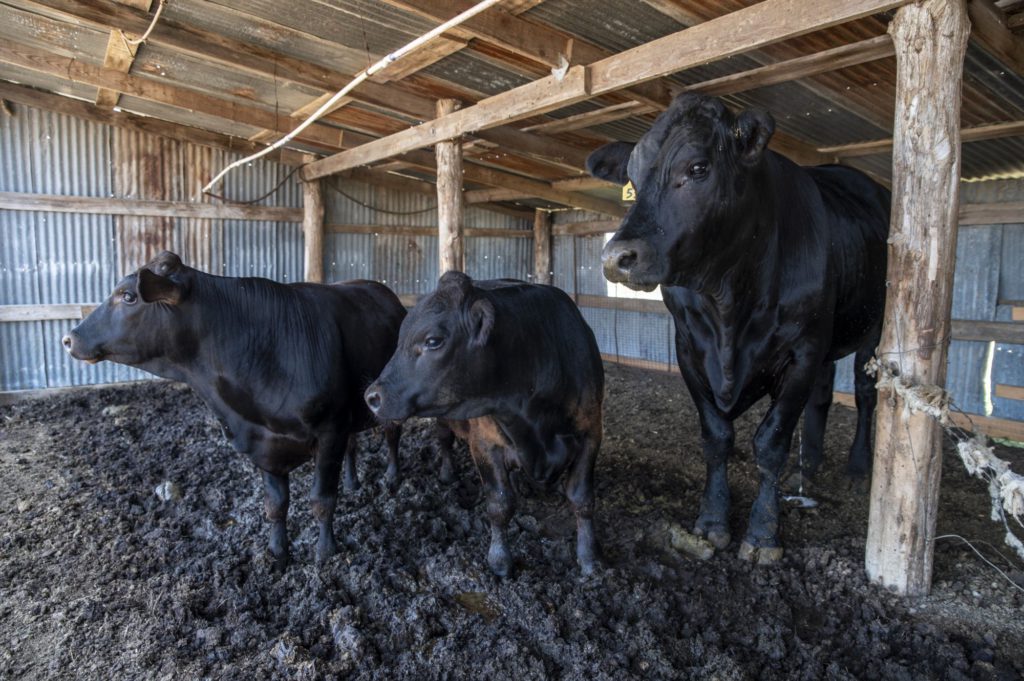
(Bloomberg) — What’s worse for the planet than Big Oil? The food system, argues environmental journalist and campaigner George Monbiot in his new book Regenesis and on Episode 17 of Zero. Agriculture is “one of the greatest causes of water pollution, of air pollution, and of climate breakdown,” Monbiot says. “And the sort of lion’s share, or cow’s share, of that is caused by livestock farming.”
In a wide-ranging conversation with host Akshat Rathi, Monbiot says the best solutions will require a radical refocusing on food’s newest technologies. Listen to the full episode below, learn more about the podcast here, and subscribe on Apple, Spotify, Google and Stitcher to stay on top of new episodes.
Our transcripts are generated by a combination of software and human editors, and may contain slight differences between the text and audio. Please confirm in audio before quoting in print.
Akshat Rathi 0:00
Welcome to Zero, I’m Akshat Rathi. This week: Microbial protein, the end of farming and really stinky cheese.
Akshat Rathi 0:14
Every year our food system does something amazing. We produce enough food for 8 billion people and then some. And although millions still go underfed, the level of hunger in the world is much lower than in all of human history. It’s a remarkable feat when put in its historical context.
Archival clip 0:31
Meanwhile, India’s food problems continue to create widespread concern, a countryside on the very edge of starvation.
Akshat Rathi 0:38
Back in the 1960s, widespread famine was averted by the Green Revolution, a transfer of agricultural technology to developing countries that massively increased farming yields across Asia and South America, and lifted hundreds of millions out of hunger and poverty. The population in the 1960s was just 3 billion. We’re now at 8 billion people and still our food system has managed to keep up. In 2019, the production of primary crops — things like cereals, fruits, vegetables — reached 9.4 billion tons globally. That’s 50% more than in the year 2000. But all that food production comes at an enormous cost. Agriculture is a major driver of global greenhouse gas emissions and almost 40% of the Earth’s surface is used for farming. That’s something that my guest today, environmental journalist and campaigner George Monbiot, argues is a disaster for our planet.
George Monbiot 1:37
The crucial environmental commodity, which we should be paying more attention to than any other environmental metric, is land. Because every hectare of land we use for an extractive industry is a hectare and not being used for wild ecosystems.
Akshat Rathi 1:52
In his new book Regenesis, George argues that the global food system needs a radical rethink. That system can sound abstract, but picture it as every business and relationship that exists to bring Ukrainian wheat to Pakistan, or Brazilian beef to a butcher in Paris. This conversation is about the difficulties facing that system. But it is also about solutions. The technologies that George hopes can fix a system in crisis and lead us to another, greener revolution. We join George surrounded by birds and bees in his community orchard in Oxford, where his book and his examination of the global food system begins.
Akshat Rathi 2:38
George, welcome to the show.
George Monbiot 2:39
Thank you very much.
Akshat Rathi 2:41
You open your book sitting in this orchard, pulling out a spit of soil. And then you examine the food system through the exploration of what is in the soil. You write about these systems being in crisis, and you then explore solutions to some of the crisis. Let’s start with the crisis. Where does the crisis in the world’s food system really begin?
George Monbiot 3:02
It begins with the world food system. In fact, the biggest problem the world food system faces is the world food system. And it’s beginning to look rather like the financial system in the approach to 2008, which is not a good place to be. There are a number of huge, super-dominant companies which have become too big to fail. So on one estimate, four companies control 90% of global grain trade. And as their operations have become more efficient and streamlined, which might be good for each individual business, it makes the system as a whole less resilient. And to understand this, you really have to grasp systems theory. And a complex system, which is what the global food system is, and indeed what most of the important things on Earth are, is a system composed of nodes, like the knots in an old fashioned fishing net, and the links between them. And if those nodes become too big and too strongly connected to each other, you lose the four elements of systemic resilience. One of those is redundancy: spare capacity that’s been more or less stripped out of the food system, everything has become super-efficient just-in-time delivery. Another one is what’s called modularity: the degree to which the system is compartmentalized. Well, that’s all been stripped out as well, as we’ve switched towards a global standard farm, supplying a global standard diet using the same seeds, the same chemicals, the same machinery everywhere. Then there’s circuit breakers: Where are the points at which shocks which pass through that system can stop being transmitted? Well, those have all gone as well. And then there’s the backup systems: Where are the entirely different systems which you could switch into if you encounter a crisis? They’re virtually non-existent now. And so, through this global homogenization, which seems to make sense — every individual step towards it makes sense — we see a system that has become systemically fragile. Now complex systems, they don’t respond to change in linear ways.
Akshat Rathi 5:13
They’re not complicated. They’re more than complicated.
George Monbiot 5:18
Yes, so an engine is a complicated system, it’s got lots of moving parts, but they behave in predictable and linear ways. Whereas a complex system is composed of billions of decision points, randomly, stochastically interacting with each other, but has this weird property of being self-regulating, within a certain range of stress. But then, if you push it beyond that stress range, those self-regulating circuits within the system become self-amplifying. And this is the same whether you’re looking at the global food system, global financial system, ecosystems, the atmosphere, the oceans, the human brain, the human body. This is how complex systems consistently behave. They’ll absorb stress and self-regulate and maintain an equilibrium state, up to a certain critical threshold.
Akshat Rathi 6:05
And you describe that threshold to be flickering, that you will start to see signs of it breaking down. Are there signs you’re seeing in the food system that respond to this sort of flickering in a complex system?
George Monbiot 6:19
Yes, you’re quite right. So as the system approaches a tipping point, its outputs begin to flicker. And we see things which don’t seem to make any sense. Just like in the approach to 2008, we saw these wild surges and fallbacks in equity values. And so what’s going on here? And then suddenly, the whole system was on the verge of going down because of the subprime crisis in the US, which wasn’t a big deal in terms of global financial flows. But it was the butterfly’s wing which nearly tipped the whole system. Well, in this case, we’re seeing those wild fluctuations in output values.
Akshat Rathi 6:50
Give us a few examples.
George Monbiot 6:52
Yes. So in 2015, something very weird happened. Between the 1960s and 2014, we saw a steady decline in chronic global hunger — fewer and fewer people going hungry. And then suddenly, in 2015, we saw that trend turn. And we started seeing the number of chronically hungry people rising. And that’s continued ever since.
Akshat Rathi 7:14
I mean, there’s the pandemic that’s made it worse, but this status was before.
George Monbiot 7:18
Yes, long before. And the really weird thing about this is that between 2014 and 2015, global food prices fell dramatically. The global food price index in 2014, was 115. In 2015, it was 93. And it stayed below 100 right up until halfway through 2020.
Akshat Rathi 7:37
So it’s not that there’s more poverty, and people can’t afford it. That’s why there’s hunger.
George Monbiot 7:41
Yeah, it’s the opposite to what you would expect. You’d expect that when the food prices fall, hunger falls, right. But it rose. And what has been happening here is that as the system has lost its resilience, shocks are more easily transmitted through it. So even something relatively small, like a speculative surge on one commodity, like an export restriction by one exporting nation, those shocks, instead of being damped down by a healthy system, get amplified by a system which is becoming fragile. We in the rich nations hardly noticed that because we’ve got the buying power, we’ve got the hard currencies. It’s the poor nations, which are food insecure, which are buying food with soft currencies in a hard currency market, that are at the end of that chain. And as the shock gets amplified through the chain, it lands on them. And so what you see is these sudden disruptions of supply in the poor nations which cause local price spikes. So even while the global price is low, the national price spikes, and that’s what seems to be driving chronic hunger. So we have the pandemic and people say, “Oh, there’s an issue with food supply here.” And then we have Russia’s invasion of Ukraine, “Oh there’s an even bigger issue with food supply.” And people assume that that’s what caused it. But actually, those problems, which are real problems, and definitely exacerbated it, revealed the systemic fragility. They haven’t caused the systemic fragility.
Akshat Rathi 9:01
And in 2015, of course, the Paris Climate Agreement was signed. Then, the world was 0.9 degrees Celsius warmer than pre industrial times. We are almost at 1.2°C now. And climate change is contributing to some of these problems?
George Monbiot 9:15
Well, a classic example was this year. After the invasion of Ukraine, India stepped forward and said, “Don’t worry, we can fill the gap because we’ve got a bumper wheat harvest coming and there’s going to be this massive shortfall of wheat exports from Ukraine. We’ll make up that shortfall. We’ll become a super exporter this year.” Literally, just four weeks later, the Indian government came forward again and said, “About those exports. We’re imposing a total export ban, because we were hit by this massive heatwave, which has shriveled the grain on the plants and and our wheat harvest is going to be much, much lower than we thought.” And so what we saw there was a climate crisis coinciding with a geopolitical crisis. And we’re going to see more and more of that. And some of the predictions for how environmental change is going to affect the global food supply are really terrifying. Absolutely, staying awake at night sweating, terrifying.
Akshat Rathi 10:14
But we have to acknowledge and sit in this sort of discomfort that this food system that we’ve created, has been able to supply food for the ever growing population. We had about 2 billion people at the start of the 20th century, who were fed. And yes, there was more hunger proportionally, then. And now we have 8 billion people, this year, we crossed that threshold. And we are still able to feed them. Yes, hunger is going up, but it’s still, relative to where we were, at a much lower level. So the system that’s allowed us to get here does have problems. But how do we sit with that discomfort?
George Monbiot 10:51
Yes. So it’s kind of like the man falling out of the window at the top of the skyscraper saying, “So far, so good.” It has served us well, so far. And we have been very fortunate, you know, we’ve seen this great surge in food production, which has outstripped population growth, such that we now produce roughly twice as many calories as humans need to survive on. Now, a huge amount of that is wasted by being channeled through livestock by being used for biofuels. Some of it disappears in food waste, as well. But we can turn out enormous volumes of food. Unfortunately, this system is now being hit by all these causes of fragility, which we’re just not attending to, and governments just don’t seem interested, they don’t even seem to understand what’s happening here. It is like the financial system before 2008, where it looked great, it looked really healthy, equity values were really high, the bank shares were soaring, it was all looking great. And then suddenly, boom. And it required this massive bailout. Now, the thing is that you could bail out the financial sector before it completely collapsed by drawing on future money. You can’t bail out the food sector by drawing on future food.
Akshat Rathi 12:09
What is it that got us to this point, where we have the ability for us to be able to make food for 8 billion people? What were the steps that led us to this point? And then where in those steps did we go wrong?
George Monbiot 12:21
The answer is the same to both questions. That’s the curious and paradoxical thing. The answer really is the Green Revolution, which moved us towards these very high-yielding, very successful new varieties, which respond very well to a particular formula or treatment. It’s the same seeds, it’s the same fertilizers, it’s the same machinery. You roll it out worldwide, and you’re producing a huge amount of food.
Akshat Rathi 12:46
And as somebody who grew up in India, that was tremendously valuable, because we were on the verge of facing hunger in levels that we’d never seen before.
George Monbiot 12:57
No question, no question at all. I mean, all the predictions were that we were going to see unbelievable and horrendous famines. And that system saved the lives of huge numbers of people. But it has these inherent instabilities for all those reasons that I mentioned. And its apparent health today, like the apparent health of the financial system, becomes ever more illusory as time goes on, because of the problem of systemic fragility.
Akshat Rathi 13:25
And so this concentrated agricultural system that’s feeding the world right now, how exactly is it contributing to climate change?
George Monbiot 13:31
Well, food production as a whole, is responsible for roughly 1/3 of all our carbon emissions, or greenhouse gas emissions. Even if we eliminate all other sources of greenhouse gas emissions, if we don’t tackle that, by the end of the century, it will exceed by between two and three times the amount of greenhouse gasses we can safely produce. Just the food system alone. But there’s an even bigger issue, which is the carbon opportunity costs. So those greenhouse gas emissions I’m talking about, you could think of those as a current account, current climate account. But the capital climate account is the carbon opportunity costs, which means what you could be doing otherwise, if you weren’t doing this particular thing.
Akshat Rathi 14:19
And those emissions that are generated are coming from fertilizer production? From changing the land use — you’re deforesting — and from the manure that’s coming from livestock and all those things?
George Monbiot 14:31
So the livestock themselves produce methane. Manure produces nitrous oxide. These are both very powerful greenhouse gasses. But the biggest question of all is this capital account. That land might otherwise be harboring for instance, forests or wetlands, both of which are very high-carbon habitats. And if the forests and wetlands are allowed to come back, they will draw down a great deal of the carbon dioxide we’ve released into the atmosphere. In fact, we now know that merely decarbonizing our economies is no longer enough. Clearly, we have to decarbonize them as quickly and as effectively as we possibly can. But even if we did that, we would almost certainly exceed two degrees of global heating. We need to draw down some of the carbon dioxide we’ve already produced. If we bring back forests and wetlands, in particular, they turn CO2 into C, into solid carbon. And in doing so, they could determine whether or not we get through this century. In fact, it’s very hard to see how we’re going to sustain our life support systems unless there’s a mass restoration of wild ecosystems, like forests and wetlands. And the biggest impediment to that is livestock keeping.
Akshat Rathi 15:42
In your book, you mention this statistic, which is stunning, which is that we produce twice as many calories as humans consume. But of course, that’s because the vast majority of those calories are not being fed to humans, they’re being fed to livestock. And that creates its own set of problems.
George Monbiot 16:02
Yes indeed. So we have this grossly inefficient system that we’ve created of eating animals. And it divides into two categories. There’s the intensive animal production, which involves these gigantic factories with tens of thousands of chickens, or thousands of pigs, all these giant feedlots with loads and loads of cattle kept in horrendous conditions, massive animal cruelty, being fed on grain often shipped from the other side of the world, particularly soya grown in the Sahara and the Amazon in South America with devastating ecological consequences. And then, when they’ve eaten that food, there’s a huge amount of nutrients that comes out the back end of those animals, and there’s nowhere for those nutrients to go, they can’t easily be transported because they’re very low value and high volume. So farmers spread them on the surrounding fields, the fields can’t absorb them all. The surplus washes off into the rivers and the rivers die. And all over the world now, we’re seeing the global standard river being created by intensive livestock farming, which is over-fertilized, which means you get these blooms of microalgae, which when they respire at night, suck all the oxygen out of the water and kill everything else. And so they’re turning into sewers effectively, our beautiful rivers, and this is happening all over the world. So that’s the intensive livestock farming. And everyone says, “Oh, we hate that.” And they say. “So the answer must be extensive livestock farming” — in other words, grazing.
Akshat Rathi 17:28
Happy farming.
George Monbiot 17:30
Exactly, happy farming. And we see all the images. We’ve got this long, bucolic pastoral tradition of the shepherd with their flocks, or the cowboy with the cows. And we think that’s the answer. But if there’s one thing worse than intensive livestock farming, it’s extensive livestock farming. And the reason for that is that, by definition, extensive farming means using more land to produce the same amount of food. That’s the definitional quality of it. And the crucial environmental commodity, which we should be paying more attention to than any other environmental metric, is land. And the amount of land you use is the key determinant of whether our life-support systems survive or not. Because every hectare of land we use for an extractive industry, like cattle ranching, for example, is a hectare not being used for wild ecosystems, such as forests, or wetlands or savannas or natural grasslands. And so we’re seeing this as the biggest driver of all habitat destruction. I mean, agriculture is the worst thing we’ve ever done to the planet, right?
Akshat Rathi 18:39
Worse than Big Oil?
George Monbiot 18:41
Oh, yeah. Well, yes, because of the full spectrum assault on the planet. I mean, it causes a massive amount of climate breakdown. More than global transport does, for example, considerably more. But it also is the greatest cause of habitat destruction by a very long way. The greatest cause of wildlife loss. The greatest cause of extinction, again, by a very long way. Greatest cause of soil degradation. Greatest source, of course, of freshwater use. One of the greatest causes of water pollution, of air pollution, and of climate breakdown, as well. And the sort of lion’s share, or cow’s share, of that is caused by livestock farming. And the more extensive that livestock farming is, the more damaging it is because of the sheer amount of land it requires to support it. There was a study in the United States saying, “What if we did what all the foodies and chefs and some environmentalists say we should do, which is to switch from grain-fed cattle production to pasture fed cattle.” And it looked at it and said “Oh, yes, we would have to raise the amount of land use to keep cattle by 270%.” That would mean more than the entire surface area of the United States. You’d have to demolish the cities. You’d have to cut down all the forests, you’d have to water the deserts, you’d have to dig up all the National Parks.
Akshat Rathi 19:58
Take away all the golf courses.
George Monbiot 20:00
Of course, take out all the golf courses. Yes, worst of all! And you would turn the whole US surface into a cattle ranch. And then you’d still need to be importing loads of your beef from the Amazon, which incidentally, they’re already doing and calling it pasture-fed. It’s an absolute environmental catastrophe. The most damaging of all farm products is organic, pasture-fed beef. And the reason for the organic bit is that organic needs even more land and produces even more greenhouse gas emissions.
Akshat Rathi 20:30
There is a stunning stat in the book which said, we use 28% of the land on the planet, to create 1% of protein that humans consume.
George Monbiot 20:43
Yeah, the land issue is so interesting and so important, right? We all hate urban sprawl, right? And we’re right to hate urban sprawl, because it’s very bad for the countryside. And it’s also very bad for our cities. But the entire urban area that humanity uses, whether in towns, villages, whatever, is 1% of the terrestrial planet surface. Much of the rest of the world is ice cap, desert, rocky mountains, which we can’t really use for extractive industries. And about 15% is protected area. Forty percent is used for agriculture. But of that 40%, the 12% is used for growing crops, and roughly half of that of those crops are going into livestock. But then, what about the 28%? That 28% — the biggest thing, the worst thing we do to the planet, is entirely for pasture-fed animals. From the animals which get their food from grazing alone, they produce just 1% of our protein, 1%! This is the most wasteful, profligate, destructive way of producing our food you could possibly imagine. And you might ask yourself, “why, in the 21st century, are we using a Neolithic means to produce our protein-rich foods?”
Akshat Rathi 22:04
After the break, George discusses the technologies that can help bring farming and protein production into the 21st century.
Akshat Rathi 22:20
I want to move to the solutions part of the book because there are different solutions. There is growing meat in labs, there’s insect protein, there is using AI for farming. But the solutions that you put forward are much more radical. We should do away with the farm entirely. You call it the techno-ethical shift. What is it?
George Monbiot 22:41
So I’m not calling for an end to all farming, I am calling for an end of all livestock farming. I think that we just can’t afford to indulge this way of feeding ourselves anymore. It is an indulgence that the planet cannot accommodate anymore. There’s just not the space for it. If we’re gonna get through this century, we have to stop livestock farming, it really is as simple as that. Yeah, you like your steak, but I quite like a habitable planet. Oh steak? Habitable planet? Steak? Habitable planet? Tough choice, right? So what I’m calling for yes, is the end of livestock farming. And we are incredibly fortunate. Because just as we need that shift, we have the means of doing it far more effectively than ever before.
Akshat Rathi 23:21
At this point, I would go, “You’re talking about lab-grown meat, right?”
George Monbiot 23:25
Yeah, except I’m not. I thought, when I started research for this book, that lab-grown meat was going to be a big part of the answer. This cultured meat where you can actually grow your steak, or grow your lamb chop, or grow your tuna filet in a flask in a factory, in a bioreactor. I think there are now just too many technical and financial barriers to doing that at scale. Not least because you need to maintain clinical standards of hygiene to do it, which is very expensive. Because if you don’t, the issue is that mammalian cells double every 24 hours. Well, bacterial cells double every 20 minutes. So unless you’ve got clinical standards, you’re gonna have a bacterial culture, not a mammalian culture. And that is where actually the answer comes in: bacterial cultures. Because bacterial cultures are really, really easy to grow and super productive and much, much cheaper. Not just cultured meat, but in fact, any protein-rich food that we produce today.
Akshat Rathi 24:27
Well, they’ve had 3 billion years to become efficient.
George Monbiot 24:32
That’s right. And I feel very privileged. This is a pure vanity thing. But when I went to Helsinki to look at a company, which was one of the early movers in this field, it’s called Solar Foods, and it’s producing this protein-rich flour from a hydrogen oxygenating bacterium found in the soil whose feedstock is hydrogen. It doesn’t eat any photosynthetic product. In fact, it turns hydrogen into its useful energy and creates its cells that way.
Akshat Rathi 25:02
And we can make hydrogen by splitting water using sunlight.
George Monbiot 25:06
Anywhere on Earth. Well, particularly places which are hungry, which tend to have a lot of sunlight. And so you’ve got this enormous potential. So anyway, I was the first person outside the lab — and this is where the vanity comes in — to eat a pancake made from this bacterial flour. A small flip for mankind. And amazingly, it tasted just like a pancake. We had to dilute it, because normally, if you’re making a western-style pancake, you start with your wheat flour, right. And that doesn’t have enough protein and fat to make a proper pancake. So you add eggs and milk. But in this case, because the bacterial flour is 60% protein and about 30% fat, you have to dilute it otherwise you’d make an omelet. So you mix it with wheat flour, bring the wheat flour in, and mix it with the wheat flour. And it was just uncanny. This is a pancake. It’s just an ordinary pancake. Now, obviously, they’re not just in the business of making pancakes, because what you can do is to produce the exact mix of proteins and fats and things that you need to replace animal products very, very cheaply — eventually — and with a tiny fraction of the land footprint, the water footprint, the nutrient footprint, all the key elements of what it takes to make food
Akshat Rathi 26:18
That’s even after you account for the solar farms and the wind turbines and electrolyzers, that would split water that would be needed for all the hydrogen.
George Monbiot 26:28
Absolutely. So on my estimates, you could, if you wanted to do it all in one place — and I very strongly advocate that we don’t, that it should be a highly distributed system — but you could produce all the world’s protein in an area the size of Greater London. And that then gives us this tremendous ability to release land for ecosystems for rewilding. To bring back the forest and the wetlands and the savannas and the natural grasslands on which we depend, on which our entire life support systems depend. I mean, if we can’t restore much of what we’ve destroyed on this planet, the entire earth system is going to reach its tipping point. I mean, that again, seems clear. We’re seeing the flickering, these wild weather events that are hitting us more and more, look very much like the flickering in a complex system that precedes a tipping point.
Akshat Rathi 27:18
So you’re looking at the food system, you’re saying, “Okay, we need proteins and vitamins and carbohydrates and fat, and the protein and the fat could come through this system.” But we’ve had vegetarian diets — I grew up in India with a vegetarian diet — for a very long time. They’re not being adopted more widely. So why do you think people would turn around and say, “Yes, George, you made a really good point. Let’s just all flip over now.”
George Monbiot 27:46
It’s not going to happen like that. That’s not how change happens. I mean, change at the margin happens. And I’ve got a plant-based diet, and a small percentage of people in Europe have plant-based diets. But that is in no way catching up with the tremendous speed of expansion of animal farming. So we can’t rely on that moral suasion to get people to change. It’s partly going to be on price, that these new technologies have steep cost curves, and it’s not going to be long at all before they undercut even the cheapest form of plant protein — which is soya — which is a lot cheaper than any animal protein. So they’ll compete very well on price, but also on quality. I mean, the plant-based substitutes for meat, a lot of them are not great. And it’s because they are dealing with these big complex ingredients which have to be broken down and extracted. There’s a lot of processing involved. You have to disguise some of the flavors — particularly if using coconut — often the fats are greasy rather than juicy, you’ve got a whole lot of issues. And these can be much more easily tackled through precision fermentation, where you’re making the exact proteins and components that you want. So you have much less processing, much healthier products, cheaper products. First of all, you can replace the great majority of the meat we eat, which is the meat that comes from factory farming, that is in all the chicken nuggets and the burgers and the sausages and stuff. And then you can start moving up that value chain. But even more importantly, I think we’re going to see a great flowering of new diets, of things we can’t even conceive of, any more than the first Neolithic farmers to capture a wild cow were thinking about Camembert. There’s going to be a whole load of products emerging from these new technologies, which we haven’t imagined.
Akshat Rathi 29:29
There was an ad that came out in 2000. I don’t know if you’ve seen it. A spaceship in the form of a Coca-Cola bottle lands on Mars. It shoots out straws and all the aliens — Martians — come and sip on the Coca-Cola and finish it up. And then they form a message on the planet that says “Send more Coke.” That is the kind of aspiration that sells, clearly. Do we need a “Send more Coke” version for this new form of eating?
George Monbiot 30:04
Well, it certainly needs a publicity boost, because a lot of people say, “Oh, I’m not eating bacteria.” I say, “Well hang on a moment. First of all, you eat bacteria with every meal. In fact, worse than that, you’re composed to a large extent of bacteria.” And we deliberately add live bacteria into some of our food. I mean, let’s think about cheese, right? So cheese, you start with the mammary secretions from another species called a cow. And you mix those, traditionally, with a chemical extracted from the fourth stomach of a nursing calf called rennet. You mix it up with the mammary secretions, you create this wobbly mass of fat and protein. And then you inject bacteria into that. The bacteria digest that wobbly mass, and then that excrement turns into this yellow stinky stuff. And if you leave it long enough, it gets really nice and stinky and moldy. And then we eat that! And people say, “Ewww bacteria!” What we’re looking at, what’s coming out the end of this process is basically a flour. It’s just a protein-rich flour. That’s what it is. It happens to be made from bacterial cells, but you wouldn’t see the difference between that and any other flour — except it’s incredibly high in protein and fat, and you just smell it and go, “Oh, well, that’s nice.” Because we’ve got a very strong attraction to protein, as humans. And then you can turn that into anything. Without all the cruelty, without the epidemics of disease, without all the slaughterhouse, and the blood and the guts and the gore and stuff. And, you think microbial food is disgusting?
Akshat Rathi 31:42
So the other solution, if we solve protein and fat with these precision fermentation vats, is to try and address the crop problem. And you look at perennials. What are those?
George Monbiot 31:57
So this is, I think, a really exciting way forward here. The great majority of our grain crops come from annual plants, in other words plants which live and die within one year. Large areas covered by annual plants are quite rare in nature. And they generally only occur in the wake of a disaster. So where a landslide, or a fire, or a volcanic eruption clears the ground. And the annual plants are specialists in colonizing bare ground, so they’ll quickly colonize it, they’ll reproduce very fast, and dominate for a couple of years. And then the longer lasting plants are perennials, which live more than one year. They then come in and swallow up that space and push the annuals out. So almost all our green crops are annual. And that means that to grow them, we need to create a disaster every year, we need to clear the land and we do it either by plowing or by spraying. And then we carry on spraying to kill the competition and to kill the pests which might eat these very tender little shoots which are coming up, and then we have to splash on the fertilizer and use loads of water and really pamper them to get them going. And it’s a catastrophic system.
For the past 100 years or so, some scientists have had the dream of replacing these annual crops with perennial crops because they see the enormous difference they can make in terms of environmental damage, but also potentially food security. And finally, at last, that dream has been realized, driven primarily by this group called The Land Institute in Salina, Kansas. One of the crops has gone all the way now and it’s fully commercialized, and it’s a variety of rice, which they have developed with Yunnan University in southern China. Already, there’s many thousands of hectares of this rice being grown. In some cases, it’s been harvested for six harvests continuously and is still producing the same yields as annual rice produces. And the farmers are desperate for it a) because there’s much less soil erosion involved, you don’t have to plow every year, I mean, eventually, you’ll have to replace the crops but after several years, rather than every year, and secondly, that they’re desperately short of labor, because a lot of the young people have moved to the cities. And of course, you don’t have to plant every year. So I’ve eaten this rice, it’s just the same as any other short grain rice, I really could not tell the difference. And then they’re developing a whole series of other grain crops now, types of wheat or related species to wheat, barley, sorghum, sunflower, beans, peas, lentils. Not all of them have gone very far down the line. Some of them are progressing faster than others. But they’re tremendously exciting, not just because you create less environmental damage by growing them, but also because they appear to be more resilient to environmental crises. So to give you an example, the Land Institute is developing this very promising perennial sunflower, and it’s been growing its blocks of perennial sunflowers alongside blocks of annual sunflowers. In one year, it was hit by a major drought that completely wiped out the annual sunflowers. The perennials just sailed through. And the reason for that is their roots are down deeper, their structures above ground are tougher and more robust. And yeah, they just shrugged the drought off.
Akshat Rathi 35:16
The solutions you are suggesting may take the same industrial route that some of the solutions that are now problems have taken. So you might get consolidation, you might get these limited varieties being grown. Just like we have big agriculture, we might have big fermentation. Would that be okay?
George Monbiot 35:39
Well, no. We have to be constantly on our guard against these tendencies: the tendency towards concentration, the tendency towards monopoly. There was a time when governments were, they had strong antitrust laws and they had weak intellectual property laws. But it’s turned on its head now. Now we have weakened trust laws and strong intellectual property laws. And that creates consolidation, drives the process of mergers and acquisitions as corporations try to concentrate intellectual property in one place. And that is deadly. And it doesn’t matter which sector you’re looking at, it’s harmful to competition, it’s harmful to human welfare, it’s harmful to workers. I mean, right across the board. This is bad news. And we’ve been given this great gift to humanity, which is precision fermentation, which has come along just when we need it most. Are we going to squander this by allowing a few big corporations to control it? Well, no, we must fight that. The problem is not the technology, it’s the same with all of these issues. It’s the control of the technology and the ownership of the technology. And that is something we need to get ahead of. And instead of sitting there and waiting for it to happen, we need to be campaigning vociferously to ensure that we have a distributed food system rather than a concentrated food system. Because that’s one of those elements of resilience. If it still has its backup systems and the circuit breakers and the modularity within the system — which a distributed and diverse food system can give you — then it’s much more likely that the system as a whole is resilient [rather] than this situation we’ve got today.
Akshat Rathi 37:16
Now capitalism has its problems. But one thing it does while it’s concentrating capital, is it also makes things more efficient. And some of the solutions you’re suggesting need to become more efficient. And so how do you split the problems that capitalism brings from the advantages that it does have?
George Monbiot 37:34
Is a very good question. And the answer always is regulation. I mean, I would love to see much more public ownership. And I don’t just mean state ownership, but community ownership. This orchard where we are today is part of a commons, which is managed collectively by the 220 plot holders, who run this allotment system. You can have a commons with technology. Linux is a classic example of a technological commons. You can have it with open source technology, you can have it with Creative Commons-licensed technology. I want to see far more of our economy directed into the commons. But even within the capitalist economy, which is a totally different economy to the commons, we need to see far more regulation, far more response to the generalized needs of humanity, rather than just the needs of shareholders. And with food, that is more of an issue than in virtually any other sector, because well, we all kind of depend on it.
Akshat Rathi 38:38
If there was a billboard outside your house, what message would you put on it?
George Monbiot 38:42
Ah, that’s a good question. Private sufficiency, public luxury.
Akshat Rathi 38:47
Explain that.
George Monbiot 38:48
There’s enough ecological space on Earth and enough physical space for us all to have wonderful public parks and public tennis courts and public swimming pools and public transport networks, to have luxurious public domains which we share. But there’s simply not enough for us all to have private luxury. Some people have private luxury only because other people don’t. If everyone had their own swimming pool and tennis court, London would be the size of England and England would be the size of Europe. Where would everyone else live? And there’s not enough ecological space as well. So we can have our own private sufficiency, our own small domain at home, where our basic needs are met. But if we want luxury, we do it together.
Akshat Rathi 39:32
That was a fascinating conversation. Thanks for coming on the show.
George Monbiot 39:35
It was a total pleasure. You asked all the right questions, thank you.
Akshat Rathi 39:42
Food is such an integral part of our lives, but we rarely think about how it’s produced, and its stunning impact on the planet. If the numbers in our conversation didn’t already blow your mind, I’d highly recommend reading George’s book Regenesis. The solutions he lays out may seem fanciful, but they can work and they’re not the only technologies we have to tackle this problem. Thanks for listening to Zero. If you like the show, please rate review and subscribe. Tell a friend or tell your favorite farmer. If you’ve got a suggestion for a guest or topic or something you just want us to look into get in touch at zeropod@bloomberg.net. Zero’s producer is Oscar Boyd and senior producer is Christine Driscoll. Our theme music is composed by Wonderly. Many people helped make the show a success. This week, thanks to Sommer Saadi, a Podcast Producer in London, who makes sure that the growing podcast team always has food to eat. I’m Akshat Rathi, back next week.
More stories like this are available on bloomberg.com
©2022 Bloomberg L.P.