

Bloomberg

Retailer Offers Shoppers Cash for Brazil’s Goals at World Cup

(Bloomberg) — When Brazil’s national squad enters the Lusail Stadium in Qatar on Thursday for its first match in this year’s World Cup, Roberto Fulcherberguer will be watching more closely than most. 

As the chief executive officer of Brazilian retailer Via SA, Fulcherberguer implemented an unusual sales campaign ahead of the tournament. The ads, featuring Real Madrid star Vinicius Jr., offered an incentive to those looking for a new TV to cheer the team on their bid for a sixth championship: cash for goals. 

That’s right. Buy a TV, or another appliance, and get cash — not store credit — straight into your bank account, based on how many goals the Brazilian team scores. 

“We’ve done our homework, and we’ll make money on the campaign,” Fulcherberguer said in an interview at Bloomberg’s Sao Paulo office. 

The World Cup usually boosts TV sales by about 30%, according to the executive. To make sure the company could meet the increased demand, Via sent a group of employees to South Korea and China last year to negotiate with manufacturers such as Samsung, LG and TCL for bulk buys. 

The bold sales campaign is part of his latest move in a three-year effort to rescue the company, which offers physical stores and online shopping, and convince investors that it has turned the corner. 

Fulcherberguer took over in 2019 after local hedge funds joined forces with retail mogul Michael Klein to buy a 36% stake sold by French grocer Casino Guichard-Perrachon SA’s local subsidiary. 

Less than a year later, the pandemic hit and Via — owner of brands including Casas Bahia — shut down all its stores. In terms of e-commerce, the company was years behind competitors, with only 15% of sales coming from its digital channels at the time. It made a push to keep connected with consumers through the messaging app WhatsApp, to help complete sales for Brazilians not used to buying online. 

The strategy worked: it sold a record 3 billion reais in the Black Friday week alone in 2020. Now, even as customers come back to stores, they are more at ease buying online, he says, but that doesn’t mean Via is dialing back on its physical presence. Many customers still prefer to pick up purchases in one of the company’s more than 1,000 brick-and-mortar stores, he said, and some of them also operate as small distribution centers, which helps lower costs.

Not sold

It’s been more of an uphill battle when it comes to markets — the stock is down almost 90% since peaking in July 2020. While the CEO has met more than 50 investors from London to New York and Boston this year, money managers have asked to see a few more quarters of stability and growth before coming back. 

One pain point has been to get analysts to understand the complexity of Via’s structure, which includes logistics operations and a massive credit arm alongside its physical stores and digital channels. 

Via relies on its own bureau of statistics to analyze credit scores for a base of 97 million people, according to Fulcherberguer, which is almost half of the Brazilian population. Its loan portfolio rose to 5.7 billion reais in the third quarter from 3.5 billion reais two years earlier. While Via sells its consumers’ debt to banks, it remains responsible for delinquencies, which hover at about 5%. 

The company and analysts have opposite approaches as to how this fits into Via’s balance sheet: while the firm says its net debt ended the third quarter at almost 800 million reais, analysts from Citigroup Inc. calculate it excluding credit card receivables, and thus see a higher amount of about 3 billion reais.

That might be, in Fulcherberguer’s words, “the biggest opportunity and the biggest problem” for the company. Analysts “need to take the receivables into account too,” he added. 

‘Please, Not 10’

For the fourth quarter, expectations are high. A combination of Black Friday, Christmas and now the World Cup means there’s no “room for errors,” but the company is excited about the cash-for-goals campaign. 

It has some caveats, of course. It doesn’t apply to all TVs or appliances, and the amount of cash varies depending on the price of the item. The payout is contingent on customers opening an account in the firm’s digital bank BanQi, which will be where the money is deposited — Fulcherberguer says the process is simple and involves no fees. It will consider net goals, so a 3×2 score for Brazil would mean customers get paid for just one goal, not three. And importantly, it applies only to the first game played after the purchase. With expectations that thousands of sales will have taken place before Thursday’s game, all eyes will be on the debut.

“I only pray that they don’t score too many goals in the first game,” he joked. “One or two is fine — but please, not 10.”

–With assistance from Daniel Cancel.

More stories like this are available on bloomberg.com

©2022 Bloomberg L.P.
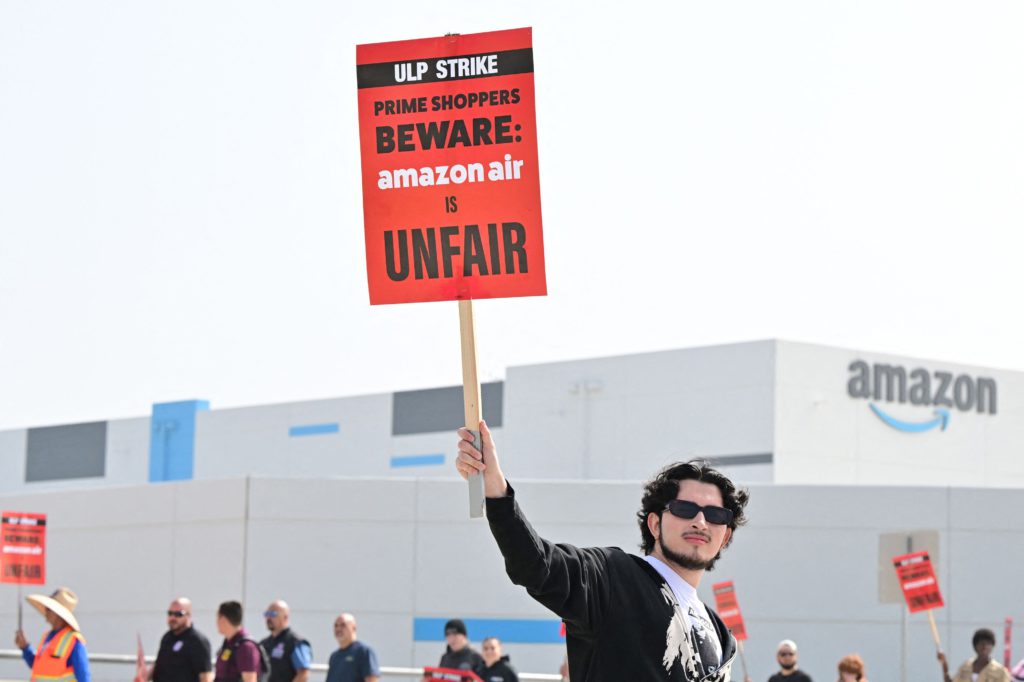
Amazon Faces Black Friday Protests, Strikes in 40 Countries

(Bloomberg) — Thousands of Amazon warehouse workers across about 40 countries plan to take part in protests and walkouts to coincide with Black Friday sales, one of the busiest days of the year for online shopping.

Employees in the US, UK, India, Japan, Australia, South Africa and across Europe are demanding better wages and working conditions as the cost-of-living crisis deepens, in a campaign dubbed “Make Amazon Pay.” The campaign is being coordinated by an international coalition of trade unions, with the support of environmental and civil society groups.

“It’s time for the tech giant to cease their awful, unsafe practices immediately, respect the law and negotiate with the workers who want to make their jobs better,” said Christy Hoffman, general secretary for UNI Global Union, one of the campaign’s organizers.

Tension with workers has been a long-running issue at the e-commerce giant, which has faced complaints of unfair labor practices as well as employee activism and union drives at some facilities. In what was seen as a watershed moment, workers at a warehouse in Staten Island, New York, voted earlier this year to join an upstart union.

“While we are not perfect in any area, if you objectively look at what Amazon is doing on these important matters you’ll see that we do take our role and our impact very seriously,” Amazon spokesman David Nieberg said. 

He cited the company’s target to reach net zero greenhouse gas emissions by 2040 and that it’s “continuing to offer competitive wages and great benefits, and inventing new ways to keep our employees safe and healthy.”

Unions in France and Germany — CGT and Ver.di — are spearheading the latest collective action, with coordinated strikes in 18 major warehouses, intended to disrupt shipments across key European markets.

Monika di Silvestre, head of Ver.di’s Amazon committee in Germany, said that workers were particularly concerned about the way their productivity was closely monitored by computers, with algorithms determining targets, for example for the number of packages they need to handle per hour.

“The workers are under a lot of pressure with these algorithms,” she said. “It doesn’t differentiate between workers, whether they are old or have limited mobility. Workers stay awake at night thinking only of their productivity stats.”

She called on European politicians to strengthen labor rights across the bloc. “We don’t have a right to strike around Europe — on the European level,” she said.

In the UK, workers associated with GMB union have planned protests outside several warehouses, including Coventry.

“Amazon workers in Coventry are overworked, underpaid and they’ve had enough,” said Amanda Gearing, a senior GMB organizer, adding that “hundreds” will assemble to demand a wage increase from £10.50 an hour to £15.

Any workers who walk out during a shift could lose out on the second half of a £500 bonus that Amazon announced for UK warehouse workers last month. The final payment is contingent on staff taking “no unauthorized absence” between Nov. 22 and Dec. 24. The GMB has said linking payments to attendance could be interpreted as unlawful inducement not to strike.

In the US, protests and rallies will take place in more than 10 cities and outside an apartment block on 5th Avenue, New York, where Amazon founder Jeff Bezos has a condo. Multiple rallies are also planned in India while in Japan, members of a recently created union will protest in front of the company’s national headquarters in Tokyo. In Bangladesh, garment workers in Amazon’s supply chain will march in Dhaka and Chittagong.

Some demonstrations will focus on Amazon’s environmental and social footprint, for example in Ireland where people will gather outside the company’s Dublin offices to push back against two new planned data centers in the city. In South Africa, protesters will gather near Amazon’s new offices in Cape Town, which is being developed on land that indigenous people consider to be sacred.

Some unions expressed concern about the current economic climate amid a warning from Amazon that its peak Christmas season might not be as busy as usual. The company’s decision to lay off 10,000 staff will also make wage negotiations more challenging.

Laurent Cretin, a delegate for the CFE-CGC union in France, said the company will have 880 workers in a warehouse in Chalon-sur-Saône this Christmas season, down from 1,000 before Covid, which he linked to tightening consumer spending and the transfer of activity to robotized warehouses.

“The projections are not great, we are not sure we will do as good as last year that saw a post-Covid surge,” he said.

(Updated with comments from Ver.di from paragraph 8.)

More stories like this are available on bloomberg.com

©2022 Bloomberg L.P.
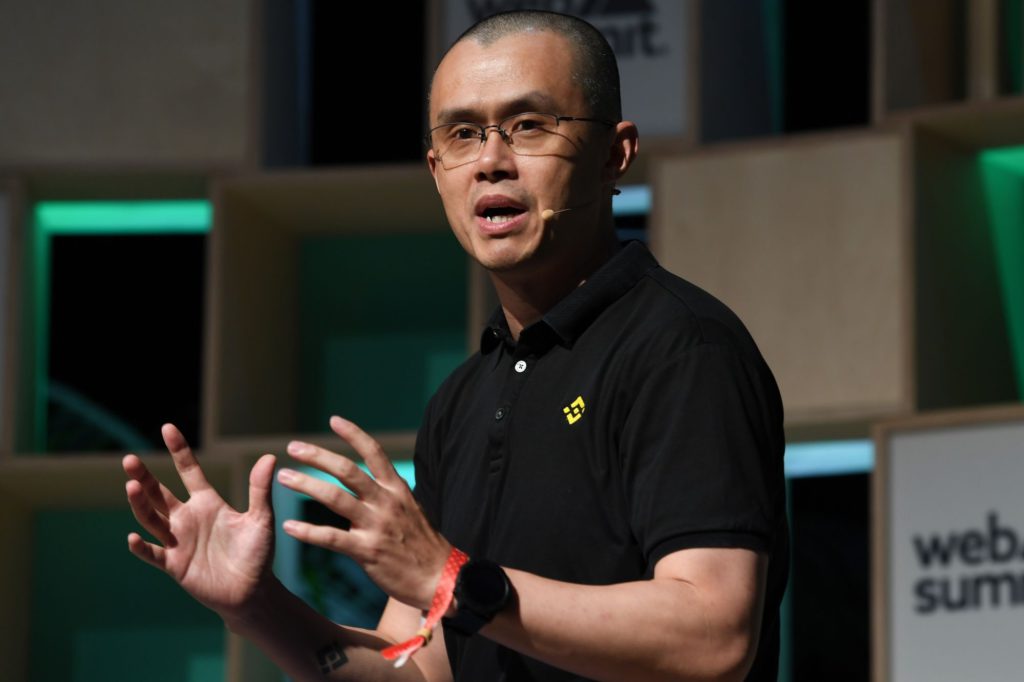
Binance’s Zhao Flags Possible $1 Billion for Distressed Assets

(Bloomberg) — Crypto billionaire Changpeng “CZ” Zhao further outlined his plans to backstop the stricken industry, pledging to amass at least $1 billion for buying distressed assets and saying his Binance Holdings Ltd. will make another bid for bankrupt lender Voyager Digital.

In an interview Thursday with Bloomberg Television’s Haslinda Amin, Zhao provided the most detailed overview yet of the various deals Binance is examining in the wake of rival FTX’s messy collapse. The centerpiece of Zhao’s plan is gathering partners for a fund aimed at backing promising but cash-strapped crypto projects. 

“We are going with a loose approach where different industry players will contribute as they wish,” he said. Zhao added that he’ll soon publish a blog post providing more detail about the fund. 

Zhao said he’s seeking to limit damage to the crypto sector from FTX’s implosion — an event the Binance chief himself helped accelerate with a Nov. 6 tweet about plans to sell a $530 million holding of FTX’s native digital token. Before his empire fell, FTX founder Sam Bankman-Fried had agreed to several deals that are now in limbo, including the purchase of Voyager. 

The Binance leader’s credibility as industry savior is a topic of controversy because of his role in FTX’s undoing, as well as investigations into the company from Singapore to the US. Members of UK Parliament have asked Binance to explain the circumstances surrounding Zhao’s Nov. 6 tweet, and whether the company understood the potential impact it might have.

Read more: Crypto’s Richest Man Faces Regulatory Crackdown, Brutal Winter (Repeat)

Another source of tension is that while Binance has licenses in many different jurisdictions, it isn’t formally based anywhere. When asked about the matter in the Bloomberg interview, Zhao demurred, saying only that Dubai and Paris are now its “global hubs.” 

Voyager Bid

This year’s deep crypto rout has lopped about $80 billion off Zhao’s personal fortune, but at $15 billion it still far exceeds that of anyone else in crypto, according to the Bloomberg Billionaires Index. 

Zhao said Binance US is planning to revive its bid for the assets of Voyager, a deal which came back into focus after FTX filed itself for bankruptcy. Binance will be competing with crypto exchange CrossTower Inc. and other companies for Voyager. 

Binance is also in talks with Genesis Global, the US-based cryptocurrency broker which is seeking emergency funding to stay afloat, Zhao said. The troubled brokerage has $2.8 billion in outstanding loans on its balance sheet, with about 30% of its lending made to related parties including its parent company, Barry Silbert’s Digital Currency Group. 

Zhao said a Genesis collapse might only impact some large institutional players and sought to downplay the potential damage to the industry as a whole.

“There will be pain whenever one player goes down,” he said. 

Dubai, Paris ‘Hubs’

The crypto billionaire, who moved to Dubai last year, has been expanding his company’s presence in Europe and the Middle East. “Today we have the largest offices in Dubai and Paris so you can view those two as global hubs,” Zhao said, declining to disclose where the company was headquartered.

With FTX now in bankruptcy, Zhao’s interactions with his former competitor is coming full circle. Binance initially agreed to buy FTX as it started crumbling, then pulled out after Zhao relized what a precarious state Bankman-Fried’s exchange was in.  

Binance did not have access to all of FTX’s books or trading history and could not trust the information it provided, Zhao said in the interview. The exchange is now planning to look at FTX’s assets as they come through bankruptcy proceedings, he said.

“They invested in a number of different projects, some of them are OK, some of them are bad but I think there are certain assets that are salvageable,” Zhao said.

For crypto market prices: CRYP; for top crypto news: TOP CRYPTO.

–With assistance from Suvashree Ghosh.

(Updates with UK parliament questions in seventh paragraph.)

More stories like this are available on bloomberg.com

©2022 Bloomberg L.P.

Veon to Sell Russian Unit to Its Managers in $2.1 Billion Deal

(Bloomberg) — Veon Ltd. decided to sell its Russian unit to some senior members of its management team in the country as the mobile operator attempts to limit the fallout from the war in Ukraine on its business.  

Veon will receive 130 billion rubles ($2.1 billion) from PJSC VimpelCom’s managers, the company said in a filing on Thursday. The total sum will be paid primarily by taking on Veon’s debt. The deal is expected to be completed by June 2023.

Veon’s share price has fallen by two-thirds this year as the invasion and subsequent sanctions on Russia imposed by the US, EU and UK undermined the company. Its Russian unit accounts for about half of the mobile operator’s revenue. 

“Following the conclusion of this transaction, Veon will have greater visibility for regaining access to international debt capital markets,” Chief Executive Officer Kaan Terzioglu told Bloomberg by phone after the announcement.

Veon was founded in Moscow in 1992 as VimpelCom, one of the nation’s first cellular-phone providers. It has grown into a Dutch-domiciled telecommunications giant with more than 217 million customers in nine countries and is the largest mobile operator in Ukraine.

LetterOne Investment Holdings, founded by Russian billionaire Mikhail Fridman, owns 48% of Veon according to data compiled by Bloomberg. Fridman was sanctioned by both the EU and the UK earlier this year, and stepped down from the boards of Veon and LetterOne. 


More stories like this are available on bloomberg.com

©2022 Bloomberg L.P.

FTX Latest: Bankman-Fried Says He Will Speak at Event as Planned

(Bloomberg) — Sam Bankman-Fried said in a tweet that he would speak with the New York Times’ Andrew Ross Sorkin at the publication’s annual DealBook Summit next week. A spokesperson for the New York Times said it currently expects Bankman-Fried to participate in the interview from the Bahamas.

Coinbase Global Inc.’s junk bonds may have been an early warning sign of the FTX contagion. The largest US digital-asset trading platform has seen the price of its bonds plunge this year. The drop is mainly due to the crypto winter, but some industry participants said it was an omen.

Binance Holdings Ltd CEO and Founder Changpeng “CZ” Zhao pledged to amass at least $1 billion for buying distressed assets as he further outlined his plans to backstop the stricken industry. The centerpiece of his plan is gathering partners for a fund aimed at backing promising but cash-strapped crypto projects, he told Bloomberg Television’s Haslinda Amin in an interview Thursday.

Crypto markets steadied as Bitcoin traded above $16,000. The world’s largest cryptocurrency by market value is down 70% since the same time last year, when the token was trading just below the almost $69,000 all-time high. So, this Thanksgiving it might be wise to avoid talking about crypto at the dinner table. 

Key stories and developments:

  • FTX Investors Go After Brady, Shaq: Here Are Their Legal Chances
  • FTX Flipped Jane Street’s Risk Obsession to Disastrous Effect
  • Cathie Wood Sticks to $1 Million Bitcoin Call as Others See Rout
  • What the FTX Collapse Suggests About Crypto and Risk
  • Sequoia Capital Says Sorry for FTX But Defends Vetting Process

(Time references are New York unless otherwise stated.)

Binance CEO Outlines Crypto Rescue Plan (05:02 a.m.)

Crypto billionaire Changpeng “CZ” Zhao plans to raise at least $1 billion for a fund to buy distressed assets, he said in an interview Thursday with Bloomberg Television’s Haslinda Amin. He said he’d seek to gather partners for the fund aimed at backing promising crypto projects that are short of cash.

Bankman-Fried Says He’ll Speak at NYT Event (8:12 p.m.)

Sam Bankman-Fried tweeted that he would be speaking with New York Times’ Andrew Ross Sorkin at the DealBook Summit in New York next week. A spokesperson for the New York Times said it currently expects Bankman-Fried to participate in the interview from the Bahamas. FTX was based in the island nation.

Accounting Firm in Metaverse Sucked Into Meltdown (2:42 p.m.)

An accounting firm that touts itself as the first to open its headquarters in the metaverse was accused in a lawsuit of turning a blind eye to a pattern of racketeering at FTX, the cryptocurrency exchange that collapsed causing billions of dollars in losses. Prager Metis CPAs LLC, an auditor for FTX, was sued by an investor who claims to have lost almost $20,000.

Coinbase Debt Seen as Early Warning Sign (2:22 p.m.)

In the wake of the spectacular meltdown of Sam Bankman-Fried’s crypto empire, many investors are looking for early warning signs that may have foretold the contagion that was about to unfold. One possibility? Coinbase Global Inc.’s junk bonds.

The largest US digital-asset trading platform has seen the price of its bonds plunge this year. In early January, the price for one of its most active notes was at about 92 cents. It then slid to about 77 cents in April before dropping to 63 cents amid the Terra Luna market crash in May. The bonds traded around 53 cents on the dollar — a level typically associated with distressed — in early morning trading in New York Wednesday, according to Trace bond trading data. 

Crypto Market Activity Plummets (1:17 p.m.)

Crypto investors are still sifting through the rubble of the FTX collapse, but one thing’s already evident: market activity has dwindled significantly.

Senators Want Executives to be Accountable (10:49 a.m.)

Democratic senators Elizabeth Warren and Sheldon Whitehouse have asked the Justice Department not to pull any punches as it investigates and seeks to hold accountable the executives at FTX who contributed to the crypto company’s demise. 

Custodians Like Fidelity Will Attract Users: Novogratz (9:45 a.m.)

Crypto billionaire Mike Novogratz said the “crisis of confidence” in the digital asset world will drive more cryptocurrency users to seek out institutional players like Fidelity Investments.

The founder of Galaxy Digital Holdings Ltd., a crypto financial services firm, told CNBC that more people will put their money in “safe and trusted custodians.”

Novogratz Says ‘Bitcoin Is Not Going Away’ (8:48 a.m.)

Mike Novogratz, the CEO and founder of Galaxy Digital, tells CNBC in an interview that while there was a “bubble” in crypto assets this is a long-term buying opportunity because “Bitcoin is not going away.”

He says that what happened at FTX is an indictment of the company and other similar firms that are poorly run, however it is not an indictment of crypto itself. 

Serving Humble Pie This Thanksgiving (8:00 a.m.)

Polite company never talks politics or religion. This Thanksgiving, it might be wise to avoid crypto, too.

Last year’s digital asset investors basted themselves in Bitcoin riches. Then, the token traded just below the almost $69,000 all-time high set weeks earlier. By dessert time, the crypto hopefuls may have even sold the Baby Boomers on a token or two. 

This holiday season, the Bitcoin bulls have less to be grateful for. The largest digital asset has plummeted about 70% since last Turkey Day. That drop might annoy the guests who bought in, including the Baby Boomers persuaded by their younger relatives.

Jane Street Alums Ditched Wall Street Firm’s Risk Focus at FTX (7:49 a.m.) 

Jane Street Group is known among peers for its obsession with risk and preference for stealth. The more-than 2,000 employee powerhouse based in lower Manhattan digs into the health of trading partners, models potential catastrophes, autopsies losses and restricts staff from commenting publicly, because even that poses a danger.

The easiest way to describe the culture that Sam Bankman-Fried and a cadre of Jane Street alumni created at FTX: The opposite.

Crypto Crash Offers a Path to Recovery for Damaged Relationships (6:58 a.m.)

Devoting days and nights to a gamified digital economy left a mark on some people’s relationships, turning partners into crypto widows and widowers. 

Now they have some emotional work to do: in the aftermath of the digital-asset mayhem, believers are trying to heal what Bitcoin and Bored Ape obsessions did to intimacy.

Wild Divergence in Bitcoin Predictions Highlights Uncertainty (4:32 a.m.) 

Over the past few days, long-term targets for the world’s largest token by market value have ranged from $5,000 at strategists BCA Research Inc. to $1 million by 2030 for Ark Investment Management’s Cathie Wood. 

The cavernous spread reflects the gnarly question of what further contagion may or may not lie ahead following the evisceration of Sam Bankman-Fried’s FTX exchange and trading house Alameda Research, onetime crypto darlings.

El Salvador Closer to Issuing Bitcoin Bonds (12:05 p.m. HK)

The country’s presidency dispatched a digital-securities bill to lawmakers, taking the nation a step closer to raising $1 billion via the world’s first sovereign blockchain bond.

The legislation calls for a digital-assets commission and a Bitcoin Fund Management Agency to oversee crypto-related debt sales. The proposed blockchain bonds, with a minimum investment of just $100, are meant to help finance the construction of the Bitcoin City project.

New York Governor Signs Moratorium to Curb Crypto Mining (11:10 a.m. HK)

Kathy Hochul signed one of the most restrictive laws in the US on regulating cryptocurrency mining, with the bill triggering a two-year moratorium on new permits for crypto-mining companies.

“I will ensure that New York continues to be the center of financial innovation, while also taking important steps to prioritize the protection of the environment,” Hochul said in a statement.

Bankman-Fried Says Collateral Crashed by $51 Billion as FTX Fell (8:30 a.m. HK)

Bankman-Fried, disgraced founder of the now collapsed crypto exchange FTX and trading house Alameda Research, apologized to staff in a letter that outlined a crash in “collateral” to $9 billion from $60 billion.

“I didn’t mean for any of this to happen, and I would give anything to be able to go back and do things over again,” he wrote in the message sent to employees Tuesday and obtained by Bloomberg News.

Sequoia Capital Says Sorry for FTX But Defends Vetting Process (7:20 a.m. HK)

Top partners at the venture capital firm apologized to their investors in a conference call Tuesday for backing FTX, according to people familiar with the meeting.

Roelof Botha, the firm’s global leader, opened the call, and he and his colleagues were repentant for backing the company, with investments totaling $214 million in FTX.com and FTX.us across two funds. Alfred Lin, the partner who led the FTX deal, provided an update on the situation. Shaun Maguire, another partner who focuses on crypto, gave an overview of the sector.

Cathie Wood Holds On to $1 Million Target for Bitcoin (7:10 a.m. HK)

“Bitcoin is coming out of this smelling like a rose,” said the ARK Investment Management CEO as she defended her forecast.

Wood also said that crypto infrastructure is “working beautifully.” She added that digital-asset manager Grayscale Investments is now the crown jewel of Barry Silbert’s once-$10 billion Digital Currency Group conglomerate.

More stories like this are available on bloomberg.com

©2022 Bloomberg L.P.

Nigeria Growth Rate Slows to 2.25% as Oil Production Slumps

(Bloomberg) — Nigeria’s economy grew 2.25% year-on-year in the third quarter amid a drop in the West African country’s oil production.

Gross domestic product growth slowed from 3.54% in the second quarter, according to data released by the National Bureau of Statistics on its website on Thursday.

“The reduction in growth is attributable to the base effects of the recession and the challenging economic conditions that have impeded productive activities,” the report said.

The non-oil economy expanded 4.27% in the quarter from a year earlier, largely driven by telecommunications, trade and transportation. But the oil sector slumped, contracting 22.7%, as production fell to 1.2 million barrels a day on average. That compared to 1.43 million barrels in the second quarter.

Africa’s second-largest crude producer has been trying to ramp up production to reach its full OPEC+ quota but has been beset by ongoing supply disruptions, including oil theft. 


More stories like this are available on bloomberg.com

©2022 Bloomberg L.P.

EU Opens Up 5G on Planes, Making In-Flights Calls More Likely

(Bloomberg) — The European Union said it will enable the “wide-spread deployment of 5G services” on aircraft by designating certain frequencies for in-flight cell-phone connectivity.

The decision will allow airlines to let customers make and receive phone calls, text messages and data just as they would on the ground, the European Commission said in a statement Thursday. Service will be provided using special network equipment called a pico-cell that connect the in-flight network to the ground via a satellite, the statement said.

“5G will enable innovative services for people and growth opportunities for European companies,” Thierry Breton, the EC’s commissioner for the internal market said in the statement. 

The US Federal Communications Commission in 2020 scuttled plans to allow in-flight voice and data services via mobile wireless frequencies, saying that there was strong opposition including from airline pilots and flight attendants on safety and national security grounds.

More stories like this are available on bloomberg.com

©2022 Bloomberg L.P.

ICBC Leads Big Banks to Offer $129 Billion to China Builders

(Bloomberg) — China’s mega banks, led by Industrial & Commercial Bank of China Ltd., pledged financing support of at least 925 billion yuan ($129 billion) to property developers as part of a push to ease turmoil in the nation’s real estate market. 

ICBC, the world’s largest bank by assets, on Thursday said it would provide 655 billion yuan in credit lines to 12 developers, including Country Garden Holdings Co. That came after Bank of China Ltd., Bank of Communications Co., Postal Savings Bank of China Ltd. and Agricultural Bank of China Ltd. also disclosed they would also extend credit lines. 

Property stocks and bonds rallied on the additional funding, as China seeks to contain the fallout from a crackdown that has already sparked dozens of defaults and sent property sales and prices tumbling. China’s priority has been to ensure that unfinished homes get completed, while supporting the stronger firms that have so far survived the crisis. 

“The core of the policy is to build a firewall between developers that have already defaulted and those that haven’t,” said Li Kai, founder of Beijing Shengao Fund Management Co.

The barrage of bank financing wasn’t extended to China Evergrande Group, the country’s most-indebted developer that in large part kicked off the current turmoil, as well as Sunac China Holdings Ltd.   

Chinese property firms rallied on Thursday. A Bloomberg Intelligence stock index of developers climbed more than 7%. Dollar bonds also gained, with investment-grade Longfor Group Holdings Ltd. rising as much as 7 cents. 

The moves came after regulators issued a 16-point plan earlier this month to financial firms for boosting the real estate market, with measures that range from addressing developers’ liquidity crisis to loosening down-payment requirements for homebuyers. 

The big state-owned banks have since set up special mechanisms to ensure quick implementation of the measures, and created whitelists for qualified regional developers to extend maturities of their existing development loans, according to a representative of the China Banking and Insurance Regulatory Commission, who declined to be identified because they aren’t authorized to speak publicly.

The big banks will also expand financing services to support acquisitions of high-risk projects by “key” developers, the representative said without naming any companies. Some joint-stock banks have allowed mortgage borrowers to delay repayments without reclassifying their loans, the person added.

CCB Plan

China Construction Bank Corp. has yet to announce any support agreement, though the bank set up a 30 billion yuan fund to buy properties from developers. The lender has made progress on more than 20 projects, with their combined assets exceeding 10 billion yuan, the CBIRC representative said. 

China’s banks have been told to provide at least 1 trillion yuan in funding in the final months of 2022 to the battered property sector to avoid a broader fallout on the economy that is also weighed down by Covid lockdowns, Bloomberg reported earlier.

The industry has issued 2.64 trillion yuan worth of loans to developers and 4.84 trillion yuan of mortgages in the first 10 months this year, the CBIRC representative said. 

At a meeting with banks on Monday, the People’s Bank of China said it planned to provide 200 billion yuan in interest-free re-lending loans to commercial banks through the end of March to provide matching funds for stalled property projects. 

–With assistance from Wei Zhou, Jackie Cai and Zhang Dingmin.

(Updates with regulator comments from eighth paragraph)

More stories like this are available on bloomberg.com

©2022 Bloomberg L.P.

Scammers Posing as HSBC, Barclays Paid Crypto to Spoof Shop

(Bloomberg) — A global “spoofing shop” which scammed victims out of tens of millions of pounds has been thwarted by international law enforcement agencies.

London’s Metropolitan Police Service said Thursday it had shut down fraud website iSpoof and made more than 100 UK arrests in connection with the case. The Met worked in coordination with the Federal Bureau of Investigation, Europol and Dutch authorities to make the arrests. 

ISpoof allowed fraudsters, who paid in Bitcoin, to disguise their phone numbers so it appeared they were calling from major banks including Barclays, HSBC, Lloyds to trick people into giving them personal details. 

As many as 20 people every minute were being contacted by the scammers and iSpoof earned as much as £3.2 million ($3.9 million) over one 20 month period from the scheme. Losses reported as a result of the iSpoof calls and texts is around £48 million, the Met said, adding that because fraud is vastly underreported, the full amount is believed to be much higher. 

“The exploitation of technology by organized criminals is one of the greatest challenges for law enforcement in the 21st century,” said Met Commissioner Mark Rowley. “The Met is targeting the criminals at the center of these illicit webs that cause misery for thousands.”

The average loss for those who reported the scam was £10,000 and police said there was more than 70,000 numbers linked to the suspects. The alleged ringmaster of the website was arrested near London’s Canary Wharf earlier this month and has been charged with several offenses.

More stories like this are available on bloomberg.com

©2022 Bloomberg L.P.

Scammers Posing as HSBC, Barclays Paid Crypto to ‘Spoofing Shop’

(Bloomberg) — A global “spoofing shop” which scammed victims out of tens of millions of pounds has been thwarted by international law enforcement agencies.

London’s Metropolitan Police Service said Thursday it had shut down fraud website iSpoof and made more than 100 UK arrests in connection with the case. The Met worked in coordination with the Federal Bureau of Investigation, Europol and Dutch authorities to make the arrests. 

ISpoof allowed fraudsters, who paid in Bitcoin, to disguise their phone numbers so it appeared they were calling from major banks including Barclays, HSBC, Lloyds to trick people into giving them personal details. 

As many as 20 people every minute were being contacted by the scammers and iSpoof earned as much as £3.2 million ($3.9 million) over one 20 month period from the scheme. Losses reported as a result of the iSpoof calls and texts is around £48 million, the Met said, adding that because fraud is vastly underreported, the full amount is believed to be much higher. 

“The exploitation of technology by organized criminals is one of the greatest challenges for law enforcement in the 21st century,” said Met Commissioner Mark Rowley. “The Met is targeting the criminals at the center of these illicit webs that cause misery for thousands.”

The average loss for those who reported the scam was £10,000 and police said there was more than 70,000 numbers linked to the suspects. The alleged ringmaster of the website was arrested near London’s Canary Wharf earlier this month and has been charged with several offenses.

More stories like this are available on bloomberg.com

©2022 Bloomberg L.P.

Close Bitnami banner
Bitnami