Bloomberg

Musk Has to Add Twitter Moderators in Europe, Commissioner Says

(Bloomberg) — Elon Musk will have to increase the number of Twitter moderators in Europe, according to Thierry Breton, the EU’s internal market commissioner.

“He is in the process of reducing a certain number of moderators, but he will have to increase them in Europe,” Breton told Franceinfo in an interview. “He will have to open his algorithms. We will have control, we will have access, people will no longer be able to say rubbish.”

Breton earlier warned that Twitter would have to “fly by our rules,” shortly after Musk closed his $44 billion takeover last month.

Breton said he had proposed establishing a “working relationship” with Musk to discuss Europe’s expectations of the social media platform. “He knows perfectly well what the conditions are for Twitter to continue operating in Europe,” Breton said.

More stories like this are available on bloomberg.com

©2022 Bloomberg L.P.

Laid Off by Silicon Valley? Barclays Still Wants You

(Bloomberg) — Silicon Valley’s painful wave of job cuts is creating an opportunity for Barclays Plc. 

The British lender is offering to provide support for laid-off workers starting new fintech businesses and hopes to attract staff for some of its thousands of technology job vacancies.

“I’m a firm believer that when one door closes, another one opens and out of adversity can come opportunity,” Mark Ashton-Rigby, chief operating officer of Barclays, wrote in a LinkedIn post this week. 

Ashton-Rigby wrote that Barclays was extending its program for aspiring entrepreneurs, which provides a 20-week course to help them create their own fintech companies. Barclays has more than 3,000 open roles for technology staff around the world in areas such as engineering and innovation.

“If you’re embarking on a new chapter and are reading this, take it as a sign that there could be something very exciting for you just around the corner… apply today,” he wrote.

Some of the world’s biggest technology firms have begun firing thousands of employees in recent weeks, putting an abrupt end to more than a decade of rapid jobs growth. Bloomberg has reported that Amazon.com Inc. is cutting 10,000 positions, while Meta Platforms Inc. has said it’s making 11,000 employees redundant. At Twitter Inc. at least 3,700 jobs are being cut, or about half the social media company’s workforce, under new owner Elon Musk.

More stories like this are available on bloomberg.com

©2022 Bloomberg L.P.

BofA Sees Bear Rally Fizzling Out Even as Equity Inflows Surge

(Bloomberg) — Investors flocked back into equities at the fastest pace in about eight months on signs of cooling inflation, but Bank of America Corp. strategists warn the rally will fizzle out due to earnings risks and staunchly hawkish central banks.

Global stock funds saw inflows of $22.9 billion in the week through Nov. 16, according to a note from the bank citing EPFR Global data. A slower-than-expected US inflation report last week initially fueled bets that the Federal Reserve could signal a slowdown in the pace of rate hikes.

But stock market moves have since been subdued as Fed officials indicated more scope to raise rates before they see a meaningful slowdown in consumer prices. Bank of America strategists led by Michael Hartnett said they predict a policy pivot only in June or July and that expecting any easing before then would be a “big mistake.”

In the absence of an earlier change to the Fed’s approach, “a fair chunk of the bear market rally is behind us,” they wrote in a Nov. 17 note.

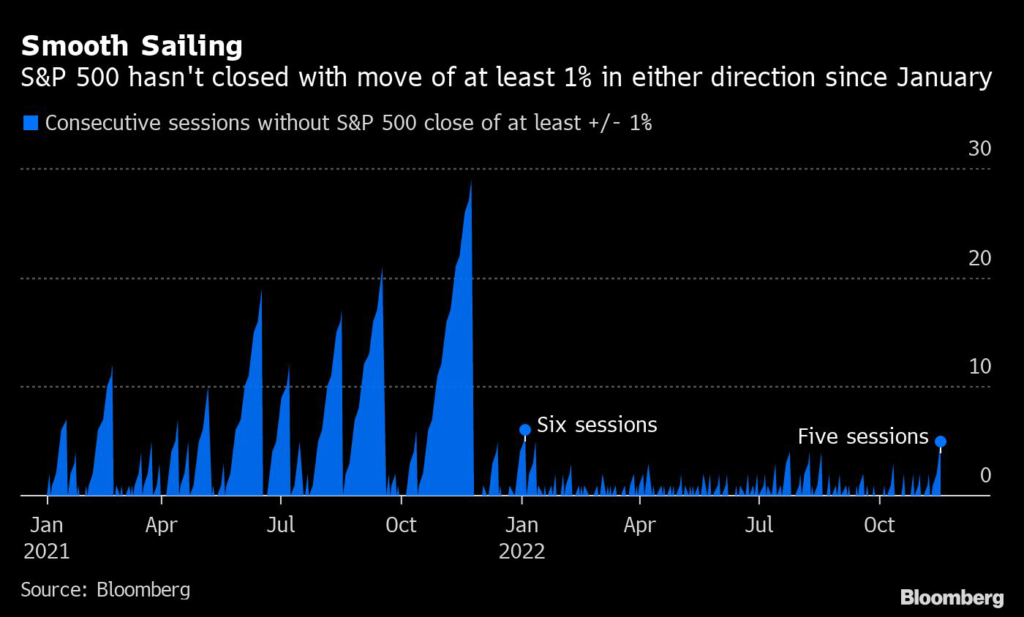
Market volatility has calmed after wild swings earlier this year. The S&P 500 Index has now gone five consecutive sessions without closing either 1% higher or lower for the first time since January, and traders expect swings to ease even further in the coming weeks.

Morgan Stanley’s Wilson Sees Rough Ride for Stocks in 2023 

The outlook is dimmer again for next year as market strategists including Michael Wilson at Morgan Stanley warn of weaker corporate earnings fueling more stock losses before a rebound in the second half. Bank of America’s team also said profits will “ironically” remain under pressure even as inflation recedes. They recommend holding bonds in the first half of 2023, with stocks becoming more attractive in the last six months of the year. 

Global bond funds had inflows of $4.2 billion in the week, while $3.7 billion retreated from cash, the data from Bank of America show. In Europe, stock redemptions reached a 40th consecutive week — the longest pace on record, according to the note.   

By style, US large cap, small cap, value and growth all saw additions. Technology and health care led sector inflows, while communication services, utilities and real estate had small outflows.

–With assistance from Thyagaraju Adinarayan, Jessica Menton and Matt Turner.

More stories like this are available on bloomberg.com

©2022 Bloomberg L.P.

India’s New Data Protection Bill Seeks to Ease Storage Norms

(Bloomberg) — India is moving ahead on a long-delayed data protection rule, seeking to allow personal digital data to be transferred to some other countries for storage in a move that will come as a reprieve for global companies including Alphabet Inc.’s Google, Amazon.com Inc. and Meta Platforms Inc.’s Facebook.

The government will “notify such countries or territories outside India to which a data fiduciary may transfer personal data,” according to the draft Digital Personal Data Protection Bill unveiled on Friday. The bill needs the approval of parliament before becoming law.

The key piece of legislation comes as digitization thrives in the country of 1.4 billion where usage of smartphones and apps is skyrocketing. Nations around the world are bringing in laws to allow users to control what personal data to share with whom, for what and how long.

The Digital Personal Data Protection Bill of 2022 requires consent before collecting personal data, and proposes stiff penalties of as much as 5 billion rupees ($61.2 million) on persons and companies that fail to prevent data breaches including accidentally disclosing, sharing, altering or destroying personal data. Companies are allowed to store the collected data for only specified periods.

The bill also proposes setting up of Data Protection Board of India that will monitor and determine non-compliance and impose penalty.

The data protection bill has been long in the framing after both global companies such as Meta and Alphabet as well as local startups said complying with data localization norms specified in an earlier version of the draft would be onerous.

–With assistance from Saritha Rai.

More stories like this are available on bloomberg.com

©2022 Bloomberg L.P.

Stocks Mixed After Fed Officials Douse Pivot Hope: Markets Wrap

(Bloomberg) — Global stocks struggled for direction after two days of losses triggered by realization that the Federal Reserve and other major central banks see no reason to pause their rate-hiking cycles any time soon.

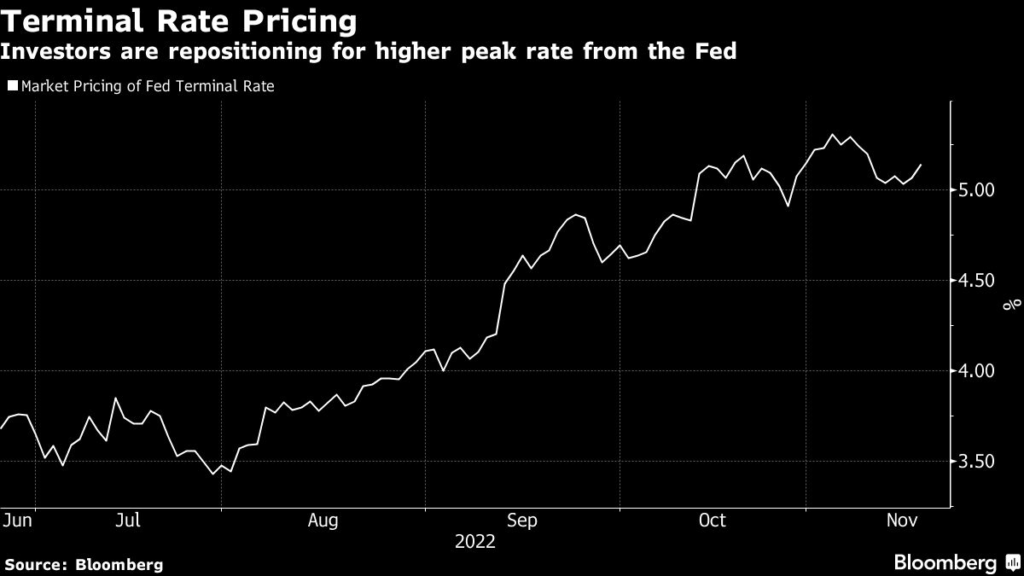
European equities opened higher, though they were on track to snap a four-week rising streak. US index futures swung between losses and gains, a day after markets were knocked lower by hawkish comments from St. Louis Fed President James Bullard, who said interest rates needed to rise at least to 5%-5.25% to curb inflation. The MSCI World Index stabilized, paring its weekly loss to 1%.

The dollar and Treasury yields were little changed, having jumped Thursday in the wake of Bullard’s comments. But Bullard is only the latest policymaker to warn markets that while inflation appears to be easing off multi-decade highs, policy needs to be tightened further to tame price pressures. Markets dialled up their expectations on Thursday for where US rates might peak, and pared the likelihood of rate cuts next year. 

“The fact of inflation having peaked is not a reason for the Fed to turn and cut rates,” Paul Christopher, head of global market strategy at Wells Fargo Investment Institute, said on Bloomberg Radio. “That’s the fundamental disconnect that still exists between the Fed and the market.”

Fears are also mounting that relentlessly rising rates will hit economic growth, with a critical segment of the Treasury yield curve at the most steeply inverted in four decades — historically such an inversion has flagged recession in the world’s largest economy. Oil was poised for a weekly loss, pressured by concerns over a worsening demand outlook. 

Ellen Hazen, chief market strategist at F.L.Putnam Investment Management, said that if the Fed kept increasing rates at the current pace, “by the time they get the information that they’ve been successful in slowing the economy and slowing inflation, it might be too late.”

“It’s just too soon to know exactly how this is going to play through the economy and that’s the biggest risk,” she told Bloomberg Television. 

Elsewhere, the dollar’s retreat allowed other major currencies to strengthen, with the Japanese yen getting some additional impetus from data showing inflation at 40-year highs. The pound attempted to recoup Thursday’s losses as investors assessed the fallout from the government budget on an economy that’s already in recession.   

Earlier, Hong Kong’s benchmark Hang Seng Index enjoyed a third straight week of gains, thanks to China’s steps to support the property sector and ease Covid restrictions. On Friday, the benchmark’s tech gauge touched a two-month high, led by Alibaba, which missed second-quarter revenues but upsized share buybacks.

Bitcoin was on course for a weekly gain even as the collapse of Sam Bankman-Fried’s FTX empire continues to rattle the crypto market.  


Key events this week:

  • US Conference Board leading index, existing home sales, Friday

Some of the main moves in markets:

Stocks

  • The Stoxx Europe 600 rose 0.4% as of 8:42 a.m. London time
  • Futures on the S&P 500 fell 0.1%
  • Futures on the Nasdaq 100 fell 0.1%
  • Futures on the Dow Jones Industrial Average fell 0.2%
  • The MSCI Asia Pacific Index rose 0.1%
  • The MSCI Emerging Markets Index was little changed

Currencies

  • The Bloomberg Dollar Spot Index was little changed
  • The euro fell 0.1% to $1.0351
  • The Japanese yen was little changed at 140.07 per dollar
  • The offshore yuan rose 0.2% to 7.1311 per dollar
  • The British pound rose 0.2% to $1.1886

Cryptocurrencies

  • Bitcoin rose 0.2% to $16,710.71
  • Ether rose 0.5% to $1,211.12

Bonds

  • The yield on 10-year Treasuries advanced one basis point to 3.78%
  • Germany’s 10-year yield advanced three basis points to 2.05%
  • Britain’s 10-year yield advanced four basis points to 3.25%

Commodities

  • Brent crude rose 0.3% to $90.02 a barrel
  • Spot gold rose 0.1% to $1,763.06 an ounce

This story was produced with the assistance of Bloomberg Automation.

More stories like this are available on bloomberg.com

©2022 Bloomberg L.P.

Meta Fired Employees for Taking Over User Accounts, WSJ Says

(Bloomberg) — Meta Platforms Inc. has fired or disciplined more than two dozen employees and contractors in the past year for improperly taking over user accounts, sometimes allegedly for bribes, the Wall Street Journal reported. 

Some workers were accused of accepting thousands of dollars in return for giving hackers access to user accounts, the newspaper reported, citing people familiar with the matter and documents that detailed the investigation. 

A Meta spokesman told the Journal that the company will continue taking “appropriate action” against people that sell fraudulent services and target its platforms. The company didn’t immediately respond to a request for comment from Bloomberg. 

The company, which owns Facebook and Instagram and holds data on more than 3.7 billion users, is a prime target for hackers. Meta said last month that it was planning to notify about 1 million Facebook users that their account credentials were compromised by malicious apps. Meta, along with other major technology companies, has also been tricked into providing sensitive personal information about customers in response to fraudulent legal requests. 

Read More: Facebook Warning 1 Million About Stolen Usernames, Passwords

In some instances, contractors who were working as security guards were given access to a Facebook tool called “Oops”, an acronym for “Online Operations,” that lets employees help users who have forgotten their passwords or had their accounts taken over by hackers. 

A number of third-party services with access to Meta employees have begun charging users to reset accounts, the Journal said. A Meta spokesman said that buying or selling accounts or paying for account recovery violates the company’s terms of service. 

More stories like this are available on bloomberg.com

©2022 Bloomberg L.P.

Limp Retail Sales Add to Bleak Economy Picture: The London Rush

(Bloomberg) — Chancellor Jeremy Hunt’s Autumn Statement laid bare a bleak new reality for the British economy, which was underscored by the latest retail sales data this morning. Britons’ consumer confidence, meanwhile, ticked higher in an audible sigh of relief following Liz Truss’s short tenure. Escaping from the gloom is another reason for England to hope for a win at the FIFA World Cup, which kicks off Sunday. 

Here’s the key business news from London-listed companies this morning:

In The City

UK Retail Sales: The volume of goods sold in shops and online was weaker than expected in October, underlining the cost-of-living crisis draining consumer spending power. 

  • Excluding fuel sales, the volume of goods sold in shops and online rose 0.3% after a 1.5% drop in September, when stores were closed for the funeral of Queen Elizabeth II. Economists had forecast a 0.6% gain

Legal & General Group Plc: The asset management firm said the chancellor’s planned Solvency II reform was “a positive step forward,” which will allow the firm greater flexibility to invest in new infrastructure. 

  • The company said its Pension Risk Transfer business continued to perform “strongly” and is “actively engaging” with pension schemes that have, or are close to having, a surplus as a result of rising interest rates

MJ Gleeson Plc: The low-cost homebuilder said that its full-year outlook depends on the pace of the housing market recovery, adding that the company was “encouraged” that Hunt’s Autumn Statement could restore stability.

  • The company experienced a significant slowdown in demand after interest rates shot up in reaction to Liz Truss’s mini-budget

Read about the earnings coming up next week:  EMEA Earnings Week Ahead: Compass, Virgin Money, Naspers, Prosus

In Westminster

Chancellor Jeremy Hunt administered the “smallest dose of fiscal medicine” he could in yesterday’s Autumn Statement, writes Bloomberg Opinion’s Marcus Ashworth. “But the unpalatable truth is that there’s a lot more to come as he tries to nurse the ailing UK economy through a recession.” 

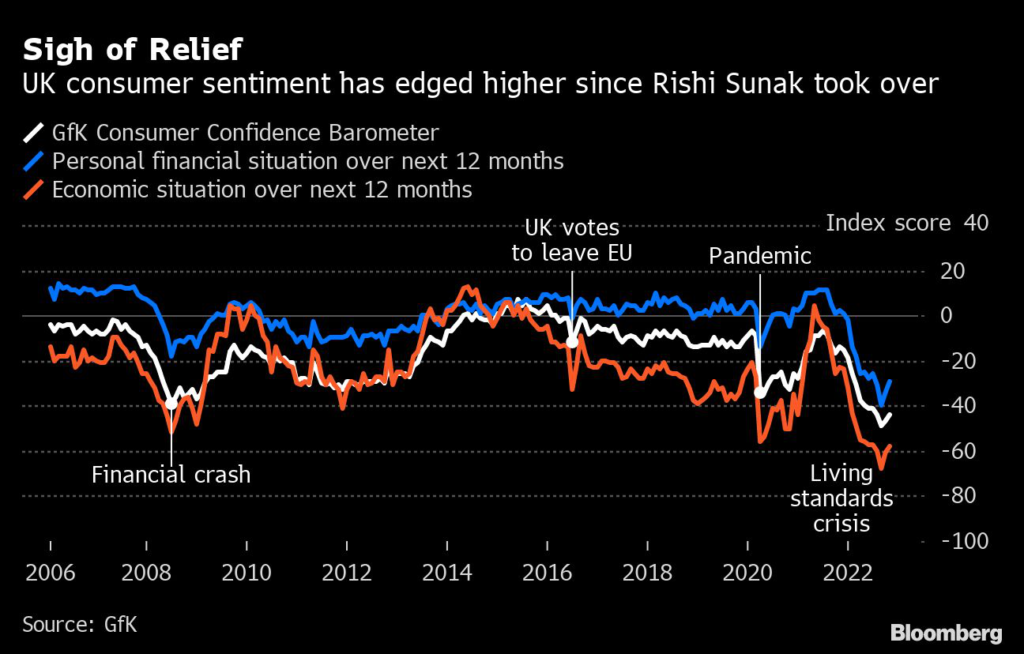
UK consumer confidence ticked higher in October, with market research firm GfK Ltd. saying the fillip was likely to reflect “nothing more than a collective sigh of relief as a new prime minister takes charge.” 

The FIFA World Cup is set to kick off Sunday. England could use a win — for the economy, says Bloomberg Opinion’s Andrea Felsted. 

In Case You Missed It 

Fintechs, including London-based Revolut Ltd., are trying to reassure customers about their cryptocurrency offerings after the implosion of crypto exchange FTX. 

The UK is tilting bond sales toward shorter maturities in the coming months to alleviate a shortage of collateral that has been distorting money markets, the country’s debt chief said.

Elsewhere, Portugal is considering to end its golden visa, which could make it harder for UK investors to access and travel through the European Union. 

Looking Ahead 

Virgin Money UK is due to report full-year results on Monday. The challenger bank’s unsecured lending business has benefited from Britons taking out more credit cards to help them through the cost-of-living crisis this year. But, with the UK probably in recession, the firm’s asset quality will come increasingly into focus in fiscal 2023. 

For a news fix when the day is done, sign up to The Readout with Allegra Stratton, to make sense of the day’s events.

More stories like this are available on bloomberg.com

©2022 Bloomberg L.P.

Kamala Harris Seeks to Coax Asia Toward US as China Gains

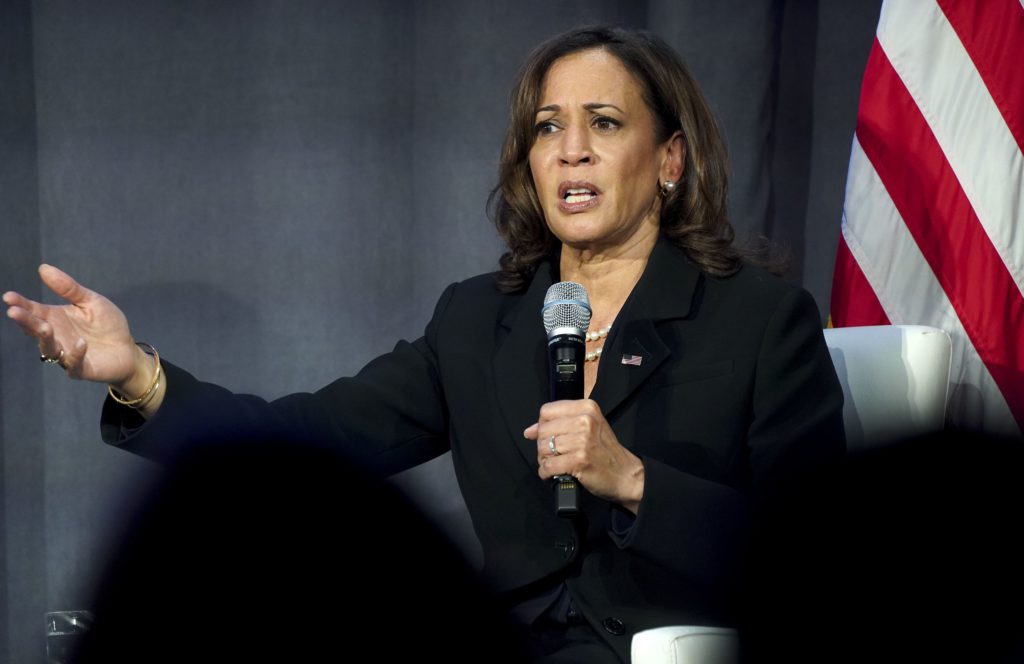
(Bloomberg) — Vice President Kamala Harris tried to persuade Asian nations that the US is their most valuable economic partner in a speech in Bangkok on Friday, with the Biden administration wary of China’s inroads in the region.

Harris sought to allay doubts about the US commitment to the region among its leaders, after a turbulent period that saw former President Barack Obama advance a major Asia trade pact only for his successor, former President Donald Trump, to scrap it. President Joe Biden has proposed a watered-down replacement.

The vice president argued that US fidelity shouldn’t be measured only by the nation’s trade policies.

“The United States has an enduring economic commitment to the Indo-Pacific, one that is measured not in years, but in decades and generations,” Harris told business executives on the sidelines of the Asia-Pacific Economic Cooperation summit. 

“And there is no better economic partner for this region than the United States of America,” she said.

With the US out of the 11-nation TPP — now known as the Comprehensive and Progressive Agreement for Trans-Pacific Partnership — China has secured the passage of a rival trade pact. Biden has proposed an arrangement called the Indo-Pacific Economic Framework, which would be less binding than the CPTPP and doesn’t include tariff reductions.

During his own visit to the region this week, Biden cautioned Cambodia’s leaders against allowing China to establish a military base in their country. Earlier this year, the US found itself trying to stave off a similar arrangement between China and the Solomon Islands.

On Thursday, Chinese President Xi Jinping offered a competing vision for developing the Asia-Pacific region’s economy and security. “The Asia-Pacific is no one’s backyard and should not become an arena for big power contest,” Xi said in written remarks to the APEC CEO Summit.

While many in Asia are wary about China’s growing military might and economic influence, they’re reluctant to openly line up with the US against a key trading partner. The Biden administration’s efforts to cut off China’s access to vital technology, such as semiconductors, have been met with resistance from allies and partners. 

The White House believes Harris’s speech is important because many countries and businesses in the Asia-Pacific region worry the US lacks an agenda, one US official told reporters on condition of anonymity to preview her remarks. Many regional countries have pressed for the US to join the CPTPP or, in its absence, deepen economic engagement with them. China, in the meantime, has applied to join the CPTPP. 

“We stand against market distortions and unfair competitive advantages,” Harris said. “And we prioritize inclusivity.”

US Trade Representative Katherine Tai is also at the APEC summit seeking to advance talks on Biden’s proposed framework.

“As a strong partner to the economies and companies of the Indo-Pacific, America’s approach to these relationships is based on collaboration, sustainability, transparency and fairness,” Harris said. “Through all of our efforts, we will continue to uphold and to strengthen international economic rules and norms that protect a free market and create predictability and stability.”

In meetings with other leaders at APEC on Friday morning, Harris was expected to criticize Russia directly for its invasion of Ukraine and urge other nations to do the same, according to the official. Both Russia and China are part of APEC. 

The US will host the group’s leaders next year. The White House hasn’t yet announced which city will be the summit site.

–With assistance from Meghashyam Mali.

(Updates with delivered quotes)

More stories like this are available on bloomberg.com

©2022 Bloomberg L.P.

UK Retail Sales Weaker Than Expected in Living Cost Crisis

(Bloomberg) — UK retail sales posted a weaker than expected rebound in October, underlining the cost-of-living crisis draining consumer spending power.

Excluding fuel sales, the volume of goods sold in shops and online rose 0.3% after a 1.5% drop in September, when stores were closed for the funeral of Queen Elizabeth II, the Office for National Statistics said Friday. Economists had forecasts a 0.6% gain.

Sales including auto fuel rose 0.6% after a 1.5% drop the month before. That was close to economists outlook for a 0.5% increase.

The rebound may prove short lived, however. With inflation in double digits, and taxes and interest rates rising, living standards are on course for the biggest drop on record, the government’s fiscal watchdog said on Thursday. 

“Looking at the broader picture, retail sales continue their downward trend seen since summer 2021 and are below where they were pre-pandemic,” said Darren Morgan, director of economic statistics for the ONS. 

Fuel sales jumped 3.3%, but elsewhere the picture was mixed with food, household goods and business at department stores all declining. This was offset by higher sales of clothing as stores introduced new fashion lines. There was also an increase in online sales and of second-hand goods, particularly at auction houses.

Overall sales in October were 6.1% lower than a year ago and down 2.4% on a three-month basis. Soaring prices meant that consumers were spending more to buy the same basket of goods. The value of retail sales rose by 1.8% in October, triple the increase in volumes.

What Bloomberg Economics Says …

“The UK’s retail sales rebound at the start of the fourth quarter masks a bleaker outlook. We expect consumer spending to remain under pressure going forward given the unrelenting squeeze on incomes.”

–Niraj Shah, Bloomberg Economics. Click for the REACT.

In a bleak assessment of the economic outlook, the Office for Budget Responsibility on Thursday warned the economy is already in a recession that will last for more than a year and drive up unemployment.

The figures chime with figures showing UK consumer confidence ticked higher for a second month after Prime Minister Rishi Sunak worked to stabilize the economy following the disastrous and short tenure of his predecessor, Liz Truss.

The market research firm GfK Ltd. said its measure of sentiment rose three points to minus 44 in November, leaving it near the record low of minus 49 recorded in September when Truss’s plan to slash taxes triggered panic in financial markets.

“This month’s fillip is likely to reflect nothing more than a collective sigh of relief as a new prime minister takes charge following the alarming fiscal antics we saw in September,” said Joe Staton, client strategy director at GfK. “External factors have changed little. More bad news is inevitable.”

Confidence is well below levels of a year ago, reflecting a jump in food and energy prices that’s squeezing living standards and driving the economy into recession. GfK said consumers remain under pressure from rising interest rates, taxes and rent payments.

GfK’s report provides a glimmer of hope for retailers and hospitality companies looking for a boost in spending around the Christmas and New Year holidays. 

“Retail and leisure businesses will be hoping for a feel-good factor that at least temporarily boosts spending, despite the increasing difficulty, or reluctance, of some consumers to spend,” said Linda Ellett, UK head of consumer markets, retail and leisure at the consultant KPMG UK.

(Updates with details from report from fourth paragraph.)

More stories like this are available on bloomberg.com

©2022 Bloomberg L.P.

Shortage of Legacy Chips Keeping Ford CEO Up at Night

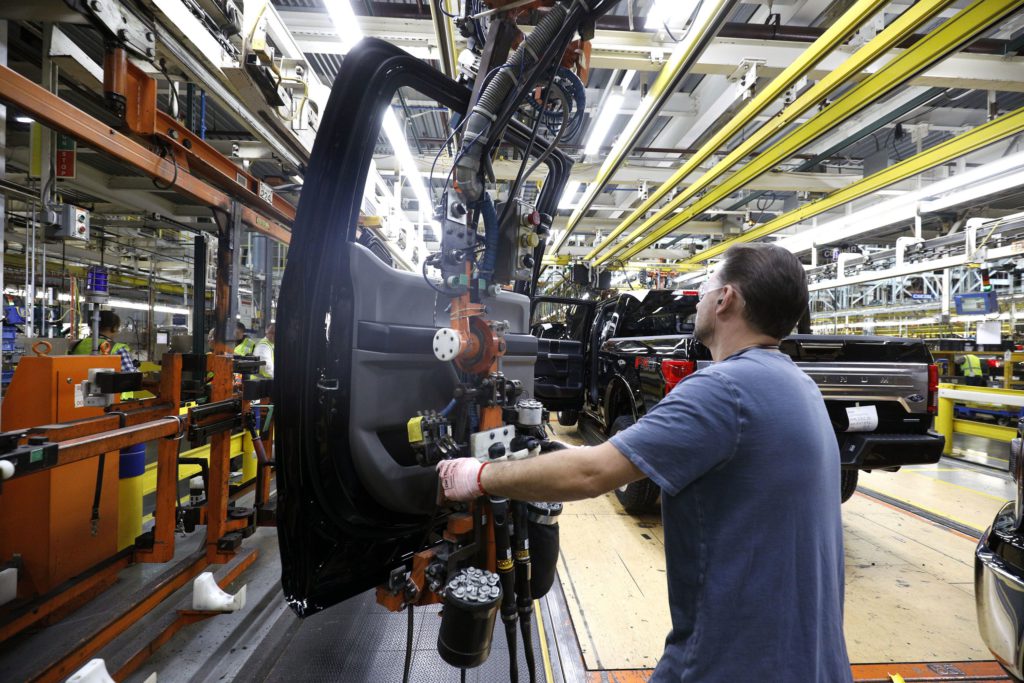
(Bloomberg) — Ford Motor Co. sees a prolonged shortage of mature chips that automakers need for their vehicles.

“It’s too painful. We need to understand your technology roadmap better,” Chief Executive Officer Jim Farley said at the annual Semiconductor Industry Association dinner, in an interview with Texas Instruments Inc. CEO Rich Templeton. “And we need supply chain people from your companies and our companies to get it right.”

Over the past two years, constrained chip supply has cost Ford 1.3 million vehicles in lost production. On top of that, the same issue led Ford to lose 4 million employee workdays this year, the company’s chief said. The parts in question are not cutting-edge silicon but mature technology doing basic tasks. Scarce MOSFET chips — costing just $0.40 apiece — for windshield wipers in the Ford F-150 cost the company 40,000 units of that vehicle’s production, Farley said. 

Also in attendance at the San Jose event were Intel Corp. CEO Pat Gelsinger and Nvidia Corp. CEO Jensen Huang.

“One thing that keeps me up at night is legacy nodes,” Farley said, referring to chips built on older manufacturing processes such as those MOSFETs Ford struggled to procure. The challenge for automakers like Ford is that capacity expansion for those production nodes is not proceeding as fast as they would like. He sees the growth in carmakers’ chip demand running at double the speed of capacity expansion from chip fabricators. 

“We underappreciated the complexity when we didn’t know,” he said. “We need silicon designers. We can’t do this anymore.”

Taiwan Semiconductor Manufacturing Co. and Samsung Electronics Co., the world’s biggest contract chipmakers, have worked to fill the demand from automakers, but both companies still focus more on growing advanced chipmaking, which yields higher profits.

“Money alone isn’t enough,” Farley said in concluding his remarks. “We have to have the vision and the operational excellence in the whole ecosystem.”

More stories like this are available on bloomberg.com

©2022 Bloomberg L.P.

Close Bitnami banner
Bitnami