Bloomberg

BlackRock Signs Pact With Saudi Wealth Fund for Infrastructure

(Bloomberg) —

BlackRock Inc signed a pact with Saudi Arabia’s $620 billion wealth fund to explore infrastructure projects in the Middle East.

Projects will be sourced across sectors including energy, power, utilities, water, environment, transportation and telecommunications, according to a statement. In its first project, the partnership will work with Saudi Investment Recycling Co. to develop and operate waste management projects in the region.

The U.S. asset manager said it plans to build a dedicated infrastructure investment team to cover the Middle East. BlackRock Alternatives will also establish a Middle East infrastructure strategy.

Read more: BlackRock Gets New Saudi Mandate for Infrastructure Fund

More stories like this are available on bloomberg.com

©2022 Bloomberg L.P.

FTX Latest: Balance-Sheet Blowup Reverberates in Crypto Markets

(Bloomberg) — Cryptocurrency prices slid again, particularly tokens associated with Sam Bankman-Fried’s collapsed FTX empire. There were growing signs that customers of the bankrupt digital-asset exchange have little chance of recovering much of their deposits.

FTX Trading International held just $900 million in liquid assets on Thursday — the day before it filed for Chapter 11 bankruptcy — against $9 billion of liabilities, according to sources familiar with the matter. The data referenced a negative $8 billion of a “hidden, poorly internally labeled” fiat currency account and noted $5 billion of withdrawals by users last week.

Compounding a reputational hit to crypto that threatens to drive retail investors away and shrivel institutional demand, an estimated $477 million vanished in unauthorized withdrawals from FTX’s platform, according to blockchain analytics firm Elliptic.  

The Bahamian police are working with the Bahamas Securities Commission to investigate whether there was any criminal misconduct in FTX’s collapse. Bankman-Fried was questioned by Bahamian police and regulators Saturday.


Key stories and developments:

  • FTX’s Balance Sheet, Hack Paint Dim Picture for User Recovery
  • Bankman-Fried: From Crypto King to King of Tech Bubble’s Losers
  • Big Investors Are Giving Up on Crypto Markets Going Mainstream
  • Summers Says FTX Meltdown Has ‘Whiffs’ of Enron-Like Scandal (1)
  • ‘It’s All Gone’: FTX Bankruptcy Is Worst Fear for Retail Traders

(All time references are New York unless otherwise stated.)

Singapore Central Bank Says FTX Wasn’t Licensed in the City-State (2:40 p.m. Hong Kong)

Singapore’s central bank said that while bankrupt crypto exchange FTX doesn’t have a license to operate in the city-state, it’s not possible to prevent local users from “directly accessing” overseas service providers. 

As a result, FTX was “able to onboard Singapore users,” a spokesperson at the Monetary Authority of Singapore said in an emailed statement to Bloomberg News on Monday. “MAS has consistently reminded the public of the risks of dealing with unlicensed entities,” the spokesperson said in the statement. 

Bank of Japan Chief Calls for Stepped Up Crypto Regulation Push (1 p.m. Hong Kong)

Bank of Japan Governor Haruhiko Kuroda called for an accelerated effort, in line with G-7 recommendations, to regulate the crypto market in a question-and-answer session after a speech on the wider macroeconomic outlook. Japan has been planning to further loosen crypto rules by making it easier to list virtual coins, but that was before the FTX imbroglio. The crisis has raised fresh questions about how regulators should approach the volatile sector.

Crypto Markets Retreat in Wake of Ongoing FTX Fallout (10:30 a.m. Hong Kong)

Cryptocurrency markets began the week in Asia on the back foot. Bitcoin retreated almost 3% at one point to drop below $16,000. Ether also suffered losses. Solana, one of the tokens associated with Bankman-Fried’s failed digital-asset empire, was down about 10% and has plunged over 60% this month.

Digital-Asset Exchange Huobi Has $18.1 Million on FTX’s Platform (10:20 a.m. in Hong Kong)

Crypto exchange Huobi’s wholly owned subsidiary Hbit Ltd. has $18.1 million in tokens deposited on FTX, according to a filing. Some $13.2 million comprises client assets about $4.9 million are Hbit assets. 

Controlling shareholder Li Lin will provide an unsecured facility up to $14 million to the group “for the purpose of covering client asset liability” if needed, according to the statement. The group’s financial performance might be “materially and adversely affected” in the event the funds are stuck at FTX, it said, adding that other assets and liabilities of the group are not affected.

Huobi Technology Holdings’s shares slid 14.1% in Hong Kong. The company in the filing also said it’s now called New Huo Technology Holdings.

Crypto Exchange AAX Suspends Withdrawals (10 a.m. Hong Kong)

Crypto exchange AAX has suspended withdrawals, citing complications with a system upgrade and blaming failures at a third-party partner.

“To prevent further risks, the technical team has had to manually proofread and restore the system to ensure maximum accuracy of all users’ holdings,” the exchange said in a notice posted online. “AAX will continue our best efforts to resume regular operations for all users within 7-10 days to ensure the utmost accuracy. In this light, withdrawals have been suspended to avoid fraud and exploitation.”

FTX’s Serum Project Is in Distress (1:05 p.m.)

Tokens issued by Serum, a liquidity infrastructure hub built by FTX and used by market makers and lending protocols on Solana, tumbled more than 23% on Sunday alone, pricing data from CoinGecko showed. FTX owned more than $2.2 billion worth of the token as of Thursday, the Financial Times reported, citing investor materials.

Developers attached to Serum split off the project’s code in a so-called fork amid concern that an upgrade key controlling the program could be compromised, a Solana spokesperson said. 

Galois Confirms $40 Million Exposure (12:26 p.m.)

Crypto hedge fund Galois Capital is the latest company to confirm its exposure to the collapsed FTX cryptocurrency exchange. In a direct message to Bloomberg News, Galois said its exposure was between $40 million to $45 million. On Friday, Galois said on Twitter that it had “significant” funds in FTX. Galois was an early critic of the now failed Terra blockchain and its TerraUSD algorithmic stablecoin.

Bahamian Police Look Into Criminal Probe (11:53 a.m.)

A team from the Financial Crimes Investigation Branch is working with the Bahamas Securities Commission to investigate if any criminal misconduct occurred in the collapse of FTX.

Binance Stops Deposits of FTX’s Token FTT (3:30 a.m. Sunday)

Binance halted deposits of FTT, FTX’s token, “to prevent potential of questionable additional supplies affecting the market,” Binance CEO Changpeng “CZ” Zhao said on Twitter. Zhao said that he would encourage other exchanges to do the same thing. Justin Sun said Huobi Global would echo Zhao’s advice.

Zhao added that FTT contract deployers moved all remaining FTT supplies worth $400 million, “which should be unlocked in batches.” Binance followed up to say it had noticed a “suspicious movement” of a large amount of FTT by the token’s contract deployers.

Matrixport Says 79 Clients Affected by FTX, ‘No Risk of Insolvency’ (11:38 p.m. Saturday)

Crypto financial-services platform Matrixport “continues to operate normally and the company has no risk of insolvency with respect to the developments at FTX and Alameda,” according to Ross Gan, head of public relations.

Matrixport had 79 clients that incurred losses via exposure to three products on its platform that were linked to FTX, Gan said.

Kraken Freezes Accounts Possibly Related to FTX (11:33 p.m.)

Crypto exchange Kraken said it has frozen Kraken account access to certain funds it suspects to be associated with “fraud, negligence or misconduct” related to FTX. Kraken said in a tweet it’s in contact with law enforcement and plans to resolve each account on a case-by-case basis.

Bankman-Fried Interviewed by Police in Bahamas (9:42 p.m.) 

Former crypto mogul Sam Bankman-Fried was interviewed by Bahamian police and regulators on Saturday, according to a person familiar with the matter. Bankman-Fried didn’t immediately respond to a request for comment.

The inquiries from Bahamian authorities add to the mounting legal pressure that Bankman-Fried is facing since his FTX empire crumbled over the past week. In the US, he is facing scrutiny from the Securities and Exchange Commission over whether he broke securities rules.

Bahamas Says it Didn’t Authorize Local Withdrawals by FTX Exchange (9 p.m.)

Bankrupt crypto exchange FTX’s move to allow withdrawals in the Bahamas was questioned by the nation’s securities regulator.

The Securities Commission of the Bahamas in a statement Saturday said that it hadn’t “directed, authorized or suggested” the prioritization of local withdrawals to FTX Digital Markets Ltd.

It added that such withdrawals could be clawed back.

Jump Crypto Says It Remains Well Capitalized After FTX Exposure (5:59 p.m.)

Jump Crypto, a cryptocurrency trading firm, told customers on Saturday it remains “well capitalized” after exposure to FTX. In a series of tweets, Jump said its exposure was “managed in accordance with our risk framework.” The company did not specify the exact nature of its exposure.

Liabilities Dwarfed Liquid Assets: FT (1:13 p.m.)

FTX Trading held $900 million in liquid assets against $9 billion of liabilities the day before the bankruptcy filing, the Financial Times reported, citing investment materials and a spreadsheet the newspaper had seen. Most of the recorded assets are either illiquid venture capital investments or crypto tokens that are not widely traded. The biggest asset as of Thursday was listed as $2.2 billion worth of a cryptocurrency called Serum.


More stories like this are available on bloomberg.com

©2022 Bloomberg L.P.

Goldman Sachs Sees Significant Decline in US Inflation Next Year

(Bloomberg) — Goldman Sachs Group Inc. economists expect a significant easing of US inflation in 2023 reflecting softening supply chain problems, a peak in shelter inflation and slower wage growth.

The US lender expects the core PCE measure to decline to 2.9% by December 2023 from 5.1% currently, economists led by Jan Hatzius wrote in a research note, with weaker commodity prices and a stronger dollar also to weigh on inflation.

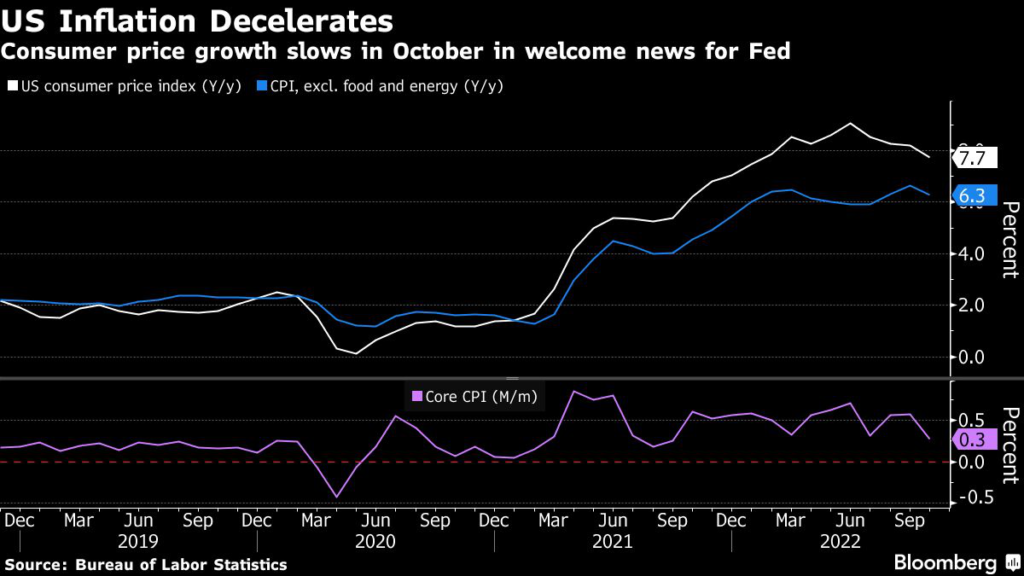
Data last week pointed to a cooling in US consumer prices. At 7.7%, inflation in October rose at the slowest pace since January.

Key points in Goldman’s forecasts are as follows:

  • The contribution of supply-constrained goods categories to core inflation will swing negative, Goldman forecasts, dropping from a boost of +0.6 percentage point currently to -0.4 percentage point by late 2023, and accounting for nearly half of the slowdown in overall core inflation
  • Supply chain disruptions and shipping congestion eased significantly in 2022, and inventories of cars and consumer goods have rebounded from extremely depressed levels. The supply of semiconductors in particular has improved dramatically, with automotive microchip shipments now 42% above 2019
  • Goldman’s second reason to expect lower core inflation is a peak in year-over-year shelter inflation, which they expect in the spring. Strong demand for rental units has already catalyzed a supply response: 1 million apartments are under construction or permitted, the largest pipeline since 1974. Rental vacancies rates are starting to rebound as a result and are likely to return to pre-pandemic rates next year, according to Goldman.
  • For its third reason, Goldman expects slower wage growth to reduce upward pressure on services inflation by late 2023. Labor market rebalancing is already lowering wage growth, particularly in sectors with large declines in the jobs-workers gap such as retail and leisure. They expect year-on-year wage growth to fall by 1.5pp to 4% by late 2023, helping to slow inflation in labor-intensive services categories

“All in, we forecast core PCE inflation to fall significantly,” the Goldman economists wrote.

More stories like this are available on bloomberg.com

©2022 Bloomberg L.P.
Asian Stocks Pulled Higher by China; Dollar Rises: Markets Wrap

(Bloomberg) — Asian equities advanced as China’s policy shifts on Covid and the property sector pushed a gauge of the region’s shares toward its highest level in two months.

Contracts for the S&P 500 and Nasdaq 100 declined amid gains in the dollar after Federal Reserve Governor Christopher Waller cautioned that policymakers had “a ways to go” before ending interest-rate hikes.

A 16-point plan to boost China’s real estate market and efforts to reduce the economic cost of the government’s pandemic response saw Hong Kong and mainland stocks rally. Shares of developers led the charge, with Country Garden Holdings Co. surging by a record 55%.   

“So much negative news flow has been now factored into price,” Catherine Yeung, an investment director at Fidelity International, said of Chinese stocks on Bloomberg Television. “It just feels that China is likely to have seen its worst.”  

The greenback had been on the backfoot before Waller’s comments amid signs of cooling in US inflation and the prospects of a dovish tilt by the Fed. The University of Michigan’s preliminary November survey on Friday showed US consumer inflation expectations increased in the short and long run while sentiment retreated.

Waller also noted that while the hiking cycle would continue for some time, the Fed could start considering a downshift to a 50 basis-point move at the next meeting in December or the one after that. 

Treasury yields rose across the curve after cash trading was closed for Veterans Day on Friday.

Cryptocurrencies remained under pressure amid FTX’s deepening woes. A swift plunge in the value of FTX’s key crypto assets and unauthorized withdrawals of funds after it filed for bankruptcy suggest customers have little chance of recovering much of their deposits. 

A negative tone also held sway in the Japanese market, with the nation’s benchmark stock indexes weighed down by a slump of as much as 14% in SoftBank Group Corp., which failed to announce a widely-expected stock buyback. 

Investors will keep a wary eye on the Group of 20 summit in Indonesia, where US President Joe Biden and Chinese leader Xi are expected to meet. Biden’s hand has been strengthened by the Democrats defying political forecasts and historical trends to keep control of the Senate.

Oil advanced for a third session as investors weighed the outlook for Chinese demand as the market tightens heading into winter. 

The positive sentiment from China also filtered through to Australian iron ore miners and steel companies as their shares surged. 

Gold declined on the stronger dollar. 

Key events this week:

  • US President Joe Biden plans to meet Chinese President Xi Jinping on the sidelines of the G-20, Monday
  • Fed’s John Williams moderates panel, Monday
  • China retail sales, industrial production, surveyed jobless, Tuesday
  • Former US President Donald Trump plans to make an announcement, Tuesday
  • US empire manufacturing, PPI, Tuesday
  • US business inventories, cross-border investment, retail sales, industrial production, Wednesday
  • Fed’s John Williams, Lael Brainard and SEC Chair Gary Gensler speak, Wednesday
  • ECB President Christine Lagarde speaks, Wednesday
  • Eurozone CPI, Thursday
  • US housing starts, initial jobless claims, Thursday
  • Fed’s Neel Kashkari, Loretta Mester speak, Thursday
  • US Conference Board leading index, existing home sales, Friday

Some of the main moves in markets:

Stocks

  • S&P 500 futures fell 0.3% as of 2:08 p.m. Tokyo time. The S&P 500 rose 0.9%
  • Nasdaq 100 futures fell 0.5%. The Nasdaq 100 rose 1.8%
  • Euro Stoxx 50 futures rose 0.4%
  • The Topix Index fell 0.7%
  • The S&P ASX Index was little changed
  • The Hang Seng Index rose 2.6%
  • The Shanghai Composite Index rose 0.5%

Currencies

  • The Bloomberg Dollar Spot Index rose 0.4%
  • The euro fell 0.4% to $1.0308
  • The Japanese yen fell 0.4% to 139.40 per dollar
  • The offshore yuan rose 0.5% to 7.0539 per dollar
  • The Australian dollar fell 0.4% to $0.6677

Cryptocurrencies

  • Bitcoin fell 2.6% to $15,944.38
  • Ether fell 2.7% to $1,183.3

Bonds

  • The yield on 10-year Treasuries advanced eight basis points to 3.89%
  • Australia’s 10-year yield advanced 11 basis points to 3.77%

Commodities

  • West Texas Intermediate crude rose to $89.08 a barrel
  • Spot gold fell to $1,760.91 an ounce

This story was produced with the assistance of Bloomberg Automation.

More stories like this are available on bloomberg.com

©2022 Bloomberg L.P.
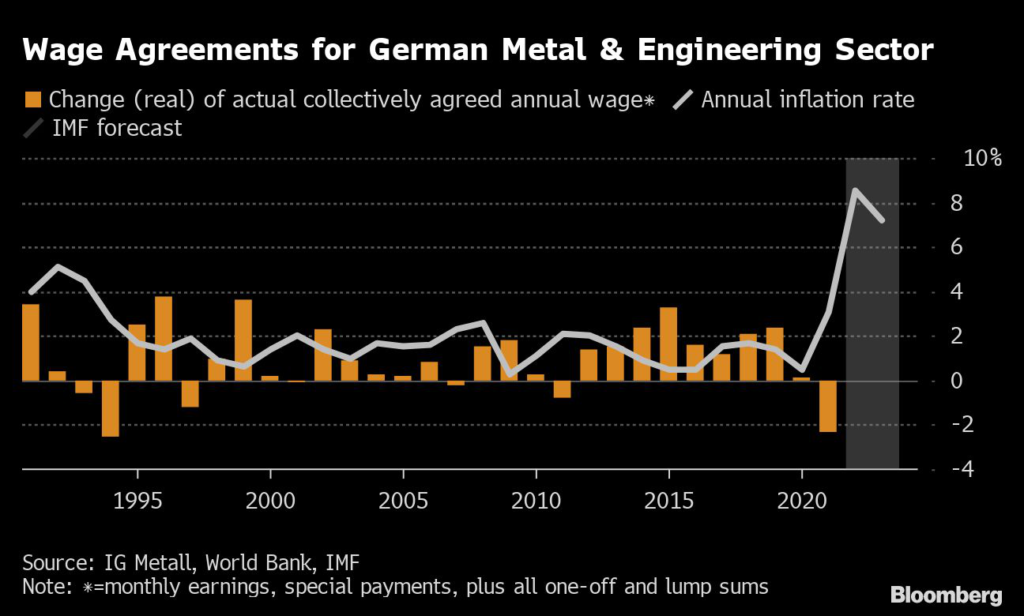
Germany’s Biggest Wage Talks Keep ECB Officials in Suspense

(Bloomberg) — Germany’s biggest labor union is locked in talks with employers over a pay deal for about 3.9 million workers, in one the most significant domestic showdowns of Europe’s energy crisis so far.

The talks pit IG Metall and its members in the metals and electronics industry against companies represented by the Gesamtmetall employers’ association. Seeking compensation for rampant price increases, the union is making the toughest demand since 2008. The employers say they can’t afford to lift wages just as a recession takes hold. 

The result will serve as an indicator of how pay might develop across the region’s largest economy, and the negotiations will be closely watched in Frankfurt by European Central Bank officials worried that significantly higher pay might risk entrenching inflation already at a historic high.

With the two sides at loggerheads, there’s also a growing risk of widespread strikes. IG Metall’s board will decide next week whether to escalate by holding a ballot on walkouts, threatening to disrupt assembly lines at firms including Airbus SE, Mercedes-Benz AG and Thyssenkrupp AG.

Here’s what you need to know:

What are German unions demanding?

IG Metall is pressing for salary increases of 8% for its members. Other unions are also agitating: Ver.di, which represents services workers, wants a 10.5% raise for the 2.5 million public-sector employees that it’s negotiating for in coming months. 

While such pay demands are the steepest in many years, Germany’s inflation rate is forecast to be even higher in 2022. Industrial workers typically need to drive to out-of-town production sites, meaning they’re more exposed to the increased cost of fuel.

What do companies say?

Unsurprisingly, the employers want to pay much less than IG Metall is asking for. Gesamtmetall wants to make a one-off €3,000 ($3,086) payment to workers, and is also seeking an agreement that they won’t have to do so again for an undetermined but lengthy period, implying several years.

The employers’ group argues that its members face threats from surging energy and material costs, as well as supply-chain disruptions related to Russia’s war in Ukraine. They also claim many companies burned through cash reserves trying to keep employees on board during the pandemic, meaning there’s not enough money available for more pay. 

“The current proposals from IG Metall would lead to enormous, unmanageable burdens for many of our companies this year and next,” said Harald Marquardt, senior negotiator for the employers’ association. “I don’t see approval from our committees and members as possible.”

What are the next steps?

Widespread strike action could erupt relatively quickly. 

IG Metall wants the employers’ representatives to drop the one-off payment offer, and to start bargaining over permanent salary increases. The union’s  board will meet on Nov. 14 to decide whether talks are moving substantially in that direction. 

If officials decide that negotiations are stalling, they’re likely to announce a ballot on Nov. 17 for strike action. That would amount to a major escalation that could shut down production lines at some of Germany’s biggest companies.

How does this usually get resolved?

In the past, labor unions have often settled for about half of their initial demand, according to JPMorgan economists. That was also roughly the outcome of an earlier negotiation in the smaller steel sector. 

However, recent deals in the metals and electronics sector have been weak due to the pandemic, so workers may feel the need to catch up. Many German companies are also short on staff, partly for demographic reasons, so labor unions are now in a better position to negotiate. 

What does it mean for the broader economy? 

Central bankers are worried that too generous a pay deal could set off a wage-price spiral and keep inflation elevated for longer. 

At the most recent ECB meeting, President Christine Lagarde singled out “higher-than-anticipated wage rises” as a key risk factor for officials’ inflation forecast. The pace of pay increases will be a factor in their judgment on when to stop raising interest rates. 

Chancellor Olaf Scholz has meanwhile hosted labor unions and business representatives for talks in a bid to keep a lid on inflation. His government has introduced the option of making direct payments worth as much as €3,000 tax-free as a way to compensate employees.

More stories like this are available on bloomberg.com

©2022 Bloomberg L.P.
FTX-Induced Crypto Swoon Saps Bitcoin’s Sway on Global Investors

(Bloomberg) — The pain spread across cryptocurrencies by the meltdown of Sam Bankman-Fried’s FTX is fracturing the link they once had with other risk assets, a sign that Bitcoin’s influence on global investors may be diminishing.

The idea that Bitcoin was a worthwhile part of a diversified portfolio of risk assets is fraying, with massive losses generated by the revelation that even FTX, until recently considered one of the most blue-chip names in crypto, was unsound. That’s a far cry from the start of this year, when Bridgewater estimated that 5% of Bitcoin was held by institutional-level investors. 

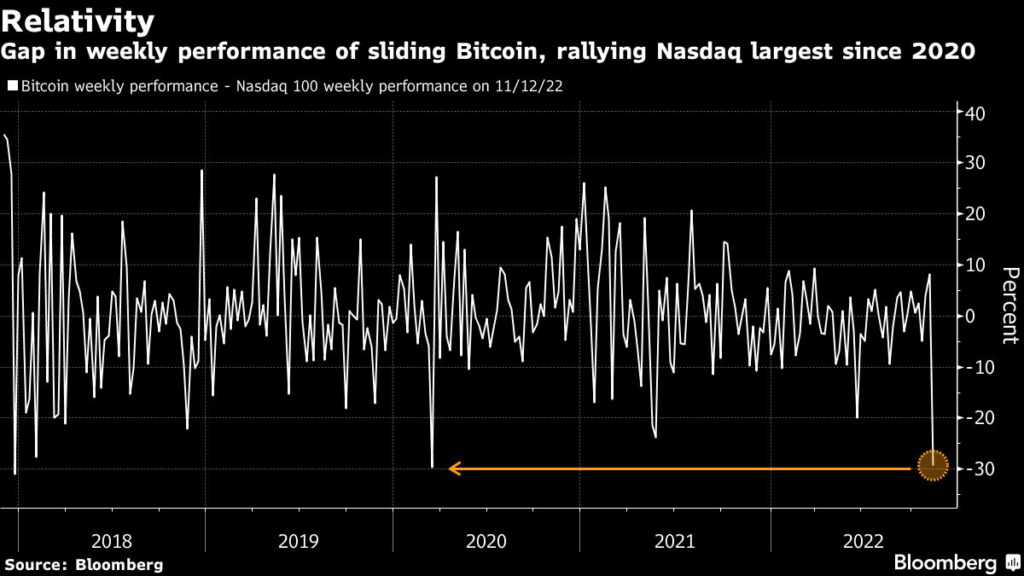
Bitcoin dropped 23% last week, its worst tumble since June, and was last trading at about $15,879. The S&P 500 Index soared 5.9% in the gauge’s best gain since June. The correlation between the two last week dropped to the lowest this year, based on a 20-day study. The performance gap between Bitcoin and the Nasdaq has hit the widest since 2020. 

“That idea of using crypto as a high-beta play on risk is fading, because there are easier ways to play that elsewhere that don’t suffer from the same systemic risk,” said Chris Weston, head of research at Pepperstone Group. “This is a structural issue, it’s about the actual architecture of the crypto system and the confidence you can have in that. Who’s next is the question on many people’s lips.”

The latest crypto rout came as investors were already souring on the space and as declines in price shrank the footprint of virtual currencies. The total market value of all tokens has dropped more than 70% from a record peak of just under $3 trillion set a year ago, according to the CoinGecko website. 

The current worth of $843 billion as assessed by the tracker is now less than 1% of the world equities market. Stocks are down a still sizable 16% over the period but a resurgence of broad risk appetite, driven by hopes for a slower pace of central bank interest-rate hikes, sent equities up by more than $13 trillion since they bottomed out Oct. 12.

The stark contrast between sliding cryptocurrencies and ebullient stocks underscores how rapid the turnaround has been for an asset class that was close to winning over mainstream investors less than a year ago. 

Back in 2021 JPMorgan Chase & Co. strategist Nikolaos Panigirtzoglou wrote Bitcoin could theoretically reach $146,000 in the long term by crowding out gold — last week he said the current upheavals could send it as low as $13,000. A PWC survey in April found that 42% of crypto hedge funds were predicting Bitcoin to trade between $75,000 and $100,000 by the end of 2022. 

More stories like this are available on bloomberg.com

©2022 Bloomberg L.P.
Crypto Exchange AAX Halts Withdrawals, Says FTX Put ‘Immense Pressure’ on Industry

(Bloomberg) — Cryptocurrency exchange AAX has suspended withdrawals, citing a glitch in a system upgrade.

AAX is a relatively small crypto exchange: data from CoinGecko showed that trading volumes over the last month peaked at around $2 billion. Over the last 24 hours, that number had dwindled to around $180,000. By contrast, Coinbase volumes were more than $1.5 billion in the same 24-hour period. 

The crypto world has been roiled in recent days by the collapse of high-profile exchange FTX, with fallout spreading to the likes of BlockFi and Galaxy Digital. According to a notice titled “Forward Through Adversity” on the exchange website, a failure attributed to a third-party partner led to some user balances being “abnormally recorded” in the system. “AAX will continue our best efforts to resume regular operations for all users within 7-10 days to ensure the utmost accuracy,” the notice read. 

In an additional statement provided to Bloomberg, AAX vice president Ben Caselin said, “The FTX situation has put immense pressure in exchanges everywhere with users nervous about exchange holdings.” He added, “It’s my observation this can be resolved in a few days, although rebuilding market confidence may take months.” Caselin also said that the AAX “funds are intact”.


–With assistance from Sidhartha Shukla.

More stories like this are available on bloomberg.com

©2022 Bloomberg L.P.
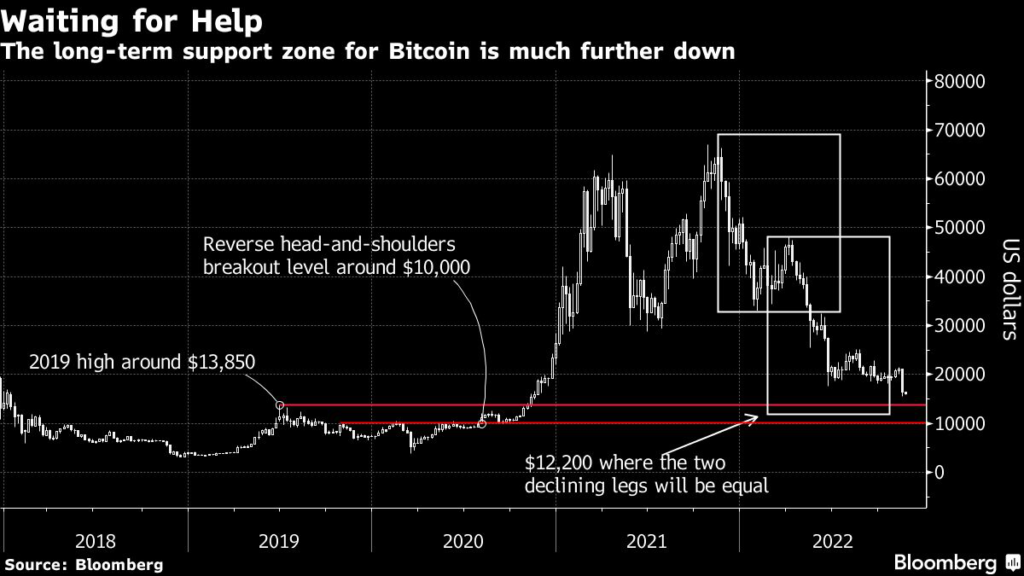
Bitcoin’s Long-Term Support Zone Lies Much Further Down, Chart Shows

(Bloomberg) — Bitcoin’s epic 22% plunge last week may not be the end of its sharp decline. The cryptocurrency has further to fall before reaching a longer-term area of support between $10,000 and $14,000 that’s defined by its 2019 peak and a “reverse head-and-shoulders” breakout in 2020. This area also includes the critical $12,200 level — the point at which the decline that began in April would equal the drop from the all-time high near $69,000 to the January trough. 

More stories like this are available on bloomberg.com

©2022 Bloomberg L.P.
Crypto’s Binance Plans Push for Global Digital-Asset Standards

(Bloomberg) — Changpeng “CZ” Zhao, head of crypto exchange Binance Holdings Ltd., said the firm plans to spearhead an effort with other industry players to set global standards in the wake of the bankruptcy of rival FTX.

“As an industry we need to increase transparency,” Zhao said at a conference in Bali, Indonesia. “We need to work very closely with regulators all around the world to make this industry more robust. There is a strong role for regulators to play but we can’t blame this on any single party.”

Zhao was involved in a public feud with Sam Bankman-Fried’s FTX, a dispute that was part of the chain of events ahead of the latter’s rapid collapse. The shakeout has left many investors questioning the future of digital assets.

Zhao argued that the “industry is still growing, we are still building.” He added that Indonesia’s tax regime for crypto is “not optimal” and that licenses should be available more easily.


More stories like this are available on bloomberg.com

©2022 Bloomberg L.P.
Asian Equities Led Higher by China on Policy Moves: Markets Wrap

(Bloomberg) — Asian equities advanced on Monday with a tailwind from the biggest weekly gain in US stocks since June and China’s policy shifts on Covid curbs and the property sector.

A gauge of the region’s shares headed for the highest in more than two months, led by an extended rally in Hong Kong and mainland China. Contracts for the S&P 500 and Nasdaq 100 declined as the dollar climbed.

Stocks in Japan were lower amid a slump of more than 10% in SoftBank Group Corp. after the company failed to announce a widely-expected stock buyback. 

The rally in Chinese equities comes as an easing of quarantine rules intensified bets that Beijing was backing away from its stringent Covid Zero stance. Sweeping relaxation measures in property added to signs that President Xi Jinping had turned his attention to rescuing the economy, sending the shares and dollar bonds of developers higher.

“So much negative news flow has been now factored into price,” Catherine Yeung, an investment director at Fidelity International, said of Chinese stocks on Bloomberg Television. “It just feels that China is likely to have seen its worst.”

The dollar’s move Monday followed Federal Reserve Governor Christopher Waller saying that policy makers still had “a ways to go” before ending interest-rate hikes.

While Waller sees the hiking cycle continuing for some time, he said the Fed could start considering a downshift to a 50 basis-point move at the next meeting in December or the one after that.

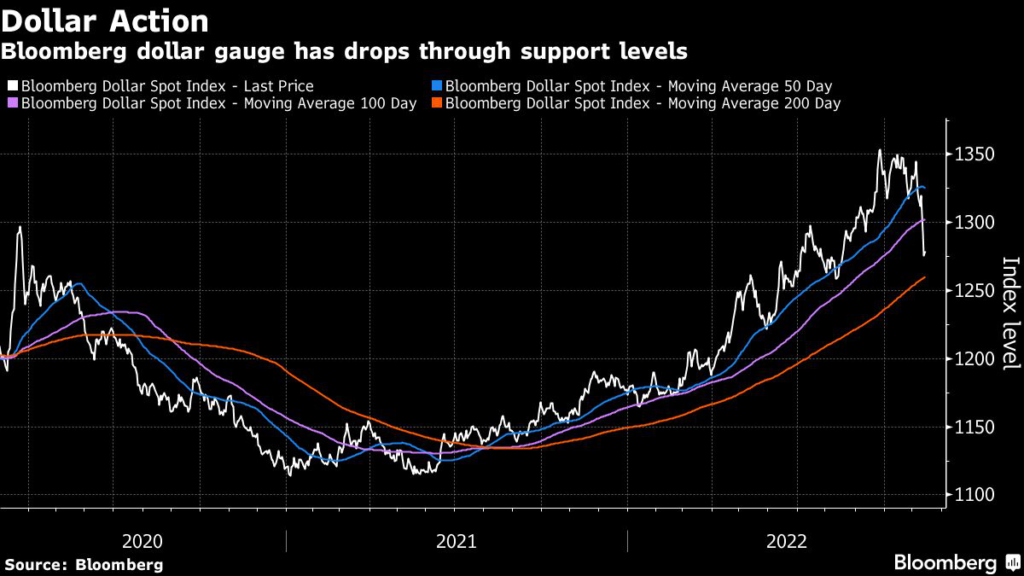
A gauge of the greenback had slumped more than 1% on Friday and fell for a fourth straight week in its worst performance since 2020. 

The greenback had been sliding amid signs of cooling in US inflation and the prospects of a dovish tilt by the Fed. The University of Michigan’s preliminary November survey on Friday showed US consumer inflation expectations increased in the short and long run while sentiment retreated. 

Treasury yields rose across the curve in Asia after cash trading was closed for Veterans Day on Friday.

Cryptocurrencies remained under pressure amid FTX’s deepening woes. A swift plunge inthe  value of FTX’s key crypto assets and unauthorized withdrawals of funds after it filed for bankruptcy suggest customers have little chance of recovering much of their deposits. 

Investors will keep a wary eye on the Group of 20 summit in Indonesia, where US President Joe Biden and Chinese leader Xi are expected to meet. Biden’s hand has been strengthened by the Democrats defying political forecasts and historical trends to keep control of the Senate.

Oil advanced for a third session as investors weighed the outlook for Chinese demand as the market tightens heading into winter. 

The positive sentiment from China also filtered through to Australian iron ore miners and steel companies as their shares surged. Gold declined on the stronger dollar. 

Key events this week:

  • US President Joe Biden plans to meet Chinese President Xi Jinping on the sidelines of the G-20, Monday
  • Fed’s John Williams moderates panel, Monday
  • China retail sales, industrial production, surveyed jobless, Tuesday
  • Former US President Donald Trump plans to make an announcement, Tuesday
  • US empire manufacturing, PPI, Tuesday
  • US business inventories, cross-border investment, retail sales, industrial production, Wednesday
  • Fed’s John Williams, Lael Brainard and SEC Chair Gary Gensler speak, Wednesday
  • ECB President Christine Lagarde speaks, Wednesday
  • Eurozone CPI, Thursday
  • US housing starts, initial jobless claims, Thursday
  • Fed’s Neel Kashkari, Loretta Mester speak, Thursday
  • US Conference Board leading index, existing home sales, Friday

Some of the main moves in markets:

Stocks

  • S&P 500 futures fell 0.2% as of 11:59 a.m. Tokyo time. The S&P 500 rose 0.9%
  • Nasdaq 100 futures fell 0.4%. The Nasdaq 100 rose 1.8%
  • Japan’s Topix fell 0.7%
  • South Korea’s Kospi index rose 0.1%
  • Hong Kong’s Hang Seng Index rose 3.1%
  • China’s Shanghai Composite Index rose 0.6%
  • Australia’s S&P/ASX 200 rose 0.1%

Currencies

  • The Bloomberg Dollar Spot Index rose 0.2%
  • The euro fell 0.2% to $1.0328
  • The Japanese yen fell 0.2% to 139.13 per dollar
  • The offshore yuan rose 0.5% to 7.0596 per dollar

Cryptocurrencies

  • Bitcoin fell 1.1% to $16,182.68
  • Ether fell 1.9% to $1,193.7

Bonds

  • The yield on 10-year Treasuries advanced seven basis points to 3.89%
  • Australia’s 10-year yield advanced nine basis points to 3.74%

Commodities

  • West Texas Intermediate crude rose to $89.43 a barrel
  • Spot gold fell to $1,763.73 an ounce

More stories like this are available on bloomberg.com

©2022 Bloomberg L.P.
Close Bitnami banner
Bitnami