Bloomberg

Yields Climb as Fed’s Waller Pushes Back on Dovish Rate Bets

(Bloomberg) — Treasury yields rose and the dollar strengthened against most of its major peers after Federal Reserve Governor Christoper Waller pushed back on bets the US central bank was nearing the end of its hiking cycle. 

Benchmark 10-year Treasury yields climbed seven basis points to 3.88%, reopening after a holiday, after Waller said the Fed has got a ways to go before its stops hiking. A gauge of the greenback rose 0.2%. Waller also said the market got “way out in front” over the unexpected cooling in inflation. 

The market is reacting after getting “a reminder the Fed isn’t going to change its view on one good CPI outcome,” said Jason Wong, a strategist at Bank of New Zealand in Wellington. 

The dollar’s advance comes after a gauge of the currency slid 3.5% last week, its biggest decline since the early days of the pandemic, as traders trimmed bets on aggressive Fed hikes after US inflation was slower in October than economists forecast. Treasury yields also tumbled and stocks surged amid optimism the Fed wouldn’t need to increase rates as much as anticipated. 

US two-year yields climbed six basis points to 4.40%, after sliding 33 basis points last week. Australian 10-year yields climbed eight basis points as traders across the Asia-Pacific region digested the potential that last week’s decline was excessive. 

Fed Speakers

Fed speakers this week are likely to push back on last week’s market reaction as they want to tighten financial conditions, not loosen them, Commonwealth Bank of Australia strategists wrote in a note to clients. The dollar can partly unwind last week’s decline as they were out of proportion to the size of the miss in inflation, they said.

Fed Vice Chair Lael Brainard is set to speak on Monday as part of a week featuring many central bank appearances. Producer price data are due due to be published on Tuesday. 

Investors will also be looking to the outcome of a meeting between US President Joe Biden and China’s Xi Jinping as leaders from around the world gather at the Group-of-20 summit in Indonesia. 

–With assistance from Ruth Carson and Garfield Reynolds.

(Updates Treasury yields.)

More stories like this are available on bloomberg.com

©2022 Bloomberg L.P.

Asia Earnings Week Ahead: Alibaba, Tencent, Japan’s Megabanks

(Bloomberg) — Asia’s key earnings may deliver a mixed bag this week, with Chinese retail giant Alibaba expected to widen its profit margin while Japan’s three biggest banks may be left nursing larger paper losses on foreign bond holdings.

The Japanese megabanks will detail their earnings performance on Monday, and analysts expect tepid results weighed down by sluggish lending growth. The Nikkei newspaper reported Sunday that between them, the three banks’ total unrealized losses from foreign bonds will likely reach the largest amount since March 2015. This week concludes the bulk of Japan’s earnings season, which so far has revealed a marked divergence between firms beating expectations in an increasingly challenging global environment and those falling short.

Later in the week, Tencent and online retail giants will post their earnings in the wake of China’s announcement that it will shift gears on the Covid Zero policy that has been casting a shadow on the country’s long-term outlook. Alibaba, reporting its second-quarter earnings on Thursday, probably witnessed its first Ebita margin expansion in three years after paring losses at local consumer services and in Southeast Asia, according to Bloomberg Intelligence. The retailers’ earnings come on the heels of the Singles’ Day shopping event, which Citi analysts described as having been disappointingly flat for Alibaba and surprisingly positive for JD.com.

  • To subscribe to earnings coverage across your portfolio or other earnings analysis, run NSUB EARNINGS function on the Bloomberg terminal.
  • Follow results, analysis and market reaction to Tencent’s report in real-time on the TOPLive blog.
  • For more on what’s going on in other regions, see the US Earnings Week Ahead or the EMEA Earnings Week Ahead, and see the ESG Stock Watch for a selection of the environmental, social and governance themes that may come up on earnings calls.

Highlights to look for this week:

Monday: Japan’s three megabanks will report earnings on Monday after market close in Tokyo. No particular fireworks are expected in the second-quarter reports. Market participants will be watching how the lenders are moving toward their full-year targets. Mitsubishi UFJ Financial Group (8306 JP) is targeting net income of 1 trillion yen this fiscal year, with smaller rivals Sumitomo Mitsui Financial Group (8316 JP) and Mizuho Financial Group (8411 JP) forecasting 730 billion yen and 540 billion yen respectively. With interest rates in the US skyrocketing while the Bank of Japan is stubbornly pinning yields to near zero, all eyes will be on ballooning paper losses on the lenders’ foreign bond holdings. Meanwhile, analysts expect MUFG to embark on another share buyback program this quarter.

Tuesday: No major earnings expected.

Wednesday: Tencent (700 HK) will report third-quarter earnings after market close. It logged its first revenue decline last quarter and investors are keen to see whether the downtrend will continue. Third-quarter revenue is expected to decline 0.4% from a year earlier, according to Bloomberg Consensus estimates. Wall Street analysts slashed their price targets by the most in months and shares dropped to the lowest level in five years last month. Onshore and offshore gaming businesses face pressure and growth has been weak during traditionally peak summer season, according to CICC. Further comments on divestment of its equity portfolio are also in focus as the Chinese giant has long been expected to reduce its investment in response to Beijing’s antitrust rules.

Thursday: Alibaba (BABA US) is due in Asia’s evening. The Chinese e-commerce behemoth could report its first year-on-year expansion in adjusted Ebita margin since 2019, thanks to narrower losses expected at its online food delivery platform Ele.me and its Southeast Asian arm Lazada, BI wrote. Analysts are expecting sales to have grown by 4.3% in the fiscal second quarter — down from the 29.4% gain seen in the same period last year — mirroring revenue concerns raised by JPMorgan when it cut the price target in September.

Friday: JD.com (JD US) reports after the market close in Hong Kong. Third-quarter results from China’s second-largest online retailer follow Singles’ Day and peer Alibaba’s earnings, with Bloomberg Consensus projecting the highest gross margin in two years. Improved product mix and platform fees could compensate for higher fulfillment expenses stemming from China’s mobility curbs, BI wrote. Nevertheless, potentially weaker business sentiment in the country could drag down service revenue contribution in the current quarter, BI added.

–With assistance from Crystal Chui and Sophie Jackman.

More stories like this are available on bloomberg.com

©2022 Bloomberg L.P.

SoftBank Sinks 12% After Loss and No New Buyback Program

(Bloomberg) — SoftBank Group Corp. shares plunged as much as 12% Monday in its biggest intraday drop since the outbreak of the pandemic in early 2020, after the company failed to announce a widely-expected stock buyback.

The company’s core Vision Fund segment posted a $7.2 billion loss in the July-September quarter, following a record 2.33 trillion yen ($17 billion) loss in the preceding period, as sliding startup valuations force the world’s biggest technology investor to go into defensive mode and virtually halt investments.

SoftBank has been grappling with declines on its portfolio of more than 400 investments in both public and private tech companies around the world, which includes China’s SenseTime Group Inc., US food delivery firm DoorDash Inc. and Indonesian ride-hailing and e-commerce firm GoTo Group. Cumulative returns on SoftBank’s Vision Fund and Latin America portfolio plummeted from a gain of $56 billion a year ago to an overall loss of $1.5 billion in its most recent report.

SoftBank’s stock price surged in the early weeks of the current quarter as the Tokyo-based company raced to complete two share repurchases: a 1 trillion yen buyback program announced last year and a 400 billion yen program announced in August. The aggressive pace of the buybacks spurred expectations of a fresh injection and speculation that billionaire founder Masayoshi Son was planning to lead a buyout to take the company private.

The lack of a buyback prompted analysts at Deutsche Bank, CLSA and Jefferies to downgrade their ratings on the stock. Citi assigned SoftBank a “High Risk” rating, citing capital market uncertainty and related impact for the company’s earnings.

“We were looking for another round of buyback announcement but there was none,” Jefferies analyst Atul Goyal said in a report. “We believe the risk-reward has now become unfavorable and asymmetric.” 

As SoftBank pivots focus to its balance sheet, it has also been hurrying to offload assets, including a disposal of its prized Alibaba Group Holding Ltd. stake, lifting its bottom line in paying down debt. The profit from that sale helped buoy it to a net income of 3.03 trillion yen in the quarter just ended, despite the Vision Fund losses. The company’s total interest-bearing debt, excluding telecom arm SoftBank Corp., stood at 13.7 trillion yen, down from more than 17 trillion yen at the end of June.

While further asset sales may result in future buybacks, the company is likely to sit still for now, given its recent stock performance, said Deutsche Bank’s Peter Milliken in a report.

–With assistance from Vlad Savov.

More stories like this are available on bloomberg.com

©2022 Bloomberg L.P.

Klarna Offers UK Price Comparison Tool in Bid to Expand Revenue

(Bloomberg) — Klarna has rolled out a search and compare tool in the UK and Nordics as the fintech giant looks to diversify its revenue streams away from its core buy-now, pay-later business, an industry under increasing scrutiny. 

It follows the product’s launch in the US last month and comes a year after the Swedish firm bought price comparison service PriceRunner for a reported $125 million, making it Klarna’s largest acquisition to date. The deal was finalized in the first quarter of 2022.   

“For Klarna, today’s launch is a major milestone in our evolution from a payment network to a single shopping destination,” Klarna boss Sebastian Siemiatkowski said in a statement. 

Klarna, the former darling of European fintech, suffered a steep valuation cut earlier this year but Siemiatkowski said in October its “painful” restructuring was largely complete.

The new offering intends to provide retailers with an alternative to Alphabet Inc.’s Google and Amazon.com Inc. and supply Klarna with an additional revenue stream. Klarna’s affiliate marketing business generates 600 million leads a year for its retail partners, according to the company.

More stories like this are available on bloomberg.com

©2022 Bloomberg L.P.

Global Funds Gorge on Korea Chip Stocks, Putting Kospi Atop Asia

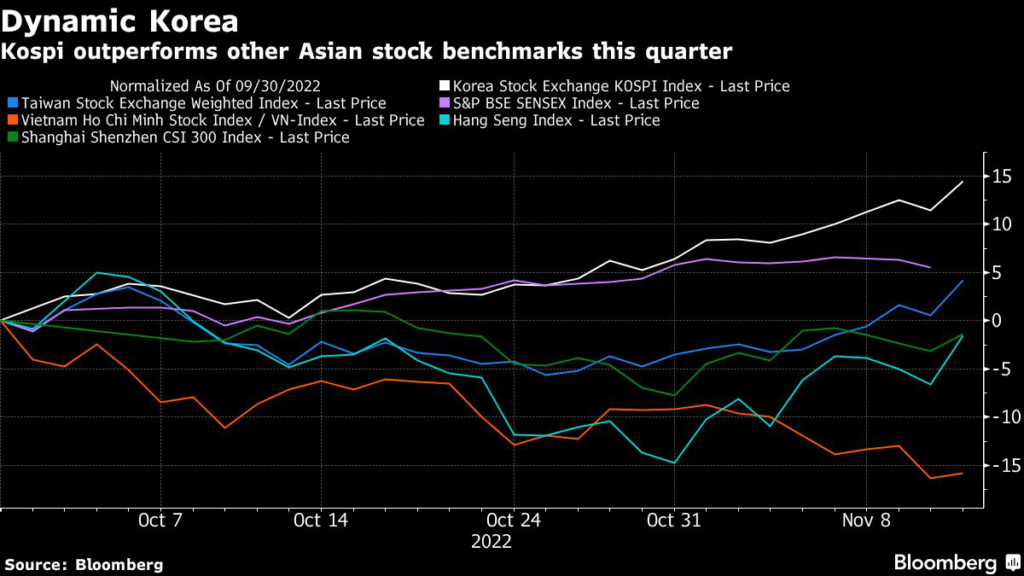
(Bloomberg) — Foreign investors have poured about $4.6 billion into stocks on South Korea’s Kospi since the end of September, making it the best-performing Asian equity benchmark so far in the last quarter of the year.

An 18% surge in Samsung Electronics Co. has been the biggest driver in Kospi’s 15% jump so far this quarter, with the chip sector getting a further lift Friday as softer-than-expected US inflation data eased rate-hike concerns. Persistent tensions between Washington and Beijing have made Korean tech shares an attractive alternative to Greater China rivals, while the won’s rebound against the dollar has also helped.

Global technology shares have staged a recovery of late, with the Nasdaq 100 on track for its first quarterly gain in 2022. Lingering doubts about Federal Reserve policy and a possible global recession, however, cast some caution on the rally’s durability.

“I expect the rebound to continue through November,” said Shin Jin-Ho, co-chief executive at Midas International Asset Management, which manages $10 billion in assets. “While liquidity risks related to the real-estate sector’s project financing still linger and could halt the rebound, the Korean tech sector overall could see continued inflows from foreign funds.”

READ: Credit Crunch in Korea Flashes Warning on Limits of Intervention

The Kospi had dropped in each of the previous five quarters, as the benchmark fell 35% from its 2021 record high amid a plunge in the won that prompted authorities to intervene in the currency market. The nation also tightened short-selling rules last month. Things turned a corner in October as foreign funds rushed back into stocks on perceived benefits from the US ban on some tech exports to China.

With China and Taiwan part of emerging markets benchmark index, “if investors are concerned about the geopolitical issues then there are only a few other large liquid markets left,” said Sanjeev Rana, an analyst at CLSA Securities Korea. “That’s why we have seen big fund flows into the Korean market.”

A regional lift from expectations for China’s gradual post-pandemic reopening has also acted as a catalyst. At the same time, US President Joe Biden’s climate bill bolstered the appeal of the Korean battery supply chain, helping drive LG Energy Solution Ltd. up 46% since the end of September.

READ: This China-Dependent Play Showing More Bullishness Than China

Even with the recent surge, the Kospi is still down 17% this year after a selloff driven by concerns over interest rates, slowing growth and tech valuations. Export-dependent South Korea may require a clear signal that the global economy is on track for recovery before a full-fledged rally, according to Charu Chanana, a senior strategist at Saxo Capital Markets.

“I would be wary of too much optimism as equities still need to price in a recession risk,” she said. “Not to mention, the latest crypto crash, which can spell liquidity concerns for Asian markets.”

–With assistance from Abhishek Vishnoi and Ishika Mookerjee.

More stories like this are available on bloomberg.com

©2022 Bloomberg L.P.

Biden Rallies Yoon, Kishida as North Korean Missile Threat Grows

(Bloomberg) —

President Joe Biden met the leaders of Japan and South Korea to rally support in the face of increasingly brazen North Korean missile tests, a show of solidarity a day before he meets Chinese President Xi Jinping.

Biden met on Sunday with Japanese Prime Minister Fumio Kishida and South Korean President Yoon Suk Yeol during a summit in Phnom Penh, Cambodia. He rattled off a series of discussion points while putting particular emphasis on Pyongyang’s threats.

“For years, our countries have been engaged in a trilateral cooperation out of a shared concern for the nuclear and missile threats North Korea poses to our people,” Biden said. North Korea continues “provocative behavior” and the partnership is more important than ever, he added. 

Biden last met Kishida and Yoon in June on the sidelines of the NATO summit. Since then, the pace of missile tests has heightened tensions in the region and put fresh pressure on the trio to maintain a show of unity, even as bilateral relations between Japan and South Korea remain frosty.

“North Korea’s provocations, unprecedented both in their frequency and manner, continue and we assume more could be coming,” Kishida said. 

Biden said the three leaders would also discuss other efforts, including how to “strengthen our supply chains” and build “economic resilience,” a nod to simmering tensions over US policies on semiconductor chips. Both South Korea and Japan, home to some of the world’s biggest carmakers, have also opposed US aid for local electric-vehicle manufacturers in the Inflation Reduction Act.

The requirements of the electric vehicles tax credit are “not consistent” with the US and Japan’s shared policy to work with allies and like-minded partners to build supply chains, the Japanese government has said. South Korea is home to three of the world’s largest EV battery manufacturers, which announced $25 billion in US investment since Biden took office. Yoon’s government and South Korean car companies have been lobbying for changes.

In a separate one-on-one meeting with Yoon, Biden said he will consider the contributions of South Korean companies to US battery and electric-vehicle industries when implementing the new law, according to a statement from the presidential office in Seoul.

Chip Controls

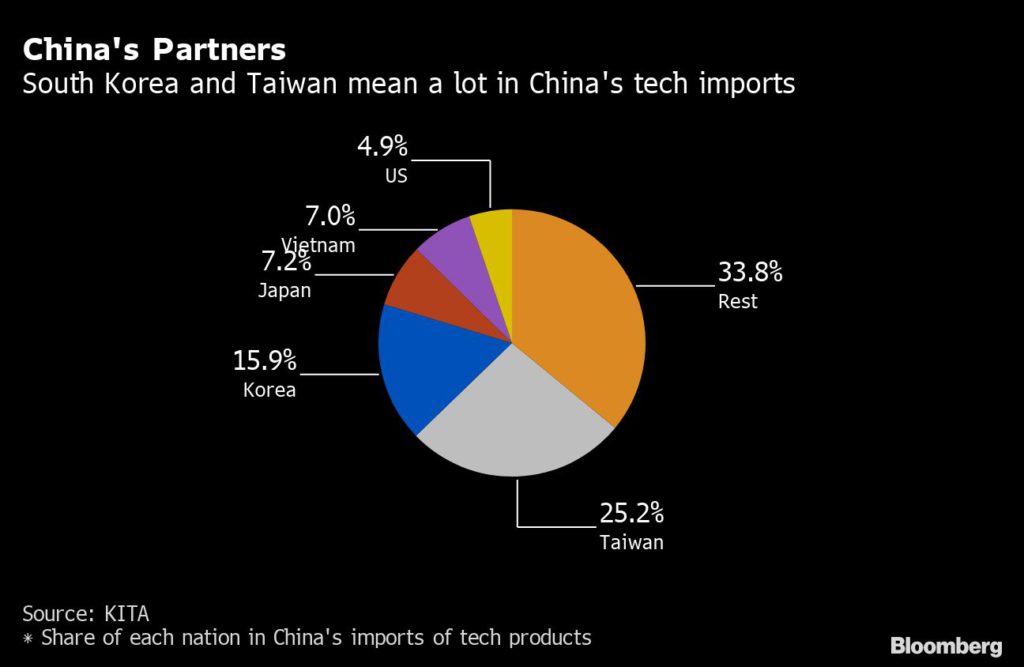
South Korea and Japan have also found themselves caught between their biggest trade partner, China, and their top security partner, the US, over Biden’s move to tighten controls on exports of some chips and chipmaking equipment to China.

South Korea’s SK Hynix Inc., one of the world’s biggest memory chip makers, has warned the Biden administration’s escalating restrictions could force the closure or sale of a major plant in China, an “extreme situation” it hopes to avert.

The US president said the three leaders would also discuss concerns about China, including how to “preserve peace and stability across the Taiwan Strait” and work toward “the common goals of a free and open Indo-Pacific.” Biden and Xi are due to meet Monday in Bali, Indonesia, ahead of the Group of 20 summit. 

Pyongyang has shown its anger over joint military drills between the US allies by firing off an unprecedented barrage of missiles in the past few weeks. They have included his newest nuclear-capable rockets designed to hit targets in South Korea and Japan, as well as the test of a long-range missile designed to reach the US.

Biden and Kishida offered condolences to Yoon and South Korea after a fatal crowd surge in Seoul, while Yoon said North Korea’s tests in the aftermath of that were a particular insult.

“At a time when South Korea is grieving and in deep sorrow, North Korea pushed ahead with such provocations, which lays bare the Kim Jong Un regime’s true inclinations that completely go against humanitarianism and humanism,” Yoon said. 

‘Extremely Serious’

He noted that one missile landed in South Korea’s territorial waters, which he said was unprecedented and “an extremely serious provocation.”

Yoon, a conservative who took office in May, has been seeking to repair ties with Japan and backed regional security policies in line with those of Kishida’s government. The three countries have all indicated that North Korea could further ratchet up security concerns with a nuclear test and promised stern and coordinated punishment if leader Kim set off an atomic device. 

Kishida and Yoon also held a bilateral meeting, where they condemned North Korean provocations and agreed to speed up talks aimed at resolving a dispute over compensation for forced labor during Japan’s 1910-1945 colonization of the Korean Peninsula, according to a statement from the Japanese government. 

The show of unity is a welcome move for Biden, who has been trying to rally nations to counter assertive moves from Beijing, Pyongyang and Moscow.

Biden is also seeking support for a supply chain agreement the US is negotiating with 13 other countries known as The Indo-Pacific Economic Framework, or IPEF. Some US allies in Asia have indicated they would have preferred a more traditional trade deal.

–With assistance from Josh Wingrove, Sangmi Cha, Isabel Reynolds, Sohee Kim and Heejin Kim.

(Updates with bilateral talks in third-from-last paragraph.)

More stories like this are available on bloomberg.com

©2022 Bloomberg L.P.

FTX’s Freefall Into Bankruptcy Shows Why Case File Is Empty

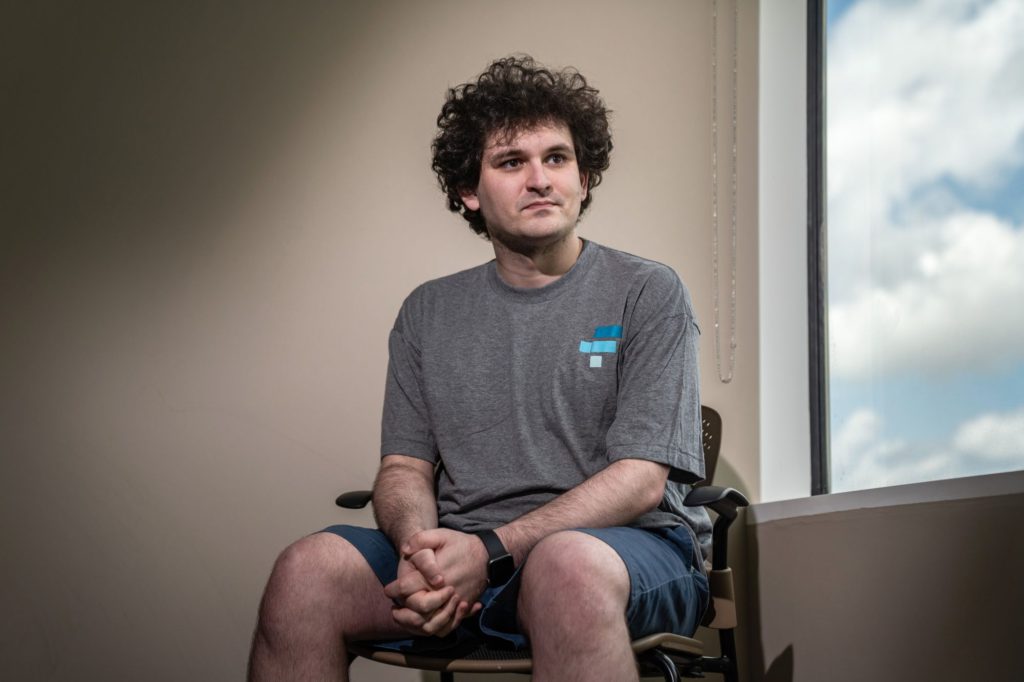
(Bloomberg) — The collapse of Sam Bankman-Fried’s crypto empire has been chaotic, fast and full of unknowns. The world should soon get some answers via a Delaware federal court. 

FTX is what’s known in the industry as a “free fall” bankruptcy. More than 130 related companies sought court protection at the end of last week without filing any of the usual court motions or explanatory documents seen in a big US insolvency case. Two days later, the companies’ main court docket contains only a 23-page fill-in-the-blank petition. In nearly every other multi-billion dollar Chapter 11 case in recent years, lawyers quickly file a smattering of routine requests designed to stabilize operations. 

In a statement, the company’s new chief executive officer — a man who helped oversee the unwinding of Enron Corp. — told customers that details about the bankruptcy would hit the court docket “over the coming days.”

“It’s not like a normal filing where you’re lining up papers literally for weeks,” said Eric Snyder, chair of the bankruptcy department at law firm Wilk Auslander, which isn’t part of the case. “Within 24, 48 hours this was on the ropes and done.”

Free Fall

Typical paperwork filed in the immediate aftermath of a bankruptcy include a detailed narrative of why the company sought court protection, what kind of judicial help it needs immediately and a general outline of what the company hopes to accomplish in bankruptcy.

A judge handles those immediate requests at a company’s first court hearing, which is typically held within a few days of the Chapter 11 petition. As of Sunday afternoon in Delaware, FTX hadn’t said when it would appear before US Bankruptcy Judge John Dorsey, who has been assigned to the case. 

When FTX does get its first hearing, Dorsey is likely to ask many of the same questions that customers and creditors are asking: Where are the company’s assets? What is the company’s goal for the bankruptcy?

One of the last major financial companies to file for bankruptcy with little warning to investors was MF Global Inc., the Wall Street broker-dealer run by former New Jersey governor and ex-Goldman Sachs Group Inc. co-chairman Jon Corzine. Wrong-way bets on European sovereign debt caused ratings firms to begin downgrading MF Global at the end of October 2011, and within days the company filed bankruptcy.

Even in the case of MF Global, customary motions were filed the same day that the company went bankrupt. Requests included permission to continue managing cash in the ordinary course of business and the disclosure of important bank account information.

FTX’s filings shift the enterprise into a universe governed by strict procedural guardrails and an emphasis on transparency. 

Were there “lots of lawyers working this weekend to prepare these papers? Absolutely,” Snyder said. Advisers need to get a sense of what FTX is worth and what, if anything of the businesses can be salvaged, and who its creditors are, all of whom need need to informed about the proceedings. 

It’s no small task for an enterprise like FTX: the company has both US and international operations and is in some way intertwined with Bankman-Fried’s trading house, Alameda Research. In initial filings, FTX estimated both its assets and liabilities fell in the range of $10 billion to $50 billion.

Adding complications, the company is subject to multiple investigations, including a criminal probe by authorities in the Bahamas. The US Securities and Exchange Commission is looking into potential securities rules violations, and the Justice Department is also involved. 

To be sure, free-fall bankruptcies can spark fast, dramatic resolutions when crisis is afoot. When it plunged into Chapter 11 protection in 2008 with little plan for a path forward, Lehman Brothers sold its core capital markets business to Barclays Plc for $1.75 billion just days after filing. The deal transferred jobs and clients to a solvent firm and helped stabilize the global economy.

Just weeks ago, FTX was on the hunt for assets itself. In September, the company won an auction to take over the assets of bankrupt crypto lender Voyager Digital Ltd. with a bid worth about $1.4 billion. Voyager said Friday it is reopening the auction process. 

More stories like this are available on bloomberg.com

©2022 Bloomberg L.P.

Indonesia Sees Swift Passage of Sweeping Financial Reform Bill

(Bloomberg) — Indonesia will make another attempt to enact far-reaching reform for its financial system that could include expanding the central bank’s mandate and paving the way for debt monetization during crises.

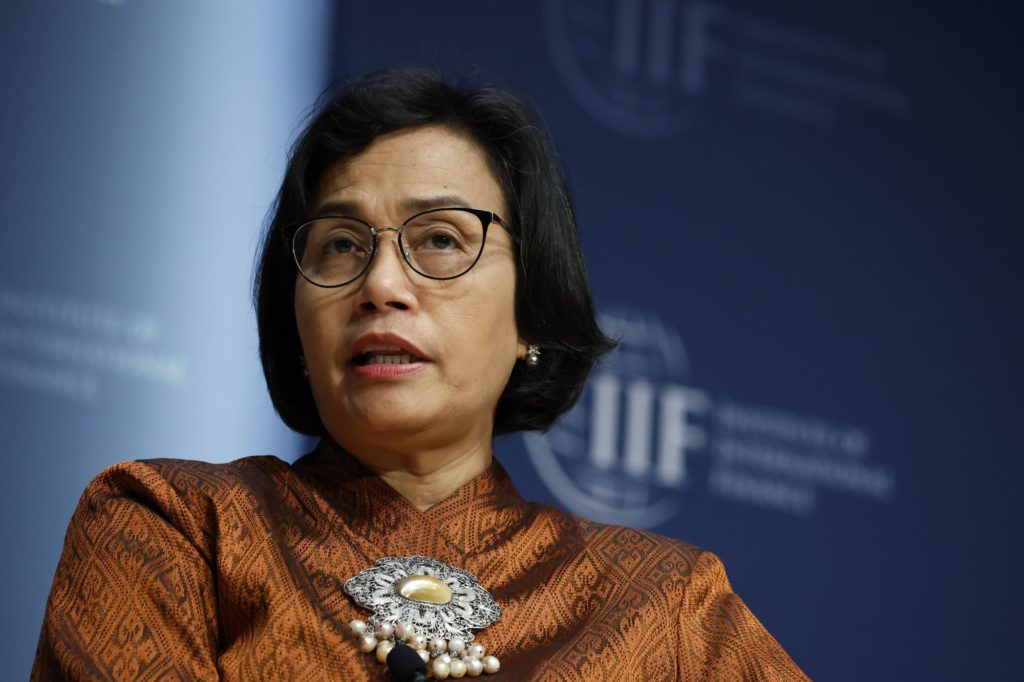
A parliamentary commission is expected to swiftly approve the latest draft of the financial sector omnibus bill in one or two sessions after reviewing the articles and concluding talks with stakeholders, Finance Minister Sri Mulyani Indrawati told Bloomberg Television’s Stephen Engle on Sunday. Once that’s approved, the bill could be passed at the next plenary session. 

The proposed legislation, first introduced in 2020, would amend dozens of “outdated” laws that govern the financial sector, including the capital market, banking, insurance and pension, Indrawati said in an interview in Bali on Sunday ahead of the Group of 20 Summit on Nov. 15-16. 

More regulations are also needed for the digital financial sector as current policies are inadequate, she added.

More pertinent to investors, though, are provisions stated in earlier versions of the bill that seek to add supporting economic growth and job creation to Bank Indonesia’s mandate of maintaining price and currency stability. The central bank could also be tasked to buy sovereign bonds directly in the primary market during times of crisis, as decided by a committee led by the finance minister.

President Joko Widodo has long sought to make permanent such unconventional coordination between the government and the monetary authority that has allowed Southeast Asia’s biggest economy to emerge well from the pandemic. However, concern among investors that it could weaken the central bank’s autonomy has held up the legislative process until now. 

The finance chief repeated assurances that Bank Indonesia’s independence would be maintained to keep monetary policy credible. Authorities do not want to “destroy” the country’s “foundation of macroeconomic stability,” Indrawati said.

Cash Rich

Southeast Asia’s largest economy expects to end the year with a “much, much lower” budget deficit due to the strong growth in tax revenues. With plenty of cash on hand, the government has space to wait out volatility in the first half of 2023 before jumping back into the bond market, Indrawati said.

“We will always be opportunistic with the timing. It’s known to many investors that Indonesia is very prudent and healthy fiscally. Hopefully that will provide us with a competitive price,” she said, adding that the government could consider currencies like the euro and yen for a global bond, given the recent strength of the US dollar.

Indrawati also confirmed that the planned carbon tax will be delayed to 2025 to give the economy time to recover, and the industry to better understand the new levy. Export taxes on nickel pig iron and ferronickel and subsidies on electric vehicle purchases are still being studied, she said.

G-20 Presidency

As the year’s culminating G-20 summit kicks off on Tuesday, Indrawati said Indonesia’s presidency of the group would be able to deliver concrete results, even if it skips a joint communique yet again. A $1.4 billion pandemic fund was launched on Sunday, and a separate climate finance pact of up to $20 billion could be announced this week too.

Another event to watch will be the landmark meeting between US President Joe Biden and Chinese President Xi Jinping in Bali, which takes place against the backdrop of a slowing global economy and worsening geopolitical tensions after Russia’s invasion of Ukraine.

“Our responsibility as G-20 president is to try to continue bridging the gap,” Indrawati said. “Many global situations now cannot be solved by any single country, like the pandemic, climate change, geopolitics, or even digital technology. This will all force us to work together.”

More stories like this are available on bloomberg.com

©2022 Bloomberg L.P.

Biden’s Chip Curbs Outdo Trump in Forcing World to Align on China

(Bloomberg Businessweek) — President Joe Biden came to office pledging to abandon Donald Trump’s with-us-or-against-us approach to China. Instead, he’s forcing US partners to pick sides in a deepening global technology standoff.

Sweeping US curbs announced last month on the sale of semiconductors and chipmaking equipment to China mark a step change in the Biden administration’s approach to its chief geopolitical rival. That’s not just a challenge to Beijing, but also asks tough questions of allies — and presents Washington with a dilemma over how far it’s willing to squeeze them to comply.

As Biden prepares to hold his first face-to-face meeting as president with Xi Jinping, the export controls loom large as a declaration that the US isn’t prepared to let China advance in a range of cutting-edge technologies that could threaten America’s status as the world’s pre-eminent power. That new reality spells more trouble ahead for US-China relations, which are already veering into dangerous territory over Taiwan: Beijing denounced the measures as US overstretch to “wantonly hobble Chinese enterprises.”  

But the chip controls are also causing friction with key allies.

In the Netherlands, home of ASML Holding NV, which has a virtual monopoly on a type of machine needed to make the most advanced chips, people familiar with the talks described the US as acting like a bully. Given ASML’s role as a linchpin of the $580 billion global chip industry, Dutch Prime Minister Mark Rutte is due to visit semiconductor giant South Korea this week, when he’s said export controls will be high on the agenda.

The mood in Japan’s government, meanwhile, was said by an official to be one of bemusement that its sovereignty could be so disregarded. All the people asked not to be named as the discussions are ongoing.

“This package is replete with unilateral measures with very big assumptions that partners will follow the US’s lead,” said Reva Goujon, director of China corporate advisory at Rhodium Group. The “game changer” controls send an unmistakable signal of intent to Beijing while containing an implicit threat for partners, she said, since “the US is willing to go extra-territorial if they consider it important enough.”

The new export controls leave American chip companies at the mercy of the US Commerce Department’s Bureau of Industry and Security to grant a license to sell certain advanced products in China. Since early October, American officials have repeatedly said that if allies do not align with Washington on the latest rules, they could ban sales of foreign chip equipment that contains even the smallest amount of US technology.

The real test for the US is whether its allies and security partners around the globe will play along, particularly as the Biden administration considers expanding the restrictions — and that kind of acquiescence isn’t guaranteed, according to interviews with government and industry officials who asked not to be named to be able to speak freely about a matter that is still under discussion.

US officials have repeatedly said export control rules will lose their effectiveness over time if partners don’t join in, but by effectively forcing governments to comply or face potential penalties, the US is alienating swing nations in Europe and Asia that are less willing to confront Beijing, whether for political or economic reasons. Consequently, there’s no sign of an imminent agreement.

US Secretary of Commerce Gina Raimondo told American firms that they will have to wait as long as nine months before Washington can seal a multilateral deal and level the playing field for them. Senior US officials including National Security Council Senior Director for Technology and National Security Tarun Chhabra are visiting the Netherlands for related talks this month, but an accord isn’t expected to come out of it. 

The Biden administration believes it will be able to persuade the Netherlands and Japan because they share the US’s concern for national security, according to a person familiar with the talks. The negotiations will be difficult but the administration is optimistic it can reach a deal, though the timeline is unclear, according to the person. The tone of the talks have shifted since Oct. 7, after the White House made clear it’s willing to disadvantage American companies in the short term to further the countries’ joint national security interest.

A spokeswoman for the National Security Council declined to comment.

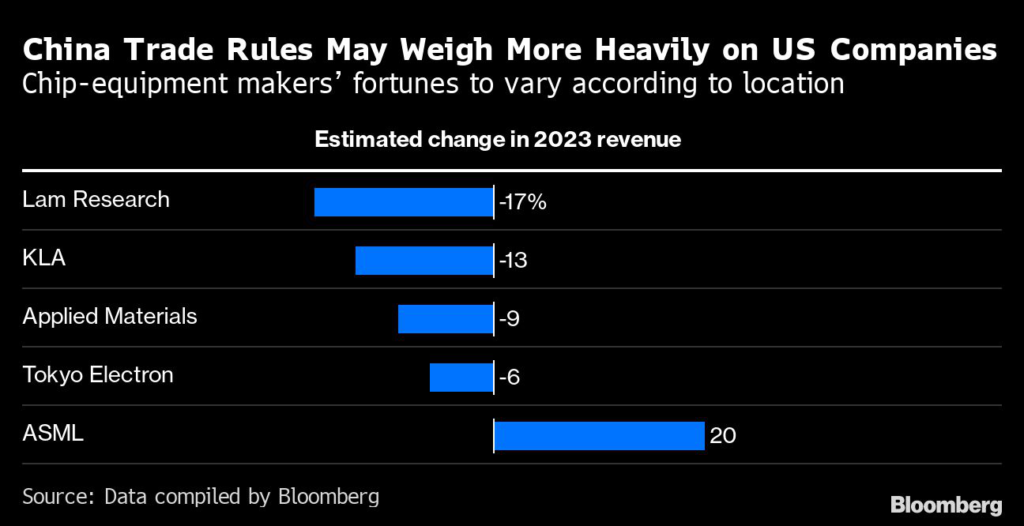
Aside from actual chips, five companies dominate the global market for the equipment needed to produce them: Applied Materials Inc., Lam Research Corp. and KLA Corp., all of the US; Japan’s Tokyo Electron Ltd.; and ASML.

The Netherlands is coordinating with South Korea, Japan and the US, Rutte told Bloomberg Television this month when asked about US pressure to halt sales of ASML’s older machines to China. An effective ban is already in place on its cutting-edge “extreme ultraviolet lithography,” or EUV, machines, since the Dutch government has not granted ASML a license to ship to China. 

While the Netherlands has concerns about many aspects of doing business in China, there’s a need to maintain dialogue with the world’s No. 2 economy, Rutte said. “We should not be naïve,” he added. “Discussing the issue of tech and also the export of the latest technology itself is a legitimate debate which we have amongst our partners.”

The countries the U.S. needs cooperation from the most have largely stayed mum on the issue except for acknowledging ongoing communications with Washington and other stakeholders.

But behind the scenes, frustrations are palpable. People familiar with the Dutch government’s thinking said it was easy for the US to implement controls on China, but they leave the Netherlands squeezed between the two and having to navigate an extremely sensitive path. ASML hinted at resistance in an October earnings call, when Chief Executive Officer Peter Wennink said that “as a European based company with limited US technology in our systems, ASML can continue to ship all non-EUV lithography systems to China out of the Netherlands.”

Read more: ASML Shrugs Off China Chip Curbs With Demand Strong Elsewhere

In fact, early this year Washington almost got allies to agree to a deal, albeit with looser restrictions than were announced last month, only for Dutch and Japanese officials to walk away. Japan and the Netherlands were ready to formalize multilateral controls through the so-called Wassenaar arrangement that would ban China’s access to equipment capable of making 5-nanometer chips, or one generation behind the current most advanced technologies, but the US then wanted to raise that threshold to more mature technologies that would lead to a bigger impact on chip companies’ China sales. That’s when talks collapsed.

Since then, Japan and the Netherlands have resisted the US demand on chip curbs and tried to convince others not to give in. ASML and Tokyo Electron have been lobbying their respective governments to stand firm.

ASML declined to comment for this story, while a Tokyo Electron spokeswoman said that as a private company it is not in a position to comment on government actions. Rutte’s office declined to comment. 

In Japan, there is strong opposition within Tokyo Electron and other equipment makers to caving in to US pressure that would hurt their lucrative business in China, where they compete with Applied Materials and Lam Research. Rather than giving a blunt refusal, the government in Tokyo is simply not acting on the US request, relying on Japan’s reputation for time-consuming bureaucracy.

Japan has long implemented strict export controls through international coordination, and “we will continue to take appropriate measures, taking into account trends in regulations in other countries, including the US,” the Ministry of Foreign Affairs said in response to questions on the government’s stance.  

There’s a sense in Japan that US companies will manage to continue to do business with China while others suffer. One complaint was the controls will spur Beijing to advance its chip technology, leaving the US and China strengthened and everyone else at a disadvantage.

Yet American equipment suppliers are livid. 

Applied Materials, Lam Research and KLA helped Washington craft a detailed list of very targeted items that they identified as choke points for Beijing’s development of chip technologies after meeting with Raimondo in July to talk about how to limit China’s capabilities without hurting the US companies’ market shares. 

They were promised the government wouldn’t move ahead with the controls before having allies onboard. However, the government officials failed to convince partners or inform the chip firms of their plans to implement the measures in October. Just days before the announcement, they were no longer picking up calls from the companies concerned. The firms are now skeptical of a deal within the nine-month timeframe cited by Raimondo. All three companies declined to comment for this story. 

For the China hawks within the Biden administration, early October was seen as the only window they had to unveil new restrictions before it got too close to the meeting between Biden and Xi at the G-20 summit in Indonesia. The two leaders will meet with the chip curbs still reverberating worldwide: Singapore’s Foreign Minister Vivian Balakrishnan said Nov. 9 that Washington’s export controls amount to “all but a declaration of a technology war.”

The measures are all the more striking given the extent to which Biden had sought to reassure nations that his administration would avoid the kind of pressure Trump had exerted on them to steer clear of Chinese products, notably by calling for bans on Huawei Technologies Co. in 5G mobile networks. 

The early talk from Biden officials of outcompeting China now extends to looking to use the US’s dominant economic position to actively weaken adversaries. That’s a toughening of its stance that is unlikely to be diluted even if the Republicans take control of the House, since a hard line on China is one of few areas of bipartisan agreement in Washington.

 The chip measures fire the gun on what US National Security Advisor Jake Sullivan has termed a “decisive decade” in competition with China, with a focus on computing, biotechnology and clean energy tech. That raises the prospect of further export controls in the future. For his part, Xi has vowed to “resolutely win the battle in key core technologies.”

All of which means life will become harder for nations like South Korea, India, Singapore and Malaysia that are already treading a precarious line balancing constructive relations with Washington and Beijing, said Ja Ian Chong, an associate political science professor at the National University of Singapore.

 “It’s very difficult for countries caught in this crossfire to extricate themselves, whether they’d like to choose sides or not,” Chong said.

–With assistance from Cagan Koc, Debby Wu, Jenny Leonard, Ian King, Takashi Mochizuki, Mayumi Negishi, Jillian Deutsch, Arne Delfs, Isabel Reynolds, Iain Marlow, Rebecca Choong Wilkins and James Mayger.

(Updates with link to ASML’s latest comments on chip curbs below 18th paragraph. )

More stories like this are available on bloomberg.com

©2022 Bloomberg L.P.

FTX’s Balance Sheet, Hack Paint Dim Picture for User Recovery

(Bloomberg) — A swift plunge in value of FTX’s key crypto assets, along with unauthorized withdrawals of funds after it filed for bankruptcy, suggests that customers of the once popular exchange face a slim chance of recovering much of their deposits. 

A breakdown of the balance sheet of Sam Bankman-Fried’s exchange shared with investors a day before its bankruptcy filing shows that it had nearly $9 billion in liabilities and $900 million in liquid assets, $5.5 billion in “less liquid” assets, and $3.2 billion in “illiquid” assets, according to sources familiar with the matter who viewed a limited version of information. Most of the biggest holdings, including lower-profile cryptocurrencies Serum, Solana and FTT, have since plunged in value. 

Within 24 hours of the bankruptcy filing, an outflow of unauthorized crypto withdrawals — estimated at $477 million by blockchain analytics firm Elliptic  — further eroded the pile of assets available for possible customer recovery. FTX is launching an investigation with law enforcement into the suspected theft. 

The balance sheet also referenced a negative $8 billion of a “hidden, poorly internally labeled” fiat currency account and noted $5 billion of withdrawals by users last Sunday. An accompanying note says, “There were many things I wish I could do differently than I did, but the largest are represented by these two things: the poorly labeled internal bank-related account, and the size of customer withdrawals during a run on the bank.” 

The balance sheet is incomplete and not granular, one source said. The Financial Times first reported on the balance sheet. Bankman-Fried didn’t respond to emailed inquiry about the balance sheet. 

Here’s a breakdown of key assets listed on FTX’s balance sheet: 

Serum Tokens: $2.2 billion 

The biggest asset listed on the balance sheet is $2.2 billion of SRM, or Serum tokens. Serum price has fallen about 38% since Nov. 10. Developers have since spun off the project to mitigate exposure to FTX. The market capitalization for Serum, based on circulating supply, is about $65 million, according to data from Coinmarketcap.

SOL Tokens: $982 million 

The balance sheet also lists assets of $982 million in SOL, or Solana tokens. SOL fell 24% in the past two days as developers distance themselves from the FTX-backed ecosystem.  

MAPS Tokens: $616 million 

The price of the MAPS token fell 25% in the past two days. The current market capitalization for MAPS token is $3.5 million, according to Coinmarketcap. 

FTT Tokens: $554 million

The price of FTT token, the token issued by FTX exchange, fell by 50% in the past two days. 

Robinhood Shares: $472 million

Robinhood’s stock rose 13% on Friday, meaning the asset value of Robinhood shares increased from what the balance sheet shows. However, Bankman-Fried’s holdings of Robinhood shares were under an entity called Emergent Fidelity, which is not among the entities listed in Friday’s bankruptcy filing. 

More stories like this are available on bloomberg.com

©2022 Bloomberg L.P.
Close Bitnami banner
Bitnami