Bloomberg

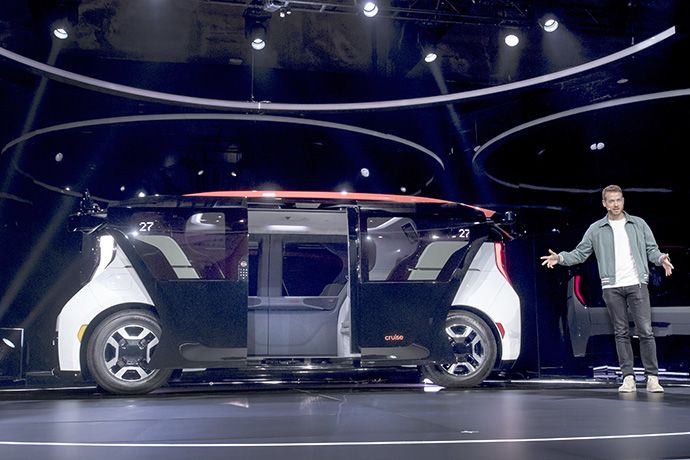
Self-Driving Survivors Struggle With ‘Trough of Disillusionment’

(Bloomberg) —

There’s a phrase that keeps getting tossed around in the autonomous vehicle business: trough of disillusionment.

Cruise CEO Kyle Vogt said it on General Motors’s recent earnings call, and Aurora Technologies CEO Chris Urmson used a variation of if on Bloomberg Television to describe where the industry is right now. Their comments came after Ford and Volkswagen-backed Argo AI shut down and after a year-long rout in self-driving tech stocks.

What’s happening is a brutal shakeout among companies trying to monetize a new technology. Money poured into startups during bubbly days before and during the pandemic. Many of those investments aren’t panning out. Companies with cash, technology chops and patient ownership are still in the game. Any company missing just one of those three pieces are going away.

The remaining players are still getting funded and are still eyeing a big prize if they can scale up a business before investors lose interest.

“The laggards are falling behind while the leaders are building value,” Vogt told me in an email. “Only the laggards are publicly traded due to unfortunate decisions made during the SPAC bubble, and unsurprisingly their declining prospects seem to be reflected in their stock prices.”

Two of the top companies keep pressing ahead. Alphabet’s Waymo is expanding its robotaxi business to Los Angeles. Cruise is doing the same by starting operations in Phoenix and Austin.

Vogt has said that Cruise’s system can be unboxed and deployed in new markets quickly. During GM’s most recent earnings call, he said expansion in San Francisco as well as new markets will start to bring in real business. Next year will begin a big push where Cruise ramps up operations and “start to generate meaningful revenue,” he said.

Analysts pressed Vogt and GM CEO Mary Barra on the rate of investment in Cruise — it’s a bit more than $500 million a quarter. Cruise’s revenue target is $1 billion in 2025. Savvy investors will understand that Cruise is at the very beginning of monetizing self-driving technology, but they may still worry about the cash burn.

Other companies are removing the driver and expanding. Gautam Narang, CEO of closely held Gatik AI, said his company focusing on middle-mile freight delivery has a solution for limiting risk and quickly bringing in revenue. Its robotic driver runs delivery trucks on relatively simple routes between distribution centers and retail stores for Wal-Mart in Arkansas and for supermarket chain Loblaws in suburban Toronto. Since the driving is easy and the routes are limited, Gatik needs less mapping data to enter new markets and can scale up quickly.

Gatik has raised $120 million and is in the process of bringing in more, which hasn’t been announced. That gives the company three to four years of runway with “aggressive growth,” Narang told me in an interview.

Aurora, whose stock has plunged 85% this year, raised a lot of money in 2021 and has $1.2 billion on its balance sheet. The company plans to deploy its driverless semi-truck technology in 2024, and Urmson told Bloomberg TV last week that it has enough cash to get to mid-2024. That’s cutting it close, so he’ll likely need to both generate more revenue and find eager investors before then.

Tight capital markets will speed up the current shakeout. Or, as Urmson put it: “The opportunity is so exciting that we just need to push through it. There is going to be at most a handful of companies that will cross the chasm.”

More stories like this are available on bloomberg.com

©2022 Bloomberg L.P.

Russian Bank in Heart of EU Lays Off Half of Workforce

(Bloomberg) — East West United Bank, one of the biggest Russian lenders in Luxembourg, will cut about half of its workforce amid “unprecedented challenges” following the Kremlin-led invasion of Ukraine. 

The bank, which was established in the Grand-Duchy in 1974, reached an accord to help protect its remaining staff and keep operating, Luxembourg’s main trade unions said in a joint statement on Thursday. Between 32 to 44 of the bank’s 80 employees will be let go.

“The bank is facing unprecedented challenges due to the geopolitical context,” the unions Aleba, OGBL and LCGB said in the statement. The agreement was reached on Oct. 25 after “tense” negotiations amid an “uncertain context for the bank,” the unions said.

East West, owned by conglomerate Sistema PJSC, provides wealth management and transaction services to Russian-speaking clients in and around Luxembourg, a European Union member state and financial hub.

The bank said in an email that the unions’ statement was correct and that it won’t comment further.

(Updates with bank’s response in last paragraph)

More stories like this are available on bloomberg.com

©2022 Bloomberg L.P.

Biden to Meet China’s Xi Nov. 14 to Buoy Strained Ties

(Bloomberg) — US President Joe Biden will seek to set a floor to prevent US-China ties from deteriorating further when he meets his Chinese counterpart Xi Jinping Nov. 14, a senior Biden administration official said.

The official, who briefed reporters Thursday, said the meeting’s main objective was for Biden and Xi to deepen their understanding of each other’s priorities and intentions — and to set so-called rules of the road.

That’s a goal that the White House has been seeking since the leaders’ first call in 2021. 

In the latest sign the White House isn’t expecting any tangible policy breakthroughs from Biden and Xi’s first face-to-face meeting, the official said the session during the Group of 20 summit in Indonesia was not being driven by a search for deliverables and that there would not be a joint statement from the event. 

The two leaders will discuss the war in Ukraine, recent North Korean nuclear activity, efforts to curb climate change and other areas where the nations can work together, the official said. 

Biden vowed Wednesday to make no “fundamental concessions” to Xi, reinforcing already low expectations for any major breakthrough in strained ties between the world’s two largest economies. 

White House Press Secretary Karine Jean-Pierre confirmed in a statement that the meeting would take place Nov. 14.

Xi’s last meeting with a US leader came in June 2019, when he reached a truce with Donald Trump that led to a trade deal six months later — right before relations fell into a downward spiral as Covid-19 spread around the globe.

Biden said he expects to discuss contentious issues such as trade and Taiwan, which China has put under increased military pressure since US House Speaker Nancy Pelosi visited Taipei in August. His administration also imposed sweeping curbs on the sale of advanced chips to China, a move designed to maintain the US’s technological edge over Beijing.

Recent US measures to curb China’s access to semiconductors are not aimed more broadly at containing China, the official said, adding that it was a targeted approach to prevent Beijing from using high-end chips for advanced military applications.

The US and China have veered toward confrontation over the past few years even as they face greater calls to cooperate on trade and pressing issues like climate change, Covid-19 and Russia’s war in Ukraine. 

Both are increasingly suspicious of each other’s intentions: The National Security Strategy released by Biden last month cast China as trying to supplant the US as the world’s dominant power, while a defiant Xi declared that the “rejuvenation of the Chinese nation is now on an irreversible historical course.”

With relations between the two nations at their lowest point in decades, both presidents have put some domestic uncertainty behind them in recent weeks. 

Xi has secured a precedent-breaking third term as leader and stacked the Communist Party’s leadership with loyalists. Biden emerged stronger than expected from US midterm elections, telling reporters Wednesday that he plans to run for re-election in 2024, though he has yet to make a formal announcement. 

China so far hasn’t confirmed the Xi-Biden meeting, with Foreign Ministry spokesman Zhao Lijian saying Thursday that Beijing took the US proposal “seriously” and the two sides were in communication.

Beijing was “committed to realizing mutual respect, peaceful coexistence and win-win cooperation with the US,” he added.

–With assistance from Akayla Gardner.

(Updates with details on US chip curbs starting in 13th paragraph)

More stories like this are available on bloomberg.com

©2022 Bloomberg L.P.

Tether Dips Below $1 as FTX Fallout Continues to Roil Markets

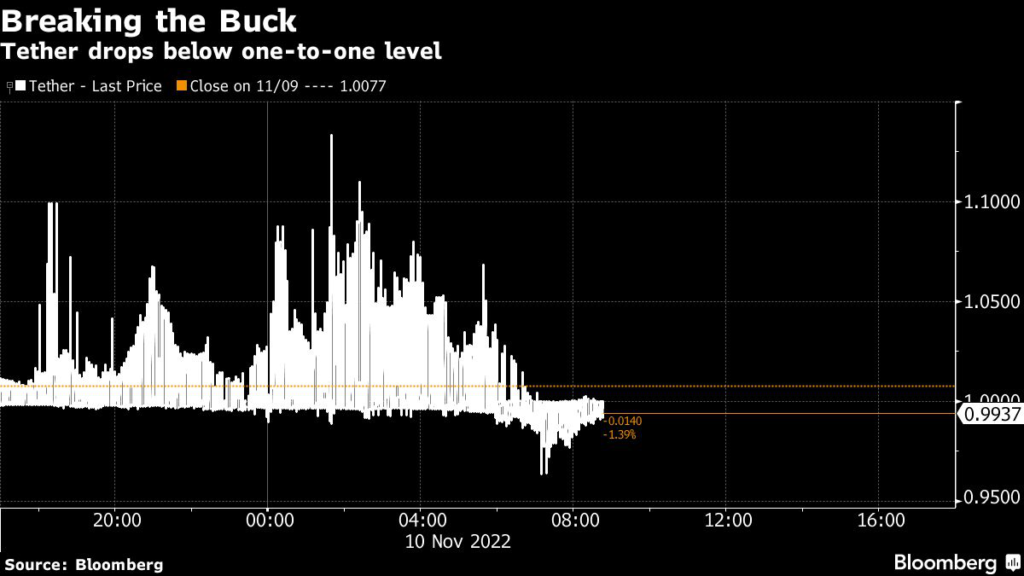
(Bloomberg) — Tether’s USDT token, the largest stablecoin by market value, veered off its dollar-peg on Thursday as market instability continued to roil the crypto sector and the issuer froze some coins in the wake of FTX’s collapse.

USDT slipped as much as 4% to around 96 cents, according to pricing data available on Bloomberg. Other major stablecoins, including Circle’s USDC, Binance’s BUSD and MakerDAO’s DAI, were broadly flat or trading at a slight premium.

The issuer also sought to freeze a pile of USDT tokens, subject to an active investigation by law enforcement. The hoard, worth roughly $46 million, were in a wallet owned by FTX, crypto news site CoinDesk reported. A Tether spokesperson declined to comment on the specifics, but said the firm has open dialog with authorities including the US Department of Justice. 

Tether has become a bellwether of crypto risk appetite during periods of market stress, struggling to maintain its peg to the dollar. The token slumped as low as 94.55 cents during the collapse of the Terra ecosystem in May, and lost around $18 billion from its total circulation over the months that followed. Traders use the tokens as a source of liquidity and to shelter funds during wide price swings.   

Meanwhile Tether’s share on Curve’s 3pool, a platform where users can swap USDT for USDC or DAI stablecoins, became imbalanced as traders rushed to offload their USDT tokens for other assets. USDT now makes up nearly 80% of the pool, compared 9.8% for USDC and 10.8% for DAI, compared to the pool’s usual even three-way split.

The amount of funds deposited in Tether have rebounded since the Terra collapse as crypto volatility eased, but redemptions began to start again in earnest this week as the broader market swung wildly. The price of Bitcoin has declined around 17% this week, while Ether declined 19.3%. 

Paolo Ardoino, Tether’s chief technology officer, said in a tweet that the firm had processed around $700 million in redemption requests in the last 24 hours.

–With assistance from Joanna Ossinger.

(Adds comment from Tether in the third paragraph.)

More stories like this are available on bloomberg.com

©2022 Bloomberg L.P.

Crypto Operator CoinShares Reveals 11% Of Assets Exposed to FTX

(Bloomberg) —

Europe’s largest digital asset investment firm CoinShares International Ltd said it had about $30.3 million in cryptocurrencies and other assets stuck on collapsed exchange FTX, making it the latest in a string of major firms to get caught in the fallout from the crisis.

The brokerage’s exposure to FTX — which represents around 11% of its total net asset value — consists of around $25.9 million in US dollars and USDC, a dollar-pegged stablecoin, it said in a statement to Bloomberg News. Pending withdrawals also include 190 Bitcoin and 1,000 Ether, worth $3.2 million and $1.2 million, respectively, at current prices. 

The assets had been part of its capital markets division and proprietary trading activities, CoinShare’s chief executive Jean-Marie Mognetti said in an interview. Coinshares’s hallmark exchange-traded products business is unaffected by the potential loss and the company has no exposure to Alameda Research, a trading outfit co-founded by FTX’s CEO Sam Bankman-Fried, Mognetti added. 

CoinShares stock dropped as much as 6.6% earlier in Thursday’s session, before paring the decline to 0.5%.

FTX began experiencing severe delays with withdrawals from its platform on Monday, following widespread speculation about the exchange’s financial health as the value of its own native FTT token plummeted. A potential takeover deal with rival exchange Binance fell apart on Wednesday evening, and Bankman-Fried warned investors of a potential bankruptcy if his firm can’t secure funds to cover a shortfall of as much as $8 billion.

  • Read more: FTX Hurtles Toward Bankruptcy With $8 Billion Hole, US Probe

Once valued at $32 billion, FTX and Bankman-Fried were held up by many as the poster children for crypto, a factor which heightens the potential for contagion from their sudden collapse. Other firms that revealed they took a hit from FTX’s demise include Amber Group, Wintermute, Galaxy Digital Holdings Ltd. and Sequoia Capital.

“For too long, things like FTX have been perceived by investors as a quasi-bank or quasi-financial institution which it is not,” Mognetti said in an interview on Thursday. “We can all trade crypto at an exchange, but you are exposing yourself to a variety of risks which are not really in your favor.”

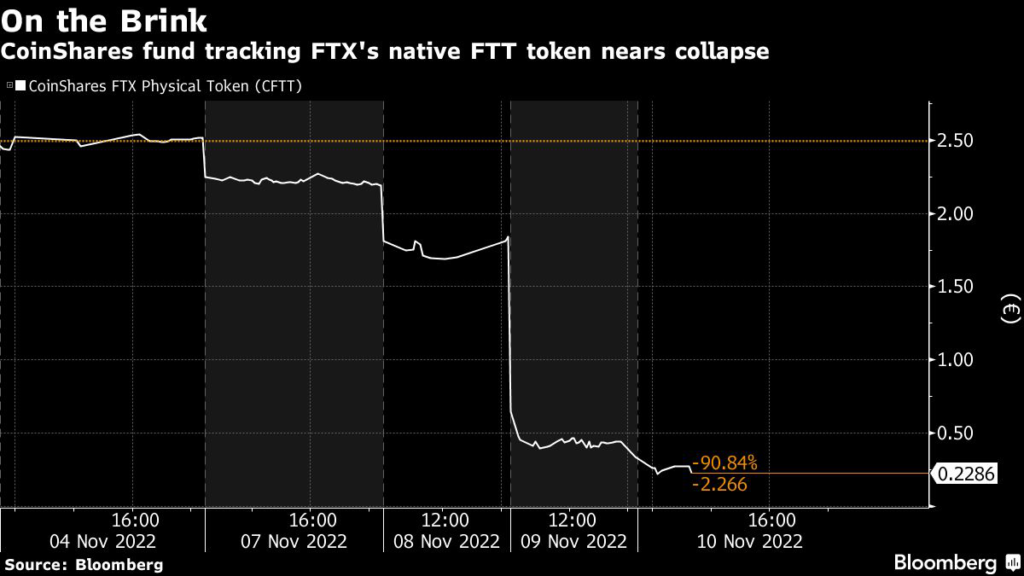
Sweden-listed CoinShares, which offers exchange-traded products tracking the prices of Bitcoin, Ether and other cryptocurrencies, also operates a tracker for FTX’s token FTT. The value of the CoinShares FTX Physical FTX Token product (ticker: CFTT) has slumped more than 90% since the close of trading last week, reflecting the crash in spot FTT prices elsewhere.

Mognetti said the firm’s asset management team was monitoring the “fluid” situation around FTT and CoinShares’s other FTX-linked ETP — a product tracking the price of staked Solana tokens — very closely. 

“It’s still liquid in both directions, poeple can take money in or out,” he said, adding that an update would be issued in due course.

(Adds CoinShares’ stock moves in fourth paragraph)

More stories like this are available on bloomberg.com

©2022 Bloomberg L.P.

With F1, Las Vegas Gears Up to Be the New Car Capital of America

(Bloomberg) — On Saturday evening, Nov. 5, Lewis Hamilton joined Diplo on stage at the XS nightclub in Las Vegas, dancing with the microphone while the EDM impresario DJed. It was the culmination to a pounding weekend for the seven-time Formula 1 champion. Earlier that day he had driven F1 cars directly under the lights of the Las Vegas strip ,along with F1 drivers Alex Albon, Sergio Perez and George Russell, in a “fan fest” to promote the sport to the city that next year will sponsor its first F1 Grand Prix race since 1982.

The upcoming race weekend, scheduled for Nov. 16-18, 2023,  will be the most expensive of any in the F1 schedule, said F1 Group Chief Executive Officer Stefano Domenicali. Three-day general admission tickets start at $500, and better seats in the grandstands start at $2,500; hospitality packages and “entertainment experiences,” which include seats during the big race, have already been ranging in price from $10,000 to $1 million. It is expected to surpass even Miami in terms of the white-hot appetite among fans to get tickets, lodging and party access.

“The Formula 1 announcement was probably one of the biggest announcements, if not the biggest announcement, Las Vegas has ever had,” says Steve Hill, CEO of the Las Vegas Convention and Visitors Authority. “I’d compare it to a Super Bowl announcement—and we got them both around the same time. The combination is certainly terrific.” (Super Bowl LVIII is slated to happen in 2024 in Paradise, Nevada, eight miles from the Vegas strip.) 

The Las Vegas Grand Prix is hardly the only major car-related event happening in Sin City next year.

The weekend prior to the GP, Wynn Las Vegas will present its second-annual Las Vegas Concours d’Elegance, a 230-plus vehicle car show set on the Wynn golf course. This year the concours was held on Oct. 29 with the dramatic MGM Sphere concert venue set like the Death Star in the background; attendance was capped at 3,500. 

Meanwhile, the SEMA show—an automotive aftermarket trade fair that showcases million-dollar off-road trucks and specialty builds to tens of thousands of ticketholders—will run from Oct. 31 to Nov. 3, 2023. Nascar will be at Las Vegas Motor Speedway on March 5 and Oct. 15. And out at the track 15 miles from Caesar’s Palace, nearly 20 NHRA racing teams will return to Las Vegas Motor Speedway on Oct. 26-29 for the NHRA Nevada Nationals, the penultimate event of the drag-racing season.  

Add the autonomous—and electric-vehicle-heavy—Consumer Electronics Show, which showcases futuristic concepts from the likes of Audi, BMW and Mercedes-Benz every January; multiple car auctions from houses like Mecums and Barrett-Jackson; and the prestigious Mint 400, America’s oldest off-road race held annually in March, and you’ve got quite a cavalcade of car events on the calendar for the Nevada desert.

LA and Miami aside, those who watch closely are saying Las Vegas is a vibrant, passionate and very well-funded rising star of car culture in the United States.

“Many of the world’s greatest car events have become very exclusive due to the combination of their well-deserved success, their location and the inevitable lack of infrastructure,” says Phillip Sarofim, a prominent collector and the owner of Meyers Manx. “Las Vegas is a destination which attracts the best food, music and entertainment from across the globe—and its enormous, purpose-built infrastructure allows [car events such as the concours] to potentially be both impressive and inclusive and continue to grow, unrestrained, for generations to come.”

“We have long been a car city,” says Hill. “We haven’t talked about being a car capital yet—but maybe we should be.”

We’ve Been Here Before

It’s not the first time Las Vegas boosters have lobbied to make their city more car-centric. In 1981, Caesar’s Palace hosted an F1 Grand Prix that was the final race of the FIA Formula 1 World Championship that year. Australian Alan Jones won, and Frenchman Alain Proust finished second. In 1982, the Italian Michele Alboreto won; that was also the last F1 race ever driven by former world champion Mario Andretti. 

But even the best efforts of  Bernie Ecclestone, the notorious “F1 Supremo” former owner of the racing series, failed to convince fans and promoters that Formula racing had a place in Vegas. Drivers hated the slow and awkward E-shaped track built in a glorified parking lot behind Caesar’s. They also hated the heat. Nelson Piquet, who struggled to finish fifth in the Oct 17 race in 1981, famously suffered heat exhaustion after the race due to the near suffocating temperatures inside his car. After two years on the F1 circuit, the track was converted to a round one in 1983 for a more specialized car-racing series. 

Organizers took note and adjusted. Earlier this year, Liberty Media paid $240 million for a 39-acre plot near the MGM Sphere to construct pit lanes, paddocks and hospitality to augment the race course, which will run through closed city streets rather than a stifling parking lot. The race is slated to begin at 10 p.m., long after the November sun has settled for the night. And the fears about sound pollution on city streets, which have stymied such places as New York City and LA from having a modern F1 race, don’t apply here, says Hill. 

“Vegas is the only city that has been built to be a platform for events and for people to come and have fun,” he says. “If you live in the resort corridor and are unaware of that, you haven’t been paying attention. It is who we are.”  

“The city now has a proven track record of attracting sports fans and following the overwhelming amount of interest during our first wave of ticket sales, we feel as though we made the right choice in bringing the sport to Las Vegas,” says Emily Prazer, chief commercial officer for F1 Heineken Silver Las Vegas Grand Prix. On Nov. 4, Heineken was named title sponsor of the race. “I think the addition of Formula 1 will continue to open the door for new and significant increases in car and car culture-adjacent events for the local area.”

Where the World Comes to Play

Visit Vegas for a weekend, and its appeal for driving enthusiasts and car aficionados is obvious. Unlike Detroit, a faded if authentic automotive hub, Vegas boasts warm year-round temperatures and just 21 days of rain. (Smart travelers will avoid the 100F-plus days of July and August.)

On any of those perfect driving weather days, collectors can aim their McLaren Speedtails and Lamborghini Huracans right off the Strip directly toward hundreds of miles of picturesque canyon roads and lonely two-lane highways, including access to large swaths of Death Valley, the red-hued sandstone petroglyphs in Valley of Fire, the Grand Canyon, and the booming Hoover Dam. A recent drive on nearby Route 167 included a chance encounter with DTM car racing champion Maximilian Götz, who drives for Mercedes-AMG, taking in the breeze on a rented Harley-Davidson motorcycle. 

“I had always wanted to come here,” Götz said. “It’s more incredible than I expected.” 

Then there are such world-class hotels as the Wynn Las Vegas, Aria, Caesar’s Palace, and Waldorf Astoria, which are larger, more polished and more accessible to world travelers than the regional, often overused and under-staffed spots attendees must frequent when they attend the concourses in Carmel, California, and Amelia Island, Florida. 

Meanwhile, LA’s too-cool hotspot Delilah opened at the Wynn last year; Cipriani at Wynn and Carbone at Aria opened in 2018 and 2019, respectively. Martha Stewart just opened the Bedford, her French cuisine restaurant, at Caesar’s. Peter Luger steakhouse will open its first outpost outside New York City later this year. Sting, Adele, Katy Perry, Lady Gaga, Santana, Justin Bieber and Rod Stewart will all play shows in Vegas in 2023. Resort World Las Vegas is already selling package experiences.

“People need a nice place to stay. They’re going to need a nice place to eat,” says Brian Gullbrants, the president of Wynn Las Vegas, noting that Wynn recently opened its flagship Gucci store and that the Louis Vuitton flagship will soon open. Givenchy, Hermès and Dior are among the shops inside the Wynn hotel. “There’s something to do for everyone.”

Then there are the casinos—going gangbusters lately, it turns out. 

“There’s clearly a lot of uncertainty in the global marketplace right now,” Vince Sadusky, CEO of slot machine maker International Game Technology Plc, told Bloomberg, but IGT’s margins have hit near historical highs and sales have exceeded expectations, he said. “The great thing is we’re achieving our numbers.”

To the well-heeled car-obsessed person, all this means two things: (1) I can finally attend a car event with accommodations on par with the other places I stay in my free time that honor my high hospitality expectations, and (2) My signifiant other who does not love cars will have plenty to do—shop, sip, spa, sunbathe, slots—while I drool over million-dollar Porsches. 

“People are looking for connection and experience and an opportunity to just let their hair down and have fun,” Gullbrants says. “Cars are the center of the weekend, but not the only piece of the weekend.” The company is already privately selling access and experience packages for concours- and race-weekend 2023; pricing is available upon request. 

Money, Money, Money

You can bet luxury brands and buyers are paying attention. McLaren attended the Las Vegas Concours with multiple show cars and a tent to get a feel for what next year’s opportunity might present, a spokesperson says. Bugatti, Bentley and Koenigsegg have all indicated they will repeat their involvement in the Concours, says Gullbrants, adding: “We have already had a few other brands that have called us and said we are so sorry we missed it; how can we get in next year?”

“The demand for [F1] is well beyond what we were expecting, and the pricing is beyond normal,” echoed Tom Reeg, the CEO of Caesars Entertainment, during a recent earnings call. “With CES coming back … [it] should all be extremely positive for room rates and occupancy in the market in ’22 and ’23.”

Rolls-Royce had a small presence highlighting its new Phantom II on the concours green this year. During dinner at the Wynn Las Vegas on Oct. 28, Martin Fritsches, the president and CEO of Rolls-Royce Motor Cars Americas, spoke about how successful he felt Miami’s F1 race was for the brand and its clients, despite the fact that Rolls-Royce does not have an F1-affiliated race team. The company is already planning how best to maximize its impact in Las Vegas for the one-two punch next year of the concours and F1 combined. It will offer 10 to 20 client-experience packages with starting prices of around $10,000, a spokesperson confirms. 

“It makes total sense for us to be in Las Vegas,” Fritsches says. “Our clients are here, so we are here.”

With additional reporting by Chris Palmeri.

More stories like this are available on bloomberg.com

©2022 Bloomberg L.P.

Bumble Joins Tech Rally After Gen Z Worries Spurred Plunge

(Bloomberg) — Bumble Inc. joined a broader rally for tech stocks Thursday fueled by softer-than-expected US inflation data, erasing a premarket plunge following its results.

The shares climbed as much as 14%, after earlier sliding on concern that younger users aren’t renewing their subscriptions on the company’s main dating app.

Stock gains notwithstanding, analysts were cautious on Bumble after it reported worse-than-forecast revenue in the fourth quarter. The update triggered price-target cuts from brokers including Deutsche Bank AG, Goldman Sachs Group Inc. and Morgan Stanley. Bumble had slumped as much as 15% in premarket trading, before rallying on the main market.

“Bumble brand is seeing lower renewal rates on subscriptions, particularly among Gen Z users,” Morgan Stanley analysts, led by Lauren Schenk, wrote in a note, lowering their price target on the stock to $19, below Wednesday’s close of $20.93.


During a post-results conference call, Chief Executive Officer and founder Whitney Wolfe Herd said the economic slowdown was affecting segments of Bumble’s user base that face “greater pressure” on disposable income.

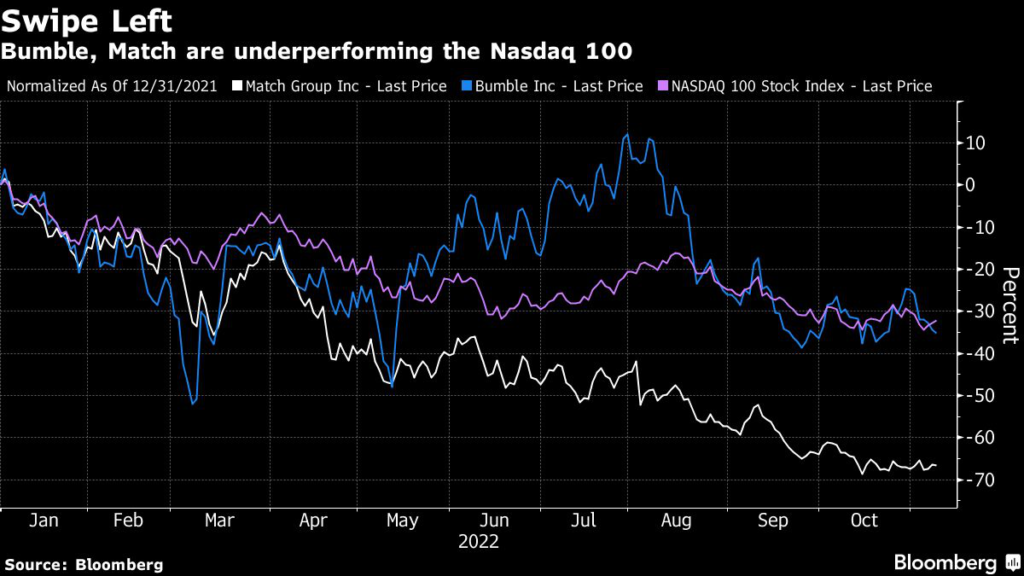
The shares were down 38% this year prior to the report as investors fled the stock as well as Tinder and Hinge parent Match Group Inc. Alongside a weakening economy curbing subscription revenue, dollar strength is cutting into international sales.

Still, no analyst has a sell rating on the stock. Morgan Stanley is among seven with a hold or equivalent recommendation, while 10 have Bumble as a buy.

–With assistance from Subrat Patnaik and Joe Easton.

(Updates share moves throughout.)

More stories like this are available on bloomberg.com

©2022 Bloomberg L.P.
Crypto Markets Stabilize on Hopes for Muted Impact From FTX Rout

(Bloomberg) — Cryptocurrencies stabilized after Wednesday’s plunge, regaining some of the losses fueled by Binance Holding Ltd.’s withdrawal of its offer to buy FTX.com.

Bitcoin rose as much as 14% to around $17,904, paring declines as data on Thursday showed US inflation cooled in October by more than forecast. The largest token by market value had already clawed back some of those losses before CPI data came out. It had dropped as low as $15,574 on Wednesday, to a level unseen since November 2020.

Meanwhile, Ether climbed 21%, while other altcoins outperformed the two larger tokens. Solana gained as much as 49% after losing roughly half its value in a week. Dogecoin jumped 30%.

There is no evidence that another other big fund or market maker in the crypto arena is facing similar distress as FTX, according to Ilan​ Solot, co‑head of digital assets at Marex Solutions.

While the fallout from FTX will not be isolated, “you could imagine a scenario in which there is no big concentrated loss — where lot of people lose money, but nothing else breaks,” he said.

“The longer that nothing happens, the more confident markets get,” Solot said.

Crypto markets have been roiled by the saga involving FTX, which until just a few days ago was seen as one of the top entities, with charismatic founder Sam Bankman-Fried seen as the crypto’s version of John Pierpont Morgan. Its FTT token plunged amid concerns fueled by Twitter comments from Binance co-founder Changpeng “CZ” Zhao, and is now close to $4 after trading near $25 just a week ago. Bankman-Fried and Zhao co-announced a non-binding offer by Binance to buy FTX, which was then scrapped on Wednesday.

“Since I entered the crypto industry in 2016, very few periods tested its market infrastructure and participants” the way the turmoil of recent days did, said crypto hedge-fund manager Dan Liebau of Modular Asset Management.

Value Loss

Despite trimming losses on Thursday, Bitcoin has still plunged about 14% so far this week. It had reached a record high of almost $69,000 a year ago. FTT, the utility token of the FTX exchange, is down roughly 85% this week, and was trading around $3.46 as of 10:04 a.m. in New York.

The FTX-Binance saga calls to mind the turmoil involving Celsius — the crypto lender that collapsed earlier this year — as well as those seen by other firms that were engulfed in this year’s crash in digital assets.

The chaos also attracted the attention of regulators and legislators.

Read more: Lummis Has ‘Many Questions’ About Binance’s Takeover of FTX

“What we’ve seen in the last two days, if I can step back from it a bit, is really part of a pattern,” US Securities & Exchange Commission Chair Gary Gensler said on Bloomberg Television. “Investors get hurt when we don’t rely upon the time-tested public policy guardrails we’ve put in place over the decades.”

He cited opacity, using other people’s money, leverage and inter-connectedness as risks in the digital-asset sector.

As for potential effects, concerns about the recent events may deter some firms which were previously tempted to enter the space.

“This is going to give pause for more traditional financial institutions,” Soona Amhaz, general partner at Volt Capital LLC, said on Bloomberg Television.

More stories like this are available on bloomberg.com

©2022 Bloomberg L.P.
Bankman-Fried’s Alameda Research Is Winding Down Trading

(Bloomberg) — Fallen crypto mogul Sam Bankman-Fried is shutting down Alameda Research, the trading house at the heart of his digital-asset empire, as he seeks last-ditch financing to save his troubled crypto exchange FTX.com. 

Bankman-Fried, who on Wednesday told investors that FTX may have to seek bankruptcy if it doesn’t get a rescue, announced the the move in a series of tweets on Thursday, adding that FTX is “spending the week doing everything we can to raise liquidity.” 

Bankman-Fried’s downfall was swift, with a hastily-agreed rescue by rival Binance Holdings Ltd. falling apart, US authorities looking into FTX’s dealings and a prominent investor writing down its stake in the company to zero. Alameda Research was a crucial part of his crypto empire, although questions around its balance sheet had been swirling after an article by CoinDesk earlier this month. 

“There is no way that Alameda could operate right now, even if FTX wasn’t in deep trouble,” said Colin Platt, a cryptocurrency consultant. “It is a business that relies on having the confidence of its counterparties, and confidence in Alameda has been irreparably harmed.”

Read more: FTX Hurtles Toward Bankruptcy With $8 Billion Hole, US Probe

Thursday’s announcement by Bankman-Fried capped a roller-coaster week that saw his creation come apart in a matter of days and sparked a rout in the broader market. The trouble started on Sunday, when Changpeng “CZ” Zhao, the Binance founder and chief rival, announced plans to sell about $530 million worth of FTT, the native coin of FTX. 

FTX saw about $5 billion of withdrawals that day, Bankman-Fried said in his Thursday Twitter thread. He also miscalculated his sense of “users’ margin” on the platform, he tweeted. 

On Tuesday, Zhao and Bankman-Fried both took to Twitter to reveal that they’d reached a tentative deal for Binance to buy FTX. A day later, Zhao pulled out and Bankman-Fried dropped the bombshell to FTX.com investors that it faced a shortfall of up to $8 billion, according to a person with knowledge of the matter. 

FTX is now in the process of trying to raise fresh liquidity, “every penny” of which will go toward making users whole alongside investors, he added. FTX.US isn’t financially impacted, and is “100% liquid,” he said. 

–With assistance from Emily Nicolle and Anna Irrera.

(Adds more details.)

More stories like this are available on bloomberg.com

©2022 Bloomberg L.P.

US Stocks Roar Higher as Yields Plunge on Soft CPI: Markets Wrap

(Bloomberg) — US stocks surged by the most in two years and Treasuries rallied after data showing prices rose slower than forecast fueled bets the Federal Reserve can dial back its aggressive tightening efforts.

The S&P 500 rallied 4%, poised for the best first-day reaction to a CPI report since 2008. Gains in the tech-heavy Nasdaq 100 topped 5%. 

Treasuries soared across the board, sending the rate on two-year notes, more sensitive to monetary policy, down 25 basis points. Rates traders pared bets on Fed hikes, with swaps indicating now that a 50-basis-point increase in December is far more likely than a 75-basis-point move.

Investors may treat the 7.7% headline figure as the latest evidence of peaking consumer-price growth, with potential to usher in an end to interest-rate hikes. The report also showed the consumer-price index coming in softer than expected on a month-on-month basis as well as in its core reading. 

“The first downside surprise in inflation in several months will inevitably be received by an equity market ovation,” Seema Shah, chief global strategist at Principal Asset Management, wrote. A 0.5% hike, rather than 0.75%, in December is clearly on the cards but, until we have had a run of these types of CPI reports, a pause is still some way out.”

US Inflation Slows More Than Forecast, Gives Fed Downshift Room

Philadelphia Fed President Patrick Harker said he expects the central bank to slow the pace of interest-rate hikes in upcoming months as US monetary policy approaches restrictive levels. But, he noted Thursday in the text of his remarks to the Risk Management Association’s Philadelphia chapter, a “ hike of 50 basis points would still be significant.”  

Fed Officials See Grounds for Soon Slowing Rate-Hike Pace

More commentary on CPI report, markets

  • “Today’s CPI report showed some moderate improvement as some of the previously elevated excessively high inflation-drivers, such as used cars, started to decline at a faster pace,” said Rick Rieder, chief investment officer of global fixed income at BlackRock Financial Management Inc.
  • “Inflation is still way above the Fed’s 2% target and we believe the Fed will keep their word and continue to raise interest rates,” Michael Landsberg, chief investment officer, Landsberg Bennett Private Wealth Management, wrote. “We are preparing for an environment where interest rates remain higher for longer. Investors should be more concerned with the effect that rising rates into a decelerating economy has on their portfolio values rather than the current level of inflation.”

Key events this week:

  • Fed officials Lorie Logan, Esther George, Loretta Mester speak at events, Thursday
  • US University of Michigan consumer sentiment, Friday

Some of the main moves in markets:

Stocks

  • The S&P 500 rose 4% as of 10:15 a.m. New York time
  • The Nasdaq 100 rose 5.6%
  • The Dow Jones Industrial Average rose 2.5%
  • The Stoxx Europe 600 rose 2.7%
  • The MSCI World index rose 3.4%

Currencies

  • The Bloomberg Dollar Spot Index fell 1.6%
  • The euro rose 1.4% to $1.0152
  • The British pound rose 2.6% to $1.1654
  • The Japanese yen rose 3% to 142.02 per dollar

Cryptocurrencies

  • Bitcoin rose 13% to $17,711.53
  • Ether rose 21% to $1,332.73

Bonds

  • The yield on 10-year Treasuries declined 24 basis points to 3.86%
  • Germany’s 10-year yield declined 17 basis points to 2.00%
  • Britain’s 10-year yield declined 16 basis points to 3.30%

Commodities

  • West Texas Intermediate crude was little changed
  • Gold futures rose 2% to $1,747.80 an ounce

This story was produced with the assistance of Bloomberg Automation.

–With assistance from Richard Henderson, Srinivasan Sivabalan, Isabelle Lee and Vildana Hajric.

More stories like this are available on bloomberg.com

©2022 Bloomberg L.P.
Close Bitnami banner
Bitnami