

Bloomberg

Ukraine Latest: Kyiv Troops Press South as Russia Quits Kherson

(Bloomberg) — Ukrainian forces moved deeper into Russian-occupied areas of the southern Kherson region a day after the Kremlin ordered a withdrawal in a significant setback for Moscow ahead of the winter months.

Kyiv’s troops have advanced 7 kilometers (4 miles) in two directions in Kherson in the last 24 hours, liberating 12 towns, according to the commander-in-chief of Ukraine’s armed forces, Valeriy Zaluzhnyi. He described the Russian withdrawal as “likely,” though couldn’t confirm or deny Russian movements in a Telegram post. 

More than 100,000 Russians and probably a similar number of Ukrainian forces have been killed or wounded in the war, General Mark Milley, chairman of the US Joint Chiefs of Staff, was cited by the Associated Press as saying. Moscow has amassed as many as 30,000 troops in the city of Kherson, he said, suggesting a full retreat from the area could take weeks. 

(See RSAN on the Bloomberg Terminal for the Russian Sanctions Dashboard.)

Key Developments

  • Ukraine Cautious Over Russia’s Kherson Exit as Army Advances 
  • Russia to Ease Child-Labor Rules as War Squeezes Worker Supply
  • Russian Embassy in Indonesia Confirms Putin Won’t Attend G-20
  • Food Prices Add to Agony for Ukrainians as Russia’s War Rages On
  • Ukraine Wants Russia to Pay for Climate Damage Wreaked by War

On the Ground

Russian troops shelled the Nikopol district in the Dnipropetrovsk region overnight, local authorities said on Telegram. Over the past day forces also struck areas in the Donetsk, Luhansk, Zaporizhzhia, Mykolaiv, Sumy and Kherson regions, Ukraine’s General Staff said in a morning update. Ukrainian troops repelled attacks near 12 settlements in Donbas and shot down 8 Russian drones, according to the statement. Ukrainian forces have moved as deep as 36.5 kilometers (23 miles) into Russia’s defense lines in the Kherson region since Oct. 1, Zaluzhnyi said. They have liberated 1,381 square kilometers in the area, including 41 towns and villages, he said.

(All times CET)

Food Prices Add to Agony for Ukrainians as Russia’s War Rages On (2:57 p.m.) 

The prices of eggs, vegetables and fruits spurred inflation to a six-year-high in Ukraine, while companies predicted a gloomy future for businesses hurt by Russia’s war. Inflation in October climbed to 26.6%, beating economists’ estimates. Egg producers and farmers say the destruction brought by Russia’s invasion may further increase prices.

Still, the central bank said last month that inflation remains below its expectations and is “quite moderate” given the war, which has killed tens of thousands of people, crippled the economy and damaged more than a third of the nation’s power infrastructure. 

Ukraine Says Russia-Backed Cyber Attacks Are Increasing (12:45 p.m.)

Cyber attacks against state information resources and critical infrastructure have been rising since the start of Russia’s war, with incidents having almost doubled in the third quarter, Ukraine’s State Service of Special Communication and Information Protection said on its website. 

The “absolute majority of cyber incidents are linked to hacker groups financed by the Russian government,” according to the statement. “Hackers resort to cyber espionage, disruption of state information services and even destruction of information systems by so called program wipers.”

European Commission Unveils Crisis Response Proposal (12:40 p.m.)

The European Commission, the bloc’s executive body, proposed plans to help European armed forces more speedily respond to a crisis by improving transport and other infrastructure within the EU. 

The proposal aims to ensure the EU’s bridges, trains and roads can support heavy duty vehicles and military trucks, allowing them to move seamlessly across the bloc’s countries. It also aims to design a fuel supply chain, ensuring forces have fuel as they travel. 

“When crisis hits, we need to make sure that member states’ military can move quickly,” Executive Vice President Margrethe Vestager told reporters. 

Estonian Premier Says Russia Losing Momentum in Ukraine (12:30 p.m.)

Kaja Kallas said Russia should not be given a chance to “pause” and regain the initiative after suffering setbacks in the fighting in Ukraine.

“Maybe I am overly optimistic, but I would like to hope that the moment is near where Russia sees that there is no point in continuing this war,” Kallas said at a news conference in Tallinn on Thursday.

Kallas praised the arrival in Ukraine of air defense weapons from Norway, Spain and the US in recent days. 

Russia to Ease Child-Labor Rules as War Squeezes Worker Supply (12:18 p.m.) 

Russia is planning to ease restrictions on child labor, removing rules that had made it hard for teenagers to get jobs as the economy struggles under sanctions and the impact of the mobilization of 300,000 reservists for the war in Ukraine.

Citing the need to boost the supply of labor amid “sanctions pressure from unfriendly countries,” legislators from the ruling United Russia party proposed legal amendments to make it easier for teenagers from 14 years old to get part-time jobs. “A teenager’s income also would be additional financial support for families and help instill a sense of responsibility,” the proposal said.

Ukraine Wants Russia to Pay for Climate Damage Wreaked by War (12 p.m.) 

Ukraine is taking its fight to repel the Russian invasion to the climate arena with demands that aggressors be forced to pay for greenhouse gas emissions caused by war. 

Weapons manufacturing and military vehicles running on fossil fuels generate significant emissions of planet-warming gas, even in times of peace. Missiles and bombs kill people but also disrupt power generation, destroy infrastructure and contribute to the warming of the atmosphere, while Russia’s decision to cut gas supplies into Europe has prompted a scramble for fossil fuels.

Baerbock Warns Hungary Over Ukraine Funds (11:30 a.m.)

German Foreign Minister Annalena Baerbock cautioned Hungary over its threat to block EU financial aid for Ukraine amid a dispute with the bloc over rule of law and Budapest’s access to recovery funds. 

Russia’s “deliberate destruction” of energy infrastructure in Ukraine is putting lives at risk this winter and EU funds will help prevent more deaths, Baerbock said at a news conference in Berlin, when asked about Hungary’s position.

“This is not some run-of-the-mill European issue where you can haggle over money,” Baerbock said. “This European financial support saves lives every day and so I believe and expect that everyone is aware, and should be aware, of that in these such difficult times.”

UK Has Frozen More Than £18 Billion in Russian Assets (10:55 a.m.) 

The UK has frozen £18.4 billion ($20.9 billion) in Russian assets since sanctions were imposed on the country following its invasion of Ukraine.

The Office of Financial Sanctions Implementation said Thursday that represents about £6 billion more than held against all other sanctioned regimes. In conjunction with its allies, the UK has penalized more than 1,200 people and 120 businesses, it said in its annual review.

Amnesty International Accuses Russia of Crimes Against Humanity (8:52 a.m.) 

Amnesty International accused Russian forces of deporting Ukrainian civilians from occupied areas, according to a report. The actions amount to war crimes and crimes against humanity, the group said.

Amnesty said children were separated from their families and people were held in overcrowded conditions, denied food or water, tortured and threatened with execution, according to the report. 

Milley Says 100,000 Russians Dead or Wounded (7:43 a.m.)

Milley, speaking at the Economic Club of New York on Wednesday night, put the toll of Russian forces killed or injured since the war began in February at “well over 100,000,” according to the Associated Press. He added that about the same number of Ukrainian forces have been killed or wounded.

He said that the pending Russian retreat from Kherson and a potential standoff over the winter could provide a chance for negotiations to end the war, according to the AP report.  

100,000 Russian Troops Killed Or Injured in Ukraine, US Says

More stories like this are available on bloomberg.com

©2022 Bloomberg L.P.

Ghana Ruling Party Declines to Back Bid to Remove Finance Chief

(Bloomberg) — Ghana’s governing New Patriotic Party declined a request by the opposition to back a bid to remove Finance Minister Ken Ofori-Atta.

The opposition National Democratic Congress earlier this week urged members of the NPP to support its motion of censure against Ofori-Atta after more than half of the ruling party’s members of parliament last month called for the minister’s dismissal. Lawmakers began debating the motion on Thursday afternoon.

“The majority cannot support the minority on the vote on censure,” Nana Ayew Afriye, a member of the NPP, told reporters at a briefing broadcast on Joy FM radio in the capital, Accra. “The course of the NDC is premised on falsehood and propaganda; their reasons are not justifiable.”

Ofori-Atta is under fire over his failure to deal with the West African nation’s economic crisis. Ghana’s currency plunged and yields on its eurobonds surged this year because of investor concerns about the sustainability of its debt. The decline in the cedi has pushed the annual inflation rate to more than 40%, sparking protests by traders and consumers, and the government has been forced to seek a $3 billion bailout from the International Monetary Fund.

Read: Why Ghana Went From Hero to Zero for Investors: QuickTake

According to the motion of censure read in parliament on Thursday, the opposition wants Ofori-Atta removed for alleged conflict of interest and unconstitutional withdrawals from the government’s so-called Consolidated Fund to build a cathedral. Under the constitution, once a vote of censure is passed against a minister, the president may revoke their appointment if they don’t resign.

The motion requires a two-thirds majority to pass in the 275-seat legislature.

Last month, about 80 of the ruling party’s 137 lawmakers demanded President Nana Akufo-Addo fire Ofori-Atta over the nation’s economic crisis. It also called for the dismissal of the minister of state in the finance ministry, Charles Adu Boahen. 

“We are back to the original position we took and that is to say that the minister of finance will not be the one who must read the budget,” Afriye said. “We are going to be positively defiant and hold that posture until the action is taken.”

Ghana’s Public Financial Management Act requires the annual budget to be presented to parliament by Nov. 15.

More stories like this are available on bloomberg.com

©2022 Bloomberg L.P.

Bankman-Fried Vows to ‘Give Anything’ for Capital as FTX Flails

(Bloomberg) — Sam Bankman-Fried began to publicly reckon with the chaos he sowed in crypto markets, pledging to “give anything” to raise capital and repay users of FTX.com.

The chief executive officer of the embattled exchange said in a series of tweets on Thursday that he “f—ed up twice,” failing to properly manage the trading platform’s finances and not communicating about the situation. 

“At the end of the day, I was CEO, which means that I was responsible for making sure that things went well,” he said. “I, ultimately, should have been on top of everything. I clearly failed in that. I’m sorry.” 

Bankman-Fried, 30, attempted to explain what went wrong, detailing the firm’s leverage and dollar liquidity. He said FTX is in talks with “a number of players.”

“We’re spending the week doing everything we can to raise liquidity,” he said. “I can’t make any promises about that. But I’m going to try. And give anything I have to if that will make it work.”

FTX is in the midst of a liquidity crisis, with Bankman-Fried telling investors on Wednesday that the firm had a shortfall of as much as $8 billion to cover, and needed $4 billion to remain solvent and avoid bankruptcy. The exchange had about $5 billion of withdrawals on Sunday, he said.

Bankman-Fried said he would do right by customers, but with scant details of how that might look. He added that Alameda Research, the crypto hedge fund he founded before FTX, would wind down trading operations.

Read more: Bankman-Fried’s Alameda Research Is Winding Down Trading

More stories like this are available on bloomberg.com

©2022 Bloomberg L.P.
Earnings Freefall for Tech Companies Looks Set to Pause a While

(Bloomberg) — Wall Street has given up on the hope that technology companies will report higher earnings next year, potentially setting up their shares to at least stabilize if not stage a short-term rally now that the third quarter reporting period is winding down.

The drop in the outlook has already been precipitous. Analysts now see profits for the industry declining 0.2% next year, compared with a prediction in late June for an increase of 10.5%, according to data compiled by Bloomberg Intelligence. While expectations have come down across a number of sectors, tech stands out: The overall S&P 500 is still expected to report earnings growth in 2023.

The worsening earnings outlook is a big reason for the Nasdaq 100 Index’s 34% drop this year, but some market watchers are optimistic the worst of the negative revisions are over for now, as investors have fairly up-to-date reads on corporate fundamentals and Federal Reserve monetary policy. A number of companies, notably Meta Platforms Inc., also are cutting costs through layoffs or other means, a trend that should support profits and margins.

The Nasdaq 100 surged 4.7% on Thursday, supported by a bullish reading on inflation.

“We’re through the Fed meeting, the midterms, and the bulk of the earnings season, so there’s no obvious catalyst for why estimates should move too much lower in the near term,” said Michael Casper, US equity strategist at Bloomberg Intelligence. “It seems safe to say that tech expectations were in a bit of a bubble, but they’ve been reset.”

The earnings season was a mixed one for tech, especially the largest companies that dominate major indexes. Microsoft Corp., Alphabet Inc., Amazon.com Inc., and Meta all sank following their results, and analysts as a result reduced their estimates for 2023 earnings per share. Microsoft estimates have fallen 5.9% over the past quarter, while they are down 7.8% for Alphabet, 14% for Amazon and 29% for Meta. 

Apple Inc., however, was an exception. It was a bright spot among megacap earnings, and despite growing concerns about its iPhone business, it has also been an exception in terms of estimates, which have only come down 2.7% over the past three months.

If Apple follows the rest of tech in seeing negative revisions, that would have implications for valuations, especially as it is the biggest US company and trades at a premium to the market and its own history. The Nasdaq 100 trades at 19.4 times estimated earnings, a modest discount to its 10-year average of 20.4. If estimates are slashed further, shrinking the denominator in the price-to-earnings equation, the index would screen as more expensive than it currently does.

And should rising inflation and higher interest rates trigger another leg down in global economic growth, analysts may need to cut estimates further in 2023. 

“While I wouldn’t want to own big tech at the weight I used to, I would be more comfortable owning them if I knew the last estimate cuts were in,” said Patrick Burton, a portfolio manager at Winslow Capital Management. “Valuations are starting to look more attractive, but I don’t think estimates have bottomed. It could be a multimonth process until we get more visibility about 2023, and it may not be until next year is half over that we start to see more relative outperformance.”

Tech Chart of the Day

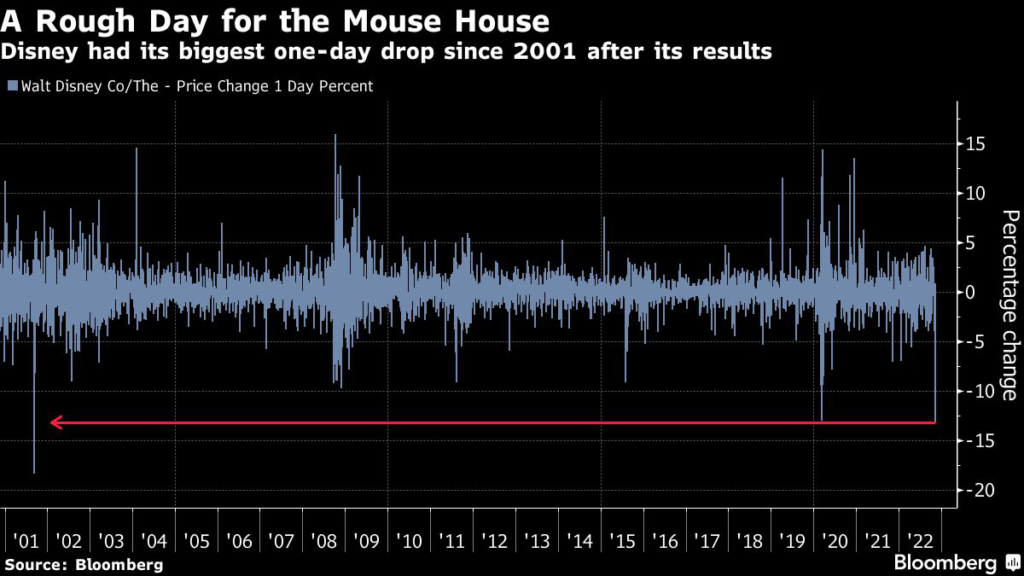
Walt Disney Co. sank 13% on Wednesday, the biggest one-day loss for the media company in more than 20 years. The selloff followed weaker-than-expected results, including at its Disney+ streaming-video service, where losses more than doubled. Shares ended at their lowest since March 2020.

Top Tech Stories

  • Amazon is the world’s first public company to lose a trillion dollars in market value as a combination of rising inflation, tightening monetary policies and disappointing earnings updates triggered a historic selloff in the stock this year.
  • Apple has limited the AirDrop wireless file-sharing feature on iPhones in China after the mechanism was used by protesters to spread images to other iPhone owners.
    • Apple has hired Timothy Campos, a startup founder and former Facebook executive to run its information systems group after departures in that department, according to people with knowledge of the matter.
  • Hon Hai Precision Industry Co., maker of most of the world’s iPhones, warned consumer electronics revenue will fall this quarter as it grapples with a Covid outbreak that walled off its main production base in central China.
  • Meta’s first major job cuts won’t be nearly enough to get the company back to being as profitable as it was just two years ago, according to analysts.
  • Key chip-equipment supplier Tokyo Electron Ltd. slashed its full-year outlook after memory makers cut spending and the US ramped up restrictions on cutting-edge chip-gear exports to China.
  • Taiwan Semiconductor Manufacturing Co. posted a 56% increase in sales for October, signaling the world’s largest contract chipmaker continues to weather a broader slowdown in electronics demand.
  • Disney just suffered its worst one-day rout in 21 years. Warner Bros. Discovery Inc., Lions Gate Entertainment Corp. and AMC Entertainment Holdings Inc. are all trading for less than $10. Paramount Global — the home of MTV, CBS and Top Gun: Maverick — has lost half of its value this year. In a matter of months, Hollywood’s feel-good streaming story has turned into a horror show.
  • Rakuten Group Inc. is reducing headcount at its mobile unit and seeking outside investors to help turn around the loss-making business, according to people familiar with the matter.

–With assistance from Subrat Patnaik.

(Updates to market open.)

More stories like this are available on bloomberg.com

©2022 Bloomberg L.P.

Everything You Need to Know About Charging an Electric Car

(Bloomberg) — Most EV owners talk about a moment of zen — a point, typically a few weeks after buying their car, at which all the anxiety about charging and range just disappears. They’ve figured out the new technology and realized it wasn’t so hard after all. 

But for new owners, or the EV-curious, charging can be intimidating. How does it work? How long does it take? What is a kilowatt-hour, anyway? 

Fueling an electric vehicle involves chemicals and currents and cords, and it will never be as simple as pouring a slug of dead dinosaur goo into a tank. But it’s also not rocket science. On the spectrum of life tasks, the brainpower required to charge a car is closer to what you’ll need to use your microwave than, say, file your taxes. (And a kilowatt-hour is just the amount of juice needed to move an electric vehicle for about 3 miles, depending on the car’s weight and speed, the driving conditions, the weather, and a bunch of other little variables.) 

If you’re new to EVs and in the US, here’s a charging primer to get you up to speed. 

Where can I charge an electric car?

There are three options: a private charger (i.e. at your home or office), a public fast-charging site or a slower public charging site, known as a Level 2 station in EV-speak. The first option is typically the best and cheapest and doesn’t involve waiting. Another smart strategy is to top up at a Level 2 public station in a place where you would be spending some time anyway — say, the gym or the grocery store. These chargers typically add somewhere around 30 miles an hour (depending on both the charger and the car). They’re also relatively cheap to build and thus are popping up all over the place, particularly in shopping centers and in office parks. For every fast-charging station in the US, there are six slower, Level 2 charging sites. 

How do you charge an EV on a long trip?

You’ll probably want a so-called fast-charger to top up along the way. There are about 8,000 of these sites in the US, dotting service stations and rest stops along interstate highways and other major roadways. Once you punch in a destination, most EVs will now map the most efficient route, including stops for charging. 

Those who prefer the DIY approach can build their own itinerary via an app like Plugshare, a platform in which drivers crowdsource information on charging locations, including feedback on each site’s speed and reliability. You can filter results in myriad ways, weeding out slower chargers or networks you don’t prefer.

Can I take a road trip in an EV?

Good question. There are still vast electron deserts in the US thanks to the country’s sheer breadth, and its reluctance to subsidize charging infrastructure as aggressively as policymakers in Europe and China. You definitely want to think twice about an EV road trip in the Dakotas, for example, or the Deep South. 

That said, there aren’t many corridors left that are off the map for electric vehicles. And cords are getting more dense by the day, thanks to a recent federal infrastructure law that started sinking $5 billion into charging infrastructure this fall. Each state has its own plan to spend the money, but the goal from the Biden Administration is 500,000 new stations, including one every 50 miles on major throughways – even in the Dakotas. 

How long does it take to charge an electric car?

Most of the time, somewhere around 15 minutes will be enough at a fast charger. The latest electric vehicles and charging infrastructure are built to get the job done quickly. When the machinery on both sides of the cord is fairly current, a quarter hour will add more than 100 miles of range for the vast majority of contemporary EVs, which is typically plenty unless you’re on a long road trip. 

That said, the car can be a limiting factor. Many older or entry-level EVs don’t have the hardware to hoover up electrons quickly. Some only add two or three miles per minute, regardless of how fast a charger they are connected to. Environmental factors, such as cold weather, can hamstring the process too. 

You can check how quickly each EV model charges at Bloomberg Green’s Electric Car Ratings. Keep in mind, all EVs take on electrons more slowly the closer they get to “full.” This is called a charge curve and most EV veterans incorporate this dynamic into their refueling strategy.

How much does it cost to charge an electric car?

In the wild, probably somewhere around $18. That’s for a 15-minute session with an average contemporary EV at a typical rate (35 cents per kWh). In truth, though, this is probably the most complex question in charging. Prices vary widely by state and by network, and pricing structures differ too, with some companies charging by kilowatt hour and others by time. To complicate matters further, rates can vary based on the time of day and there are memberships, which provide lower per-unit prices in exchange for a monthly or annual fee. 

There are, however, loopholes. Some EV purchases these days come with free charging on certain networks for a certain period of time. And if you charge at work, odds are good it’s at least partially subsidized by your employer. Municipal charging stations often have gratis hours as well, say after 6 p.m. 

How much does it cost to charge an EV at home?

On average, about $50 a month. That’s based on how much Americans drive (13,476 miles per year, on average) and how much they pay for electricity (16 cents per kilowatt hour, on average). Though again, this varies widely based on where you live and how efficient your EV is at turning electrons into miles. For example, charging a relatively inefficient machine, say a GMC Hummer, in Hawaii, the most expensive state for electricity, could easily cost more than $300 a month — though Hawaiians generally drive less than the rest of us. 

How accurate are EV range estimates? 

That depends. Official EV range estimates reflect a mixed-route driving regimen as determined by the Environmental Protection Agency. Higher-speed cruising is only part of the equation; ditto stop-and-go traffic. Generally speaking, if you are going fast on an interstate, your observed range will be slightly lower than the estimate. In traffic or running errands around town, the opposite will be true — your battery will stretch farther than expected.

Keep in mind, your choices matter too. Cranking the AC, carrying heavy cargo and accelerating quickly, among other things, will hamstring distance.  

Can any car charge at a Tesla station?

Unfortunately, no. While the EV leader has opened some of its charging stations to other car brands in Europe, its US network is still only available to Tesla drivers. The company realized early that chargers sell cars and its ecosystem in America still has more fast-charging cords than all of the other networks combined. When it comes to EV market share, Tesla’s so-called Superchargers remain a sizable competitive advantage. 

Can you charge a Tesla at a non-Tesla station?

Yup, if you’ve got a Tesla, you can plug in at pretty much any public charging station, though you will need an adapter (Tesla uses a different plug type than the other EVs in the market, who have almost all converged on a standard format called J1772). Because of the sheer number of Teslas relative to other EVs, private, for-profit charging networks still desperately need your business. You get your charging cake and you get to eat it too!  

What happens if my EV runs out of battery? 

When range is getting low, most contemporary EVs do the math and automatically navigate to a nearby charger. Many also activate some form of “limp-home” function, a setting that shuts down climate control and other non-essentials in order to squeeze a  few more miles of distance. Even when the battery is all but dry, your car will drag itself along slowly — the accelerator pedal will feel mushy — to at least die in a safe place. At that point, there are emergency roadside charging services in some markets, but in many places, you’ll need a tow truck to move your bricked EV to a plug.

What’s the most efficient way to charge an EV?

If you want to prioritize battery life, charge mainly on slower networks, don’t fill up all the way and don’t drive until empty. Get a Level 2 charger at home (or work), plug in at 20%, top up to 80%. Rinse. Repeat. 

The government reckons most EV batteries will last between 12 and 15 years. And remember, the longer that you own your electric vehicle – and the further you drive – the more carbon it offsets. Get it up around 200,000 miles and it will start glowing green.**Metaphorically speaking.

More stories like this are available on bloomberg.com

©2022 Bloomberg L.P.

Kelly Ripa, Mark Consuelos Buy Stake in Italian Football Club

(Bloomberg) — Television host Kelly Ripa and actor Mark Consuelos are buying a minority stake in a small Italian football club, becoming the latest celebrities to invest in a sports team.

The couple is buying a piece of Campobasso 1919, a club in the fifth tier of the Italian football system, and will play a role arranging sponsorship deals and marketing. They have also had talks about producing a show about the team, though there are not yet any concrete plans, Consuelos said in an interview Wednesday. Financial terms weren’t disclosed.

Lower-tier football clubs are attracting a wide set of new investors seeking to run a sports team without shelling out billions for a top franchise. In many countries, these clubs have growth appeal because they can earn a spot in a more prestigious and lucrative league.

“It’s fascinating that a team with a small stadium can be promoted and be playing against these giants like Manchester City or Juventus or Milan,” Consuelos said. “I love the idea of an underdog story.”

Some investors have already had success investing in small teams, building hype for the practice. In 2020 actors Ryan Reynolds and Rob McElhenney bought Wrexham AFC, a Welsh football club. It’s now featured in the FX docuseries Welcome to Wrexham. Earlier this year, a group of US crypto investors acquired fourth-tier English club Crawley Town FC. In the US, at least four Major League Soccer clubs have lured celebrity backers, and the National Women’s Soccer League’s Angel City FC has a long list of Hollywood stars in its ownership group, led by actress Natalie Portman. 

Campobasso, located in the city 100 kilometers (62 miles) north of Naples in southern Italy, was purchased by New York public relations executive Matt Rizzetta’s North Sixth Group LLC in 2022. The century-old club’s predecessor was declared ineligible to compete by the Italian Football Federation due to administrative failures. Under new ownership, Campobasso is now restarting from Italy’s lowest professional league and aims to return to the upper levels. 

“We’re starting at the bottom,” Consuelos said. “The only way to go is up.”

Ripa and Consuelos will also take a small stake in second-tier team Ascoli FC through North Sixth Group.

More stories like this are available on bloomberg.com

©2022 Bloomberg L.P.

Jefferies CEO Says He Offered FTX’s Bankman-Fried Rescue Advice in July

(Bloomberg) — Jefferies Financial Group Inc. Chief Executive Officer Rich Handler reckons he could have helped FTX.com avoid its current troubles if only Sam Bankman-Fried had taken his meeting earlier this year.

“Do you know Sam Bankman-Fried? He seems in over his head and could quickly be in a precarious position,” Handler wrote in a July 7 email to an unidentified colleague that the banking executive posted on his personal Twitter account. “Our expertise in rescuing financial services companies might make it worthwhile to meet w him and begin a relationship. Just a thought.”

Handler suggested setting up a dinner date. “What he is going through is not going to pass as quickly as he might wish and you can quickly become the rescuee versus the rescuer if you are not careful,” he emailed. 

Bankman-Fried appears to have ignored the offer. “He never responded nor took a meeting,” Handler posted, the latest in a series of social media missives intended to provide business advice to people looking to develop their careers. 

A spokeswoman for Jefferies confirmed the thread was authentic. A spokesperson for FTX declined to comment.

Second Rebuff

Handler, like any good investment banker, was unfazed and in September made another attempt to connect with Bankman-Fried.

“I’m at the Rosewood Hotel in the Bahamas today,” Handler wrote to his colleague in a September 16 email with the subject line ‘Long shot.’ “Do we have a smart way to see if the FTX guy wants to grab lunch? I believe he is here.” 

Once again he was rebuffed. “No response and no meeting/discussion,” Handler tweeted.

Step forward then to this Tuesday. “Sure looks like Sam Bankman-Fried should have taken this meeting. :),” Handler emailed his colleague.

There followed a tweet listing eight “Conclusions, observations and lessons” from Handler. The final one: “arrogance and hubris destroys everything. Every time.”

–With assistance from Jenny Surane and Yueqi Yang.

More stories like this are available on bloomberg.com

©2022 Bloomberg L.P.
Paris Opens Flying Taxi Hub Targeting Flights for 2024 Olympics

(Bloomberg) — France opened a hub for testing electric air taxis as it seeks to introduce the world’s first service with the new category of aircraft in time for the 2024 Summer Olympics in Paris.

Aeroports de Paris, which runs the French capital’s major airports, will operate the facility alongside UK-based Skyports Ltd., a leading developer of so-called vertiports, as flying-taxi bases have been termed.

The hub at Pontoise Cormeilles aerodrome, unveiled Thursday, combines a passenger terminal, take-off and landing area, mission control zone and hangar, all as close as possible to the configuration envisaged for 2024.

As part of the launch, Volocopter GmbH, a German developer of electric vertical take-off and landing craft or eVTOLs, as flying taxis are known, carried out a flight integrated into conventional air traffic.

The project is also backed by RATP Group, which provides public transport in the Paris area, and the DGAC aviation regulator, as well as the transport ministry and Ile-de-France region.

ADP Chief Executive Officer Augustin de Romanet said the opening of the test site marks “a new decisive step in the development of electric air mobility,” and that work will include development of multiple use cases for the hub, including health and logistics applications.

Valérie Pécresse, president of the Paris Region, said in a statement she wants the city to be known as the site of the first passenger eVTOL flight, adding that the Olympics provide “an incredible opportunity to showcase and launch this project.”

Flying taxis are emerging as a new transport market, with developers raising hundreds of millions of dollars.

The French project adds to a growing list of planned bases around the world including those being promoted by Skyports rival Urban-Air Port, which showcased a demonstration vertiport in Coventry, England, last spring.

More stories like this are available on bloomberg.com

©2022 Bloomberg L.P.

Ukraine War Spurs Sales of QinetiQ’s Battlefield Robots

(Bloomberg) — UK defense firm QinetiQ Group Plc said the war in Ukraine is boosting sales of products including battlefield robots, while demand for the latest military technology is helping the business more generally. 

The US has increased orders for the Talon robot, primarily designed for bomb disposal but also used in reconnaissance and other roles, Chief Executive Officer Steve Wadey said in an interview. Britain has increased purchases in secure communications that provide super-encrypted links to the front line. 

Wadey, who spoke Thursday after London-based QinetiQ reported an 18% jump in first-half orders, said he couldn’t comment on whether purchases were aimed at directly supplying Ukraine’s defense forces.

Kyiv’s success in combating a Russian military holding a numerical advantage in headcount and armaments has also reinforced the importance of fielding state-of-the-art systems in areas such as surveillance, bolstering interest in QinetiQ’s suite of technology-led products, the CEO said.

“Countries have realized they need the technological advantage,” Wadey said by phone. “So they’re looking at the next generation available.”

QinetiQ is also a key player in developing Britain’s first high-powered laser weapon, which has recently been undergoing test firing.

The DragonFire energy beam has been trialled at the Porton Down military research center in England, hitting long-range targets with pinpoint accuracy, the Ministry of Defense said Nov. 8. QinetiQ supplies the laser for the device.

More stories like this are available on bloomberg.com

©2022 Bloomberg L.P.

Chip Delivery Times Shrank Rapidly in October as Supply Crunch Subsides

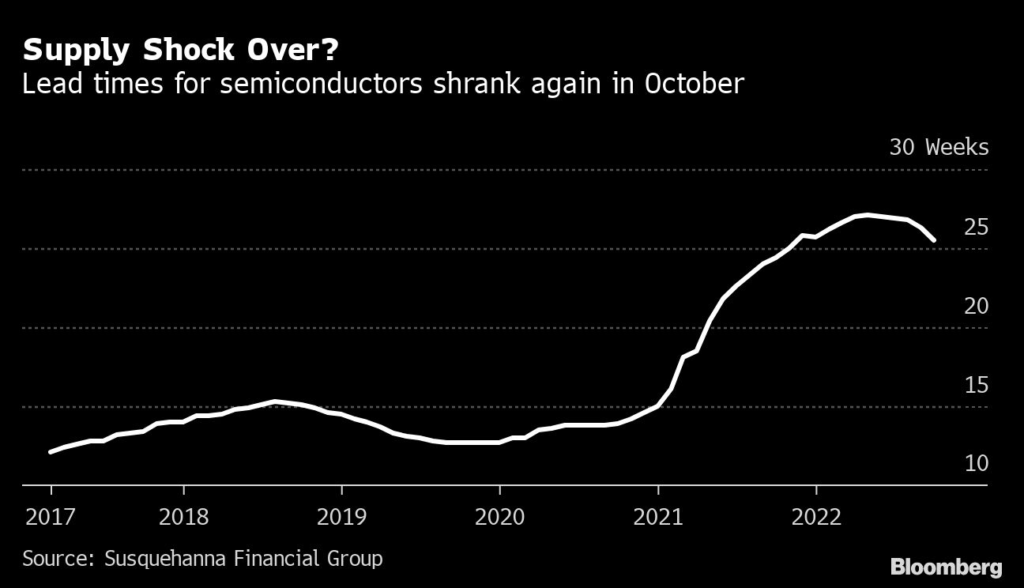
(Bloomberg) — Chip delivery times shrank by six days in October, the biggest drop since 2016, adding evidence that demand for electronic components is falling off quickly.

Lead times — the gap between when a chip is ordered and when it is delivered — averaged 25.5 weeks in the period, according to research by Susquehanna Financial Group. 

All major product areas are now available more quickly than they were and 70% of the companies surveyed by Susquehanna say they’re able to supply chips more swiftly, analyst Christopher Rolland said in a research note.

A swath of companies across the $580 billion industry have told investors that demand is falling amid a weakening economy and weaker consumer spending. Makers of parts for personal computers and smartphones have seen some of the steepest declines.

The reports mark a sudden shift for the industry which has been beset by the inability to fill all of its orders over the last two years. Semiconductors typically go through a complex production process that takes over 3 months but producers have been telling some of their customers that they’d have to wait as much as a year for some types of products. 

According to Susquehanna, the lead time for Texas Instruments Inc., the chipmaker with the biggest product range and customer list, was down 25 days in October. Despite that, supply of some off its products that go into vehicles remains constrained.

US tensions with China also are clouding the chip industry’s future. The Biden administration announced new export curbs this month, restricting what US companies can sell to the Asian nation, the largest single market for chips.

The Philadelphia Stock Exchange Semiconductor Index, a key benchmark of chip stocks, has fallen 39% this year, recovering some lost ground. 


More stories like this are available on bloomberg.com

©2022 Bloomberg L.P.

Close Bitnami banner
Bitnami