
Bloomberg

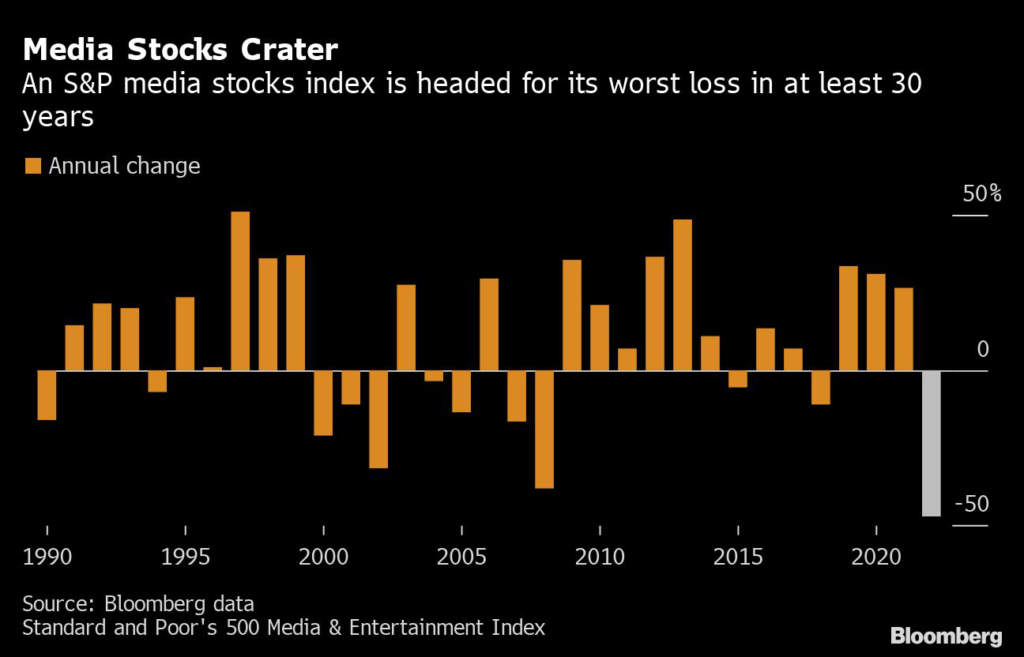
Disney Drop Sends Media Stocks Toward Worst Decline in 30 Years

(Bloomberg) — Walt Disney Co. just suffered its worst one-day rout in 21 years. Warner Bros. Discovery Inc., Lions Gate Entertainment Corp. and AMC Entertainment Holdings Inc. are all trading for less than $10. Paramount Global — the home of MTV, CBS and Top Gun: Maverick — has lost half of its value this year.

In a matter of months, Hollywood’s feel-good streaming story has turned into a horror show.

Consumers are streaming more movies and shows, and watching less in theaters and on traditional channels. To encourage the switch and attract subscribers, media companies are putting some of their best programs online. But the new services are losing boatloads of money, even as viewers drop traditional channels in droves. Executives who promised a smooth transition to the digital era are getting punished by Wall Street, with media stocks headed toward their steepest annual loss since at least 1990.

“The media and entertainment industry is going though a major transition,” said Porter Bibb, a longtime investor and observer of the business. “They’ve entered the tunnel, and nobody knows where they’re going to come out.”

The shift is evident in the number of consumers canceling their pay-TV subscriptions. Cable-TV giants Comcast Corp. and Charter Communications Inc. together lost almost 800,000 TV subscribers last quarter. At that pace, it will mean millions of fewer customers to help pay for MTV, CNN and ESPN.

The one bright light this quarter was Netflix Inc., whose subscriber loss in the first half of the year prompted a reevaluation of the industry’s business models and stock values. The streaming industry pioneer reported a better-than-expected 2.41 million new subscribers last quarter. Its shares are still down 57% this year.

Losses at Disney’s direct-to-consumer arm, driven by the Disney+ streaming service, more than doubled to $1.47 billion in the company’s fiscal fourth quarter, due to higher programming expenses and the cost of rolling the service in new countries.

Weakness in cable-television advertising revenue also hurt the company’s performance, as it has for other media giants. Disney finished the day down 13%, the biggest one-day loss since Sept. 17, 2001, when trading resumed after the Sept. 11 terrorist attacks.

The losses in media stocks aren’t all Hollywood entertainment companies. The biggest loser in the S&P 500 Media & Entertainment Index this year is Facebook parent Meta Platforms Inc., which gets nearly all of its revenue from advertising. Meta is down 70% this year.

The deterioration of Disney’s traditional TV business may be the bigger shocker from this week’s earnings, according MoffettNathanson analyst Michael Nathanson. The company projected high single-digit profit growth next year, well below what he’d been expecting.

“Rarely have we ever been so incorrect in our forecasting of Disney profits,” Nathanson wrote in a research note on Wednesday. “It appears that the negative economic force of cord-cutting (plus a weakening ad market) has finally begun to manifest in Disney’s FY 2023 results,” 

Disney’s sales, at $20.2 billion, came up about $1 billion short of analysts’ projections. Earnings, excluding certain items, fell to 30 cents share, missing the average estimate of 51 cents from analysts surveyed by Bloomberg.

Disney told investors this week that losses in its streaming business have peaked. 

At the Paley International Council Summit in New York Wednesday, Disney Chief Executive Officer Bob Chapek acknowledged Wall Street’s frustration with the massive investments in online TV, including ESPN+ and Hulu.

“Our investors expect us to have a return on that,” he said. 

The company, he noted, is celebrating it 100-year anniversary next year. There will be speed bumps, Chapek said, especially when trying a new business model.

“But it’s certainly better than the other option, which is to become extinct,” he said.

More stories like this are available on bloomberg.com

©2022 Bloomberg L.P.
Apple Taps Facebook Veteran as Information Chief After Departures

(Bloomberg) — Apple Inc. has hired a startup founder and former Facebook executive to run its information systems group after departures in that department, according to people with knowledge of the matter.

Timothy Campos will lead the Information Systems and Technology department, better known as IS&T, which handles the infrastructure behind Apple’s online services, customer support and website. Apple refers to the operation as its “nerve center” because it lets employees, suppliers and customers stay connected. The division reports to Chief Financial Officer Luca Maestri.

Mary Demby, the current information chief, is retiring after this year, Bloomberg News reported earlier. Her deputy, vice president of software engineering David Smoley, is also retiring after a three-year stint. The people familiar with Campos’s hiring asked not to be identified because the move hasn’t been announced.

Campos held the chief information officer role at what is now Meta Platforms Inc. from 2010 to 2016. Before that, he had the same position at KLA Corp., a semiconductor company. Most recently, he co-founded Woven, a popular calendar app that was acquired last year by Slack Technologies Inc., which was later purchased by Salesforce Inc.

On his LinkedIn profile, Campos said he is “getting ready for something new,” without disclosing the Apple job. Smoley, meanwhile, came to Apple from AstraZeneca Plc in 2019. A spokesman for Cupertino, California-based Apple confirmed the new hire.

The changes add to management changes at Apple, which is facing the loss of some key executives. In addition to Demby and Smoley, the chief privacy officer, vice president of industrial design and head of the company’s online retail store are leaving. Apple also parted ways with its vice president of procurement following his appearance in a crass TikTok video.

Apple shares were little changed in late trading Wednesday. Its stock is down 24% in 2022, though that’s a better performance than many of its tech peers have managed. The Nasdaq Composite Index is down 34%, and companies like Meta and Twitter Inc. have been laying off thousands of workers in the face of a sales slowdown.

(Updates with shares in final paragraph.)

More stories like this are available on bloomberg.com

©2022 Bloomberg L.P.

How Binance, FTX Deal Rocked the Crypto World and Then Collapsed

(Bloomberg) — It’s been a tumultuous few days in the largely unregulated cryptocurrency world, with mudslinging on Twitter, a shock exchange takeover bid — which then collapsed — and plunging token values.

On Tuesday, the world’s biggest exchange, Binance Holdings Ltd., was set to acquire troubled rival FTX.com. On Wednesday, Binance walked away from the deal citing problems with FTX’s finances as well as potential regulatory investigations. Its decision to walk away deepened the ongoing crypto rout, with Bitcoin tumbling to the lowest level in two years. 

While crypto might seem like a niche corner of finance, the saga between two of its top players has upended the crypto ecosystem and is likely to have far-reaching repercussions.

What are Binance and FTX?

They’re two of the biggest crypto exchanges, which are marketplaces where investors buy, sell and store tokens. Binance is the biggest crypto exchange by volume by a long way — and FTX is in the top five, according to crypto data provider CoinMarketCap (which is owned by Binance). 

Who runs them?

They’ve also been led by two of the most visible and charismatic people in the crypto world: Binance by Changpeng Zhao (or CZ, as he is known), and FTX by Sam Bankman-Fried (or SBF).

Formerly a trader at Jane Street, until just a few weeks ago the curly-haired 30-year-old was everywhere in the crypto industry — backing flailing projects including BlockFi, Voyager Digital and Celsius. He counted the likes of Softbank Vision Fund, Singapore wealth fund Temasek and Ontario Teachers’ Pension Plan as investors. 

Zhao is a China-born Canadian citizen who emigrated to Vancouver aged 12 and graduated with a degree in computer science from McGill University in Montreal. He started Binance in 2017 in Shanghai — but the Chinese government banned crypto exchanges the same year. He’s now based in Dubai.

Read More: Crypto’s Richest Man Faces Regulatory Crackdown, Brutal Winter

Why did they fall out?

Back in 2019, Binance invested in FTX, then a derivatives exchange. The next year, Binance launched its own crypto derivatives, quickly becoming the leader in the field.

Tensions rose as the two companies increasingly took divergent tacks with regulators. Bankman-Fried was testifying in the US Congress, while Binance was said to be facing regulatory probes around the world.

The two companies have also been competing for assets, with both bidding for assets of Voyager Digital. FTX.US, the American affiliate of FTX, won the auction.

Zhao and Bankman-Fried have been trading barbs on Twitter for months, feuding over issues ranging from lobbying US politicians to allegations of frontrunning trades.

So what just happened in the crypto world?

Over the weekend Zhao tweeted that Binance would be liquidating its holdings of a token known as FTT, which is issued by FTX.  

The tweet followed a story from crypto news outlet CoinDesk saying that Alameda Research, a trading house owned by FTX’s founder Bankman-Fried, had a lot of its assets in FTT token. 

That fueled broader concerns about FTX’s health and investors began to withdraw money. The FTT token plunged. A day before reaching a deal, Bankman-Fried said on Twitter that assets on FTX were “fine” and that “a competitor is trying to go after us with false rumors.”

On Tuesday, CZ announced a potential takeover of FTX, with due diligence to be conducted “in the coming days.”

Then late Wednesday afternoon New York time, Binance said it was pulling out of the deal saying its rival’s issues were “beyond our control or ability to help.” Binance executives had discovered a gap between FTX’s liabilities and assets that may amount to more than $6 billion,  a person familiar with the matter told Bloomberg. 

What’s more, US regulators are investigating whether FTX properly handled customer funds, as well as its relationship with other parts of Bankman-Fried’s crypto empire, including his trading house Alameda Research, Bloomberg News reported Wednesday. 

What does this mean for the markets?

It’s injected a lot of uncertainty for investors who are worried about the potential for spreading contagion given the pivotal role FTX and its co-founder Sam Bankman-Fried played in the industry.

FTT, the utility token of the FTX exchange, collapsed by more than 40% Wednesday following a tumble of more than 70% Tuesday. But just about every digital coin is struggling. 

Bitcoin fell as much as 15% to $15,987 on Wednesday, the least since November 2020, which leaves a lot of holders under water.

What does this mean for FTX users?

That’s unclear. Clients worried about the future of the exchange have already pulled out  $430 million worth of Bitcoin in the space of just four days.

Read more: Crypto Retail Investors Rattled as Binance Moves to Acquire FTX

How does this affect CZ and SBF?

It’s a huge comedown for SBF, who had previously been seen as one of the most accomplished people in the industry.

That’s playing out in fortunes, as well. Bankman-Fried’s 53% stake in FTX was worth about $6.2 billion before Tuesday’s takeover, according to the Bloomberg Billionaires Index, based on that fundraising round and the subsequent performance of publicly traded crypto companies. His crypto trading house, Alameda Research, contributed $7.4 billion to his personal fortune.

The Bloomberg wealth index assumes existing FTX investors, including Bankman-Fried, will be completely wiped out by Binance’s bailout, and that the root of the exchange’s problems stemmed from Alameda. As a result, both FTX and Alameda are given a $1 value. That leaves SBF’s net worth at about $1 billion, down from $15.6 billion heading into Tuesday. The 94% loss is the biggest one-day collapse ever among billionaires tracked by Bloomberg.

Even after pulling out of the deal, Bankman-Fried’s fall from grace leaves CZ as the top person in the crypto world. He’s had a rough period too, with his fortune down 84% year-to-date, according to the Billionaires Index — but he’s still estimated to be worth $14.9 billion.

What does this mean in terms of regulation?

This episode and how quickly it unfolded provide a stark example for regulators who have been concerned about the lack of guardrails in the freewheeling crypto space. Jurisdictions that have been considering looser rules may be less likely to do so — especially on the back a few months ago of implosions in the Terra/Luna ecosystem and hedge fund Three Arrows Capital.

What’s Next?

Bankman-Fried told FTX.com investors on Wednesday that the company needs a cash injection, or else it would need to file for bankruptcy, Bloomberg News reported. 

Whether FTX survives this crisis or not, the entire industry is on edge about the risks of contagion. 

–With assistance from Tom Maloney.

(Updates throughout with details of Binance deal collapse)

More stories like this are available on bloomberg.com

©2022 Bloomberg L.P.
Disney Erases Almost All Its Pandemic Gains After Earnings Miss

(Bloomberg) — Walt Disney Co. shares fell the most September 2001, dragged down by disappointing advertising sales and costly streaming programming.

Losses at the company’s direct-to-consumer arm, driven by its Disney+ service, more than doubled to $1.47 billion in its fiscal fourth quarter, due to higher programming expenses and the cost of global expansion. Weakness in cable-television advertising revenue also hurt Disney’s performance. 

Sales, at $20.2 billion, came up about $1 billion short of analysts’ projections. Earnings, excluding certain items, fell to 30 cents share, missing the average estimate of 51 cents from analysts surveyed by Bloomberg.

Disney shares fell 13% on Wednesday to $86.75, the lowest closing price since March 2020. That’s the biggest one-day drop since Sept. 17, 2001, the day markets reopened after the terrorist attacks.

Chief Executive Officer Bob Chapek, nearly three years into that position, faces a pivotal moment where the company’s massive investments in streaming need to pay off. Chapek reiterated his forecast that Disney+ will be profitable in fiscal 2024. He said price increases and the introduction of a new ad-supported version will help the company’s direct-to-consumer unit reach that goal.

“Our financial results this quarter represent a turning point as we reached peak DTC operating losses, which we expect to decline going-forward,” Chapek told investors on a call Tuesday.

Although spending on content will remain near $30 billion next year, the company is seeking to reduce expenses in other areas of its business, such as marketing. Core Disney+ subscribers will increase only slightly in the first quarter, Disney said, before accelerating in the second quarter. The company forecast high-single-digit growth in operating income and sales for fiscal 2023.


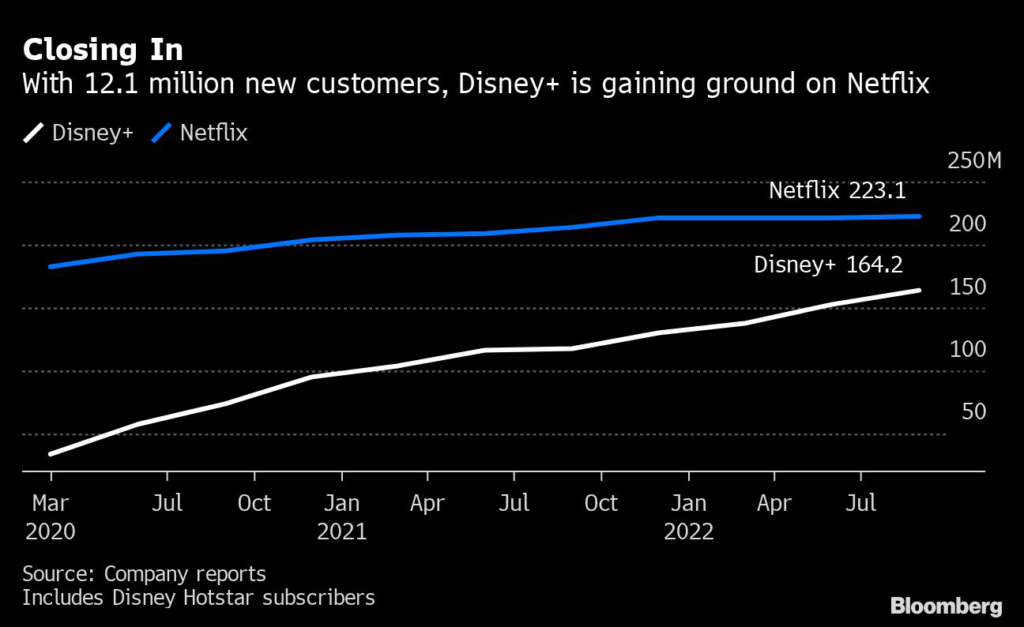
The company beat expectations for streaming subscriber additions in the fourth quarter, signing up 12.1 million new customers at its flagship Disney+ service alone. Total subscribers, including those for its Hulu and ESPN+ products, rose to almost 236 million. Those numbers come after rival Netflix Inc. beat internal forecasts as well as Wall Street expectations in the most recent quarter, adding 2.41 million customers. 


Disney has made streaming a major focus for growth. On Dec. 8, the company will begin selling the ad-supported version of Disney+ at a monthly price of $8. The price of its ad-free version will jump 38% to $11 per month. The company reported a decline in its average revenue per Disney+ subscriber, as more customers subscribed through a discounted bundle with the company’s other services. The bundled offering now makes up about 40% of domestic subscribers.

“Our experts say that ad-tiers can be more profitable for Disney+ than its traditional tier,” Third Bridge analyst Jamie Lumley said, adding that “Disney is in a better position than Netflix” because of existing ads infrastructure through Hulu and ABC.

Profit at Disney’s theme-park unit more than doubled to $1.51 billion, due to higher attendance and increased guest spending, but fell short of what analysts were projecting. Hurricane Ian reduced operating income by $65 million.

“The parks number is much lower than we expected,” Bloomberg Intelligence analyst Geetha Ranganathan said on Bloomberg TV. Inflation could be crimping consumer demand in what has been a strong growth area.

“These results don’t look that rosy anymore,” Ranganathan said.

Revenue from Disney’s traditional TV business, which includes networks such as ESPN and ABC, fell 5% in part due to ad sales weakness. Profit rose 6% to $1.74 billion due to lower programming costs in cable TV, particularly for sports. Disney reduced the number of Major League Baseball games it aired this season under a new contract.

More stories like this are available on bloomberg.com

©2022 Bloomberg L.P.
Evercore’s Emanuel Warns Bitcoin Plunge May Take Stocks to Lows

(Bloomberg) — The fallout from FTX.com’s blowup has so far been contained to the crypto world. The relative calm won’t last if Bitcoin’s swoon takes it to levels last seen in 2019.

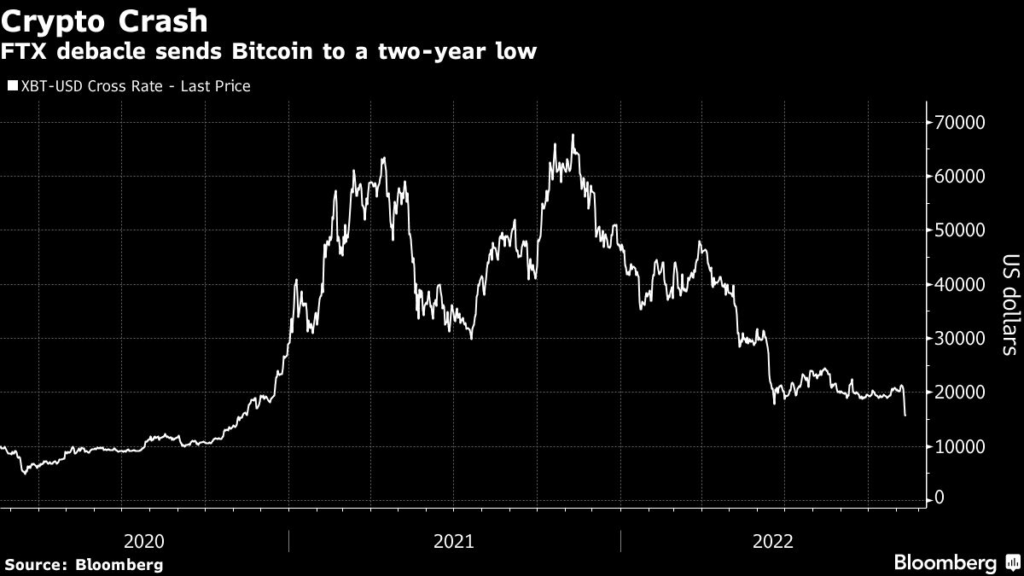
That’s the view of Julian Emanuel, Evercore ISI’s chief equity and quantitative strategist, who says that if the biggest digital token plunges past its pre-pandemic high of around $13,850, the hit to investor sentiment could spread to other asset classes. Bitcoin sank 16% Wednesday to below $16,000 for the first time in two years.

Stocks did drop the most in a week Wednesday, halting a three-day rally as the crypto drama and mixed results in US midterm elections soured sentiment before a key inflation report. And while it’s nearly impossible to determine what level of threat the crypto meltdown poses to the broader market, Emanuel is now warning that the mere specter of contagion can start to drag other assets lower.

“Price action could dictate both fundamentals and psychology,” he said in a note. “Bitcoin below the 2019 high at $13,850 will elevate stress, ending the current equity bear-market rally.” It would also reinforce his team’s view that Oct. 13 marked a recent low but not “the” low of the yearlong selloff in American stocks, he said. 

The rout in cryptocurrencies snowballed Wednesday afternoon in New York, after exchange Binance walked away from its planned takeover of rival FTX, run by Sam Bankman-Fried. Bitcoin is down more than 23% in two days. The coin had reached a record high of almost $69,000 a year ago. 

Read more: Crypto Market Rout Deepens as Binance Drops FTX Takeover Offer

The spectacular blowup of one of crypto’s most respected businesses has rekindled concern that the entire industry is on shaky ground as central banks around the world ratchet up interest rates to combat runaway inflation. Going by the value of all the digital tokens, the sector had already shed around $2 trillion in value before FTX’s troubles this week.

The debacle has ensnared some of the biggest names in finance. Tiger Global Management, Third Point and Altimeter Capital Management are among hedge funds that recently participated in funding rounds for Bankman-Fried’s once-high-flying crypto exchange, Bloomberg News reported. 

Plenty others have also partaken, with Brevan Howard Asset Management’s Alan Howard, the family office of Paul Tudor Jones and Millennium Management founder Izzy Englander chipping in as angel investors, as well as celebrities like Tom Brady and Gisele Bündchen. 

Though a lot of big investors and funds have exposure to crypto, in most cases, it might be small, says Dan Suzuki, deputy chief investment officer at Richard Bernstein Advisors LLC. 

“Overall, the economy just doesn’t have a lot of crypto exposure,” he said in an interview at Bloomberg’s New York headquarters on Wednesday. “From here, it’s going to be more limited. But to the extent that it’s the days where liquidity is driving markets, it should affect both huge parts of the equity markets as well as bond markets.” 

More stories like this are available on bloomberg.com

©2022 Bloomberg L.P.

Wheat Grown Indoors Offers Potential for Global Food Security

(Bloomberg) — Vertical farmers, known for growing herbs and salads indoors, have made a breakthrough in the quest for global food security: cultivating wheat in the same controlled environment. 

Amsterdam-based startup Infarm grew wheat without using soil or chemical pesticides, and with far less water than conventional farming. The first indoor farming company to grow a staple crop is a milestone for a nascent industry that’s attracted venture capital funding on a promise that its technology can help feed the planet. 

“To continue to feed the world’s growing population, we need to achieve higher crop yields which we have now proven to be possible for wheat,” said Guy Galonska, chief technology officer and the co-founder of Infarm. “We are confident that wheat can be grown successfully at scale indoors as a climate-resilient alternative.”

So far, indoor farmers have delivered premium foods such as herbs, salads and occasional fruit. They’ve also faced questions over their relatively high production costs, energy usage and the ability to scale. 

If delivered at scale, growing a staple crop indoors has the potential to be a game changer. Supplies have increasingly been challenged by climate change and logistical issues, with the war in Ukraine highlighting the world’s dependence on few breadbaskets. 

Infarm said that its first trials show projected annual wheat yields of 117 tons a hectare. That compares with average 2022 yields of 5.6 tons a hectare in the European Union and 3.1 tons in the US, which are some of the world’s biggest exporters, according to estimates from the US Department of Agriculture. 

But the challenges of achieving scale and keeping costs low remain huge.

Wheat cultivation takes more than 216 million hectares of land, more than any other crop. To satisfy current needs at Infarm’s projected yields would require indoor farms exceeding the area under wheat in France. 

Infarm, which is co-hosting a food systems pavilion at COP27 in Sharm el-Sheikh this month, said it could potentially increase its yield by a further 50% in the coming years thanks to better technology.

–With assistance from Megan Durisin.

More stories like this are available on bloomberg.com

©2022 Bloomberg L.P.
China $131 Billion Singles’ Day Faces Stagnation After Scandals

(Bloomberg) — A year ago, one of China’s most famous internet celebrities sold about $1 billion of products — from shampoo to scarves — in a 14-hour livestream as part of Singles’ Day, the country’s annual e-commerce extravaganza.

This year, the 37-year-old super saleswoman known as Viya won’t take part in the world’s biggest shopping event at all after disappearing from the internet since being fined for tax evasion. A slew of other popular livestream stars who have found themselves caught up in President Xi Jinping’s crackdown on celebrity are also likely to be missing this year, dulling the glamor and likely hurting the takings of the marathon event that ends Nov. 11.

A slump in consumer confidence from recurring Covid lockdowns and heightened scrutiny on internet firms was already casting a chill over an annual event that’s shattered sales records since its inception in 2009. Alibaba Group Holding Ltd., the tech giant that dominates Singles’ Day, is expected to post flat to meager growth in takings from this year’s event — Bloomberg Intelligence has even projected an unprecedented fall in the value of its transactions. 

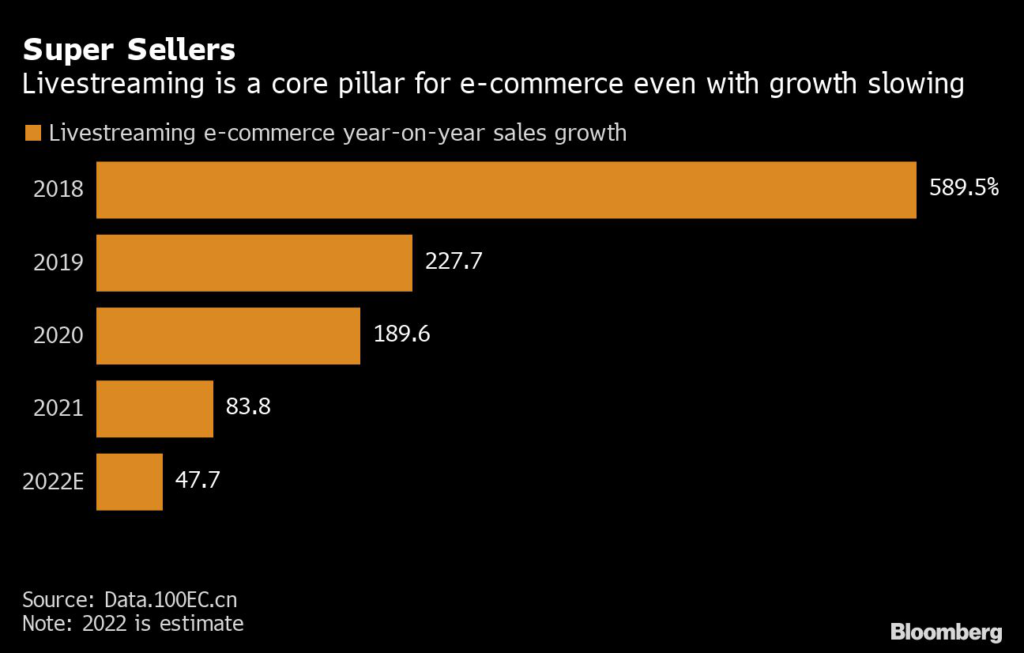
But it’s the loss of the celebrity sellers, which quickly became integral to how clothing to food was retailed in China, that will be felt the most. Livestream shopping — where people buy products through social media platforms and interact directly with broadcast hosts — had become a part of regular life for millions of consumers. But its growth has collided with a government push to shape Chinese culture and rein in celebrity influence. Scandals like Viya’s are already prompting brands to shift away from big-name stars, bring broadcasting in-house or use digital avatars to sell goods.

Customers are wary too. About three-quarters of consumers say they would watch a livestream or buy items through the sales channel this year, down from 97% a year ago, consulting firm AlixPartners reported from a survey of about 2,000 people in China. Some shoppers said that negative news relating to broadcast hosts had made them less engaged.

“In recent years, livestreaming seems to have created a quick way for brands to get famous and sales boomed,” said Dave Xie, a Shanghai-based principal of consultancy Oliver Wyman. “Amid the recent falls of the superstar livestreamers, brands are now actively speeding up the development of their own livestreaming studios” in order to cut ties with the top influencers, while retailers are also shifting to smaller platforms, he said.

The roughly two-week Singles’ Day bonanza dwarfs similar events around the world. Last year, millions of shoppers bought what Bain & Co. estimates was about 952 billion yuan ($131 billion) of goods during the event — more than the US buying spree that spans Thanksgiving through Cyber Monday.

But prominence comes with scrutiny. Xi’s ‘common prosperity’ drive, aimed at reining in excess wealth, and the government’s efforts to curb the private sector’s influence have hit some of the biggest names across media and technology. E-commerce firms were caught up in a regulatory assault on China’s top internet companies that kicked off in late 2020, when authorities halted the planned initial public offering of Ant Group Co. — the financial affiliate of Alibaba — after Jack Ma criticized regulators. 

Celebrity Scandals

Viya, once seen as the future of shopping, has been the highest-profile casualty in the livestream sector. During her career she’d partnered with Kim Kardashian to host a livestream that sold 15,000 of bottles of the US celebrity’s perfume within minutes. And she held a special event in Wuhan to showcase the city’s revitalization after a tough Covid lockdown, underscoring how influencers can wield their fame to align with the government’s values.

Her empire came crashing down in December though, when Chinese tax authorities ordered her to pay 1.34 billion yuan in back taxes, late fees and fines. She apologized but hasn’t returned online since.

Another top livestream influencer, Li Jiaqi, was caught up in a scandal mid-year when a tank-shaped cake appeared in one of his broadcasts on the eve of the anniversary of the 1989 Tiananmen Square massacre. That saw the man called ‘Lipstick King’ for his ability to sell the cosmetics vanish from the internet for about three months.

Others have also been done for tax evasion, impacting the valuations of companies that have capitalized on their rise. Viya’s tax fine sparked a drop in shares across the sector, including TVZone Media Co. and Shanghai Fengyuzhu Culture and Technology Co., amid concerns the crackdown could target more influencers.

The controversies are helping transform how brands, fearful of being collateral damage if an influencer falls afoul of the government, sell their products in the world’s biggest consumer market.

Firms are now avoiding the kind of long-term contracts that were typical for Viya and Li, and putting far more emphasis on short-term deals, according to people who’ve worked on such strategies, who asked not to be identified because the discussions are private. Companies are also setting up their own studios for livestream broadcasts and grooming in-house influencers, who are more easily controlled, according to the people. 

Representatives at Meione and Qianxun, the agencies behind Li and Viya respectively, didn’t respond to requests for comment.

Global retail giants are among those going in-house. Nike Inc., L’Oreal SA and Fast Retailing Co.’s Uniqlo, as well as local labels including Anta Sports Products, have all accrued more than 20 million fans on their company-run livestreaming pages on Taobao, Alibaba’s mammoth online shopping platform that’s similar to Amazon.

Some companies are even doing away with humans entirely. Digitally created influencers are emerging, including Ayayi, who debuted on social platform Xiaohongshu last year and has worked with Tiffany & Co. Forrester Research Inc. estimates that 20% of business-to-consumer brands in China will use virtual idols in 2023.

While its brightest stars may have been dimmed, the livestream sector remains core to Chinese consumption — if in an altered form.

And at least one celebrity host has managed to redeem himself. On the first day of Singles’ Day presales, Li — the ‘Lipstick King’ — generated 460 million views and gross merchandise value of 21.5 billion yuan, about double his own record from last year’s promotions, according to Forrester. 

But the sector’s loss of popular names is likely to ripple beyond just this year’s Singles’ Day.

“I watched Viya and Li Jiaqi every day last year to buy everything: snacks, cosmetics, dresses and shampoos. I just trust their tastes and quality control,” said Jelly Li, a civil servant in Guangzhou. But now, “my interest in livestreaming has been much lowered,” she said.

–With assistance from Jane Zhang, Jinshan Hong and Lucille Liu.

More stories like this are available on bloomberg.com

©2022 Bloomberg L.P.
Crypto Chaos Stirs Fresh Wall Street Selling as Inflation Report Looms

(Bloomberg) — Enduring crypto chaos, an election signaling fresh partisan battles, an ugly Treasury auction. It was all too much for Wall Street to bear Wednesday, igniting the biggest cross-asset selloff in a month and raising the stakes ahead of a make-or-break inflation report.

As the existential crisis engulfing the biggest crypto players intensifies, investors are in no mood to blithely rebuild their risk exposures right now.

Read more: Binance Backs Out of FTX Rescue, Citing Finances, Investigations

Speculative darlings of the cheap-money era — profitless tech firms and Bitcoin — plunged anew to wipe out most pandemic-era gains. The S&P 500 sank 2% for a second time in a week. And investors loaded up on hedges in single stocks ahead of a consumer price reading that will heavily influence the next bout of disruptive policy tightening from the world’s biggest central bank. 

“The combo of hot CPI and crypto melt-down continuing would be a concerning one to two punch for the market,” said Dennis DeBusschere, the founder of 22V Research.

With five major assets tracked by exchange-traded funds scoring a combined 5.3% loss, Wednesday marked the worst session for financial markets since mid-October. And more chaos looms on news that Binance will back out over a proposed bailout of Sam Bankman-Fried’s FTX.com. It’s a spectacular blowup for one the sector’s biggest exchanges — sending prices for virtually every token into a freefall and sparking angst over a notoriously opaque industry that regulators fear poses a new risk to financial stability. 

In equities, risky stocks bore the brunt of Wednesday’s selling. A basket of unprofitable tech firms tumbled more than 6%. Cathie Wood’s ARK Innovation ETF (ticker ARKK), a poster child of the investing craze, dropped for a sixth session, hitting the lowest level since 2017. 

The equity selloff deepened following a weak auction in 10-year Treasuries. Amid reasons cited for the weaker showing, dealers may have been reluctant to take risk before the release of the October’s consumer price index, as the last two reports sparked selloffs.   

All this forms a treacherous backdrop for Thursday’s report, with the trading team at JPMorgan Chase & Co. warning that anything but a solid drop in the pace of price gains could spur a fresh wave of selling. 

A widespread selloff has become frequent in 2022’s market as everything from stocks to bonds and commodities got turned on almost exclusively on views as to whether the central bank will cause a recession. The obsession with economic data and remarks by Fed officials have driven a measure of cross-asset correlation tracked by Barclays Plc to spike in recent months, putting it among the highest levels of the past 17 years. 

Wednesday’s risk-off is a departure from earlier this week, when stocks brushed aside Jerome Powell’s hawkish posture. To Dan Suzuki, deputy chief investment officer at Richard Bernstein Advisors LLC, the pain is not over as a valuation-driven correction leaves equities still vulnerable to an economic growth shock. 

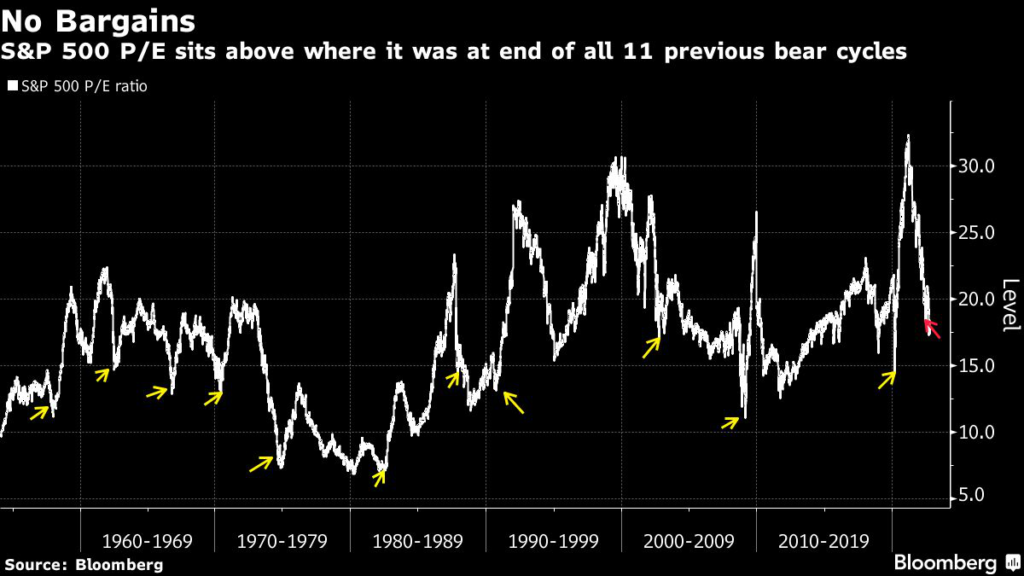
At the low in October, the S&P 500 was trading at 17.3 times profits, exceeding trough valuations from all 11 previous drawdowns and topping the median of those by 30%.

“The reality is if you step back from all the day-to-day noise, the predominant factor going forward is going to be about slowing growth,” Suzuki said. “Growth is going to be taking the driver’s seat, whereas the Fed repricing is going to take the back seat.”

–With assistance from Isabelle Lee.

More stories like this are available on bloomberg.com

©2022 Bloomberg L.P.
Stocks Rattled by Crypto, Earnings Woes Before CPI: Markets Wrap

(Bloomberg) — US stocks declined as renewed selling in cryptocurrencies and disappointing earnings weighed on risk sentiment ahead of a key inflation report. The dollar gained for the first time in four days. 

The S&P 500 put paid to a three-day rally, with all 11 major industry groups in the red. The tech-heavy Nasdaq 100 dropped the most among benchmarks, closing down 2.4%. Walt Disney Co. and News Corp. tumbled after posting results that fell short of expectations. Bitcoin dropped below $16,000 to a level not seen since 2020 amid a deepening selloff in cryptocurrencies as Binance walked away from its planned takeover of FTX.com. 

After midterm elections failed to deliver a Republican sweep, attention shifted toward the closely watched inflation report due Thursday for clues on the path of Federal Reserve policy tightening. 

“Elections matter, but other factors matter more for markets and the economy,” Keith Lerner, co-chief investment officer at Truist Wealth, said in a note. “The path of inflation, interest rates, monetary policy, the economy, and earnings will continue to exert the greatest influence on markets over the next year.”

US inflation probably moderated slightly in October, with the consumer price index and the core measure that excludes food and energy both seen cooling on an annual basis. But with the overall annual inflation rate exceeding forecasts in six of the prior seven months, another upside surprise could dash hopes of a Fed downshift after four jumbo rate hikes.

On the election front, investors had eyed prospects of a Republican comeback in Congress, with GOP taking control of both the House of Representatives and Senate. But US voters delivered a mixed verdict, with Republicans heading for control of the House by smaller margins than forecast and the race for Senate still wide open. 

Read more on elections

GOP Closes In on Narrow House Majority, Senate Still in Play

Warnock, Walker Head to Runoff That May Decide Control of Senate

Ron DeSantis Victory Sets Him on Collision Course With Trump

California’s Slow Counting Could Delay House Control Decision

Record Number of Female Governors Win as Gender Gap Narrows

More commentary 

  • “Portfolios will assess and adjust their risk now that the ‘uncertainty’ of the U.S. mid-term elections fading,” wrote Craig Johnson, chief market technician at Piper Sandler. “Soon enough, their focus will shift back to this week’s corporate earnings results and the upcoming October CPI data.”
  • “The market is still going to fixate on inflation, which is going to stay high and sticky at least over the next couple of quarters,” Luke Barrs, global head of fundamental equity client portfolio management at Goldman Sachs Asset Management, said on Bloomberg TV.

Key events this week:

  • US CPI, US initial jobless claims, Thursday
  • Fed officials Lorie Logan, Esther George, Loretta Mester speak at events, Thursday
  • US University of Michigan consumer sentiment, Friday

Some of the main moves in markets:

Stocks

  • The S&P 500 fell 2.1% as of 4 p.m. New York time
  • The Nasdaq 100 fell 2.4%
  • The Dow Jones Industrial Average fell 1.9%
  • The MSCI World index fell 1.6%

Currencies

  • The Bloomberg Dollar Spot Index rose 0.6%
  • The euro fell 0.6% to $1.0011
  • The British pound fell 1.7% to $1.1349
  • The Japanese yen fell 0.6% to 146.52 per dollar

Cryptocurrencies

  • Bitcoin fell 13% to $16,216.08
  • Ether fell 13% to $1,163.86

Bonds

  • The yield on 10-year Treasuries declined two basis points to 4.11%
  • Germany’s 10-year yield declined 11 basis points to 2.17%
  • Britain’s 10-year yield declined 10 basis points to 3.46%

Commodities

  • West Texas Intermediate crude fell 3.7% to $85.58 a barrel
  • Gold futures fell 0.5% to $1,707.80 an ounce


–With assistance from Vildana Hajric, Muyao Shen, Tassia Sipahutar, Srinivasan Sivabalan and Isabelle Lee.

More stories like this are available on bloomberg.com

©2022 Bloomberg L.P.

Crypto Market Rout Deepens as Binance Drops FTX Takeover Offer

(Bloomberg) — The week’s rout in cryptocurrencies deepened, with Bitcoin tumbling to the lowest levels in two years, as Binance walked away from its planned takeover of FTX.com.

Bitcoin, the largest token by market value, fell as much as 15% to $15,987 on Wednesday, the least since November 2020. That brings the two-day decline to as much as 23%, the most since June. It reached a record high of almost $69,000 a year ago. Just about every digital coin was struggling: Ether, Solana, Polkadot and Avalanche all dropped.

FTT, the utility token of the FTX exchange, collapsed by more than 40%, following a more-than-70% tumble on Tuesday.

“The market is now in full fear mode,” said Ilan​ Solot, co‑head of digital assets at Marex Solutions. “Everyone’s looking to see if there’s more dominoes and what else needs to be liquidated.”

As a result of corporate due diligence, as well as the latest news reports regarding mishandled customer funds and alleged US agency investigations, we have decided that we will not pursue the potential acquisition of FTX.com, a Binance spokesperson said. 

Binance Chief Executive Officer Changpeng “CZ” Zhao had stunned the crypto world on Tuesday with an announcement that his firm was moving to take over FTX.com, which suffered a liquidity crunch after Zhao announced that he was selling a $530 million holding of FTX’s native token. 

Investors are on edge about spreading contagion given the pivotal role FTX and its co-founder Sam Bankman-Fried played in the industry.

“Since I entered the crypto industry in 2016, very few periods tested its market infrastructure and participants like the last 24 hours did,” said crypto hedge-fund manager Dan Liebau of Modular Asset Management.

Read more: FTX’s Financial Black Hole Leaves Binance Balking at Rescue

Noelle Acheson, author of the “Crypto is Macro Now” newsletter, pointed out that Bitcoin, which typically holds up better than other tokens during times of stress, was seeing greater declines than some other altcoins. That potentially points to institutional investors bailing “as a result of the drama.”

“It’s a sign that this is a blow to confidence in the industry as a whole, from the investor’s point of view,” she said in an interview. “From the industry’s point of view, it’s also a pretty steep blow, much more so than what we saw with Three Arrows Capital and with the Terra implosion. This is sitting harder.”

The sense of dread that swept across clients of fallen crypto exchange FTX.com was so intense that they pulled out $430 million worth of Bitcoin in the space of just four days. FTX had more than 20,000 Bitcoins going into Sunday, according to data from CryptoQuant. That fell to almost zero by Wednesday after fears about FTX.com’s financial health led customers to flee.

FTT, the utility token of the FTX exchange, has collapsed by more than 75% in the past 24 hours and was trading around $4.20, according to CoinGecko data. 

The offer by Zhao’s Binance Holdings had came after a bitter feud between with Bankman-Fried spilled into the open. Zhao actively undermined confidence in FTX’s finances, helping spark an exodus of users from the three-year-old FTX.com exchange. 

A day before reaching a deal, Bankman-Fried said on Twitter that assets on FTX were “fine.” 

The price of Sol, the native token of the Solana blockchain — which is associated with both FTX and Bankman-Fried’s crypto trading house Alameda Research — posted dramatic declines alongside other tokens of Solana-based projects. Sol was down as much as 46% on Wednesday, taking losses this year to 90%. 

The FTX-Binance ordeal gave some traders flashbacks to the issues suffered by Celsius — the crypto lender that collapsed earlier this year — as well as those seen by other firms that were engulfed in this year’s crash in digital assets.

–With assistance from Olga Kharif, David Pan, Yueqi Yang, Joanna Ossinger and Sidhartha Shukla.

More stories like this are available on bloomberg.com

©2022 Bloomberg L.P.

Close Bitnami banner
Bitnami
