
Bloomberg

Meta to Begin Widespread Job Cuts Wednesday Morning

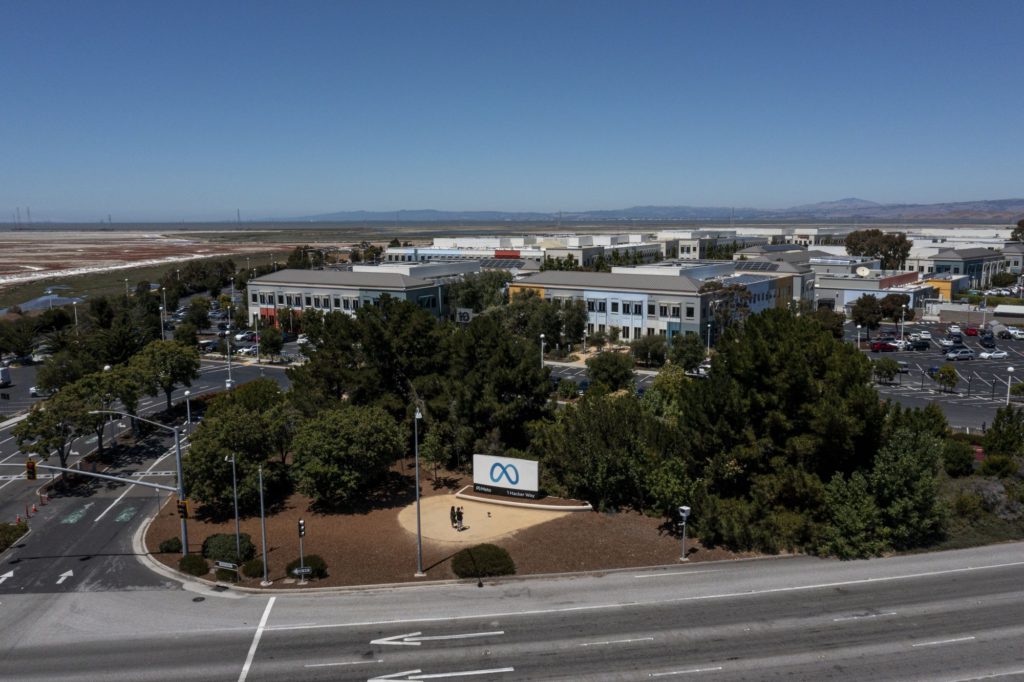
(Bloomberg) — Facebook parent Meta Platforms Inc. is planning to begin widespread job cuts on Wednesday, according to people familiar with the matter, part of a plan to reduce costs at the social-media giant following disappointing earnings and a drop in revenue.

Employees who are affected will be told starting Wednesday morning, and Chief Executive Officer Mark Zuckerberg spoke to executives on Tuesday to prepare them for the cuts, said the people, who asked not to be identified discussing private information. On the executive call, Zuckerberg said he was accountable for the company’s “missteps,” according to the Wall Street Journal.

A Meta spokesperson didn’t immediately respond to a request for comment.

Zuckerberg warned employees in late September that Meta intended to slash expenses and restructure teams. The Menlo Park, California-based company, which also owns Instagram and WhatsApp, implemented a hiring freeze, and the CEO said that Meta expected headcount to be smaller in 2023 than it is this year.

The cuts are expected to affect about 10% of the company, which employed more than 87,000 as of Sept. 30, according to Insider. The reductions, part of the first major budget cut since the founding of Facebook in 2004, reflect a sharp slowdown in digital advertising revenue, an economy wobbling on the brink of recession and Zuckerberg’s heavy investment in a speculative virtual-reality push called the metaverse.

“This is obviously a different mode than we’re used to operating in,” Zuckerberg said in a Q&A session with employees in September. “For the first 18 years of the company, we basically grew quickly basically every year, and then more recently our revenue has been flat to slightly down for the first time. So we have to adjust.”

Read more: Twitter, Meta Push Tech Job-Cut Pace Near Early Pandemic Levels

Meta’s job reductions follow cutbacks at Twitter Inc. last week, which saw that company cut roughly 50% of its workforce following its sale to Elon Musk. Those layoffs were chaotic, with many employees finding out they had lost their jobs when they were suddenly cut off from Slack or email. Musk said the moves were necessary to stem losses at the social network. He later asked some fired workers to return.

Snap Inc., parent of rival app Snapchat, is also scaling back, saying in August that it would eliminate 20% of its workforce.

Earlier: Meta to Cut Headcount for First Time, Slash Budgets Across Teams

More stories like this are available on bloomberg.com

©2022 Bloomberg L.P.
Microsoft’s Cloud Sparks Complaint to EU by Amazon-Linked Group

(Bloomberg) — A collection of Microsoft Corp.’s rivals including OVH and Amazon.com Inc.’s AWS fired off an antitrust complaint to European Union watchdogs alleging the software giant uses unfair licensing practices to lure customers in the region to its cloud infrastructure.

CISPE, a European cloud-company policy group, said it’s calling for a probe into Microsoft’s business model before some companies are shut out of the market, causing “material harm to customers.” It’s the fourth current complaint targeting Microsoft at the Brussels-based European Commission.

Bowing to months of pressure from rival cloud providers, Microsoft earlier this year announced changes to its software licensing terms to make it easier for customers of rival cloud-service companies in Europe to move their existing software to these other networks. The changes took effect on Oct. 1.

Read More: Mr. Smith Goes to Washington: Fully Charged

But CISPE called the changes a “smokescreen” that fail “to tackle the harms to consumers and providers” that have already been outlined in a previous complaint to the EU.

Microsoft, whose $69 billion takeover bid for Activision Blizzard Inc. was earmarked on Tuesday for an in-depth EU review, said in a statement the licensing changes it had recently introduced “give customers and cloud providers around the world even more options for running and offering our software in the cloud.” 

It said it was “committed to addressing valid licensing concerns and support a competitive environment where all providers can thrive.” 

More stories like this are available on bloomberg.com

©2022 Bloomberg L.P.

Lucid Falls After Maker of Luxury EVs Misses Profit Estimates

(Bloomberg) — Lucid Group Inc. shares fell in late trading after third-quarter sales and earnings trailed estimates and reservations declined for the company’s luxury electric vehicles.

The automaker’s loss was 40 cents a share, according to a statement Tuesday, wider than analysts’ average estimate of a 31-cent loss. Revenue was $195.5 million, missing the $204 million prediction in a Bloomberg survey.

The Newark, California-based company’s shares declined 13% as of 5:23 p.m. in New York, after losing 65% of its value this year through Tuesday’s close.

Supply-chain snags and logistics problems marred the beginning of Lucid’s year, leading the startup to revise down its production target twice. Lucid reaffirmed the lowered goal Tuesday, saying it still expects to be able to make 6,000 to 7,000 vehicles by year’s end. Reservations for Lucid’s Air sedan dropped from 37,000 in the second quarter to 34,000, and the company announced it would start taking preorders for its delayed SUV in 2023.

Lucid exited the third quarter with $3.85 billion in cash, equivalents and investments, down from $4.6 billion at the end of the prior quarter. 

The company also said Tuesday that it struck a deal to sell as much as $600 million in shares through Bofa Securities Inc., Barclays Capital Inc. and Citigroup Global Markets Holdings Inc., and as much as $915 million in shares to an affiliate of Saudi Arabia’s sovereign wealth fund. Saudi Arabia already owns a majority of Lucid’s shares through its wealth fund.

(Updates with additional details beginning in first paragraph)

More stories like this are available on bloomberg.com

©2022 Bloomberg L.P.
Bitcoin Miner Marathon Posts Wider Loss as Revenue Falls

(Bloomberg) — Bitcoin mining company Marathon Digital Holdings Inc. posted a wider third-quarter loss as revenue tumbled.  

The Las Vegas-based miner had a loss of $75.4 million, or 65 cents a share, compared with $22.2 million or 22 cents, in the year-earlier prior period. Revenue fell to $12.6 million from $51.7 million. Lower production due to operational issues and Bitcoin prices declines are among the biggest reasons for the loss, Marathon said in a statement Tuesday. 

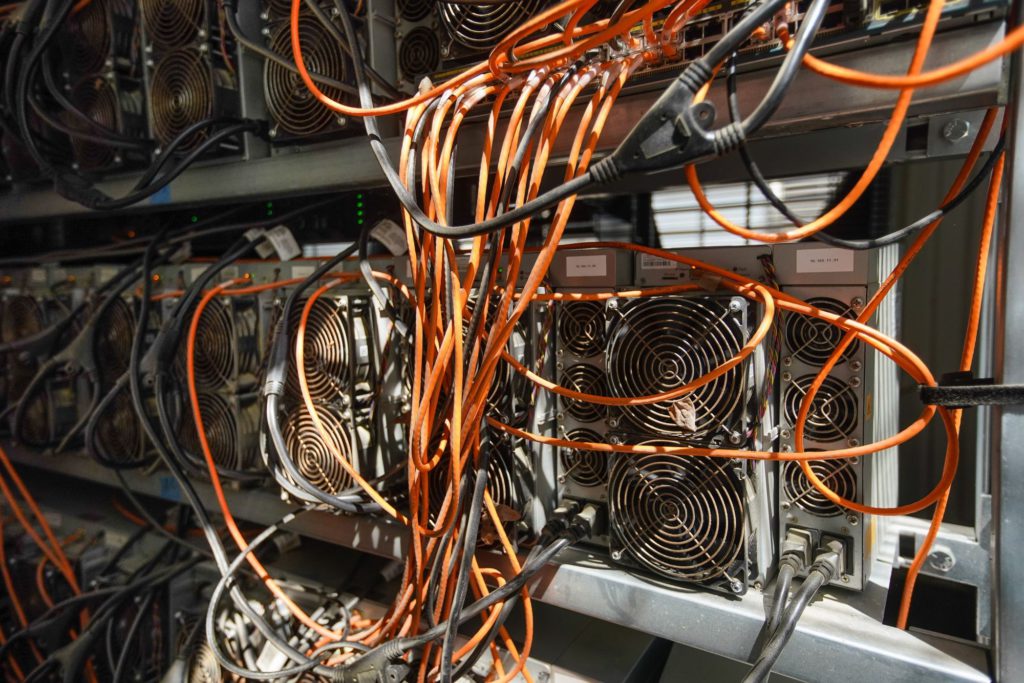
The company continues to deploy mining machines whereas other miners have ceased expansions due to liquidity issues. The firm plugged in 32,000 rigs in October, bringing the number of its operating machines to about 69,000 in total, according to the firm’s operational update. 

Marathon has taken an “asset-light” approach to expand its mining operations in which the firm spends most of its money on buying rigs and put them in third-party hosting sites to run its machines. That is opposed to the vertically integrated miners that have borrowed heavily to pay hefty overhead costs to build out their own Bitcoin mining infrastructure such as data centers and transforms. 

Major Bitcoin miners Core Scientific Inc. and Argo Blockchain PLC are struggling to stay afloat as they complete the constructions of their mining sites. Those miners have sold off their coin reserves and planned to sell new shares to raise cash. Marathon has been one of the few miners that have not sold mined coins. Its Bitcoin holdings rose to 11,285 last month, with 3,464 in unrestricted coins, according to the update. The firm has $52.1 million cash as of the end of October, down from $55.3 million in the prior month.

Marathon faced multiple delays to energize their 40,000 installed mining machines in a 280-megawatt facility hosted by Compute North due to regulatory issues earlier this year. Compute North was able to start a portion of the machines in August. While the host filed for bankruptcy in September, Marathon claimed its operations remain unaffected in its update.

Shares of Marathon fell about 1% in trading after the close of regular markets. The stock has tumbled 70% this year.

More stories like this are available on bloomberg.com

©2022 Bloomberg L.P.

FTX Proves ‘FUD’ Is Dangerous Weapon in Crypto’s Game of Thrones

(Bloomberg) — Not even the king of crypto is immune from “FUD.” 

The acronym for “fear, uncertainty and doubt” has long been used to mock the drumbeat of warnings about risks that has served as the background music throughout the history of cryptocurrencies.

Yet the announcement on Tuesday that Binance would potentially take over Sam Bankman-Fried’s FTX.com shows — once again — that FUD can create an existential crisis even for a company that appears to be a cornerstone of the industry, with its corporate logo displayed proudly on the breast of Major League Baseball umpires or illuminated above the entrance of famous arenas. 

Of course, the phenomenon is not unique to crypto. It caused liquidity concerns that morphed into solvency issues for levered-up major banks in the global financial crisis. And most recently, FUD speculation arguably has been at play in forcing Credit Suisse AG to embark on capital-raising efforts. Yet in crypto, FUD — often aimed at highly leveraged targets — is often lurking just below the surface, even when it comes to the most respected, billionaire-minting firms that dominate the industry.

In this case, the FUD started less than a week ago when the crypto news website CoinDesk reported a troubling link between two separate companies in billionaire Bankman-Fried’s cryptocurrency empire: the FTX exchange and the trading firm Alameda Research. According to the report, the $14.6 billion in assets on Alameda’s balance sheet were heavily comprised of a cryptocurrency called FTT, a coin issued by FTX that grants users discounts on FTX trading fees and other perks. Meanwhile, Alameda’s balance sheet showed $8 billion of liabilities dominated by $7.4 billion in loans. (Alameda CEO Caroline Ellison responded in a tweet that the company had more than $10 billion of assets elsewhere). 

The report was followed by tweets from billionaire Changpeng “CZ” Zhao, the founder of rival exchange Binance Holdings, who said that “due to recent revelations that have come to light,” his firm decided to sell its holdings of the FTT token received from its exit from an investment in FTX last year. “Regarding any speculation as to whether this is a move against a competitor, it is not,” he added. The industry is still in its nascence, he wrote, “and every time a project publicly fails it hurts every user and every platform.” 

Still, the tweet swiftly undermined confidence in FTX’s finances and helped spark an exodus of users from the FTX.com exchange, as well as a crash in the value of FTT. 

The digital-asset equivalent of a run on the bank was underway, with all eyes on a pair of billionaires known by their initials SBF and CZ, already prone to the occasional Twitter scuffle. Bankman-Fried responded on Twitter to say that “a competitor is trying to go after us with false rumors” and assets on FTX are “fine.” Yet the comment did little to ease the FUD. 

“You invest in illiquid assets and all of a sudden people want their money back, you’ve got a problem,” said Cam Harvey, finance professor at Duke University and author of the book “DeFi and the Future of Finance. “The thing that struck me the other day was once SBF had to say, ‘Oh yeah, we’re OK, we’ve got enough money to cover.’ As soon as you have to say that, then everybody knows that the game is over.” 

What makes this latest chapter in the crypto train wreck of 2022 so surprising is that Bankman-Fried had made so many headlines this year as the rescuer of other troubled firms, often drawing comparisons to John Pierpont Morgan’s efforts to rescue Wall Street and even the US government in financial crises more than a century ago. 

Following the collapse of the TerraUSD stablecoin that roiled crypto markets, SBF bought two companies, propped up the crypto platform BlockFi, and tried to save another, Voyager Digital, with a large loan.

Sam Bankman-Fried Expands Crypto Empire During $2 Trillion Rout

“You have to prepare for these scenarios because these are not black swan events,” Duke’s Harvey said. “This is not unexpected. To be under stress because of something that we’ve seen multiple times in terms of the price movements I guess is another kind of red flag.”

Adding to anxiety in the crypto world is the fact that more than five hours after SBF announced the emergency takeover on Twitter, details of its terms were nowhere to be found and speculation was rampant that FTX investors were in for serious pain. That triggered deep losses in prices of cryptocurrencies, which had stabilized briefly after the announcement. 

As of yesterday, SBF was worth about $15.6 billion, making him the 95th richest person on Bloomberg’s list of billionaires. CZ was worth $18.3 billion, making him No. 75. 

Where those figures land when the dust settles from Tuesday’s developments is anybody’s guess. 

–With assistance from Muyao Shen.

More stories like this are available on bloomberg.com

©2022 Bloomberg L.P.

Astra Space to Cut 16% of Staff on ‘Challenging’ Environment

(Bloomberg) — Astra Space Inc. is eliminating 16% of its workforce and reallocating some capital as the launch provider grapples with worsening business conditions.

The company expects savings from the headcount reduction to be realized beginning in early 2023, according to a statement Tuesday that detailed third-quarter results. Astra is also redirecting near-term investments in its Space Services business to support growth of the Launch Services and Space Products operations.

“Given the challenging macroeconomic environment, we made the difficult but prudent decision to reduce our operating expenses to support our primary near-term objectives,” Chris Kemp, Astra’s co-founder and chief executive officer, said in the statement.

The move follows a significant strategic shift in August, when Astra said it would cease work on its Rocket 3.3 system, designed to deliver small satellites into low-Earth orbit. Only two flights of the rocket successfully made it to orbit, while the vehicle has suffered multiple in-flight anomalies on other missions while carrying payloads for NASA. Astra decided to focus on developing a new rocket system.

Astra on Tuesday reported an adjusted net loss of $45.2 million in the past quarter and sales of $2.8 million.

The shares rose 2.6% as of 4:55 p.m. in volatile late trading in New York.

More stories like this are available on bloomberg.com

©2022 Bloomberg L.P.
Stocks Notch Three-Day Rally Ahead of Vote Results: Markets Wrap

(Bloomberg) — US stocks rose for a third day as investors awaited midterm election results and monitored the selloff in crypto tokens that wiped out more than 10% from the price of Bitcoin. The dollar fell with Treasury yields. 

The S&P 500 closed higher, after earlier wiping out gains that had topped 1%. Sentiment was dented after Bitcoin plunged as the owner of the largest crypto exchange swooped in to buy a smaller rival that ran into liquidity trouble. The yield on two-year Treasuries, more sensitive to Federal Reserve policy changes, shed 6 basis points, while a gauge of the dollar dropped for a third day.

In postmarket trading, shares in Walt Disney Co. declined after the company reported sales and profit that fell below Wall Street expectations.

Equities gained in the regular session as investors eyed potential gridlock from midterm results. Still, any final outcome may not be known for days or even weeks if races are as close as polls suggest and if losers challenge results.

In an unexpected development, billionaire Changpeng “CZ” Zhao consolidated his position atop the crypto world on Tuesday with a move to take over FTX.com. Terms of the emergency buyout were scant, helping to send prices of cryptocurrencies tumbling after a brief rebound.

“The mini crash in Bitcoin/crypto did destabilize the stock market and cause a sharp drop,” Jay Hatfield of Infrastructure Capital said. “Investors don’t like to see any disruptions or mini crashes in any risk asset.

A history of robust performance following midterm results has helped buoy optimism about the outlook for equity markets. While polls suggest Republicans could make gains, thereby placing a check on Democratic policies, there are multiple scenarios. The best outcome for Treasuries could be a Republican control of both the House of Representatives and Senate, while the dollar could find support should Democrats keep both chambers.

Read more on elections:

Election Latest: Voting Glitches Are Isolated, Sporadic So Far

Deeply Divided America Votes Amid Inflation Fears, Culture Wars

Here Are Key Races to Watch Hour by Hour as Midterm Voting Ends

For many the biggest headwind for markets is the Fed’s monetary tightening with Thursday’s consumer-price-index data the next event risk coming on the heels of core consumer prices rising more than forecast to a 40-year high in September. Even if prices begin to moderate, the CPI is far above the Fed’s comfort zone. 

Going forward there may be a silver lining in gridlock for policy makers, according to Art Hogan, chief market strategist at B. Riley Wealth. 

“Divided government, particularly leading into a presidential election, will most likely create a standstill where very little gets done,” Hogan wrote. “That’s probably a good thing for the Fed because various stimuli have not made their work easier.”

More commentary

  • “The more and more you just get polls or even some slight acknowledgements from places that the Republicans are probably going to take up at least one chamber of Congress, I think the market is actually seeing that as a good outcome,” Shawn Cruz, head trading strategist at TD Ameritrade, said in an interview. “They actually want a little bit of gridlock out of Washington.”
  • “The inflation statistics are going to be more important than the election,” Michael Darda, chief economist at MKM Partners, said on Bloomberg TV. “Inflation will tend to lag the cycle so if you have the Fed chasing down lagging indicators with a very rapid succession of interest rate increases and quantitative tightening, there is a very significant risk that the Fed significantly overshoots neutral.”
  • “The gridlock rally is a bit overdone, as we were already there,” said Victoria Greene, G Squared Private Wealth CIO. “Investors will need to temper expectations on results coming in this evening. Many contested races it might be weeks, or god forbid, months before we know results. Politics matters personally, less so to the markets.”

Treasuries gained across the board Tuesday, with the benchmark 10-year rate dropping as much as 9 basis points. Meanwhile, traders shaved bets on rate hikes, with swap markets still leaning toward a 50 basis-point Fed hike in December. More notable moves were further out, with the peak reaching just above 5% in the first half of 2023.

Nvidia Corp. climbed as it began producing a processor for China. Take-Two Interactive Software Inc. fell after reducing its forecast for net bookings.

Europe’s Stoxx 600 rallied, after a weak open. Chinese equities halted a rally as traders considered a jump in virus infections and official comments defending Covid Zero. Oil fell as China’s renewed commitment to strict Covid-19 policies overshadowed a global market backdrop of shrinking fuel inventories.

Key events this week:

  • US midterm elections, Tuesday
  • EIA oil inventory report, Wednesday
  • China aggregate financing, PPI, CPI, money supply, new yuan loans, Wednesday
  • US wholesale inventories, MBA mortgage applications, Wednesday
  • Fed officials John Williams, Tom Barkin speak at events, Wednesday
  • US CPI, US initial jobless claims, Thursday
  • Fed officials Lorie Logan, Esther George, Loretta Mester speak at events, Thursday
  • US University of Michigan consumer sentiment, Friday

Some of the main moves in markets:

Stocks

  • The S&P 500 rose 0.6% as of 4 p.m. New York time
  • The Nasdaq 100 rose 0.8%
  • The Dow Jones Industrial Average rose 1%
  • The MSCI World index rose 0.8%

Currencies

  • The Bloomberg Dollar Spot Index fell 0.4%
  • The euro rose 0.5% to $1.0071
  • The British pound rose 0.2% to $1.1536
  • The Japanese yen rose 0.7% to 145.63 per dollar

Cryptocurrencies

  • Bitcoin fell 12% to $18,172.17
  • Ether fell 17% to $1,310.88

Bonds

  • The yield on 10-year Treasuries declined seven basis points to 4.14%
  • Germany’s 10-year yield declined six basis points to 2.28%
  • Britain’s 10-year yield declined nine basis points to 3.55%

Commodities

  • West Texas Intermediate crude fell 2.8% to $89.18 a barrel
  • Gold futures rose 2.1% to $1,715.10 an ounce

–With assistance from Jan-Patrick Barnert, Haidi Lun, Brett Miller, Srinivasan Sivabalan, Isabelle Lee, Natalia Kniazhevich and Vildana Hajric.

More stories like this are available on bloomberg.com

©2022 Bloomberg L.P.
Tesla Loses Valuation Race to Berkshire as Growth Stocks Sputter

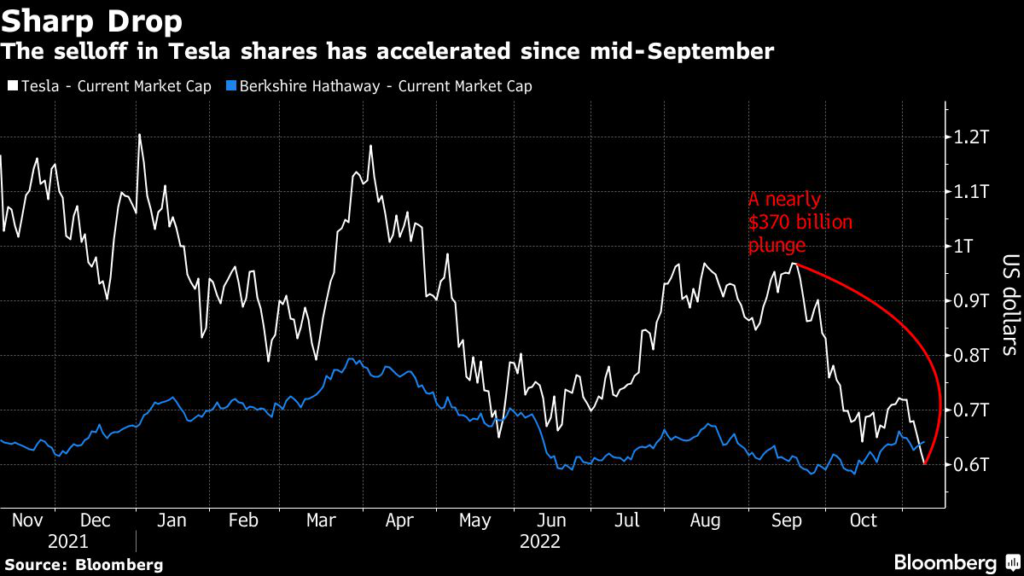
(Bloomberg) — After a $360 billion rout, Tesla Inc. has just been supplanted by old-economy stalwart Berkshire Hathaway Inc. as the fifth-biggest company in the S&P 500 Index.

The Elon Musk-led electric-vehicle maker’s shares closed with a market valuation of $604 billion Tuesday, versus nearly $645 billion for Warren Buffett’s conglomerate, underscoring this year’s great economic upheaval as former high-flying technology stocks plunge anew while industrial companies outperform.

A former member of the $1 trillion capitalization club as recently as this April, Tesla has succumbed to a fresh drawdown since September. Thank a hawkish Federal Reserve that’s sending growth stocks ever lower — and the backlash caused by Musk’s mercurial acquisition of social-media giant Twitter Inc.

“Berkshire has branded itself as an American bedrock, a place to hide when one is uncertain about the future,” said Catherine Faddis, chief investment officer of Grace Capital.

The US stock market is witnessing the end of an era when richly priced tech companies with aggressive future growth plans could do no wrong. Rising interest rates are spurring investors to bid up value firms that offer stable cash flows in the here and now, while the relative resilience of the industrial and consumption cycle is proving a boon for steady and stable businesses.

The Dow Jones Industrial Average is far outperforming both the benchmark S&P 500 Index and the technology-heavy Nasdaq 100 Index, while Tesla’s 46% slide this year compares with a just a 2% drop for Berkshire. 

Meanwhile the four big technology companies — Apple Inc., Microsoft Corp., Google-parent Alphabet Inc. and Amazon.com Inc. — have all fallen at least 20% so far in 2022.

Faddis also notes that Berkshire is hard to value in the current economic climate, given its holdings in growth companies like Apple and Microsoft, in addition to value stocks like American Express. The conglomerate also holds positions in privately held entities that are involved in everything from insurance and railroads to electric utilities. 

“This is a great representation of slow and steady wins the race in the current environment,” said Arthur Hogan, chief market strategist at B. Riley Wealth. “Value has underperformed growth for the better part of a decade, but the tide has certainly shifted this year and likely will continue into next year.”

(Updates valuations in first and second paragraphs)

More stories like this are available on bloomberg.com

©2022 Bloomberg L.P.

Robinhood Plunges as Bankman-Fried’s FTX Sells Itself to Binance

(Bloomberg) — Robinhood Markets Inc. tumbled by the most in more than a year after Binance Holdings Ltd. agreed to acquire Sam Bankman-Fried’s troubled crypto exchange FTX.com, which had been considered a potential suitor for the trading platform. 

Shares of Robinhood plunged 19% Tuesday, their steepest decline since August 2021, after the founders of Binance and FTX.com announced that they have signed a non-binding letter of intent on the takeover to “help cover the liquidity crunch” at FTX.com. 

Investors may have soured on Robinhood after the announcement as FTX was said to have been exploring a possible acquisition of the company, people with knowledge of the matter told Bloomberg News in June. 

“While the knee-jerk reaction is negative amid Sam Bankman-Fried’s ~8% stake, Robinhood’s exposure to crypto is small as the business remains diversified,” Mizuho Securities USA analyst Dan Dolev wrote in a report. 

Coinbase Global Inc. tumbled 11% to a four-month low on concerns that the Binance-FTX deal puts a spotlight on the challenges facing the $1 trillion crypto industry. 

“The rapid fall from grace of a crypto exchange demonstrates how fickle the crypto industry could be,” Dolev wrote. “This is a red flag for Coinbase, where the vast majority of revenues are from trading crypto tokens with little diversification elsewhere.”

Other cryptocurrency-linked stocks slipped Tuesday as Bitcoin fell as much as 17% to touch the lowest since November 2020 amid investor jitters. MicroStrategy Inc. sank 21% and Riot Blockchain Inc. lost 7.3%, while Marathon Digital Holdings Inc. fell 5.1% and Silvergate Capital Corp. tumbled 23%.

–With assistance from Bailey Lipschultz.

(Updates share performance throughout.)

More stories like this are available on bloomberg.com

©2022 Bloomberg L.P.

Dialing 411 and 0 for Operator Going the Way of the Phone Booth

(Bloomberg) — Come Jan. 1, AT&T Inc. phone customers with digital landlines will no longer be able to dial 0 for the operator or get directory assistance from 411:  The telecom giant is ending the age-old services in 21 states, sending them the way of the pay phone.

The company stopped offering operator and directory assistance to wireless customers over a year ago. Other telecom giants have phased out the services as well. 

The internet has made these jobs irrelevant to much of the population. Appointments, phone numbers and operating hours for most businesses can all be obtained quickly and easily online. And while AT&T serves more than 200 million subscribers with its wireless service, the company’s shrinking landline operations had just over 8.5 million customers at the end of the third quarter, including 3 million slated to lose operator services.

“It’s becoming apparent that there’s not really a need,” said Jeff Kagan, an independent telecommunications analyst. “It’s an older service that’s shrinking and dying, same as with traditional phone lines.”

In 2000, Verizon Communications Inc. rolled out an automated menu for customers after realizing most calls couldn’t be handled by traditional operators who were paid to route calls. Almost a quarter of inquiries were for billing or repair questions, and over 40% were for miscellaneous queries including “requests for the temperature, the cooking time for turkeys and the number of eggs used to bake a cake,” according to a Verizon statement.

Alongside the operator, the sun is setting on many icons of 20th century communications, like switchboards, rotary dials, landlines, phone books and pay phones.

Until electronic switchboards came along in earnest in 1965, operators were necessary to route many calls. Even after emergency phone numbers like 911 were adopted throughout the US in the 1970s and 1980s, operators remained crucial in directing callers to the correct personnel. Their services have also long been important for disabled and elderly customers.

Read more: NYC Says Its Final Goodbye to the Pay Phone

The first telephone exchange was founded in 1878 in New Haven, Connecticut, according to the History Channel, with about 20 clients including the local police, the post office and a drugstore. While the first operators were teenage boys, the field came to be dominated by women by the turn of the century. Much like flight attendants and other roles once defined by gender, operators were subject to strict dress codes, rigid rules of conduct, and height and weight requirements—all under close monitoring.

As the demand for phone service grew, so did operators’ power as a collective. As World War I ended, the profession had grown to nearly 180,000. In 1919, some 8,000 went on strike at the New England Telephone Co., paralyzing businesses across Maine, Massachusetts, New Hampshire, Rhode Island and Vermont. Less than a week later, the company bowed to the women’s call for better working conditions and higher wages.

But the strike also hastened investments in automation. Within a few years, some of the first “automatic” dial phones were introduced across the country.

Telecommunications companies employed a mere 550 operators in the US as of last year, according to the Bureau of Labor Statistics, down from the mid 20th-century high of almost 350,000.

More stories like this are available on bloomberg.com

©2022 Bloomberg L.P.

Close Bitnami banner
Bitnami