
Bloomberg

Fast-Fashion Upstarts Are Using Shein’s Own Strategies Against It

(Bloomberg) — Loved by Gen Z shoppers for its ultra-cheap throwaway fashion—and held up as a pariah by sustainability experts for exactly the same reason— Shein’s impact on global consumers over the past couple of years is indisputable. 

Behind the scenes, the Chinese retailer’s influence on manufacturing has been just as seismic. Now, the breakneck supply chain pioneered by Shein is allowing a new swathe of brands to make the most of operating in the colossal retailer’s slipstream. 

At least one—Temu, a new global offshoot of Chinese e-commerce heavyweight Pinduoduo Inc.—may present a genuine threat. Shein management see Temu as their most serious potential competitor, according to people familiar with the situation, who say the newcomer is actively headhunting its employees and targeting its suppliers. 

“Shein has created a new standard for the apparel online export business,” said Ye Zhibin, founder of fzthinking.com, an online platform that helps cross-border e-commerce companies find suppliers. 

Now that low-cost Chinese brands can sell directly to Western consumers online, “the supply chain and brands that plan to go overseas need to follow the standard.” 

The new crop of rivals is just one of Shein’s many current headaches. Sales growth has tailed off as the pandemic recedes and new higher-end products are not cutting through with consumers. Worse, the super-fast-fashion business model that made the brand’s name has given rise to allegations of environmental damage and worker exploitation that may stand in the way of its IPO ambitions. 

Read More: Fast-Fashion Behemoth Shein Says It’s Cleaning Up Its Act. Will Anyone Buy It?

But in the Chinese manufacturing heartland of Guangdong, signs of Shein’s current dominance are everywhere. 

On a recent evening in the village of Nancun, the alleyways were quiet except for the sound of children playing—and the looms in the garment workshops, which operate day and night in service of a startup whose annual sales vaulted to $16 billion in 2021. Even as growth slows, that figure is on track to rise by about 50% this year, according to people familiar with the situation. 

In downtown Guangzhou, logo makers namecheck Shein along with Nike and Champion as evidence that they serve the most important clients. Industry forums highlight Shein—valued at $100 billion, more than Hennes & Mauritz AB and Inditex SA’s Zara combined—as a model of expansion into overseas markets. 

Data Deluge

Shein’s impact on China’s textile business has been heightened because its rise began at an otherwise challenging time for the $700 billion sector. Industry profits have fallen in two of the past three years and the decline deepened to 17% in the first half of 2022. Global economic uncertainty, geopolitical tensions and a range of Covid-related disruptions have all weakened demand at home and abroad. Rising costs for labor and raw materials have also hit factories hard. 

“Shein is a lifesaver to the apparel supply chain at least in Southern China in recent years,” said He Zhikang, assistant director of Guangdong Apparel and Accessories Association. 

“It provides huge orders to factories that have been struggling with weak demand, and it inspires many local brands to eye overseas markets for a new growth engine.” 

For decades, China’s textile workforce has provided low-cost, quick-turnaround garments to global brands like H&M and Zara. But the Shein has found ways to squeeze the system even further, using reams of consumer data to inform every move. 

While Zara’s garments go from drawing board to shipping container in three weeks, the fast-fashion behemoth demands a turnaround of just 10 days.

It also relies on contractors rather than investing in its own manufacturing facilities, ordering batches of as few as 50 pieces. It’s an approach that enables the brand to respond quickly to customer interest—or lack of it—in any given item, and to launch tens of thousands of pieces every day.

The company’s data collection goes way beyond sales trends, though. It monitors social media for viral looks that can be quickly copied, tracks users’ browsing history and keeps tabs on reviews and fashion events. A customer might see their favorite celebrity on TikTok in a puff-sleeve blouse or drop-shoulder dress, then within days be offered a near-identical style on Shein’s website, thanks to a powerful recommendations algorithm that analyzes users’ profiles, online habits and historical data. 

“There have always been disruptors in the fast-fashion space, but what Shein brings to this is a bigger scale,” said Caroline Gulliver, an analyst at Stifel Financial Corp. in London. 

“They’ve dominated the digital landscape in the US over the past couple of years. It’s reflective of where they’ve invested their marketing spend most aggressively.”

Trail Blazing

Shein’s outsized footprint has democratized supply chains. Few established factories were prepared to work with new brands that didn’t offer profitable bulk orders until Shein blazed the trail, aided by a pandemic-driven plunge in orders from longer-standing customers. Lockdowns fueled an online shopping boom, the retailer’s annual revenue tripled and barriers to entry were lowered for new apparel businesses. 

Now its small-batch strategy is seen as key to its success. 

Apparel factories in Guangzhou told Bloomberg News that they often lose money on small orders from Shein, but the brand’s rich customer data help to improve decision-making about everything from raw materials and design to capacity and efficient production. In recent months, the brand has also sought to reframe small-batch production as a waste-minimizing strategy that shows its sustainability credentials.

Suppliers have enjoyed explosive growth as a result of working with the brand. Two Guangdong manufacturers who work solely with Shein said their output had tripled since 2019, while one stallholder at Guangzhou’s enormous wholesale markets described how her annual sales had soared after she used Shein data to tailor her product range to Western tastes. 

Now other e-commerce businesses are seeking to take advantage of the apparel retailer’s production model, although its sheer scale limits the opportunities for smaller companies.

“We’ve seen many young brands coming and quickly exiting the market in the past two years,” said fzthinking.com’s Ye. “Imagine if you sell a similar dress to Shein. How can you compete with it, since it has squeezed costs to the minimum and enjoys economies of scale?”

Deep-Pocketed Rivals

The risk for Shein comes from upstarts with deeper pockets.

In September, Pinduoduo launched Temu—a global online shopping platform that is already climbing the ranks in the US Apple Store. Pinduoduo operates one of the biggest players in China’s online shopping sphere, lowering costs by letting customers buy directly from manufacturers. The Shanghai-based, US-listed company has an annual active user base of 880 million and controls roughly 13% of Chinese online retail. 

As yet unproven on the global stage, Temu is casting a wider net than Shein and stocks everything from groceries to pet supplies. But its range includes distinctly Shein-like products such as $7 tunic blouses and “stylish sunglasses” for 99 cents. 

Temu has also been actively targeting the apparel giant’s Guangzhou suppliers as potential partners, according to people familiar with the situation, and attempting to lure employees from its supply-chain department by offering to triple their compensation packages. Pinduoduo has a deep pool of resources to call on—both financially and in terms of skills such as supply-chain management—that increases the risk it presents to Shein. 

“We set out to provide consumers access to premium products from around the world by the best manufacturers at wholesale prices,” a Temu spokesperson said. “We believe this direct access will improve the online retail experience.”

Another potential threat is Urban Revivo, which overtook Fast Retailing Co.’s Uniqlo to become the No.1 women’s clothing brand on shopping platform Taobao in June. Urban Revivo is higher-end than Shein. But with its “fast fashion and affordable luxury” tagline and target audience of 18- to 35-year-olds in the US, Europe and Southeast Asia, the overlap is clear. 

“We still need to take time catching up with the established online exporters,” the company said in an emailed statement. “But we have 16-year experiences in flexible supply chain and brand management to back us up.” 

For now, there’s little sign that Western brands are aping Shein’s production model, which takes advantage of Guangdong’s tight network of wholesalers and workshops. Zara, for example, is focused on “near-shoring” its factories in locations like Morocco and Portugal, closer to its customer base. Shein, which declined to comment for this story, is also moving some of its manufacturing to other countries including Brazil, although China remains its main production hub. 

As its universe of competitors expands, Shein’s environmental, social, and governance practices present an ongoing threat to its success. A recent investigation into the poor conditions faced by factory employees is just the latest blow to the retailer’s reputation. 

For Chinese suppliers, that’s less important than Shein’s sheer heft. One manager with the surname Chen, who oversees hundreds of workers, said his factory was too busy to work with anyone else. 

“Shein is our sole client,” he said. “We’ll just follow its pace, and expand for it.”

–With assistance from Katie Linsell.

More stories like this are available on bloomberg.com

©2022 Bloomberg L.P.

Twitter Now Asks Some Fired Workers to Please Come Back

(Bloomberg) — Twitter Inc., after laying off roughly half the company on Friday following Elon Musk’s $44 billion acquisition, is now reaching out to dozens of employees who lost their jobs and asking them to return.

Some of those who are being asked to return were laid off by mistake, according to two people familiar with the moves. Others were let go before management realized that their work and experience may be necessary to build the new features Musk envisions, the people said, asking not to be identified discussing private information.

Twitter cut close to 3,700 people this week via email as a way to trim costs following Musk’s acquisition, which closed in late October. Many employees learned they lost their job after their access to company-wide systems, like email and Slack, were suddenly suspended. The requests for employees to return demonstrate how rushed and chaotic the process was.

A Twitter spokesperson did not reply to a request for comment. Twitter’s plan to hire back workers was previously reported by Platformer.

“Regarding Twitter’s reduction in force, unfortunately there is no choice when the company is losing over $4M/day,” Musk tweeted on Friday.

Twitter has close to 3,700 employees remaining, according to people familiar with the matter. Musk is pushing those who remain at the company to move quickly in shipping new features, and in some cases, employees have even slept at the office to meet new deadlines.

Over the weekend, Twitter rolled out a new Twitter Blue subscription plan, offering a verification check mark for any user who pays $8 a month. The company also said it will soon be launching other features, including half the ads, the ability to post longer videos and get priority ranking in replies, mentions and searches.

The New York Times on Sunday reported Twitter will delay changes to the check marks until after Tuesday’s midterm elections, after users and employees raised concerns that the plan could be misused to sow discord. 

More stories like this are available on bloomberg.com

©2022 Bloomberg L.P.

Binance To Sell $529 Million of Bankman-Fried’s FTT Token 

(Bloomberg) — Zhao Changpeng, chief executive of the world’s biggest cryptocurrency exchange Binance, said on Twitter that he has decided to sell all remaining FTT tokens.

FTT is the coin of billionaire Sam Bankman-Fried’s FTX, the rival cryptocurrency exchange that Binance used to hold a minority stake in. When Binance exited that investment last year, it received $2.1 billion in Binance USD and FTT coins, the remainder of which it has decided to unload, Zhao said, citing “recent revelations that came to light.” 

Binance holds about 23 million FTX tokens, worth about $529 million at current prices, according to a person close to the exchange who asked not to be identified as the information isn’t public.

“Due to market conditions and limited liquidity, we expect this will take a few months to complete,” Zhao said. The coin dropped about 7% to $23.06 in the last 24 hours, according to tracker CoinMarketCap.

Zhao didn’t specify what “revelations” he was referring to. A Binance spokesperson declined to comment. 

Bankman-Fried didn’t immediately return requests for comment on Sunday, though he tweeted that he respects what those who have built the industry have done, “including CZ.” 

News site CoinDesk said in a Nov. 2 story that much of the balance sheet of Alameda Research — a crypto trading house Bankman-Fried owns — is comprised of the FTT token. 

On Sunday, Caroline Ellison, CEO of Alameda, said “that specific balance sheet is for a subset of our corporate entities, we have >$10b of assets that aren’t reflected here.”

Ellison tweeted to Zhao that “if you are looking to minimize the market impact on your FTT sales, Alameda will happily buy it all from you today at $22!” She didn’t respond to a request for further comment. 

Quant Shop With Ties to FTX Powers Bankman-Fried’s Crypto Empire

More stories like this are available on bloomberg.com

©2022 Bloomberg L.P.

Ukraine Latest: Warnings of War Fatigue; Key Dam Strike Claim

(Bloomberg) —

Russian news agencies, citing local officials, said Ukraine struck the Kakhovka dam north of Kherson with a missile on Sunday, without causing major damage. There was no comment from Kyiv. Ukraine for weeks has accused Russian forces of planning to blow up the dam and flood the surrounding region to slow a Ukrainian counteroffensive around Kherson.  

The White House is privately suggesting Ukraine’s president indicate an openness to talks with Russia as a way to help Volodymyr Zelenskiy’s government address war support fatigue among some allies, the Washington Post reported, citing people familiar with the effort.  

Officials in Kyiv sought to provide reassurance after a New York Times report that a total evacuation from the capital is being considered. For now, Ukraine’s grid operator said it was limiting power supplies to the capital and seven northern and central regions because of damage from ongoing Russian bombardment of electrical infrastructure. Russia said the annexed southern city of Kherson lost power after Ukrainian strikes. 

(See RSAN on the Bloomberg Terminal for the Russian Sanctions Dashboard.)

Key Developments

  • US Announces $400 Million in Tanks and Missiles for Ukraine 
  • The Latest Russia Oil Mystery: Vostok Sale Announced Then Denied
  • US National Security Adviser Visits Kyiv in Show of Support
  • Sweden to Dissociate From Kurdish Groups in NATO Bid, SVT Says

On the Ground

Russian troops, after months of setbacks, intensified their efforts to capture territory near Bakhmut in the Donetsk region. The strategic value of the heavily-bombarded town is unclear. Kremlin forces continued to set up defensive positions along the left bank of the Dnipro River, according to the Institute for the Study of War, as the situation in Kherson remains in the balance. Kyiv’s troops continue to target Russian logistics and transportation equipment in the Kherson region. Ukraine’s southern operational command said Russian forces have destroyed dozens of civilian ships as part of their retreat to prevent Kyiv’s military from potentially using them. Separately, Russian occupying forces continue to forcibly evacuate the population from the temporarily occupied territories of the Kherson region to Crimea and beyond, Ukrainian officials said. Russian media reported ten towns and villages in the Kherson region, including Kherson itself, were left without electricity after “sabotage.” 

(All times CET) 

Kyiv Must Set Own Course on Talks: German President (4 p.m.)

It’s not up to Germany to “decide in Ukraine’s place” if or when to start negotiations with Russia, said German President Frank-Walter Steinmeier. “Ukraine must say when it wants to hold such negotiations, when it considers them promising,” Steinmeier told ARD public television.

Diplomatic efforts shouldn’t have the purpose of endorsing Russia’s “violation of borders,”said Steinmeier, a former foreign minister. His comments came as the Washington Post reported the US is privately pressing Kyiv to show an openness to talks as “war fatigue” sets in among some allies.

No Grounds for Evacuation, Kyiv’s Mayoral Office Says (3 p.m.) 

The situation in Kyiv is under control, the mayoral office said on its website, hours after a New York Times report that contingency plans are being made for a possible mass evacuation if power fails completely following recent repeated Russian missile strikes on key infrastructure. 

“There are no grounds to talk about evacuation now,” said Roman Tkachuk, Kyiv’s municipal security chief. “Yes, we work on different plans, we train people to act and be prepared. It is important to avoid chaos and minimize risks for people.” 

Zelenskiy, EC’s Von Der Leyen Speak on Financial Support (2:46 p.m.)

European Commission President Ursula von der Leyen spoke on Sunday with Volodymyr Zelenskiy, focused on ensuring financial support for Ukraine in the months ahead, on the Black Sea grain initiative, and on sanctions. 

Von der Leyen said she would propose an EU financial package this week of up to EU1.5 billion a month, totaling up to EU18 billion, to help cover Ukraine’s financing needs for 2023, according to a readout. 

The support in the form of highly concessional long-term loans, with coverage of the interest costs, would also work to support Ukraine’s reforms and its path towards EU membership, according to the readout. 

Kakhovka Dam Above Kherson Hit by Ukraine, Russian Media Says (12:30 p.m.)

The Kakhovka dam on the Dnipro River was hit Sunday by a Ukrainian strike from US-donated HIMARS rockets, according to Russia’s the state-run Tass news agency. The damage was termed non-critical. 

There was no comment from Ukraine on the claim, which couldn’t be verified. 

Ukraine’s president has accused Russian forces, which captured the Kakhovka hydroelectric plant in February, of mining the dam and preparing to blow it up to create catastrophic flooding and slow down a Ukrainian counteroffensive. 

Ukraine’s Environmental Losses Estimated at $37 Billion so Far (12 p.m.)

“Even this insane amount does not reflect the real picture,” the Accounting Chamber, an audit body of the Ukrainian parliament, said on Facebook as it estimated environmental losses at 1.35 trillion hryvnia ($37 billion).

The amount of harmful emissions from forest fires, fuel burning and blazes at at industrial companies has exceeded 67 million tons this year, compared with annual 2.2 million tons in two previous years, the chamber said. 

The total of 3 million hectares or one third of Ukraine’s total forested areas have been effected, and losses were termed irreversible. in some cases. about one third of Ukrainian territory requires mine clearing, which may take at least ten years. 

Kyiv Mayor Urges Residents to Stock Up on Essentials (11 a.m.)

Speaking on television Saturday night, Kyiv Mayor Vitali Klitschko said he was “asking everyone to stock up on drinking water, technical water, power banks, food, warm clothes,” and that the city is “making calculations for different scenarios.”  

The former heavyweight boxing champion spoke as the New York Times reported that Ukraine’s capital is planning for a potential total evacuation if power and water supplies are cut off. 

“I am asking people to prepare for a bad scenario in case of total cut off of water and power supply,” he said, adding that Russia, through its ongoing airstrikes on key infrastructure, is “doing everything to deprive the city of electricity and water.” 

Ukraine Deputy PM Vows to ‘Keep Fighting’ (8:41 a.m.)

Ukraine’s deputy prime minister told an Italian newspaper that “there is no peace because Russians do not want it,” and that if Europe should “betray”its support for Ukraine, the entire Western world would be at risk.

“The only way to reach peace in this phase is to keep fighting,” Iryna Vereshchuk told Corriere della Sera in an interview published on Sunday. “If we stop fighting, we will disappear as people and as a nation.”

Her comments came as the Washington Post reported the US is privately pressing Kyiv to show an openness to talks with Russia as “war fatigue” sets in among some allies.

Kyiv Considers Total Evacuation If It Loses Electricity: NYT (8 a.m.)

Officials in Ukraine’s capital have begun planning for a possible complete evacuation of its 3 million remaining residents if it loses electricity supplies, blackout that would require the New York Times reported. 

For now, rolling blackouts continue in Kyiv and in seven other regions in a bid to keep the electricity grid somewhat stable.  

US Seeks Ukraine Signal on Negotiations: Washington Post (11:40 p.m.)

The Biden administration is prodding Ukrainian leaders to signal openness to negotiations with Russia as a way to help the government in Kyiv address war support fatigue among some of its allies, the Washington Post reported, citing people familiar with the discussions.

The people described it as a calculated attempt to maintain international support for Ukraine’s war effort, rather than pressure for Ukraine to negotiate, according to the Post.

One official told the newspaper that “Ukraine fatigue is a real thing” for some allies. 

Ukraine to Boost Maritime Drone Power, Zelenskiy Says (6:45 p.m.)

Ukraine’s government is seeking to replenish its maritime drone fleet to boost its defenses in the Black Sea, President Volodymyr Zelenskiy said, a week after a drone strike on Russia’s new Black Sea fleet, possibly including the frigate Admiral Makarov.

“Next week, we will launch another fund-raising direction — we will raise funds for a fleet of marine drones,” Zelenskiy said in his nightly video address. He didn’t elaborate on the proposed source of funding. 

Addressing the Iranian foreign minister’s earlier comment that Tehran “gave a limited number of drones to Russia months before” the war, Zelenskiy said Ukraine shoots down “at least 10 Iranian drones every day.”  

US Envoy Says Iran’s Drone Account ‘Not True’ (6:09 p.m.)

Robert Malley, the US special envoy for Iran, said an Iranian claim that its drones were provided to Russia before the war in Ukraine began is false.


More stories like this are available on bloomberg.com

©2022 Bloomberg L.P.
Rogers Finally Gets Its Day in Court to Rescue Shaw Takeover

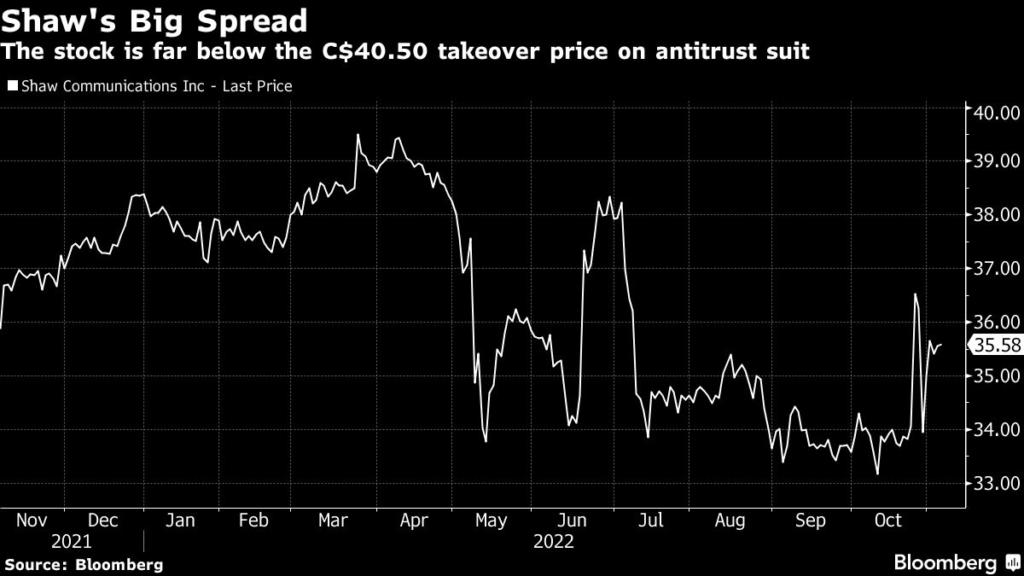
(Bloomberg) — One of the biggest corporate mergers in Canada’s history is about to face its hardest test, as antitrust lawyers square off in court to decide the fate of a deal between two billionaire cable families. 

It’s been a long haul for the Rogers family and Rogers Communications Inc. since they announced a takeover offer for Shaw Communications Inc. in March 2021. Executives from both companies confidently predicted they could steer the C$20 billion ($14.8 billion) transaction through regulators in a little more than a year.

They didn’t account for the doggedness of Matthew Boswell, Canada’s competition commissioner, who in May sued to block the deal, arguing it would make Rogers too powerful in the wireless industry. Several weeks later, the companies announced the sale of most of Shaw’s wireless business to Quebecor Inc. 

But Boswell kept going. His office argues that even the divestiture of billions of dollars in Shaw assets isn’t enough to solve the inherent problem with the larger deal: it’s going to weaken the choices for Canadian consumers, potentially driving up costs for data connections just as 5G service is rolled out.

Hearings begin Monday at Canada’s Competition Tribunal, a body overseen by federal court judges that handles cases involving mergers and antitrust disputes. Boswell is seeking nothing less than to stop the deal entirely. 

But the law may be on Rogers’s side. 

The companies say Boswell’s application to halt the transaction is excessive, given that they’ve already made a major concession to him with the Quebecor side deal.

“What you’re witnessing is a remarkably stubborn refusal by the commissioner to recognize reality,” Kent Thomson, a lawyer for Shaw, said at a pretrial conference on Nov. 1.   

Family Ties

Rogers, Canada’s largest wireless company by number of subscribers, pursued the deal as a way to fill in gaps in its network in Western Canada and become a truly national communications company. Post-acquisition, it would have more than C$20 billion in annual revenue, the kind of scale it says it needs to make 5G network investments and compete with BCE Inc., which is Canada’s largest telecommunications firm, and Telus Corp., which has a reputation for superior customer service. 

The deal is also the realization of a family dream. Ted Rogers and JR Shaw, the companies’ late founders, were friends who sometimes did deals together, including a huge asset swap in 2000 that allowed Shaw to consolidate cable TV territories in Canada’s west in return for Rogers gaining new markets in the east. Their sons, Rogers Chairman Edward Rogers and Shaw Chief Executive Officer Bradley Shaw, have known each other since they were children. It’s long been thought the companies would eventually get together. 

Along the way, the Rogers family publicly tore itself apart in a feud over control of the board and who should be the CEO to guide the company through the Shaw acquisition. Edward Rogers fought his mother and sisters in court, prevailed, then effectively fired much of the board. The board then sacked CEO Joe Natale and hired as his replacement Tony Staffieri — a man who, just weeks earlier, had been fired as chief financial officer. 

The bizarre sequence did nothing to enhance the family’s reputation. Nor did Rogers Communications help its cause for the merger when its networks collapsed one day in July — knocking consumers offline, disrupting business payments and even forcing the postponement of a concert by The Weeknd. 

But those episodes, as embarrassing as they were, may not matter much in the Competition Tribunal case. Rogers and Shaw have some advantages in the law. 

The tribunal has a number of options. It could side with Boswell or with the companies, but the most likely outcome is a compromise that forces some changes to the deal — an “alternate remedy” in legal parlance — while still allowing it to close, according to Keldon Bester, a fellow at the Center for International Governance Innovation and a former special adviser to the Competition Bureau. 

Canada’s competition law is remedy-oriented, according to Jennifer Quaid, a law professor at the University of Ottawa. Merging companies have a powerful legal weapon in the “efficiencies defense,” which allows them to argue that the cost savings involved in a deal are so great that they outweigh the harmful impacts on competition.

“Historically, the efficiencies defense has always succeeded when it was argued,” said Quaid, though it has only been the crucial factor in a very small number of cases. 

The current law and the efficiencies defense are holdovers from the 1980s, when bigger companies were seen as better and market concentration was viewed more favorably by policymakers, said Ben Klass, an Ottawa-based researcher in telecommunications policy.

The judges’ decision in this merger may serve as a test of how the law currently applies — and could bolster Boswell’s call for a rewrite of Canada’s Competition Act to make it tougher. In fact, some believe Boswell has dug in his heels against Rogers not because he thinks he can win, but because he’s trying to make a point.

“Part of this is a gambit to demonstrate the flaws in Canada’s competition law,” Klass said. 

“If they can go to the wall to challenge this merger and lose on the efficiencies defense, strategically speaking there may be some salvage benefit to the decision. The conversation will shift away from Rogers and Shaw and toward fixing the antitrust laws in Canada.”

Quaid agrees that the case might provide “serious motivation” for reform of the law. But, she asks, “will the merger be the sacrificed for that? That’s the big question.” 

If the companies win their case and the deal passes in some form, there’s still one more hurdle. The federal government has to say yes.

Industry Minister Francois-Philippe Champagne, who’s responsible for telecom policy, appeared to signal support last month by publicly setting out the conditions under which he’d sign off on Quebecor’s purchase of Shaw’s main wireless division, known as Freedom Mobile. 

Most analysts believe he wouldn’t have done so unless he was prepared to allow Rogers and Shaw to complete the big deal their investors have been waiting for. 

More stories like this are available on bloomberg.com

©2022 Bloomberg L.P.

Ethereum Insiders to Get Fee Cuts That Others Won’t in Upgrade

(Bloomberg) — When the Ethereum blockchain undergoes its next major upgrade, some key participants will likely see fees decline while they’ll remain the same for other users of the most commercially important cryptocurrency network.

The so-called Shanghai software update projected for next year is expected to give users who pledge, or stake, the network’s native Ether cryptocurrency the ability to free up their coins at some point from special digital wallets used to order transactions on the network. But a number of other small changes are being tucked in with this main one. One of them, called WARM Coinbase — which has nothing to do with crypto exchange Coinbase Global — will dramatically reduce some fees paid by major ecosystem participants called builders, who already hold a lot of sway over Ethereum.

Builders such as Flashbots and BloXroute package transactions that are sent on Ethereum into blocks, which are then relayed to validators that order them into the blockchain. Currently, Flashbots relays more than 81% of such block, according to data tracker mevboost.org. Flashbots is also the biggest builder, raising concern among some observers that it could use its power to seek out an advantage or to claim more fees.

Since September, when the new system using builders went into effect under an upgrade known as the Merge, 88% of validators have opted into working with the builders, to get extra fees from traders trying to perform a variety of lucrative strategies, according to data tracker mevboost.org. The builders get paid to package transactions in a certain order, which might allow a trader to, for example, buy a coin ahead of someone else and to resell it to them for a higher price.

One of the justifications for the WARM Coinbase change is that it should help improve economics of the builders’ business. After it’s implemented, some fees builders pay to the network could become 26 times lower, said Matt Nelson, a product manager at ConsenSys, an Ethereum infrastructure provider. 

Certain users like builders need to access a special blockchain software dubbed coinbase that’s used to receive new tokens on the network and is basically a connection to validators. Every such transaction may need to interact with the coinbase multiple times. The first time it accesses the coinbase, it costs more to “warm” the coinbase up, hence the name. Once it’s warmed up, it costs less to access it thereafter in memory. With this change, coinbase starts off warm, and is loaded into memory for a much lower so-called gas fee up front.

“Transactions who did this will save a bit of gas, but it’s a marginal saving,” said Tim Beiko, who coordinates Ethereum developers. “The main reason to do it is that it was an oversight to not consider the coinbase address ‘warm’” when Ethereum implemented another update months ago.

That could mean major savings for the traders using builders. William Morriss, who proposed the WARM Coinbase change and owns a trading company that uses builders, said the change would mean that he won’t then have to pay network fees for transactions that don’t succeed, for whatever reason. While the fees can be small, they do add up.

“You only pay a network fee if your transaction succeeds,” Morriss said. “This is what everyone should prefer.” Another trader who executes complex trades using builders, Nathan Worsley, said high-volume traders may be able to save “100K or more” a year thanks to this change.

With coin prices having dropped in the current bear market, traders are increasingly focusing on more ambitious and complex trades that builders can help with to make a buck.

Flashbots didn’t return a request for comment. The value of the change “would mostly (probably 90%) go to the validators,” said Uri Klarman, chief executive officer of BloXroute.

Many industry insiders believe the change simply makes sense, and should have been implemented months ago.

“The view is this operation is overpriced,” Nelson said.

More stories like this are available on bloomberg.com

©2022 Bloomberg L.P.
Ukraine Latest: Missile Damages Kakhovka Dam, Russian Media Says

(Bloomberg) —

Ukraine struck the Kakhovka dam north of Kherson with a missile on Sunday, Russian news agencies reported, citing local officials. There was no comment on the reports from Ukraine. Kyiv for weeks has accused Russian forces of preparing to blow up the dam to slow a Ukrainian counteroffensive in the Kherson region. 

The Biden administration is privately suggesting Ukraine’s president indicate an openness to talks with Russia as a way to help Volodymyr Zelenskiy’s government address war support fatigue among some allies, the Washington Post reported, citing people familiar with the effort.  

Officials have begun planning for a potential total evacuation of Kyiv if electrical supplies are cut, the New York Times reported. For now, Ukraine’s grid operator said it was limiting power supplies to the capital and seven northern and central regions because of damage from ongoing Russian bombardment of electrical infrastructure. 

(See RSAN on the Bloomberg Terminal for the Russian Sanctions Dashboard.)

Key Developments

  • US Announces $400 Million in Tanks and Missiles for Ukraine 
  • The Latest Russia Oil Mystery: Vostok Sale Announced Then Denied
  • US National Security Adviser Visits Kyiv in Show of Support
  • Sweden to Dissociate From Kurdish Groups in NATO Bid, SVT Says

On the Ground

Russian forces continued to set up defensive positions along the left bank of the Dnipro River, according to the Institute for the Study of War, as the situation in Kherson remains in the balance. Kyiv’s troops continue to target Russian logistics and transportation equipment in the Kherson region. Ukraine’s southern operational command said Russian forces have destroyed dozens of civilian watercraft as part of their retreat. Separately, Russian occupying forces continue to forcibly evacuate the population from the temporarily occupied territories of the Kherson region to Crimea and beyond, Ukrainian officials said. Russian media reported ten towns and villages in the Kherson region, including Kherson itself, were left without electricity after “sabotage.” 

(All times CET) 

No Grounds for Evacuation, Kyiv’s Mayoral Office Says (3 p.m.) 

The situation in Kyiv is under control, the mayoral office said on its website, hours after a New York Times report that contingency plans are being made for a possible mass evacuation if power fails completely following recent repeated Russian missile strikes on key infrastructure. 

“There are no grounds to talk about evacuation now,” said Roman Tkachuk, Kyiv’s municipal security chief. “Yes, we work on different plans, we train people to act and be prepared. It is important to avoid chaos and minimize risks for people.” 

Zelenskiy, EC’s Von Der Leyen Speak on Financial Support (2:46 p.m.)

European Commission President Ursula von der Leyen spoke on Sunday with Volodymyr Zelenskiy, focused on ensuring financial support for Ukraine in the months ahead, on the Black Sea grain initiative, and on sanctions. 

Von der Leyen said she would propose an EU financial package this week of up to EU1.5 billion a month, totaling up to EU18 billion, to help cover Ukraine’s financing needs for 2023, according to a readout. 

The support in the form of highly concessional long-term loans, with coverage of the interest costs, would also work to support Ukraine’s reforms and its path towards EU membership, according to the readout. 

Kakhovka Dam Above Kherson Hit by Ukraine, Russian Media Says (12:30 p.m.)

The Kakhovka dam on the Dnipro River was hit Sunday by a Ukrainian strike from US-donated HIMARS rockets, according to Russia’s the state-run Tass news agency. The damage was termed non-critical. 

There was no comment from Ukraine on the claim, which couldn’t be verified. 

Ukraine’s president has accused Russian forces, which captured the Kakhovka hydroelectric plant in February, of mining the dam and preparing to blow it up to create catastrophic flooding and slow down a Ukrainian counteroffensive. 

Ukraine’s Environmental Losses Estimated at $37 Billion so Far (12 p.m.)

“Even this insane amount does not reflect the real picture,” the Accounting Chamber, an audit body of the Ukrainian parliament, said on Facebook as it estimated environmental losses at 1.35 trillion hryvnia ($37 billion).

The amount of harmful emissions from forest fires, fuel burning and blazes at at industrial companies has exceeded 67 million tons this year, compared with annual 2.2 million tons in two previous years, the chamber said. 

The total of 3 million hectares or one third of Ukraine’s total forested areas have been effected, and losses were termed irreversible. in some cases. about one third of Ukrainian territory requires mine clearing, which may take at least ten years. 

Kyiv Mayor Urges Residents to Stock Up on Essentials (11 a.m.)

Speaking on television Saturday night, Kyiv Mayor Vitali Klitschko said he was “asking everyone to stock up on drinking water, technical water, power banks, food, warm clothes,” and that the city is “making calculations for different scenarios.”  

The former heavyweight boxing champion spoke as the New York Times reported that Ukraine’s capital is planning for a potential total evacuation if power and water supplies are cut off. 

“I am asking people to prepare for a bad scenario in case of total cut off of water and power supply,” he said, adding that Russia, through its ongoing airstrikes on key infrastructure, is “doing everything to deprive the city of electricity and water.” 

Ukraine Deputy PM Vows to ‘Keep Fighting’ (8:41 a.m.)

Ukraine’s deputy prime minister told an Italian newspaper that “there is no peace because Russians do not want it,” and that if Europe should “betray”its support for Ukraine, the entire Western world would be at risk.

“The only way to reach peace in this phase is to keep fighting,” Iryna Vereshchuk told Corriere della Sera in an interview published on Sunday. “If we stop fighting, we will disappear as people and as a nation.”

Her comments came as the Washington Post reported the US is privately pressing Kyiv to show an openness to talks with Russia as “war fatigue” sets in among some allies.

Kyiv Considers Total Evacuation If It Loses Electricity: NYT (8 a.m.)

Officials in Ukraine’s capital have begun planning for a possible complete evacuation of its 3 million remaining residents if it loses electricity supplies, blackout that would require the New York Times reported. 

For now, rolling blackouts continue in Kyiv and in seven other regions in a bid to keep the electricity grid somewhat stable.  

US Seeks Ukraine Signal on Negotiations: Washington Post (11:40 p.m.)

The Biden administration is prodding Ukrainian leaders to signal openness to negotiations with Russia as a way to help the government in Kyiv address war support fatigue among some of its allies, the Washington Post reported, citing people familiar with the discussions.

The people described it as a calculated attempt to maintain international support for Ukraine’s war effort, rather than pressure for Ukraine to negotiate, according to the Post.

One official told the newspaper that “Ukraine fatigue is a real thing” for some allies. 

Ukraine to Boost Maritime Drone Power, Zelenskiy Says (6:45 p.m.)

Ukraine’s government is seeking to replenish its maritime drone fleet to boost its defenses in the Black Sea, President Volodymyr Zelenskiy said, a week after a drone strike on Russia’s new Black Sea fleet, possibly including the frigate Admiral Makarov.

“Next week, we will launch another fund-raising direction — we will raise funds for a fleet of marine drones,” Zelenskiy said in his nightly video address. He didn’t elaborate on the proposed source of funding. 

Addressing the Iranian foreign minister’s earlier comment that Tehran “gave a limited number of drones to Russia months before” the war, Zelenskiy said Ukraine shoots down “at least 10 Iranian drones every day.”  

US Envoy Says Iran’s Drone Account ‘Not True’ (6:09 p.m.)

Robert Malley, the US special envoy for Iran, said an Iranian claim that its drones were provided to Russia before the war in Ukraine began is false.

Iran Says It Sent Drones to Russia ‘Before the War’ (9 a.m.)

Iran’s foreign minister said his country had sent drones to Russia before Moscow’s invasion in February. “We gave a limited number of drones to Russia months before the Ukraine war,” Hossein Amirabdollahian told reporters in Tehran, according to the Associated Press. 

Iran has previous denied sending arms to Russia for its war on Ukraine. Kremlin troops have used Iranian loitering drones to strike Ukrainian energy facilities and other targets for several weeks. 

On Twitter, Iran’s government said it was “completely wrong” to claim Iran has provided missiles to Russia. Iranian intelligence has indicated that Russian forces may already have received ballistic missiles from Tehran. 


More stories like this are available on bloomberg.com

©2022 Bloomberg L.P.

Vivendi Open to Talks With Italy on Plan for Single Network

(Bloomberg) —

Vivendi SE is open to discussions with the Italian government on a plan to create a single land-line phone network that would include the grid of Telecom Italia SpA, where Vivendi is the biggest shareholder, according to people familiar with the French company’s plans.

On Saturday Alessio Butti, a government undersecretary for technological innovation, said the plan for the network, which would be controlled by the state, is “a priority,” for the new government, news agency Ansa reported.

Italy Says State-Controlled Phone Network ‘a Priority:’ Ansa

Last month Italian Prime Minister Giorgia Meloni said she plans to broaden state powers over telecommunications network assets deemed to be of national interest as her right-wing government looks to assert “technological sovereignty” in the interest of cybersecurity.

Butti said he would contact all stakeholders, beginning with state lender Cassa Depositi e Prestiti SpA, the Italian carrier’s second-largest shareholder, and then approach Telecom Italia and other operators.

The Italian government’s approach is acceptable to Vivendi, which is willing to find a solution in a short time, the people said.


More stories like this are available on bloomberg.com

©2022 Bloomberg L.P.

Ukraine Latest: Kyiv Total Evacuation Plan; US Presses Zelenskiy

(Bloomberg) —

The Biden administration is privately suggesting Ukraine’s president indicate an openness to talks with Russia as a way to help Volodymyr Zelenskiy’s government address war support fatigue among some allies, the Washington Post reported, citing people familiar with the effort.  

Officials have begun planning for a potential total evacuation of Kyiv if electrical supplies are cut, the New York Times reported. For now, Ukraine’s grid operator said it was limiting power supplies to the capital and seven northern and central regions because of damage from ongoing Russian bombardment of electrical infrastructure. 

A US envoy called Iran’s statement that it provided drones to Russia months before the invasion of Ukraine “not true,” saying the Tehran government transferred dozens “just this summer.” That followed Iran’s first acknowledgment of any sort that it had supplied Russia with drones.   

(See RSAN on the Bloomberg Terminal for the Russian Sanctions Dashboard.)

Key Developments

  • US Announces $400 Million in Tanks and Missiles for Ukraine 
  • The Latest Russia Oil Mystery: Vostok Sale Announced Then Denied
  • US National Security Adviser Visits Kyiv in Show of Support
  • Sweden to Dissociate From Kurdish Groups in NATO Bid, SVT Says

On the Ground

Russia launched another four missile and five other air strikes against Ukraine on Saturday, Kyiv-based military staff said without providing more detail. Shelling was reported in the Kharkiv, Donetsk, Zaporizhzhia, Kherson and Mykolaiv regions. Russian forces continued to set up defensive positions along the left bank of the Dnipro River, according to the Institute for the Study of War, as the situation in Kherson remains in the balance. Kyiv’s troops continue to target Russian logistics and transportation equipment in the Kherson region. Ukraine’s southern operational command said Russian forces have destroyed dozens of civilian watercraft as part of their retreat. Separately, Russian occupying forces continue to forcibly evacuate the population from the temporarily occupied territories of the Kherson region to Crimea and beyond, Ukrainian officials said. 

(All times CET) 

Ukraine Deputy PM Vows to ‘Keep Fighting’ (8:41 a.m.)

Ukraine’s deputy prime minister told an Italian newspaper that “there is no peace because Russians do not want it,” and that if Europe should “betray”its support for Ukraine, the entire Western world would be at risk.

“The only way to reach peace in this phase is to keep fighting,” Iryna Vereshchuk told Corriere della Sera in an interview published on Sunday. “If we stop fighting, we will disappear as people and as a nation.”

Her comments came as the Washington Post reported the US is privately pressing Kyiv to show an openness to talks with Russia as “war fatigue” sets in among some allies.

Kyiv Considers Total Evacuation If It Loses Electricity: NYT (8 a.m.)

Officials in Ukraine’s capital have begun planning for a possible complete evacuation of its 3 million remaining residents if it loses electricity supplies, blackout that would require the New York Times reported. 

Municipal workers are setting up 1,000 heating shelters that can double as bunkers while engineers try to fix bombed-out power stations without the needed equipment, according to the newspaper. 

For now, rolling blackouts continue in Kyiv and in seven other regions in a bid to keep the electricity grid somewhat stable. 

US Seeks Ukraine Signal on Negotiations: Washington Post (11:40 p.m.)

The Biden administration is prodding Ukrainian leaders to signal openness to negotiations with Russia as a way to help the government in Kyiv address war support fatigue among some of its allies, the Washington Post reported, citing people familiar with the discussions.

The people described it as a calculated attempt to maintain international support for Ukraine’s war effort, rather than pressure for Ukraine to negotiate, according to the Post.

One official told the newspaper that “Ukraine fatigue is a real thing” for some allies. 

Ukraine to Boost Maritime Drone Power, Zelenskiy Says (6:45 p.m.)

Ukraine’s government is seeking to replenish its maritime drone fleet to boost its defenses in the Black Sea, President Volodymyr Zelenskiy said, a week after a drone strike on Russia’s new Black Sea fleet, possibly including the frigate Admiral Makarov.

“Next week, we will launch another fund-raising direction — we will raise funds for a fleet of marine drones,” Zelenskiy said in his nightly video address. He didn’t elaborate on the proposed source of funding. 

Addressing the Iranian foreign minister’s earlier comment that Tehran “gave a limited number of drones to Russia months before” the war, Zelenskiy said Ukraine shoots down “at least 10 Iranian drones every day.”  

US Envoy Says Iran’s Drone Account ‘Not True’ (6:09 p.m.)

Robert Malley, the US special envoy for Iran, said an Iranian claim that its drones were provided to Russia before the war in Ukraine began is false.

Anti-War March in Rome Draws Tens of Thousands (5 p.m.)

Tens of thousands marched through Rome on Saturday calling for efforts toward a negotiated settlement in Ukraine and urging Italy, a NATO member, to stop providing military aid to Kyiv to fight Russia’s invasion. “No to war. No to sending weapons,” read a large banner carried by protesters. 

Police estimated attendance at about 30,000; organizers claimed 100,000.  Italy’s government, led by right-wing Prime Minister Giorgia Meloni, is being watched for any change in policy toward the war in Ukraine.  

Marchers included former Prime Minister Giuseppe Conte, who heads the Five Star party. The event had the support from unions, some churches and Rome political figures. A smaller, competing rally in support of Ukraine was held in Milan.

Iran Must Realize ‘Consequences of Complicity,’ Ukraine Says (4 p.m.)

Iran “should realize that the consequences of complicity in crimes of Russia’s aggression against Ukraine will very much offset the benefit from support of Russia,” a Ukrainian foreign ministry spokesman said. 

Oleg Nikolenko commented on Facebook after Iran said it had provided drones to Russia, reversing earlier denials.

Iran’s foreign minister said Tehran gave Russia a limited number of drones, months before Moscow’s invasion of Ukraine. Western estimates suggest a large number of the weapons have been provided, including during the course of the conflict, now into its ninth month. 

Iran Says It Sent Drones to Russia ‘Before the War’ (9 a.m.)

Iran’s foreign minister said his country had sent drones to Russia before Moscow’s invasion in February. “We gave a limited number of drones to Russia months before the Ukraine war,” Hossein Amirabdollahian told reporters in Tehran, according to the Associated Press. 

Iran has previous denied sending arms to Russia for its war on Ukraine. Kremlin troops have used Iranian loitering drones to strike Ukrainian energy facilities and other targets for several weeks. 

On Twitter, Iran’s government said it was “completely wrong” to claim Iran has provided missiles to Russia. Iranian intelligence has indicated that Russian forces may already have received ballistic missiles from Tehran. 

Kyiv, Several Other Regions Face Continued Electricity Cutoffs (8 a.m.)

Ukraine’s power grid will limit power supplies on Saturday to consumers in the capital, Kyiv, and in seven northern and central regions, said Ukrenergo, the main grid operator. 

Irregular blackouts are likely during the day given higher electricity usage on Saturdays than during the workweek. 

The nation continues to struggle to fix severe damage to electrical generating equipment from weeks of Russian missile and drone attacks. 


More stories like this are available on bloomberg.com

©2022 Bloomberg L.P.

Methane Clouds Spotted in China by High-Resolution Satellite

(Bloomberg) — A high-resolution satellite image taken less than 48 hours ago appears to show methane releases from China’s largest oilfield. The image is the first in a series of exclusive observations Bloomberg Green will publish during COP27 from emissions monitoring firm GHGSat Inc. 

The detection highlights the rapidly expanding ability of satellites to identify and track methane almost anywhere in the world that is driving a new era of climate transparency in which greenhouse gases will be quantified and attributed in near real-time to individual assets and companies. Scientists say reducing the emissions of the potent greenhouse gas, which has 84 times the warming power of carbon dioxide during its first two decades in the atmosphere, is one of the fastest and cheapest ways to cool the planet. 

Methane is the primary component of natural gas and responsible for about 30% of the Earth’s warming. Leaks can occur during extraction and transport of the fossil fuel, but methane is also routinely generated as a byproduct of oil and coal production and if operators don’t have infrastructure to get the gas to market they may release it into the atmosphere. The International Energy Agency has called for oil and gas operators to halt all non-emergency methane venting. 

The satellite image taken at 1:15 pm Beijing time on Nov. 4 and shows six methane releases in northeast China from the Daqing oilfield, according to GHGSat. Estimated emissions rates ranged between 446 and 884 kilograms per hour and the cumulative rate was 4,477 kilograms an hour, the Montreal-based company said. If the releases lasted for an hour at that rate they would have the same short-term climate impact as the annual emissions from about 81 US cars.

Read more of Bloomberg Green’s coverage of COP27

PetroChina, which operates the Daqing oil field, didn’t immediately respond to an email seeking comment on Sunday outside of regular business hours. China’s Ministry of Ecology and Environment didn’t immediately respond to a faxed request for comment on Sunday.

China is the world’s largest source of energy-related methane emissions with an estimated 28 million metric tons last year, according to the International Energy Agency’s Methane Tracker. Russia was second and the US third with 18 million and 17 million tons respectively. 

China is the world’s largest coal miner, the fourth-biggest producer of natural gas and ranks sixth in terms of crude output. The country has so far declined to join the Global Methane Pledge, a US- and EU-led initiative that aims to cut emissions of the potent greenhouse gas 30% by the end of this decade from 2020 levels. More than 120 countries have so far joined the effort. 

More companies and institutions are launching multi-spectral satellites that can detect methane’s unique signature. GHGSat has six satellites in orbit now dedicated to monitoring industrial methane and aims to launch another five by the end of next year. US non-profit Environmental Defense Fund plans to launch its MethaneSAT in 2023 and a consortium including Carbon Mapper, the State of California, NASA’s Jet Propulsion Laboratory and Planet Labs expects to launch two satellites next year.  

Around 40% of total methane emissions generated from human activity come from the energy sector and more than 40% of oil and gas emissions could be reduced at no net cost using existing technologies, according to the IEA. That’s because the captured gas can be sold as a product and combusted for energy or heating. Methane is the primary component of natural gas.

Concentrations of methane in the atmosphere had the biggest year-on-year jump since measurements began four decades ago, according to the World Meteorological Organization. 

–With assistance from Luz Ding and Dan Murtaugh.

More stories like this are available on bloomberg.com

©2022 Bloomberg L.P.

Close Bitnami banner
Bitnami