Bloomberg

Booking Holdings’ Results Top Estimates After Summer Travel Boom

(Bloomberg) — Booking Holdings Inc. provided an upbeat forecast on the current quarter, saying that room nights booked in October were roughly 12% higher than 2019 levels, alleviating concerns after room night growth slowed in July. 

Chief Executive Officer Glenn Fogel said that room night growth also improved by 10% over 2019 levels in August and September, adding that consumers have been able to stomach higher average daily rates at hotels. 

“We’re seeing people who want to travel, who have a significant amount of savings,” Fogel said on a call with analysts Wednesday. “Some are even traveling longer and enjoying it regardless of what the economic situation is.” 

The Norwalk, Connecticut-based company is forecasting more than $1.1 billion in adjusted earnings before interest, taxes, depreciation and amortization in the fourth quarter, lower than the average analysts’ of $1.22 billion. Shares rose by 5.2% in after hours trading, paring some gains. 

The largest US online travel company has rebounded from an early pandemic slump and had been anticipating one of the strongest summer seasons ever with the end of Covid-19 restrictions around much of the world. But rising inflation and a strong dollar have injected some doubt into the outlook for the rest of the year. On Tuesday, Airbnb Inc. said it expected nights and experiences booked to “moderate slightly” in the current period. 

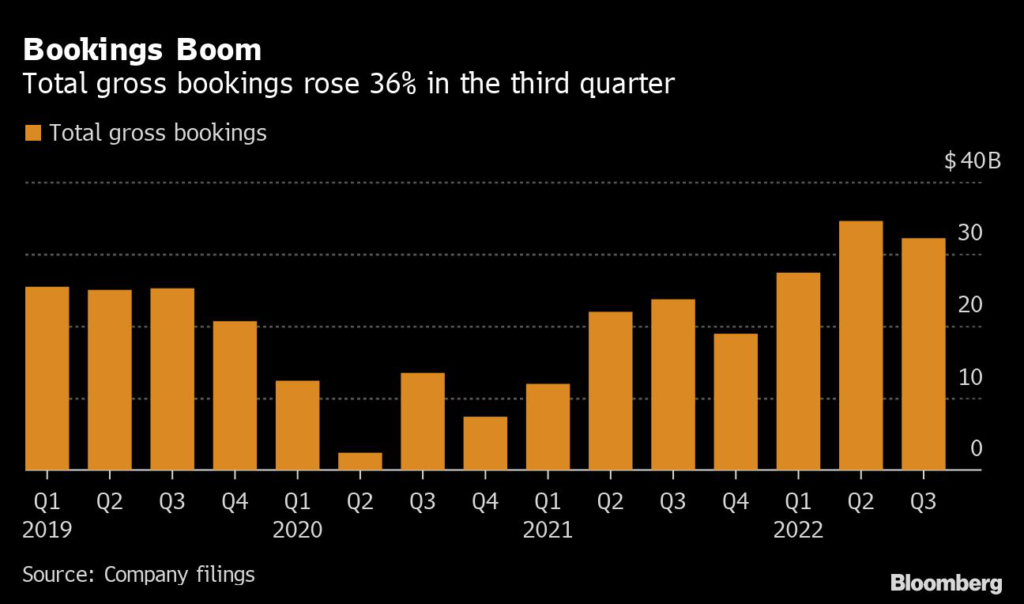
Gross bookings, which include all travel services booked by customers net of cancellations, jumped 36% to $32.12 billion in the third quarter. Analysts had forecast $30.74 billion. Revenue was $6.1 billion, a quarterly record and up 29% from last year. Room nights booked, which reflects the largest category of travel services at Booking, rose 32% to 240 million. Analysts had forecast 236.9 million. Adjusted net income gained 26% to $2.7 billion, or $53.03 a share. Analysts had projected $49.62 per share.

Booking operates across six sites, giving it a comprehensive view of the global travel market. Its namesake brand offers online reservation services at hotels, resorts and apartments around the world in addition to a growing alternative accommodations platform to rival Airbnb and Expedia Group Inc.’s Vrbo. The parent company also owns Priceline, which provides discount bookings for hotels, cruises, cars and vacation packages. Other brands include flight aggregator Kayak and restaurant reservation portal OpenTable. The company earns about 85% of its revenue from international markets, making it particularly vulnerable to fluctuations in currencies.


Even with record revenue across the travel industry, investors have punished travel companies, sending shares of Booking down 26% this year. The company has fared better than its rivals Airbnb and Expedia, which have declined 43% and 50% so far this year, respectively. 

(Adds updates from analyst call throughout.)

More stories like this are available on bloomberg.com

©2022 Bloomberg L.P.

S&P 500 Suffers Worst ‘Fed Day’ Since January 2021: Markets Wrap

(Bloomberg) — Stocks sold off as Jerome Powell continued to sound unequivocally hawkish as the Federal Reserve pushed ahead with its most-aggressive tightening campaign since the 1980s to thwart inflation.

The S&P 500 suffered its worst rout on a Fed decision day since January 2021. Stocks came decidedly lower after Powell said the Fed still has “some ways to go” in its policy cycle, adding that it’s premature to think about a pause as rates could peak at higher levels than previously thought. The move wiped out an earlier rally driven by his remarks that a slower pace of hikes could come as soon as December.

“It’s as if investors came to a haunted house and got candy, but once they unwrapped it, saw it was soggy broccoli,” said Max Gokhman, chief investment officer at AlphaTrAI.

The hint of a potential downshift in tightening saw estimates for the Fed peak in policy rates for 2023 briefly drop below 5% right after the announcement. But by the end of the session, forecasts extended to a new cycle high of around 5.1% for the May meeting.

Megacap tech bore the brunt of the selling, with giants like Apple Inc. and Tesla Inc. tumbling more than 3.5%. In late trading, Qualcomm Inc., the biggest maker of smartphone processors, slumped on a weak forecast. Two-year US yields — which are more sensitive to imminent Fed moves — reversed course and pushed higher. The dollar gained.

“When Powell made his comments regarding nothing pivot-related, or no shot of that, I think that was the ‘dagger’ for the market,” said Alon Rosin, head of institutional equity derivatives at Oppenheimer & Co.

The Federal Open Market Committee said that “ongoing increases” will still likely be needed to bring rates to a level that’s “sufficiently restrictive to return inflation to 2% over time,” in fresh language added to the statement. Officials unanimously decided to lift the target for the benchmark rate by another 75 basis points to a range of 3.75% to 4%, its highest level since 2008.

Comments:

Ronald Temple, head of US equity at Lazard Asset Management:

“This is not an environment in which the Fed will pivot or signal a pivot. To do so would be malpractice, and the Fed knows that.”

Ian Lyngen and Ben Jeffery, strategists at BMO Capital Markets:

“One thing is obvious from the Fed’s tone; ‘Santa Pause’ ain’t coming to town.”

Edward Moya, senior market analyst at Oanda:

“Stocks might struggle here as the risks of the Fed taking rates above 5.00% are clearly still on the table.” 

Sam Stovall, chief investment strategist at CFRA:

“Data will largely determine the policy path going forward. Our best guess is that the Fed continues to take the more hawkish path.”

Quincy Krosby, chief global strategist at LPL Financial:

“Factoring in the bond market’s assessment, markets are becoming increasingly convinced that the path towards the terminal rate will include a recession.”

Christopher Harvey, equity analyst at Wells Fargo Securities:

 “The major message during the press conference was that rates needed to go (and stay) higher for longer than many expected.”

Data Wednesday showed hiring at US companies rose in October by more than forecast, underscoring resilient labor demand despite the Fed’s efforts to cool the economy. A strong job market has fueled fast wage growth, contributing to rapid inflation and putting pressure on the Fed to aggressively tighten monetary policy.

The Treasury halted the longest string of cutbacks to its quarterly sales of longer-term debt in about eight years, showcasing the end of a period of historic reduction in the fiscal deficit.

In corporate news, Boeing Co.’s chief said the planemaker could generate $10 billion in cash annually by mid-decade, once it turns around its operations after years of setbacks and miscues. China has ordered a seven-day lockdown of the area around Foxconn Technology Group’s main plant in Zhengzhou, a move that will severely curtail shipments in and out of the world’s largest iPhone factory.

Key events this week:

  • Bank of England rate decision, Thursday
  • US factory orders, durable goods, trade, initial jobless claims, ISM services index, Thursday
  • ECB President Christine Lagarde speaks, Thursday
  • US nonfarm payrolls, unemployment, Friday

Some of the main moves in markets:

Stocks

  • The S&P 500 fell 2.5% as of 4 p.m. New York time
  • The Nasdaq 100 fell 3.4%
  • The Dow Jones Industrial Average fell 1.6%
  • The MSCI World index fell 1.7%

Currencies

  • The Bloomberg Dollar Spot Index rose 0.3%
  • The euro fell 0.5% to $0.9830
  • The British pound fell 0.8% to $1.1395
  • The Japanese yen rose 0.3% to 147.77 per dollar

Cryptocurrencies

  • Bitcoin fell 1.1% to $20,245.42
  • Ether fell 2.5% to $1,536.43

Bonds

  • The yield on 10-year Treasuries advanced four basis points to 4.08%
  • Germany’s 10-year yield advanced one basis point to 2.14%
  • Britain’s 10-year yield declined seven basis points to 3.40%

Commodities

  • West Texas Intermediate crude rose 1% to $89.23 a barrel
  • Gold futures fell 0.6% to $1,640 an ounce

–With assistance from Lu Wang, Vildana Hajric, Emily Graffeo and Michael MacKenzie.

More stories like this are available on bloomberg.com

©2022 Bloomberg L.P.

Robinhood’s Results Are Latest to Fall Victim to Crypto Winter

(Bloomberg) — The steep market downturn for digital assets continues to weigh on a score of companies with exposure to crypto. 

Robinhood Markets Inc. reported Wednesday that its crypto transaction revenue fell to $51 million during the third quarter, a 12% decline compared to the previous quarter and below analysts’ estimates of $56.1 million. The trading platform, which went public in July 2021, said it had an overall net loss of $175 million, or about 20 cents a share. 

Other companies have also suffered amid a sharp drop in crypto prices, as the industry continues to be battered by the collapse of major blockchain platforms, scams and layoffs. MicroStrategy Inc., the world’s largest publicly traded corporate owner of Bitcoin, posted a third-quarter loss on Tuesday and said it had a $727,000 impairment charge on its Bitcoin holdings. 

Robinhood previously benefited from last year’s meme stock craze as well as rising interest in cryptocurrencies, as retail investors used the platform to purchase faddish tokens like Dogecoin. After seeing strong demand from customers for a crypto wallet, the company released a beta version of the product in September and added new digital coins for users to buy.  

More stories like this are available on bloomberg.com

©2022 Bloomberg L.P.

Google, IBM, Wells Fargo Join Growing List of Companies Posting Pay for All US Jobs

(Bloomberg) — Alphabet Inc.’s Google, International Business Machines Corp. and Wells Fargo & Co. joined a growing group of companies listing pay ranges on all their US job postings — not just where it’s required by law. 

Alphabet and IBM confirmed to Bloomberg News that starting Nov. 1 salaries will appear in postings for all open roles across the country.

“IBM recognizes the value and importance of wage transparency and, beginning November 1, 2022, will include pay ranges for all new US job postings,” Jessica Chen, a spokesperson for IBM, said in an email. 

Wells Fargo says it’s working on implementation, but some job postings already have pay information listed for various US cities. “This approach is aligned with company expectations to do what’s right,” said Natasha Webster, a spokesperson for Wells Fargo. 

Only New York City and Colorado currently require pay ranges to be listed on job ads. With regulation slated to take effect in California and Washington state next year — and New York state potentially to follow — more companies have been motivated to adopt the salary range practice on listings nationwide. 

On Monday, American Express Co. confirmed a similar move the day before New York City’s requirement for employers with four or more workers in the city went into effect. Citigroup Inc. is already posting salary ranges with job listings. And Washington-based Microsoft Corp. will adopt the practice in 2023, it said earlier this year. 

Surveys have found that a majority of employers are considering the same as more states adopt similar laws — and as workers demand more transparency on compensation. 

Still, a glitchy start to the New York City law showed that many companies are resistant to the idea, or at the very least weren’t ready to disclose pay for even just city-based roles. Some companies took all their New York postings down and others had no compensation listed at all, as of Tuesday. 

US cities and states have adopted various wage transparency laws in a bid to close the gender and racial wage gaps. In theory, having the information out there levels the playing field. New York City’s law, however, only requires “good faith” ranges for jobs and does not include benefits or bonuses, which in fields like finance can make up the bulk of someone’s compensation. 

More stories like this are available on bloomberg.com

©2022 Bloomberg L.P.

Robinhood Revenue Beats Estimates as User Activity Stabilizes

(Bloomberg) — Robinhood Markets Inc. posted third-quarter revenue that beat analysts’ estimates as transactions rebounded slightly.

Revenue totaled $361 million, exceeding the $357.8 million average estimate of analysts surveyed by Bloomberg. Net loss was $175 million, or 20 cents a share, the Menlo Park, California-based company said Wednesday in a statement. 

Shares of Robinhood rose 4% to $11.86 in extended trading at 4:46 p.m. in New York. The stock had lost 36% this year through the close of regular trading and 70% since its July 2021 initial public offering.

Because Robinhood still relies on user transactions for most of its revenue, a decline in trading activity has been bruising the business. The company pivoted in its strategy, cutting costs by slashing jobs and closing offices while introducing features geared toward the most-active users of its trading app.

Read more: Robinhood Slashes 23% of Its Workforce in Sweeping Overhaul

Despite those efforts, customer enthusiasm is waning. Monthly active users fell to 12.2 million at the end of September, an 8% slide from the previous month.

The latest quarter “continued to be a difficult trading environment for customers, but we’re encouraged to see customers continuing to contribute billions of dollars to their accounts,” Chief Financial Officer Jason Warnick said in a conference call with journalists.

Robinhood’s third-quarter transaction revenue totaled $208 million, fueled by increases in options and equities trading compared with the previous three-month period. Cryptocurrency transaction revenue, however, slid 12% from the second quarter.

(Updates with monthly active users in fifth paragraph, CFO comment in sixth.)

More stories like this are available on bloomberg.com

©2022 Bloomberg L.P.

DuPont-Rogers Merger Failure Puts Focus on Deals Needing China’s Approval

(Bloomberg) — Takeover targets awaiting approval from Chinese regulators slumped after DuPont de Nemours Inc. scuttled its planned acquisition of Rogers Corp. due to a drawn-out antitrust review.

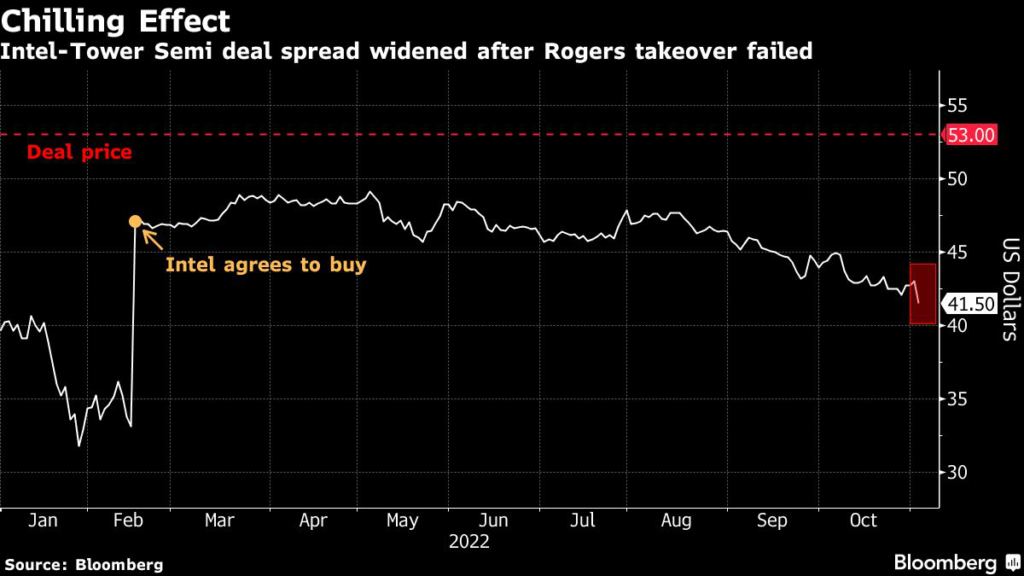
Tower Semiconductor Ltd. and Silicon Motion Technology Corp., both of which have agreed to be bought out, saw their deal spreads widen Wednesday as traders dropped the stocks. Shares of Israeli chipmaker Tower fell as much as 4.7%, the most since January, sinking 23% below Intel Corp.’s offer price. Silicon Motion, which agreed to be bought by MaxLinear Inc., slid as much as 4.2% before reversing amid earnings results.

DuPont called off its proposed $5.2 billion deal with Rogers late Tuesday, saying it was “unable to get timely clearance” from required regulators. The company previously identified China’s State Administration for Market Regulation, SAMR, as the last remaining hurdle. 

The move was a surprise to a number of merger arbitrage specialists. While the deal had hit its so-called walk date, the companies could have extended the deadline. Traders who bet on the transaction closing got burned by Rogers’s record 46% drop on Wednesday.

“Many had hoped for an extension or a price cut with DuPont having just completed its divestiture to Celanese, leaving a buyer with a lot of cash on its balance sheet,” said Cabot Henderson, a merger specialist at JonesTrading. 

It isn’t unusual for China’s merger reviews of foreign companies to drag on. In 2018, US-based Qualcomm Inc. scrapped a $44 billion bid for Dutch chipmaker NXP Semiconductors NV after SAMR failed to approve the megadeal. 

Now, mounting tensions between the US and China are adding to the concerns as the countries vie for preeminence in key technology sectors such as semiconductors, electric-vehicle batteries and artificial intelligence.

DuPont’s proposed purchase, which was announced in November 2021 amid a boom in takeovers, valued Rogers at a steep premium. Even before Tuesday’s decision, the stock was down 16% for the year and trading significantly below the offer price. Wednesday’s rout sent it plunging to a level not seen since November 2020. 

“This termination is less about SAMR blocking a deal than DuPont using the delay to get out of a deal struck in a very different environment,” JonesTrading’s Henderson said.

Representatives for DuPont and Rogers didn’t respond to requests for comment. 

Julian Klymochko, chief executive officer of Accelerate Financial Technologies, said that while the Dupont-Rogers deal was unlikely to have faced any major anticompetitive issues, in general “all deals subject to China approval face a material risk of termination.” 

DuPont shares surged as much as 9.5% Wednesday, as analysts said terminating the Rogers acquisition will bolster the company’s balance sheet and improve its ability to do share buybacks. 

Meanwhile, Silicon Motion bounced back to rise as much 8.6% after Needham & Co. upgraded the stock on its better-than-feared earnings and the upside potential of SAMR approving its deal with MaxLinear, noting the current spread is 86.6%. The stock has dropped more than 37% since the May deal announcement.

“While the process may take longer than expected, we believe chances are clearly above zero,” analyst Rajvindra Gill wrote in a note to clients.

(Updated with share prices at close of trading.)

More stories like this are available on bloomberg.com

©2022 Bloomberg L.P.

Coinbase Chief Product Officer Steps Down During Reorganization

(Bloomberg) — Coinbase Global Inc., the largest US crypto exchange, said Chief Product Officer Surojit Chatterjee agreed to step down amid a reorganization of its product, engineering and design teams.

Chatterjee’s departure will be effective Nov. 30 and he will continue to serve as an adviser through at least Feb. 3, 2023, the company said in a filing on Wednesday.  

“Coinbase is grateful for Mr. Chatterjee’s contributions throughout his employment at Coinbase, including his leadership in building Coinbase’s product organization and launching products in aim of increasing economic freedom in the world,” the firm said in a filing. 

Under Chatterjee’s tenure, Coinbase launched its NFT platform, but the long-awaited debut arrived when the NFT hype was already cooling down.

After years of aggressive expansion and hiring, Coinbase has reset its strategy in recent months to reign in costs. In May, Chatterjee told employees the firm will focus “on critical revenue-generating products” and refocus on core products while seeking improvements in developer productivity.  

Chatterjee joined Coinbase in February 2020 after three years at Alphabet Inc.’s Google, where he led the company’s shopping platform during his second stint at the search giant. 

Read More: Google Executive’s 2020 Move to Coinbase Worth $646 Million 

The crypto industry has seen a series of C-suite shuffling, restructuring and layoffs. Galaxy Digital is exploring cutting as much as 20% of jobs, while crypto conglomerate Digital Currency Group laid of 10% of staff. 

On Thursday, Coinbase is expected to report $649 million in third-quarter revenue, with retail and institutional trading revenues both shrinking, according to the average estimate of analysts surveyed by Bloomberg. That would be a 20% drop from the second quarter and at about half of the level from a year ago. Monthly transacting users is estimated to fall to 7.8 million from around 9 million. Adjusted net loss is expected to be $521 million, compared with a $1.1 billion net loss in the second quarter.

Coinbase’s stock has plummeted by 76% so far this year, more than the 56% decline in the price of Bitcoin.

More stories like this are available on bloomberg.com

©2022 Bloomberg L.P.

Ukraine Latest: Russia Agrees to Resume Grain Export Deal

(Bloomberg) — Russia resumed its participation in the Black Sea grain-export deal after Moscow said it had received written guarantees from Ukraine that the safe-passage corridor will be used only for grain exports. 

The decision was an abrupt reversal after President Vladimir Putin suspended the deal on Saturday following a strike on his naval forces off the port of Sevastopol. The United Nations coordinator for the Black Sea Grain Initiative welcomed Russia’s return and Turkish President Recep Tayyip Erdogan’s efforts to help make it happen. 

Ukrainian President Volodymyr Zelenskiy asked the European Union to help restore electricity in his country, where the energy infrastructure has been damaged by a barrage of Russian missile and drone attacks.

(See RSAN on the Bloomberg Terminal for the Russian Sanctions Dashboard.)

Key Developments

  • Ukraine’s First Lady Urges World to Resist Fatigue With the War
  • Russia Resumes Ukraine Grain-Export Deal in Abrupt Reversal
  • Russians Find Refuge From Putin in Europe’s New ‘Casablanca’
  • Conflict in Ukraine Moves Toward ‘War of Drones’ as Winter Looms
  • Europe’s Calmer Gas Markets Could Be Roiled Again by Price Cap
  • Nord Stream Operator Finds Manmade Craters at Pipe Blast Site

On the Ground

Russian forces launched seven missile strikes and 47 air attacks over the past day, while Ukrainian troops shot-down six Shahed-136 loitering drones, Ukraine’s General Staff said on Facebook. The city of Nikopol in the central Dnipropetrovsk region was shelled overnight, local authorities said on Telegram. To the east, Russia conducts offensive operations in the directions of Bakhmut, Avdiivka and Novopavlivka, and Ukrainian forces repelled assaults near 12 settlements in the Donetsk and Luhansk regions over the past 24 hours, Ukraine’s military said. 

(All times CET)


Ukraine First Lady Warns Against War Fatigue (9:40 p.m.) 

Ukraine’s first lady said her country could perish if the world gives in to fatigue with the war begun by Russia’s invasion.

“Ukrainians are ready to endure in the dark, in the cold, the most terrible things, so the tragedies we’ve seen don’t happen again,” Olena Zelenska said in an interview with Bloomberg Television on the sidelines of the annual Web Summit conference in Lisbon. Zelenska, whose country has also endured attacks by Russian hackers and assault drones, urged caution in who gets their hands on the latest in technology. 

“It can be used for murder as well as for rescue,” she said.

Erdogan Says He Discussed Grain Priorities With Putin (8:35 p.m.)

Erdogan said he discussed prioritizing grain exports to less-developed countries, including Djibouti, Somalia and Sudan, in a telephone call Tuesday with Putin.

“Let’s transfer the grain to these countries in the first phase,” he told the AHaber news channel in an interview Wednesday evening. “We spoke about this with Zelenskiy and Putin. We will widen our activities.”

Erdogan Cites Importance of Grain Shipments in Call (7:29 p.m.)

Erdogan held a phone call with his Ukrainian counterpart Zelenskiy, according to a statement from the Turkish presidency. 

Erdogan noted the importance of “the continuation of the grain shipment agreement” during the call, according to the statement, while also saying diplomatic efforts must be increased for a “fair solution to end the war.”

Nord Stream Operator Finds Man-Made Craters at Pipe Blast Site (5:24 p.m.) 

The operator of the Nord Stream pipeline said an initial survey found man-made craters on the seabed near the damaged gas link.

Nord Stream AG, led by Russian gas giant Gazprom PJSC, opened a probe in the Swedish zone of the Baltic Sea last week, following the explosions in September. The blasts damaged both lines of the idled Nord Stream and one line of the twin Nord Stream 2 pipelines that failed to start operations because of earlier sanctions. 

Ukraine Resumes Gas Drilling in Areas Retaken From Russia (4:52 p.m.) 

Ukraine’s state-run natural-gas extraction firm JSC Ukrgasvydobuvannya has regained control over drilling rigs in areas recaptured from Russia, the company said. Two have been repaired and drilling resumed in the country’s east. Rigs and drilling sites have been damaged and were subjected to looting, it said. A third rig is being repaired.  

“Drilling of new wells has the most significant and sustainable impact in terms of providing the country with its own Ukrainian gas,” the company cited acting Ukrgasvydobuvannya CEO Oleksandr Romaniuk.

Spain Sends Air-Defense Systems, Anti-Tank Rockets, to Kyiv (3:49 p.m.) 

Spain has provided an Aspide anti-aircraft missile complex, Hawk air-defense systems, anti-tank rockets, grenades and ammunition, which are on the way to Ukraine, Foreign Minister Dmytro Kuleba said at a press conference with Spanish counterpart, Jose Manuel Albares, in Kyiv. 

Spain is also sending power generators to help cover energy needs and other humanitarian aid, including ambulances, Albares said. Spanish experts will participate in an investigation into alleged Russian crimes against humanity, he said.  

US Says North Korea Covertly Sending Artillery Shells to Russia (3:40 p.m.) 

The Biden administration accused North Korea of covertly supplying Russia with artillery shells for use in the Ukraine invasion despite previous denials that it planned to do so.

North Korea has provided Russia with a “significant number of artillery shells,” National Security Council spokesman John Kirby told reporters. He said North Korea is trying to mask the shipments’ destination by making it look like they’re going to the Middle East or North Africa.

Russia Reaffirms Commitment Not to Use Nuclear Weapons (2:49 p.m.) 

Russia said it remains committed to a pledge made in January together with four other nuclear powers — China, the UK, France and the US — to avoid an atomic conflict. The nation’s doctrine is governed by the principle of “the unacceptability of nuclear war, in which there cannot be any winners,” the Foreign Ministry said in a statement.

President Putin last week dialed back his increasing escalation of nuclear threats, saying there is “no point, either military or political” in a nuclear strike on Ukraine.

Poland Begins Building Fence on Border With Russia (12:58 p.m.) 

Poland will begin the construction of a barbed-wire fence on its 210-kilometer (130-mile) border with Russia’s Baltic exclave of Kaliningrad to prevent the Kremlin from sending asylum-seekers into the country, Defense Minister Mariusz Blaszczak said.

With the airport in Kaliningrad open to flights from North Africa and the Middle East, Poland sees the risk of a migration crisis similar to what happened with Belarus last year, he told reporters in northeastern Poland, near the border with Kaliningrad. The barrier will be 2 1/2 meters tall (8 feet), with three layers of concertina wire, and work will start as early as Wednesday, according to the minister.

UK Sanctions Four Russian Steel, Petrochemical Tycoons (12:30 p.m.)

Alexander Abramov and Alexander Frolov have been targeted for their involvement in the extractive, transport and construction sectors. The business associates of Roman Abramovich previously owned major stakes in Russian steel manufacturer Evraz plc and are reported to have UK property investments worth about £100 million.

Airat Shaimiev and Albert Shigabutdinov were also sanctioned and, therefore, are subject to travel bans, asset freezes and transport sanctions. 

Since Russia’s invasion of Ukraine, the UK has sanctioned more than 1,200 people and 120 entities. The list includes more than 120 oligarchs with a net worth of more than £140 billion ($163 billion).

Estonia to Strip Gun Rights From Local Russian Nationals (12:15 p.m.)

Interior Minister Lauri Laanemets said in a statement that Estonia cannot “risk” granting gun licenses to citizens of a “hostile foreign country.” “They may feel in certain situations that they need to take up arms to defend the interests of their country of origin,” he said.

The government’s new rules would affect all non-EU and non-NATO nationals, but most of the 3,000 guns that would be taken away over the course of two years as a result are held by Russian citizens and Russian-speaking residents who have opted not to take either Russian or Estonian citizenship.

Russia Agrees to Let Grain Corridor Resume Operations (11:55 p.m.)

“The Russian Federation considers the guarantees received sufficient at the moment, and is resuming the implementation of the agreement,” the defense ministry said in a statement. It said it had received “written guarantees” from Ukraine that it would not use the humanitarian corridor for military operations.

Russia Military Leaders Discussed Using Tactical Nuclear Weapons: NYT (11:50 a.m.)

Senior Russian military leaders discussed when and how Russia might use a tactical nuclear weapon in Ukraine, though Putin wasn’t part of the conversations, the New York Times reported, citing senior US officials it didn’t identify.

Intelligence on the conversations was circulated in the US government in mid-October, the Times said, noting that officials there still have seen no evidence Russia is moving such weapons into position or preparing for a strike.

Kremlin spokesman Dmitry Peskov dismissed the report, accusing the US of “pumping up” the nuclear issue. While Putin has been more circumspect, other officials have publicly called for using tactical nuclear weapons in the conflict.

More stories like this are available on bloomberg.com

©2022 Bloomberg L.P.

Roku Plunges 24% on Forecast for Loss, Shrinking Ad Budgets

(Bloomberg) — Roku Inc., the maker of set-top boxes consumers use to watch Netflix and other streaming services, slumped in late trading after forecasting a wider-than-expected fourth-quarter loss and saying advertisers’ budgets are under pressure.

The adjusted loss this quarter may come to $135 million before interest, taxes, depreciation and amortization, Roku said Wednesday. That’s three times the $45.5 million analysts were expecting.

Roku is the latest technology or media company to announce weakness in advertising sales. The company said it expects a tough economy to pressure consumers and advertiser spending through the holiday season. 

“We expect these conditions to be temporary, but it is difficult to predict when they will stabilize or rebound,” Roku said in a letter to shareholders.

The company forecasts fourth-quarter revenue of about $800 million, below the current $897 million average of analysts’ estimates.

Shares of San Jose, California-based Roku tumbled as low as $41.15 in extended trading after the company announced the forecast, along with third-quarter results. The stock closed at $54.32 in regular trading in New York and is down 76% this year.

The company plans to rein in expenses and slow hiring growth due to current conditions. It also said Chief Financial Officer Steve Louden plans to leave the company next year.

(Updates with company comment starting in first paragraph.)

More stories like this are available on bloomberg.com

©2022 Bloomberg L.P.
EBay Rallies With Top End of Profit Forecast Beating Estimates

(Bloomberg) — EBay Inc. reported robust third-quarter earnings, evidence that the online marketplace’s shift to luxury items and refurbished goods could help temper declining sales.

The shares rose as much as 10% in extended trading.

EBay revenue decreased 5% to $2.4 billion in the period ended Sept. 30. Analysts, on average, estimated $2.32 billion. Earnings, excluding some items, were $1 per share, beating estimates of 93 cents.

Chief Executive Officer Jamie Iannone has turned to higher-priced products such as watches and brand-name sneakers to try to boost spending on the marketplace and lure more shoppers. He’s also trying to make EBay the go-to place for refurbished used goods to appeal to cost-conscious shoppers adjusting to inflation. On Monday, the company announced completion of its $295 million acquisition of collectible card game marketplace TCGplayer.

Sales will be $2.42 billion to $2.5 billion in the period ending in December, the San Jose, California-based company said Wednesday in a statement. Analysts, on average, projected $2.5 billion, according to data compiled by Bloomberg. Earnings, excluding some items, will be $1.03 to $1.09 a share, in line with the average estimates of $1.07.

Last week, Amazon.com Inc. forecast its slowest ever holiday-quarter growth, sending the shares down 11% the next day.

EBay shares rose as high as $41.84 in extended trading after closing at $38.06 in New York. The stock has fallen about 40% so far this year, in line with a broader market drop.

EBay ended the quarter with 135 million active buyers, down 11% from a year earlier. Gross merchandise volume, which is the value of all goods sold on the site, fell 11% to $17.7 billion. The declines in both metrics slowed from the previous quarter.

More stories like this are available on bloomberg.com

©2022 Bloomberg L.P.
Close Bitnami banner
Bitnami