Bloomberg

Amazon Sees Record Interest From Retail Investors After Earnings

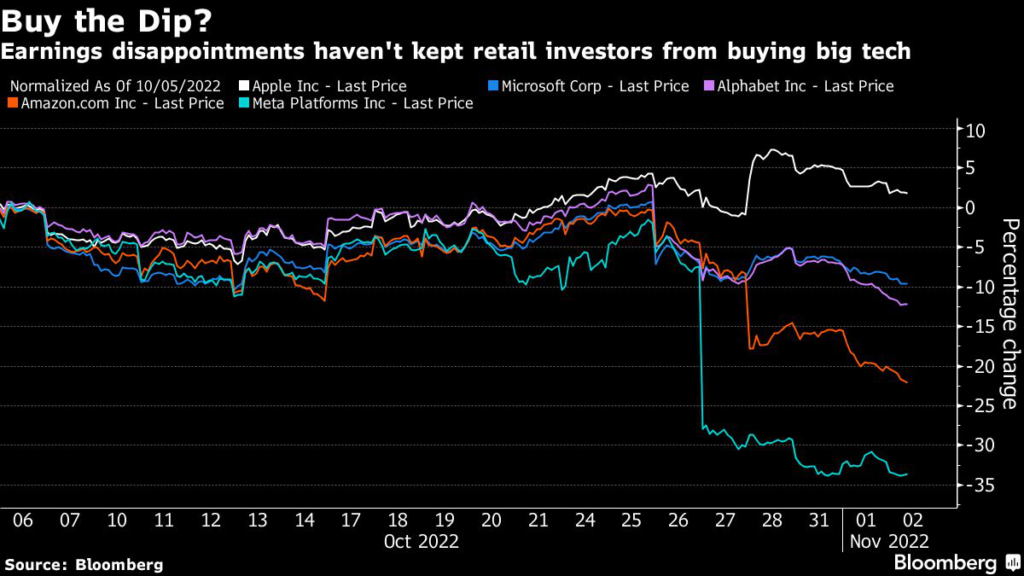
(Bloomberg) — Major US technology and internet stocks have tumbled in recent sessions, pressured by some disappointing quarterly results. But that hasn’t deterred retail investors from scooping up beaten-down shares, according to Vanda Research.

The aggregate retail buying of Wall Street’s biggest stocks “broke all records” in the latest week, in what Marco Iachini, senior vice president, said was a function of both earnings and FOMO — or a fear of missing out. 

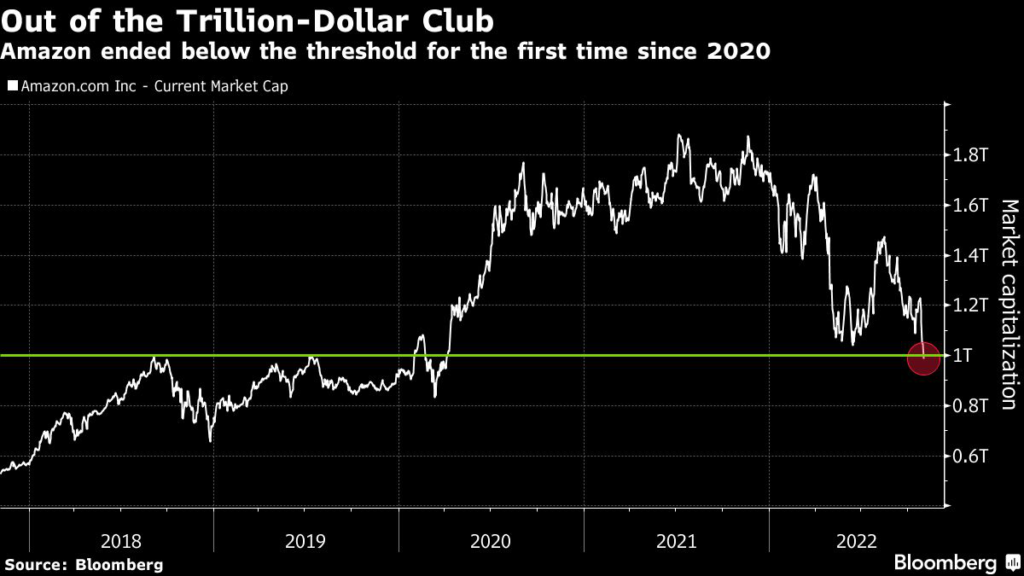
The interest came despite a broadly negative set of results. While Apple Inc. rallied in the wake of its earnings release, companies like Microsoft Corp. and Alphabet Inc. both sank. Selling was even fiercer at Meta Platforms Inc., where the Facebook parent has sunk to multi-year lows, and at Amazon.com Inc., whose market valuation has dropped under $1 trillion for the first time since 2020.

Despite that, retail flows into Amazon registered a record high of $292 million last Friday, “and the pace of buying has remained above the company’s historical average this week,” Iachini wrote. “The selloff in mega caps was seen as a buy-the-dip opportunity rather than a capitulation moment.”

Amazon was the name with the highest retail purchases over the past week, per Vanda, followed by Meta, Apple, Tesla Inc., and Alphabet. Nvidia Corp. and Microsoft also ranked among the top 10.

The group largely fell on Wednesday, as investors looked ahead to an expected rate hike from the Federal Reserve. Apple, Microsoft, and Alphabet all dropped more than 1%, while Amazon and Meta slid more than 2%. The Nasdaq 100 Index fell 1.1%.

More stories like this are available on bloomberg.com

©2022 Bloomberg L.P.

Revolut Crypto Revenue Plunges, Yet CEO Storonsky Still Believes

(Bloomberg) — Revolut Ltd. still wants to invest in its cryptocurrency offering, despite this revenue stream almost vanishing during the recent price crash, according to the fintech’s founder.

“It used to contribute up to 30%, 35% of revenues in 2021,” Chief Executive Officer Nikolay Storonsky said in an interview with Bloomberg TV’s Guy Johnson and Alix Steel. He said it was now less than 5%, “which is quite sad from my point of view. I think crypto has a lot of potential for financial systems.”

The London-based firm’s crypto team is now larger than it was two years ago as Revolut continues to improve the service that allows customers to buy and sell cryptocurrencies through its app, Storonsky said. “We continue to invest in crypto.”

Bitcoin has dropped more than 70% from last year’s peak to trade around $20,000, in a crash that’s been echoed around the world’s nascent crypto markets. 

Revolut, which was valued at $33 billion in a funding round last year, is one of Europe’s largest startups with statutory revenue of £222 million ($254 million) in 2020, according to filings. About 20 million customers globally use the platform for payments, trading and other wealth services. 

Earlier Wednesday, Revolut announced a new instant messaging function, as part of its attempts to become Europe’s answer to lifestyle “super app” WeChat.

Storonsky said it was keeping an eye on spending, but was not looking to make dramatic savings to reflect the worsening outlook. “We always look at costs, it’s not necessarily because it’s an economic downturn,” said Storonsky. He added that Revolut, which is yet to publish its 2021 accounts, is generating gross profits. 

Storonsky added that he hopes the UK is “quite close” to approving Revolut’s application for a banking license after several years of waiting. 

–With assistance from Alix Steel, Guy Johnson and Aisha S Gani.

More stories like this are available on bloomberg.com

©2022 Bloomberg L.P.

Binance, With Over $1 Billion to Spend, Weighs Buying a Bank

(Bloomberg) — Binance Holdings Ltd. founder and CEO Zhao “CZ” Changpeng, who last month said the crypto exchange may spend more than $1 billion on deals this year, is considering targets including banks as the boundary between the digital-asset industry and traditional finance blurs. 

“There are people who hold certain types of local licenses, traditional banking, payment-service providers, even banks. We’re looking at those things,” Zhao said in an interview at the Web Summit conference in Lisbon, without identifying a target. “We want to be the bridge between crypto and the traditional, financial world.”

Zhao’s comments underscore how digital assets and traditional finance, or “TradFi” in crypto parlance, are becoming increasingly interlinked. Financial institutions from Goldman Sachs Group Inc. to BlackRock Inc. are pushing deeper into crypto, even after a market meltdown that’s lopped some $2 trillion off digital assets’ value. 

Read more: Binance May Spend Over $1 Billion This Year on Deals, Zhao Says

Binance is open to minority investments or a full acquisition, according to Zhao. He said it’s an opportunity for Binance to capitalize on the expected increase in a bank’s share price after signing a business agreement with the company, which operates the world’s largest crypto exchange. 

“What we have found is when banks work with us, we drive so many users to them, so the bank’s valuation goes up exponentially, like why don’t we just invest in them as well, so that we capture some of the equity upside,” he said. 

More stories like this are available on bloomberg.com

©2022 Bloomberg L.P.

Germany Backstops Commodity Traders as War Drives Resource Dash

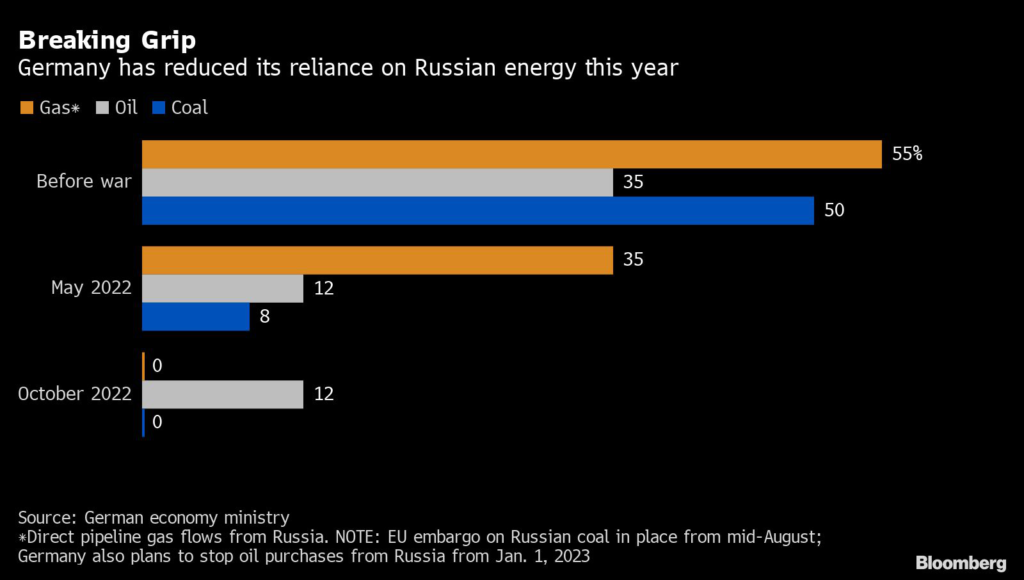
(Bloomberg) — Germany is offering loan guarantees to commodity trading houses to buy energy and key metals, as Russia’s invasion of Ukraine sparks a global scramble for resource security.

Trafigura Group, the world’s biggest trader of copper, has already agreed to supply German customers with non-Russian metals for the next five years, helped by $800 million in bank credit that’s ultimately guaranteed by the German government. The trading house is now discussing a similar deal for liquefied natural gas, according to people familiar with the situation, and commodity bankers are pitching more deals that would have state guarantees to other traders.

The war has forced Germany to retool its entire energy policy after years of tight dependence on Russia for supplies of oil, gas and metals. That urgency has meant Berlin is willing to put taxpayer funds on the hook, even if it means backstopping privately owned and highly profitable commodity trading houses. 

The deals “show it’s dawning on the developed world that strategic sourcing matters,” said Jean-Francois Lambert, who runs a consultancy on commodity trade and structured finance.  “In these times, when you need the flexibility or to be nimble, you go to the trading houses and nowhere else. Other European governments will have to start thinking along the same lines.” 

It comes amid a broader shift in thinking about natural resources in Europe and the US, where governments had left commodity production and trading to the private sector in recent years, even as the likes of Japan and China backed state and private companies to secure supplies. US President Joe Biden’s Inflation Reduction Act, signed in August, includes provisions to support domestic production of battery metals, and the European Union has also sounded the alarm.

A spokesman for the German Economy Ministry said a pre-existing program known as the untied loan guarantees is being used to increase Germany’s security of supply, and talks continue on developing the measures further. He didn’t give details. Trafigura declined to comment.

Germany is also making more high-profile diplomatic efforts to secure alternative sources of energy, and Chancellor Olaf Scholz has traveled to Saudi Arabia and Qatar. But there’s still not much sign of clear progress securing more LNG. 

Commodity traders may provide a quicker, more agile solution.

The untied loans program is managed via Euler Hermes AG — an export credit unit that’s now part of Allianz SE — and has historically been used to facilitate German companies investing in resource development abroad. But the recent deals offer credit guarantees to non-German traders to directly procure commodities. 

For the traders, Germany’s insurance guarantees enable bankers to jump through internal hurdles to offer more credit to their trading clients at a time when high commodity prices and volatility have left many reluctant to add more exposure to the sector. 

But the measure could prove controversial at home. Opposition Christian Democrat lawmaker Stefan Rouenhoff said the government instead should be helping German industry secure raw materials abroad.

“Agreements with foreign commodity traders do not make a sustainable contribution to strengthening our security supply,” he said.

Read: How Europe Became So Dependent on Putin for Its Gas: QuickTake

–With assistance from Kamil Kowalcze and Elena Mazneva.

More stories like this are available on bloomberg.com

©2022 Bloomberg L.P.

Stocks Drop After Strong ADP as Fed Decision Looms: Markets Wrap

(Bloomberg) — Stocks fell as data showed continued labor-market strength, with investors waiting to hear from Federal Reserve Chair Jerome Powell on whether it would be realistic to expect a slowdown in the pace of rate hikes going forward.

The pronounced sense of caution was reflected in the S&P 500’s swings Wednesday — with the gauge currently on track for its narrowest range this year. While the tech-heavy Nasdaq 100 underperformed, chipmakers bucked that trend on strong results from Advanced Micro Devices Inc. Boeing Co. also climbed after its chief’s bullish cash outlook.

Two-year US yields — which are more sensitive to imminent Fed moves — were little changed. The Treasury halted the longest string of cutbacks to its quarterly sales of longer-term debt in about eight years, showcasing the end of a period of historic reduction in the fiscal deficit.

The Fed is expected to raise rates by 75 basis points, extending its most aggressive tightening campaign since the 1980s. The decision will be announced at 2 p.m. in Washington and Powell will hold a press conference 30 minutes later. He may emphasize policymakers remain steadfast in their inflation fight, while leaving options open for their December gathering.

“Markets want clarity on where the Fed will at least pause the current rate hike cycle, but Chair Powell is not really in any position to provide that just yet,” said Nicholas Colas, co-founder of DataTrek Research. “For every sign the US economy is slowing (housing, commodity prices, retail sales ex-inflation) there are others that say labor market conditions remain strong.”

Hiring at US companies rose in October by more than forecast, according to data from ADP Research Institute in collaboration with Stanford Digital Economy Lab. To Jeffrey Roach at LPL Financial, “a tight labor market and rising wages will complicate things for the Fed, and the risk is the labor market could remain tight for quite some time.”

A survey conducted by 22V Research showed that 47% of respondents believe that the Fed meeting and Powell’s conference will be “risk off.” That’s up from 22% last week. “We DO NOT expect Powell to be dovish, he just doesn’t need to surprise on the hawkish side, relative to what is priced,” wrote founder Dennis DeBusschere.

Given the market rally in October, a less hawkish Fed might not be able to support the recovery significantly further, according to Fawad Razaqzada at City Index and Forex.com. The bigger risk in his view is that the central bank disappoints traders looking for a downshift, which could create “a fresh wave of risk selling.”

“Therefore, if you are bullish or long, take extra care here,” Razaqzada added. “If you are bearish, then there might be tactical shorting opportunities to take advantage of again, especially if the Fed delivers a hawkish surprise today.”

In fact, the recent rally in the S&P 500 has left traders with little conviction as to what will happen next. 

While many closed out their put contracts during the rebound, they didn’t gorge on calls in the expectation that the gains would continue, based on the cost of bearish options versus bullish ones analyzed by SpotGamma. While there have been bets on moves in either direction, a big chunk of the crowd is willing to wait until it hears the Fed’s actual message — even if that leads to near-term pain.

Read: El-Erian Sees Danger That Fed Will Do ‘Too Little’ on Inflation

Inflation is too high at the moment for the Fed to start hinting at loosening financial conditions, making the stock market’s recent optimism “misplaced,” according to Barclays Plc strategists. The narrative for a pivot is “overblown,” strategists led by Emmanuel Cau wrote.

Meantime, a key indicator of US stocks is close to flashing a “buy” signal, supporting bulls who have pushed equities higher in the run-up to the Fed meeting. 

Bank of America Corp.’s so-called Sell Side Indicator — a measure of Wall Street sentiment on stocks — is at its lowest level since 2017. Such levels typically trigger rallies, with 12-month returns for the benchmark S&P 500 positive for 94% of the time, strategists including Savita Subramanian wrote in a note dated Nov. 1.

In other corporate news, a rally in US-listed Chinese stocks went unabated on Wednesday after health authorities said the nation will stick to its Covid Zero policy. Separately, China has ordered a seven-day lockdown of the area around Foxconn Technology Group’s main plant in Zhengzhou, a move that will severely curtail shipments in and out of the world’s largest iPhone factory.

Key events this week:

  • Bank of England rate decision, Thursday
  • US factory orders, durable goods, trade, initial jobless claims, ISM services index, Thursday
  • ECB President Christine Lagarde speaks, Thursday
  • US nonfarm payrolls, unemployment, Friday

Some of the main moves in markets:

Stocks

  • The S&P 500 fell 0.6% as of 11:22 a.m. New York time
  • The Nasdaq 100 fell 0.9%
  • The Dow Jones Industrial Average fell 0.2%
  • The Stoxx Europe 600 fell 0.3%
  • The MSCI World index fell 0.3%

Currencies

  • The Bloomberg Dollar Spot Index was little changed
  • The euro was little changed at $0.9873
  • The British pound was little changed at $1.1474
  • The Japanese yen rose 0.8% to 147.09 per dollar

Cryptocurrencies

  • Bitcoin fell 0.3% to $20,414.35
  • Ether fell 1.2% to $1,557.03

Bonds

  • The yield on 10-year Treasuries was little changed at 4.04%
  • Germany’s 10-year yield was little changed at 2.13%
  • Britain’s 10-year yield declined five basis points to 3.42%

Commodities

  • West Texas Intermediate crude rose 1.4% to $89.62 a barrel
  • Gold futures were little changed

–With assistance from Lu Wang, Vildana Hajric, Isabelle Lee and Emily Graffeo.

More stories like this are available on bloomberg.com

©2022 Bloomberg L.P.

Car Loan Rates Head for 14-Year High in New Barrier for Buyers

(Bloomberg) — Just as automakers start making headway sorting out the parts shortages that have constrained production and left dealers with a scarce supply of vehicles to sell, the Federal Reserve is putting up a new obstacle: much costlier car loans.

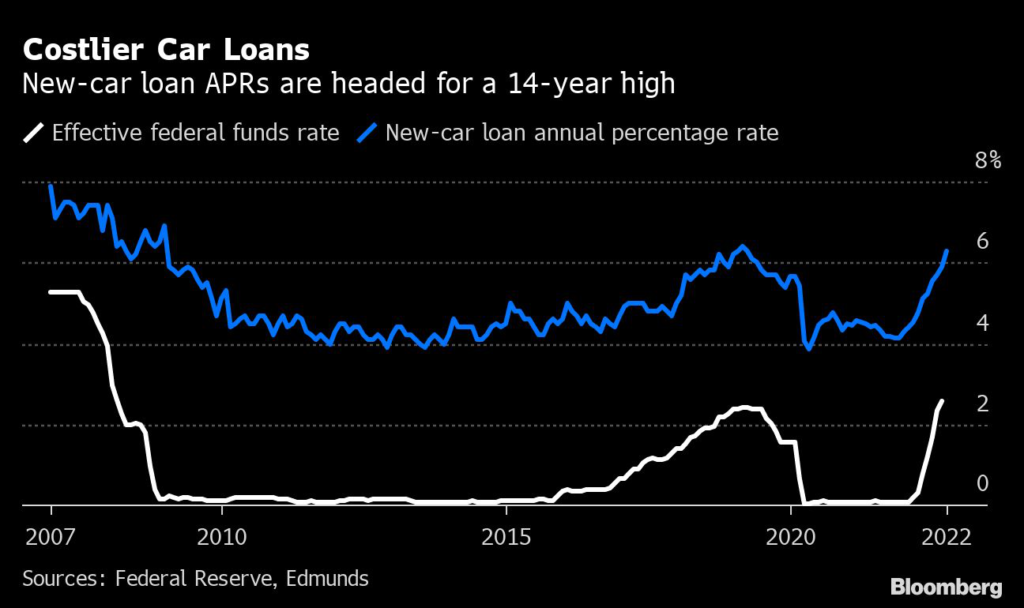
The average annual percentage rate on new-car loans was 6.3% last month, the highest since April 2019, according to Edmunds. The auto-market researcher’s data show APRs closely track the effective federal funds rate, which suggests financing a new vehicle will be costlier in the coming months than it’s been since early 2009.

“New-vehicle inventory might finally be improving, but the automotive industry is still on a long road to recovery because rising interest rates are creating a major barrier to entry for car shoppers,” Jessica Caldwell, executive director of insights for Edmunds, said in an email. “Many consumers who have been sitting out of the market due to high prices and limited options will likely continue to do so over high interest rates.”

The auto market has drastically changed since loan rates were last this high. The average amount financed toward a new-vehicle purchase last month was $40,438, according to Edmunds. That’s up 27% from $31,914 in April 2019.

“The average price of a vehicle has risen dramatically, there are fewer smaller, budget-friendly vehicles for shoppers to choose from,” Caldwell said. “And on top of that, consumers are paying more for everything else in their lives.”

More stories like this are available on bloomberg.com

©2022 Bloomberg L.P.

US Banks Spent $1 Billion on Ransomware Payments in 2021, Treasury Says

(Bloomberg) — US financial institutions reported nearly $1.2 billion on likely ransomware-related payments last year, most commonly in response to breaches originating with Russian criminal groups, according to the Treasury Department.

The payments more than doubled from 2020, underscoring the pernicious damage that ransomware continues to wreak on the private sector. The Financial Crimes Enforcement Network, or FinCEN, said its analysis “indicates that ransomware continues to pose a significant threat to U.S. critical infrastructure sectors, businesses and the public.”

Financial institutions filed 1,489 incidents related to ransomware in 2021, up from 487 the year before, according to data collected under the Bank Secrecy Act. FinCEN’s analysis included extortion amounts, attempted transactions and payments that were unpaid.

In the US, banks are required to file suspicious activity reports to help the government detect money laundering or other criminal activity.

FinCEN said the top five highest-grossing ransomware variants from the second half of 2021 are connected to Russian cybercriminals. The damage from Russian-related ransomware during that period totaled more than $219 million, according to the data.

Treasury’s report comes as a US-hosted ransomware summit in Washington brings together nearly three dozen countries to tackle a scourge that’s hobbled businesses, non-profits and government agencies globally. The pace and sophistication of those intrusions is increasing faster than the US’s ability to disrupt them, a senior Biden administration official said Sunday.

FinCEN said its analysis was in response to the increase in both number and severity of recent ransomware hacks against US critical infrastructure. The jump, officials said, could also be reflective of institutions getting better at identifying and reporting incidents.

The findings were previously reported Tuesday by CNN.

In March, President Joe Biden signed sweeping cybersecurity legislation that mandates certain sectors report breaches to the US Department of Homeland Security within 72 hours of discovery of the incident, and 24 hours if they make a ransomware payment.

Ransomware actors continue to release private troves of data if their demands aren’t met. Their targets include a breach this fall on the Los Angeles Unified School District, in which confidential information about students was leaked when the ransom wasn’t paid.

(Updated to include additional context about suspicious activity reports in fourth paragraph. A previous version incorrectly reported US banks had spent more than $1 billion on ransomware payments.)

More stories like this are available on bloomberg.com

©2022 Bloomberg L.P.

DuPont Shares Rise in Relief as $5.2 Billion Rogers Deal Falters

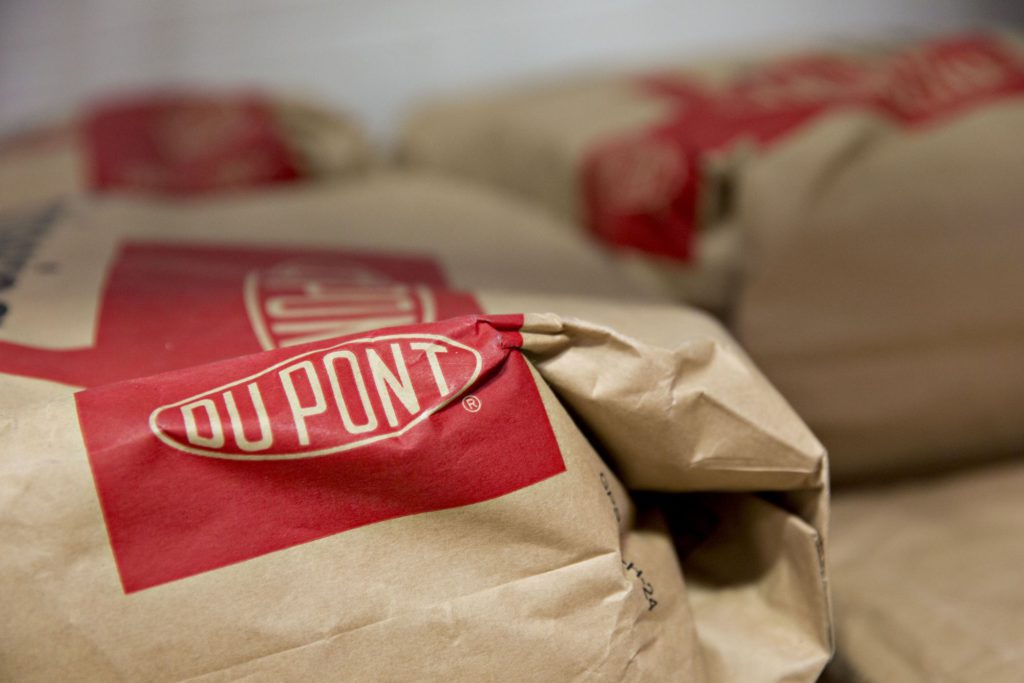
(Bloomberg) — DuPont shares rose the most in a year as investors cheered the company’s decision to call off a planned $5.2 billion acquisition of Rogers Corp. that would have valued the engineering materials maker at a steep premium.

Wilmington, Delaware-based DuPont de Nemours Inc. jumped as much as 9.5% in New York trading Wednesday, the most intraday since the deal was announced 12 months ago.

DuPont scuttled the acquisition plan after needed approvals were held up by authorities in China. While the original pact had valued Rogers shares at $277, a premium of more than 30% at the time, the company’s shares had fallen 16% this year to $229.49 through Tuesday’s close.

“We do believe investors will react favorably to this news as it demonstrates the new DuPont’s discipline in capital allocation,” RBC Capital Markets analyst Arun Viswanathan said in a client note. At Citi, analyst P.J. Juvekar wrote that investors had a sense that DuPont was overpaying for Rogers.

DuPont said it will pay a breakup fee of $162.5 million to Rogers, whose shares on Wednesday plummeted as much as 46% to $124.50. DuPont’s brief statement was issued after the close of trading Tuesday, hours short of the one-year anniversary of the deal’s announcement.

While Tuesday’s statement didn’t specify which “required regulators” hadn’t cleared the transaction, DuPont previously identified China’s State Administration for Market Regulation, SAMR, as the last remaining hurdle for deal approval. 

The scuttling comes as mounting tensions between the US and China spill into industry as both governments vie for preeminence in key sectors such as semiconductors, advanced batteries for electric cars and artificial intelligence.

Representatives for the two companies declined to comment beyond the statement.

China has been wielding its power over the mergers of foreign companies with increasing force in recent years. In 2018, US-based Qualcomm Inc. scrapped a $44 billion bid for Dutch chipmaker NXP Semiconductors NV after Chinese regulators failed to approve what would have been the largest-ever deal in the chip industry.

Last year, Blackstone Group Inc.’s $3 billion takeover of Soho China Ltd. collapsed a month after the companies said SAMR had formally accepted the deal for review.

Mergers that have won SAMR’s approval this year include Taiwan-based GlobalWafers Co.’s takeover of Germany’s Siltronic AG and Advanced Micro Devices Inc.’s $35 billion acquisition of Xilinx Inc.

China sales accounted for more than a third of Rogers’ 2021 revenue, while nearly half of DuPont’s sales came from the broader the Asia-Pacific region, according to data compiled by Bloomberg.

DuPont had pitched the Rogers purchase as a way to tap into the rapid growth of electric vehicles and advanced auto electronics. The deal also would have expanded its position in advanced materials for other key growth markets such as clean energy and 5G mobile-phone service.

More stories like this are available on bloomberg.com

©2022 Bloomberg L.P.

Arizona Democrat Bets That Tough Talk on ‘Big Lie’ Will Woo Voters

(Bloomberg) — Adrian Fontes doesn’t like terms like “election denier” and “disinformation.” He prefers “‘Stop the Steal’ crowd” and “liars.”

That’s how the 52-year-old former US Marine, Arizona’s Democratic candidate for secretary of state, refers to people who spread conspiracies claiming former President Donald Trump really won the 2020 vote.

Fontes’s tough-talking strategy is now being put to the test. He is locked in a tight race with Mark Finchem, who is endorsed by Trump and has sought to undercut the legitimacy of President Joe Biden’s victory.

“We got to stop talking like Democrats,” Fontes said, in an interview with Bloomberg News. Too often people sugarcoat their words and dance around ideas because they don’t want to hurt anybody’s feelings or seem unfair, he said, adding, “The truth is not unfair. Jan. 6 was an act of terror.”

The contest in Arizona for secretary of state—a job “ dedicated to ensuring the integrity of our elections”—reflects a broader schism ahead of the midterm elections next week, when voters will decide whether hundreds of politicians who embrace what is often called Trump’s “Big Lie” should hold public office.

The issue is a tricky one for Democrats. While it energizes the Democratic base, it doesn’t necessarily motivate independents to vote for them and has the potential to invigorate Republicans, polling has found. 

Fontes, who was Maricopa County Recorder until he lost the job to a Republican in 2020, argues there is no ignoring what is at stake. The county seat of Maricopa County is Phoenix.

“We used to have one denialist who lost an election. Now we’ve got hundreds of them running countrywide, many of them running to run our elections,” he said, later adding, “If you don’t call it fascism because you’re afraid to offend somebody, you’re not doing your job.”Finchem’s campaign team declined interview requests, saying he was only talking to conservative media or too busy. On a recent October weekend, he appeared via video at an “election integrity forum,” alleged electoral fraud and suggested the audience had a divine right to rule.

“God’s people need to take control of the government that God ordained from the start,” he said.  He talked about existential threats to the survival of the US and directed the audience to document suspected election irregularities.


QuicktakeElection Deniers on Ballot: 14 for GOP Who Fought 2020 Results

Arizona, a traditionally red state turning purple, represents a particularly acute example of the disinformation quagmire. While the electorate voted for a Democratic president in 2020, some Trump-supporting conservatives fought vigorously to overturn Biden’s narrow victory in the state. Now, it’s the only state where the Republican candidates for Senate, governor, attorney general and secretary of state deny the 2020 election results were legitimate.Arizona election officials say they continue to be besieged by threats, insults and unfounded claims the 2020 election was stolen, despite publishing a 93-page report in January that debunked the allegations.

The Maricopa County Recorder’s Office has expanded its communications team and established a new “command center” to combat disinformation.

Stephen Richer, who beat Fontes to become Maricopa County recorder, said his team monitors Truth Social, Trump’s social media platform, and far-right discussion threads on platforms such as Rumble and Telegram. But he said they decided not to open accounts on these platforms.

“We think that our message there would be completely drowned out and would maybe just stir the pot and further animate people who likely aren’t ready, or not even willing, to hear the factual side of the story,” said Richer, a Republican. 

Finchem, a former Michigan firefighter, is a member of the America First Secretary of State Coalition, whose 14 secretary of state candidates want to eliminate mail-in ballots and switch to single-day voting, arguing it will help eliminate fraud. At the moment, nearly 90% of Arizonans mail in their ballot in the weeks before polling day, a system Fontes wants to expand. 

Finchem’s campaign has accused Fontes of disinformation too. For instance, Fontes’s campaign ads have exaggerated Finchem’s role in the Jan. 6 attack on the US Capitol, Finchem’s team has said. Finchem has said he was outside but didn’t go in the building. Finchem has also cited occasions where the courts ruled against Fontes as a local election official for overstepping his authority.

Both candidates suffer a lack of name recognition, as many voters said they had never heard of either. Complicating Fontes’s task is that Democrats rank third in overall number of registered voters in Arizona, after Republicans and independents. “If we get every Democrat, we’re still losing,” said Lucy Marshall, a local district chairman for the Democratic Party.

QuicktakeMLIV Pulse Survey:  How will the US midterms impact stocks and bonds? Fill out our survey.

Fontes has brought in more money than Finchem, at $3.3 million to $2 million, and is benefiting from an effort from Democratic-aligned groups to defeat Finchem, at $4 million so far. (Michael Bloomberg, the founder and majority owner of Bloomberg LP, contributed $1 million to the Arizona Democratic Party in October, and Everytown for Gun Safety Victory Fund, a PAC associated with his gun control group, has spent at least $465,000 to defeat Finchem. )

Fontes said reaching conservatives holds the key for him to win. And he described the decision by some Democratic organizations to help boost the chance of election deniers in Republican primaries—aiming for decisive defeat—as “the stupidest thing anybody could have done.”

At a small weekend fundraising event in Chandler, Fontes counseled supporters on how to best to debunk right-wing conspiracy theories. Fontes suggests starting with questions: “Where did you hear that from, and how do you know that? And have you heard anybody say anything different about that?” 

Even better, he said, is being kind and listening. “If you’re just fighting them, it’s whack-a-mole,” he said, requesting people take 10 minutes to decide their own approach. “A little bit of humanity, a little bit of grace and plenty of that American spirit.”

–With assistance from Ryan Teague Beckwith.

More stories like this are available on bloomberg.com

©2022 Bloomberg L.P.

Cybercrime Buoys Security Software in Bear Market

(Bloomberg) — Companies that make security software have turned out to be a relative bright spot in this year’s stock market meltdown, favored by both traders and firms looking to make acquisitions.

The critical nature of security — especially given high-profile hacks — means companies and governments are unlikely to skimp on spending for it, even as the threat of a recession weighs on technology budgets. And the long-term need for protection has made takeover targets of companies including Mandiant Inc. and KnowBe4 Inc.  

“Within enterprise budgets, security is the last area businesses will cut, so growth should continue even if we see a recession,” said Ivana Delevska, chief investment officer at Spear Invest. “This constant underpinning of demand makes security a very attractive space, which is why people are getting in even though there’s so much uncertainty everywhere else.”

Palo Alto Networks Inc., CyberArk Software Ltd., and Check Point Software Technologies Ltd. are among notable outperformers in the sector this year. An index of cybersecurity stocks is down 22% in 2022 including dividends, a narrower drop than the 33% slump in a broader software index. The Nasdaq 100 Index is down 31%. 

The cybersecurity index fell 1% on Wednesday. The Nasdaq 100 Index was down 0.1%.

Morgan Stanley’s quarterly survey of corporate technology executives underlines the group’s resiliency. Near-term demand for software is waning, even as it is expected to remain the fastest-growing sector for enterprise spending, the survey shows. However, the executives said security was a top priority, as well as among the most defensive areas for enterprises.

“Security demand remains strong and budgets continue to grow much faster than overall IT,” wrote analyst Hamza Fodderwala, who said customer and channel checks point to durable demand trends over the remainder of 2022. He sees Palo Alto Networks and Crowdstrike Holdings Inc. as the most likely beneficiaries.

Stocks in the group are cheaper than software overall. The security index trades at 26 times estimated earnings and 1.3 times sales. For the broader software index, the multiples are 28 and 5.7, respectively.

Software has also emerged as a favorite place for M&A activity this year, with security’s lower valuations making it especially attractive. 

Among notable deals, Alphabet Inc. recently closed its $5.4 billion purchase of Mandiant and Vista Equity Partners agreed to buy KnowBe4 for about $4.6 billion on an equity value basis. Private equity firm Thoma Bravo announced three multi-billion-dollar security acquisitions in the past six months: ForgeRock, Ping Identity, and SailPoint Technologies. 

“It’s tough to call an end to this trend, because the cheaper valuations will continue to make these companies attractive to buyers,” said Ryan Issakainen, senior vice president of First Trust Portfolios. 

“What’s different about security compared with the rest of software is that the business model is still really strong. While we’re expecting a slowdown in economic growth, cyber criminals operate in a growth industry that’s not tied to the cycle.”


Tech Chart of the Day

Amazon.com Inc. is coming off a five-day drop, and the slump had pushed the e-commerce and cloud-computing company out of the $1 trillion club. The stock fell 5.5% on Tuesday, ending with a market capitalization of $987.4 billion. This is the first time it has closed below $1 trillion since April 2020, though it fell under it on an intraday basis last week. Recent losses were spurred by results last week, when it projected the slowest holiday-quarter growth in the company’s history.  

Top Tech Stories

  • China has ordered a seven-day lockdown of the area around Foxconn Technology Group’s main plant in Zhengzhou, a move that will severely curtail shipments in and out of the world’s largest iPhone factory.
  • Amazon is freezing staffing levels in its profitable advertising business, according to a person familiar with the matter, showing that the world’s largest e-commerce company is taking more drastic measures to align expenses with slowing sales.
  • Twitter Inc.’s top advertisers are being urged by dozens of advocacy groups to boycott the platform if its new billionaire owner, Elon Musk, lowers safety standards for content.
  • Sony Group Corp. shares had their biggest surge in seven months after the company said PlayStation 5 production went better than expected in the past quarter and it now aims to surpass its sales target for the fiscal year.
  • Blackbird Ventures has raised the largest Australian venture capital fund yet, securing more than A$1 billion ($640 million) from sovereign wealth funds and individual investors.

–With assistance from Subrat Patnaik.

More stories like this are available on bloomberg.com

©2022 Bloomberg L.P.
Close Bitnami banner
Bitnami