

Bloomberg

Futures Drop After ADP as Traders Await Fed: Markets Wrap

(Bloomberg) — Stock futures fell after data showed labor-market strength, with investors waiting to hear from Federal Reserve Chair Jerome Powell on whether it would be realistic to expect a slowdown in the pace of rate hikes going forward.

S&P 500 contracts posted mild losses, while two-year US yields — which are more sensitive to imminent Fed moves — were little changed. The Treasury halted the longest string of cutbacks to its quarterly sales of longer-term debt in about eight years, showcasing the end of a period of historic reduction in the fiscal deficit.

Private payrolls rose 239,000 last month after a revised 192,000 gain in September, according to data from ADP Research Institute in collaboration with Stanford Digital Economy Lab. The median forecast in a Bloomberg survey of economists called for a 185,000 advance. A resilient job market has fueled fast wage growth, contributing to rapid inflation and putting pressure on the Fed to aggressively tighten monetary policy. 

The Fed is expected to raise rates by 75 basis points on Wednesday as the central bank extends its most aggressive tightening campaign since the 1980s. The decision will be announced at 2 p.m. in Washington and Powell will hold a press conference 30 minutes later. He may emphasize policymakers remain steadfast in their inflation fight, while leaving options open for their gathering in mid-December, when markets are split between another big move or a shift to 50 basis points. 

Read: US PREVIEW: Powell to Signal Slower Hikes, Higher Endpoint

Inflation is too high at the moment for the Federal Reserve to start hinting at loosening financial conditions, making the stock market’s recent optimism “misplaced,” according to Barclays Plc strategists. A Bank of America Corp. contrarian indicator based on Wall Street strategists’ allocation views is nearest to flashing “buy” US equities in more than five years.

“The indicator is the closest it has been to a ‘Buy’ signal since early 2017 and is closer to a ‘Buy’ signal than a ‘Sell’ signal for a sixth consecutive month,” strategists including Savita Subramanian wrote. “Wall Street’s consensus equity allocation has been a reliable contrarian indicator over time.”

The S&P 500 is currently trading at around 3,860, which is neither too expensive for short sellers, nor too cheap for dip-buyers, strategists from Citigroup Inc. to SpotGamma say. While there have been bets on moves in either direction, a big chunk of the crowd is willing to wait until it hears the Fed’s actual message — even if that leads to near-term pain. 

Multiple screen shots purporting to show the world’s second-largest economy is moving closer to a reopening have been circulating on social-media platforms since late Monday. While none of them have been confirmed — and all outward signs from Chinese officialdom are that the Covid Zero policy remains intact — investors have propelled the Hang Seng China Enterprises Index to an 8.4% two-day gain in Hong Kong.

China has ordered a seven-day lockdown of the area around Foxconn Technology Group’s main plant in Zhengzhou, a move that will severely curtail shipments in and out of the world’s largest iPhone factory.

Key events this week:

  • Bank of England rate decision, Thursday
  • US factory orders, durable goods, trade, initial jobless claims, ISM services index, Thursday
  • ECB President Christine Lagarde speaks, Thursday
  • US nonfarm payrolls, unemployment, Friday

Some of the main moves in markets:

Stocks

  • Futures on the S&P 500 fell 0.2% as of 8:43 a.m. New York time
  • Futures on the Nasdaq 100 were little changed
  • Futures on the Dow Jones Industrial Average fell 0.3%
  • The Stoxx Europe 600 fell 0.2%
  • The MSCI World index rose 0.1%

Currencies

  • The Bloomberg Dollar Spot Index fell 0.2%
  • The euro rose 0.2% to $0.9893
  • The British pound was little changed at $1.1490
  • The Japanese yen rose 0.8% to 147.15 per dollar

Cryptocurrencies

  • Bitcoin fell 0.4% to $20,400.07
  • Ether fell 1.3% to $1,554.46

Bonds

  • The yield on 10-year Treasuries declined one basis point to 4.03%
  • Germany’s 10-year yield was little changed at 2.14%
  • Britain’s 10-year yield declined one basis point to 3.46%

Commodities

  • West Texas Intermediate crude was little changed
  • Gold futures rose 0.5% to $1,657.70 an ounce

More stories like this are available on bloomberg.com

©2022 Bloomberg L.P.
Netanyahu Inherits Economy Resilient to Years of Turmoil

(Bloomberg) — Israel has weathered recent global economic storms better than most and nearly four years of government instability at home thanks to deep structural changes in its $482 billion economy.

The resilience will likely outlast what’s shaping up as the most right-wing government in Israel’s history following the country’s fifth election in less than four years. It’s set to bring back the nation’s longest-serving prime minister, Benjamin Netanyahu, who was removed from office in 2021 after 12 years in power.

The disconnect from turmoil at home “reflects the significant structural changes that Israel’s economy has undergone, most notably a large improvement in its balance of payments, leaving it less susceptible to capital flows due to political uncertainty,” Goldman Sachs Group Inc. economists including Clemens Grafe said in a report. 

Netanyahu Set for Return in Coalition With Israeli Far Right 

Israel is in a sweet spot. With the budget back in surplus for the first time in over a decade and an unemployment rate that touched a record low this summer, Israel boasts a currency that’s more likely to react to US stocks than to any shocks at home.

“The primary factors affecting trade for the shekel, i.e. local natural gas production and the export of high-tech services, have both benefited from the supportive policy of the government, regardless of political sides and even stability,” Yonie Fanning, market economist for Mizrahi-Tefahot, said in a note to clients.

Netanyahu, once nicknamed “Mr. Economy” for his time as finance minister in the early 2000s, is poised to retake power even as he fights corruption charges against him — which many in Israel say should disqualify him from office.

The empowerment of the nation’s far right has raised doubts about the future of Israel’s democracy, and the rift between its Jewish citizens and Arab minority is likely to deepen. It’s also likely to rule out any immediate solution to the Palestinian question, a driver of friction with neighbors and periodic outbursts of violence.

A Former General Has Her Focus Set on Israel’s Skewed Economy

Meanwhile, unease over the country’s high cost of living is widespread, and there are signs that a boom in investment driven by the vaunted high-tech sector is waning. Poverty is rampant among both Arabs and ultra-orthodox Jews, leaving Israel as one of the world’s most unequal high-income countries.

“The overall economy, when you look at the growth number, when you look at the labor market, is still very strong,” said Rafi Gozlan, chief economist at IBI Investment House Ltd.

Here’s a snapshot of the economy the next leader will inherit:

Israel bounced back strongly from the pandemic, with gross domestic product expanding by more than 8% last year and on track to grow in 2022, according to the central bank. 

Although Israel’s unemployment rate ticked up slightly, it remains near June’s low of 3.3%. Shortages of workers in key sectors are adding to pressure on wages and inflation, which has been above the government’s 1%-3% target range since the start of the year.

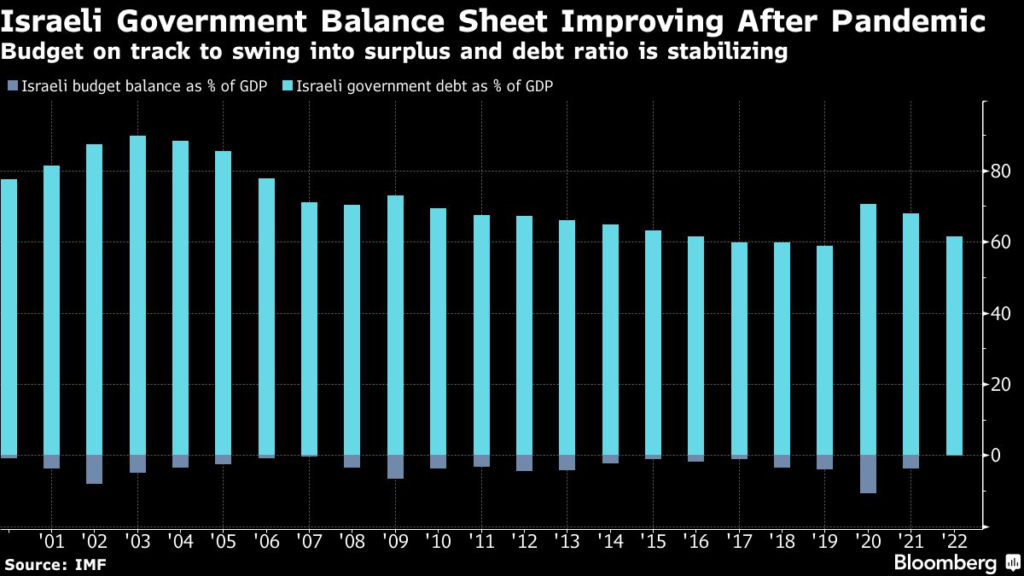
When Netanyahu was ousted from power in June 2021, Israel’s budget was deeply in the red and government debt as a percentage of economic output was on the rise.

Public finances have been on the mend since then. Earlier this year, Israel recorded its first 12-month budget surplus for 15 years — and its highest as a percentage of GDP for 35 years — fueled by a rise in government revenue. 

The country’s debt ratio, which ballooned to 71.9% during the pandemic in 2020, declined last year and is set to approach 60% in 2022, according to the International Monetary Fund.

But challenges abound, especially as tech funding dries up with the end of easy money and soaring global inflation.

Capital investment in Israel’s high tech sector was $2.6 billion in the third quarter, a decline of almost 70% from the final three months of last year, and a drop of almost 40% from the second quarter of this year, according to a recent report from IVC and LeumiTech. 

Israel also remains one of the most expensive places to live among the world’s developed economies.

Netanyahu has campaigned against the current government’s handling of the growing cost of living, stoked in part by increases in housing prices, and said he wants to reduce it.  

The government of incumbent Prime Minister Yair Lapid has tried to highlight the progress it made on structural reforms, including changes to the import tariffs, and boosting the number of housing starts.

But the payoff won’t be immediate and may benefit Lapid’s successor.

“I think you have a lagging effect on housing,” Gozlan said. “You can see it already on the demand and I believe in a quarter or two you’re going to see it also on the price.” 

(Adds economist comment paragraph 5)

More stories like this are available on bloomberg.com

©2022 Bloomberg L.P.

Crypto Exchange Zipmex in Buyout Talks With V Ventures

(Bloomberg) — Zipmex Pte, the embattled Asian cryptocurrency exchange, is in advanced talks to receive a financial lifeline from one of its investors, people with knowledge of the matter said. 

Zipmex is “on track to sign a majority buyout” agreement this week, the company said in an email to Bloomberg News on Wednesday, without naming the buyer. It is in talks with venture capital fund V Ventures, a subsidiary of Thoresen Thai Agencies Pcl, according to the people, who asked not to be identified discussing confidential information. 

V Ventures didn’t immediately respond to an email seeking comment. Negotiations are ongoing and it isn’t certain they’ll lead to a deal, the people said. 

Bangkok-based Zipmex has been restructuring after being granted protection from creditors in Singapore in August. It was derailed by a wave of defaults that ripped through the crypto industry in June and July, claiming high-profile casualties including lender Celsius Network and hedge fund Three Arrows Capital.  


More stories like this are available on bloomberg.com

©2022 Bloomberg L.P.

Crypto Winter Spurs Delisting of Bitcoin, Ether ETFs in Australia

(Bloomberg) — A clutch of crypto exchange-traded funds launched with much fanfare in Australia are headed for delisting, becoming the latest casualties of the this year’s digital-asset rout.

The management teams behind the Cosmos Purpose Bitcoin Access ETF, Cosmos Purpose Ethereum Access ETF and Cosmos Global Digital Miners Access ETF applied to revoke their quotations on the exchange run by Cboe Australia Pty.

Cosmos Asset Management was part of the race to roll out the first crypto ETFs in Australia earlier this year. But a $2 trillion slump in digital assets over roughly the 12 months has dulled investor ardor for virtual coins.

“While we strongly believe in the asset class, we are all disappointed with this result, however, we will continue to follow the process in the best interest of all unit holders,” Dan Annan, chief executive at Cosmos, wrote in an email.

The Cosmos Bitcoin and Ethereum funds, which feed into Toronto-listed funds run by Purpose Investments, have total assets of about A$1.1 million ($710,000). The miners vehicle, an equity portfolio, has about A$630,000.

The Global X Bitcoin and Ether funds continue to be available in Australia and have a combined market value of roughly A$8.5 million.

The bulk of crypto exchange-traded product assets, about 83%, are housed in the US, followed by Europe with 16%, according data compiled by Bloomberg Intelligence. Most of the remainder is in Brazil and the Asia-Pacific region hardly figures at all.

“Australia’s hope of becoming Asia’s crypto hub now diminishes, especially after Hong Kong just announced a pathway for Bitcoin and Ether ETFs,” said Rebecca Sin, an ETF analyst at Bloomberg Intelligence. 

Hong Kong this week unveiled a sweeping policy revamp that allows for futures-based crypto ETFs as it seeks to become a virtual-asset center in Asia.

(Updates with comment from BI analyst in the penultimate paragraph.)

More stories like this are available on bloomberg.com

©2022 Bloomberg L.P.

Crypto Hack Swipes $28 Million From Derivatives Exchange Deribit

(Bloomberg) — Hackers inflicted more pain on the cryptocurrency sector by looting $28 million from derivatives exchange Deribit in what’s shaping up to be a record year for thefts of virtual assets.

A wallet connected to the internet was compromised Tuesday, Deribit said on Twitter, adding that losses will be covered by company reserves and that other client funds are safe.

Deribit, one of the largest derivatives exchanges in crypto, said the firm’s procedure is to keep 99% of user funds in so-called cold storage, or unconnected to the internet, to limit the impact of hacks.

The attack is the latest in an ever-lengthening list of security incidents at crypto projects and protocols. More than $3 billion has been hacked so far in 2022, which is on course to be a record year for exploits involving digital assets, according to blockchain specialist Chainalysis.

Deribit shared the current location of the funds that were spirited away. That shows that approximately 691 Bitcoins and 9,080 Ether have been taken.

Hacks have compounded an already difficult period for digital assets, which have shed about $2 trillion in market value since a peak in November 2021.

More stories like this are available on bloomberg.com

©2022 Bloomberg L.P.
Microsoft President Wants More Training for Workers to Fight Climate Change

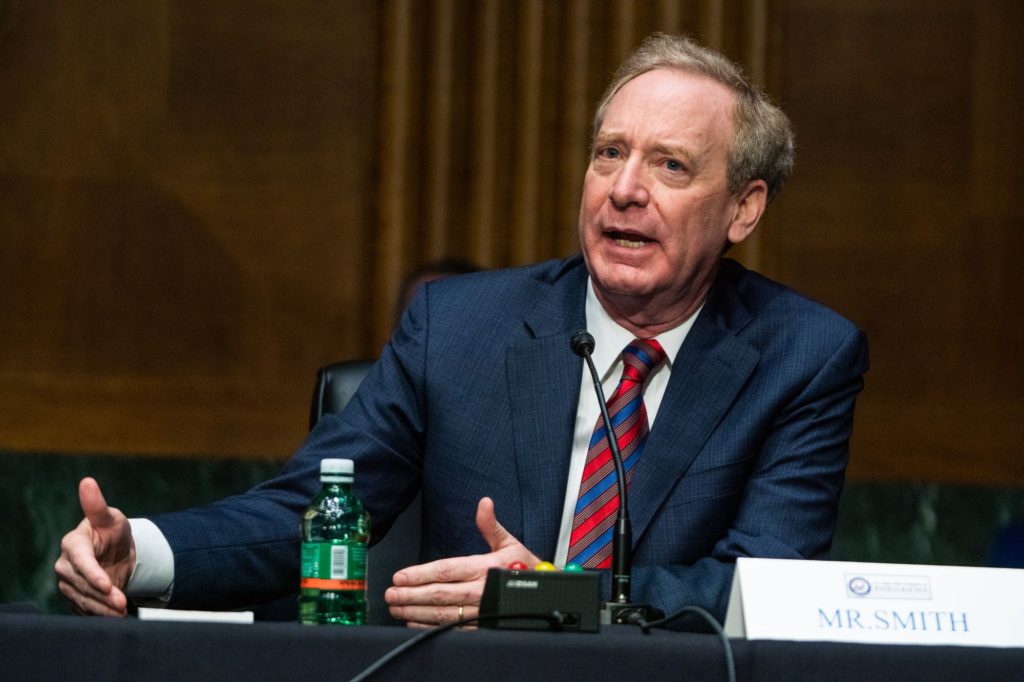
(Bloomberg) — Microsoft Corp. President Brad Smith is calling for companies, schools and governments to dramatically increase training workers for new and redesigned roles tackling the climate crisis. The software giant, which has pledged to remove more carbon than it emits by 2030, says the lack of skills in areas like carbon accounting, green procurement and supply chain management is a threat to the kind of progress needed to arrest global warming.

The company, along with the Boston Consulting Group, studied 15 companies they said were leading the pack in sustainability innovation to produce a report on what’s needed. Microsoft plans to develop and share more training resources through its LinkedIn business, work with United Nations and International Monetary Fund groups and NGOs, as well as convening a conference of corporate chief sustainability officers to share best practices.

Smith will discuss the effort at the Web Summit conference today in Lisbon. He spoke with Bloomberg Green about what’s needed in the workforce to tackle climate change. The interview has been edited and condensed.

As you see it, what is the challenge ?

Roughly 3,900 companies around the world have signed up for climate pledges. But what we’re finding as a leading technology provider to these companies, is that we all now need to figure out how to turn these pledges into progress. That’s easier said than done. It takes a real revolution in different business processes and in the use of digital technology as core components. But foundationally, it all relies on building a more skilled workforce.

How do we we know we have a shortfall in these types of skills?

LinkedIn did a study a year ago—what it showed was that the number of jobs in the economy that require sustainability skills is growing by 8% a year but the number of people in the workforce that have these skills is growing by only 6% a year. So we’re seeing a gap, and in fact, we’re seeing a widening of this gap. When we entered the digital era, we needed to bring computer science into schools and we needed to bring digital fluency into the workplace. When we’ve reviewed the data, employers around the world really invested more in employee training between 1980 and 2000. Computers entered the workforce— people needed to be trained how to use them. But we saw employer investments in employee training really declining after the year 2000 and have been stagnating ever since. We’re going to need to reinvest in employee training. 

What kind of jobs are we talking about?

Some of these will be sustainability specialists. A great many more are people who work on a wide variety of other business processes like procurement and supply chain management, for example, and now they need a significant dose of sustainability background and fluency in order to help their companies meet their climate pledges. There’ll be new jobs and existing jobs. They are people who are doing carbon accounting — these may be people who have done financial accounting, but now they’ll be financial accountants and carbon accountants at the same time. 

Will it be more an issue of training people for new jobs or retraining in existing roles?

For every category I can name that’s new there’s probably five that are existing, but changing, because of the climate pledges that companies have made. An easy example: People have to change the procurement process. They have to redesign those reports from their suppliers. They then need to partner with their suppliers to help them drive down their carbon emissions. Another really interesting example we discovered within Microsoft is basically, virtually all the world’s kitchens have to move from cooking on gas to cooking on electricity instead. We’ve started to do that with some of the big kitchens at Microsoft. And in the coming years we’ll start to change all of our kitchens and our cafeterias so that they’re using electric rather than gas. It turns out that people need to be retrained in the way they cook.

What’s the risk if we don’t fix the skills shortfall here?

We need to address this with a huge sense of urgency. It’s easy as this decade has unfolded to focus first on Covid and then focus on the war in Ukraine, focus on the energy shortage in Europe, and lose sight of the urgency of the climate crisis. But it is a crisis. 


More stories like this are available on bloomberg.com

©2022 Bloomberg L.P.

Women’s Sports Get Their Own TV Network Via New Streaming Outlet

(Bloomberg) — Finding women’s sports on TV is about to get a lot easier.

The venture firm Fast Studios on Wednesday launched the Women’s Sports Network, a streaming service for game highlights, original shows and documentaries. The network plans to add live matches and tournaments to its lineup, starting in January with an undisclosed sport. The channel is available through streaming services like Amazon.com Inc.’s Freevee, Fox Corp.’s Tubi and FuboTV, as well as through smart TVs. It has the support of the Women’s NBA, the Ladies Professional Golf Association, U.S. Ski & Snowboard and nine other sports leagues and federations. 

The programming will be free to watch and supported by yet-to-be-named advertisers. Fast Studio is betting there’s a significant overlap between cord cutters—people who drop cable TV for a la carte streaming services—and women’s sports fans. The company is counting on the public’s growing interest in women’s sports. 

“No longer do we have to wait for a highlight to run that should have been in the top of the show, and wait till the end of the show and pray that it does run,” said Carol Stiff, who chairs WSN’s board of advisers, a group that includes league executives and athletes. “Those days are over.”

Though 20% of US sports fans express interest in women’s sports, finding programs that serve that audience can prove tough. Major broadcast networks allocated only 5% of their sports coverage to women in 2019, according to a March 2021 study by researchers at Purdue University and the University of Southern California. That’s despite growing interest: The 2022 WNBA season was the most-watched in 14 years.

“As we started to talk to the various leagues and athletes, there was a level of frustration there in terms of the ability to get these athletes showcased,” Stuart McLean, chief executive officer of Fast Studios, said in an interview.  “Everyone saw the value of coming together.”

It’s been 21 years since the Canadian network CTV tried to launch a women’s league channel. It folded two years after its debut. Walt Disney Co.’s ESPN announced a women’s sports vertical in 2010, ESPNW, and 10 years ago marked the 40th anniversary of Title IX with five weeks of content on ESPN3. The landmark amendment to the Civil Rights Act protects people from discrimination on the basis of sex. Now at the law’s 50th anniversary, Fast Studios is positioning its third streaming offering as a more comprehensive hub. 

“Many years ago, I’d say, ‘No, I want to be part of the main menu. I don’t want to be off to the side,’” said Stiff, a 31-year veteran of ESPN who retired from the network last year.

She believes the network’s dedicated focus will benefit women’s leagues and viewers, and is excited about programming a new operation from scratch.

“We have prime time wide open,” Stiff said in an interview. “We’re 24/7, and we can put games and stories and documentaries where the league partners want their games to be played versus being forced into areas or windows that they don’t even want to be in.”

The new network represents an opportunity to upend a vicious cycle in women’s sports: less coverage means fewer viewers and less advertising. Female athletes typically make a fraction of what their male counterparts command, both in salary and in sponsorships. The United States Soccer Federation in May said it would pay players on men’s and women’s teams equally, after a years-long equal pay suit.

Said McLean: “The fact that now we’re at a place where we can launch a network with support from 12 league partners across all of women’s sports is going to further help the cause of the athletes and and the leagues overall.”

More stories like this are available on bloomberg.com

©2022 Bloomberg L.P.

Billionaire Harvard Alum Aims to Make Office Work More Efficient

(Bloomberg) — Rohan Murty saw his father build Infosys Ltd. into one of India’s national champions by pioneering a novel strategy of outsourcing technology services. Now the 39-year-old is attempting a no less daunting task of using data to make white-collar workers more efficient.  

The billionaire Harvard alum’s Soroco works with global corporations to streamline office tasks, using techniques similar to Toyota Motor Corp.’s pioneering efforts decades ago to eliminate waste in manufacturing. The company collects data to study patterns of how workers use software across teams and suggests fixes to iron out kinks, boost productivity and reduce costs. The solutions can be better technology, automation, standardization and preventing repetition of tasks.

The startup, based both in Boston and Bangalore, gets a real-time view of how people in teams get work done by using machine learning. Customers include drugmaker Bayer AG, engineering giant Robert Bosch GmbH, candy and petfood maker Mars Inc. as well as some Wall Street banks and global online retailers.

“The manufacturing industry built and refined processes to make blue-collar work more efficient but the digital age has no parallel,” founder and Chief Technology Officer Murty said in an interview recently in Bangalore. “Soroco has built the white-collar equivalent.” 

He’s hardly the first one to come up with the concept, which is dubbed task mining in industry parlance. Giants such as Microsoft Corp., International Business Machines Corp. and SAP SE all have similar offerings and have struggled to make much of a dent in the daily inefficiencies of white-collar work. 

Murty thinks he’s found a more effective approach. Soroco’s software can collect data and map patterns across entire teams, uncovering inefficiencies and waste that top executives can’t see, he said.

“It’s common to see the management pitted against the team doing the work,” said Murty, who earned a bachelor’s degree from Cornell University and a doctorate from Harvard University, both in computer science,. “Soroco helps align both toward a common goal.”

In one example, a global pharmaceutical firm faced complaints from customers about delays in handling orders, rebates and returns. Soroco says its machine-learning software detected steps along the way that required a significant amount of manual work and recommended automation across multiple locations. That cut the processing time by 75%, resulting in a steep reduction in complaints, according to the startup.

Murty teamed up with Arjun Narayan, a computer scientist from Massachusetts Institute of Technology and George Nychis, a PhD from Carnegie Mellon University to create Soroco in 2014. The startup is seeking to expand at a time when the pandemic has hastened the proliferation of digital devices and apps used by more than half-a-billion office workers around the world. Murty estimates that people interact with work-related software roughly 70 times as often as they do with leading social networks.

Besides formidable competition, Soroco could also face internal resistance from employees who feel threatened by the scrutiny of how they work, according to Amardeep Modi, a vice president at researcher Everest Group. Addressing such concerns, Soroco says the whole exercise is anonymous and carried out without compromising the privacy of individuals. It is also transparent, allowing users to pick only those applications they want analyzed, according to the company. 

Most companies obsess over the wrong kind of workplace questions — like the number of days employees work from home or office — said Sandeep Dadlani, who was until last month the chief digital officer at Mars.

“Any technology capability that allows enterprises to empathize with and understand how employees work, can help frame the productivity problem better, make life better for teams and at scale,” said Dadlani, now the chief digital and technology officer at health-care conglomerate UnitedHealth Group Inc.

Infosys Stake

Murty owns 1.45% of Infosys, whose market value is about $79 billion, making him the second-largest individual shareholder of the outsourcing giant founded by his father Narayana Murthy. Murty’s sister Akshata, a billionaire herself, is married to the newly elected British Prime Minister Rishi Sunak. 

Soroco, with about 250 employees and 40 patents, isn’t in a hurry to seek external funding yet, Murty said, adding its customer base tripled in the past year.

–With assistance from Ben Stupples.

(Updates with tool’s transparency in 10th paragraph.)

More stories like this are available on bloomberg.com

©2022 Bloomberg L.P.
Stocks Steady Ahead of Fed Meeting; Dollar Falls: Markets Wrap

(Bloomberg) — Equities erased early gains ahead of the Federal Reserve’s policy meeting Wednesday. A gauge of the dollar fell and gold rose. 

European stocks and US futures were little changed after euro-area manufacturing activity sank to the lowest level since the first Covid-19 lockdowns in 2020 as record inflation and a weakening global economy erode demand for goods. The Hang Seng Index rose in a session cut short by a storm warning. 

Traders are weighing mixed economic data ahead of the Fed meeting, where the central bank is expected to raise interest rates by 75 basis points for the fourth time in a row. That would bring the upper limit of its target range to 4%, the highest level since 2008 as it extends its most aggressive tightening campaign since the 1980s.  

Treasury yields were little changed and the yen strengthened in a sign traders anticipate a muted impact of Fed tightening on the currency. 

Focus will be on Fed Chair Jerome Powell’s comments following the decision as traders seek clues about where policy is headed.

A continuation of the recent equity rally is contingent on the Fed supporting the “pivot narrative” and the market’s optimism on the matter is “misplaced,” according to Barclays strategists. Former Treasury Secretary Larry Summers also warned that expectations the central bank would pivot were “badly misguided,” saying the Fed should “stay on the current course.”

European investors are grappling with an energy crisis, a looming recession and soaring prices. A.P. Moller-Maersk A/S, a bellwether for global trade, cut its forecast for the global container market, saying demand will shrink as much as 4% this year and could also contract in 2023 as an economic slowdown weighs on bookings.

Healthcare stocks outperformed in Europe after Novo Nordisk A/S raised its operating profit and sales forecasts for the year. Mining and energy shares gained as oil rallied on reports of dwindling US stockpiles. 

US-listed Chinese stocks rallied in premarket trading after new unverified social media posts saying the government is considering a slew of changes to its Covid Zero policy, including a shorter quarantine period for inbound travelers.

Meanwhile, China ordered a seven-day lockdown of the area around Foxconn Technology Group’s main plant in Zhengzhou, a move that will severely curtail shipments in and out of the world’s largest iPhone factory.

Key events this week:

  • EIA crude oil inventory report, Wednesday
  • Federal Reserve rate decision, Wednesday
  • US MBA mortgage applications, ADP employment, Wednesday
  • Bank of England rate decision, Thursday
  • US factory orders, durable goods, trade, initial jobless claims, ISM services index, Thursday
  • ECB President Christine Lagarde speaks, Thursday
  • US nonfarm payrolls, unemployment, Friday

Some of the main moves in markets:

Stocks

  • The Stoxx Europe 600 was little changed as of 9:25 a.m. London time
  • Futures on the S&P 500 were little changed
  • Futures on the Nasdaq 100 rose 0.1%
  • Futures on the Dow Jones Industrial Average were little changed
  • The MSCI Asia Pacific Index rose 2%
  • The MSCI Emerging Markets Index rose 2.3%

Currencies

  • The Bloomberg Dollar Spot Index fell 0.2%
  • The euro rose 0.1% to $0.9889
  • The Japanese yen rose 0.8% to 147.10 per dollar
  • The offshore yuan rose 0.3% to 7.2893 per dollar
  • The British pound was little changed at $1.1494

Cryptocurrencies

  • Bitcoin was little changed at $20,474.5
  • Ether fell 0.5% to $1,567.85

Bonds

  • The yield on 10-year Treasuries was little changed at 4.04%
  • Germany’s 10-year yield was little changed at 2.13%
  • Britain’s 10-year yield declined two basis points to 3.45%

Commodities

  • Brent crude rose 0.3% to $94.97 a barrel
  • Spot gold rose 0.5% to $1,655.63 an ounce

–With assistance from Richard Henderson, Brett Miller and Shen Hong.

More stories like this are available on bloomberg.com

©2022 Bloomberg L.P.

How to Trade an Unusually Boring Bitcoin

  • Listen to Bloomberg Crypto on the iHeartRadio App
  • Listen to Bloomberg Crypto on Apple Podcasts
  • Listen to Bloomberg Crypto on Spotify  

(Bloomberg) — Crypto is notorious for its volatility. All its wild swings in prices have become a trademark of the market. And it’s also something that has for years now shaped the trading behaviors of investors looking to make a quick profit. But what happens when the market’s largest digital asset, Bitcoin, starts losing its volatility?

Recently, the coin has traded in a tight range around $20,000, unable to break out in any real way. How have crypto investors – who are used to trading on the ups and downs of the coin – responded? How have their investing strategies shifted?

For more on how traders are dealing with Bitcoin’s stasis, guest host and Bloomberg reporter Vildana Hajric is joined by Bloomberg reporter Katie Greifeld.

Follow us on Twitter @crypto, and subscribe to the Bloomberg Crypto Newsletter at https://bloom.bg/cryptonewsletterThis podcast is produced by the Bloomberg Crypto podcast team: Supervising producer: Vicki Vergolina, Senior Producer: Janet Babin, Producers: Sharon Beriro and Muhammad Farouk, Associate Producers: Mo Andam and Ty Butler. Sound Design/Engineer:  Desta Wondirad.

More stories like this are available on bloomberg.com

©2022 Bloomberg L.P.

Close Bitnami banner
Bitnami
