Bloomberg

Twitter Plans to Raise Monthly Subscriber Price to $19.99: Verge

(Bloomberg) — Twitter Inc. plans to raise its optional Twitter Blue monthly subscription price to $19.99 from $4.99, and launch new features including paid user verification, the Verge reported late Sunday. 

Under the plan, verified users would have 90 days to subscribe or they would lose their blue checkmark, according to the report, which cited unidentified people familiar with the matter and internal correspondence it had seen.

Staff working on the project were told they will be dismissed if they don’t meet the Nov. 7 launch deadline, the Verge said.

After the report, investor Jason Calacanis queried Twitter users in a poll on how much they would spend to get verified, with options ranging from “wouldn’t pay” to $15 a month. Musk noted it was “interesting” after 78.7% of the responders so far said they wouldn’t pay.

Elon Musk’s plans for Twitter have been wide-ranging since his $44 billion takeover closed, with focuses including potential cuts to staffing and overhauling content moderation. The billionaire entrepreneur has also been vocal about eliminating bots on the website.

A spokesperson for Twitter didn’t respond to the The Verge’s request for comment. 

Read more: Musk Preparing for Twitter Job Cuts, Asks Leaders for Lists

(Updates with Musk response to poll in paragraph four.)

More stories like this are available on bloomberg.com

©2022 Bloomberg L.P.

US Suggests EU Consider Using Export Controls to Target China

(Bloomberg) — The US has raised with European allies the idea of drawing upon lessons from the export control regime they’re using to punish Russia to target China, according to people familiar with the matter. 

The conversations came up as European Union and US officials are negotiating the agenda for their next high-level trade forum in early December. The allies have cooperated on restricting exports to Moscow since President Vladimir Putin invaded Ukraine, and the Biden administration is exploring using some of the same information sharing and enforcement coordination to reinforce its own bilateral restrictions on exports to China, said the people, who asked for anonymity to address sensitive topics.

So far, the people added, the EU isn’t inclined to consider following the same approach to China as with Russia because the circumstances are different, but one of the people said there may be room to look at goods that could be used by Beijing to bolster its military capability. It’s unclear whether the topic will come up when US Trade Representative Katherine Tai meets EU trade ministers who are in Prague for an informal meeting on Monday. 

“The U.S. is not considering extending the Russia export controls to China nor have we raised doing so with the Europeans,” Saloni Sharma, a spokeswoman for the US National Security Council, said in response to questions.

Export controls have been one of the more effective tools to cripple Russia’s arsenal and are seen as potentially useful to slow down China in the global tech race. Earlier this month, the Biden administration restricted US companies from selling some chips used for supercomputing and artificial intelligence to Chinese firms.

Senior EU and US officials are set to meet Dec. 5 near Washington to agree on a list of economic plans in the third meeting of the Trade and Technology Council. The European Commission, the EU’s executive arm, is considering six priorities, including the joint development of digital infrastructure projects, an artificial intelligence roadmap or megawatt electric vehicle charging, the people said. 

US Expects Deal With Allies on China Chip Curbs in Near Term

Some member states have been wary of the US efforts to turn the forum into an anti-China body and instead have preferred to focus on a positive bilateral agenda.

But European countries are increasingly worried about what they see as the confrontational stance of the Chinese government, in particular following the recent party congress that cemented President Xi Jinping’s leadership. Some member states including Germany have suggested that the bloc should revise its approach toward China, as Beijing is becoming less a partner or a competitor and more a rival, the people said.

EU leaders held a strategic discussion on China this month, where there was consensus on the need to reduce critical dependences on Beijing, a senior EU diplomat summarized.

Some European capitals are in favor of using the TTC to bolster coordination with the US to develop effective anti-coercion and trade defense tools against non-market economies, including China, a second senior EU official said.

US Eyes Expanding China Tech Ban to Quantum Computing and AI

Commission spokesperson Miriam Garcia Ferrer said that contacts with the US administration are ongoing as the EU analyzes the implications of the latest US restrictive measures on China.

Last year, the US and EU agreed on a joint statement after a TTC meeting which said that “a multilateral approach to export controls is most effective for protecting international security and supporting a global level-playing field,” and restrictions should not unduly disrupt strategic supply chains.

The Netherlands have expressed concerns about the impact of the US export controls, especially in the field of semiconductors, the people said. The country is home to ASML Holding NV, a Dutch maker of semiconductor manufacturing gear.

Negotiations ahead of the next TTC meeting have been hampered by the recently passed US Inflation Reduction Act, which provides subsidies to support green technologies in the US and is seen as discriminatory by the EU and other countries. Officials from both sides are scheduled to meet this week to address the European concerns, and the EU executive’s arm hoped to solve these irritants before the high-level meeting takes place in early December

Tai said the US and EU have overcome other trade disputes under the Biden administration, including fights over subsidies to civilian aircraft makers and the aluminum trade. 

“I feel like we have every right to feel confidence about our ability to navigate these conversations around the EU’s concerns on the Inflation Reduction Act also,” she said in an interview at Bloomberg’s Washington office Friday. “In terms of our actual work with the EU, it is an important and additional item that we have to take on now. But it is not in my view, overshadowing.”

Biden Trade Chief Says Next Phase of China Relationship Unclear

A large majority of member states expressed serious concerns about the US law during a meeting of EU ambassadors last week, the people said, noting that the law could hurt the bloc’s green transition and its competitiveness in general. France said that it could lose 8 billion euros ($8 billion) in green investments, the people said.

Countries including Germany and France believe that the best solution would be to obtain the same treatment Mexico and Canada get under the IRA and the bloc should use all the tools available to that end, the people said.

–With assistance from Jenny Leonard and Alberto Nardelli.

More stories like this are available on bloomberg.com

©2022 Bloomberg L.P.

Japan’s Best Stock This Year Is a Games Studio That Charges More

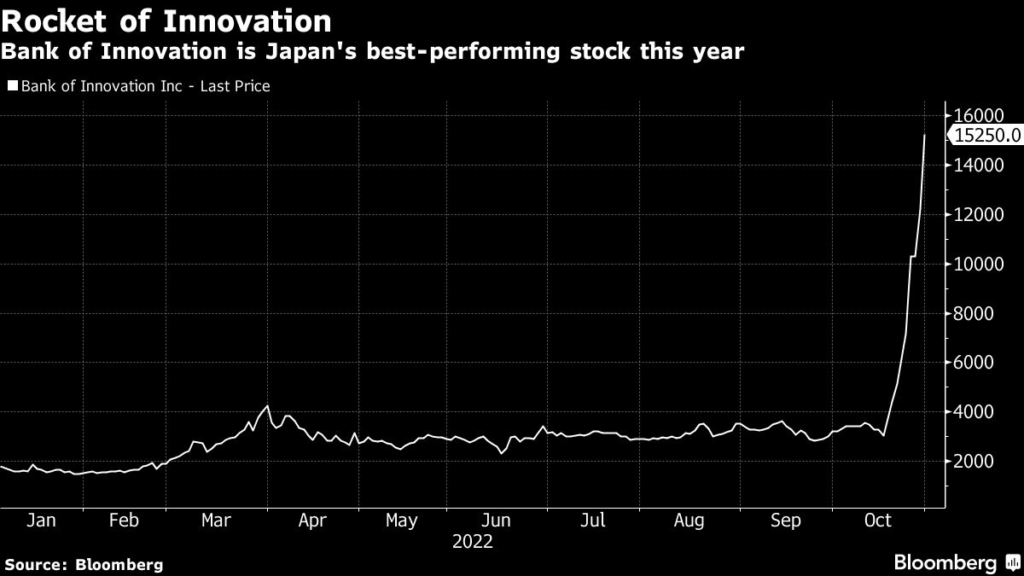
(Bloomberg) — Bank of Innovation Inc., a little-known games publisher based in Tokyo’s Shinjuku, has a hit on its hands that’s propelled its shares to Japan’s best performance of the year.

Traded on Tokyo’s Mothers market for startups, BOI is up 790% this year, with its biggest surge coming since the Oct. 18 release of mobile role-playing game Memento Mori. Featuring high-profile musicians and voice actors, the game charges almost double for in-game content compared to local competitors — without alienating users.

Game production for mobile platforms has risen in cost and complexity in recent times, but Japanese studios have been reluctant to pass on those costs to players. BOI’s move to raise prices from the traditional 300 yen ($2) or less to more than 500 yen could open the door for others in the industry to follow suit. The game, also available on PC, had more than 1.2 million global pre-registrations and nearly half a million downloads in its first five days of availability in Japan.

Memento Mori brought in 1.8 billion yen in sales over those first five days, validating the upfront production investment as well as the choice to hike pricing in the game. It’s been among the top 10 grossing games on iPhone in Japan since its launch. BOI’s eightfold gain this year has brought its market value to about $400 million.

“The move is a big surprise,” said Hideki Yasuda, an analyst at Toyo Securities. “With the rising cost of making games, many mobile game companies have long wanted to raise prices, but none of them went ahead for fear of losing customers. But with Memento Mori’s success, other firms could follow the move with their new games.”

More stories like this are available on bloomberg.com

©2022 Bloomberg L.P.

Musk Polls Twitter Users on Bringing Back TikTok Precursor Vine

(Bloomberg) — Elon Musk has started a poll on Twitter Inc. asking users whether he should bring back short-video app Vine, which was shut down by the social media platform in 2016.

Musk has previously run polls on whether he should sell 10% of his stake in Tesla Inc. and if the platform should include an edit button. While the votes did side in favor of the final outcome, it’s unclear how much of an influence they played.    

Twitter bought Vine in 2012 and it helped a raft of internet stars get noticed by a wider audience. Those creators eventually left the platform over disagreements over compensation. It was then shut after Twitter was unwilling to continue investing in the app. The following year ByteDance Ltd. acquired Musical.ly before combining it with its own short-video service TikTok.

More than 700,000 users voted in the Vine poll so far, with 72% voting Yes as of 12:15 a.m. New York time.

More stories like this are available on bloomberg.com

©2022 Bloomberg L.P.
iPhone Assembler Foxconn Moves to Limit Plant Disruption as Shares Slide

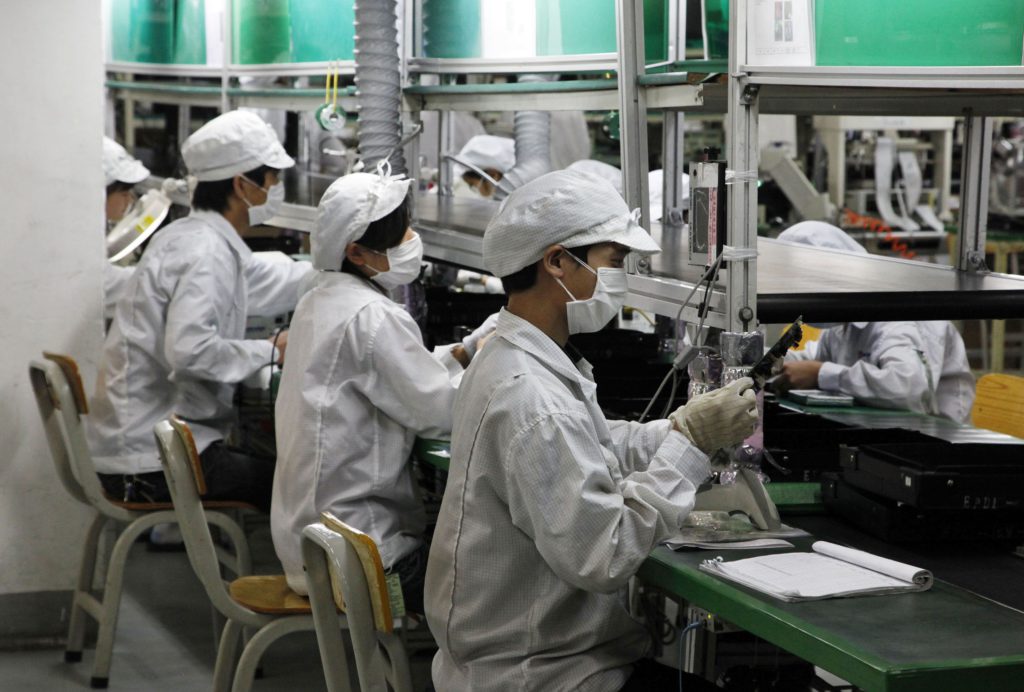
(Bloomberg) — Foxconn Technology Group’s main listed arm fell the most in three weeks, after the world’s largest maker of iPhones said it may boost capacity at alternative sites to mitigate potential disruption at its main Covid-stricken plant in China.

Foxconn, whose listed vehicle is Hon Hai Precision Industry Co., is grappling with mounting concern that a Covid flare-up at its main Zhengzhou plant could hurt production just as Apple Inc. gears up for the holiday season. The Taiwanese company also makes iPhones at a factory in Shenzhen, which together with Zhengzhou cranks out the majority of the world’s iPhones. Its shares fell as much as 2.4% Monday in Taipei.

Social media erupted over the weekend with photos and videos of workers departing the Zhengzhou plant, some on foot, to return to hometowns miles away. They were seeking to escape hastily enacted Covid-prevention measures that have left many of the 200,000 staff grappling with inadequate living conditions. Other videos depicted local residents offering food and shelter to some of the departing staff. 

Bloomberg hasn’t verified the authenticity of the content. But the rising tensions underscore the economic and social costs of Xi Jinping’s Covid Zero policy — a rigorously policed system of mass testing and lockdowns that has fostered growing resentment. It also shows the potential risk to global supply chains and products from China’s approach.

“Further developments will be important as 4Q is the peak season for iPhone shipments,” Morgan Stanley analysts wrote. “The potential impact on iPhone production is worth monitoring as Zhengzhou is one of Hon Hai’s major production sites, particularly for iPhone assembly.”

Read more: Workers Leave Biggest IPhone Plant to Escape Covid Curbs

It’s unclear how many workers were allowed to leave Foxconn. The company hires many temporary staff from nearby regions to assemble electronics including Apple’s latest iPhone 14 devices. Foxconn last week described the situation as a “small” outbreak. 

“We are deeply aware that it’s a ‘protracted war’ in terms of how to take care of over 200,000 workers and their security” in Zhengzhou, Foxconn said in a Monday stock exchange filing.

Discontent has been brewing among staff at Foxconn’s main factory in Zhengzhou, where the emergence of Covid cases saw it go into a closed loop system. Food became a source of unrest after the company shut cafeterias at the manufacturing site known as “iPhone City.” 

At one point, only workers on production lines were given meal boxes, with those infected or afraid to leave their company-provided dormitories given more basic fare like bread and instant noodles, Bloomberg News reported. On Monday, Foxconn said the local government had agreed to let it re-open cafeterias on campus.

The “Zhengzhou park operation, in coordination with the government’s epidemic prevention, is gradually coming under control,” Foxconn said in a brief statement Sunday. “The Group will also coordinate back-up production capacity with our other parks to reduce any potential impact.”

The discontent comes at a crucial time for Apple, which launched the iPhone 14 during an unprecedented slump in global electronics demand. While faring better than other smartphone makers, it’s backed off plans to increase production of its new iPhones this year after an anticipated surge in demand failed to materialize, Bloomberg has reported. Apple reported better-than-expected results Thursday but warned of a holiday slowdown.

Any disruption at Zhengzhou threatens to snarl Apple’s finely orchestrated supply chain. Thousands of components from Europe to Asia are shipped into Zhengzhou, assembled manually into devices, then shuttled off to the rest of the world.

–With assistance from Ville Heiskanen.

More stories like this are available on bloomberg.com

©2022 Bloomberg L.P.
Blinken Speaks With China’s Top Diplomat in Latest Sign of Thaw

(Bloomberg) — US Secretary of State Antony Blinken spoke with Chinese Foreign Minister Wang Yi, the latest in a series of such exchanges ahead of a possible face-to-face meeting between the nations’ presidents.  

The two discussed the need to maintain an open dialogue and responsibly manage their relationship, the State Department spokesperson Ned Price said in a statement late Sunday. Blinken raised concerns about Russia’s war against Ukraine and the threats it poses to global security and economic stability, Price said. 

The pair also spoke about the deteriorating humanitarian and security situation in Haiti and the need to provide continued support. 

John Kirby, a spokesman for President Joe Biden’s National Security Council, said last week that teams were still working through a possible meeting between Biden and Chinese President Xi Jinping when world leaders gather at a Group of 20 meeting in Bali, Indonesia, in November. If a meeting were to happen, it would be Biden’s first sit-down as president with the Chinese leader. 

Nicholas Burns, the US ambassador to China, also met with Wang on Friday, almost eight months after the envoy arrived in Beijing. Last week, Xi said in a letter to a New York-based group supporting stronger bilateral ties that Beijing was willing to find a way to get along with Washington.  

The comments from Xi struck a conciliatory tone after a Communist Party congress during which he secured a norm-breaking third term in power and promised China would stand its ground in a more hostile world.

More stories like this are available on bloomberg.com

©2022 Bloomberg L.P.

Asian Stocks Gain on Earnings Optimism, Yen Drops: Markets Wrap

(Bloomberg) — Asian stocks rise, tracking Friday’s gains in the US, with optimism over corporate earnings helping to drive an advance in Japan. The dollar climbed as traders start to position for a policy decision by the Federal Reserve. 

An index of Asian equities on Monday climbed for the fourth time in five days. Apple Inc.’s earnings report on Friday had buoyed technology shares, helping the S&P 500 and the Nasdaq 100 notch their longest weekly rising streak since August. Tech equities in Hong Kong jumped, with gains seen from Japan to Australia. US futures pared losses.  

The yen fell against all its Group-of-10 peers, with economists expecting the Fed to raise rates by another 75-basis-points this week, widening the policy divergence with the Bank of Japan. A core gauge of US inflation accelerated in September, bolstering the case for more tightening. 

Meanwhile, wheat soared after Russia exited a key agreement to allow Ukrainian crop shipments. 

The yield on the 10-year Treasuries hovered at around 4% after surging by nine basis points on Friday. Yields climbed in Australia ahead of a policy decision by the country’s central bank on Tuesday.

Read: Treasuries Swept Up in Global Rout as Inflation Fears Resurface

“The question is does the narrative of front loading come to an end? I think that’s where the market’s waiting for this pivot,” Priya Misra, global head of rates strategy at TD Securities, said on Bloomberg Radio. “I just think if the Fed can signal that they can go 75 and then they can slow down the pace of hikes, I think the market will be comforted by that.”

Economists surveyed by Bloomberg expect Fed officials will maintain their hawkish stance, laying the groundwork for interest rates reaching around 5% by March 2023, potentially leading to a US and global recession.

Brazil’s local assets are set to weaken on Monday after Luiz Inacio Lula da Silva won the presidential election. The extent of the market drop will depend on whether President Jair Bolsonaro will concede as a contested election would likely trigger larger losses.

Oil headed for the first monthly advance since May ahead of output cuts by the OPEC+ alliance, which may tighten the market further.

Key events this week:

  • Companies reporting earnings this week include: Moderna, Pfizer, Airbnb, AIG, Maersk, Barrick Gold, BMW, Bharti Airtel, BP, ConocoPhillips, Estee Lauder, Ferrari, ING, Intercontinental Exchange, KKR, Mitsui, Newmont, Petrobras, Qualcomm, Restaurant Brands, Saudi Arabian Oil, SoftBank, Sony, Starbucks, Toyota, Uber and Yum! Brands.
  • Eurozone CPI and GDP, Monday
  • Reserve Bank of Australia policy decision, Tuesday
  • US construction spending, ISM manufacturing index, Tuesday
  • EIA crude oil inventory report, Wednesday
  • Federal Reserve rate decision, Wednesday
  • US MBA mortgage applications, ADP employment, Wednesday
  • Bank of England rate decision, Thursday
  • US factory orders, durable goods, trade, initial jobless claims, ISM services index, Thursday
  • ECB President Christine Lagarde speaks, Thursday
  • US nonfarm payrolls, unemployment, Friday

Some of the main moves in markets:

Stocks

  • S&P 500 futures fell 0.2% as of 12:05 p.m. Tokyo time. The S&P 500 rose 2.5% Friday
  • Nasdaq 100 futures fell 0.3%. The Nasdaq 100 rose 3.2%
  • Japan’s Topix index rose 1.3%
  • South Korea’s Kospi index rose 0.9%
  • Hong Kong’s Hang Seng Index added 0.5%
  • China’s Shanghai Composite Index dropped 0.1%
  • Australia’s S&P/ASX 200 Index rose 0.8%

Currencies

  • The Bloomberg Dollar Spot Index rose 0.1%
  • The euro fell 0.1% to $0.9955
  • The Japanese yen fell 0.3% to 148.06 per dollar
  • The offshore yuan fell 0.2% to 7.2797 per dollar

Cryptocurrencies

  • Bitcoin fell 1% to $20,478.11
  • Ether fell 1.3% to $1,574.93

Bonds

  • The yield on 10-year Treasuries advanced two basis points to 4.04%
  • Yields on Australia’s 10-year bonds rose two basis point to 3.76%

Commodities

  • West Texas Intermediate crude fell 0.5% to $87.49 a barrel
  • Spot gold fell 0.2% to $1,641.74 an ounce

–With assistance from Garfield Reynolds.

More stories like this are available on bloomberg.com

©2022 Bloomberg L.P.
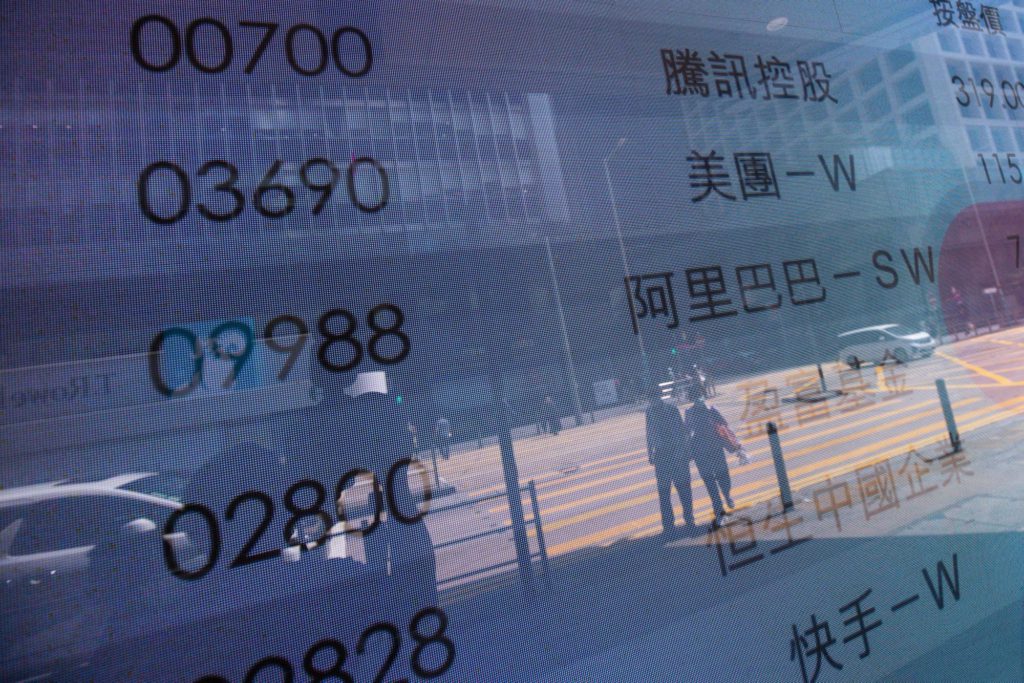
Wild Swings Greet China Stock Traders After Post-Congress Rout

(Bloomberg) — Chinese shares saw big swings early on Monday, as a ramp-up of Covid restrictions and poor economic data worsened the outlook for the market, while some dip-buyers emerged. 

The Hang Seng China Enterprises Index slumped as much as 2.2% early Monday, before erasing all the losses. Tech shares surged following automaker BYD Co.’s record earnings while property stocks plunged. The CSI 300 Index, a benchmark of onshore shares, fell as much as 1.3% before paring a bulk of the decline.

Chinese stocks have faced relentless selling pressure through most of the year, hammered by Covid curbs and tensions with the US. Sentiment suffered a fresh blow after President Xi Jinping’s power grab and his recommitment to the Covid Zero strategy at the Community Party congress, which spurred the worst ever five-day rout for the Hang Seng China gauge following any leadership meet since its 1994 inception.  

Down nearly 40% this year, the Hang Seng China Enterprises Index is the worst performer among more than 90 global equity measures tracked by Bloomberg. The gauge stared at its lowest close since 2005 at one point early on Monday before trading up 0.7% as of 10:43 a.m. in Hong Kong.

“Investors appear to be increasingly concerned about three issues in particular,” namely that China’s reopening might take longer than expected, China’s social priorities may take precedence over the economy and Beijing’s emphasis on security means a higher risk premium, Nomura Holdings Inc. strategists including Chetan Seth wrote in a note.

China’s factory and services activity contracted in October, data showed on Monday. That signaled Covid curbs and an ongoing slump in the property market are continuing to pressure the world’s second-largest economy. The official manufacturing purchasing managers index fell to 49.2, below an estimate of 49.8 in a Bloomberg survey.

Read: China Factory, Services Activity Slump as Covid Hits Recovery

Policymakers last week imposed fresh lockdowns from Wuhan to the nation’s industrial belt on the east coast, following a pickup in cases. Meantime, Macau mandated residents to undergo three days of rapid Covid tests and locked down a casino resort over the weekend.

The biggest drag on the HSCEI was Longfor Group Holdings Ltd. which plummeted most on record following the resignation of its chairman. 

Read: Longfor Billionaire Wu Quits as Chair, Shocking Investors (1)

More stories like this are available on bloomberg.com

©2022 Bloomberg L.P.

Japan’s Production Falls as Cars Drag on Solid Third Quarter

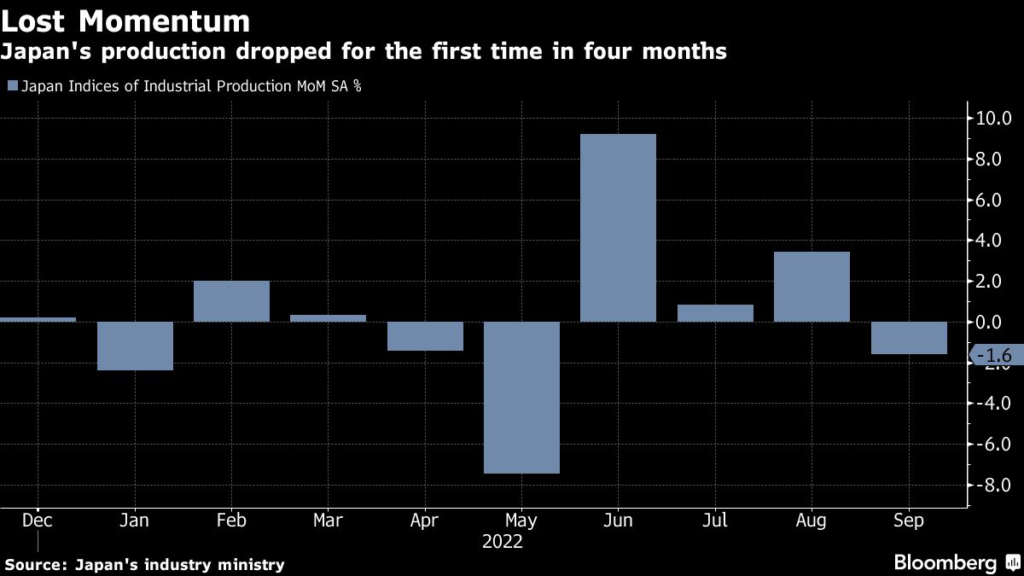
(Bloomberg) — Japan’s factory output fell in September for the first time in four months, as a slump among carmakers weighed on an otherwise solid gain for the third quarter.

Industrial production declined 1.6% from August, turning negative after three straight months of increase, according to the industry ministry Monday. Economists had forecast a 0.8% drop. The decrease in carmakers’ output dragged on overall figures by 1.85 percentage points, accounting for most of the fall. 

Still, production in the third quarter saw output gaining 5.9%, a positive sign for Japan’s continued recovery from the pandemic. 

“Production plans by automakers don’t suggest a strong rebound in the fourth quarter,” said Mari Iwashita, chief market economist at Daiwa Securities Co. “With exports and production lacking strength, the economy will have to rely on consumption in the fourth quarter.”

A separate industry ministry report showed retail sales increased 1.1% in September from August, rising for a third straight month. Spending on food and beverages and general merchandise led gains.

The Federal Reserve and other major central banks have been aggressively raising their interest rates, cooling down their respective economies. The impact appears to have begun to hit some producers in Japan, who may face a further slowing of global demand.

Earlier this month Toyota Motor Corp. warned it expects to miss its fiscal-year target of assembling 9.7 million vehicles, as a persistent shortage of semiconductors and other parts weighs on the carmaker and its global rivals. Honda Motor Co. said it will continue to reduce its car production at its plants in Japan through the end of October due to ongoing disruptions in parts supply.

Japan’s currency has slumped to a three-decade low against the dollar this year, a move that has pushed up the import bills particularly for energy and food. Inflation in the nation also hit 3% for the first time in over three decades excluding the impact of tax hikes, weighing on households’ spending power as wages continue to lag price gains.

What Bloomberg Economics Says…

“Looking ahead to October, we expect production to increase as companies make up for September’s lost ground and move to fill export orders buoyed by the weaker yen. But downside risks are high.”

— The Asia economist team

For the full report, click here

To protect people from accelerating inflation, and to support the recovery, the government unveiled a 29.1 trillion yen ($197 billion) economic-support package on Friday. A centerpiece of the plan includes measures to reduce energy costs, which will save the average household about 45,000 yen next year according to the government.

“I expect consumption to strengthen as the government tourism support increases the traffic of people,” said Daiwa’s Iwashita. “But I’m not seeing enough evidence to think the momentum will be intact into the next year.”

More details from the reports:

  • Industrial production is forecast by companies to fall 0.4% in October and gain 0.8% in November. Those projections tend to be overly optimistic.
  • Retail sales increased 1.1% in September from August and climbed 4.5% from a year ago. Analysts had forecast a 0.8% gain and a 4.1% increase respectively.

(Updates with more details, economist comments)

More stories like this are available on bloomberg.com

©2022 Bloomberg L.P.

From Sony to Kakao, Here Are the Asian Company Earnings to Watch

(Bloomberg) — Asia’s earnings spotlight shifts to Japan this week with Toyota, Sony and Nomura scheduled to release quarterly results. As Bank of Japan’s ultra-easy monetary policy continues to pressure the yen, investors will be on high alert for any adjustment to Japanese companies’ forecasts.

In other parts of the region, Macau casino operator SJM Holdings and Singapore Airlines are expected to announce earnings as well. It is worth watching out for how the companies evaluate the impact of Covid restrictions in China amid recent flare-up of cases, which triggered workers departing Apple’s biggest iPhone plant in China and new rounds of mandatory Covid tests in Macau. 

Adding to the uncertainties, Federal Reserve officials will meet for their Nov. 1-2 policy meeting, at which they’re expected to raise the benchmark lending rate by 75 basis points for a fourth-straight time. With last Monday’s historic selloff of Chinese stocks in the US and Hong Kong still fresh on traders’ minds, the market could react strongly to any earnings disappointment or policy shifts. 

  • To subscribe to earnings coverage across your portfolio or other earnings analysis, run NSUB EARNINGS function on the Bloomberg terminal.
  • Follow results, analysis and market reaction to Nomura’s report in real-time on the TOPLive blog.
  • For more on what’s going on in other regions, see the US Earnings Week Ahead and the EMEA Earnings Week Ahead, and the ESG Stock Watch for a selection of environmental, social and governance themes that may come up on this week’s earnings calls.

Highlights to look for this week:

Monday: SJM Holdings (880 HK) will announce third-quarter results after market close. Adjusted Ebitda loss for the July-September period is expected to widen to about HK$758 million ($97 million) from HK$460 million a year earlier, according to Bloomberg consensus. Macau casino operators have had a few tough years with China’s crackdown on corruption followed by Covid-19 curbs. SJM may have suffered more than its peers as it took over 10 satellite casinos in June and its operating expenses will rise faster than revenue, Bloomberg Intelligence’s Angela Hanlee wrote. The sector is pinning its hopes on more Chinese visitors to bring in much-needed revenue as local government has said that the resumption plan for Chinese group tours won’t be affected if no community Covid cases are found in the city. Still, investors may approach Macau casino shares with trepidation as the government on Sunday asked residents to undergo three days of rapid Covid tests and locked down the MGM Cotai resort. 

  • ESG in Focus: LG Chem Ltd. (051910 KS), along with subsidiary LG Energy, has announced several multi-billion dollar deals that will help the Korean manufacturer stake its claim in the burgeoning US electric vehicle market, as well as qualify its batteries for incentives included in the Inflation Reduction Act. Thanks to its US-based plants, just under half of LG Energy’s production costs could be subsidized under the IRA, providing a major boost to profit margins. To read more, see the ESG Stock Watch.

Tuesday: Toyota Motor (7203 JP) is set to report second-quarter earnings during trading hours. The auto industry has been hit hard by parts shortages and Covid lockdowns in China, and the world’s biggest carmaker is no exception. It recently warned that it expects to miss its target of manufacturing 9.7 million vehicles this fiscal year due to ongoing difficulties in procuring semiconductors and other components. The market will be looking for updated guidance on that front. Adding to its woes, Toyota likely can’t count on a weakening yen to significantly boost income — it didn’t raise its full-year operating profit forecast last quarter despite revising its foreign exchange assumption, as it expects to be weighed down by soaring raw material costs.

  • Weak Yen: Sony Group (6758 JP) is scheduled to release second-quarter results after market close. Analysts expect the Japanese electronics and entertainment giant’s operating profit to have dropped 14% from a year earlier, according to a consensus estimate. Its gaming business might have been weighed down by PlayStation 5 production bottlenecks and yen weakness due to dollar-based costs, according to Bloomberg Intelligence. The Tokyo-based company has said conditions for the flagship console are improving, and investors will be looking for updates heading into the holiday shopping season. Meanwhile, image sensors used in recently-launched iPhones may provide a bright spot, as could the movie and music businesses, all of which are expected to benefit from a weaker yen, BI said.

Wednesday: Nomura Holdings (8604 JP) will announce second-quarter earnings after market close. Japan’s largest brokerage barely made a profit in the previous three months amid a fall in underwriting and losses tied to its stake in mutual fund manager American Century Investments. While Chief Executive Officer Kentaro Okuda has pledged to diversify revenue streams and cut Nomura’s dependence on fixed income, the process may not immediately bear fruit, with Bloomberg Intelligence saying income recovery could be slow due to weak equity and investment trust sales. Investors will also be watching how the company’s retail business stacks up compared to smaller rival Daiwa Securities Group, which reports earnings on Monday, after falling behind for two straight quarters.

Thursday: Kakao Corp. (035720 KS) plans to release third-quarter results in the morning. The operator of South Korea’s most widely-used mobile messaging app and taxi-hailing app is likely to post an 8% increase in third-quarter operating profit to about 182 billion won ($128 million), according to an average consensus of 24 analysts polled by Bloomberg. Investors are expected to focus on the company’s comments on the impact of a data-center fire on Oct. 15, which caused a nationwide service blackout and prompted one of its co-CEOs to step down. Since then, multiple brokerages have lowered their price targets on Kakao, with JPMorgan analyst Stanley Yang slashing his 39% to 46,000 won, the lowest price target contributing to Bloomberg consensus. Speaking at a parliament audit hearing in Seoul last Monday, Kakao founder Brian Kim apologized for the service disruptions and promised compensation as lawmakers considered stepping up scrutiny of the company.

Friday: Singapore Airlines (SIA SP) will release its second-quarter earnings after market close. As travel rebounds, operating profit for the quarter is expected to rise for the first time since the start of the pandemic to over S$600 million, thanks to a 22% increase in revenue passenger kilometers, according to Bloomberg Intelligence. First-half earnings may reach about S$1.2 billion. In September, the airliner reported group airlines passenger load factor of 87%, compared to 18.5% a year earlier. The carrier saw continued momentum in travel recovery across all route regions except for East Asia, where restrictions remained in place in some key markets. Strong demand could have lifted yield and supported profitability amid higher fuel and staffing costs, as well as helped to offset a drop in cargo profits as pricing wavered amid weakening global freight demand. The company is also likely to maintain a strong balance sheet even after redeeming S$3.5 billion of mandatory convertible bonds, BI said.

–With assistance from Zoe Ma.

(Updates top graphs and adds highlights for LG Chem and Singapore Airlines.)

More stories like this are available on bloomberg.com

©2022 Bloomberg L.P.
Close Bitnami banner
Bitnami