Bloomberg

Apple Issues New App Store Rules for Crypto and NFT Payments

(Bloomberg) — Apple Inc. updated its App Store guidelines Monday with new and clearer language explaining its policy toward cryptocurrency trading and non-fungible tokens.

The Cupertino, California-based company has no issue with crypto exchanges or any other apps that allow the trading of digital tokens and currencies — provided those exchanges have the requisite regional licenses to operate where the app is distributed. 

But in order for apps to sell NFTs and related services, they’ll have to go through Apple’s in-app purchase systems and “may not include buttons, external links, or other calls to action that direct customers to purchasing mechanisms other than in-app purchase.”

The fight to funnel payments through Apple’s own payment system, justified by the iPhone maker as the only sure way to secure users and their sensitive information, has spanned legal tussles with Fortnite maker Epic Games Inc. and confrontations with governments like South Korea’s. 

Apple charges a typical 30% fee on payments it handles, which has yielded significant income from products like Fortnite that include a lot of in-game content unlockable by deep-pocketed players.

Apple specifically guides against any app functionality that lets NFT holders “unlock features or functionality within the app,” which may have served as an oblique workaround to its payments rule. That may affect some NFT projects that use the token like a membership card, providing added perks and access not otherwise accessible.

Still, Apple will allow users to display, browse and share their NFT collection with others in apps across its iPhones and iPads.

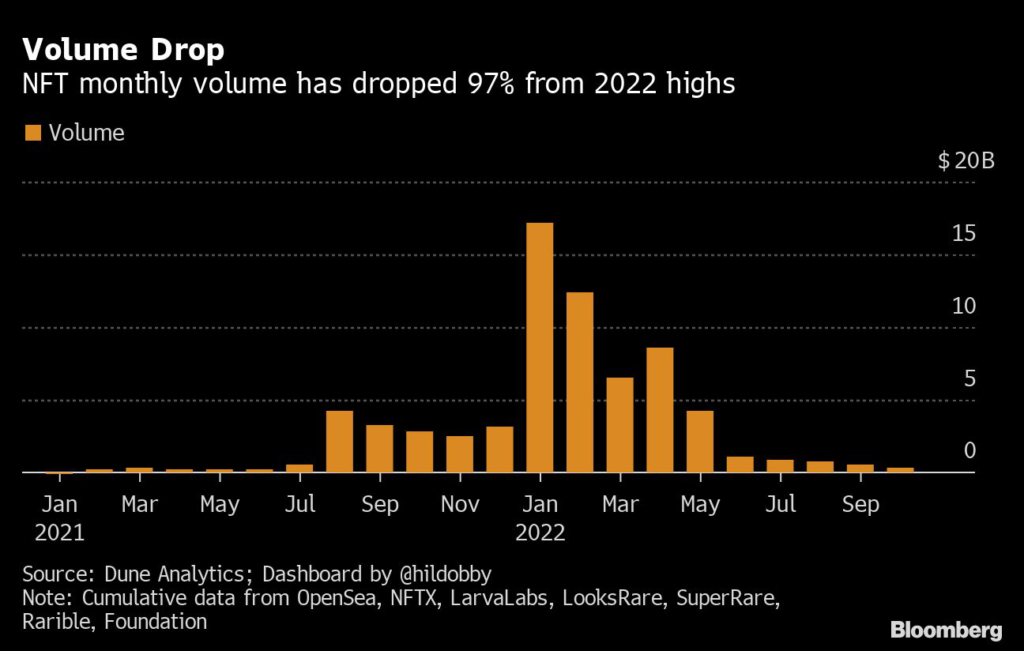
Trading volumes for NFTs — digital art and collectibles recorded on blockchains — have plummeted 97% from their January record high after a series of economic shocks and crypto sector blowups soured appetites for digital assets. 

–With assistance from Sidhartha Shukla.

More stories like this are available on bloomberg.com

©2022 Bloomberg L.P.

Shunned Digital Currency Looks for Street Credibility in Nigeria

(Bloomberg) — A year after launching Africa’s first digital currency, Nigeria’s central bank is turning to the nation’s three-wheeler taxi operators to speed the adoption of the eNaira, as regulators across the world scrutinize its every move.

It’s offering a 5% discount to drivers and passengers of the motorized rickshaws — known locally as Keke Napep — who use the eNaira. It’s the latest attempt to kickstart the digital currency, which has so far attracted just one in 200 people in the continent’s most populous country.

The central bank’s focus on the digital currency is creating confusion among many Nigerians, who fail to see the difference between the government-backed eNaira and cryptocurrencies. For drivers of Keke Napep, the most popular form of transport around the gridlocked streets of Lagos and other cities, the heavy promotion of the eNaira just as authorities crack down on cryptocurrencies has them befuddled. The Central Bank of Nigeria has barred commercial banks from doing business with crypto exchanges.

“Why is it asking us to collect eNaira?” said 23-year-old driver Hamed Lawan. “I thought the government said cryptocurrency is bad?”

When Nigeria became the first African nation to start a central bank digital currency, or CBDC, it was partly targeting the almost 40 million people in the country without a bank account. Policy makers also hoped to take a share of Nigeria’s multi-billion dollar remittance flows and widen the country’s tax base.

Disappointing Results

The results, so far, have been disappointing. While the eNaira uses similar distributed ledger technology as Bitcoin or Ethereum and can be saved in digital wallets, Nigerians’ passion for cryptocurrencies doesn’t extend to the central bank offering. 

Virtual currencies have lured residents of Africa’s top oil producer as a hedge against inflation and currency depreciation, but eNaira is seen as a proxy for the challenges facing the continent’s biggest economy and a symbol of distrust in the ruling elite.

Educating Nigerians about the digital currency is a key task for both the central bank and the government. As the largest economy to fully launch, it’s also being scrutinized by the more than 100 nations considering their own CBDCs, according to Josh Lipsky, senior director of the Atlantic Council’s GeoEconomics Center.

“Nigeria’s project is hugely important to the world,” he said. “My bottom line on Nigeria is the jury is still out, but the world is paying close attention to what they’re doing.”

CBDCs emerged amid the rise of thousands of cryptocurrencies, which are disrupting traditional payment systems and pushing central bankers to innovate to compete. The digital money aims to make payments safer, cheaper and more reliable, while giving governments in poorer nations an alternative to underdeveloped banking systems.

Although central banks typically are not aiming for universal adoption, they do need to achieve a critical mass of users, said Tommaso Mancini-Griffoli, a deputy division chief in the Monetary and Capital Markets Department at the International Monetary Fund. Authorities are targeting the “sweet spot,” as excessive CBDC usage could disrupt the flow of credit and potentially dis-intermediate commercial banks overnight, he said.

Mis-Targeted Messaging

The relatively low adoption up until this point, while not uncommon for countries in the early phases of launching a digital currency, may be caused by insufficient incentives for commercial banks or mis-targeted consumer messaging, according to John Kiff, managing director of the CBDC Think Tank.

Nigeria’s central bank remains upbeat. After attracting almost 1 million people to its digital platform, it’s targeting 8 million users by next August.

All the eNaira needs is “a little push from the government,” said Kingsley Obiora, deputy governor in charge of economic policy at the central bank.

While virtual currencies have crashed this year, their speculative appeal still draws Nigerians, who can also use them to bypass the central bank’s foreign currency restrictions, according to Adesoji Solanke, director at Renaissance Capital in Lagos. 

A shortage of dollars has prompted the central bank to ration foreign exchange in the official market prompting residents to turn to the more expensive parallel market and cryptocurrencies. 

“The eNaira does not address any of these basic use cases, so no surprise at its low adoption rates so far,” Solanke said. 

Even though the central bank last year asked lenders in the West African nation not to transact with cryptocurrency exchanges, Nigeria ranked 11th in the world in adopting cryptos, according to blockchain specialist Chainalysis Inc.

Nigeria’s enthusiasm for virtual currencies partly reflects a long history of naira depreciation. Africa’s largest economy has devalued the naira about six times since 2015, and Bank of America Corp. economist Tatonga Rusike expects a further 20% weakening next year. Those concerns are compounded by record interest rates and inflation at a 17-year high. 

That makes the eNaira a hard sell, particularly as it faces competition from established mobile-banking apps. With money loaded on eNaira wallets not counting as cash on a lender’s book, banks also have little incentive to market the digital currency, said Babatunde Obrimah, chief operating officer of the Fintech Association of Nigeria. 

At the same time, millennials and Generation Z — the main cryptocurrency users — are suspicious of the central bank’s project.

“They see the regulator as hostile to them and therefore have no interest in anything it introduces,” Obrimah said. 

Since August, Nigerians without bank accounts have also been able to open eNaira wallets using a so-called USSD code and their mobile phones. Still, the government may need to provide further impetus, according to Adedeji Olowe, founder of Open Banking Nigeria.

Central Bank Deputy Governor Obiora echoes that sentiment, suggesting that if half of government salaries were paid in eNaira it could be a “game changer.”

A positive sign is that those who have adopted the eNaira are active users, according to Lipsky of the Atlantic Council. That’s the opposite of China, where hundreds of millions opened wallets during a pilot CBDC phase but with very low activity for the average user, he said.

For the moment, the eNaira continues to struggle, especially among the poorest communities it’s targeting.

“Did you say eNaira? I don’t even have a bank account, let alone an eNaira account,” said Adamu Alidu, another taxi driver in Abuja. “Me, I don’t know anything about it.”

–With assistance from Emele Onu.

More stories like this are available on bloomberg.com

©2022 Bloomberg L.P.

Deutsche Bank Executive Says ESG Is Now Entering ‘Phase Three’

(Bloomberg) — First, no one had heard of it. Then everybody was touting it. Now, people are rethinking what it is.

Environmental, social and governance investing has entered “Phase 3,” according to Markus Müller, the chief investment officer for ESG at Deutsche Bank AG’s private banking arm.

“With Phase 3, we are likely to have both consolidation and reorientation in ESG investing,” he said. “I don’t think that investors will materially reduce or stop allocations to ESG as they wait for better information, but they will continue to reassess and reorient investment approaches.”

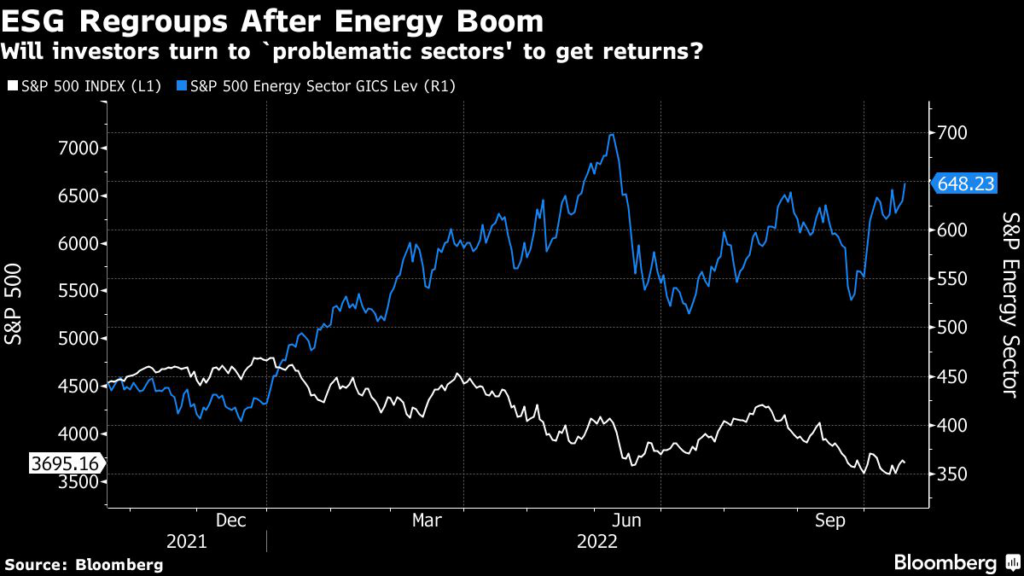
The big game-changer for ESG this year was the energy crisis. Fund managers who weren’t exposed to energy assets are now regrouping to make sure they don’t get wrong-footed again. Müller points to the huge gains ESG investors have missed out on by snubbing oil and gas assets, with the S&P 500 Energy Index up almost 60% this year, while the broader S&P index is down about 20%.

That “performance shortfall has led to a broader debate” within the ESG fund industry, according to Müller.

The challenge ESG fund managers now face is figuring out whether to include “certain potentially problematic sectors” in their ESG strategies to make sure investment clients don’t miss out on returns, Müller said.

Such observations come as ESG faces its toughest year yet. Vladimir Putin’s war on Ukraine revealed that billions of dollars in ESG funds had been placed in Russian state-backed assets, as some strategies failed to protect investors from clear social and governance risks. Those losses were exacerbated by a boom in commodities that ESG investors had tended to steer clear of. And tech stocks, a staple of ESG funds, slumped.

As if that weren’t enough, financial firms embracing ESG strategies have found themselves on blacklists in a number of Republican states in the US. Combined with a tougher ESG regulatory environment, ESG fund managers are therefore arguably enduring the toughest phase of their careers.

Meanwhile, the need to invest in asset classes that enable a transition to a lower-carbon economy is greater than ever, Müller said.

“It is essential we have a broad and wide-ranging debate about how to deal with current economic transformation,” he said. “This debate will encourage better information flows that can underpin future ESG investment approaches.”

Ultimately, money will continue to flow into ESG, according to Müller.

“I don’t see any long-term reduction in ESG allocations,” he said.

(Updates S&P index values)

More stories like this are available on bloomberg.com

©2022 Bloomberg L.P.
Toronto Mayor Wins Third Term Pledging to Fix Housing Crisis

(Bloomberg) — John Tory cruised to a third term as mayor of Toronto, as voters in Canada’s financial capital opted for a status-quo candidate with a strong fiscal pedigree at a time of growing economic uncertainty.

It’s the first time any mayor has won three consecutive elections in Toronto since it was merged with five other municipalities to create an enlarged city in 1998. Tory had 62% of the vote with the vast majority of polls counted as of 11:56 p.m. Toronto time, according to the city’s election website. Gil Penalosa, an urban planner and consultant, was second with 18%. 

Canada’s largest city is facing a number of challenges, including the lingering financial effects of Covid-19 lockdowns, a likely recession and a housing affordability crisis. 

Among Tory’s main campaign promises was a pledge to fix the housing crisis. Years of rising prices and the recent surge in mortgage rates has kept home ownership out of reach for many residents, and rents are rising. Tory’s plan involves opening up vast tracts of residential land currently dedicated to single-family homes to multiplexes and apartment buildings.

That promise resonated with voters, even as Tory’s Bay Street credentials won support from the right. A fiscal conservative, Tory hails from an established Toronto business family; a storied law firm, Torys LLP, was founded by his grandfather. The mayor previously served as leader of Ontario’s Progressive Conservative party.

Thirty-one candidates ran for the mayor’s office in Toronto, which has about 2.8 million people. 

Elections for four-year terms also happened in other municipalities across Ontario. In Ottawa, voters elected former broadcaster Mark Sutcliffe after a contentious campaign that divided members of the country’s governing Liberal Party. Sutcliffe’s main opponent, city councilor Catherine McKenney, received endorsements from high-profile Liberals including former Bank of Canada and Bank of England Governor Mark Carney. 

Read more: Low-Key Mayor Floats Fix for World’s Biggest Housing Bubble

(Updates vote tally in second paragraph)

More stories like this are available on bloomberg.com

©2022 Bloomberg L.P.

Global Stocks Extend Gain Amid Volatility in China: Markets Wrap

(Bloomberg) — Global equities extended an advance amid sharp swings in Chinese stocks while other key markets around the region followed Wall Street higher following optimism from early US earnings reports.

Hong Kong and mainland shares swung back to gains Tuesday, with the biggest move in the hard-hit technology sector. The Hang Seng Index rose around 1% after suffering its worst day since the financial crisis on Monday as investors reacted to President Xi Jinping tightening his control of government. 

An index of global equities rose fractionally after advancing over the past two days. Markets in Japan and Australia reflected gains in the the US on Monday while futures for the S&P 500 fluctuated during Asian trading. 

The offshore yuan fell to the lowest level since trading began a dozen years ago, as Xi’s power grab raised concern that concentrated decision-making could weaken growth and destabilize geopolitics. The decline extended after China’s central bank set the official fixing rate for the currency at the lowest level in 14 years.

“We’re certainly staying away from the Chinese market right now because the political scene is not favorable,” Laila Pence, president of Pence Wealth Management, said in an interview on Bloomberg TV. “There’s a lot less risk in the US and just as much upside.”

A fifth of S&P 500 companies have now posted third-quarter earnings with more than half outperforming estimates. Microsoft Corp., Alphabet Inc., Amazon.com Inc. and Apple Inc. report this week. The iPhone maker raised prices for its subscription music and TV services, citing higher input costs.

Manufacturing and services data for the US underwhelmed, indicating Federal Reserve rate hikes are beginning to slow activity. Fed officials have entered a blackout period ahead of the central bank’s meeting next week, where it’s expected to raise rates 75 basis points.

Elsewhere in markets, a gauge of the dollar slipped as traders speculated that the Federal Reserve may be approaching the end of its aggressive tightening campaign. Treasury 10-year yields fell back toward 4.20%, with yields also declining in Australia and New Zealand.

Oil steadied as traders assessed near-term supply tightness in the crude market and broad appetite for risk assets including commodities. Gold was also steady in Asia.

Key events this week:

  • Earnings due this week include: Apple, Microsoft, Exxon Mobil, Ford Motor, Credit Suisse, Airbus, Alphabet, Amazon, Bank of China, Boeing, Caterpillar, Cnooc, Coca-Cola, HSBC, Intel, McDonald’s, Mercedes-Benz, Merck, Samsung Electronics, Shell, UBS, UPS, Vale, Visa, Volkswagen
  • US Conference Board consumer confidence, Tuesday
  • Bank of Canada rate decision, Wednesday
  • ECB rate decision, Thursday
  • US GDP, durable goods orders, initial jobless claims, Thursday
  • Bank of Japan policy decision, Friday
  • US personal income, personal spending, pending home sales, University of Michigan consumer sentiment, Friday

Some of the main moves in markets:

Stocks

  • Futures on the S&P 500 were little changed as of 12:51 p.m. Tokyo time. The S&P 500 gained 1.2% Monday
  • Nasdaq 100 futures were little changed. The Nasdaq rose 1.1%
  • The Topix Index rose 1.2%
  • The S&P ASX Index rose 0.2%
  • The Hang Seng Index rose 0.7%
  • The Shanghai Composite Index rose 0.7%
  • Euro Stoxx 50 futures were unchanged

Currencies

  • The Bloomberg Dollar Spot Index fell 0.1%
  • The euro rose 0.1% to $0.9886
  • The Japanese yen was little changed at 148.83 per dollar
  • The offshore yuan was little changed at 7.3299 per dollar

Cryptocurrencies

  • Bitcoin fell 0.2% to $19,347.02
  • Ether fell 0.4% to $1,346.4

Bonds

  • The yield on 10-year Treasuries declined four basis points to 4.21%
  • Australia’s 10-year yield declined five basis points to 4.10%

Commodities

  • West Texas Intermediate crude rose 0.4% to $84.93 a barrel
  • Spot gold rose 0.2% to $1,652.33 an ounce

More stories like this are available on bloomberg.com

©2022 Bloomberg L.P.
DeSantis Won’t Say in Debate If He Plans Presidential Run

(Bloomberg) — Florida Governor Ron DeSantis declined to say whether he’ll run for president as Democratic challenger Charlie Crist accused him of being too distracted by a bid for the White House in 2024.

In Florida’s first and only re-election debate, Crist, 66, a member of Congress and former governor of the state, said DeSantis had taken “his eye off the ball” on issues like rising housing and insurance costs amid rising speculation of a presidential run in the 2024 Republican primaries. 

Instead, Crist asserted, DeSantis is focusing on divisive policies intended to engender national support from Republicans, like abortion restrictions, clamping down on how gender and race are taught in schools and immigration. 

“Why don’t you look in the eyes of the people the state of Florida and say to them, if you’re re-elected, you will serve a full four-year term as governor, yes or no?” Crist said, prompting applause and jeers from the audience. 

DeSantis, 44, declined to respond, and said Crist’s support for President Joe Biden “100% of the time,” meant that he should share the blame for the worst inflation in 40 years in the US and failed immigration policies, especially at the southern border. 

“I know that Charlie’s interested in talking about 2024 and Joe Biden, but I just want to make things very, very clear,” DeSantis said. “The only worn-out old donkey I’m looking to put out to pasture is Charlie Crist.” 

Crist faces some tough odds. DeSantis has maintained a steady lead in polls since Crist won the state Democratic primary in late August. As of Monday, DeSantis had an 8.1 percentage-point lead over Crist, according to the FiveThirtyEight polling average. That’s up from a 6.7 point lead on Oct. 10.

The most recent poll, for Telemundo/LX News, showed DeSantis ahead of Crist by a 51% to 44% margin among Hispanic voters, a group that’s long leaned Democratic in Florida. The Oct. 17 to 20 poll of 625 registered Hispanic voters across Florida, by Mason-Dixon Polling & Strategy, had a margin of error of 4 percentage points.   

DeSantis also has the advantage of money. Since January 2021, he’s raised a record $164 million, mainly from wealthy donors, campaign finance disclosures show. He’s booked $62 million of broadcast, cable, satellite and connected television, radio and digital platforms so far, according to AdImpact, which tracks political spending. That’s more than seven times the $8.5 million that Crist is spending.

DeSantis has left Florida often to raise money and speak to supporters. He’s also endorsed GOP candidates outside his state, including Colorado Senate hopeful Joe O’Dea. That recent endorsement came after former President Donald Trump urged voters not to support O’Dea, putting DeSantis at odds with another possible Republican contender for the presidency in 2024, the Washington Examiner reported. 

“A BIG MISTAKE,” Trump responded on Truth Social.        

During the one-hour debate in Fort Pierce, Crist kept coming back to DeSantis’s presidential ambitions.  

“You talked about Joe Biden a lot, and I understand,” said Crist, sparking another round of applause from his supporters in the room. “You think you’re gonna be running against him. I can see how you might get confused, but you’re running for governor, you’re running for governor.”  

–With assistance from Bill Allison.

(Updates with details of recent poll, DeSantis endorsement and fund raising.)

More stories like this are available on bloomberg.com

©2022 Bloomberg L.P.
South Korea Battery Fire Fears Are Worry for EV Sector (Correct)

(Bloomberg) —

A major blaze in South Korea that knocked out a wide range of key digital services for days — snarling banking, ride-sharing and online deliveries — is reigniting safety concerns in a nation that’s a key global supplier of lithium-ion cells used in electric vehicles.

The days-long outage followed a fire Oct. 15 at a data center in Pangyo which engulfed batteries used in backup power systems, impacting key local tech firms including Kakao Corp., South Korea’s almost ubiquitous social media giant and provider of the country’s most popular instant messaging service.

Kakao users were left unable to hail a taxi, pay for groceries or chat with family members, disruptions which prompted the company’s co-chief executive officer to resign and led lawmakers to question the risks of concentrating too much digital power in a single entity.

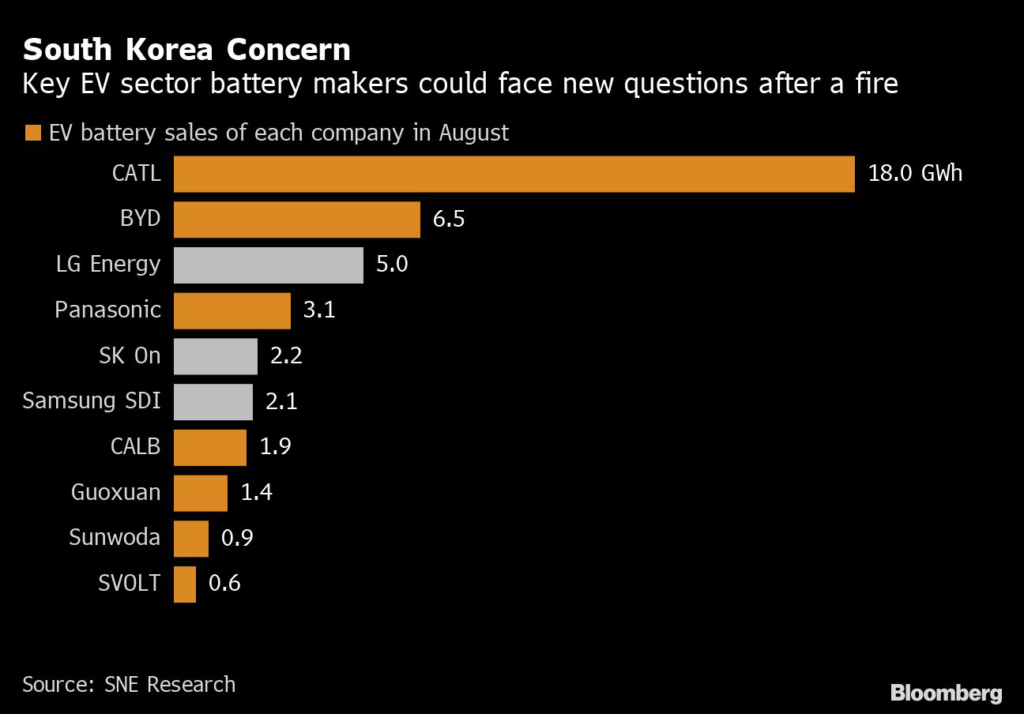
Even with SK C&C, the operator of the data center, still investigating the cause of the fire, the incident has stoked a new bout of concerns over battery safety. That’s important for the electric car sector, given three South Korea-based companies — LG Energy Solution Ltd., SK On Co. and Samsung SDI Co. — rank among the top tier of global battery suppliers. 

“Safety concerns are re-emerging over lithium-ion batteries, and the government needs to step in to prevent similar accidents from happening because once things go wrong with batteries, the impact is often unbearably significant,” said Lee Hoguen, a professor of automotive engineering at Daeduk University.

The latest fire could be a specific negative for SK On, a supplier to Ford Motor Co. and Volkswagen AG, which provided batteries at the data center that were intended to deliver backup power and prevent outages, according to Yoon Joonwon, a fund manager at DS Asset Management, which invests in the tech sector. SK C&C said it didn’t receive any alerts on its battery management system — which would indicate any problems, including changes in voltage or current — until the fire started at 3:19 p.m. local time.

South Korea has been deeply involved in debate over the safety of batteries used in vehicles and giant power storage centers. Manufacturers LG Energy Solution and LG Electronics Inc. last year booked more than $900 million in charges over General Motors Co.’s recall of Chevrolet Bolt electric vehicles.

A spate of fires at energy storage sites between 2017 and 2019 prompted intervention from the country’s government and manufacturers to boost standards, and is cited as among key factors which have hampered South Korea’s efforts to boost the share of clean energy in its power grid. 

(Corrects attribution of company statement in sixth paragraph.)

More stories like this are available on bloomberg.com

©2022 Bloomberg L.P.
Toshiba Valued at $16 Billion by JIP In Takeover Bid, Sources Say

(Bloomberg) — A consortium led by Japan Industrial Partners Inc. is considering a takeover of Toshiba Corp. at a valuation of about 2.4 trillion yen ($16.1 billion) in what could be Asia’s biggest buyout this year, according to people familiar with the matter.

The JIP-led group, which is the preferred bidder to take the Japanese industrial group private, plans to provide 1 trillion yen in cash, while seeking financing totaling 1.4 trillion yen from banks along with a committed line of credit of 200 billion yen in working capital, said the people, who asked not to be identified as the matter is private.

Toshiba, in its regular meeting with banks including Sumitomo Mitsui Banking Corp. on Oct. 20, informed them that JIP is valuating the company at around 2.4 trillion yen and asked them to give financing support, the people said.

Shares of Toshiba fell as much as 1.3% on Tuesday in Tokyo, giving the conglomerate a market value of about $15.6 billion. A bid at 2.4 trillion yen would be worth about 5,541 yen per share according to Bloomberg calculations, similar to Toshiba’s closing price of 5,391 per share on Monday. 

JIP has yet to finalize the equity commitments from its partners, while banks remain cautious about making binding commitments, the people said. Both the consortium led by JIP and a rival group led by state-backed investment fund Japan Investment Corp. will find it hard to meet a Nov. 7 deadline to line up commitment letters, Bloomberg News reported earlier. 

Considerations are still ongoing and there’s no certainty that talks will lead to any transaction, the people said. Toshiba could still decide to explore certain asset sales instead of a full sale of the business, they said.

Spokespeople for JIP and SMBC declined to comment. A Toshiba spokesperson said in response to a Bloomberg News query that, as a general rule, they cannot answer information about candidates, including co-investors, as it may undermine a fair process.

JIP is in talks to form a partnership with domestic companies including Orix Corp. and Chubu Electric Power Co. as well as global investment firms such as Baring Private Equity Asia and CVC Capital Partners, Bloomberg News has reported. That coalition has made a proposal that would keep Toshiba’s current business structure intact. 

Investors including Bain Capital and MBK Partners have discussed being involved in JIC’s rival bid group, people familiar with the matter have said.

Read More: Season of Shelved M&A Surpasses $150 Billion as Credit Woes Bite

–With assistance from Kana Nishizawa.

(Updates with shares in fourth paragraph.)

More stories like this are available on bloomberg.com

©2022 Bloomberg L.P.

Amazon Workers Abandon California Union Election Plan After Loss

(Bloomberg) — Amazon.com Inc. workers seeking to join a union at a company warehouse in Southern California have backed away from their attempt to hold an election, a setback for the upstart Amazon Labor Union following its defeat at a New York facility last week. 

The union withdrew its petition for an election at a warehouse in Moreno Valley, California, according to a National Labor Relations Board docket that includes a letter, dated Friday, approving a request to stop the vote. Unions that make such requests aren’t asked to give a reason, NLRB spokesperson Kayla Blado said. Amazon Labor Union organizers didn’t respond to messages seeking comment. 

The union won an election at an Amazon warehouse in Staten Island in April, but has struggled to consolidate those gains or expand its reach. The union lost an election at a second, smaller Staten Island facility, and last week workers at a warehouse near Albany, New York, rejected joining the union by a 2-1 margin. 

The union is seeking higher wages, better benefits and other improvements to working conditions. Amazon has challenged the legitimacy of the Staten Island vote, raising objections to the conduct of organizers and the NLRB instead of bargaining with the union.

The Moreno Valley facility, called ONT8, is located in the heart of a massive cluster of Amazon warehouses in the Inland Empire region east of Los Angeles. It is a critical hub for the Seattle-based e-commerce company, which relies heavily on imported goods from the ports of Los Angeles and Long Beach. Labor organizers have spent years discussing Amazon employees’ concerns about working conditions in the region. Workers at ONT8 filed for an election earlier this month. 

The Verge reported earlier that the union had withdrawn plans for the vote.

–With assistance from Josh Eidelson.

More stories like this are available on bloomberg.com

©2022 Bloomberg L.P.
Consumers At Risk From “Predatory” Big Tech Firms Report Warns

(Bloomberg) — UK consumers could be at risk from the “predatory” behavior of Big Tech companies if the government continues to delay new laws intended to curb their power, according to a new lawmaker report.

The Business, Energy and Industrial Strategy Committee urged the government to push through the Digital Markets Bill, according to a report published Tuesday. The new law would help boost the powers of the Competition and Markets Authority and its new unit that polices tech firms.

The CMA is toughening its stance on tech dominance post-Brexit with the newly set up Digital Markets Unit, that’ll be able to enforce a code of conduct and potentially suspend, block and reverse decisions made by companies like Alphabet Inc. and Meta Inc. The new rules could hike the maximum potential fines to 10% of their global revenue. 

But the DMU has been in limbo since it was trailed in this year’s Queen’s Speech, meaning it can currently only operate in shadow form as it awaits formal legislative powers from the government. The European Union stormed ahead with its similar landmark new legislation, the Digital Markets Act, despite the UK at one point being ahead with its plans.

“The Competition, Consumer and Digital Markets Bill has wide support and should be prioritized, especially given the difficulty the government currently has at passing other laws which are more controversial,” Darren Jones, BEIS committee chair, said. “This bill is an essential stepping stone to driving this issue forward.”

The UK’s Financial Conduct Authority also said Tuesday that it’s looking at the potential antitrust benefits or pitfalls from the world’s biggest tech companies entry into the country’s retail financial services sectors. 

Silicon Valley firms could cause harm to consumers if they rapidly gain market share in the financial sector and are able to exploit this, the Financial Conduct Authority said in a statement. 

More stories like this are available on bloomberg.com

©2022 Bloomberg L.P.

Close Bitnami banner
Bitnami