Bloomberg

Singapore Home Affordability to Get Worse for First-Time Buyers

(Bloomberg) — Singapore’s housing affordability will deteriorate further in the coming year, due to the double whammy of rising prices and interest rates, according to Moody’s Investors Service.

First-time private home buyers in August needed 19.4% of their average monthly household disposable income to cover monthly mortgage repayments on new loans, up from 17.3% in December 2021, Moody’s analysts said in a report Tuesday. The measure will worsen over the next 12 months because gradual gains in incomes won’t be enough to offset increases in home prices and interest rates, they added.

While home values from the US to New Zealand are declining, Singapore’s private property prices jumped 13.2% in the third quarter from a year ago due to factors including a shortage of supply and an influx of expatriate arrivals. That’s fueled affordability concerns for nearly six in 10 potential buyers and tenants, according to a recent survey.

The trend is “credit negative” for Singapore covered bonds —which include mostly loans for private residential properties —because it increases risks for new mortgages, Moody’s analysts including Daniel Gan wrote. 

Increases in accommodation costs are “anticipated to stay firm” in future quarters amid strong demand for rental housing, the central bank and Ministry of Trade and Industry said in a joint statement on Tuesday. Authorities introduced measures in September to ensure homebuyers borrow prudently as rates rise. 

–With assistance from Low De Wei.

More stories like this are available on bloomberg.com

©2022 Bloomberg L.P.

Bilt, Startup Turning Rent Into Points, Valued at $1.5 Billion

(Bloomberg) — Bilt Rewards, which operates a loyalty program and credit card that converts rent payments into points, said its valuation more than quadrupled to $1.5 billion.

Left Lane Capital led the $150 million equity funding round, which featured Wells Fargo & Co, Greystar, Invitation Homes Inc., Camber Creek, Fifth Wall, Smash Capital, Prosus and Kairos, Bilt Chief Executive Officer Ankur Jain said in an interview.

The New York-based startup, which launched last year, processes $3 billion in annualized rent payments, and its Bilt Mastercard customers are spending at an annualized rate of $1.6 billion, Jain said. Bilt is profitable and has more than 500,000 active members, a figure Jain said he expects to grow dramatically as the company’s landlord partners direct tenants to Bilt as a primary payment platform.  

These real estate firms, including AvalonBay Communities Inc., Blackstone Inc., Related Cos. and Equity Residential, own more than 2.5 million apartments. Bilt plans to expand its multifamily ties and deepen its foray into single-family rentals beyond Invitation Homes, Jain said. Other US apartment dwellers outside Bilt’s landlord network also can use the company’s card to pay rent.

“Programs like Bilt are key to delivering the resident experience renters want and expect,” Greystar CEO Bob Faith said. “We’re excited to join as partners and investors in this venture.”

In an effort to make homebuying easier, the startup launched Bilt Homes, which shows renters which homes they can own with a mortgage payment equal to their monthly rent. Bilt customers can use points toward down payments and closing costs and, ahead of any purchase, can bolster their credit history by having on-time rent payments reported to credit bureaus Equifax, Experian and TransUnion. 

“Bilt gives us another way to be there for our customers during their biggest life purchases, including a unique solution to help customers build credit from on-time rent payments, ultimately creating an easier path to homeownership,” Wells Fargo CEO Charlie Scharf said in an emailed statement.

Jain said Bilt has gained traction with 21-to-35-year-olds in major metropolitan US cities including New York and Los Angeles, which together account for 21% of its users, as well as Houston, San Francisco, Atlanta, Seattle and Austin, Texas.

The company plans to retain most of its newly raised capital in reserves, though it will invest in brand-building and product education, Jain said. 

“Housing represents the largest monthly expense for over 100 million renters in the US and yet consumers have never received any incremental value in return,” said Harley Miller, a Left Lane managing partner who is joining Bilt’s board.

More stories like this are available on bloomberg.com

©2022 Bloomberg L.P.

Matt Levine Talks Crypto, Trust and the Metaverse: Crypto IRL

(Bloomberg) — Matt Levine has taken a break from his “Money Stuff” newsletter to tackle crypto, and he was kind enough to stop by our “Crypto IRL” set to give us an idea of what he learned after spending months reading whitepapers and thinking about web3. 

So what’s actually cool about crypto? In part, that it’s attempting to create a new financial system from scratch. And we talked about the philosophy of trustlessness, and how maybe everything being on the public blockchain can maybe get us to trust a system in a different way than we trust banks. Maybe.

And of course: everything that’s happened in crypto over the last dozen years sets up a significant challenge for regulators, who don’t even know how – or where – to start with this asset class. 

  • Read more: 10 Takeaways From Matt Levine’s ‘The Crypto Story’

Watch Crypto IRL including the special Matt Levine episode on the website or via YouTube

More stories like this are available on bloomberg.com

©2022 Bloomberg L.P.

Ukraine Latest: Kyiv Needs $17 Billion of Aid Now as War Goes On

(Bloomberg) — Ukrainian President Volodymyr Zelenskiy urged allies to provide $17 billion of financial aid now, while Russia’s war rages on, and much more once the conflict ends and the rebuilding begins.

Chancellor Olaf Scholz, who hosted a confererence addressing Ukraine’s post-war reconstruction, said the war-battered nation’s global backers will provide assistance “as long as it takes.”  

“Putin’s Russia is desperate” and the Ukrainian people will prevail in the conflict with Russia, he said. European Commission President Ursula von der Leyen said the EU will develop funding of up to 1.5 billion euros ($1.5 billion) a month, or around 18 billion euros for next year as a whole.

(See RSAN on the Bloomberg Terminal for the Russian Sanctions Dashboard.)

Key Developments

  • Progressives Urge Biden Shift on Ukraine, Before Backpedaling
  • Putin’s Threats Worry NATO as Sign of Russian Desperation
  • Top US, Russian Generals Speak Amid Fears of Nuclear Escalation
  • Europe’s Autumn Heatwave Means More Gas for Later in Winter
  • Russian Oil Logistics in Chaos With Weeks Until Sanctions Bite

On the Ground

Russian troops shelled the Nikopol district of the Dnipropetrovsk region overnight, local authorities said on Telegram. Analysts at the US-based Institute for the Study of War said that the slower pace of Russian air, missile, and drone strikes may reflect “decreasing missile and drone stockpiles and the strikes’ limited effectiveness of accomplishing Russian strategic military goals.” 

(All times CET)

Ukraine Needs $17 Billion for Immediate Recovery (10:12 a.m.)

Ukrainian President Zelenskiy urged allies to provide his country with financial support “now, when the war is on and for the post-war period.”

The country needs $17 billion immediately for a quick recovery “as we have not got a single cent,” Zelenskiy told International Expert Conference on the Recovery, Reconstruction and Modernisation of Ukraine in Berlin in a video address. Speaking at the same conference, his premier said the amount doesn’t include the latest widespread damage to Ukraine’s energy infrastructure.

On the whole, Ukraine needs $38 billion of aid next year to fill the budget gap opend by the war — and it won’t manage without external help, he said.

Poland Mulls Border Wall With Kalinigrad to Stave Off Migration (10:11 a.m.)

Poland will reinforce its border with Russia’s Baltic exclave of Kaliningrad and may consider building a fence along the 210 kilometer (130 mile) frontier, ruling party official Krzysztof Sobolewski said on public radio.

Poland has also accused the Kremlin of masterminding the artificial flow of thousands of people from countries including Iraq, Syria and Afghanistan onto the border, hoping to cross into the EU late last year. 

Lithuania Calls for More EU Sanctions Against Iran (9:14 a.m)

The EU should consider more sanctions against Iran to match those imposed against Belarus to prevent the country from producing drones for Russia’s war in Ukraine, Lithuanian Foreign Minister Gabrielius Landsbergis said.

Iran is effectively a participant in the war against Ukraine, Landsbergis told radio LRT.

“It seems to me that similar sanctions that apply to Belarus should at least be considered for Iran, limiting its ability to continue supplying weapons,” he said.

Yakunin Appeals Arrest by Authorities in Norway (9:01 a.m.)

A Russian-British citizen who’s the son of a long-standing ally of President Vladimir Putin has appealed his arrest by Norwegian authorities last week for flying a drone on the Svalbard islands.

Andrey Yakunin, who was held on Oct. 17 during a boating holiday in the Arctic archipelago, said he was using the drone to take landscape photographs and check for weather conditions on hiking routes, according to an emailed statement by his lawyers.

His lawyers said the sanctions regulations, which prohibit Russian nationals from flying drones in Norway, do not apply to British citizens, and they also argued the sanctions do not apply to the recreational flight of drones. Yakunin’s father Vladimir was among Putin’s closest allies until leaving his post as the head of the national railways in 2015.

Ukraine Limits Power to Industries (8:45 a.m.)

Ukrainian electricity grid operator Ukrenergo said it limited power to industries in all regions of the country to stabilize the functioning of the energy system.

The operator also urged people to save power and use home appliances — like washing machines and boilers — at night.

Investigation Identifies Alleged Russian Missile Programmers (8:41 a.m.)

An investigation published by Bellingcat, in partnership with The Insider and Der Spiegel, identified dozens of members of a “secretive” group of military engineers in Russia’s Defense Ministry that it said were linked to the programming of cruise missiles “that have killed hundreds and deprived millions in Ukraine of access to electricity and heating.”

Phone metadata records showed contacts between the specialists and their superiors “spiked shortly before” the strikes, according to the six-month investigation, which found that members of the group are mostly young men and women, including a husband-and-wife couple, with IT and even computer-gaming backgrounds working in centers in Moscow and St. Petersburg. 

World Bank Disburses Additional $500 Million to Ukraine (8:38 a.m.)

The World Bank announced the disbursement of an additional $500 million to help Ukraine meet urgent spending needs.

The money will be used to maintain essential government services, the lender said in a statement. The bank has already mobilized $13 billion in emergency financing for Ukraine, including commitments and pledges from donors. So far, $11.4 billion has been fully disbursed, according to the bank’s data.

German President Visits Ukraine (8:08 a.m.)

German President Frank-Walter Steinmeier said his visit aims to show solidarity with Ukraine and convey a message his nation stands by the war-torn country.

“Our solidarity is unbroken and it will stay that way,” he said in a statement posted on his website.

Austin Discussed Russia With Stoltenberg, Ukraine’s Reznikov (1:39 a.m.)

US Secretary of Defense Lloyd Austin and NATO Secretary General Jens Stoltenberg discussed recent diplomatic engagements with Russia, according to a readout.

In a separate readout, Austin reiterated that the US rejects false allegations by Russia about Ukraine and any attempt to use them as  a pretex for further escalation of Russia’s war against Ukraine.

More stories like this are available on bloomberg.com

©2022 Bloomberg L.P.

Huawei Investigation Was Targeted by Chinese Spies, US Alleges

(Bloomberg) — The US unsealed charges claiming two Chinese intelligence officers tried to obstruct a criminal investigation of Huawei Technologies Co., and alleged others were working on behalf of a “foreign power” to try procure technology and recruit spies.

The charges were part of a series of recently unsealed cases the Justice Department announced Monday that officials said had disrupted criminal activity being conducted by the People’s Republic of China.

“The government of China sought to interfere with the rights and freedoms of individuals in the United States and to undermine our judicial system that protects those rights,” Attorney General Merrick Garland told reporters in Washington. “They did not succeed.”

Ten of the 13 individuals charged were Chinese intelligence individuals, according to FBI Director Chris Wray. 

Deputy Attorney General Lisa Monaco added that the case involving alleged obstruction of a US probe of a telecommunications company — which the DOJ wouldn’t identify — exposes the connection between the Chinese government and its companies. She said the telecom giant tried to “unlawfully gain an edge” to undermine the US investigation, and shows why Chinese companies shouldn’t be trusted to handle the personal data of Americans.

In a complaint made public Monday, the US claims Guochun He and Zheng Wang worked on behalf of the Chinese government to target the US, from 2019 until the present, for the benefit of the company. A person familiar with the matter confirmed it is Huawei.

$61,000 in Bitcoin

The US claims He and Wang bribed a law enforcement employee to provide what they believed was confidential information about witnesses, evidence and possible additional charges to be filed against the technology giant. He paid the employee $61,000 in Bitcoin, according to the criminal complaint.

In a separate action, four people were charged in federal court in New Jersey with conspiracy to act as an illegal agent of a foreign government. The conspiracy allegedly involved Chinese intelligence officers posing as academics to recruit US law enforcement workers and others in seeking help procuring fingerprint technology and equipment for the US. They also allegedly pressured one former official to stop protests in the US along the 2008 Olympic torch route, according to court filings.

In addition, the Justice Department announced that seven people from China were charged in an indictment unsealed in the Eastern District of New York last week with conspiring to harass a Chinese citizen living in the US in hopes of causing the person to return. The actions were allegedly part of an effort by China, called “Operation Fox Hunt,” to force the repatriation of alleged fugitives living in other countries.

In the case involving the Huawei probe, the complaint includes conversations between He and Wang and a US government employee working as a double agent under supervision of the Federal Bureau of Investigation. They were using an encrypted messaging program that is not identified. 

At a regular press briefing Tuesday in Beijing, Foreign Ministry spokesman Wang Wenbin said “the US was overstretching the concept of national security to hobble Chinese companies and undermine the legitimate interests of Chinese citizens.”

Financial Difficulties

In a January 2019 message, the employee told He that he was “having financial difficulties.”

He responded “let me see if there are something I can do for you,” according to the complaint.

Later, in February 2020, when the US added new charges to the existing case against Huawei, He wrote “And you know, yesterday, the US department of justice make a new lawsuit just aim to [Huawei], can you talk about this with your ex-college [colleague] who work for department of justice?” He allegedly asked. “Evidences, next measures, or communication…, anything about this are good, Thank you very much.”

The government alleges He and Wang first cultivated their relationship with the law enforcement employee, who is not named, in February 2007, before the employee started working with the FBI.

A US magistrate judge on Thursday approved warrants for the arrest of He and Wang, both Chinese citizens, on charges of obstruction of an official proceeding and money laundering. Their current location is not known. 

US prosecutors charged Huawei in 2019, claiming it stole trade secrets from T-Mobile USA Inc. and committed bank fraud by violating sanctions against doing business with Iran. The US expanded the case the following year, adding racketeering conspiracy charges.

Mike Hong, a Huawei spokesman, didn’t immediately comment about the new charges related to the US probe of the company.

The alleged efforts to interfere in the prosecution escalated in October 2021 when He and Wang told the law enforcement employee to give them details of prosecution strategy meetings with the US team in Brooklyn, the US claims. The employee passed to He a fake, single-page document labeled “SECRET,” discussing a potential plan to charge two current principals of the company residing in China. He paid $41,000 for the single page, according to the complaint.

As recently as last month, He and Wang allegedly gave the employee $14,000 plus $600 worth of jewelry for sensitive information.

The case is US v. Guochun He and Zheng Wang, 22-mj-1137, US District Court, Eastern District of New York (Brooklyn). 

–With assistance from Chris Dolmetsch, Erik Larson and Ava Benny-Morrison.

More stories like this are available on bloomberg.com

©2022 Bloomberg L.P.

THG Shares Jump as Online Retailer Signs Banking Facility

(Bloomberg) — THG Plc’s shares soared as much as 17% on Tuesday after the troubled online retailer said it agreed a £156 million ($176 million) banking facility with its lenders to provide more liquidity amid the ongoing cost-of-living crisis.

The new lending was “a strong endorsement” of THG’s long-term business model, the company said in a statement on Tuesday announcing third-quarter results. THG said the fourth quarter has got off to a positive start and the company expects to grow margins in 2023 as commodity prices ease further. 

“As cost-of-living pressures rise, customers are continuing to prioritize beauty, health and wellness categories,” Chief Executive Officer Matthew Moulding said in the statement.

Shares of THG were up 10.8% to 51.5 pence at 8:17 a.m. in London.

THG is sticking to its lowered outlook for the year with adjusted earnings before interest, taxes, depreciation and amortization falling below 2021 levels to £100 million to £130 million and revenue growth of 10% to 15%. As well as weaker consumer sentiment, THG has seen steep hikes in raw material costs, including whey for the retailer’s protein shakes.

The stock has fallen more than 75% this year, with some investors betting on declines continuing. Qube Research & Technologies, Citadel and GLG Partners are among those to build short positions totaling 4.1% of the shares. 

Analysts offered mixed views on Tuesday. Sherri Malek at RBC said in a note that THG requires “strong acceleration” in earnings to meet its full-year guidance, while Jefferies’ James Grzinic and colleagues said “access to another £156 million of funding will be welcome as we head into peak trading season and an uncertain 2023.”

THG reported revenue of £518.6 million for the third quarter, which missed the average estimate of analysts surveyed by Bloomberg of £557 million. The retailer stuck to its previous guidance for the year. 

SoftBank Group Corp. offloaded its stake in THG last week to Moulding and Qatar Investment Authority, the latest in a series of blows for the retailer. THG has been battling questions from investors over its business model and governance controls, and last month the retailer issued a profit warning because of cost-of-living pressures on customers and increasing raw material costs.  

SoftBank’s exit boosted Moulding’s control of THG, where the co-founder and CEO is also the company’s landlord and only relinquished the role of chairman in March. Moulding has hinted he could take the business private again. 

Founded in 2004 by Moulding and John Gallemore, THG, formerly known as The Hut Group, started out selling CDs but today operates hundreds of websites offering beauty, skincare and health-food products as well as helping rivals sell online via its Ingenuity business.

Ingenuity has repositioned to focus on larger, higher contract value clients and the business has a strong and growing pipeline, THG said Tuesday. 

–With assistance from Lisa Pham.

(Updates with share move in third graph.)

More stories like this are available on bloomberg.com

©2022 Bloomberg L.P.

SAP Third-Quarter Revenue Beats Estimates on Cloud Income

(Bloomberg) — SAP SE beat revenue estimates in the third quarter as earnings from its cloud business accelerated. Shares rose. 

Revenue increased 5% at constant currencies to €7.8 billion ($7.7 billion) in the period, the Walldorf, Germany-based software firm said in a statement Tuesday. That compares with a €7.6 billion forecast by analysts in a Bloomberg survey.

Adjusted operating profit remained flat at €2.09 billion in the third quarter, down 8% at constant currencies, amid a decline in revenue from software licenses. SAP said most of the adjustments were related to share-based payments and acquisitions. 

SAP has focused in recent quarters on a strategy to get customers to adopt Rise, a service for firms to transition to a suite of new cloud-based products that are intended to work faster while costing less to distribute and maintain. 

Third-quarter adjusted operating profit took an approximately €20 million hit from winding down operations in Russia and Belarus. The termination of cloud agreements in those countries reduced the current cloud backlog at the end of the third quarter by €64 million. 

SAP will likely miss its end-of-year deadline to exit Russia, Chief Financial Officer Luka Mucic said on a call with reporters. 

“We continue to look for options to hand on our remaining business, which is essentially the maintenance business with non-sanctioned customers,” Mucic said. “All other lines of business are going to be wound down by the end of the year.”

Revenue from the software licensing business decreased 42% in constant currencies to €406 million due to the shift to the cloud and tighter cost controls from clients, SAP Chief Executive Officer Christian Klein said on the call. 

Key Insights

  • Cloud revenue rose 25% at constant currencies to €3.29 billion in the third quarter, beating the average estimate of analysts surveyed by Bloomberg of €3.23 billion.
  • The company’s current cloud backlog is €11.27 billion, an increase of 26% at constant currencies.
  • SAP took an approximately €250 million hit to its operating profit in the first nine months due to its winding down of operations in Russia and Belarus. The company projects a €300 million impact for the full year.
  • SAP downgraded its free cash flow outlook for the year to €4.5 billion, from above €4.5 billion.
  • SAP reaffirmed its 2022 cloud revenue outlook, expecting €11.55 billion to €11.85 billion.

What BI Says

“SAP’s high exposure to Europe, with 44% of its sales coming from the region, makes it more susceptible to any pullback in enterprise IT spending vs. other large, diversified software companies.” 

-Anurag Rana, Bloomberg Intelligence

Market Context

  • Shares of SAP rose 4% as of 9:15 a.m. in Frankfurt. They have fallen 24% this year, compared to a 32% decline in the Stoxx Europe tech index.

(Updates with share price)

More stories like this are available on bloomberg.com

©2022 Bloomberg L.P.

DeFi’s Highest Bidders at Center of Market-Moving Crypto Trades

(Bloomberg) — There’s a telltale sign in the fully automated world of decentralized finance for traders who know something that others don’t: They’re at the front of the line and they pay the highest door fees.

So say three Columbia University academics who argue that those who pay the most to access the blockchain get preferential treatment and often possess private, potentially-market moving information. 

In a new paper, “The Information Content of Blockchain Fees,” the professors show that preference is given to these big spenders and the market’s priciest transactions could be followed by others to glean the direction of crypto markets.

“Blockchain fees can potentially serve as a new public signal revealing the private information contained in DEX trades,” the authors wrote, using the acronym for decentralized exchanges.

The way DeFi transactions are processed is supposed to be democratic and fair — trades are batched and processed by so-called network validators who approve trades on the blockchain. But whoever pays the most has their order processed first, according to Agostino Capponi, Ruizhe Jia and Shihao Yu, revealing a system of favoritism driving crypto markets.

The study used statistical methods to measure the price impact of trades that indicated the actors had private information.

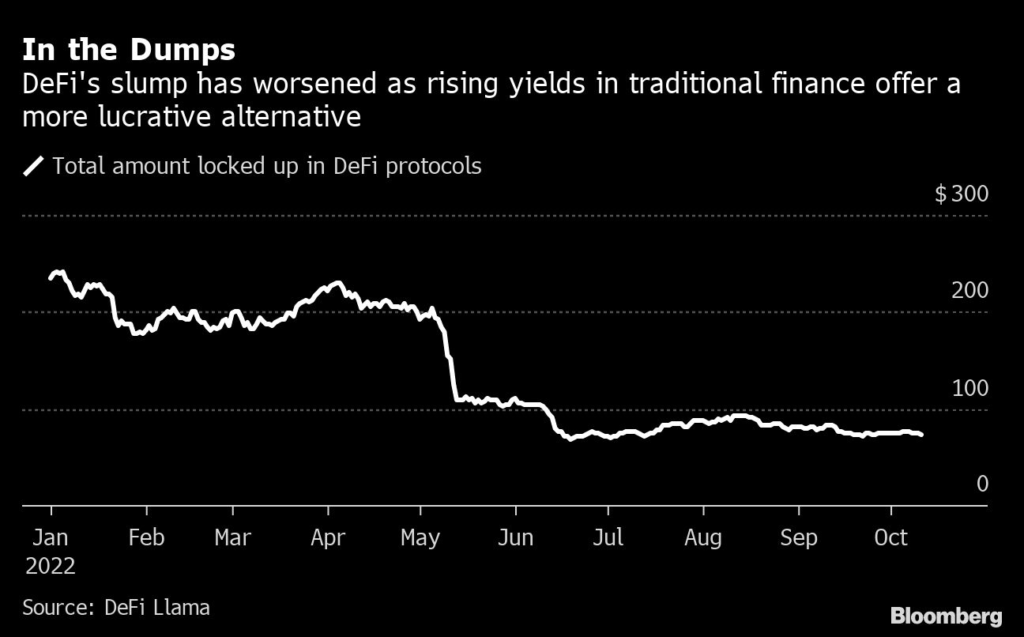
The total value locked onto decentralized exchanges is around $50 billion, having shrunk from a peak of about $200 billion last year as scandals have rocked confidence in crypto markets, according to data specialist website DeFiLlama.

Access to information also divides the winners from the losers in traditional markets, where costs for data are rising 10-15% every year and high-frequency traders are ready to pay up to get it fastest, according to Bloomberg Intelligence.

“If you’re looking at the egalitarian view of the blockchain, it is absolutely not fair,” said Larry Tabb, the head of market structure at Bloomberg Intelligence. “On the other hand, looking at the economics of markets it is absolutely fair. Fair is in the eyes of the beholder.”

More stories like this are available on bloomberg.com

©2022 Bloomberg L.P.

THG Signs Banking Facility as Online Retailer Pledges Growth

(Bloomberg) — THG Plc agreed a £156 million ($176 million) banking facility with its lenders to provide the troubled online retailer with more liquidity as it battles the ongoing cost-of-living crisis.

The new lending was “a strong endorsement” of THG’s long-term business model, the company said in a statement on Tuesday announcing third-quarter results. THG said the fourth quarter has got off to a positive start and the company expects to grow margins in 2023 as commodity prices ease further. 

Still, THG reported revenue of £518.6 million for the third quarter, which missed the average estimate of analysts surveyed by Bloomberg of £557 million. The retailer stuck to its previous guidance for the year. 

“As cost-of-living pressures rise, customers are continuing to prioritise beauty, health and wellness categories and, through investing in bringing them into and retaining them within the THG ecosystem, we are laying the foundations for our future growth,” Chief Executive Officer Matthew Moulding said in the statement.

THG is sticking to its lowered outlook for the year with adjusted earnings before interest, taxes, depreciation and amortization falling below 2021 levels to £100 million to £130 million and revenue growth of 10% to 15%. As well as weaker consumer sentiment, THG has seen steep hikes in raw material costs, including whey for the retailer’s protein shakes.

The shares have fallen 80% this year, with some investors betting on declines continuing. Qube Research & Technologies, Citadel and GLG Partners are among those to build short positions totaling 4.1% of the shares. 

Analysts offered mixed views on Tuesday. Sherri Malek at RBC said in a note that THG requires “strong acceleration” in earnings to meet its full-year guidance, while Jefferies’ James Grzinic and colleagues said “access to another £156m of funding will be welcome as we head into peak trading season and an uncertain 2023.”

SoftBank Group Corp. offloaded its stake in THG last week to Moulding and Qatar Investment Authority, the latest in a series of blows for the retailer. THG has been battling questions from investors over its business model and governance controls, and last month the retailer issued a profit warning because of cost-of-living pressures on customers and increasing raw material costs.  

SoftBank’s exit boosted Moulding’s control of THG, where the co-founder and CEO is also the company’s landlord and only relinquished the role of chairman in March. Moulding has hinted he could take the business private again. 

Founded in 2004 by Moulding and John Gallemore, THG, formerly known as The Hut Group, started out selling CDs but today operates hundreds of websites offering beauty, skincare and health-food products as well as helping rivals sell online via its Ingenuity business.

Ingenuity has repositioned to focus on larger, higher contract value clients and the business has a strong and growing pipeline, THG said Tuesday.

–With assistance from Lisa Pham.

(Updates with context, details from statement from sixth paragraph.)

More stories like this are available on bloomberg.com

©2022 Bloomberg L.P.
Global Stocks Hold Gain Amid Volatility in China: Markets Wrap

(Bloomberg) — Global equities held an advance amid sharp swings in Chinese stocks while other key markets in Asia followed Wall Street higher following optimism from early US earnings reports.

Hong Kong and mainland shares swung in and out of positive territory Tuesday, with the biggest moves in the hard-hit technology sector. The rocky trading followed the worst day for the Hang Seng Index since the 2008 financial crisis on Monday as investors reacted to President Xi Jinping tightening his control of government.

An index of global equities rose fractionally after advancing over the past two days. Markets in Japan and Australia reflected gains in the US on Monday, while futures for the S&P 500 fluctuated during Asian trading. 

The offshore yuan fell to the lowest level since trading began a dozen years ago, as Xi’s power grab raised concern that concentrated decision-making could weaken growth and destabilize geopolitics. The decline extended after China’s central bank set the official fixing rate for the currency at the lowest level in 14 years.

“We’re certainly staying away from the Chinese market right now because the political scene is not favorable,” Laila Pence, president of Pence Wealth Management, said in an interview on Bloomberg TV. “There’s a lot less risk in the US and just as much upside.”

A fifth of S&P 500 companies have now posted third-quarter earnings with more than half outperforming estimates. Microsoft Corp., Alphabet Inc., Amazon.com Inc. and Apple Inc. report this week. The iPhone maker raised prices for its subscription music and TV services, citing higher input costs.

Manufacturing and services data for the US underwhelmed, indicating Federal Reserve rate hikes are beginning to slow activity. Fed officials have entered a blackout period ahead of the central bank’s meeting next week, where it’s expected to raise rates 75 basis points.

Higher rates buoyed third-quarter results from UBS Group AG, which beat profit expectations, and HSBC Holdings Plc, which reported on Tuesday.

Elsewhere in markets, a gauge of the dollar was little changed as traders considered whether the Federal Reserve may be approaching the end of its aggressive tightening campaign. Treasury 10-year yields fell back to about 4.20%, with yields also declining in Australia and New Zealand.

Oil steadied as traders assessed near-term supply tightness in the crude market and broad appetite for risk assets including commodities. Gold was also steady in Asia.

Key events this week:

  • Earnings due this week include: Apple, Microsoft, Exxon Mobil, Ford Motor, Credit Suisse, Airbus, Alphabet, Amazon, Bank of China, Boeing, Caterpillar, Cnooc, Coca-Cola, HSBC, Intel, McDonald’s, Mercedes-Benz, Merck, Samsung Electronics, Shell, UBS, UPS, Vale, Visa, Volkswagen
  • US Conference Board consumer confidence, Tuesday
  • Bank of Canada rate decision, Wednesday
  • ECB rate decision, Thursday
  • US GDP, durable goods orders, initial jobless claims, Thursday
  • Bank of Japan policy decision, Friday
  • US personal income, personal spending, pending home sales, University of Michigan consumer sentiment, Friday

Some of the main moves in markets:

Stocks

  • Futures on the S&P 500 were little changed as of 7:01 a.m. London time. The S&P 500 rose 1.2% Monday
  • Nasdaq 100 futures were little changed. The Nasdaq 100 gained 1.1%
  • The S&P/ASX 200 Index rose 0.3%
  • The Topix Index rose 1.1%
  • The Hang Seng Index rose 0.2%
  • The Shanghai Composite Index rose 0.1%
  • Euro Stoxx 50 futures rose 0.2%

Currencies

  • The Bloomberg Dollar Spot Index was little changed
  • The euro was unchanged at $0.9874
  • The Japanese yen was little changed at 148.90 per dollar
  • The offshore yuan fell 0.2% to 7.3402 per dollar

Cryptocurrencies

  • Bitcoin fell 0.2% to $19,340.95
  • Ether was little changed at $1,350.43

Bonds

  • The yield on 10-year Treasuries declined four basis points to 4.20%
  • Australia’s 10-year yield declined seven basis points to 4.08%

Commodities

  • West Texas Intermediate crude rose 0.2% to $84.78 a barrel
  • Spot gold was little changed

More stories like this are available on bloomberg.com

©2022 Bloomberg L.P.

Close Bitnami banner
Bitnami