
Bloomberg

Bitcoin Stuck in the Doldrums Has Fans Wondering ‘Wen Uptober?’

(Bloomberg) — October may bring ghosts and ghouls alive, but Bitcoin bulls’ hoping for “Uptober” are finding that even the typically positive month can’t resurrect the token’s price.

The largest digital asset is down roughly 1% this month, which, were it to close at that level, would mark its first down October since 2018, coinciding with the last time it was mired in a crypto winter. At this time last year, Bitcoin had gained 40%, 30% the year before that and 12% the one prior. 

This year’s tepid moves prompted analysts at Genesis, among others, to wonder: “Wen Uptober?” That’s the name crypto fans have bequeathed the month for typically being positive. “Wen” is their version of “when” and is used in memes and on social media.

“When I think about Uptober, I’m usually looking for a bit more than a flattish green candle,” said Quantum Economics Founder and Chief Executive Officer Mati Greenspan. “If Bitcoin is to fulfill the meme this month, it better start moving soon.” 

Coming into the month, die-hards hung their hopes on October being a good one for the token, which has only seen three positive months so far this year. And history’s been on their side: Bitcoin tends to rise roughly 25% during the month, and has since 2015 advanced more than 85% during it, according to Bespoke Investment Group. 

Bitcoin’s been stuck in a tight range in recent weeks, with the coin largely hovering around $20,000. On Monday, it traded around $19,300. Even big announcements, like BlackRock Inc.’s recent partnership with crypto platform Coinbase Global Inc., have failed to shake the asset class from its stupor. 

Its lack of swings, in contrast to its usual turbulent reputation, has analysts pointing out that the coin, along with some others, has become less volatile in that time frame. The average spread between the past month’s peak and trough across the 10 largest digital assets has only been around 23%, according to data compiled by Bespoke Investment Group. Since late 2017, no other period has seen this level of serenity. Since the start of 2020, in fact, the average reading was in a range of over 80%, the researcher said. 

“Given that we expect a rather hawkish Fed meeting in November, I think it’s not likely we’ll get an Uptober,” said Max Gokhman, chief investment officer for AlphaTrAI. “I think a lot of Bitcoin holders will be asking ‘Why-tober?’” 

The coin could still finish October up or down 5% from where it started, he said, adding that he expects the token will likely stick to the range it’s traded in for the past several months. 

Wilfred Daye, chief executive officer of Securitize Capital, a digital-asset management firm, says the crypto market is being swayed by macro forces, including what the Federal Reserve has been doing in regards to interest rates. That, and the fact that Bitcoin became positively correlated with tech stocks during the Covid years is what’s largely swaying prices currently. 

“We were in a macro bull market since 2012 — QE worked in BTC’s favor,” he said. “Macro risk-off sentiment puts pressure on BTC.”

More stories like this are available on bloomberg.com

©2022 Bloomberg L.P.

Bain Capital Raises $2 Billion for Latest Tech Fund With Eyes on Europe

(Bloomberg) — Bain Capital has raised more than $2 billion for its latest Tech Opportunities Fund and plans to use part of the investment to expand its dealmaking in Europe. 

The private equity firm has surpassed its $1.5 billion target for the fund and expects to close in the near future, a person familiar with the matter said, asking not to be identified because the plans are private. That’s up from the $1.3 billion Bain raised for the first, US-focused fund, which launched in 2019. 

The Boston-based buyout company has also hired investors in London this year, the tech opportunities investment arm’s first international outpost, led by partner James Stevens, Bain executives said. The group invests in fields such as financial technology and application software.

“The tech environment is more global now and we’re seeing really interesting software opportunities in Europe,” said Bain managing director Darren Abrahamson. “Since the launch of our first fund, 20% of deals we see are in Europe.”

Bain’s tech opportunities strategy has backed companies in Europe such as UK fintech company SumUp. Investors are interested in sectors where they believe Europe is producing global leaders such as payments and cybersecurity, Bain executives said.

The team makes later-stage private company investments and buyouts, and is looking for companies with annual recurring revenue in its target zone. 

“There’s a growing number of companies in Europe in our target $20 million to north of $100 million ARR range,” said managing director Philip Meicler. “Tech companies like our partnership model and ability to help them capture growth opportunities at home and in the US.”

More stories like this are available on bloomberg.com

©2022 Bloomberg L.P.

Chinese Spies Tried to Obstruct Probe of Telecom Company, US Alleges

(Bloomberg) — The US unsealed charges claiming two Chinese intelligence officers tried to obstruct a criminal investigation of “a global telecommunications company” based in China.

In charges unsealed Monday, the US claims the company, which it doesn’t name, was involved in a pending prosecution in Brooklyn, New York, disclosed in press releases in January 2019 and February 2020. The allegations are consistent with charges against Huawei Technologies Co.

The US claims Guochun He and Zheng Wang worked together to bribe a law enforcement employee to provide confidential information about witnesses, evidence and possible additional charges to be filed against the company. He paid the employee $61,000, according to the criminal complaint.

The alleged efforts to interfere in the prosecution escalated in October 2021 when the two told the law enforcement employee to give them details of prosecution strategy meetings with the US team in Brooklyn, the US claims. The employee passed to He a fake, single-page document labeled “SECRET,” discussing a potential plan to charge two current principals of the company residing in China. He paid $41,000 for the single page, according to the complaint.

The government alleges He and Wang first cultivated their relationship with the law enforcement employee, who is not named, in February 2007. The employee later began working against them as a double agent under supervision of the Federal Bureau of Investigation, the US says.

As recently as last month, He and Wang allegedly gave the employee $14,000 plus $600 worth of jewelry for sensitive information.

The case is US v. Guochun He and Zheng Wang, 22-mj-1137, US District Court, Eastern District of New York (Brooklyn). 

(Adds details and context starting in second paragraph.)

More stories like this are available on bloomberg.com

©2022 Bloomberg L.P.

Tesla Slumps to 16-Month Low as China Slowdown Spurs Price Cuts

(Bloomberg) — Tesla Inc. shares fell to the lowest since June of last year after the carmaker lowered prices across its lineup in China, where competitive and economic pressures are intensifying.

The carmaker cut the cost of the cheapest locally built Model 3 sedan by 5% to 265,900 yuan ($36,774), its website showed Monday. The company dropped the starting price of the Model Y SUV by 8.8% to 288,900 yuan.

The move sent Tesla’s stock down as much as 7.4% to $198.59 in New York trading, the lowest intraday in 16 months. US-listed shares of Nio Inc., Xpeng Inc. and Li Auto Inc. all plunged at least 23% at their intraday lows after President Xi Jinping’s unprecedented power play sparked a rout of Chinese equities.

Tesla’s cuts reflect the tougher time international carmakers are having going up against local manufacturers led by BYD Co. — which sold a record 200,973 vehicles last month — and upstarts including Nio and Xpeng, which are expanding their lineups. Domestic automakers accounted for almost 80% of electric-vehicle sales through the first seven months of the year, according to China’s Passenger Car Association.

Chief Executive Officer Elon Musk also flagged last week that demand has been “a little harder” to come by due to China’s property market slowdown and Europe’s energy crisis. He said during Tesla’s earnings call that while prices of some commodities have eased, other inputs for EVs including battery-grade lithium are still “crazy expensive.”

Read more: Tesla Smacks Nio in China, Likely Weighs on Views

The price changes partly reverse several rounds of hikes by Tesla earlier this year after Musk flagged rising costs of raw materials and logistics. The company is now looking to goose sales in a market from which it derives almost a quarter of revenue, which fell short of estimates last quarter.

“EV competition this year is very fierce, and Tesla’s performance may not match its expectations,” said Yale Zhang, managing director at Shanghai-based consultancy Autoforesight Co. “Hence, it decided to hit its rivals with a direct blow by cutting prices to further boost sales in the last two months of the year.”

Tesla delivered a record 83,135 cars in China last month, including 5,522 for export, after upgrading production capacity at the Shanghai factory. The plant can now produce about 1 million cars a year.

A representative for Tesla China said that improved utilization of the company’s Shanghai factory and “relative stability” of the supply chain have contributed to lower costs, and that the carmaker has always priced its vehicles based on costs.

Delivery times in China have shortened to just one to four weeks for the Model Y, and four to eight weeks for the Model 3, according to the company’s website. Lead times were as long as 22 weeks earlier this year, AllianceBernstein analysts wrote in a report last week.

“It is an expected price cut,” said Wang Hanyang, an automotive analyst at Shanghai-based 86Research Ltd. “Order inflow for Model 3s and Ys haven’t fulfilled the expanded production capacity, as you can tell from the shortened wait time. The company needs to secure more orders by cutting prices.”

–With assistance from Craig Trudell.

(Updates share move in the headline and third paragraph.)

More stories like this are available on bloomberg.com

©2022 Bloomberg L.P.
Stocks Rise as Investors Mull Data, Await Earnings: Markets Wrap

(Bloomberg) — US stocks rose as investors await the next batch of earnings from some of the world’s biggest companies and mull whether the Federal Reserve will slow its pace of interest-rate hikes after assessing weak economic data. Treasuries fell.

The S&P 500 climbed, buoyed by health-care companies. The Nasdaq 100 wavered, paring losses of more than 1%. US-listed Chinese shares plunged after that nation’s equity index tumbled as President Xi Jinping solidified his power. Among the megacap companies slated to report earnings this week are Alphabet Inc., Microsoft Corp. and Meta Platforms Inc.

Risk assets struggled to hold gains in a carryover from Friday, when reports that the Federal Reserve may soon start reducing the size of its rate hikes pushed stocks higher by more than 2%. Data Monday indicated that Fed tightening is starting to hit the economy, with purchasing managers indicators showing contraction in the services and manufacturing sectors. Earnings remain in focus, with investors on edge over whether companies can deliver profits with inflation crimping margins. 

“Earnings season is just starting, but so far, with 20% of the companies in (notably big banks), the results, are once again, affirming that the broader earnings picture is not falling apart,” wrote Michael Purves, founder and CEO of Tallbacken Capital. “Big tech earnings is the story this week, and given the outsized weighting in the index, we can’t stress how important it is they perform reasonably well.”

Fed policy is still a key focus for investors. San Francisco Fed President Mary Daly’s comments on Friday added to tentative optimism that the central bank could look to slow its pace of rate hikes after the widely-expected jumbo increase at its next meeting.

“In our view we’re certainly ‘not out of the woods yet’ but the efforts of the Fed since it pivoted policy to address inflation along with the resilience of the economy in a challenging period — and some rumbling among Fed speakers that while the rate hike in November may indeed be 75bps, the Fed may not have to be quite as heavy handed in December — have caught the attention of market participants,” wrote John Stoltzfus, chief investment strategist at Oppenheimer.

Other investors are more cautious in their expectations that the central bank is moderating its rhetoric. 

“While it is encouraging that Fed officials have started to point to an end in sight for rate rises, such a pause will remain conditional on fading inflation and a cooling labor market,” wrote Mark Haefele, chief investment officer at UBS Global Wealth Management. “This has yet to be seen in the data.”

A gauge of the dollar strength rose while the yen dropped amid signs of a second intervention from Japanese authorities in two sessions. British bonds held onto gains, with Rishi Sunak now set to become prime minister. 

Key events this week:

  • Earnings due this week include: Apple, Microsoft, Exxon Mobil, Ford Motor, Credit Suisse, Airbus, Alphabet, Amazon, Bank of China, Boeing, Caterpillar, Cnooc, Coca-Cola, HSBC, Intel, McDonald’s, Mercedes-Benz, Merck, Samsung Electronics, Shell, UBS, UPS, Vale, Visa, Volkswagen
  • PMIs for US, Monday
  • US Conference Board consumer confidence, Tuesday
  • Bank of Canada rate decision, Wednesday
  • ECB rate decision, Thursday
  • US GDP, durable goods orders, initial jobless claims, Thursday
  • Bank of Japan policy decision, Friday
  • US personal income, personal spending, pending home sales, University of Michigan consumer sentiment, Friday

Some of the main moves in markets:

Stocks

  • The S&P 500 rose 0.5% as of 11:09 a.m. New York time
  • The Nasdaq 100 fell 0.2%
  • The Dow Jones Industrial Average rose 0.9%
  • The Stoxx Europe 600 rose 1.4%
  • The MSCI World index rose 1.2%

Currencies

  • The Bloomberg Dollar Spot Index rose 0.3%
  • The euro rose 0.2% to $0.9880
  • The British pound was little changed at $1.1298
  • The Japanese yen fell 0.8% to 148.85 per dollar

Cryptocurrencies

  • Bitcoin fell 1.2% to $19,261.27
  • Ether rose 0.4% to $1,335.65

Bonds

  • The yield on 10-year Treasuries advanced three basis points to 4.25%
  • Germany’s 10-year yield declined eight basis points to 2.34%
  • Britain’s 10-year yield declined 31 basis points to 3.74%

Commodities

  • West Texas Intermediate crude was little changed
  • Gold futures fell 0.3% to $1,651.90 an ounce

–With assistance from Charlotte Yang, Brett Miller and Robert Brand.

More stories like this are available on bloomberg.com

©2022 Bloomberg L.P.

Meta Needs to Slash Metaverse Spending to ‘Get Mojo Back,’ Shareholder Says

(Bloomberg) — About a year after Facebook changed its name to Meta Platforms Inc. to highlight its new focus on the metaverse, long-term shareholder Altimeter Capital Management has called on the company to rein in its spending on the bet.

Meta has lost focus and its shares are underperforming peers, Brad Gerstner, chief executive officer of the investment firm, wrote in a blog post. The firm holds 2.5 million shares representing 0.11% of outstanding stock, Bloomberg data show. Meta shares dropped 3.4% to $125.62. in New York on Monday morning. They are down 63% this year, compared with a drop of about 30% in the Nasdaq 100 Index.

The name change heralded the company’s intent to stake its future on a new computing platform where people will congregate and communicate in a virtual environment. But with revenue growth slowing it’s already had to cut costs and freeze hiring to cope with a fierce competition for users’ attention.

“Like many other companies in a zero rate world — Meta has drifted into the land of excess — too many people, too many ideas, too little urgency,” he wrote. “Meta needs to get its mojo back.”

To double free cash flow to $40 billion a year the company must reduce headcount expense by at least 20%, cut annual capex by at least $5 billion, to $25 billion, and limit investment in the metaverse and Reality Labs to no more than $5 billion a year, Gerstner wrote. 

The firm’s recommendations “will lead to a leaner, more productive, and more focused company — a company that regains its confidence and momentum,” he said. “We believe in this team.”

More stories like this are available on bloomberg.com

©2022 Bloomberg L.P.
Startup Sees a $60 Billion Bond Market Ripe for Disruption

(Bloomberg) — Among the ideas that have minted billion-dollar tech companies, Cicada’s business model is about as unflashy as it gets. 

The startup isn’t going after the industries that have grabbed headlines and the bulk of venture capital cash like credit cards, transportation and food delivery. Instead, it sees a fortune to be made in fixed-income trading —  specifically, local currency bonds in emerging markets. 

Three Mexican founders, including Javier Hernandez, who is a former member of Morgan Stanley’s debt capital markets team, and Manuel Ballesteros, a trader with 20 years experience, are quick to point out that in Latin America alone — where they are focusing their business — $60 billion worth of bond and swaps trades take place every day, according to company estimates based on market data. 

They’re building a digital trading exchange and a tech platform aimed at centralizing information and bringing transparency to a system in which many investors still rely on antiquated methods to make trades. This week, the company will launch in Mexico, its first market, with government bonds and some frequently-traded corporate notes. 

“Right now, $7 billion of trades in Mexico are done by phone. It’s brutal,” Ignacio Tovar, the creative director and co-chief executive officer, said in an interview. “Our vision is to finally provide a technological alternative to traditional execution by phone, in a way that gives access to and creates a fair environment for all participants.”

The Greenwich, Connecticut-based startup, which has 17 employees and an office in Mexico, raised $7.6 million, including $4 million in an extension of its seed round led by Kaszek Ventures and DILA Capital recently. It’s not disclosing its valuation, but does plan to pursue a series A fundraising round in early 2023, Tovar said. 

Its latest round came as venture capitalists have cut back. Investments to Latin American startups fell to $1.1 billion in the third quarter, compared to $6.6 billion the same period a year earlier, according to a report from CB Insights. Funding has dropped for five-straight quarters. 

Chile, Peru 

Hernandez left Morgan Stanley and decided to start Cicada two years ago along with Tovar and Ballesteros. The company has since gained approval from FINRA and the SEC to run the alternative trading system and is launching with local and international investors and broker-dealers, said co-CEO Hernandez.

Cicada plans to expand to swaps in Mexico before moving to other markets, starting with Peru, Chile and Central America. The series A round will be used to fund further expansion. 

The exchange allows for electronic, anonymous trading that’s also available to investors outside of Mexico, according to the company, which plans to collect a fee for each transaction. Third-party apps can link into the exchange, allowing retail investors to trade fixed income they way they can with stocks.  

Hernandez said the market is long overdue for disruption, particularly as most other areas of finance have gone digital.

“We’re not only providing a platform for institutional investors,” he said. “We’re providing the piping that finally gives digital access to the Mexican fixed-income market. We’re opening access to everyone.”

(Adds number of employees in 6th paragraph. A previous version corrected the firm’s regulatory status.)

More stories like this are available on bloomberg.com

©2022 Bloomberg L.P.

Lower Volatility Confounds Crypto Traders Used to Yo-Yo Swings

(Bloomberg) — In contradiction to its usual tempestuousness, Bitcoin and some other cryptocurrencies have become less choppy, stupefying market-watchers who’ve long known them for their volatility. 

The average spread between the past month’s peak and trough across the 10 largest digital assets has only been around 23%, according to data compiled by Bespoke Investment Group. Since late 2017, no other period has seen this level of serenity. Since the start of 2020, in fact, the average reading was in a range of over 80%, the researcher said. 

“BTC and ETH continue to confound us all with narrow moves and languishing volatility,” Noelle Acheson, author of the “Crypto is Macro Now” newsletter, said of Bitcoin and Ether. “This is not what crypto assets are supposed to do.”

It’s the latest reading to show that activity in the crypto markets has slowed markedly from its usual near-daily wild swings. And a number of volatility gauges have shown Bitcoin to be in a less-choppy phase as it meanders around the $20,000 level. It traded down 0.9% on Monday at about $19,300. 

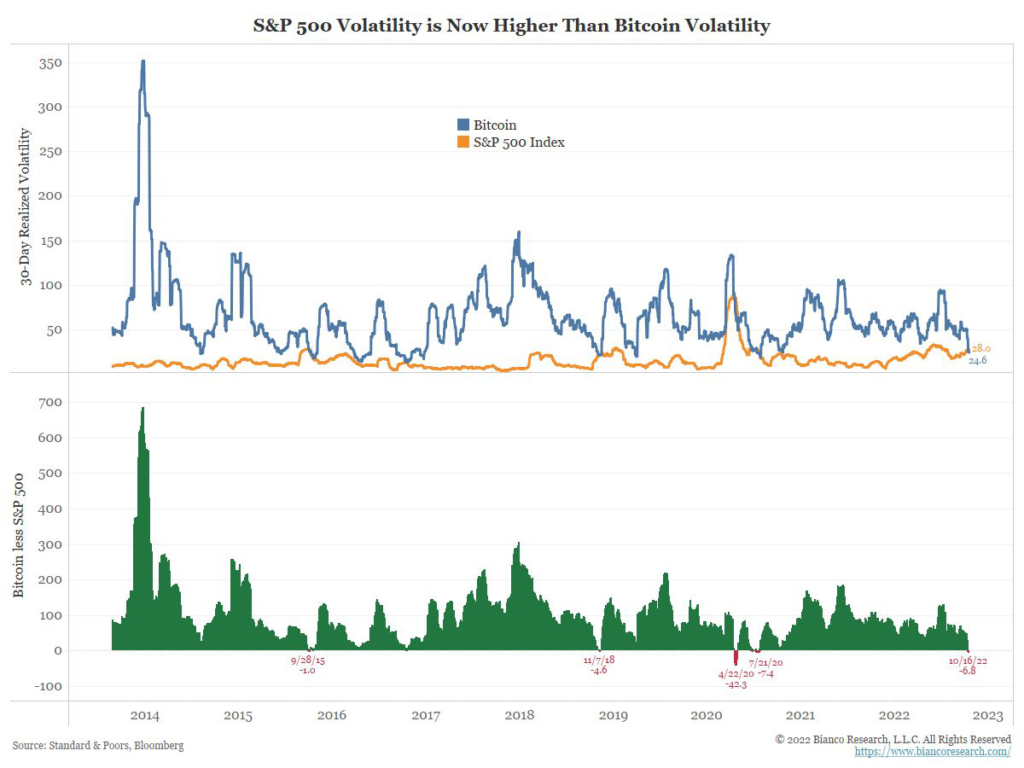
The T3i Bitcoin volatility index, for instance, clocks in at 62, down from a 2022 high of 140 in May. And this lull is happening amid a rally for the US stock market — Bitcoin’s volatility has dipped below that of the S&P 500, something that’s only happened on four other occasions in the coin’s history, according to Jim Bianco, president of Bianco Research LLC.

Though stocks and cryptocurrencies have traded in tandem for most of the year, the correlation has lessened in recent days. The 60-day correlation coefficient of Bitcoin and the S&P 500 currently stands around 0.61, down from 0.70 earlier this month. 

“Crypto is largely agnostic to equity earnings,” Sean Farrell, head of digital asset strategy at Fundstrat Global Advisors LLC, wrote in a note. “Crypto has decoupled from equities in recent trading sessions in which equities moved higher/lower due to key earnings announcements.” 

The fact that Bitcoin’s been less volatile recently has caught a lot of attention considering its reputation for fluctuating wildly. Still, some have warned that its calming might not be great news: the development coinciding with lower volumes might mean it crashes faster in the event of a downturn. 

Viewed from the lens of investors, the lack of volatility could also be seen as a negative. A lot of individual traders have been in the space precisely because of its wild nature, says Acheson. While warnings abound about staying away from such volatile markets, their turbulence is also a reason for many to dive in, especially considering that some platforms “offer eye-watering leverage,” she wrote in a note.  

“Without traders, we wouldn’t have liquid markets. And without liquid markets, we would not have institutional interest,” she said. “And without institutional interest, our industry would still be insignificant, poorly funded, less innovative and more vulnerable to regulatory interference.”

Read more: The Bitcoin Futures ETF at 1: $1.8 Billion Lured, Over Half Lost

Elsewhere, results from a Bloomberg Markets Live survey showed that traders are welcoming of further regulation of the space, with many saying they’d be more comfortable to invest in cryptos should greater enforcement come about. Almost half of respondents also expect the world’s largest cryptocurrency by market value to continue trading between $17,600 and $25,000 until the end of this year. 

Rick Bensignor, president of Bensignor Investment Strategies and a former Morgan Stanley strategist, points out that Bitcoin last week climbed above its downtrend line, though “buyers didn’t really show up.” The token “has not proven bulls right, yet,” he wrote in a note. 

More stories like this are available on bloomberg.com

©2022 Bloomberg L.P.

New ESG Fund Numbers Plunge Amid Crackdown on Greenwashing

(Bloomberg) — Asset managers have dramatically reduced the number of new ESG funds they’re rolling out, as a tougher regulatory environment makes it harder to make claims of environmental, social and governance investing.

Reclassifications that add an ESG element to conventional funds are down 84% compared with a year ago, according to data complied by Jefferies. New ESG funds built from scratch fell 60% over the same period. Overall, the data show that the decline was most pronounced in Europe and marks the first time that reclassifying old products hasn’t led ESG fund growth.

“Increased regulatory scrutiny and enforcement in this market is changing behavior,” analysts at Jefferies said in the report.

Regulators in the EU, UK and US are investigating ESG funds amid growing concerns that asset managers keen to sell products are promising more than they can deliver. To meet demand, asset managers have tended to rename existing products rather than build new ones. That’s raised questions about the ESG credentials of the funds, and fed concerns of widespread greenwashing.

A recent analysis by PwC showed that of 8,017 so-called Article 8 funds — an EU designation that requires a product to “promote” sustainability — only 989 were new at the end of the second quarter. The rest were reclassifications of existing funds. A similar analysis of 1,061 Article 9 funds — whereby a product needs to have sustainability as its “objective” — showed that only 286 were new.

In Europe, a review over the summer indicated that asset managers may have to downgrade hundreds of ESG funds in the coming months. The European Sustainable Investment Forum, whose members represent about $20 trillion in combined assets, has warned that “a significant proportion classified as Article 9 are far short” of meeting EU requirements.

In Sweden, a probe of Article 9 products last month found “many cases” in which managers failed to document their claims. The Stockholm-based regulator will meet with industry representatives to discuss its findings, and has warned that it will act to stamp out false ESG labeling.

Institutional and retail investors have been calling for regulators to do more to protect against greenwashing after years of unfettered growth in the ESG industry. An analysis by PwC showed that 71% of institutional investors want stronger ESG regulatory requirements to guide the actions of the fund management industry. The hope is that extra rules “can act as an important lever to build trust and decrease the risk of mislabeling,” according to PwC.

Asset managers have blamed an absence of clear and consistent rules. The EU led the world with the March 2021 implementation of its Sustainable Finance Disclosure Regulation, but the groundbreaking framework has since been criticized for lacking clarity around key concepts. For example, EU regulators are still waiting for the European Commission to provide detailed guidance on what it means by a “sustainable investment.” 

“A key issue for the industry is that the definition of ‘sustainable investment’ leaves too much room for interpretation,” Hortense Bioy, global director of sustainable research at Morningstar, said last month. “Different interpretations of the regulation have led asset managers to adopt different approaches to the calculation of sustainable investment exposure, rendering it impossible to compare products directly.”


(Adds reference to European ESG Template results, comment from Morningstar)

More stories like this are available on bloomberg.com

©2022 Bloomberg L.P.

Saudi PIF Offers to Buy Stake in $5.8 Billion STC Towers Unit

(Bloomberg) — The Public Investment Fund has offered to buy a majority stake in the telecom towers unit of Saudi Arabia’s largest phone company, the next step in its ambition to create a cellular tower behemoth in the kingdom.

The PIF made a non-binding offer to Saudi Telecom Co. for 51% of Telecommunications Towers Co, according to a statement on Monday. STC is assessing the offer for Tawal and said the entire business has been valued at $5.8 billion on a cash- and debt-free basis.

The fund has been weighing a deal to combine the mobile phone infrastructure of Saudi Telecom and Zain Saudi Arabia in a merger that would form the kingdom’s largest cellular towers company, Bloomberg reported last year. The PIF and two other investors acquired stakes in Zain Saudi’s 8,069 telecom towers in February.

Saudi Telecom, which is 64% owned by the PIF, spun out its more than 15,000 towers into the Tawal subsidiary in 2019 and capitalized it with 2.5 billion riyals ($670 million). 

Read more: Saudi Wealth Fund Said to Weigh Deal to Form Mobile Towers Giant

To view the source of this information click here

More stories like this are available on bloomberg.com

©2022 Bloomberg L.P.

Close Bitnami banner
Bitnami