Bloomberg

Ken Griffin Committed Millions to Funding Elon Musk’s Twitter Deal

(Bloomberg) — Billionaire Ken Griffin has committed to back Elon Musk’s bid to buy Twitter Inc., according to a person familiar with the matter, though the amount he pledged was less than $20 million.

The backing from Griffin, who has an estimated net worth of $29.2 billion, hadn’t been disclosed publicly by Musk. Twitter had described the Citadel founder as an “actual or potential” co-investor in the equity financing for the deal.

Read More: Twitter Subpoenas Ken Griffin Amid Hunt for Musk’s Deal Backers

Musk disclosed in a May filing that he had $7.1 billion of financing commitments to help him buy the social-media platform, including $1 billion from Larry Ellison, $700 million from Sequoia Capital and $500 million from Binance. 

Tesla Inc.’s chief executive officer has raised about $15 billion in cash from reducing his stake in the electric carmaker since he launched his $44 billion takeover of Twitter in April. Depending on how many other external investors have backed his bid, he may need to sell more Tesla shares. 

The Washington Post earlier reported on Griffin’s backing. The newspaper said that billionaire Peter Thiel’s Founders Fund and LinkedIn Corp. founder Reid Hoffman were among those who passed on supporting the deal.

More stories like this are available on bloomberg.com

©2022 Bloomberg L.P.

Musk Plans to Cut Twitter Workforce by 75%, Washington Post Says

(Bloomberg) — Elon Musk’s plans for Twitter Inc. involve slashing its staff by nearly 75% in a matter of months, according to documents obtained by the Washington Post.

Musk, whose $44 billion purchase of the social network is set to close by Oct. 28, would reduce Twitter’s staff to just more than 2,000 people, compared with the 7,500 it currently employs, the Post reported, citing Musk’s comments to prospective investors. Musk had told investors he planned to shrink staff in his initial pitch to bankers for funding, people familiar with the matter told Bloomberg in April.

The billionaire, also chief executive officer of Tesla Inc., earlier this month said he would follow through with his agreement to take Twitter private, ending a months-long court battle over the deal. Even if Musk doesn’t end up owning Twitter, the company would need to trim its workforce to cut costs, according to the Post.

More stories like this are available on bloomberg.com

©2022 Bloomberg L.P.

Ukraine Latest: Zelenskiy Says Russia Must Pay for Devastation

(Bloomberg) — Ukrainian President Volodymyr Zelenskiy said Russia must compensate his country for the destruction that has been wrought by the invasion. Almost eight months into Russia’s invasion, Ukrainians were warned of rolling blackouts because of damage to the country’s power infrastructure from missile attacks. Camping stoves, generators and winter underwear are in high demand. “Controlled limits” were placed on electricity consumption in Kyiv and several northern and central areas on Thursday.

The UK defense secretary said a Russian warplane in late September fired a missile “in the vicinity of” an unarmed Royal Air Force jet flying in international airspace over the Black Sea. 

Weeks after Russia and Belarus announced the formation of a new joint force, and days after the force started to assemble in Belarus, Ukraine’s army faces rising military threats from the north. Russian servicemen, equipment and aircraft are flooding into Belarus. 

(See RSAN on the Bloomberg Terminal for the Russian Sanctions Dashboard.) 

Key Developments

  • White House Says Iran Sent Trainers to Aid Russian Drone Strikes
  • Russia Threatens Thousands With Mined Dam, Zelenskiy Tells EU
  • Putin’s Belarusian Ally Lets Him Build Up Forces Near Ukraine Again 
  • US and Five APEC Allies Issue Joint Statement Blasting Russia
  • Ukraine Faces Rolling Blackouts After Attacks on Power Stations
  • Italy’s Rising Coalition Dealt Blow After Berlusconi Lauds Putin

On the Ground

Zelenskiy said in his Thursday evening address that the situation at the front remains difficult, especially in the vicinity of Donetsk, near Bakhmut and in some areas in the south. Russia launched three missiles, delivered 20 air strikes and used multiple-launch rocket systems (MLRS) as many as 10 times on Thursday, Ukraine’s General Staff said. Of 20 Iranian drones launched today, Ukrainian forces shot down 15. Iran has called claims it’s sending missiles to Russia “baseless.” Russia hit Mykolaiv and the surrounding region with C-300 missiles on Thursday morning, Kyrylo Tymoshenko, deputy head of the president’s office, said on Telegram.  

(All times CET)

Zelenskiy Says Russia Must Compensate Ukraine (12:10) 

Ukrainian President Volodymyr Zelenskiy vowed that Russia would pay for the devastation that it has caused in his country “with isolation, degradation and assets, of the state and of quasi private individuals linked to this Russian regime.”

“Russia is trying to demolish Ukrainian energy systems, to force our people suffer even more, but instead this only mobilizes the world community to provide us more help and to apply more pressure on the terrorist state,” Zelenskiy said in his nightly address on Thursday. 

“All our expenditure for the protection of power blocks and the renovation of our infrastructure after Russian strikes will be compensated at the expense of Russia assets.”

US Says Iran Sent Trainers to Aid Russian Drone Strikes (11:50 p.m.)

The White House accused Tehran of sending trainers and technicians to Crimea to support Russian attacks on Ukraine with Iranian-made drones, and pledged to interrupt further Iranian aid for Russian forces.

John Kirby, a spokesman for the US National Security Council, said in a briefing for reporters, said that Iranian advisers are helping Russian pilots based in Crimea to operate the drones. Russian forces initially had trouble using Iranian drones, so the Islamic Republic “decided to move in some trainers and some technical support to help the Russians use them with better lethality,” Kirby added.

Zelenskiy Calls on EU to Ratchet Up Sanctions on Iran (9:14 p.m.)

The Ukrainian president told EU leaders that the bloc must impose additional sanctions on the Iranian regime for deliveries of single-use attack drones to Russia, which have been used to attack energy infrastructure and civilians across the country. The 27-member bloc backed sanctions on three Iranian individuals and one entity this week.

“It is good that the first step has already taken place,” Zelenskiy told leaders by video at a two-day summit. “New individual sanctions against Iranian figures and companies have been approved. But a few individuals and companies are not a responsibility yet. More systematic steps are needed.”

Zelenskiy Met Goldman Sachs Executives in Kyiv (8:45 p.m.)

Ukrainian President Volodymyr Zelenskiy met Goldman Sachs Executive Vice-President John Rogers and President of Global Affairs and co-head of the Office of Applied Innovation Jared Cohen in Kyiv, according to his press office. The group discussed Goldman Sachs possibly helping attract investments for Ukraine, including cyberdefense and fighting against fakes.

“I highly appreciate when such people are not scared and come to Ukraine to support us,” Zelenskiy said. “And it is very important to share true information about the situation in Ukraine, Russia’s attacks and their consequences via smart people.”

The visit took place as Russia intensified air raids to destroy Ukraine’s energy infrastructure.

Ukraine Limits Electricity Supply in Kyiv, Seven Regions(6:04 p.m.)

Ukraine’s national grid operator Ukrenergo said it’s been forced to temporarily introduce “controlled limits of electricity consumption” after usage levels “rose sharply” at a time citizens have been asked to conserve as much as possible, according to a statement on its Telegram channel. 

The limits are in place for Kyiv and its surrounding regions, as well as for  Kharkiv, Sumy, Chernihiv and Zhytomyr in the north, and the central regions of Poltava and Cherkasy. 

Putin Practices Sniper Shooting With Reservists (5:48 p.m.)

Russian President Vladimir Putin on Thursday visited a training center for mobilized reservists, where he shot a sniper’s rifle several times, state television reported. Dressed in civilian clothes, Putin spoke with one of the reservists briefly and hugged him, the footage showed.

Putin last week said his recent order to call up 300,000 reservists for what he calls a “special operation” in Ukraine would wrap up soon and won’t be extended. 

The order spurred an exodus of draft-age men from the country, hurting consumer confidence and business activity but would likely weigh on the economy for months to come, including by worsening an already-acute labor shortage. 

Ukraine Sees Growing Threat of Russian Offensive From North (4:15 p.m.)

Ukraine’s armed forces see a rising threat of a fresh new military offensive from the north, where Russian and Belarusian troops have assembled a “joint force,” spokesman Oleksiy Hromov said Thursday at a video briefing. 

Putin’s Ally Lets Him Build Up Forces Near Ukraine Again 

Increasingly bellicose rhetoric from Russian and Belarusian leadership has accompanied the deployment of forces in Belarus, which started last weekend, he said. 

The offensive may be repositioned to the northwest part of the Belarus-Ukraine border — that is, closer to Poland — in a bid to cut the main logistical arteries supplying weapons to Ukraine from allies, Hromov said. 

Read more: Ukraine Army Sees Growing Threat of Russian Offensive From North

Turkey Wants Another Russian-Built Atomic Plant (4:08 p.m.)

Turkey asked Russia to build its second nuclear power plant, in the latest sign of closer economic ties even as the US and its allies try to isolate the Kremlin for its invasion of Ukraine. 

Turkey’s President Recep Tayyip Erdogan made the request in talks last week in Kazakhstan with Vladimir Putin, their fourth meeting in four months, according to people familiar with the situation. 

Read more: Turkey Asks Russia to Build Another Nuclear Plant, Defying US

Russia Snubbed at Atomic-Energy Summit in Washington (3:45 p.m.) 

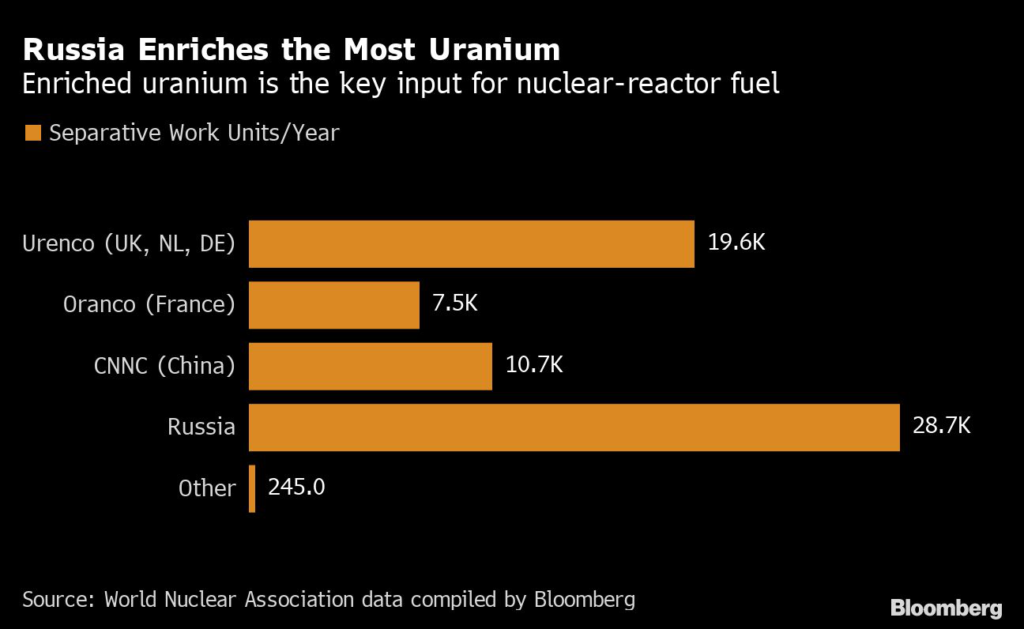
Russia will lose its place on stage at an atomic energy summit in Washington next week, as US authorities seek ways to limit the influence of Kremlin-controlled nuclear fuel and technology suppliers on the global market.

The International Atomic Energy Agency confirmed that executives from Rosatom Corp. and Russia’s industry regulator were dropped from the agenda. White House officials have been considering for months ways to reduce the Kremlin’s influence on global nuclear markets. 

Read more: Russia Removed From Nuclear-Energy Stage at Washington Summit 

Ukrainians Stock Up on Power Banks, Generators (3:48 p.m.)

Demand for power banks, generators and candles jumped in the week since Kremlin forces launched widespread attacks on power infrastructure, said Prom.ua, one of Ukraine’s biggest online sellers. 

“The demand for electric generators rose fivefold, and the average check grew to 20,000 hryvnia ($541),” the retailer said in an emailed comment. 

Gas cylinders, headlamps and camping stoves are also in demand, along with thermal underwear. In September, radiation meters and preventative medicine were the most-coveted items, Prom.ua said.

Push For New EU Sanctions on Russia (2:41 p.m.) 

Estonia, Lithuania, Latvia and Poland proposed broadening EU sanctions on Russia by adding a ban on cooperating with Russia on nuclear energy, according to a document seen by Bloomberg News. The nations also want to ban the sale of real estate to Russian citizens and companies and limit the concessions that Belgium previously won on the import of steel products from Russia.

The ninth sanctions package should broaden the ban on information and communication technology services to include computer software and extend the scope of a ban on business services to cover marketing and opinion poll services, according to the document. 

“Schemes involving marketing and leasing services are regularly used in Russia as a cover-up to facilitate flows of a large scale providing funds for military sector,” the countries said.

Ukraine Expects Electrical Equipment Next Week (2:10 p.m.)

Generators, components and spare parts needed to replace equipment damaged by recent Russian strikes are expected to start arriving in Ukraine next week from Italy, France, Lithuania, Finland, Germany and Poland, Ukraine’s foreign minister said. 

“The equipment will help to ensure uninterrupted functioning of Ukrainian households, hospitals and schools,” Dmytro Kuleba said in a statement.

Separately, on Twitter, Kuleba welcomed the EU’s moves against Iran for its provision of drones used by Russia in recent attacks on energy infrastructure and other targets. 

Ukraine Sanctions Thousands of Russian Citizens, Companies (2 p.m.) 

Ukraine sanctioned 1,374 Russian companies and companies affiliated with Russia, and 2,507 individuals, mainly Russian citizens, in decrees signed on Wednesday. 

Billionaire Roman Abramovich was sanctioned, with the proviso that the measures only take effect after an exchange of prisoners and bodies of deceased soldiers between Ukraine and Russia is complete. 

Among others, Ukraine sanctioned billionaire Mikhail Fridman; Petr Aven; Eugene Kaspersky, CEO of the cybersecurity firm Kaspersky Lab, and the daughter of President Vladimir Putin, Ekaterina Tikhonova.  

UK Says Russia Fired Missile Near RAF Jet in September (1:34 p.m.) 

A Russian aircraft released a missile on Sept. 29 near an unarmed British plane patrolling in international airspace over the Black Sea, UK Defense Secretary Ben Wallace told parliament during an update on the situation in Ukraine. 

The UK temporarily suspended patrols after the “potentially dangerous” incident and raised its concerns with Russian Defense Minister Sergei Shoigu. Russia, in an Oct. 10 response, blamed a “technical malfunction” by its fighter jet, Wallace said. After consulting with allies, “I have restarted routine patrols but this time escorted by fighter aircraft,” he added. 

Russia’s Defense Ministry didn’t respond to requests for comment. 

Ukraine Keeps Key Rate Steady (1:04 p.m.)

Ukraine’s central bank kept its benchmark borrowing rate unchanged at 25% as the body’s new governor presses ahead with negotiations with the IMF on a financial lifeline for the war-battered economy. 

“Continued cooperation with international partners remains an important factor in maintaining the Ukrainian economy during the full-scale war and postwar recovery,” the Kyiv-based bank said in a statement. 

Russia Controls Only 1.8% of Kharkiv Region, Official Says (12:58 p.m.)

Russia retains control over 1.8% of the area around Kharkiv in the east of Ukraine, Kharkiv Governor Oleh Syniehubov said on Telegram. 

“Since September, our military has expelled the occupiers from 544 settlements in the region. Only 1.8% of the region’s territory remains under temporary occupation — that’s 32 settlements,” Syniehubov told. 

Ukraine’s armed forces and local authorities have formed three lines of defense in liberated areas, he said. Kremlin troops continue “limited assaults” in a bit to recapture lost territory, according to the Institute for Study of War. 

Germany Probing Fire at Refugee Shelter (11:45 a.m.)

German authorities are investigating a suspected arson attack at a former hotel housing  housing Ukrainian refugees in the eastern state of Mecklenburg-Western Pomerania.

German Interior Minister Nancy Faeser said in a tweet that if arson is confirmed the perpetrators would “be prosecuted with the utmost severity.” Emergency services rescued the residents an no one was harmed, she said. 

Italy’s Coalition Roiled by Berlusconi Lauding Putin (11:30 a.m.)

Giorgia Meloni, the right-wing leader poised to be Italy’s next prime minister, said she’d give up on her fledgling coalition if her allies can’t commit to supporting Ukraine along with Italy’s European Union and NATO partners. 

Meloni commented after audio surfaced of coalition partner Silvio Berlusconi saying he rekindled his friendship with Russian President Vladimir Putin and laying the blame for Russia’s invasion on Ukrainian President Volodymyr Zelenskiy. 

EU Adopts Sanctions Against Iran for Drone Sales to Russia (11:23 a.m.)

Bloomberg reported the measures targeting three Iranian generals and Shahed Aviation Industries, a company responsible for the design and development of the Shahed series of Iranian drones that have been supplied to Russia and are currently being used in Ukraine. Iran denies sending weapons to Russia.


More stories like this are available on bloomberg.com

©2022 Bloomberg L.P.

Audio App Clubhouse Still Has ‘Years of Cash’ as It Shifts Strategies

(Bloomberg) — Clubhouse, the audio-only social app that surged in popularity early in the pandemic, is focusing more on smaller, private groups, its chief executive officer Paul Davison said Thursday.

While Clubhouse initially grabbed headlines in 2020 with rapid-fire venture fundraising and appearances from celebrities such as Elon Musk and Oprah Winfrey, the startup failed to maintain its rapid growth. Clubhouse laid off employees this summer and has experimented with shifting its strategy. Now, the once-hot app for public speaking is focused on cultivating online communities that are more intimate, Davison said at the TechCrunch Disrupt conference in San Francisco on Thursday.

To allow for smaller conversations, Clubhouse has been testing a new feature called Houses, which Bloomberg first reported on in June and which Davison confirmed in August. In Houses, users can create private clubs, in which invite-only members can more freely talk to each other. Davison said that users from all over the world tell him about the connections they’ve built or deepened in Clubhouses’s closer-knit communities.

“More and more of those rooms are happening in private every day,” he said. “When we look at the product, that’s what drives the magical experience.”

Davison, who has created a string of social apps during his career, said he’s fixated on building tech that mimics real-life social interactions. “The real world operates through friends of friends,” he said. Twitter created a rival product called Spaces, where users can host live audio conversations, but Davison said that it’s not focused on the same thing. “Twitter is a broadcast product,” he said. “Clubhouse at its core is about participation in conversations and friendships.”

To keep growing the company, Clubhouse can’t simply become one sprawling community — it needs to become a network of smaller clusters, he said. He compared it to the way a cell cleaves via mitosis once it reaches a certain size. “We split off so we can retain that intimacy,” he said. Clubhouse now has around 100 employees and “years of cash in the bank,” he added.

More stories like this are available on bloomberg.com

©2022 Bloomberg L.P.
Trump Deposed in Suit by Investors Claiming Fraud in ‘Apprentice’ Videophone Pitches

(Bloomberg) — Lawyers for investors who claim they were defrauded by Donald Trump more than a decade ago finally got a chance to depose the former president about his marketing of a failed videophone venture on “Celebrity Apprentice,” according to a person familiar with the matter.

A New York judge had ordered Trump to sit for questions in the videophone case by Oct. 31, after a planned testimony date was derailed by Hurricane Ian and triggered a fierce war of words between lawyers for plaintiffs and Trump. The deposition, which occurred earlier this month, hadn’t been reported. 

It’s one of several depositions Trump has had to sit for recently. He was deposed in a separate case Wednesday for a defamation suit brought by New York author E. Jean Carroll. She alleges he raped her in a department store dressing room two decades ago and defamed her when he denied it.

Trump, his company and his three oldest children were sued in 2018 by four investors who claim they were duped by Trump’s promotions into paying thousands of dollars to become independent sellers with ACN Opportunity LLC, which sold a doomed videophone device that the future US president touted as the next big thing. The clunky devices were made obsolete by smartphones.

Read More: Trump’s Doomed Video Phones Loom in Backdrop of Media Foray

“As we complete fact discovery in this important fraud case, we could not be more pleased with the substantial body of evidence we have developed that will prove our clients’ claims,” plaintiffs’ lawyer Roberta Kaplan said in an email. “We are eager to move this case forward to trial as soon as possible.”

Trump has denied wrongdoing, arguing his comments praising ACN as an essentially risk-free investment amounted to mere “puffery” that no “reasonable investor” would have relied on.

A judge will rule next year on a request by the plaintiffs to let them represent potentially thousands of other investors who may have been wronged by the Trumps’ ACN pitches. The trial in Manhattan federal court is expected to last as long as four weeks, though a date hasn’t yet been set.

The investors’ lawyers have said they planned to grill Trump about why he started pitching the company to his viewers around 2008, assuring his fans that they could make easy money selling the phones “without any of the risks most entrepreneurs have to take.” 

According to the suit, the Trumps lied about their faith in its products and also failed to disclose that they were being paid to promote the company. Trump himself starred in promotional videos and appeared in person at events for the company.

The case is McKoy v. Trump Corp., 18-cv-9936, US District Court, Southern District of New York (Manhattan).

(Updates with comment from plaintiffs’ attorney in fifth paragraph.)

More stories like this are available on bloomberg.com

©2022 Bloomberg L.P.
How China Became a Threat to the US’s Tech Leadership

(Bloomberg) — Seven years after China unveiled its ambitious Made in China 2025 plan to become globally competitive in 10 industries, President Xi Jinping is using the Communist Party congress this month to redouble efforts to “win the battle in key core technologies.”

His rallying call reflects the intensifying tensions between China and the US, which has tightened the screws in recent years on the transfer of cutting-edge technology to the world’s second-largest economy.

Here are seven charts that illustrate how much China has closed the gap with the US in state-of-the-art technology, and why the Biden administration feels threatened to the point it is dramatically increasing restrictions.

Booming Research

As its economy has boomed, China has relentlessly increased investments in technology in the decades since Deng Xiaoping rekindled the country’s economic opening up in the early 1990s. The country now lags just slightly behind the US in total expenditures on research and development.

Times of economic crisis have been opportunities for China to narrow its gap with the US. After the 2000 dot-com bust and the 2008-2009 global financial crisis, US R&D spending grew at a slower pace or shrank, whereas China kept expanding.

Gross R&D spending for 2021 isn’t available yet from the Organisation for Economic Cooperation and Development, but China announced its official investment rose more than 14% to 2.8 trillion yuan ($388 billion) last year, accelerating from 10.2% in 2020. Meanwhile, the US federal budget for R&D fell 2.6% last fiscal year to $165.6 billion, according to the National Center for Science and Engineering Statistics.

High-Tech Demand Grows

The world’s biggest exporter, China, is also the most aggressive importer of satellites, optical fibers, silicon, laser beams and other high-tech products that underpin the development of advanced technology. China’s share in the global imports of high-tech products has steadily increased in the last decade from 16.3% to 18.6%, according to data from Kim Minwoo, a researcher at the Korea International Trade Association. 

Some of that increase is likely due to China’s position as the factory of the world, as it imports high-tech parts for assembly into products such as phones or computers that are then exported.

But the large amount of imported goods also means China is more vulnerable as the US toughens export controls. In particular, China’s high-performance computing — essential in aerospace, weapons and artificial intelligence development — may be “severely damaged” if US bans widen further, according to TrendForce.

Supercomputing Status

China surpassed the US in the number of supercomputers in 2016, widening the gap to the most in 2020. But the lead is narrowing as the US increases restrictions on China’s access to advanced devices, according to data from TOP500, a project that tracks trends in high-performance computing.

Supercomputers are used for a variety of purposes from climate forecasts to vaccine development to space exploration. They can also simulate nuclear tests and missile defense and handle large volumes of data used in artificial intelligence development. The new Biden administration restrictions on China exports specifically ban chips that are used in supercomputers and AI.

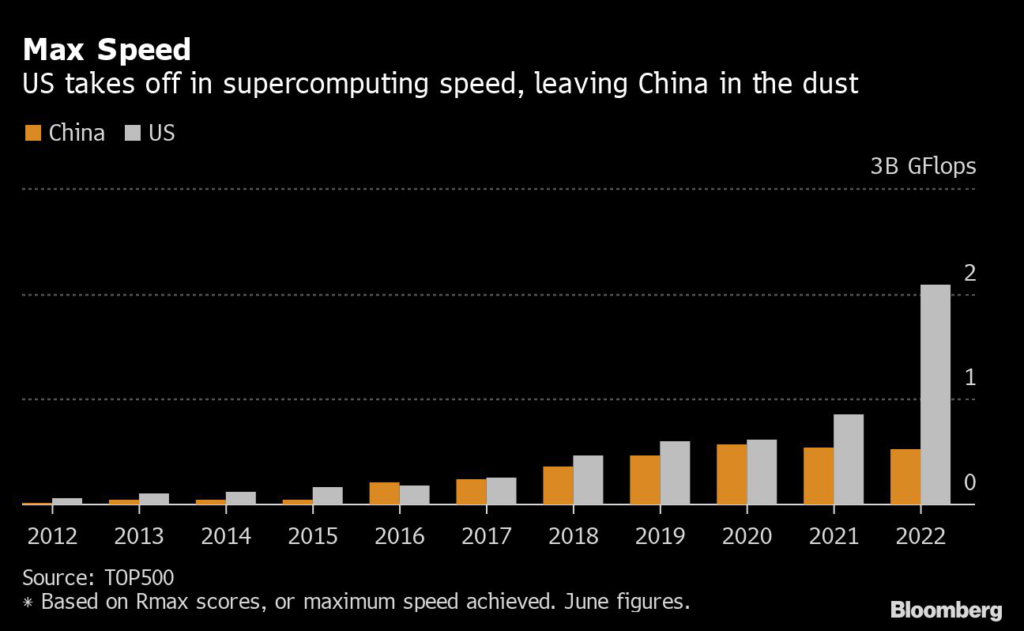
Supercomputer Speed 

The problem is more serious for China when it comes to supercomputer performance. Whereas China struggles to improve speed, the US began to surge ahead last year, at the same time it imposed sanctions on seven Chinese supercomputing firms.

The US cited activities undermining American national-security or foreign-policy interests. Beijing has repeatedly rejected the American claims, saying the moves against Chinese tech firms are aimed at preventing China from surpassing the US.

AI Influence

China’s stagnating supercomputer performance contrasts with the rising number of high-impact AI papers by its researchers, who can rely on data generated from the country’s 1.4 billion-strong population.

China’s academics got a boost in 2017 when the government enshrined the pursuit of global AI leadership by 2030. They focus more on surveillance-related tasks, such as tracking, action recognition and object detection compared with American ones, according to the State of AI Report 2022, by investors Nathan Benaich and Ian Hogarth.

Chip Size 

The $550 billion semiconductor industry is the front-line in the tech war between the two countries. China accounted for 17% of global chip production in 2020, a jump from 2% in 2000, while the US share halved from 24% to 12% in the same period, according to South Korea. By 2030, China is forecast to raise its share to 24% while the US slides to 10%, according to a report from the Belfer Center for Science and International Affairs at Harvard University, which was published before the latest round of sanctions.

A key scorecard in the competition is progress in downsizing individual transistors for faster and more efficient chips. In July, China’s Semiconductor Manufacturing International Corp. reportedly developed a Bitcoin-mining chip that was built with 7-nanometer technology, overturning expectations it wouldn’t be able to develop a chip smaller than 10-nanometers due to a US ban on the sale of advanced lithography machines that project patterns on silicon wafers.

Despite that reported success, China is struggling to develop a domestic chip industry, even with the billions of dollars in funding it has thrown at the sector in the past decade. 

Startup Money

The US has since widened regulations further limiting the sale of chipmaking tools to Chinese firms, including electronic design automation software key to 3-nm fabrication and beyond.

That is spurring China to accelerate the growth of its homegrown developers. Chinese startups in chipmaking and other key technologies outpaced US ones by about nine times in funding procurement last month, according to data available from Semiconductor Engineering, an industry publication.

“China believes what doesn’t kill you will make you stronger,” said Kwon Seok Joon, author of “Semiconductor War in East Asia” who teaches chip fabrication at Korea’s Sungkyunkwan University. “It’s a war that will be costly for the US as well and intensify further after the congress as Xi ramps up his bid for self-reliance.”

More stories like this are available on bloomberg.com

©2022 Bloomberg L.P.
AI Knows How Much You’re Willing to Pay for Flights Before You Do

(Bloomberg) — Armed with mountains of data, artificial intelligence is emerging as an important tool for airlines to find the ideal fares to charge passengers, helping them squeeze out as much revenue as possible as the industry emerges from its biggest crisis. 

Fed by data on everything from internet searches and Covid outbreaks to weather forecasts and football results, computers are learning how everyday life influences demand for flights. In its most advanced form, AI blows up the arcane airfare codes and pricing bands that have straight-jacketed ticket sales for decades.

By weighing up the data, technology providers can determine how much passengers are willing to pay for tickets and continuously reprice seats. Calculating fares using AI can lift an airline’s revenue by 10% or more, according to Fetcherr, an Israeli startup that operates a live-pricing engine.

“We are able to determine at every price point how many people will buy a ticket,” said Roy Cohen, chief executive officer and co-founder of Fetcherr, whose directors include Alex Cruz, a former CEO of British Airways Plc. “It’s very hard to hide from a system like us.”

Brazilian carrier Azul SA last month announced the first public trial of Fetcherr’s demand prediction and pricing technology. Azul didn’t reply to emails asking for more information about the trial.

Fetcherr’s demand simulations are so accurate, according to Cohen, that fares determined by algorithms for flights six months away barely change by the time the plane takes off. “Almost spot on,” he said. “Sometimes to the cent.”

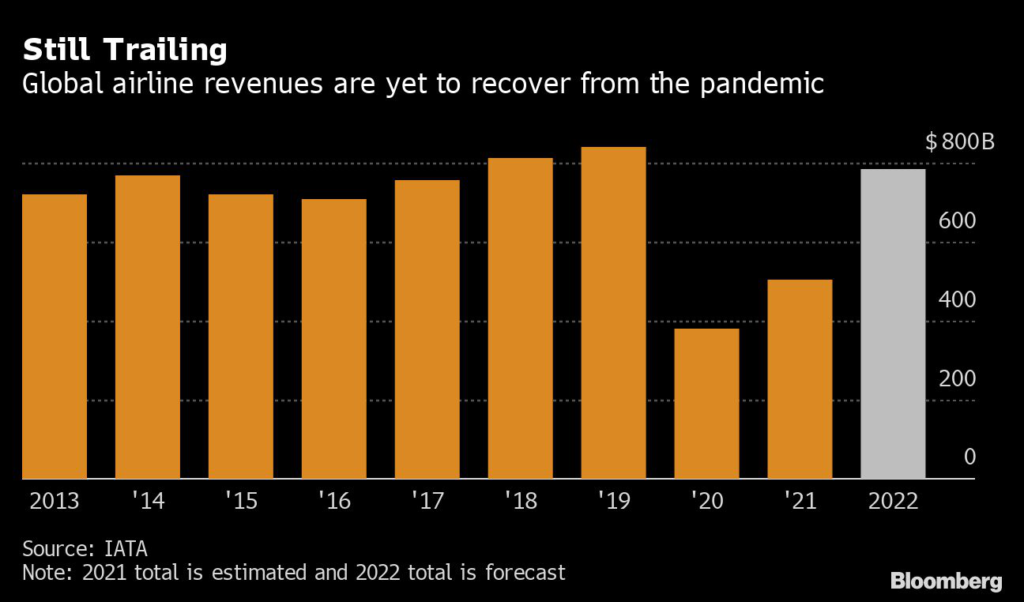
Aviation needs all the help it can get. Travel evaporated in 2020 as governments around the world closed borders and rolled out Covid-19 restrictions. A recovery from the pandemic should drive global airline revenue to $782 billion this year, still shy of the $838 billion in 2019, according to the International Air Transport Association. Typical annual revenue growth has been in the single digits since the financial crisis more than a decade ago.

While airlines have for years used software to manage airfares, what passengers ultimately pay has been governed to some degree by seat availability in various price brackets. AI seeks to match fares far more closely to passengers’ desire to pay, something that has become tougher to pinpoint after two years of lockdowns.

“The traditional techniques are almost blunt instruments, really, to deliver certain products at certain price points to the market,” Amanda Campbell, solutions marketing director at global travel technology provider Accelya, said in an interview.

AI’s influence on aviation is in its infancy, but the information flows are already too large to sensibly grasp. Cohen reckons Fetcherr alone processes multiple petabytes of data from around the world every second as it sizes up travel demand. A single petabyte is estimated to equate to 500 billion pages of standard printed text. “The bigger we become, the better we become,” he said.

The supply of data is endless, said Conor O’Sullivan, chief product officer at Datalex Plc, a provider of real-time pricing. The Dublin-based company last year announced a trial with Aer Lingus, the Irish airline owned by IAG SA. Aer Lingus didn’t reply to an email seeking details of the tests.

Datalex still leans heavily on historical information such as airline bookings and schedules to estimate current and future flight demand, O’Sullivan said. But computers are increasingly weighing one-off events such as concerts and sports tournaments, as well as hotel reservations and airport queues. Changes in governments and policy, or even a ministerial ousting, can influence the market. It’s the algorithm’s job to determine the relative importance of each byte.

“All of these things have effects,” O’Sullivan said. “Then you get down to all sorts of behavioral psychology. If it’s raining outside, you’re more likely to book to a sunny destination than if it’s sunny.”

While giant AI-powered retailers like Amazon.com Inc. clearly show the benefits of machine learning, aviation’s in-built aversion to risk means it is likely to embrace the technology at a far slower pace. Change in the industry moves at a glacial pace, hamstrung by legacy network systems and aging ticket distribution partnerships.

“A lot of trust needs to be built up before they go full on into something like this,” O’Sullivan said. “They see this as really high potential value, but high risk as well.”

Revenue on some routes can jump as much as 8% with the benefit of AI-driven ticket pricing, though on an airline’s entire network the benefit is likely closer to 2%-3%, he said.

“If it’s raining outside, you’re more likely to book to a sunny destination”

Frequent flyers can provide useful data — although it’s not personalized — when they log onto airline websites to plan trips. Browsing sessions that don’t end up with a booking are sometimes as useful as those that do.

“How many searches got abandoned? You have to figure out why,” said Tim Reiz, Accelya’s chief product and technology officer. “It’s about finding the optimum price where the airline can fill aircraft to capacity.”

More stories like this are available on bloomberg.com

©2022 Bloomberg L.P.

Boost Mobile Founder Wants to Buy Back Service, Prevent Deal by Dish

(Bloomberg) — The founder of Boost Mobile wants to buy the wireless service back and keep current owner Dish Network Corp. from merging it with a blank-check company controlled by Chairman Charlie Ergen.

Australian Peter Adderton said by phone from Sydney on Thursday that he’s preparing a bid for Boost and has talked to at least one major private equity shop about financing the deal. He’s been trying to get the business back since he first sold it to Nextel in 2003.

Adderton created the Boost brand in 2001 with hope that the prepaid service could dominate the youth wireless market. He says subsequent owners, including Dish, have no idea how to develop that approach.

“I have been laser focused on buying this business for a long time now,” Adderton said. “We’ll be putting together a full offer to take to the Dish board.” 

Dish, a satellite TV and wireless company, said earlier this month it’s in preliminary discussions to merge Boost with Ergen’s blank-check company, Conx Corp. Dish acquired the prepaid service in 2020 as part of a government-brokered antitrust deal that let T-Mobile US Inc. merge with Sprint.

Since that sale, Boost has been rolling out 5G services in 120 cities, using airwaves Dish has acquired over the years, so it can stop relying on leased capacity from other carriers’ networks

Adderton plans to make the Dish board members aware of his interest before they approve the SPAC merger plan. The Conx board is awaiting a decision from Dish before they go ahead with a vote on Oct. 31 to extend the Boost discussions.

Dish declined to comment beyond its statement from a week ago.

“We are in regular dialog with interested parties who may assist us in accomplishing our goals, including recently preliminary conversations with Conx,” Dish said in a emailed statement. “There can be no assurance that these preliminary discussions will lead to a transaction nor as to the structure or terms of any such transaction.”

Early Player

Boost was one of the early prepaid mobile-phone brands that tailored itself to a specific niche. In this case, Adderton aimed at a cool demo: city kids, surfers and skateboarders.

In 2003, he sold Boost to Nextel, later to become Sprint Nextel, but within months he was battling the company over how to run the business and was out soon after.

In 2018, he saw a chance to get his hands on Boost again, When T-Mobile US Inc. offered to acquire Sprint. Adderton said he worked with regulators to get Boost divested as a way to preserve competition in the prepaid market. 

But in 2020, Dish stepped in to acquire Boost, seeing the purchase as a way to hasten its transition from a satellite TV provider to a 5G wireless network operator, and become a fourth nationwide mobile competitor. 

“I believe it went to the wrong company,” Adderton said. “Now it’s time to right that wrong.”

–With assistance from Gillian Tan.

More stories like this are available on bloomberg.com

©2022 Bloomberg L.P.
ASML Sees ‘Fairly Limited’ Impact From New US Curbs on China

(Bloomberg) — Key chip equipment supplier ASML Holding NV said it sees “fairly limited” impact from the latest US export control measures to restrict China’s access to cutting-edge semiconductor technologies, a fact that highlights the challenges Washington faces with its efforts to get allies on board to suppress China’s technological rise. 

“The fact that we are a European company with limited US technology in it of course creates this situation where a direct impact on us is fairly limited,” ASML Chief Financial Officer Roger Dassen said in a video released together with earnings on Wednesday, adding that the company will comply with US regulations. 

While the company still cannot ship its most advanced machines to China, Dassen said that the company can continue to ship less sophisticated tools out of Europe to Chinese customers. 

Earlier this month, Washington unveiled sweeping regulations to curb the sale of advanced semiconductors and chipmaking equipment to China and ban US persons from helping with China’s development of chip technologies, sending shockwaves through the $550 billion industry.

The new US move dealt a major blow to China’s chip industry. American firms including Applied Materials Inc., KLA Corp. and Lam Research Corp. pulled employees from China’s top memory chipmaker, while ASML told its employees in the US to refrain from servicing customers in China. ASML expects the total indirect impact from U.S. measures to be around 5% of its backlog, Chief Executive Officer Peter Wennink said on Wednesday.

The administration of US President Joe Biden continues to express its wish for allies to collaborate on export control mechanism when it comes to restricting China’s access to critical chip technologies. 

Earlier this year Washington renewed its pressure on the ASML to halt sales of the firm’s immersion lithography machines, its second most advanced products after extreme ultraviolet lithograph systems, to China, and Dutch newspaper FD has reported that the US Department of State again broached the subject of collaboration on chip issues with Europe earlier this month. 

Earlier this year, Washington renewed its pressure on the Dutch government to halt ASML’s sales of its immersion lithography machines — its second most advanced products, after extreme ultraviolet lithograph systems — to China. Dutch newspaper FD has reported that the US Department of State again broached the subject of collaboration on chip issues with Europe earlier this month.

The Dutch government has yet to consent to the US demand that ASML should stop supplying China with immersion lithography machines.

In June, Dutch Prime Minister Mark Rutte said the European Union shouldn’t isolate China and that the block should develop its own policies toward the Asian country. German Chancellor Olaf Scholz also said recently that decoupling from China is the wrong answer for resolving economic woes. 

–With assistance from April Roach.

(Updates information on US lobbying in final three paragraphs.)

More stories like this are available on bloomberg.com

©2022 Bloomberg L.P.
Stocks Wipe Out 1% Rally as Fedspeak Boosts Yields: Markets Wrap

(Bloomberg) — It was another down day for stocks, with Treasury yields climbing amid hawkish remarks from Federal Reserve officials and swaps pricing in a 5% peak policy rate in 2023. The pound wavered after Liz Truss resigned as UK prime minister.

The wariness around economic challenges has been so pronounced that it doesn’t take much to see the S&P 500 dropping at least 1% after posting a rally of the same magnitude earlier in the day. It happened again Thursday, with the gauge seeing intraday swings of that size in both directions for the 16th time in 2022 — the most for any year since the financial crisis.

Volatility is showing no signs of abating ahead of Friday’s $2 trillion options expiration and another raft of corporate earnings. In late trading, Snap Inc. plummeted after reporting its slowest quarterly sales growth ever, saying that a decline in advertising spending on the platform continues to drag on results.

A tech-led advance in equities quickly fizzled out Thursday after Philadelphia Fed chief Patrick Harker said policymakers are likely to raise rates to “well above” 4% this year and hold them at restrictive levels, while leaving the door open to doing more if needed. The current benchmark sits between 3% and 3.25%. Fed Governor Lisa Cook also spoke, noting that rates will need to keep rising to get inflation under control.

“Stocks are not out of the woods yet,” said Fawad Razaqzada, market analyst at City Index and Forex.com. “Fears over further tightening of central bank policy amid an environment of high-inflation and low-growth means investors will avoid buying stocks aggressively. Even at these relatively-inexpensive levels.”

Traders also scoured a mixed bag of quarterly results, with Tesla Inc.’s sales disappointing and International Business Machines Corp. topping forecasts. Several market observers said the bar has been lowered quite a bit ahead of the earnings season, boosting the odds of upside surprises. It’s also worth noting that there’s been no shortage of warning signals about the economy from the corporate side.

Alcoa Corp. joined metals higher, but its quarterly loss indicated a worsening environment for a company that recently said it was being squeezed by higher costs and falling aluminum prices. And that’s a dependable barometer of the health of sectors including construction, aerospace and consumer packaging. Another worrisome signal came from Union Pacific Corp., which sees slowing freight demand.

As traders wade through corporate results, “with an extra eye on guidance, expect volatility to remain elevated,” said Mike Loewengart at Morgan Stanley Global Investment Office.

The latest batch of economic reports didn’t provide much encouragement either, with sales of previously owned US homes down for an eighth straight month — underscoring how soaring mortgage rates are punishing the housing market. The stretch of declines is the longest since 2007, when a housing market collapse swept the economy into the Great Recession.

Some of the main moves in markets:

Stocks

  • The S&P 500 fell 0.8% as of 4 p.m. New York time
  • The Nasdaq 100 fell 0.5%
  • The Dow Jones Industrial Average fell 0.3%
  • The MSCI World index fell 0.6%

Currencies

  • The Bloomberg Dollar Spot Index was little changed
  • The euro rose 0.1% to $0.9784
  • The British pound was little changed at $1.1227
  • The Japanese yen fell 0.2% to 150.15 per dollar

Cryptocurrencies

  • Bitcoin fell 0.7% to $19,066.28
  • Ether fell 0.8% to $1,284.5

Bonds

  • The yield on 10-year Treasuries advanced nine basis points to 4.23%
  • Germany’s 10-year yield advanced three basis points to 2.40%
  • Britain’s 10-year yield advanced three basis points to 3.91%

Commodities

  • West Texas Intermediate crude rose 0.5% to $85.98 a barrel
  • Gold futures fell 0.2% to $1,631.40 an ounce

–With assistance from Vildana Hajric, Peyton Forte and Matt Turner.

More stories like this are available on bloomberg.com

©2022 Bloomberg L.P.
Close Bitnami banner
Bitnami