Bloomberg

Shetland Islands Go Dark After Cable Accidentally Broken

(Bloomberg) — The Shetland Islands, 110 miles north of the mainland UK, have been cut off from communications following what is believed to be an accidental break in their main submarine internet cable.

The incident is not suspected as malicious and is being attributed to a trawler boat fishing on the seabed, according to the UK’s biggest broadband network owner BT Group Plc.

The only cable linking the British mainland to Shetland is SHEFA-2, owned by Faroese Telecom. A representative for Faroese Telecom said by phone they believed the damage to be accidental from a passing ship. 

“Faroese Telecom spotted the damage via marine tracking being done by a trawler in the area and reported this to the UK Coastguard,” a BT spokesman said by email. “They are working with us on re-route options as a result of this accidental damage and to repair their cable as soon as possible.”

BT said some phone, broadband, TV and mobile services are affected, apologized for any inconvenience, and said that anyone who needs to call 999 should try their landline or their mobile “even if they don’t have signal from their own mobile provider.


More stories like this are available on bloomberg.com

©2022 Bloomberg L.P.

No Longer Tied To Offices, Workers Are Still Bound by the Clock

(Bloomberg) — Even as more companies accept remote-work arrangements, the norm of being available from 9 a.m. to 5 p.m. shows little sign of fading.

That’s even though 94% of desk workers want flexibility in when they work, according to a new survey by Slack Technologies Inc.’s Future Forum, compared with 80% who say they want location flexibility. Slack polled more than 10,000 desk workers in the US, Australia, France, Germany, Japan and the UK.

Asynchronous arrangements — meaning that employees get work done on their own schedules and aren’t required to be online at the same time as their coworkers — remain rare outside some startups and tech companies.

While remote work provides more schedule flexibility than the office — allowing time to do laundry or take the dog for a walk, for instance — many people still feel pressure to have a “green dot” on their workplace software that shows they’re online and working. 

A lot of this pressure comes from leaders and managers who are holding onto outdated norms of professionalism, said Future Forum’s co-founder, Sheela Subramanian. “We need to have a broader conversation about professional norms and what it means to be a good employee,” she said. “We’re at the beginning of this experiment, of re-evaluating the role of work in our lives. We have a long way to go.” 

Subramanian said that when she talks to executives about schedule flexibility, they often get alarmed (“But we have so many meetings!”). Yet having scheduling flexibility doesn’t mean working at all hours or that employees will never get together in person, she said. On the contrary, many people want clearer boundaries around when they’re expected to respond to messages. “Organizations can create flexibility within a framework,” she said. “They can set expectations and be intentional.”

Read more: Useless Meetings Waste Time and $100 Million a Year for Big Companies

Future Forum suggests adopting “core working hours,” where coworkers are all online for a set, limited block of time, team-level agreements so everyone’s on the same page in terms of how the work will get done, and digital tools that help keep track of progress in a transparent way.

Crunchbase Inc., a software firm that specializes in private company data, established a core working-hours policy when it went remote last year. Since the company was hiring employees across time zones, it set aside 1 p.m. to 6 p.m. New York time for meetings and synchronous work.

For people used to traditional schedules, it can take some time to adjust to the fact that they may not get immediate responses outside of core working hours, said Kelly Scheib, Crunchbase’s chief people officer. 

According to Future Forum, workers who have full schedule flexibility are almost 30% more productive than those with no ability to shift their schedule. Location flexibility, by comparison, is associated with a 4% bump in productivity. Employees with schedule flexibility say they can focus better and have improved work-life balance. Workers with no schedule flexibility are also more than twice as likely to look for a new job in the coming year compared with those who have moderate schedule flexibility.

The 9-to-5 shift was formalized on the factory floor by Henry Ford in 1926, and while its origins hold little in common with today’s digitized workplaces, it’s so culturally ingrained in our economy and social lives that it may not make sense to abandon altogether, said Alexia Cambon, a human-resources research director at Gartner Inc. Instead, she advocates for getting away from the norm of back-to-back meetings.

It all comes down to workers’ need for autonomy and trusting they can get the job done.

“The person who is best placed to decide how they should work is the individuals themselves, because they know what makes them productive,” Cambon said.

More stories like this are available on bloomberg.com

©2022 Bloomberg L.P.

Ukraine Latest: EU to Address Emergency Energy Aid for Kyiv

(Bloomberg) — Ukrainians were warned of rolling blackouts because of damage to the country’s power infrastructure from Russian missile attacks this month, and President Volodymyr Zelenskiy urged people to use as little electricity as possible. 

European Union leaders meeting in Brussels will discuss how to help Ukraine’s emergency energy needs.

NATO Secretary General Jens Stoltenberg, meanwhile, called on Iran not to support President Valdimir Putin’s war in Ukraine with drones or missiles as the EU adopted sanctions against the Islamic Republic for selling drones to Russia.

(See RSAN on the Bloomberg Terminal for the Russian Sanctions Dashboard.) 

Key Developments

  • US Ratchets Up Pressure on Turkey Over Its Ties With Russia 
  • US Calls for Security Council Briefing on Russia, Iranian Drones
  • Ukraine Faces Rolling Blackouts After Attacks on Power Stations
  • US Charges Seven in Plot to Buy Chips for Russian Military
  • Ukraine’s New Central Banker Focuses on IMF Aid: Decision Guide

On the Ground

Ukrainian forces repelled Russian assaults near nine settlements in the Donetsk and Luhansk regions, including Bakhmut, Ukraine’s General Staff said. Russia launched 11 missile attacks, 28 airstrikes, and more than 65 multiple rocket launcher assaults over the day, according to the General Staff. Russia hit an industrial facility and energy infrastructure in the Kryvyi Rih district of the Dnipropetrovsk region overnight, inflicting serious damage, local authorities said on Telegram. 

(All times CET)

EU Adopts Sanctions Against Iran for Drone Sales to Russia (11:23 a.m.)

Bloomberg reported the measures targeting three Iranian generals and Shahed Aviation Industries, a company responsible for the design and development of the Shahed series of Iranian drones that have been supplied to Russia and are currently being used in Ukraine. Iran denies sending weapons to Russia.

EU States Split on Forming War Crimes Tribunal for Ukraine (10:33 a.m.)

Some EU member states are wary about setting up a war crimes tribunal for atrocities committed in Ukraine, following what some said were mixed experiences of the court set to deal with such crimes committed during the 1990s in the former Yugoslavia, according to a person familiar with the issue.

An early version of the EU summit conclusions contained a reference suggesting a special tribunal to investigate crimes of aggression be formed, but the reference to the “special tribunal” was removed in a subsequent draft after opposition from a few countries. Some nations are not pushing to have it restored.

NATO Chief Calls on Iran to Not Back Russia Against Ukraine (10:21 a.m.)

While NATO Secretary General Jens Stoltenberg said “every indication points to Iran supplying Russia with drones,” he declined to confirm reports the country is also sending missiles to Russia, saying he wouldn’t go into specific intelligence.

Sweden to Work With Turkey on Support for NATO Bid (10:15 a.m.)

Sweden’s new cabinet will “redouble efforts” to work with Turkey to allay its concerns so that it’s able to ratify the Nordic country’s accession to NATO, Prime Minister Ulf Kristersson told reporters in Brussels. He added that he’s prepared to visit Ankara as soon as possible, with preparations for the trip already being made.

EU Leaders to Discuss Ukraine’s Emergency Needs (9:41 a.m.)

European Union leaders meeting in Brussels will discuss how to help Ukraine’s emergency energy needs following Russia’s attacks on critical infrastructure this month, according to people familiar with the matter.

The issue was a late addition to the agenda for the summit starting Thursday, the people said. Kyiv has provided a list of its most urgent needs, covering dozens of items such as circuit breakers, disconnecters, transformers and relay protection automation devices. 

Other requirements include surge arresters, aerials, power cables, vehicles, as well as several types of switches and high-voltage inputs, according to a document seen by Bloomberg.

Russia’s Attack Is Test for Germany and Europe, Scholz Says (9:23 a.m.)

Russia’s attack on Ukraine is the biggest test for Germany and Europe in decades, German Chancellor Olaf Scholz said in parliament. 

President Putin’s “brutal war,” his “merciless use of hunger and energy as weapons” and his “totally irresponsible threat to use nuclear weapons” aim at dividing and frightening Europe, Scholz said. “Putin won’t reach his war goals.”

Grid Operator Warns of Possible Blackouts Across Ukraine (7:57 a.m.)

Ukrenergo, the state-run energy company, warned about possible blackouts all over Ukraine and urged citizens to reduce electricity consumption on Thursday. 

“Russian constant missile attacks destroy our energy infrastructure, and energy workers need time to restore it,” the company said on Telegram. “We need to be very conscious and frugal with our electricity consumption in order to get through the coming winter as well as possible.”

US Hands Out Charges in Plot to Buy Chips for Russia (2:05 a.m.)

The US Justice Department accused seven people of evading US sanctions as part of a purported plot to sell Venezuelan oil to Russia and China and use the proceeds to buy black market chips for Russia to install in high-tech weapons on the battlefields in Ukraine.

The five Russians and two Venezuelans, “knowingly sought to conceal the theft of US military technology and profit off black market oil,” FBI Assistant Director in Charge Michael Driscoll said in announcing the charges in New York. “This network schemed to procure sophisticated technology in direct support of a floundering Russian Federation military industrial complex.”

Zelenskiy Urges Citizens to Conserve Power (1:40 a.m.)

Zelenskiy urged Ukrainians to use as little electricity as possible on Thursday after electrical grid operator Ukrenergo warned of rolling blackouts because of damage to power infrastructure from Russian missile attacks.

“It is very important energy is consumed with awareness tomorrow,” Zelenskiy said in his nightly address. “We are preparing for all possible scenarios in the light of approaching winter season. We proceed from the fact that Russian terror will be directed at energy facilities until, with the help of our partners, we can shoot down 100% of enemy’s missiles and drones.”

All regions in Ukraine may face four-hour cutoffs between 7 a.m. and 10 p.m., a necessary step because of a shortage of power generation, Ukrenergo said.

More stories like this are available on bloomberg.com

©2022 Bloomberg L.P.

Cellnex Eyes Non-Tower Deals After Losing Deutsche Telekom Unit

(Bloomberg) — Cellnex Telecom SA, Europe’s largest telecom tower operator, is planning to focus its future takeover efforts on “adjacent” infrastructure after losing out on what would’ve been its biggest-ever deal.

“We see deals happening in ‘adjacent’ infrastructure, the infrastructure in proximity to towers,” Alex Mestre, the Barcelona-based company’s deputy chief executive officer, said in an interview. “There have already been some deals of this type in the industry, but there will be more and of larger scale. We expect to see this in the next few years.”

Those deals might be for assets including fiber optic cables that carry signals to and from the towers, small data centers and so-called central offices. More assets of this kind are going on sale across Europe as firms shift to asset-light models, Mestre said. For Cellnex, the key will be deals that allow it to offer more services to existing tower partners, he said, adding that the company is not interested in direct-to-consumer business.

In July, Cellnex dropped out of the race to buy a stake in Deutsche Telekom AG’s tower unit, a long coveted target that would have been the takeover-hungry company’s largest deal ever. The deal would have also given Cellnex access to the only major European market where it isn’t present. The company is also unlikely to bid for a stake in Vodafone Group Plc’s unit Vantage Towers AG, which has a strong German presence, people familiar have said.

The Spanish mast operator decided to pull out of the Deutsche Telekom auction when it became clear that the German carrier was interested in selling to a financial investor. Cellnex wants to control and operate its assets, and consolidate them in its earnings, Mestre said. 

In the absence of large tower assets for sale in the foreseeable future, Cellnex, which has been built on a strategy of making acquisitions to gain scale, has had to find a new path forward. The company has spent more than €20 billion ($19.6 billion) on deals since its share listing, according to data compiled by Bloomberg. While shares have nearly tripled since the initial public offering, the stock is down about 40% this year. 

“We will always seek to have a certain balance, with towers representing the bulk of our infrastructure, but the rest will grow,” Mestre said, adding that the company still forecasts a number of smaller tower deals potentially happening in Europe.

More stories like this are available on bloomberg.com

©2022 Bloomberg L.P.

GoTo in Talks With Alibaba, SoftBank for $1 Billion Stake Sale

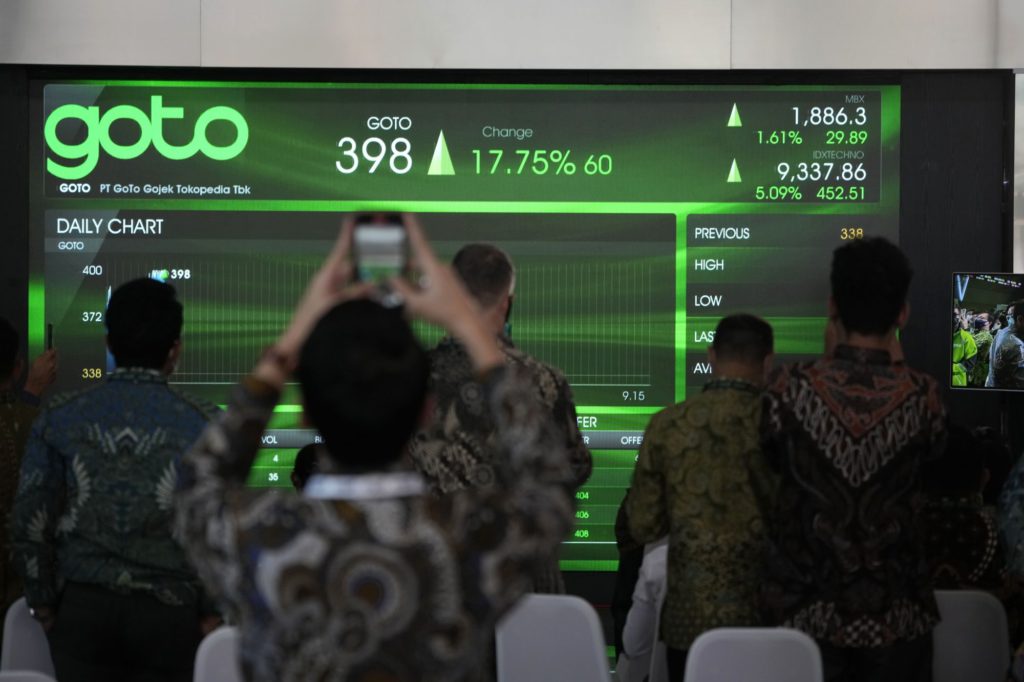
(Bloomberg) — Indonesia’s largest tech company GoTo Group is in talks with its major owners for a controlled sale of roughly $1 billion of their stakes, aiming to avoid a potential stock crash when a lock-up on their holdings ends next month.

The ride-hailing and e-commerce provider is gauging the interest of early backers including Alibaba Group Holding Ltd. and SoftBank Group Corp. for a managed sale of some of their shares to new investors, according to people familiar with the matter. The plan is part of an effort to prevent a potential drop in GoTo stock price that could occur if many investors sell shares when a lock-up period expires on Nov. 30, the people said.

GoTo has also held discussions with some investors to get them to commit to holding their shares for a further period of as long as six months, said one of the people, who asked not to be identified because the matter is private. The Jakarta-based company is in the early stages of talks with the investors and the price levels for any deals are subject to negotiations, the people said. Deliberations are ongoing and GoTo hasn’t made any final decisions, they said.

The regional tech giant, which has a market value of about $15 billion, is trying to avoid a situation where a large part of its backers would seek to cash out at the same time. Many major shareholders agreed to hold to their stakes for at least eight months following the company’s initial public offering in late March.

In late June, Chinese artificial intelligence software maker SenseTime Group Inc. slumped as much as 51% in Hong Kong trading after a lock-up of its shares expired following its December IPO.

About 1 trillion GoTo shares, or more than 90% of the total outstanding, become eligible to be sold starting Nov. 30. Still, that includes holders such as GoTo’s employee fund that are unlikely to sell. Alibaba holds about 8.8% of GoTo, and SoftBank’s stake is about 8.7%.

GoTo has engaged Citigroup Inc. and Goldman Sachs Group Inc., along with local advisers, to help with managing the potential selldown by existing shareholders, the people said. Representatives of GoTo, Citigroup, Goldman Sachs and SoftBank declined to comment. Alibaba didn’t respond to a request for comment.

Formed via a merger of ride-hailing provider Gojek and e-commerce firm Tokopedia, GoTo raised $1.1 billion in one of the world’s largest initial public offerings this year. The share sale boosted the value of stakes of China’s Alibaba and SoftBank’s Vision Fund to almost $5 billion combined.

After an initial surge following the debut, GoTo shares have pared gains to now trade about 40% below the IPO price. Still, cashing out after the lock-up expires could provide many investors a much needed boost this year amid a global decline in tech stocks.

GoTo is among Southeast Asian consumer-internet companies that are adding users at a rapid clip but has yet to generate a profit. It is a leading internet company in Indonesia, a country of more than 270 million people whose mobile-savvy consumers are shopping on Tokopedia’s platform and ordering rides and food via Gojek’s app.

–With assistance from Elffie Chew, Jane Zhang and Min Jeong Lee.

More stories like this are available on bloomberg.com

©2022 Bloomberg L.P.

Truss’s Government on Brink as Tories Agitate for Her to Go

(Bloomberg) —

Liz Truss’s UK premiership is on the brink of collapse as backbench Tory MPs openly said she should go and even Cabinet ministers discussed her future.

A tumultuous day in Parliament on Wednesday saw Truss fire a senior minister, before a routine House of Commons vote descended into chaos as Conservative Party discipline crumbled. 

Early Thursday, Truss’s press secretary told journalists by text message that Downing Street would begin disciplinary action against Tories who failed to support the government in a Wednesday evening vote on fracking that was treated as a confidence motion. Beforehand, lawmakers had been threatened with ejection from the parliamentary party if they didn’t fall into line.

But the premier herself also faces being booted from office by her mutinous party as even some of her closest allies join plots to remove her. Cabinet ministers took part in late night conversations about whether Truss should resign, according to two people familiar with the discussions. And increasing numbers of MPs from across the party now want Truss to resign immediately –including her former backer Sheryll Murray, who said on Twitter on Thursday that the premier’s position was “untenable.”

“We need to effect a change, frankly, today in order to stop this shambles,” veteran Tory MP Crispin Blunt told the BBC. Serial rebel backbencher Simon Hoare said Truss had 12 hours to turn things around.

Even the cabinet minister sent out to bat for the government on the morning broadcast didn’t sound confident about Truss’s prospects. Asked on Times Radio whether Truss, 47, will lead the Conservatives into the next election – due in January 2025 at the latest — Transport Secretary Anne-Marie Trevelyan told Times Radio “at the moment that is still the case.”

The problem for the rebels is the lack of an obvious unifying candidate to replace Truss as leader. Former Chancellor of the Exchequer Rishi Sunak and House of Commons leader Penny Mordaunt are widely seen as the most likely candidates, having come second and third  to the premier in this summer’s leadership contest.

Even so, the risk for Truss is that events begin to snowball. Until yesterday, there was a widely-held view in her party that a leadership change should wait at least until a new economic plan is announced on Oct. 31 to calm financial markets.

But her sacking of Home Secretary Suella Braverman for a security breach that in normal times might have earned her a mere reprimand alienated a swathe of the right of her party, and Braverman herself didn’t mince her words in her departing letter to the premier. 

“Pretending we haven’t made mistakes, carrying on as if everyone can’t see that we have made them, and hoping that things will magically come right is not serious politics,” she said.

Braverman’s sacking followed that of Kwasi Kwarteng, who was replaced as Chancellor of the Exchequer last week by Jeremy Hunt. That Truss appointed Grant Shapps to replace Braverman is a sign of how weak the premier now is. Just two weeks ago at the Conservative Party conference, he had been openly plotting to oust her. 

In just six weeks in office, Truss has already triggered a run on the pound, been bailed out by the Bank of England, abandoned almost her entire policy program and fired two of her closest political allies from so-called Great Offices of State. 

UK markets were relatively calm on Thursday, in contrast to the turmoil that followed Kwarteng’s ill-fasted fiscal plan last month. The yield on 10-year bond yields edged eight basis points higher, but are still down almost 40 basis points this week.

A few hours after the Braverman story blew up, the Commons vote on fracking descended into a potentially fatal debacle for Truss, exposing the amateurishness of her operation and the lack of cohesion in her party. 

After Tory whips — who manage party discipline — had told MPs the vote was one of confidence, Climate Minister then appeared to tell his lawmakers this wasn’t the case. But he was unable to clarify whether they faced being ejected from the party if they didn’t toe the government line. 

Adding to the sense of disorder, as MPs lined up to cast their ballots, Truss’s top parliamentary enforcer, Chief Whip Wendy Morton, announced she was quitting. Truss took her by the arm and followed Morton out of the voting lobbies, according to two people who witnessed the scene. Morton’s deputy, Craig Whittaker, also quit, other people said. Truss’s office later said that he and Morton remained in post. 

After the ballots were counted, the danger intensified, amid accusations from a Labour MP, Chris Bryant, that he’d seen members of the government corralling apparently reluctant-looking Tory backbenchers into voting with the administration. That was denied by both the government and the alleged victim.

In the event, Truss won the vote by a routine-looking 326 votes to 230. But her tough line now leaves her with a disciplinary problem. Some 320 of 357 Tory MPs toed the party line, leaving 37 unaccounted for. While some will have been given permission to skip a vote, others clearly defied party orders. Those MPs can expect “proportionate disciplinary action,” the prime minister’s press secretary said. 

Hours before the disastrous events in the House of Commons unfolded, Truss had appeared in the same chamber for Prime Minister’s Questions, knowing she needed a strong performance to have any chance of regaining authority.

Truss Fights On Against Backdrop of Glum Tory Faces in Commons

“I’m a fighter and not a quitter,” she said — twice. But the subsequent events have done major damage to Truss’s prospects, and Tory MPs are now queuing up to change her mind.

“It’s a shambles and a disgrace. I think it is utterly appalling. I am livid,” veteran Tory MP Charles Walker told the BBC. “I hope all those people that put Liz Truss in Number 10, I hope it was worth it. I hope it was worth it for the ministerial red box, I hope it was worth it to sit around the Cabinet table, because the damage they have done to our party is extraordinary.”

–With assistance from Joe Mayes, Emily Ashton and David Goodman.

(Updates with comments from Blunt, Trevelyan, starting in fourth paragraph.)

More stories like this are available on bloomberg.com

©2022 Bloomberg L.P.

Stocks Slip Amid Elevated Yields, Growth Worries: Markets Wrap

(Bloomberg) — European stocks and US equity contracts fell amid rising bond yields, with investors concerned that strong inflation and hawkish monetary policy will further slow the global economy.

Telecommunications companies were the biggest laggards in Europe’s Stoxx 600 index, while luxury stocks outperformed after sales surged at Birkin handbag maker Hermes International. S&P 500 and Nasdaq 100 futures were in retreat. Tesla Inc. fell more than 6% in premarket trading after the electric-vehicle maker reported sales that missed Wall Street estimates. 

The yen weakened past the closely watched 150 per dollar level, marking a 32-year low and keeping investors on high alert for further intervention to support it. The move followed a surge in US Treasury yields to multi-year highs that widened the gap with Japanese equivalents. A Bloomberg gauge of dollar strength was steady.

Investors are closely monitoring events in the UK where Liz Truss’s chaotic premiership looked close to imploding after she fired a minister over a security breach, while many Conservative lawmakers now want her to resign immediately. The pound weakened and 10-year UK bond yields climbed.

A strong start to the third-quarter earnings season has bolstered sentiment toward equities. But investors are having to balance signs of corporate resilience against fears about the impact of persistent inflation, hawkish moves by the Federal Reserve and other central banks and threats to the economy.

“I think the market now is looking at 2023 and baking some kind of mild downturn into the price,” Hugh Gimber, global market strategist at JPMorgan Asset Management, said on Bloomberg Television. “The key is that inflation number coming down, because if it does, 5% for the Fed looks to me roughly as the right figure and then the market can have a clearer picture.”

Federal Reserve Bank of St. Louis President James Bullard said he expected the US central bank to end its “front-loading” of aggressive interest-rate hikes by early next year and shift to keeping policy sufficiently restrictive with small adjustments as inflation cools.

The Fed is expected to raise interest rates by 75 basis points at its Nov. 1-2 meeting — its fourth straight increase of that size — as central bankers seek to cool the hottest inflation in four decades. 

Elsewhere in markets, oil advanced as Chinese officials debated easing some Covid rules, a policy that has weighed on its economy and energy demand. Gold was near a three-week low.

Key events this week:

  • US existing home sales, initial jobless claims, Conference Board leading index, Thursday
  • Euro area consumer confidence, Friday

Some of the main moves in markets:

Stocks

  • The Stoxx Europe 600 fell 0.5% as of 10:12 a.m. London time
  • Futures on the S&P 500 fell 0.4%
  • Futures on the Nasdaq 100 fell 0.8%
  • Futures on the Dow Jones Industrial Average were little changed
  • The MSCI Asia Pacific Index fell 0.7%
  • The MSCI Emerging Markets Index fell 0.5%

Currencies

  • The Bloomberg Dollar Spot Index was little changed
  • The euro rose 0.1% to $0.9786
  • The Japanese yen was little changed at 149.87 per dollar
  • The offshore yuan rose 0.2% to 7.2506 per dollar
  • The British pound fell 0.3% to $1.1180

Cryptocurrencies

  • Bitcoin fell 0.4% to $19,117.68
  • Ether fell 0.3% to $1,290.56

Bonds

  • The yield on 10-year Treasuries advanced one basis point to 4.15%
  • Germany’s 10-year yield advanced four basis points to 2.42%
  • Britain’s 10-year yield advanced three basis points to 3.91%

Commodities

  • Brent crude rose 1% to $93.32 a barrel
  • Spot gold rose 0.2% to $1,632.13 an ounce

–With assistance from Tassia Sipahutar, Brett Miller and Allegra Catelli.

More stories like this are available on bloomberg.com

©2022 Bloomberg L.P.
Taiwan Export Orders Fall in September on Weak China Demand

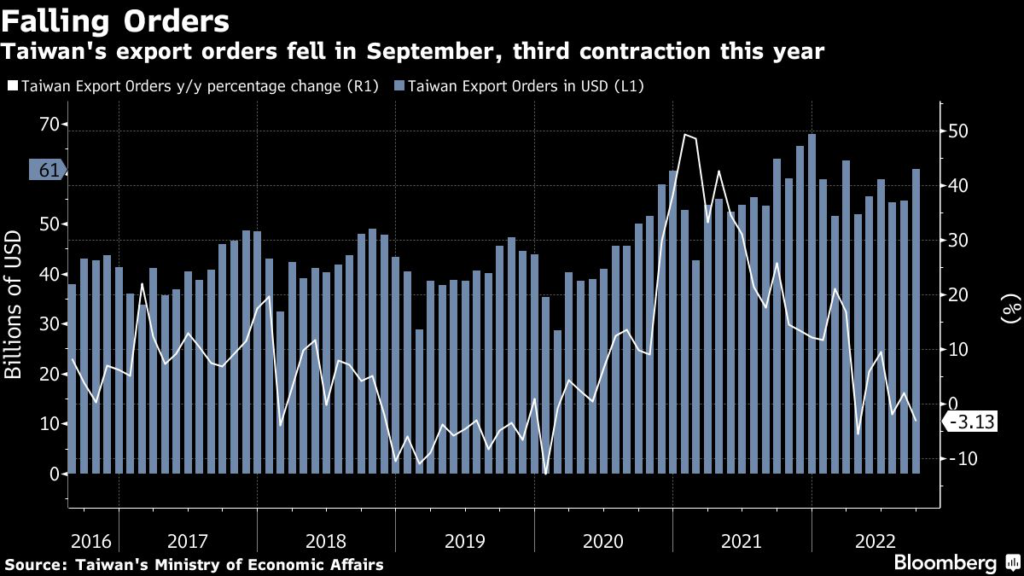
(Bloomberg) — Taiwan’s export orders contracted for the third time this year in September as demand from China continues to fall, the latest sign the trade-dependent economy is under growing pressure. 

Orders dropped 3.1% in September compared to the same month last year, according to a Thursday statement from Taiwan’s Ministry of Economic Affairs. That was better than the median estimate of a 5% decline in a Bloomberg survey of economists, but worse than August’s 2% growth. 

Taiwan’s trade outlook has worsened in recent months as a global slowdown weighs on the economy, and as Covid restrictions and dampened consumer demand in China take a toll. Before September’s data, exports orders had already fallen twice this year in July and April, largely because of the downturn in orders from China and Hong Kong. 

Orders from China and Hong Kong decreased 27.9% in September from a year earlier, worsening from August’s 25.5% decline. 

“Mainland China’s economic recovery is slower than originally estimated,” affecting the performance of export orders, said Huang Yu-lin, director of the economics ministry’s statistics department, at a press conference Thursday. 

Weakening chip demand and China’s economic downturn will provide the “most immediate hit,” said Ho Woei Chen, economist at United Overseas Bank Ltd. before Thursday’s data release. She pointed out that China and Hong Kong account for nearly 40% of Taiwan’s exports, creating uncertainty.

Huang said orders for what the government calls new consumer electronics — a category that includes integrated circuits and memory chips — performed slightly better than expected in September. But she acknowledged that the pace of growth may slow.

Taiwanese officials have been sounding the alarm on trade and economic growth in recent weeks. Earlier Thursday, the Cabinet’s chief statistician Chu Tzer-ming told lawmakers that exports in the third quarter were weaker than expected, according to the Taipei-based Central News Agency. 

Chu said it’s hard to say whether 2022 gross domestic product growth will dip below 3.5%, the news outlet reported. The government forecasts GDP will likely grow 3.76% this year, slowing from last year’s growth of more than 6%.

Taiwan Central Bank Governor Yang Chin-long on Wednesday warned the economy’s challenges will become even more severe in 2023, making it harder to predict the outlook for growth, inflation and capital outflows.

Read More: Taiwan Central Bank Sees Severe Economic Challenges Next Year

Yang cited uncertainties from the Russia-Ukraine war and growing US-China trade tensions, which have roiled the chip industry, as factors, along with lingering supply chain disruptions from Covid-19 and high inflation. 

Export orders could be a gauge for how Taiwan’s trade shapes up the rest of this year. Exports contracted in September for the first time since 2020, and officials have already warned that “winter is coming” earlier than expected. Finance Minister Su Jain-rong last month said that growth in overseas shipments might slump to single-digits in the fourth quarter.

–With assistance from Cindy Wang.

(Updates throughout with additional details from the press conference.)

More stories like this are available on bloomberg.com

©2022 Bloomberg L.P.
Hiring for the Metaverse: What Minding the Virtual Store Entails

  • Listen to Bloomberg Crypto on the iHeartRadio App
  • Listen to Bloomberg Crypto on Apple Podcasts
  • Listen to Bloomberg Crypto on Spotify  

(Bloomberg) — It might seem like the conversation about the metaverse right now is a combination of jokes about Mark Zuckerberg’s digital legs, snark about the cost of virtual reality headsets, and a real lack of clarity on why any corporation might want to be in the space. 

So we asked Matthew Boyle, a Bloomberg reporter who’s written a lot about the future of work, to help explain what’s going on here. Specifically, what’s happening with businesses hiring Chief Metaverse Officers – and what these folks do all day. 

Follow us on Twitter @crypto, and subscribe to the Bloomberg Crypto Newsletter at https://bloom.bg/cryptonewsletter


More stories like this are available on bloomberg.com

©2022 Bloomberg L.P.

Amazon Faces UK Class-Action Suit Over ‘Secretive’ Algorithm

(Bloomberg) — Amazon.com Inc. faces a UK class-action lawsuit over claims the tech giant uses a “secretive” algorithm to abuse its dominant position in the online marketplace.

Amazon has made millions of customers pay more by hiding better deals on platforms to boost its own products, Hausfeld, the law firm behind the case, alleges. It does this by using a “secretive and self-favoring algorithm” in its Buy Box feature.

A spokesperson for the Seattle-based company said the claim “is without merit and we’re confident that will become clear through the legal process.” 

Britain’s opt-out class-action regime finally sparked into life last year after new laws allowed US-style claims under competition law. A flurry of cases have been filed recently including against Meta Platforms Inc.’s alleged misuse of personal data and overcharging on Alphabet Inc.’s Google Play Store. The latest suit will still need to be officially notified as a class action by a judge.

Read More: Litigation Funders Are Betting on a Rise in UK Class Actions

The Amazon suit will be filed at the Competition Appeal Tribunal by Oct. 31., Hausfeld said. Damages, which are based on economists’ estimates from potential losses, could be as much as £900 million ($1 billion). Julie Hunter, a consultant who has worked with consumer rights organizations, will represent the potentially tens of millions of people who could be part of the suit. 

Opt-out class-action style lawsuits mean someone impacted doesn’t have to be involved in the case to be included or to get a share in any eventual award.

Amazon has been dealing with wider antitrust scrutiny surrounding its Buy Box. The CMA is currently investigating the company’s suspected anticompetitive conduct relating to the feature, while the European Commission has been in talks to settle a case on possible bias.

“Amazon takes advantage of consumers’ well known tendency to focus on prominently placed and eye-catching displays, such as the Buy Box,” Lesley Hannah, a lawyer at Hausfeld, said. “Amazon should not be allowed to take advantage of its customers in this anticompetitive way.” 

(Updates with Amazon spokesperson comment in third paragraph)

More stories like this are available on bloomberg.com

©2022 Bloomberg L.P.
Close Bitnami banner
Bitnami