

Bloomberg

N26 Offers Crypto Trading to Users in Bitpanda Partnership

(Bloomberg) — N26 will start offering cryptocurrency trading to its customers via a partnership with Bitpanda GmbH following similar moves by the digital bank’s peers. 

The product will be offered in Bitpanda’s home market of Austria first and then rolled out more broadly in the next six months, the Berlin-based company said in a statement on Thursday. Customers will be able to trade 100 coins at the start, and N26 said it plans to have almost 200 available in the coming month. 

N26 is following rivals — including Revolut Ltd. and Vivid Money GmbH — in offering crypto trading to customers. Even Mastercard Inc. said this week that it would let customers trade crypto products through their bank accounts. N26 Co-Chief Executive Officer Valentin Stalf said that while cryptocurrencies had been in decline over the last year, the company’s customers are still requesting access to them. 

Read More: Mastercard Offers Crypto-Trading Service Tied to Bank Accounts

“Investing in a market like today’s market is actually really good because it takes the fad element away,” Chief Product Officer Gilles Bianrosa in an interview. While the company will have to roll out crypto a single market at a time because of different regulations, N26’s goal is ultimately to offer the product everywhere they operate, he said. 

More mainstream financial institutions have started offering customers access to cryptocurrency products even as widespread declines in the markets have led to trillions of dollars in losses. In August, BlackRock Inc., the world’s largest asset manager, began offering its first product that allowed direct investment in Bitcoin. 

Read More: Bitpanda Cuts Hundreds of Jobs Citing Uncertain Crypto Outlook

Bitpanda will manage trade execution and coin custody, N26 said in the statement. N26, whose backers include Coatue, Li Ka-Shing and Peter Thiel, said customers will be able to trade Bitcoin at a 1.5% transaction fee and will be charged 2% for other coins. Those are the same rates offered on Bitpanda’s platform. 

More stories like this are available on bloomberg.com

©2022 Bloomberg L.P.

UK Watchdog Fires Warning Shots at Snap and Twitch on Safety

(Bloomberg) — UK internet regulator Ofcom has criticized how platforms including Snap Inc. and Amazon.com Inc.’s Twitch deal with protecting users.

At streaming service Twitch, the watchdog said users of any age “can easily watch videos that are marked by creators as ‘mature.’” Twitch also has said that parental controls or systems for viewers to rate harmful material would be a disproportionate measure or impracticable, according to Ofcom. 

Twitch shared plans with Ofcom to stop users under 18 from stumbling across mature content, but the regulator said it still “has concerns that these plans may not fully address this problem and will continue to engage with Twitch on this.”

Read More: Child Predators Use Twitch to Systematically Track Kids Livestreaming

Meanwhile at Snapchat owner Snap, it’s “not clear that it has a formalized online safety governance structure in place,” and the company’s decision-making structure is also “not clear,” the watchdog said, in a first-of-its-kind report on video-sharing platforms.

“The report from Ofcom addresses a number of important industry issues,” a Snap spokeswoman said by email. “In particular, our approach around moderation of public content, parental tools and proactive education campaigns are recognized positively in the report. We look forward to continuing our constructive partnership with Ofcom as we work together on these industrywide matters.”

A Twitch spokesman said it’s premature to comment on work still in development but it has “significant work in progress that will specifically seek to further protect users aged 13-17.” 

It said as a live video streaming service it has “a unique set of safety tools and policies, working in consultation with academics, experts, and organizations including our safety advisory council,” which are different to those used by video-on-demand companies. It added its community guidelines prevent nudity, sexually suggestive content and extreme violence. 

The UK is preparing to introduce controversial and sweeping new legislation designed to protect the public. The Online Safety Bill has spent five years being drafted, and gives Ofcom significant new powers.

Ofcom compiled the 112-page report about 19 companies as part of its job enforcing video-sharing platform regulation, a precursor to the bigger Online Safety Bill expected to come into effect next year. It also included statistics from Ipsos on the users of each service.

Most adult-oriented websites under Ofcom’s remit don’t have robust measures to stop children access pornography, the regulator said. The biggest, UK-based OnlyFans, has introduced new age verification technology “in response to regulation,” it added.

(Updates with Twitch comment in sixth paragraph)

More stories like this are available on bloomberg.com

©2022 Bloomberg L.P.

Nokia Falls 5% After Missing Third-Quarter Profit Forecast

(Bloomberg) — Nokia Oyj shares fell after it missed estimates for third-quarter profits due to delayed licensing deals.  

Nokia reported operating profit rose 3.9% from a year earlier to €658 million ($644 million), the Finnish maker of mobile networks said in a statement Thursday. That missed analysts’ average €702.6 million estimate, according to a Bloomberg survey. Shares fell as much as 5% in Helsinki trading. 

Profit margins missed estimates due to delays in the signing of new patent and licensing agreements with handset makers Vivo Communication Technology Co Ltd. and Guangdong Oppo Mobile Telecommunications Corp Ltd., according to analysts at Jefferies. 

“We are not going to just accept any deal that would be available,” Chief Executive Officer Pekka Lundmark said in an interview of the patent negotiations. “We believe that it’s more important for the longer term to protect the value of the patent portfolio, rather than rush with the timing.” 

Revenues grew thanks to demand for its mobile equipment and network infrastructure, seeing good demand for 5G in key regions like India. Nokia reiterated its full-year growth outlook for 2023.

Third-quarter sales rose 6% in constant currency to €6.24 billion, Nokia said. That compared to a €6.03 billion analyst outlook according to the average of estimates in a Bloomberg survey.

Nokia was down 4.1% to €4.5525 a share as of 9:16 a.m. in Helsinki, and have have declined 18% this year. The Espoo-based vendor posted results on the same day as top rival Ericsson AB in Sweden, which also reported a profit miss. 

More stories like this are available on bloomberg.com

©2022 Bloomberg L.P.

Activist Says Ericsson Must ‘Drain the Swamp of Losses’

(Bloomberg) — Activist investor, Cevian Capital AB, called Ericsson AB’s third-quarter results “disappointing” after the telecom network provider reported profit that missed analysts’ estimates. The stock dropped to its lowest level in more than two years. 

“The earnings miss is driven by the divisions outside Networks, namely Cloud Software & Services and Enterprise,” said Christer Gardell, founder and managing partner of Cevian, which owns about 5% of Ericsson according to data compiled by Bloomberg. “Here, you must drain the swamp of losses.”

Adjusted operating profit was 7.2 billion Swedish kronor ($643 million) in the quarter, Ericsson said in a statement on Thursday. That missed analysts’ forecast for 8.51 billion kronor, according to the average of estimates in a Bloomberg survey. 

The company, one of the world’s biggest providers of 5G networking equipment, said it would make pricing adjustments and find ways to manage margins. Ericsson Chief Financial Officer Carl Mellander said he’s looking broadly for ways to save money and could consider cuts to headcount, property holdings and energy use, though he said it’s still too early to say anything definitive on potential job losses. 

Ericsson shares declined 11% to 64.05 kronor at 9:08 a.m. in Stockholm after previously dropping as much as 13%, falling to their lowest level since March 2020. The stock has declined 28% this year through Wednesday. 

Rising energy costs are also making Ericsson’s customers more price sensitive, and the company is looking for ways to promote technology that’s more efficient, he said. 

“Energy consumption has become, I would say, more and more important as part of that evaluation,” that carriers make about their network spending, Mellander said in an interview. “There many components there, but energy has really come up because of the climate, of course, CO2, but also the soaring energy prices.”

  • Revenue rose 21% in the quarter from a year earlier to 68 billion kronor, driven by network sales in North America. the company said. That beat analysts average estimate for 66.5 billion kronor, according to the Bloomberg survey.
  • The company said sales in the Cloud Software & Services segment were hurt by lower revenue from managed services and intellectual property. The unit’s management team is working to drive down costs, though “improvements in performance will be gradual,” Ericsson said in the statement.
  • The managed services business line suffered as customers in some regions, including Europe, are scaling back, renegotiating or in-housing some functions, Mellander said.
  • Ericsson bought Vonage Holdings Corp. this year for about $6.2 billion, it’s largest-ever acquisition, to build out its enterprise business and ramp up its cloud communications offering.

(Updates with share trading from first paragraph.)

More stories like this are available on bloomberg.com

©2022 Bloomberg L.P.

Ericsson Activist Says Company Must ‘Drain the Swamp of Losses’

(Bloomberg) — Activist investor, Cevian Capital AB, called Ericsson AB’s third-quarter results “disappointing” after the telecom network provider reported profit that misses analysts’ estimates. 

“The earnings miss is driven by the divisions outside Networks, namely Cloud Software & Services and Enterprise,” said Christer Gardell, founder and managing partner, which owns about 5% of Ericsson according to data compiled by Bloomberg. “Here, you must drain the swamp of losses.”

Adjusted operating profit was 7.2 billion Swedish kronor ($643 million) in the quarter, Ericsson said in a statement on Thursday. That missed analysts’ forecast for 8.51 billion kronor, according to the average of estimates in a Bloomberg survey. 

The company, one of the world’s biggest providers of 5G networking equipment, said it would make pricing adjustments and find ways to manage margins. Ericsson is also finding ways to manage costs across the company, including “simplifying operations,” it said in the statement. 

Ericsson shares closed Wednesday at 72.19 kronor in Stockholm. The stock has declined 28% this year. 

Ericsson Chief Financial Officer Carl Mellander said he’s looking broadly for ways to save money and could consider cuts to headcount, property holdings and energy use, though he said it’s still too early to say anything definitive on potential job losses. 

Rising energy costs are also making Ericsson’s customers more price sensitive, and the company is looking for ways to promote technology that’s more efficient, he said. 

“Energy consumption has become, I would say, more and more important as part of that evaluation,” that carriers make about their network spending, Mellander said in an interview. “There many components there, but energy has really come up because of the climate, of course, CO2, but also the soaring energy prices.”

  • Revenue rose 21% in the quarter from a year earlier to 68 billion kronor, driven by network sales in North America. the company said. That beat analysts average estimate for 66.5 billion kronor, according to the Bloomberg survey.
  • The company said sales in the Cloud Software & Services segment were hurt by lower revenue from managed services and intellectual property. The unit’s management team is working to drive down costs, though “improvements in performance will be gradual,” Ericsson said in the statement.
  • The managed services business line suffered as customers in some regions, including Europe, are scaling back, renegotiating or in-housing some functions, Mellander said.
  • Ericsson bought Vonage Holdings Corp. this year for about $6.2 billion, it’s largest-ever acquisition, to build out its enterprise business and ramp up its cloud communications offering.

More stories like this are available on bloomberg.com

©2022 Bloomberg L.P.
Swiss Watch Exports Head for Record Year After Bumper September

(Bloomberg) — Swiss watch exports surged 19% in September, putting the industry on track for a record year in 2022.

Shipments rose to 2.2 billion francs ($2.2 billion) last month, making September one of the best on record, the Federation of the Swiss Watch Industry said Thursday. Exports are up 13% in the first nine months of the year.

Growth was led by the U.S., Japan, Singapore and the United Arab Emirates last month. Exports rose 15% in China despite the government’s Covid-zero strategy. The luxury-goods industry has bounced back from the pandemic, helped by consumers accumulating savings during lockdowns and online sales. 

More stories like this are available on bloomberg.com

©2022 Bloomberg L.P.

Amazon Faces Class Action Suit Over Abuse of Secretive Algorithm

(Bloomberg) — Amazon Inc. faces a UK class action lawsuit over claims the tech giant uses a “secretive” algorithm to abuse its dominant position in the online marketplace.

Amazon has made millions of customers pay more by hiding better deals on its website and mobile app to boost its own products, Hausfeld, the law firm behind the case, alleges. It does this by using a “secretive and self-favoring algorithm” in its Buy Box feature.

Britain’s opt-out class action regime finally sparked into life last year after new laws allowed US-style claims under competition law. A flurry of cases have been filed recently including against Meta Platforms Inc’s alleged misuse of personal data and overcharging on Alphabet Inc’s Google Play Store. The suit will still need to be officially notified as a class action by a judge.

Read More: Litigation Funders Are Betting on a Rise in UK Class Actions

The suit will be filed against the tech giant at the Competition Appeal Tribunal by Oct. 31., Hausfeld said. Damages, which are based on economists estimates from potential losses, could be as much as £900 million ($1 billion). Julie Hunter, a consultant who has worked with consumer rights organizations, will represent the potentially tens of millions of people who could be part of the suit. 

Opt-out class action style lawsuits mean someone impacted doesn’t have to be involved in the case to be included or to get a share in any eventual award.

Amazon has been dealing with wider antitrust scrutiny surrounding its Buy Box. The CMA is currently investigating the company’s suspected anticompetitive conduct relating to its Buy Box, while the European Commission is in talks to settle a case on possible bias from the same feature.

“Amazon takes advantage of consumers’ well known tendency to focus on prominently placed and eye-catching displays, such as the Buy Box,” Lesley Hannah, a lawyer at Hausfeld, said. “Amazon should not be allowed to take advantage of its customers in this anticompetitive way.” 

More stories like this are available on bloomberg.com

©2022 Bloomberg L.P.

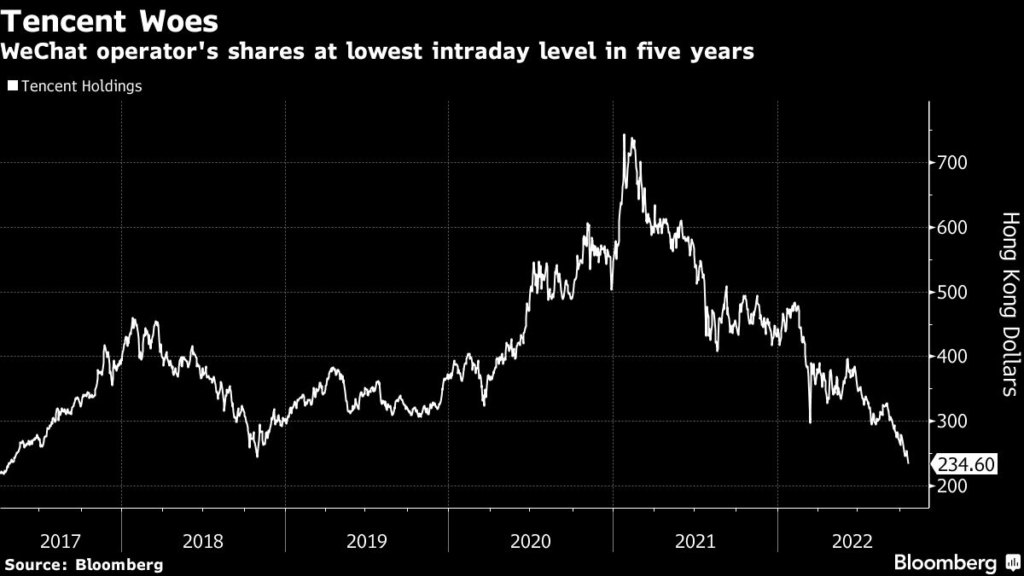
Tencent Hits Lowest Price in Five Years on China Economy Concern

(Bloomberg) — Tencent Holdings Ltd. is on track to close at its lowest point in five years as investor sentiment turned negative following concerns over China’s macro outlook.

Shares of the WeChat operator fell as much as 5.3% in Hong Kong trading Thursday, setting it on a path to close around HK$235 per share — its lowest point since early 2017.

The drop comes as Chinese stocks have declined across the board this week, weighed by concern about their earnings outlook after China delayed the release of key economic indicators and reiterated its commitment to a harsh Covid Zero policy at its twice-a-decade Communist Party congress. The Nasdaq Golden Dragon China Index, which tracks a basket of Chinese tech stocks that trade in the US, fell 7% on Wednesday to the lowest reading since 2013.

Once China’s most valuable company by a comfortable margin, Tencent’s fortunes have slumped this year as the world’s second largest economy has struggled to find momentum. It’s now tied for the lead with liquor giant Kweichow Moutai Co., which most recently overtook Tencent last month.

Tencent recorded its first-ever revenue drop in the quarter ended June and is expected to report negligible sales growth and a 34% drop in net income, according to analyst estimates. Online ad sales have been hit by China’s economic slowdown and the bread-and-butter gaming division is facing stiffer competition. CICC lowered its Tencent price target by 20% last week, citing weakness in its gaming business.

Read more: Tencent’s Sales Fall for First Time as China’s Economy Sinks

Like domestic peers, Tencent has moved to shore up its bottom line by lowering costs and disbanding non-core businesses after a year of Beijing’s sweeping crackdown that engulfed everything from online entertainment to venture investment. Given the new realities, executives have said that international games, cloud software and WeChat’s TikTok-style short video will be their major strategic priorities.

More stories like this are available on bloomberg.com

©2022 Bloomberg L.P.

Stocks Decline in Asia Amid Elevated Bond Yields: Markets Wrap

(Bloomberg) — Stocks fell in Asia and bond yields spiked higher amid concern that strong inflation and hawkish monetary policy will further slow the global economy.

Shares dropped in Japan, Australia and Hong Kong. News that Chinese officials were debating whether to reduce the amount of quarantine time for people coming into the country helped curb declines, with mainland indexes erasing most of their earlier losses.

Investors remained wary of slowing growth and rising Covid cases in China as they kept watch on the twice-a-decade party congress in Beijing. The offshore yuan moved away from a fresh record low.  

Meanwhile in Japan, the 10-year yield again pushed above the 0.25% upper limit of the central bank’s target range, triggering it to announce unscheduled bond purchases to rein it back in.

Adding to the challenge for policy makers, the yen traded at levels last seen in 1990 and remained within a whisker of the key mark of 150 versus the greenback. This has traders on guard for potential government intervention to shore up the currency.

Government bond yields jumped more than 10 basis points in Australia as US Treasury yields held near recent highs. The policy-sensitive two-year Treasury yield was near the highest since 2007.

The Philippine peso dropped to a record low against the greenback while in South Korea credit strains prompted authorities to revive a $1.1 billion bond stabilization fund.

Federal Reserve Bank of St. Louis President James Bullard said he expected the central bank to end its ‘’front-loading” of aggressive interest-rate hikes by early next year and shift to keeping policy sufficiently restrictive with small adjustments as inflation cools.

The Fed is expected to raise interest rates by 75 basis points at its Nov. 1-2 meeting — its fourth straight increase of that size — as central bankers seek to cool the hottest inflation in four decades. 

US equity futures fell in Asia after stocks on Wednesday halted a back-to-back rally, making any calls for a bottom look elusive. Not even bright earnings spots like Netflix Inc. and United Airlines Holdings Inc. were able to enthuse investors about more gains in the S&P 500. A late day rout in Tesla Inc. on disappointing sales could further weigh on sentiment.

“As we look at third-quarter results, we think there are going to be more misses than the market is currently expecting,” Ellen Hazen, chief market strategist at F.L.Putnam Investment Management, said on Bloomberg Radio. “If you look at GDP for this year, it keeps getting revised downward and it’s really hard for companies to keep growing their earnings in the face of that.”

Elsewhere in markets, oil held gains as the market shrugged off measures from US President Joe Biden to tame rising energy prices that have fueled inflation. Gold was near a three-week low.

Key events this week:

  • US existing home sales, initial jobless claims, Conference Board leading index, Thursday
  • Euro area consumer confidence, Friday

Some of the main moves in markets:

Stocks

  • Futures on the S&P 500 fell 0.2% as of 7:02 a.m. London time. The S&P 500 fell 0.7% Wednesday
  • Nasdaq 100 futures fell 0.6%. The Nasdaq 100 fell 0.4%
  • Japan’s Topix index fell 0.5%
  • The Hang Seng Index fell 1.7%
  • The Shanghai Composite Index rose 0.1%
  • Australia’s S&P/ASX 200 Index fell 1%
  • Euro Stoxx 50 futures fell 0.4%

Currencies

  • The Bloomberg Dollar Spot Index was little changed
  • The euro rose 0.1% to $0.9784
  • The Japanese yen was little changed at 149.96 per dollar
  • The offshore yuan rose 0.3% to 7.2469 per dollar
  • The British pound was little changed at $1.1218

Cryptocurrencies

  • Bitcoin fell 0.4% to $19,124.67
  • Ether fell 0.2% to $1,291.99

Bonds

  • The yield on 10-year Treasuries advanced one basis point to 4.14%
  • Australia’s 10-year yield climbed 12 basis points to 4.06%

Commodities

  • West Texas Intermediate crude rose 1.5% to $86.84 a barrel
  • Spot gold rose 0.1% to $1,631.64 an ounce

–With assistance from Tassia Sipahutar.

More stories like this are available on bloomberg.com

©2022 Bloomberg L.P.

Nokia Confirms 2023 Outlook as Third-Quarter Sales Beat Estimate

(Bloomberg) — Nokia Oyj reiterated its full-year growth outlook for 2023 as it said demand for 5G in key regions like India will help it outperform the market. 

Third-quarter sales rose 6% in constant currency to €6.24 billion, the Finnish maker of mobile networks said in a statement Thursday. That compared to the €6.03 billion analyst outlook, according to the average of estimates in a Bloomberg survey.

Sales growth was driven by demand for its mobile networking and network infrastructure, while sales declined at Nokia Technologies, which has been impacted by expired licenses.

Nokia reported operating profit of €658 million, missing analysts’ average €702.6 million estimate, according to a Bloomberg survey.

Nokia shares have declined 15% this year through Wednesday.  

More stories like this are available on bloomberg.com

©2022 Bloomberg L.P.

Close Bitnami banner
Bitnami