
Bloomberg

China’s Underground Market for Chips Draws Desperate Automakers

(Bloomberg) — In her two-bedroom apartment on the outskirts of Chinese tech hub Shenzhen, Wang woke to a deluge of messages. One read: “SPC5744PFK1AMLQ9, 300 pc, 21+. Any need?”

Within minutes, the 32-year-old was at her computer in the living room, hurriedly clearing away empty packets of instant noodles and pulling up a spreadsheet. The code referred to a chip produced by NXP Semiconductors Inc. and used in a car’s microcontroller unit. The sender of the message was trying to find a taker for the 300, made no earlier than 2021, that had come into his possession.

Neither Wang, nor any of her six-member team, are legitimate chip dealers. Freelance brokers like her used to be bit players in China’s semiconductor market, but they became increasingly important in late 2020 when a worldwide shortage of chips began to disrupt supplies of everything from smartphones to vehicles. Now, they’ve formed a massive gray market — an opaque forum populated by hundreds of middlemen and riddled with second-hand or out-of-date chips where the cost of acquiring just one can run to 500 times its original price. The situation is most acute with chips destined for cars, which are becoming more like computers on wheels as the industry is revolutionized. The US’s recent chip technology export curbs will only make the shortages worse, encouraging underground activity, the head of China’s major car association said.

“Recent US sanctions have introduced another round of panic to the market and disturbed the supply of both entry level and more advanced chips,” China Passenger Car Association Secretary General Cui Dongshu said last week. “Distribution channels and the prices of chips are messed up.”

Opportunists the world over have seized on the chips shortfall, jacking up the price companies pay for the crucial circuital components. But a lack of regulation and soaring demand — China is by far the biggest global market for cars and is in the throes of a new wave of electric vehicles — mean under-the-table deals are more widespread here.

In scores of interviews with more than a dozen people involved in this world, all of whom declined to be identified because of the sensitive nature of what they’re doing, Bloomberg News pieced together how the complicated network operates. Substandard chips have so infiltrated the supply chain, many brokers say, that car quality, and worse — safety — is at risk. Should a fraudulent chip fail in the ABS brake module of a vehicle, for example, the consequences could be life threatening.

Leading German auto-parts supplier Robert Bosch GmbH received several requests from Chinese carmakers to process vehicle components using chips that had been sourced on the gray market by the companies themselves, people familiar with the matter said. Bosch ultimately turned down the requests, believing the chips could risk the integrity of its own parts. One automaker requested Bosch work with gray-market semiconductors whose price had soared during a Covid outbreak because Bosch’s Malaysian supplier had to cease production of the chips, used in Bosch’s ESP (Electronic Stability Program) product. (Electronic stability programs work with a car’s antilock braking system to detect skidding movements and counteract them.) Bosch refused, one of the people said. A representative for Bosch referred to an interview that Xu Daquan, its executive vice president of China, did in September, in which he said the chip shortage “is not expected to be solved in the next year.” The company declined to comment further.

While operations like Wang’s are legal in that they’re registered companies and pay taxes, the provenance of chips bought and sold on the gray market can be difficult to assess. Chips can come from questionable channels — backdoor sales from authorized agents, who may have, intentionally or otherwise, placed surplus orders with a manufacturer, or legitimate companies that are selling excess chips for a profit, violating agreements with the original chipmakers. Some of the brokers also try to juice profits by hoarding and price gouging, behavior that violates Chinese regulations and that local authorities have sought to crack down on.

According to Wang, who asked to only be identified by her last name, the “conventional system whereby auto suppliers place an order through an authorized agent and wait for distribution from an original chipmaker no longer works.”

Semiconductors required for microcontroller units have been among the hardest to source and command the most eye-watering prices, reporting by Bloomberg found. That’s because they’re used in so many parts of a car, from electronic braking systems to air conditioning and window control units. In a world where chips are becoming smarter and smaller, they require much less advanced technology to manufacture and therefore command smaller margins. As demand surged during the pandemic, chipmakers switched production to more profitable semiconductors for use in consumer electronics or medical devices, greatly reducing the supply of microcontroller unit chips.

Carmakers responded in different ways. Toyota Motor Corp. and Volkswagen AG largely just pulled back on production and deliveries, while Tesla Inc. found workarounds, developing new software that allowed the pioneering electric vehicle maker to use alternative semiconductors. In China, the cutthroat nature of the local market — there were some 200 registered EV makers, alone, last year — saw domestic players in particular embrace the chip gray market.

All three of China’s main, US-listed EV upstarts — Nio Inc., Xpeng Inc. and Li Auto Inc. — have tried to buy chips via these unauthorized agents, middlemen who are classified as such because they don’t have permission from the original chipmakers to distribute their products, according to people familiar with their activities. In fact, almost every Chinese carmaker except the country’s biggest EV manufacturer BYD Co., which makes its own chips, has attempted to source semiconductors this way, the people said.

Beijing-based Li Auto, known for its flagship Li One sports utility vehicle, paid the equivalent of over $500 to one broker for a single brake chip that cost about $1 before the pandemic, people familiar with the matter said.

In an interview with Bloomberg in July, Li Auto President Kevin Shen said the company was still struggling with some key chip supplies and expected to continue to face problems given the number of semiconductors required by tech-laden EVs. A representative for Li Auto denied the company paid 500 times the original price for a chip, but declined to comment further for this story. Spokespeople for Nio and Xpeng declined to comment.

The gray-market trade mainly takes place online, in WeChat groups and over email, but trades also sometimes happen at physical marketplaces like the Saige (SEG) Electronics Market Plaza Huaqiangbei in Shenzhen, where brokers have been known to bring chip samples in knapsacks to secure orders. And it hasn’t escaped regulators’ notice. In August last year, the government launched a probe into possible price manipulation, fining three brokers a total of 2.5 million yuan ($350,000) for selling car chips “with a substantial markup.” But in a market where automakers are so desperate for supply they’re willing to pay multiple times what a chip is worth, that sort of penalty isn’t much of a deterrent.

China’s secondary chip market didn’t spring up overnight. It existed before the semiconductor crunch, but with so many people sensing an opportunity to profit, it’s ballooned. “Everyone’s a speculator,” one of the unauthorized brokers interviewed by Bloomberg said.

While in most cases, brokers get sales commissions, the most profitable, albeit risky, way to make money is to try to predict demand and hoard chips, offloading them later for huge markups. It requires good luck, plenty of cash and lots of guanxi, the Chinese system of social networks and influential relationships that facilitates business dealings. If a bet goes wrong, it could mean bankruptcy. Reports of overnight millionaires, and suicides, aren’t unheard of.

Relatively low barriers to entry mean that “anyone with sources can be a broker,” according to a manager at a Shenzhen-based semiconductor trading company. “Companies like us may have some advantage in terms of product reliability but the opportunists have muddled the market. We had no choice but to join it.”

Brokers with better guanxi are always the first to get information and enjoy priority when it comes to securing orders at an advantageous price. Bribery isn’t commonplace, but it’s also not unheard of. Chip supplier employees are sometimes paid to steal chips that have been allocated to an automaker, people familiar with the matter said. Aware of such misconduct, one Chinese car company has begun dispatching staff to oversee delivery of their semiconductors. An employee then sits alongside the parts maker’s production line to make sure that the chips are used in their products and any left over are properly locked away, according to a person familiar with the arrangement.

A sale typically goes to the party willing to pay the highest price but sometimes, having better guanxi trumps that. Instead of paying by installments — the conventional way of automotive chip supply — all transactions in the gray market are paid in cash.

To prevent others from tracing where chips have come from, intermediaries often scrub labels or information on packaging. Though completely fake chips aren’t commonly seen because of the technical expertise and machines required to make them, several automakers have fallen into the trap of unwittingly buying second-hand chips that have been removed from discarded auto parts and sold as new, people familiar with the matter said.

“Reused chips can cause problems because they might have been built for too small a temperature range, for example,” said Phil Koopman, an associate professor of electronic and computer engineering at Carnegie Mellon University. He’s been involved with automotive chip design and safety for around 30 years. “Just as important is that chips wear out over time, so reused chips might fail much sooner than expected. I’m not aware of any practical way to detect this problem other than re-doing factory qualifications for temperature ranges and reverse engineering to check for signs of repackaging.” These chips can easily slip into vehicles unnoticed, he said.

The risk of that happening has spawned another grass roots industry: chip quality inspectors. Typically former employees of chip companies or authorized agents, they claim to have the ability to verify labels and packaging and even to be able to X-ray the interiors of the chips. Business consultants are also joining the fray, vetting brokers for carmakers and running business credibility checks.

In a bid to accelerate the procurement process considering how volatile prices are, several Chinese automakers have appointed people internally to oversee the direct purchase of chips from brokers. In some cases, chip prices may change overnight, every other hour, or even after a purchase inquiry is made. If carmakers have well-oiled systems in place, the time from quotation to delivery can be as fast as 24 hours. “Chinese automakers are more flexible in finding the solutions to ease the chip supply,” Wang Bin, an automotive analyst at Credit Suisse Group AG, said at a briefing in May.

However faced with such immediate demand for chips, almost all car companies have chosen to compromise, at a minimum by accepting chips with older production dates. Before Covid, automakers typically only used chips produced in the past 12 months; now many are using semiconductors made four or five years ago, so long as they’re the right type.

Older chips that have never been used but that have been well stored “can be acceptable depending on the circumstances,” said Koopman at Carnegie Mellon. One hitch is that older chips might have design defects — ‘errata’ that have subsequently been corrected in newer versions. “Newer vehicles might not ever have been tested to see if they can survive the defects in the older chips,” he said.

The PCA’s Cui said it’s impossible to detect what used or refurbished chips may be circulating inside cars and as such, regulators have a difficult time supervising gray market transactions. Whether it will lead to safety issues is hard to say but “at the very least it’s not fair to consumers because they’re not informed about it,” he said.

China’s State Administration for Market Regulation has said hoarding chips violates several articles under national price law. “Brokers are taking advantage of the imbalance between the supply and demand of auto chips in China,” it said, adding that such behavior could lead to “panic stocking and worsen the imbalance.” China’s Ministry of Information and Technology and its Ministry of Transport, each of which has a safety regulation unit, didn’t respond to requests for comment. There haven’t been any accidents publicly known to have been caused by faulty chips purchased on the gray market.

While global automakers like Toyota and General Motors Co. say the chip shortfall is showing signs of easing, Fitch Ratings Inc. doesn’t see a full recovery until 2023, due to the combination of semiconductor shortages, shipping delays and Covid Zero lockdowns, especially in China. That means automakers are increasingly being pushed to switch up their long-held strategy of  only holding enough inventory for the immediate future and building in buffers, according to Kenny Yao, a director at Shanghai-based auto industry consultancy AlixPartners.

“An automaker has to think about three questions,” Yao said. “In the short term, can it find a good replacement for certain types of chips? In the mid-term, can it alter its design to allow for more flexibility in semiconductor parts? And in the long term, can levels of integration be raised to combine the functions controlled by several basic chips into one advanced one?”

Until that point, business should remain brisk for Wang.

While her company has a small office about 30 minutes’ subway ride away, she’s so busy that she rarely goes in, spending most of her waking hours hunched over her laptop at the dining room table or answering WeChat messages from her bedroom. When things get really crazy, she has to stockpile food. “We’ve become the go-to guys for urgent supplies,” she said. “It keeps our clients’ production lines running.”

More stories like this are available on bloomberg.com

©2022 Bloomberg L.P.

Bankrupt Crypto Lender Celsius Facing Federal ‘Investigations’

(Bloomberg) — Bankrupt cryptocurrency lender Celsius Network faces US federal “investigations,” according to a filing from lawyers for its committee of unsecured creditors.

“The number and extent of investigations of the debtors by governmental entities is significant: Celsius is apparently subject to enforcement proceedings or investigations in at least 40 states, in addition to investigations or inquiries involving the federal government,” counsel said in the Tuesday filing.

The document cited a Sept. 7 statement from the Texas State Securities Board that said multiple states are looking into Celsius.

The latest filing signals ever greater scrutiny of Celsius, which rocketed in popularity by paying people interest on their coin deposits. But it froze withdrawals in June as crypto prices collapsed and its risky bets backfired before seeking bankruptcy protection in July. 

Prior filings show that the US Securities and Exchange Commission, Commodity Futures Trading Commission and Federal Trade Commission have sent inquiries to the lender. The company has also received a federal grand jury subpoena from the US District Court for the Southern District of New York.

Most of Celsius’s customers ended up as the firm’s unsecured creditors, represented by the committee.

Many creditors have sent letters to the judge in charge of the case, accusing Celsius and its former Chief Executive Officer Alex Mashinsky of misleading them about risks involved in entrusting their coins to the company. 

The judge recently appointed an examiner to look into this and other issues. The committee doesn’t want the examiner’s time to be taken up by keeping an eye on ongoing government investigations, given their extent.

–With assistance from Suvashree Ghosh.

More stories like this are available on bloomberg.com

©2022 Bloomberg L.P.

Adobe’s Annual Sales Forecast Falls Short on Currency Impact

(Bloomberg) — Adobe Inc., the biggest maker of creative design software, reiterated its forecasts for the current quarter even while projecting 2023 revenue that fell just short of analysts’ estimates, relieving investors who feared economic uncertainty would hinder demand.

Exchange rates and the strong US dollar are expected to cause a 4% headwind to sales growth in 2023, and about a $700 million downward revaluation to the company’s digital media annual-recurring revenue, the company said. Adobe generates more than 40% of its sales overseas. Speaking during the company’s presentation Tuesday to analysts, Chief Executive Officer Shantanu Narayen said the forecast was muted by the economic environment. 

“CEO confidence has clearly come down a little bit,” Narayen said, citing customer concerns about inflation, the continuing war in Ukraine and a potential recession.

Adobe said the forecast doesn’t include Figma Inc., a product design rival the company announced last month it would acquire for $20 billion. Analysts were surprised by the price tag, the highest ever for a private software company, and suggested competitors were making greater inroads than previously thought. The San Jose, California-based company’s shares have declined 21% since the Figma deal was announced, closing Tuesday at $292.98 in New York.

Fiscal-year sales will be about $19.2 billion, the company said in a statement. Profit, excluding some items, will be as much as $15.45 a share for the period ending in November 2023. Analysts, on average, projected earnings of $15.53 a share on revenue of $19.8 billion.

The company also affirmed its fiscal fourth-quarter guidance of about $4.5 billion in sales and earnings, excluding some items, of $3.50 a share. Shares gained about 3.2% in extended trading after the announcement.

Adobe’s fiscal-year forecast for its digital media segment, which includes its marquee creative software, missed estimates, strengthening the argument that the Figma acquisition “shows a sense of urgency to counter slowing growth in its Creative Cloud unit,” wrote Bloomberg Intelligence’s Anurag Rana.

Adobe is looking to expand its slate of web-based products to attract more casual users and product designers, a market that has gravitated in recent years to companies such as Canva Inc., Lightricks Ltd. and Figma. During Adobe’s annual product conference earlier Tuesday, the company introduced changes to its flagship Photoshop image-editing program to add more collaboration tools, artificial intelligence features and web capability.

Narayen touted the release of Adobe Express, the company’s browser-based solution for quick media editing, during the event. The company said the service has had 20 million sign-ups since launch. “We were probably a little late,” Narayen said. “But it’s here and it’s awesome.”

(Updates with analyst’s comments in the sixth paragraph.)

More stories like this are available on bloomberg.com

©2022 Bloomberg L.P.
Senate’s Warner Scolds Apple, Tesla for ‘Blind Eye’ Toward China

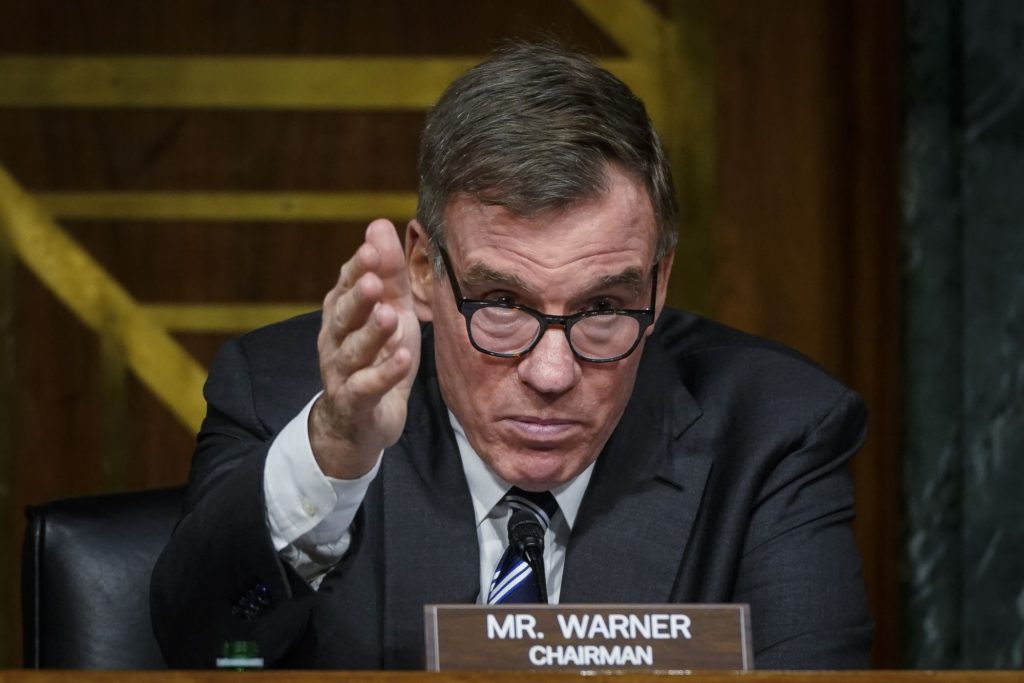
(Bloomberg) — Senate Intelligence Committee Chairman Mark Warner said he’s “disappointed” that companies such as Apple Inc. and Tesla Inc. tout their ESG bona fides but neglect glaring environmental or human rights issues when relying on China for supply chains and sales.

Multinationals may highlight their commitment to Environmental, Social and Governance goals but also reason that “the Chinese markets, it’s so big, we’ve got to turn a blind eye” to abuses, Warner said in an interview with Bloomberg in New York. “Whether it’s oppression of the people in Hong Kong or whether it’s the Uyghurs or whether it’s using electrical power coming out of Xinjiang to build the batteries that go in your Tesla.”

China has been accused of widespread human rights abuses against mostly Muslim Uyghurs in the far west region of Xinjiang, 

Warner said he’s “disappointed with our friends at Apple” and has been “really frustrated with not just American companies, but other multinationals.”

Spokespeople for Apple and Tesla didn’t immediately return emails seeking comment on Tuesday. Sales in China accounted for roughly a quarter of Tesla’s automotive revenue in the third quarter. Apple are 99% made in China, according to Bloomberg Industries, and about a fifth of its revenue comes from China.

Warner reiterated his past calls to get the US off an over-reliance on Chinese supply chains and other initiatives. He said a blockade of Taiwan by China would be “an economic catastrophe” and hostilities with China would be “exponentially different” than with Russia.

“If China dominates a series of the technology domains they could run the table,” he said.

Warner predicted additional legislative action on the issue, including on synthetic biology, advanced energy, quantum computing and other emerging technologies.

Warner also critiqued some environmentalists for measuring the impact of electric cars based only on when the vehicle is used as opposed to “how the car got got to your driveway in the first place.” 

“I think that’s starting to change,” he said.

More stories like this are available on bloomberg.com

©2022 Bloomberg L.P.
Big Tech and Streaming Stocks Stage Late Rally After Netflix Beat

(Bloomberg) — Stronger-than-expected quarterly results from Netflix Inc. fueled a rally in tech stocks, easing investor concerns about growth in one of the hardest hit sectors this year. 

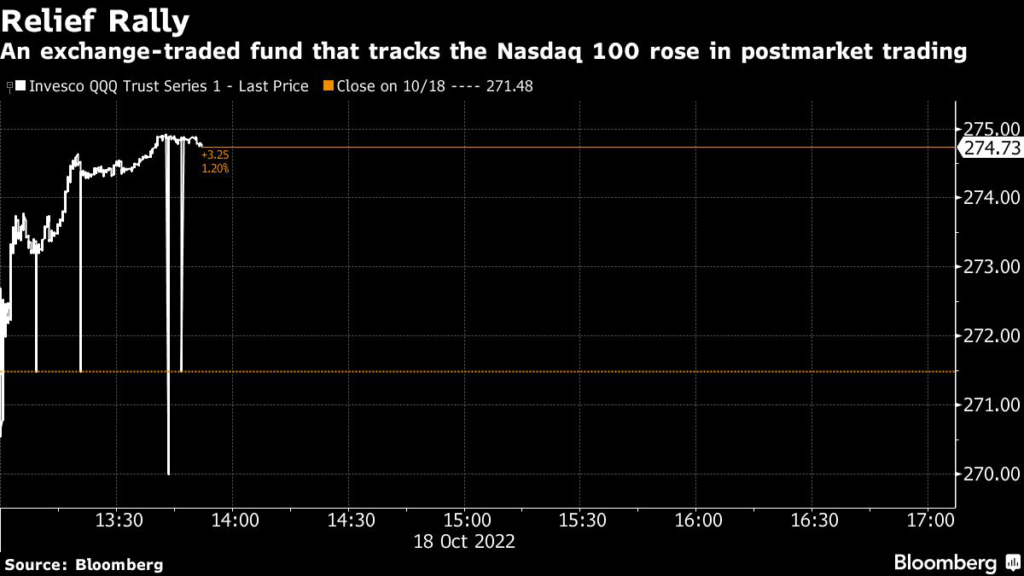
Shares of the biggest US technology stocks from Amazon.com Inc. to Alphabet Inc. climbed by at least 1% in postmarket trading after Netflix added 2.41 million customers in the third quarter, exceeding Wall Street analysts’ expectations, and projected even more subscriber additions in the current quarter. The Invesco QQQ exchange traded fund, which tracks the Nasdaq 100 Index, rose as much as 1.2% in postmarket trading.

The tech sector has struggled amid slowing growth and rising interest rates, which have also pressured the earnings multiples of the group. The Nasdaq 100 Index is down 32% this year, as of its Tuesday close. The First Trust S-Network Streaming and Gaming ETF is down 38% off a peak hit earlier this year. 

Shares of streaming-video companies also jumped after Netflix’s upbeat results with Roku Inc. leading the rally on a gain of more than 4%. Among media stocks Walt Disney Co. gained 2.4%, Warner Bros Discovery Inc. added 2.6%, Paramount Global climbed 2.1% and fuboTV Inc. gained 2.4%. Netflix rallied as much as 15%.


More stories like this are available on bloomberg.com

©2022 Bloomberg L.P.

The NBA’s Secret Weapon for Winning Fans in Japan: Rakuten

(Bloomberg) — On a recent Sunday afternoon, a basketball fan in a Cleveland Cavaliers jersey took his seat for a preseason NBA game in a sold-out arena. This would have been unremarkable if not for the fact the game was taking place 5,000 miles away from US shores and the Cavaliers weren’t even part of it.

This year’s NBA Japan Games were a marketing executive’s dream, mobilizing fans and wallets and further marrying the league’s brand with the sport’s growing popularity internationally. Scores of people packed in to watch a pair of preseason games between the Washington Wizards — featuring Rui Hachimura, one of two Japanese players in the NBA — and the reigning champion Golden State Warriors. The crowd went nuts anytime Hachimura touched the ball.

All of it was organized by the NBA and Rakuten Group Inc., a Japanese e-commerce giant that’s been leveraging its sponsorship of the Warriors to build name recognition in the US. The company signed up with the team in 2017 at a cost of $20 million a year. That deal featured a logo patch on players’ jerseys and a partnership around merchandising. Rakuten and the Warriors renewed and expanded their pact in May — excellent timing because the team won the championship a month later. The Japan Games ran from Sept. 30 to Oct. 2.

Two-time NBA most-valuable player Steph Curry said at a press conference ahead of the games that the Warriors were “excited to play in front of our Japanese fans and hopefully make some new ones.”

One of those fans was Korean rapper Suga from the boy-band BTS, who was gifted Curry’s sneakers afterward.

The success of Rakuten’s deal with the Warriors comes as China, a top global focus for the NBA, continues to impose strict pandemic restrictions. Africa and India are also international priorities, Deputy Commissioner Mark Tatum said at the CAA World Congress of Sports this month.

Rakuten says its brand recognition in the US has grown to almost 70% from 23% over the five years it has been working with Golden State. Its choice of NBA team also wasn’t by accident. The company’s regional headquarters is in Silicon Valley and executives say investing in the Warriors has been a big plus for recruitment and employee satisfaction.

“We have one of the most global and diverse fan bases around the world of any sports property,” the NBA’s Tatum said in a Bloomberg Television interview Monday. He credited the success of international players in driving interest in the league around the world.

Rakuten previously sponsored preseason games in Japan in 2019. Before that, the last time the NBA played in Japan was 2003. Ticket sales this year were about 40% higher than they were for the 2019 games and on-site merchandise sales were the highest ever for an NBA Global Games event, the company said.

“There are 6 million NBA fans here in Japan, of which one in six is a Warriors fan,” said Brandon Schneider, Golden State’s president and chief operating officer. “Warriors are the biggest team in the country and Rakuten gets credit for that. No question.”

The recent games were the first time either the Warriors or the Wizards had played in Japan. The 2019 Japan Games featured the Toronto Raptors and Houston Rockets.

The Warriors will begin their campaign to repeat as champions on Tuesday night with the NBA regular-season tipoff.

(Updates with merchandise partnership in third paragraph. A prior version corrected the event organizers and ranking of NBA global priorities.)

More stories like this are available on bloomberg.com

©2022 Bloomberg L.P.
Stocks Extend Rebound on Rising Earnings Optimism: Markets Wrap

(Bloomberg) — Stocks continued their rebound from nearly oversold levels as traders took solace from a solid start to the corporate-earnings season even as central banks remain on hawkish footing.

After almost giving up all of its gains, the S&P 500 notched back-to-back gains to start the week. Futures extended the advance in late trading after Neflix Inc. delivered a surge in subscribers. Its shares jumped more than 13% as of 4:40 p.m. in New York. The biggest ETF that tracks the Nasdaq 100 advanced more than 1%. United Airlines Holdings Inc. climbed 7% after reporting its results.

During the cash session, the S&P 500 rose 1.1% and is now up 3.8% in two days. Goldman Sachs Group Inc. climbed on solid results. Apple Inc. rebounded after briefly turning negative on a report it was cutting production of its iPhone 14 Plus.

“Earnings season offers investors the opportunity to focus more on the actual earnings power of corporate America, and less on the machinations of the backward-looking economic data stream,” said Art Hogan, chief market strategist at B. Riley. “A better-than-feared earnings season may well be the catalyst the market needs to see a break in the steady grind lower.”

Upbeat company results, cheaper valuations and UK policy reversals have helped buoy risk sentiment. The sentiment on stocks and global growth among fund managers surveyed by Bank of America Corp. shows full capitulation, opening the way for equities to bottom in the first half of 2023.

Still, with headwinds from inflation, risks to the economy and hawkish central banks continuing to confront investors, there’s debate over how durable the gains will prove.

Read: Fed’s Bostic Says Slowing Inflation Best for Long-Run Employment

Some regional Fed directors last month favored raising a key interest rate by a smaller or larger amount than the 75 basis points that policymakers ultimately decided was needed to curb persistent inflation, according to minutes of discount-rate meetings released Tuesday.

“There’s still a strong feeling of a bear-market rally about trading over the course of the last week,” said Craig Erlam, senior market analyst at Oanda Europe Ltd. “The economic landscape looks treacherous and we don’t even know if we’re at peak inflation and interest rate pricing yet. Those are substantial headwinds that will make any stock market rebound extremely challenging.”

Key events this week:

  • Euro area CPI, Wednesday
  • EIA crude oil inventory report, Wednesday
  • US MBA mortgage applications, building permits, housing starts, Fed Beige Book, Wednesday
  • Fed’s Neel Kashkari, Charles Evans, James Bullard speak, Wednesday
  • US existing home sales, initial jobless claims, Conference Board leading index, Thursday
  • Euro area consumer confidence, Friday

Some of the main moves in markets:

Stocks

  • The S&P 500 rose 1.2% as of 4 p.m. New York time
  • The Nasdaq 100 rose 0.8%
  • The Dow Jones Industrial Average rose 1.1%
  • The MSCI World index rose 1.1%

Currencies

  • The Bloomberg Dollar Spot Index was little changed
  • The euro rose 0.2% to $0.9856
  • The British pound fell 0.3% to $1.1323
  • The Japanese yen fell 0.1% to 149.23 per dollar

Cryptocurrencies

  • Bitcoin fell 1.5% to $19,227.77
  • Ether fell 2.2% to $1,300.61

Bonds

  • The yield on 10-year Treasuries declined two basis points to 3.99%
  • Germany’s 10-year yield advanced two basis points to 2.28%
  • Britain’s 10-year yield declined three basis points to 3.95%

Commodities

  • West Texas Intermediate crude fell 2.6% to $83.24 a barrel
  • Gold futures fell 0.5% to $1,656.50 an ounce

More stories like this are available on bloomberg.com

©2022 Bloomberg L.P.

The IRS is Making It Easier To File Your Crypto Taxes

(Bloomberg Law) — The IRS has given US cryptocurrency holders a bit more clarity about how to report digital assets on their 1040 income tax forms, a likely precursor to regulatory guidance.

In 2022 tax form draft instructions released late Monday, the Internal Revenue Service expanded how taxpayers should list their crypto transactions, including switching the verbiage from “virtual currency” to “digital assets.”

“They’re being a little more attuned to the terminology of the industry and being more inclusive of potential crypto transactions,” said Adnan Islam, tax partner with Marcum LLP.

The additional clarity is welcome, tax professionals said, but getting guidance is still their No. 1 ask.

In August, the IRS expanded the crypto question on the 1040 tax form to specify that taxpayers should report if they had received crypto as a “reward, award or compensation.”

The latest instructions change “virtual currency” to digital assets,” a nod to the definition in Section 6045 as amended in the 2021 infrastructure bill that expanded cryptocurrency reporting requirements. That change addresses ambiguity about whether a nonfungible token, or NFT, is considered virtual currency. In the updated form, the agency explicitly says, digital assets includes NFTs and virtual currencies.

The change in terminology is a good sign the agency is preparing more guidance, said Miles Fuller, head of government solutions at TaxBit and former senior counsel with the Office of Chief Counsel at the IRS.

“The IRS is ramping up by coalescing their terminology around this digital asset term that was in the statute,” he said. “So it means that it’s more likely than not in the near future, we’re gonna see those regs come out and the IRS continuing to move forward with sort of implementation of a regulatory regime. Probably sooner rather than later.”

While there is no penalty for not checking “yes” on the 1040 form, a taxpayer who underreports their income could be subject to penalties and interest on the non-reported crypto income. The elaborated forms help taxpayers get clarity to prevent that, tax professionals said.

Financial interest is further defined in the updated instruction form draft, another area where the industry was seeking guidance. “Financial interests,” it says, are present “if you are the owner of record of a digital asset, or have an ownership stake in an account that holds one or more digital assets, including the rights and obligations to acquire a financial interest, or you own a wallet that holds digital assets.”

“They’ve never really defined what that meant,” Fuller said.

The definition of financial interest is what tax professionals expected, said Kevin Ainsworth, a partner at BDO. Ainsworth said he would like to see more specific examples, so taxpayers know whether to check the box on the form.

The form draft elaborates that if a taxpayer received digital assets as a “result of mining, staking and similar activities,” they should check the “yes” box on the form. The “similar activities” might include decentralized finance activities, or DeFi, such as liquidity pools, said Lisa Zarlenga, a partner at Steptoe & Johnson LLP and a former Treasury tax legislative counsel.

In a tax dispute, instruction forms are not binding guidance, so taxpayers may not be able to rely on it, she noted.

“When you think about it, as a practical matter, most everyday taxpayers rely on the instructions when they’re filling out their tax forms,” Zarlenga said. “And so it seems kind of unfair that if they relied on something that these instructions said, and the IRS then challenged it, they wouldn’t be able to point to this in court and say this is something that I relied on.”

The digital asset question on the 1040 form “doesn’t have anything to do with substantive tax,” and it is more disclosure-based, Fuller said, so it could potentially be used as a “kind of defense” to an argument.

Guidance or law—particularly in the areas of staking and mining, and in the treatment of NFTs—are what industry professionals say they want the most.

Trying to make sense of the instructions and changes to the forms is “like reading the tea leaves,” said Zarlenga. She said she would prefer guidance.

To contact the reporter on this story: Erin Slowey in Washington at eslowey@bloombergindustry.com

To contact the editors responsible for this story: Meg Shreve at mshreve@bloombergindustry.com; Butch Maier at bmaier@bloombergindustry.com

More stories like this are available on bloomberg.com

©2022 Bloomberg L.P.
Crypto Bank Silvergate Falls After Third Quarter Earnings Miss

(Bloomberg) — Silvergate Capital Corp. shares slumped 23% after the cryptocurrency-focused bank’s third-quarter results missed consensus estimates and a much-anticipated stablecoin launch was delayed. 

The bank reported earnings-per-share of $1.28 for the quarter, lower than the average analyst estimate of $1.41, according to data compiled by Bloomberg. It also said deployment of its stablecoin — built with technology the bank acquired from the failed Meta Platforms Inc.-backed Diem project — would be delayed to an unknown future date. A rollout had been expected by the end of this year.  

Silvergate is working with regulators and policy makers to ensure compliance of the stablecoin, said Alan Lane, president and chief executive officer of Silvergate, during an earnings call. “We still feel very strongly that we are in the best position of any other bank out there to launch a regulatory compliant, safe and sound, tokenized dollar on the blockchain.”

Analysts at Wedbush including David Chiaverini cut their EPS estimate for the bank for the next three years, citing lower average earning asset growth assumptions and the delay of the stablecoin launch. Still, they said Silvergate is “well-positioned to thrive” when the crypto market rebounds and expect revenue to ramp up after the pilot launch of the stablecoin, which they now expect to occur in the third quarter of 2023. 

The total cryptocurrency market valuation dropped by about $2 trillion in the last year as investors have, at least temporarily, lost interest in cryptocurrencies and other risky growth assets.

Silvergate Exchange Network, the firm’s key growth driver, reported a drop in usage in the quarter. The payments platform for crypto firms and investors handled $112.6 billion of US dollar transfers, down 41% from the prior quarter and 30% from a year ago. 

Silvergate’s digital asset customers grew to 1,677 at Sept. 30, up from 1,585 at the end of last quarter. But average digital asset customer deposits fell to $12 billion, down from $13.8 billion from the prior quarter. 

Shares of the company, which are down 63% so far this year, fell 23% to $54.71 on Tuesday in New York. 

(Update shares move, analyst comment)

More stories like this are available on bloomberg.com

©2022 Bloomberg L.P.

Dallas Air Traffic Rerouted as FAA Probes Faulty GPS Signals

(Bloomberg) — Flights into the Dallas area are being forced to take older, cumbersome routes and a runway at Dallas-Fort Worth International Airport was temporarily closed after aviation authorities said GPS signals there aren’t reliable. 

The Federal Aviation Administration said in an emailed statement Tuesday it’s investigating the possible jamming of the global-positioning system that aircraft increasingly use to guide them on more efficient routes and to runways. So far, the agency has found “no evidence of intentional interference,” it said. 

American Airlines Group Inc., the primary carrier at DFW, said the GPS issue is not affecting its operations. Southwest Airlines Co., which flies from nearby Love Field, said it also isn’t experiencing any disruptions. The FAA reopened the closed runway earlier on Tuesday. A representative for DFW did not reply immediately to a request for comment.

The GPS problem — despite the lack of impact — highlights the risk of widespread reliance on the weak GPS radio signals from space used for everything from timing stock trades to guiding jetliners.

The FAA occasionally warns pilots in advance of military testing that may degrade the GPS signals and pilots sometimes report short-lived problems, but the interference in Dallas is atypical, said Dan Streufert, founder of the flight-tracking website ADSBexchange.com. 

“In the US, it’s very unusual to see this without a prior notice,” Streufert said in an interview. 

ADSBExchange.com monitors aircraft data streams that indicate the accuracy of the GPS signals they are receiving and the website began seeing problems around Dallas on Monday, he said. 

The military has told the FAA it isn’t conducting any operations that would interfere with GPS in that area, said a person familiar with the situation who wasn’t authorized to speak publicly about it. 

“GPS jamming has always been a risk area,” said John Hansman, an aerospace professor at the Massachusetts Institute of Technology. “It’s not that difficult or expensive technically to jam GPS. Which is why we don’t use GPS as the only navigation source.”

The primary way FAA’s air-traffic system tracks planes is based on GPS, but older radars and radio-direction beacons have remained in place as backups. 

As a result, a GPS failure would create less efficient routes and a higher workload for controllers, but wouldn’t necessarily threaten safety or halt flights, Hansman said. 

(Updates with re-opening of DFW airport runway in third paragraph.)

More stories like this are available on bloomberg.com

©2022 Bloomberg L.P.

Close Bitnami banner
Bitnami
