

Bloomberg

Amazon Workers Reject Union Bid at Warehouse in Upstate New York

(Bloomberg) — Amazon.com Inc. workers at a warehouse near Albany, New York, voted by a 2-1 margin against joining an upstart labor union — the group’s second defeat in a row. 

Of the approximately 650 ballots cast, 206 workers voted yes and 406 voted no to unionize under the banner of the Amazon Labor Union, which earlier this year won a historic election at a much larger Amazon facility in Staten Island. There were 31 contested ballots, not enough to change the outcome. 

The loss is a setback for the ALU, which has struggled to expand its influence beyond New York City and even hang on to its gains there. The ALU lost a vote at a second Staten Island facility in May and is now battling Amazon over the results of the election it did win.

The push at the warehouse in the upstate town of Schodack, was led by Heather Goodall, who started working at the facility in February. She and her colleagues were demanding higher wages, more paid time off and safer working conditions. 

ALU President Chris Smalls said the union would continue to work at the facility and expressed pride in workers who “stood up in the face of a vicious anti-union campaign.” In an emailed statement, he said the election “wasn’t free and fair” and that Amazon subjected workers to “intimidation and retaliation on a daily basis.” 

Smalls didn’t say whether the ALU would challenge the result to the National Labor Relations Board, as Amazon did following the union’s sole victory. The ALU has filed dozens of unfair labor practice charges against the company for its conduct in Schodack since going public with the campaign.  

In an emailed statement, Amazon spokesperson Kelly Nantel said: “We’re glad that our team in Albany was able to have their voices heard and that they chose to keep the direct relationship with Amazon as we think that this is the best arrangement for both our employees and customers.”

Labor unrest has roiled various US companies in the past couple of years. Last week, Apple Inc. workers at a store in Oklahoma City voted to unionize, marking the second location to do so. A union victory at a Starbucks Corp. store in Buffalo, New York, has since led to hundreds of successful votes around the country.

Last week the labor board said workers at an Amazon warehouse in Southern California had filed paperwork to hold a vote on whether join the ALU. Amazon said it doubted organizers there had collected sufficient signatures to call an election.

The Retail, Wholesale and Department Store Union, meanwhile, is seeking to represent workers at an Amazon warehouse in Bessemer, Alabama. Federal officials determined that Amazon’s conduct during a vote there last year made a fair election impossible, and a rerun election remains too close to call. Other unions have also ramped up their efforts in recent years to organize workers at Amazon, the second largest private employer in the US behind Walmart Inc. 

In the UK, hundreds of Amazon workers at a logistics hub near Coventry will vote Wednesday whether to strike. The walkout, if it goes ahead, would probably happen on Black Friday. Staff at several UK locations have previously staged informal work stoppages and walkouts to protest a 35-pence-an-hour wage increase, but a strike in Coventry would mark the first time Amazon workers have formally walked off the job. The workers there are backed by the GMB Union. 

(Updated with union, company statements beginning in fourth paragraph.)

More stories like this are available on bloomberg.com

©2022 Bloomberg L.P.
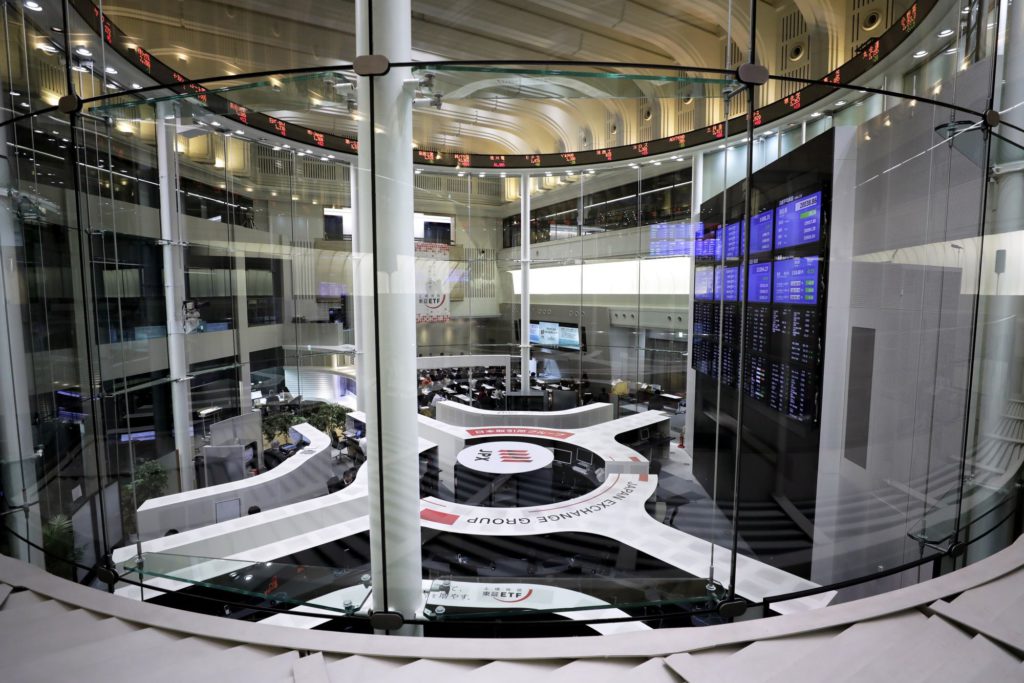
Stocks Trade Off Day’s High as Dollar, Yields Rise: Markets Wrap

(Bloomberg) — US stocks pared gains and the dollar caught bids amid signs of weakening investor sentiment. Treasuries erased gains, sending yields higher.

The S&P 500 pulled back from session highs as energy stocks declined with a slump in oil prices and rising Treasury yields weighed on growth stocks. The Nasdaq 100 swung between gains and losses amid weakness in big tech names including Microsoft Corp. and Nvidia Corp. Goldman Sachs Group Inc. jumped the most intraday since July following better-than-expected third-quarter results. 

The dollar ticked higher, while Treasury rose across the board. The pound weakened after the Bank of England denied a report it’s delaying the sale of government bonds until markets are calmer.

“Earnings season offers investors the opportunity to focus more on the actual earnings power of corporate America, and less on the machinations of the backward-looking economic data stream,” said Art Hogan, chief market strategist at B. Riley. “A better-than-feared earnings season may well be the catalyst the market needs to see a break in the steady grind lower.”

On the data front, US factory production rose for a third month in September, and capacity utilization increased to 80%, matching the highest since 2000 and a sign that labor and supply constraints have eased. 

Meanwhile, US homebuilder sentiment fell for a 10th straight month in October to the lowest level since the early days of the pandemic, illustrating a housing market battered by higher mortgage rates.

Upbeat company results, cheaper valuations and UK policy reversals have helped buoy risk sentiment. But with headwinds from inflation, risks to the economy and hawkish central banks continuing to confront investors, there’s debate over how durable the gains will prove.

“There’s still a strong feeling of a bear market rally about trading over the course of the last week,” said Craig Erlam, senior market analyst at Oanda Europe Ltd. “The economic landscape looks treacherous and we don’t even know if we’re at peak inflation and interest rate pricing yet. Those are substantial headwinds that will make any stock market rebound extremely challenging.”

Bank of America Corp. said sentiment on stocks and global growth among fund managers it surveyed shows full capitulation, opening the way to an equities rally in 2023. The bank’s monthly global fund manager survey “screams macro capitulation, investor capitulation, start of policy capitulation,” strategists led by Michael Hartnett wrote in a note on Tuesday. They expect stocks to bottom in the first half of next year after the Federal Reserve finally pivots away from raising interest rates.

The pound weakened 0.5% after the BOE said a Financial Times report that the central bank is pushing back the start of its quantitative tightening was “inaccurate.”

The yen paused in its run toward the closely watched 150 per dollar level, which has investors on high alert for possible intervention. Japanese Finance Minister Shunichi Suzuki said he was watching market moves with a sense of urgency.

Elsewhere in markets, oil edged lower as the prospect of additional barrels from strategic reserves assuaged market concerns of a tight market heading into the winter season. Gold also fluctuated and Bitcoin continued to trade below $20,000.

Key events this week:

  • Fed’s Neel Kashkari speaks, Tuesday
  • Euro area CPI, Wednesday
  • EIA crude oil inventory report, Wednesday
  • US MBA mortgage applications, building permits, housing starts, Fed Beige Book, Wednesday
  • Fed’s Neel Kashkari, Charles Evans, James Bullard speak, Wednesday
  • US existing home sales, initial jobless claims, Conference Board leading index, Thursday
  • Euro area consumer confidence, Friday

Some of the main moves in markets:

Stocks

  • The S&P 500 rose 0.5% as of 11:49 a.m. New York time
  • The Nasdaq 100 rose 0.2%
  • The Dow Jones Industrial Average rose 0.6%
  • The Stoxx Europe 600 rose 0.3%
  • The MSCI World index rose 0.7%

Currencies

  • The Bloomberg Dollar Spot Index rose 0.1%
  • The euro was little changed at $0.9837
  • The British pound fell 0.5% to $1.1306
  • The Japanese yen fell 0.1% to 149.23 per dollar

Cryptocurrencies

  • Bitcoin fell 0.9% to $19,345.75
  • Ether fell 1.9% to $1,304.74

Bonds

  • The yield on 10-year Treasuries advanced three basis points to 4.04%
  • Germany’s 10-year yield advanced one basis point to 2.28%
  • Britain’s 10-year yield declined three basis points to 3.94%

Commodities

  • West Texas Intermediate crude fell 3.5% to $82.50 a barrel
  • Gold futures fell 0.7% to $1,651.70 an ounce

More stories like this are available on bloomberg.com

©2022 Bloomberg L.P.

Neurodiversity Emerges as a Skill in Artificial Intelligence Work

(Bloomberg) — Staring closely at the screen, Jordan Wright deftly picks out a barely distinguishable shape with his mouse, bringing to life a stark blue outline from a blur of overexposed features.

It’s a process similar to the automated tests that teach computers to distinguish humans from machines, by asking someone to identify traffic lights or stop signs in a picture known as a Captcha.

Only in Wright’s case, the shape turns out to be of a Tupolev Tu-160, a supersonic strategic heavy bomber, parked on a Russian base. The outline — one of hundreds a day he picks out from satellite images — is training an algorithm so a US intelligence agency can locate and identify Moscow’s firepower in an automated flash.

It’s become a run-of-the-mill task for the 25-year-old, who describes himself as on the autism spectrum. Starting in the spring, Wright began working at Enabled Intelligence, a Virginia-based startup that works largely for US intelligence and other federal agencies. Founded in 2020, it specializes in labeling, training and testing the sensitive digital data on which artificial intelligence depends. 

Peter Kant, chief executive officer of Enabled Intelligence, said he was inspired to start the company after reading about an Israeli program to recruit people with autism for cyber-intelligence work. The repetitive, detailed work of training artificial intelligence algorithms relies on pattern recognition, puzzle-solving and deep focus that is sometimes a particular strength of autistic workers, he said.

Enabled Intelligence’s main type of work, known as data annotation, is usually farmed out to technically skilled but far cheaper labor forces in countries including China, Kenya and Malaysia. That’s not an option for US government agencies whose data is sensitive or classified, Kant said, adding that more than half his workforce of 25 are “neurodiverse.”

“I can easily say this is the best opportunity I’ve got in my life,” said Wright, who grew up with an infatuation for military aviation, dropped out of college and has since experienced long stints of unemployment in between poorly paid work. Most recently, he bagged frozen groceries.

For decades, workers with developmental disabilities, especially autism, have faced discrimination and disproportionately high unemployment levels. A large shortfall in cybersecurity jobs, along with a new push for workplace acceptance and flexibility — in part spurred by the Covid-19 pandemic — has started to focus attention on the abilities of people who think and work differently. 

Enabled Intelligence has adjusted its work rules to accommodate its employees, ditching resumes and interviews for online assessments and staggering work hours for those who find it hard to get in early. It has built three new areas for classified material and hopes to secure government clearances for much of its neurodiverse workforce — something the US intelligence community has sometimes struggled to accommodate in the past. Pay starts at $20 an hour, in line with industry standards, and the company provides health insurance, paid leave and a path for promotion. Enabled Intelligence expects to make revenues of $2 million this year and double that next year, along with doubling its workforce.

The US intelligence community has been slow to catch on to the opportunity, critics say. It falls short of the 12% federal target for workforce representation of persons with disabilities, according to the latest statistics out this month. Until this year, it has also regularly fallen short of the 2% federal target for persons with targeted disabilities, which include those with autism. 

“In other countries it’s old hat,” said Teresa Thomas, program lead for neurodiverse talent enablement at MITRE, which operates federally funded research and development centers. She cites well established programs in Denmark, Israel, the UK and Australia, where one state recently appointed a minister for autism.

Thomas has recently spearheaded a new neurodiverse federal workforce pilot to establish a template for the US government to hire and support autistic workers, but so far only one of the country’s 18 intelligence agencies, the National Geospatial-Intelligence Agency, known as NGA, has participated. Now the federal government’s cyberdefense agency, the Cybersecurity and Infrastructure Security Agency, intends to undertake a similar pilot. 

Stephanie La Rue, chief of diversity, equity and inclusion for the Office of the Director of National Intelligence, told Bloomberg the US intelligence community needs to acknowledge that it’s “not where we need to be” when it comes to employing people with disabilities. 

“It’s like turning the Titanic,” said La Rue, adding that NGA’s four-person pilot would be reviewed and shared with the wider intelligence community as a “promising practice.” “Change is going to be incremental.”

Research indicated that neurodiverse intelligence officers on the autism spectrum exhibit the ability to parse large data sets and identify patterns and trends “at rates that far exceed folks who are not autistic” and were less prone to cognitive bias, La Rue said. Yet securing a clearance to access classified information can still present an additional challenge, according to some observers.

If an office wall board at Enabled Intelligence is any indication, experiences vary. There, 18 anonymous handwritten notes answer the question: “What does neurodiversity mean to you?”

“Difficult. Trying. It’s held me back a lot,” says one in an uncertain script. “Strength,” answers a second in careful cursive. A third, in capital letters, declares: “SUPERPOWERS.”

More stories like this are available on bloomberg.com

©2022 Bloomberg L.P.

Voyager Opts to Settle CEO Negligence Claims Tied to 3AC Loans

(Bloomberg) — Crypto lender Voyager Digital Ltd. is pursuing settlements with two top executives after an internal probe uncovered potential claims of gross negligence stemming from risky loans made to defunct hedge fund Three Arrows Capital, court papers show. 

Chief Executive Officer Stephen Ehrlich, in consultation with then-Chief Financial Officer Evan Psaropoulos, agreed to let Voyager lend nearly $1 billion of crypto to Three Arrows despite extremely limited financial disclosure from the hedge fund, according to court papers filed Monday. The uncollected loans weighed heavily on Voyager prior to its July bankruptcy filing.

But pursuing lawsuits against Ehrlich and Psaropoulos would be difficult and potentially fruitless, according to the results of a investigation conducted by two members of Voyager’s board of directors. Even if the company could prove that the executives breached their fiduciary duties to Voyager, the cost of litigating would likely outweigh any payout from potential lawsuits, the board members concluded. 

Instead, the company is proposing a settlement that calls for Ehrlich to pay $1.125 million in cash to Voyager, pursuing claims under directors and officers insurance policies worth as much as $20 million, and for both Ehrlich and Psaropoulos to continue guiding the company through bankruptcy. Ehrlich remains Voyager’s CEO and Psaropoulos is now the company’s chief commercial officer.

The board’s investigation found no fraud or theft by any Voyager executive, according to court papers. A representative for Voyager decline to comment on the settlement, while Ehrlich and Psaropoulos didn’t immediately respond to emails seeking comment. 

Voyager needs its bankruptcy judge to approve the settlement before it can be executed. 

Due Diligence

Voyager, looking to diversify its loan book early this year, began pursuing a lending relationship with Three Arrows in February, according to court papers. During Voyager’s due diligence, Three Arrows provided information about its corporate structure, anti-money laundering policies and controls, along with descriptions of its trading strategy. 

But the hedge fund’s financial disclosures fell short of those provided by other institutional Voyager borrowers: Three Arrows provided a single-sentence statement, signed by co-founder Kyle Davies, indicating the firm controlled net assets worth $3.729 billion. 

When pressed for greater transparency, Davies told Voyager the hedge fund only provided summary net-asset value statements to its lenders, according to the bankruptcy court papers. The policy stemmed from a bad experience with a prior counterparty who used more detailed disclosures to mimic Three Arrows’ trading strategy, Davies said.

Voyager agreed to began lending crypto to Three Arrows on March 8 despite the limited disclosures. By May 5, the loans totaled 15,250 Bitcoin and 350 million USDC, a stablecoin. A little more than a month later, Three Arrows said it lost money in the Terra blockchain collapse. The hedge fund entered liquidation in the British Virgin Islands in June and Voyager has collected none of the loan principal.

The bankruptcy is Voyager Digital Holdings Inc., 22-10943, U.S. Bankruptcy Court for the Southern District of New York (Manhattan).

More stories like this are available on bloomberg.com

©2022 Bloomberg L.P.
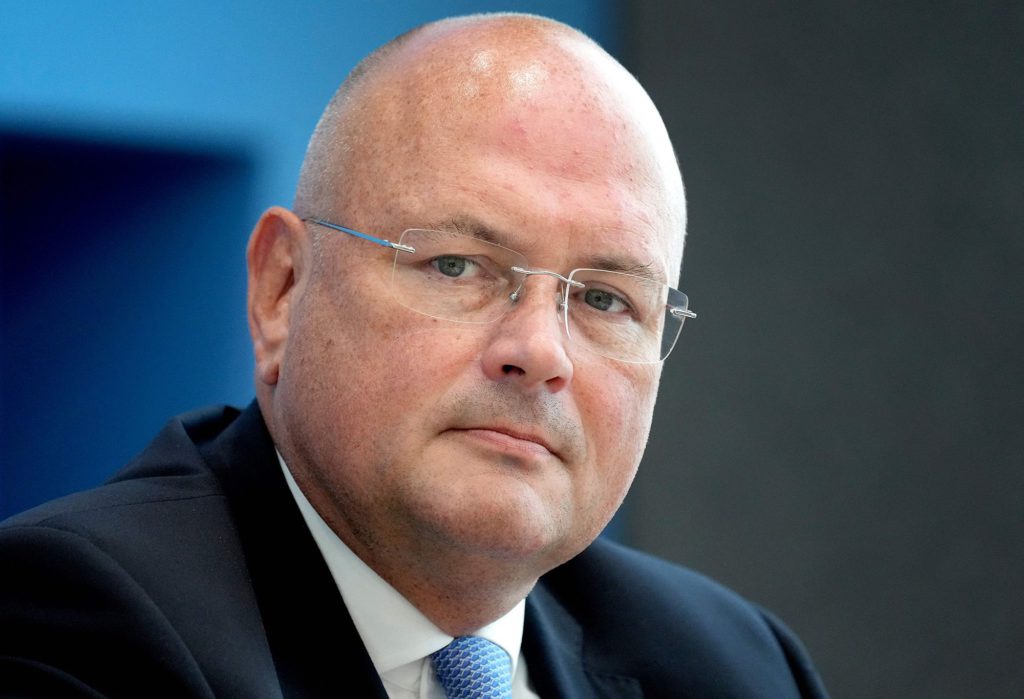
German Cybersecurity Chief Suspended Over Alleged Russia Ties

(Bloomberg) — Germany’s interior minister suspended the head of the country’s cybersecurity agency after a television report uncovered an alleged link with Russian intelligence.

A ministry spokeswoman said Tuesday that the decision to strip Arne Schoenbohm of his powers as president of the Federal Cybersecurity Authority was taken because the allegations in the report “have permanently damaged the public’s necessary trust in the neutrality and impartiality of the conduct of his duties.”

“This applies all the more in the current crisis situation with regard to Russian hybrid warfare,” the spokeswoman said by email, adding that an investigation was ongoing and Schoenbohm would be presumed innocent of any wrongdoing until it’s concluded.

Schoenbohm took over Germany’s BSI cybersecurity agency in February 2016 having previously worked at European defense company EADS and at DaimlerChrysler Aerospace.

A report by public broadcaster ZDF last week said that he was a co-founder of an association called Cybersecurity Council Germany. The group, which gathered government officials and experts from the private sector, had links with a former official of Russia’s KGB intelligence service, ZDF said.

The interior ministry did not say how long its investigation might take or whether it was seeking a replacement for Schoenbohm.

More stories like this are available on bloomberg.com

©2022 Bloomberg L.P.

BNP Paribas Hires Barclays to Sell South African Financial Unit

(Bloomberg) — BNP Paribas SA hired Barclays Plc to sell South African financial-services business RCS as part of a wider scaling back on the continent, according to people familiar with the matter. 

The Paris-based lender started a formal process to dispose of the credit and financial-services provider that operates across South Africa, Namibia and Botswana, said the people, who asked not to be identified as the plans are still private. 

A spokeswoman for BNP Paribas declined to comment. Barclays declined to comment. 

The deal is part of the French bank’s plan to exit certain African units, said the people, as the company focuses on expanding its European and Asian operations. 

BNP sold a majority stake in its Ivory Coast business to the country’s government last month and offloaded a lender in Senegal in July. The group has also exited units in nations including Guinea, Burkina Faso and Mali, and the bank said previously it was reviewing “certain peripheral locations”. 

RCS, founded 23 years ago, offers clients store cards, loans and insurance policies, according to its website. BNP bought RCS for 2.65 billion rand ($147 million) from Standard Bank Group Ltd. and clothing retailer Foschini Group Ltd. eight years ago. 

Offers for RCS are anticipated within the next few weeks, the people said.  

More stories like this are available on bloomberg.com

©2022 Bloomberg L.P.

Validity of Turkey’s New Disinformation Law Tested in Top Court

(Bloomberg) — Turkey’s main opposition party asked the nation’s top court to halt the implementation of part of a controversial new law that will enable social media users who knowingly spread disinformation to be jailed.

The application to the Constitutional Court by the Republican People’s Party, or CHP, on Tuesday came just hours after the law went into effect, and argued that the government could use its provisions to intimidate critics in the run-up to next year’s elections.

The move by President Recep Tayyip Erdogan’s administration to criminalize the spread of what it describes as false information on digital platforms is a troubling sign in a nation already under fire for its failure to protect free speech. Reporters Without Borders’ World Press Freedom Index ranks Turkey 149th out of 180 nations. 

Read more: New Turkey Law Mandates Jail Time for Spreading ‘Disinformation’

“We’ve filed a case for the annulment of Article 29 to stop its implementation,” until a verdict is given on its validity, Engin Altay, the CHP’s deputy parliamentary whip, told reporters outside the courthouse. “This law reflects the mindset of Stalin.”

Article 29 of the law provides for those who deliberately spread disinformation about the country’s security, public order and overall welfare in an attempt to incite panic or fear to be imprisoned for between one and three years. The challenge is unlikely to succeed because of the considerable influence Erdogan wields over the court — he has appointed 10 of its 15 judges. 

Civil rights groups have also condemned the law’s provisions as censorship, and say they are aimed at muzzling dissent ahead of presidential and parliamentary elections that will be held in about eight months’ time.

More stories like this are available on bloomberg.com

©2022 Bloomberg L.P.
Adobe Wants Photoshop to Be More Like New Acquisition Figma

(Bloomberg) — Adobe Inc. is tweaking its most-famous product to work more like the design tool it committed $20 billion to acquire.  

Photoshop, the company’s flagship image-editing product, will add more collaboration tools, artificial intelligence features and web capability as the creative giant aims to update its software portfolio for a younger and more-casual audience. Last month, Adobe announced it would buy Figma Inc. to try to capture some of the small businesses, social media creators and nonprofessionals who have flocked to the upstart maker of web-based design tools.  

The updates introduced Tuesday at Adobe’s annual product conference symbolize the company’s efforts to streamline its offerings as smaller rivals like Figma and Canva Inc. threaten the software juggernaut’s market dominance. Adobe has responded with updates to its line of desktop creative tools and the introduction of a slimmed-down online Photoshop and Adobe Express, a web-based service that looks more like Canva than other Adobe products on the desktop. 

Browser-based products are crucial to Adobe’s efforts to pick up new customers, Chief Product Officer Scott Belsky said in an interview. “There’s no friction when you can just click and be in a web app in seconds.”

The integration of design tool Figma could help “modernize the entire Creative Cloud product portfolio over the next 3-5 years,” wrote Piper Sandler analyst Brent Bracelin in a note Monday. Adobe has said the deal is expected to close sometime in 2023, subject to regulatory approvals.

Still, Wall Street has panned the acquisition as too expensive and revealing stronger competitive pressures than previously appreciated. Adobe’s shares are down 22% since the deal became public, more than three times the decline in the broad-based S&P 500. Management will likely try to “pacify investor angst” during its annual conference and shareholder event beginning Tuesday, wrote Bloomberg Intelligence’s Anurag Rana in a note.

One new feature, dubbed “share for review,” allows Photoshop, Lightroom, and InDesign files to be shared for feedback in a web browser rather through exporting large files or requiring reviewers to have the program installed. The workflow mirrors that of video-review platform Frame.io, which was acquired by Adobe last year for $1.3 billion.

The company will also add new artificial intelligence updates like the ability to remove objects from images with one click, detection of people, and background removal in Adobe Express. AI-generated images have taken off this year thanks to providers like OpenAI’s Dall-E, and Belsky said Adobe is focused on how to integrate this kind of AI into creative workflows, rather than just making “silly JPEGs from words.”

As manipulated of online content has become more common, creative artists have expressed worry about protecting their intellectual property. To address such concerns, now Adobe’s Content Authenticity Initiative is partnering with camera manufacturers Nikon Corp. and Leica Camera AG on technology that will attach a photographer’s credentials to a picture’s metadata, at the time of capture, through advanced coding. The picture retains its creator’s identity while being edited, published and shared on social media.

“It’s important to remember that technology companies — like Adobe, like social media platforms — are not the arbiters of truth,” Adobe’s Chief Trust Officer Dana Rao said. “They don’t want to be sitting in that judgment seat trying to decide if something is true, deceptive or satire. This solution gives them the opportunity to put the power back in the hands of the people.”

Adobe isn’t the only software titan betting on web-based creative tools integrated with artificial intelligence. Microsoft Corp. announced a new design feature last week that will be part of its suite of office products like Word and Teams. The tool, called Designer, will be integrated with Dall-E, which generates images based on text commands.

Microsoft’s new solution “seems to be pretty focused on a very limited set of features for some of their office products right now,” Belsky said. “We have a deep partnership with Microsoft and they’re also exploring ways to integrate with Adobe Express.”

(Updates with Content Authenticity Initiative in ninth paragraph)

More stories like this are available on bloomberg.com

©2022 Bloomberg L.P.

GOP-Friendly House District Becomes Nail-Biting Race on Abortion

(Bloomberg) — In any other election year, two Navy veterans vying to represent a Virginia district dominated by military interests would focus on their national security bonafides. 

Instead, the race between two women on opposite sides of the abortion debate has turned one of the nation’s closest House contests into a referendum on Roe v. Wade. 

The bellwether district, which includes Virginia Beach and its Oceana Naval Base, skewed more Republican after redistricting brought in more GOP-heavy areas, hurting incumbent Representative Elaine Luria’s prospects for a third term. 

But the Supreme Court’s June decision overturning a constitutional right to an abortion shook up the race and put GOP challenger Jen Kiggans, a self-described “champion for the unborn,” suddenly on the defensive after months of hammering Democrats on soaring inflation and the weakening economy. 

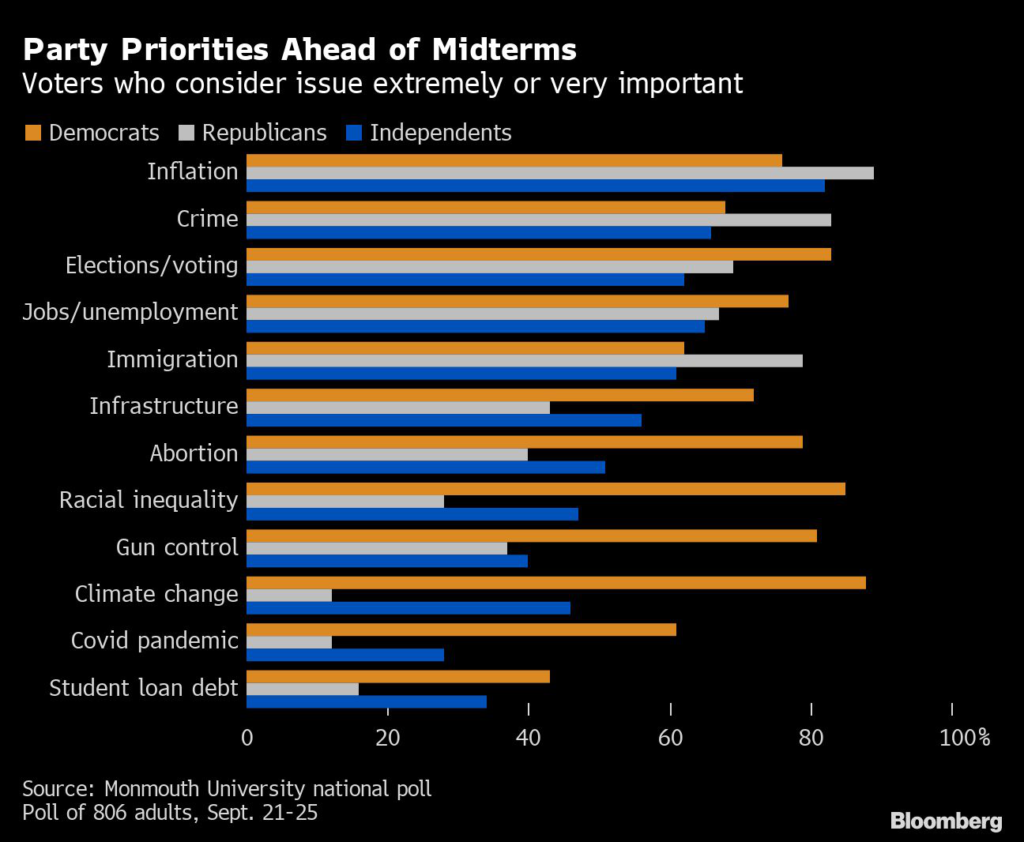
In good news for Kiggans, a state senator, nurse practitioner and former Navy pilot, and other Republicans who have centered their campaigns on President Joe Biden’s handling of the economy, inflation continues to dominate all other issues, with 82% of Americans saying rising costs are extremely or very important to them in a Sept. 21 to 25 Monmouth University poll of 806 adult Americans. Abortion ranked seventh of 12 issues in terms of importance, with 56% of those surveyed considering it extremely or very important. 

Yet that number changes significantly when broken down by party, and Democrats see a winning strategy in concentrating on abortion rights. Seventy-nine percent of Democrats — compared to 40% of Republicans — consider abortion extremely or very important. In Virginia, the abortion decision has sparked an 8% jump in the state’s female voter registration, according to Democratic data analytics firm TargetSmart. There was no such gender gap in 2020.


“Without that issue, the district would lean Republican rather than be a toss-up,” said J. Miles Coleman, the associate editor of Larry Sabato’s Crystal Ball at the University of Virginia.

Interviews with dozens of voters in this coastal Virginia district confirmed Coleman’s take. Abortion rights is the premiere issue for Democrats and the Supreme Court decision has convinced some independents and Republicans to vote for Luria.

“I’m concerned about the Supreme Court and its politicization,” said Ken Chapman, 60, who owns Chapman’s Market at the Virginia Beach Farmers Market and says he was a lifelong Republican until 2020. “Republicans packed the court.”

Luria, a retired Navy commander, has pummeled Kiggans on abortion in a series of attack ads, saying Kiggans “applauded” and “celebrated” the Supreme Court decision. Luria, who favors codifying Roe v. Wade, painted Kiggans as an extremist who supports no exceptions for abortions.

Kiggans countered with an ad saying she’s been called lots of things, but “extremist? That’s a new one.” She then immediately pivoted back to inflation and the economy. 

Luria seized on abortion again during an Oct. 12 debate, before the moderator even asked. Kiggans argued that Luria misrepresented her position and that she wants exceptions for rape, incest and when the life of the mother is at stake.

“I’ve never made it my goal to ban or make abortion illegal at the federal level,” she said at the debate. Kiggans did not answer more detailed questions on her position after the debate and declined an interview for this article. 

Long-Simmering Debate

Abortion politics were raging in Virginia well before the Supreme Court’s decision. Democrats won control of the state Legislature in 2019 for the first time in two decades and the next year passed legislation rolling back multiple abortion restrictions and codifying new protections. Kiggans opposed the legislation.

In 2021, Republican Glenn Youngkin won the governorship and the GOP retook the House of Delegates. Youngkin has said he would move to ban most abortions after 15 weeks — a tough climb with Democrats still in control of the state Senate.

“Here in Virginia we don’t have any snap-back laws or any of those kinds of things going into effect immediately, but people understand the importance on the federal level of having people in office who are going to protect that right” Luria said in an interview in the district.

That includes Belinda Whittaker of Chesapeake, who persuaded her 21-year-old granddaughter, Aryn Lovell, to join her in early voting because “it’s about women getting the right kind of health care when they need it.”

Middle of the Road

The Luria-Kiggans race is playing out in a place that’s literally in the center of US politics. The district ranks 218 of 435 House districts in the range of pro-Biden and pro-Donald Trump districts in 2020, according to Coleman’s research. 

Luria, who in 2018 helped win Democrats their House majority, is one of almost 40 frontline Democrats whose races will determine whether Republicans take control of the House. 

What was once expected to be a conservative wave, thanks to economic woes and historical trends favoring the party out of power, has turned into a ripple. Political analysts haven’t counted Democrats out of keeping control of the 50-50 Senate and perhaps hanging onto the House, particularly if incumbents like Luria hold on. 

Yet in a district so evenly split, abortion isn’t always a winning issue for Luria. 

“I believe very much that life beings at conception, and these babies deserve protections in the law,” said Victoria Kieser, a 29-year-old independent voter and stay-at-home mom who is voting on abortion. She says she agrees with Luria on some issues, but can’t vote for her now.

Republicans, at the same time, are benefiting from stubborn inflation in the weeks before the election. 

Pausing during his lunch at Warriors Taphouse in Virginia Beach, Fred Wilson, a 54-year-old military training contractor, said his 401(k) “is dying,” his grocery and gas costs have risen dramatically, and he worries about the security of his grown childrens’ jobs. He’s voting for Kiggans.

And at the annual Suffolk Peanut Festival, Amanda Lakey said she’s a Republican and will stick with her party this year. She blames Biden for inflation and worries about paying her mortgage. 

“We didn’t know if we would have the money to pay for everything,” added Lakey, 41. “Everything keeps going up.”

More stories like this are available on bloomberg.com

©2022 Bloomberg L.P.

BMW Boss Says Hydrogen, Not Electric, Will Be ‘Hippest Thing’ to Drive

(Bloomberg) — BMW is hanging in there with hydrogen. That’s what Oliver Zipse, the chairman of BMW AG, reiterated during an interview Oct. 17 in Goodwood, England. 

“After the electric car, which has been going on for about 10 years and scaling up rapidly, the next trend will be hydrogen,” he says. “When it’s more scalable, hydrogen will be the hippest thing to drive.”

BMW has dabbled with the idea of using hydrogen as a power source for years, even though it is obscure and niche compared to the current enthusiasm surrounding vehicles powered by electricity. In 2005, BMW built 100 “Hydrogen 7” vehicles that used the fuel to power their V12 engines. It unveiled the fuel cell iX5 Hydrogen concept car at the International Motor Show Germany in 2021. 

In August, the company started producing fuel-cell systems for a production version of its hydrogen-powered iX5 sport utility vehicle. Zipse indicated it would be sold in the United States within the next five years, although in a follow-up phone call a spokesperson declined to confirm that point. Bloomberg previously reported that BMW will start delivering fewer than 100 of the iX5 hydrogen vehicles to select partners in Europe, the US, and Asia from the end of this year.

All told, BMW will eventually offer five different drivetrains to help diversify alternative-fuel options within the group, Zipse says.

“To say in the UK about 2030 or the UK and in Europe in 2035, there’s only one drivetrain, that is a dangerous thing,” he says. “For the customers, for the industry, for employment, for the climate, from every angle you look at, that is a dangerous path to go to.” 

Zipse’s hydrogen dreams could even extend to the group’s crown jewel, Rolls Royce, which BMW has owned since 1998. The “magic carpet ride” driving style that has become Rolls-Royce’s signature selling point is flexible enough to be powered by alternatives to electricity, says Rolls-Royce Motor Cars CEO Torsten Müller-Ötvös. 

“To house, let’s say, fuel cell batteries: Why not? I would not rule that out,” Müller-Ötvös told reporters during a roundtable conversation Oct. 17 in Goodwood on the eve of the debut of the company’s first-ever electric vehicle, Spectre. “There is a belief in the group that this is maybe the long-term future.”

Such a vehicle would contain a hydrogen fuel-cell drivetrain combined with BMW’s electric “eDrive” system. It works by converting hydrogen into electricity to reach an electrical output of up to 125 kW/170 horsepower and total system output of nearly 375hp, with water vapor as the only emission, according to the brand.

Hydrogen’s big advantage over electric power, which requires an extensive and so-far nonexistent charging network, is that it can supply fuel cells stored in carbon-fiber-reinforced plastic tanks. “There will [soon] be markets where you must drive emission-free, but you do not have access to public charging infrastructure,” Zipse says. “You could argue, well you also don’t have access to hydrogen infrastructure, but this is very simple to do: It’s a tank which you put in there like an old [gas] tank, and you recharge it every six months or 12 months.”

Fuel cells at BMW would also help reduce its dependency on raw materials like lithium and cobalt, because the hydrogen-based system uses recyclable components made of aluminum, steel, and platinum. 

Zipse’s continued commitment to prioritizing hydrogen has become an increasingly outlier position in the automotive world. In the last five years, electric-only vehicles have become the dominant alternative fuel—if not yet on the road, where fewer than 3% of new cars have plugs, at least at car shows and new-car launches.

Rivals Mercedes-Benz and Audi scrapped their own plans to develop fuel cell vehicles and instead have poured tens of billions of dollars into developing pure-electric vehicle. Porsche went public to finance its own electric aspirations. 

BMW will make half of all new-car sales electric by 2030 across the group, which includes MINI and Rolls-Royce. 

More stories like this are available on bloomberg.com

©2022 Bloomberg L.P.

Close Bitnami banner
Bitnami