
Bloomberg

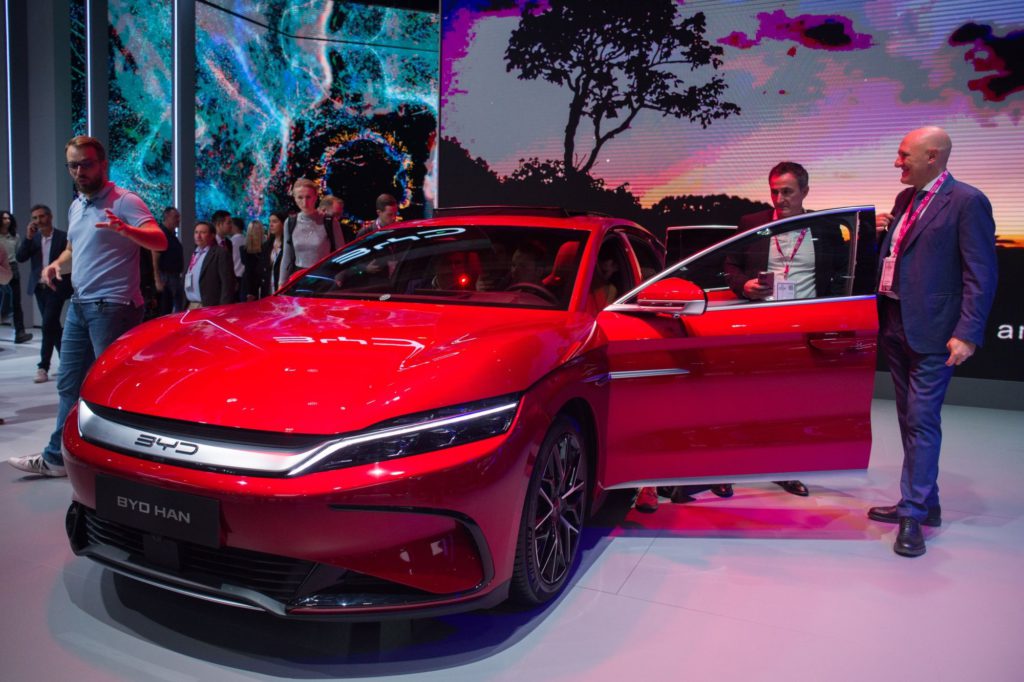
BYD’s Red Carpet Treatment Puts Europe’s Auto Industry On Edge

(Bloomberg) —

With one daughter and another on the way, the Bentvelsens were in the market for a roomier set of wheels.

Jerry, 34, grows cucumbers in Rotterdam and was familiar with China’s largest electric-vehicle maker from the family business using its commercial trucks. Next week, he and his wife Jessica, 33, take delivery of a black BYD Tang, having been won over by a test drive in the seven-seat SUV that gets from zero to 100 kilometers (62 miles) per hour in 4.6 seconds.

If there were any doubts left that the company known for landing a major investment from Warren Buffett’s Berkshire Hathaway has arrived on the world stage, the handover of keys to the Bentvelsens and BYD’s other European customers during this week’s Paris motor show put them to rest. The world’s third-most-valuable automaker — behind Tesla and Toyota, and ahead of newly public Porsche — looks to be the frontrunner among Chinese challengers that roughly matched up with the number of western brands in attendance.

And BYD is doing more than just putting on a good show. It’s drawing interest from governments in central and southern Europe that are eager to land investment from the company, which is contemplating manufacturing cars locally as relationships between China and western countries that are threatened by its rise turn increasingly fraught.

“Some of the countries are very detailed,” Michael Shu, general manager and managing director of BYD Europe, said of offers it’s getting to help address the company’s needs for labor, land, energy, construction and an ecosystem of nearby suppliers. “Even in China, we don’t have such a kind of investing in the service.”

Carmakers led by Stellantis, Europe’s second-largest, are on edge about the friendly reception their potential disruptors are getting on their home turf.

“Chinese manufacturers are welcomed in Europe with a red carpet,” Carlos Tavares, CEO of the Jeep, Peugeot and Fiat maker, told reporters in Paris. “It’s not like this that we’re welcomed in China.”

“It’s disturbing,” said Laurens van den Acker, director of design for Renault group. “I root for Europe. I want it to be us taking the leadership. Chinese carmakers have an advantage over us, and the Chinese government has been betting on the EVs for 15 years.”

Other automakers have fared better having made bargains decades ago in China, agreeing to set up compulsory joint ventures with domestic manufacturers to share in what was a jaw-dropping period of meteoric growth. Some of those western companies, including Volkswagen and General Motors, built massive positions in the market that have started to deteriorate the last few years, as local players field attractive electric models.

“The competitive intensity is increasing,” Mercedes-Benz CEO Ola Kallenius said in an interview. “It’s the most fun time to work in automotive since 1886,” he added, referring to the year Carl Benz rolled out the first car powered by a gas engine. “It’s also the most uncertain time.”

While some governments are offering a helping hand, President Emmanuel Macron is prepared to play defense. His government is preparing a measure to subsidize EVs only if they’re made in France, or at least in Europe.

The policy, which appears to take a page from the Inflation Reduction Act recently signed into law in the US, may only make it more likely that China’s most well-off auto companies look to manufacture in Europe. On top of BYD, this could include Great Wall Motor, whose small Ora Funky Cat EV with retro looks to live up to its name was among the models the company is staging in Paris.

Great Wall is about to start building electric Mini hatchbacks with BMW in China. A next step could be to make cars together at Mini’s home plant just outside Oxford, England, which will cease making electric Minis for at least the next several years.

Whether by leveraging partnerships with companies consumers know, or in BYD’s case, an existing presence in commercial vehicles and buses, China’s automakers look poised as ever to overcome the qualms European car buyers have had in the past about making a big-ticket purchase from a new entrant.

“We know BYD,” Jerry Bentvelsen said, when asked whether he had any second thoughts about becoming one of the first in the Netherlands to take delivery of the company’s cars. “I don’t have reservations.”

More stories like this are available on bloomberg.com

©2022 Bloomberg L.P.
Terra Founder Kwon Says He Hasn’t Seen Korean Arrest Warrant

(Bloomberg) — Crypto fugitive Do Kwon, who faces charges in South Korea related to his collapsed stablecoin ecosystem, said he’s cooperating with prosecutors but hasn’t seen the arrest warrant issued for him. 

“We haven’t seen a copy of the arrest warrant so every piece of data we are consuming is from the media,” the co-founder of Terraform Labs said in an interview on the Unchained podcast published Tuesday and hosted by journalist Laura Shin. He added that he’s cooperated with all document requests he’s received from authorities. 

Kwon refrained from specifying his whereabouts during the discussion, citing threats he’s received. The 31-year-old’s location has been unclear since South Korea in mid-September issued a warrant for his arrest on charges linked to the $60 billion wipeout of two tokens he created, TerraUSD and Luna. Singapore authorities have said he’s no longer there. 

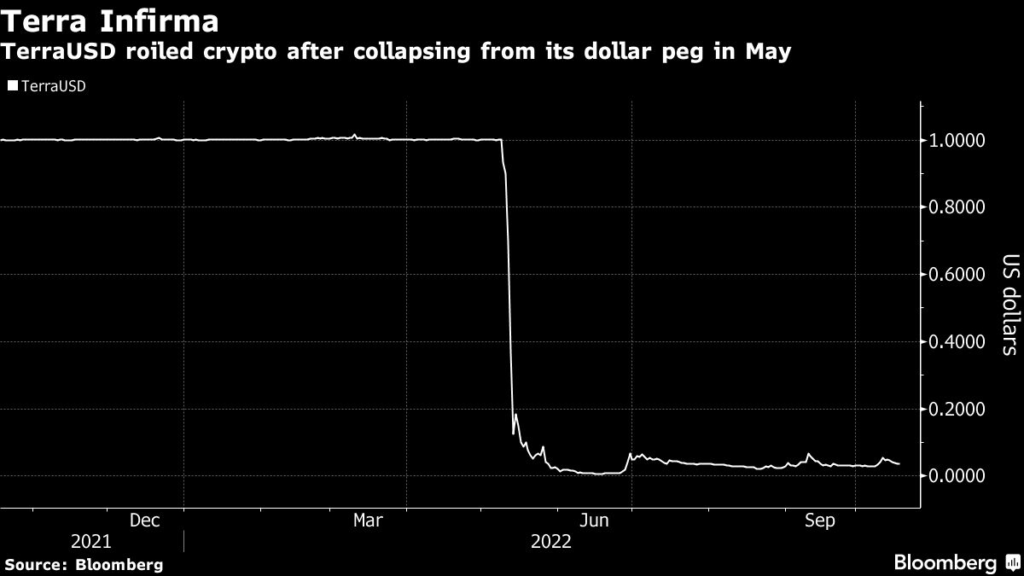
Algorithmic stablecoin TerraUSD was meant to have a constant $1 value via a mix of algorithms and trader incentives involving Luna but the edifice imploded in May, sending shockwaves through the crypto market and catching regulators off guard.

Terra’s collapse exacerbated a $2 trillion crypto rout and spurred the unraveling of the once high-flying digital-asset hedge fund Three Arrows Capital. Contagion also buffeted lenders and brokers such as Voyager Digital Ltd. and Celsius Network.

Critics argue Kwon created a giant Ponzi system that was doomed to fail as it relied in part on luring investors with unsustainable interest rates of 20%. He has countered that he acted in good faith in an attempt to create a new kind of currency.

In the months before Terra’s implosion, Kwon cultivated a brash online persona, frequently taking to Twitter to taunt his detractors. That’s an approach he now regrets, he told Shin. 

“So I think I got too much carried away interacting with other people on Crypto Twitter,” he said. “I think in retrospect I should have held myself to a more stringent standard.”

‘Highly Politicized’

Prosecutors in Seoul have accused Kwon and five others of crimes including breaches of capital-markets law. He’s also the subject of an Interpol red notice. Kwon has rejected any wrongdoing, denied he’s on the run and argued that the case against him has become “highly politicized.”

When pressed by Shin about authorities not being able to physically deliver an arrest warrant to him, Kwon said he also hasn’t seen a PDF version of the document, “so besides application of the Capital Markets Act we haven’t seen what specific charges we are facing.”

A key issue is whether Luna is subject to securities law — echoing a wider question officials globally are asking about the status of digital tokens.

A court in South Korea earlier this month said there was room for legal argument over whether Luna does qualify as a security as it dismissed a request to detain an executive linked to Terraform Labs.

In late September, a Bitcoin reserve connected to Kwon, the Luna Foundation Guard, denied transferring digital tokens after a trail of coin movement prompted South Korean prosecutors to take steps to freeze assets.

Local reports say officials have frozen about 95 billion won ($66 million) of assets they claim are Kwon’s. He has said he doesn’t know who owns them.

More stories like this are available on bloomberg.com

©2022 Bloomberg L.P.
Tiger Global-Backed LogiNext Seeks $100 Million for Expansion

(Bloomberg) — LogiNext is seeking to raise as much as $100 million in a funding round that could value the Tiger Global-backed logistics software startup at about $800 million, according to a person familiar with the matter.

The US-based firm, which also counts China’s Alibaba Group Holding Ltd. as a backer, will look to raise $80 million to $100 million for its Series C round to expand globally, the person said, asking not to be named as the information is private.

Founded in 2015, LogiNext uses algorithms to help predict estimated shipping times and prices as well as organize fleets. It’s seeking to raise funds at a difficult time for tech startups — global venture funding fell to its lowest level in quarters in the past three months, according to CB Insights.

Deliberations are ongoing and details such as the size of the funding round and the startup’s valuation could change, the person said. A representative for LogiNext declined to comment.

Based in New Jersey, the software startup is operating in more than 50 countries, including India, Singapore and Indonesia. It counts companies such as Alibaba, Singapore Post Ltd. and Decathlon UK Ltd. among its clients. In 2020, the company raised $39 million in a funding round from investors including Tiger Global and Steadview Capital.

More stories like this are available on bloomberg.com

©2022 Bloomberg L.P.
EU Puts Bitcoin in Crosshairs With Crypto Energy Labeling Plan

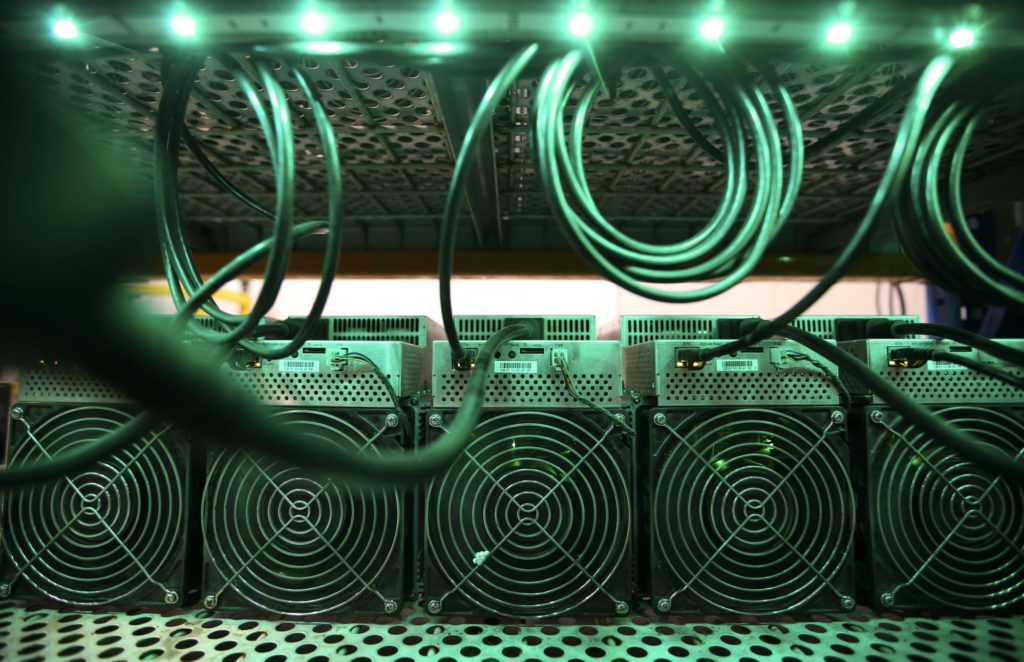
(Bloomberg) — The European Union will develop an energy efficiency label for cryptocurrencies like Bitcoin in a bid to rein in the growing electricity consumption of the industry.

The European Commission will work with international partners to come up with a grading measure that will encourage more environmentally friendly crypto systems, such as “proof of stake,” according to a draft proposal seen by Bloomberg News set to be announced Tuesday. The EU will also call on countries to target miners’ energy consumption this winter as it tries to navigate the season with far less Russian gas.

“Just as their use has grown significantly, the energy consumption of cryptocurrencies has more,” the the EU’s executive arm said in the draft action plan. “In harnessing the use of cryptocurrencies and other blockchain technologies in energy markets and trading, care must be taken to use only the most energy efficient versions of the technology.”

Read more: Why Ethereum’s Merge Means Crypto That’s Much Greener: QuickTake

While the EU makes up only around 10% of proof-of-work crypto mining — a more-energy intensive system used by Bitcoin to issue new digital tokens — any action taken by the bloc can still have knock-on effects globally. It has previously considered banning proof-of-work practices before deciding that cryptoasset providers should be required to disclose the energy consumption and environmental impact of the assets they choose to list.

By comparison, proof-of-stake mining — which is now used by Ethereum — can use 99.9% less energy than proof-of-work. The idea is that a labeling system could encourage other cryptocurrencies to make the switch. 

The bloc will also produce a report that evaluates the climate impact of the industry by 2025, while urging member states to put an end to tax breaks for cryto-miners, according to the document. In the event of an electricity shortage, countries must also be ready to stop mining activities, the EU will recommend.

More stories like this are available on bloomberg.com

©2022 Bloomberg L.P.
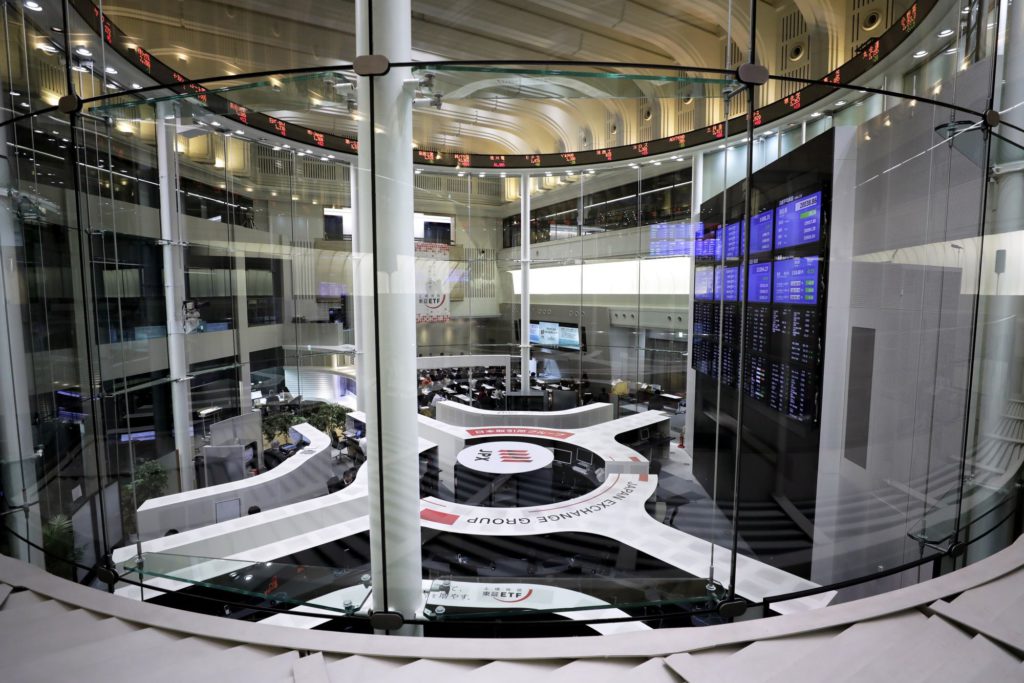
Stocks Pare Gain; Pound, Gilts Drop on BOE Comment: Markets Wrap

(Bloomberg) — Stocks trimmed their advance and the pound and UK gilts weakened after the Bank of England said a report that it is likely to delay the sale of government bonds until the market has calmed was “inaccurate.”

European stocks surrendered most of their fourth day of gains. US equity futures were still 1% higher, after the S&P 500 closed above a key technical support level on Monday. Amazon.com Inc. and Microsoft Corp. led major technology and internet stocks higher in New York premarket trading on Tuesday.

A Bloomberg gauge of the greenback steadied, while the pound weakened by 0.7% after the BOE denied the Financial Times report that the central bank is pushing back the start of its quantitative tightening. The yield on the UK 10-year bond rose 10 basis points to 4.08%. Treasury yields edged higher.

The BOE’s comment took some steam out of a recovery in risk assets spurred by positive company results, cheaper valuations that enticed buyers and after policy reversals soothed concerns about UK assets. With headwinds from inflation, risks to the economy and hawkish central banks continuing to confront markets, there’s debate over how durable the gains will prove.

“There’s still a strong feeling of a bear market rally about trading over the course of the last week,” said Craig Erlam, senior market analyst at Oanda Europe Ltd. “The economic landscape looks treacherous and we don’t even know if we’re at peak inflation and interest rate pricing yet. Those are substantial headwinds that will make any stock market rebound extremely challenging.”

Bank of America Corp. said sentiment on stocks and global growth among fund managers it surveyed shows full capitulation, opening the way to an equities rally in 2023. The bank’s monthly global fund manager survey “screams macro capitulation, investor capitulation, start of policy capitulation,” strategists led by Michael Hartnett wrote in a note on Tuesday. They expect stocks to bottom in the first half of next year after the Federal Reserve finally pivots away from raising interest rates.

The yen paused in its run toward the closely watched 150 per dollar level, which has investors on high alert for possible intervention. Japanese Finance Minister Shunichi Suzuki said he was watching market moves with a sense of urgency.

A gauge of Asian equities rose, led by technology stocks in Hong Kong, even as China’s decision to delay the publication of key economic data added a touch of caution to trading in the region.

Elsewhere in markets, oil switched between gains and losses as traders weighed a tight market against concerns over a global economic slowdown. Gold also fluctuated and Bitcoin continued to trade below $20,000.

Key events this week:

  • US industrial production, NAHB housing market index, Tuesday
  • Fed’s Neel Kashkari speaks, Tuesday
  • Euro area CPI, Wednesday
  • EIA crude oil inventory report, Wednesday
  • US MBA mortgage applications, building permits, housing starts, Fed Beige Book, Wednesday
  • Fed’s Neel Kashkari, Charles Evans, James Bullard speak, Wednesday
  • US existing home sales, initial jobless claims, Conference Board leading index, Thursday
  • Euro area consumer confidence, Friday

Some of the main moves in markets:

Stocks

  • The Stoxx Europe 600 rose 0.2% as of 10:46 a.m. London time
  • Futures on the S&P 500 rose 1.1%
  • Futures on the Nasdaq 100 rose 1.3%
  • Futures on the Dow Jones Industrial Average rose 0.8%
  • The MSCI Asia Pacific Index rose 1.3%
  • The MSCI Emerging Markets Index rose 1.3%

Currencies

  • The Bloomberg Dollar Spot Index was little changed
  • The euro was little changed at $0.9838
  • The Japanese yen was little changed at 149.00 per dollar
  • The offshore yuan was little changed at 7.2105 per dollar
  • The British pound fell 0.6% to $1.1291

Cryptocurrencies

  • Bitcoin fell 0.1% to $19,509.71
  • Ether fell 0.5% to $1,323.75

Bonds

  • The yield on 10-year Treasuries advanced two basis points to 4.03%
  • Germany’s 10-year yield advanced eight basis points to 2.35%
  • Britain’s 10-year yield advanced 10 basis points to 4.08%

Commodities

  • Brent crude fell 0.5% to $91.13 a barrel
  • Spot gold was little changed

More stories like this are available on bloomberg.com

©2022 Bloomberg L.P.
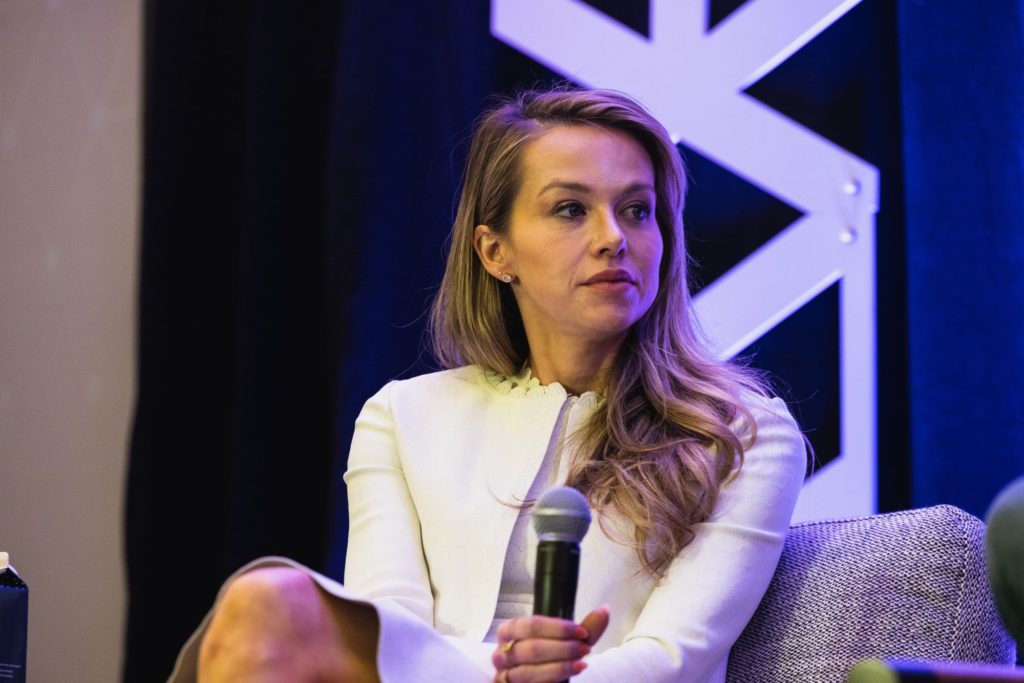
Alan Howard-Backed Crypto VC Firm Hires Biggs as Partner

(Bloomberg) — 1k(x), a crypto venture capital firm that counts British hedge fund tycoon Alan Howard among its backers, hired former Valour Inc. executive Diana Biggs as a partner. 

Biggs will provide support to new and existing portfolio companies, driving partnerships with institutions and non-crypto applications for British Virgin Islands-based 1k(x), it said in a statement. She was previously chief strategy officer at Valour, the Swiss provider of crypto exchange-traded products. 

Founded by European crypto investors Lasse Clausen and Christopher Heymann four years ago, 1k(x) focuses on early-stage investing in blockchain ecosystems and developers such as Arweave, Gnosis and Matter Labs. Its assets under management reached over $1 billion last year, according to the firm. 

Biggs left Valour this summer after spending two years there, holding positions such as chief executive officer of its ETP business. Before that, she was global head of innovation at HSBC Holdings Plc’s private bank. 

The broader crypto market has been in stuck in a downturn since late 2021, and venture capital investment in digital asset businesses plunged to its lowest level in over a year in the third quarter. Despite the so-called crypto winter, traditional financial firms have continued to launch products and services related to digital assets. 

“We are entering a new phase of adoption of these emerging technologies, as they gain market share and converge with the established platforms,” Biggs said in an email. 

(Updates to clarify that 1k(x)’s AUM hit $1 billion last year.)

More stories like this are available on bloomberg.com

©2022 Bloomberg L.P.
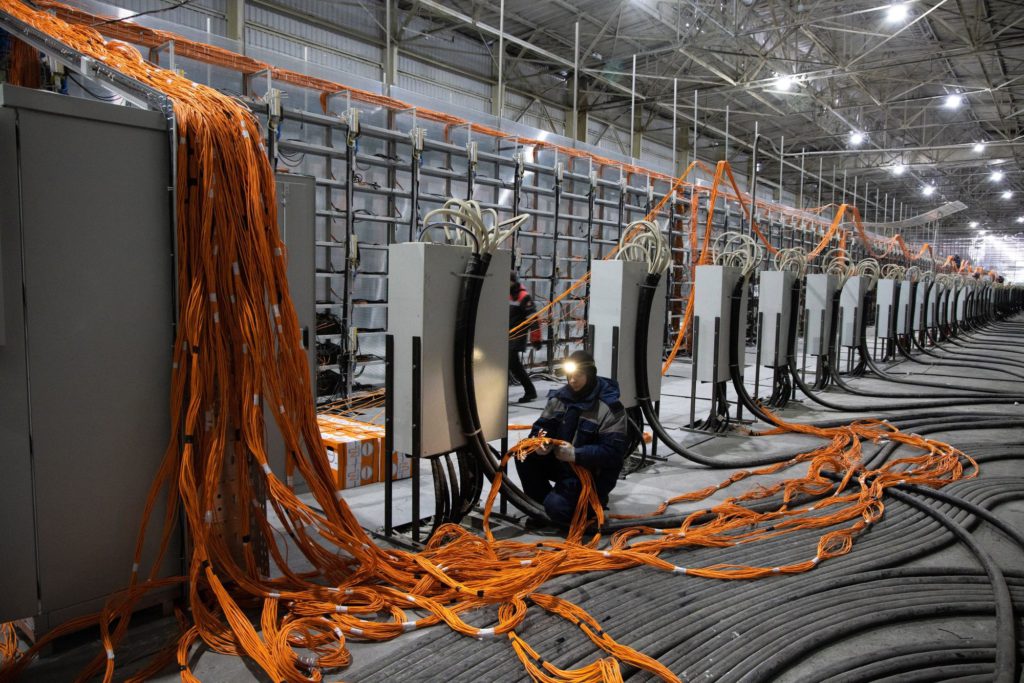
 Finding Opportunities in the Distress of Crypto Bankruptcies

  • Listen to Bloomberg Crypto on the iHeartRadio App
  • Listen to Bloomberg Crypto on Apple Podcasts
  • Listen to Bloomberg Crypto on Spotify  

(Bloomberg) — Bankruptcies can be chaotic times for companies, and for their creditors. Investors, vendors and former customers often end up jostling in court to get their share of what they lost from what remains of the firm. 

In the crypto space, bankruptcies can bring even more questions. 

Some restructuring lawyers say the US bankruptcy code still does not adequately address how to handle crypto assets. But just like other bankruptcy cases, there will be winners and losers. 

To explain what happens to crypto assets during these times, Bloomberg reporter Justina Lee joins Thomas Braziel, the founder of 507 Capital, in this latest episode.


Follow us on Twitter @crypto, and subscribe to the Bloomberg Crypto Newsletter at https://bloom.bg/cryptonewsletter

More stories like this are available on bloomberg.com

©2022 Bloomberg L.P.
California Faces Loss of IPO Crown as Tech Startup Plans Stymied

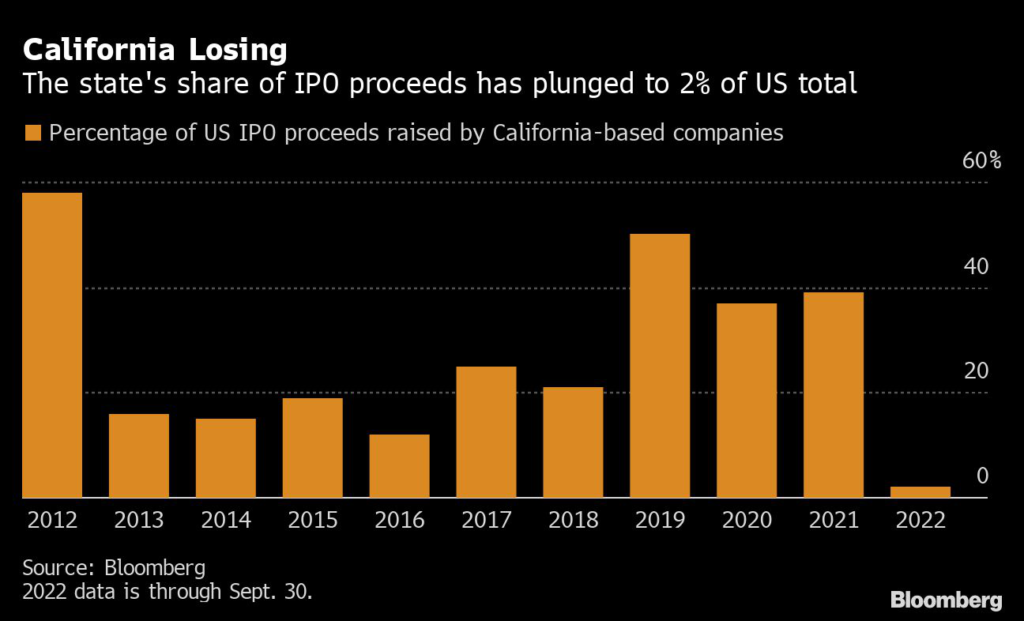
(Bloomberg) — California has been generating the most initial public offerings of any US state every year since 2003. That streak could end this year unless the Golden State picks up the pace.

Only nine companies headquartered in California went public during the first three quarters of 2022, compared with 81 that launched IPOs during the same period last year, according to a Bloomberg News analysis. Even more dramatically, California’s share of US IPO proceeds fell to 2% through Sept. 30, compared with 39% for 2021.

Massachusetts has the lead at this moment, with 10 companies debuting in the public market this year, thanks to its robust biotechnology scene. Moreover, the total raised by those companies — $1.2 billion — is more than six times that of their California counterparts.

To zero in on US corporate activity, the Bloomberg News calculation is limited to IPOs of common stock and excludes the special purpose acquisition companies that helped propel listing volume to an all-time high last year. It also leaves out real estate investment trusts and closed-end funds.

California’s change of fortune is explained largely by the drop in valuations among Silicon Valley’s tech startups, said Jay Ritter, a finance professor at the University of Florida. “It is almost entirely just a reset of valuations,” he said.

Instacart, Stripe

Instacart Inc. and Stripe Inc. are among the California-based startups that have cut their valuations this year. That’s part of an abrupt change from 2021, when tech IPO valuations climbed to the highest level since the peak of the dot-com boom more than two decades ago based on average price-to-sales ratio data compiled by Ritter.

Discouraged tech companies in the state are waiting for the storm to pass, postponing their IPO plans, seeking alternative financing or trimming their expenses.

“The only one that will wind up IPO-ing if their value is down is someone who has no other alternatives,” said Larry Tabb, head of market-structure research at Bloomberg Intelligence. “Unless they don’t see an exit in the next couple of years, they are going to wait for as long as they possibly can.”

Startup backers and employees aren’t the only ones with a stake in California. IPO “instant-millionaires” have fueled a large portion of the state’s personal income tax revenue, said Somjita Mitra, chief economist at the California Department of Finance.

‘Immediate Effect’

This year, the state’s homegrown IPOs raised only $177 million through the end of September, compared with an average of $16 billion for the same period in the past five years.

“We are already seeing an immediate effect,” said Brian Uhler, deputy legislative analyst at California’s Legislative Analyst’s Office. “And it does appear to be significant.” 

In September, California employers’ income tax withholding payments were down 5%, or $354 million, from a year ago, according to an LAO tracker. This year’s IPO drought has been a driver of the decline, Uhler said.

Massachusetts, meanwhile, has been among the top three states with the most US IPOs for nine years running.

This year, four of the biopharmaceutical IPOs in the state raised more than $200 million in proceeds, eclipsing smaller California deals.

Biotech Pipeline

According to Ritter’s data, 2022 will be the 10th year in which the biopharmaceutical sector represents about a third of newly public companies. 

Biotech firms, after going public, typically seek an eventual acquisition once their clinical trials produce significant results. That unique growth pipeline gives them a more stable share of the IPO market.

When tech companies aren’t going public and biopharmaceuticals still are, the IPO market will have “a compositional change” and Massachusetts is going to stand out, said Martin Kenney, professor at University of California, Davis. “Boston is really the center of biotech startups.” 

More stories like this are available on bloomberg.com

©2022 Bloomberg L.P.

Former Grab Fintech Veteran Joins Digital Lending Startup Julo

(Bloomberg) — Grab Holdings Ltd.’s former head of lending Ankur Mehrotra is joining Julo, an Indonesian fintech startup backed by Japanese credit card company Credit Saison Co. 

Mehrotra, a former managing director of Grab Financial Group, left the company earlier this year after a six-year stint. He briefly served as a consultant for Indonesian startup BukuWarung before joining digital lending firm Julo as president. Mehrotra confirmed the move when reached by phone.

He will be responsible for Julo’s overall strategy and corporate finance, including international expansion, fundraising and mergers and acquisitions. After joining Grab in 2016, Mehrotra helped set up the ride-hailing provider’s car leasing business before leading debt fundraising for the company and building its lending business.

Julo’s app lets users in Indonesia withdraw and send cash, make online purchases and pay bills. The Jakarta-based startup raised $80 million in a new round of funding from Credit Saison in April. The deal comprised $30 million in equity investment and $50 million in debt facility.

More stories like this are available on bloomberg.com

©2022 Bloomberg L.P.

SoftBank Sells THG Stake to Online Retailer’s Founder, Qatar After Share Drop

(Bloomberg) — THG Plc’s stock rose after key shareholder Softbank Group Corp. offloaded its stake in the struggling British online shopping firm to co-founder Matthew Moulding and Qatar Investment Authority.

In a move that further cements Moulding’s control of THG, the Japanese group finally ended speculation about its disastrous investment, writing off as much as as £450 million ($511 million) of a stake that was once valued at about £500 million. THG stock rose 10% in early trading Tuesday before paring back slightly.

The Japanese group’s investment vehicle SB Northstar became a cornerstone investor in THG in May 2021 as part of a £1 billion fund raise. 

While it is unclear exactly how much Softbank lost on the deal it is selling its stake for just £31 million, according to a statement Monday. The QIA, already a shareholder, will purchase about 84% of the shares, and the transaction is expected to take place on Oct. 20. 

Founded in 2004 by Moulding and John Gallemore, THG, formerly known as The Hut Group, started out selling CDs but today operates hundreds of websites offering beauty, skincare and health-food products as well as helping rivals sell online via Ingenuity. 

The shares have fallen 80% this year as investors question the company’s business model and governance controls. THG issued a profit warning last month on weaker consumer appetite in the UK and higher costs for raw materials like whey used to make the retailer’s protein shakes.

Takeover speculation has constantly swirled around THG after Moulding said he regretted floating the company and hinted he may take the business private again. The co-founder has kept a tight grip on THG as a major shareholder, landlord and chief executive officer and only relinquished the role of chairman in March. Now, by growing his stake, he has strengthened his hold on the company once again.

“The further increase in Moulding’s stake and by QIA may very well increase rumours that THG will be subject to a potential management buyout or public-to-private,” transaction, said Wayne Brown, an analyst at Liberum. 

Softbank deal 

After THG’s successful £5.4 billion float, SoftBank struck a deal with the company, which included an option to buy a 20% stake in its Ingenuity business at a lofty valuation of £4.5 billion. However, amid skepticism about the growth prospects of the unit, SoftBank said in July it would not take up the offer.

Moulding thanked SoftBank for its support in a statement and said THG expects to benefit from relationships formed across the investor’s technology portfolio. Softbank declined to comment. 

Read More: THG Finds Out What Happens to Instagram Fame in a Market Crash

SB Northstar, a trading vehicle set up by SoftBank founder Masayoshi Son, was set up in 2020 and aimed at using the company’s excess cash to make some money picking stocks. Son took a personal 33% interest in the unit, while the company held the rest of the equity.

However, the unit has been hammered by falling tech stocks. SoftBank said it would recognize a loss of 670 billion yen ($4.5 billion) for the last fiscal year, with Son on the hook for 315 billion yen.

(Updates with share graph, analyst comment)

More stories like this are available on bloomberg.com

©2022 Bloomberg L.P.

Close Bitnami banner
Bitnami
