
Bloomberg

Software Sprawl: Workers Flit Between Apps 1,200 Times a Day

(Bloomberg) —

Technology overload. IT bloat. Barnacle apps.

The problem goes by many names, but the story’s the same: Employees are swamped by an ever-expanding array of specialized software that’s made the workday a disjointed slog.

Workplace tools have never been popular — who enjoys filling out expense reports? — but when the pandemic hit, virtual communication and collaboration programs became critical for businesses. New employees got onboarded by one app, trained by another and surveyed by a third.

As Covid-19 wore on, concerns about burnout and record quitting rates prompted companies to add well-being and recognition programs. Rogue workers and teams brought in their own favorite tools as well. Apps upon apps, all with incessant notifications, cryptic passwords and byzantine protocols. And unlike your uncle’s Facebook posts, they’re not easily muted. 

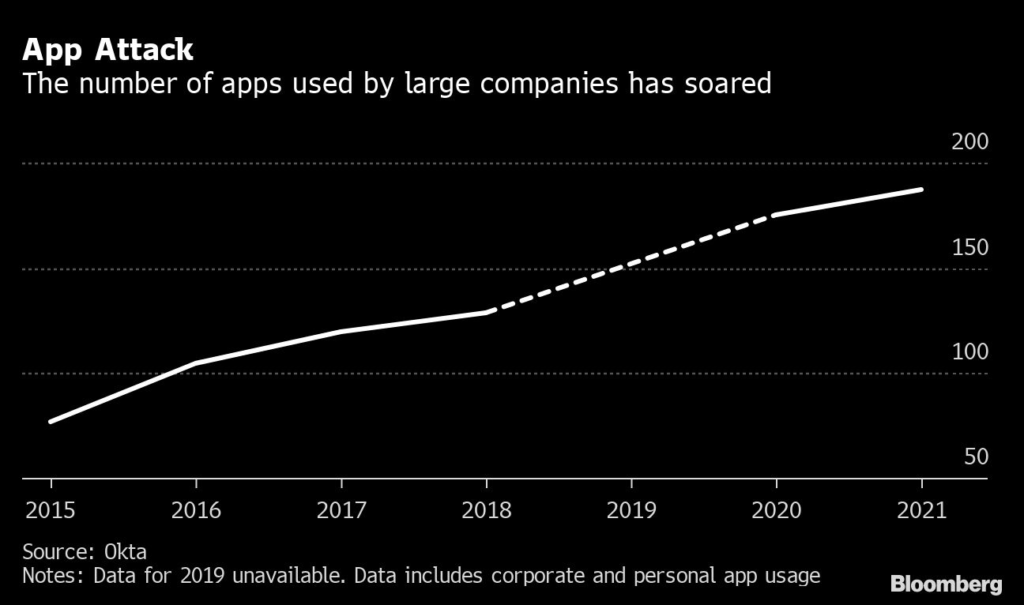
How bad is it? Companies deployed 89 different apps on average last year, up from 58 in 2015, according to Okta, a cloud software company. At large employers, that figure is now 187. Of those apps, close to 30% are duplicative or add no value, according to a survey of senior business leaders by WalkMe, an enterprise software provider.

A recent study of 20 teams across three big employers found that workers toggled between different apps and websites 1,200 times each day. That’s just under four hours a week, or roughly five weeks a year, spent hitting the Alt-Tab key. The researchers dubbed it the “toggling tax,” but it’s better known among psychologists as context switching — a habit that makes it hard to focus and, over time, stresses us out.

“Basically, how we work is itself a distraction,” said Rohan Narayana Murty, founder and chief technology officer at Soroco, which uses machine learning to map out how work gets done, and conducted the toggling study. “All day long, we just repeatedly switch between disparate applications.”

Frustrations with technology at big firms prompted 76 employees, on average, to leave last year, WalkMe’s survey found. “People only have a certain tolerance level and then they just check out,” said Bob Ellis, global head of the talent and organization practice at Infosys Consulting.

Scott Fingerhut, a longtime Silicon Valley marketing executive, has seen that firsthand over the years. “The hard thing,” he said, “is that most people don’t see it coming. You don’t get a notification for burnout.”App overload can strike any workplace. Natacha Arboleda is a hairdresser at Fox & Jane, a chain of about a dozen salons, mostly in New York City. The company uses one app for scheduling appointments, another for the stylists to chat with the office staff, and a third for HR functions like payroll and time off requests. Making matters worse, management has changed the HR app three times since Arboleda started there.

“If it ain’t broke, don’t fix it,” she said. The apps can be time-consuming, especially when she gets logged out of one, forgets her password and has to ask a manager to help her get back in. The chat notifications are constant, and particularly distracting on her days off. But when she silences them, “I forget to turn them back on,” Arboleda said.

If a hair salon requires multiple apps, imagine a professional-services firm with dozens of clients, each with their own preferred programs that must be mastered. Steve Dinelli, who runs a digital marketing agency in Chicago, says the overload problem has hurt his company’s productivity.

“There are always messages going back and forth internally asking where different things are for different clients. Is it in a Google doc? Email? Dropbox? Slack? It could be anywhere.” And good luck trying to eliminate apps: “Clients will just find someone who will work the way they want.”

Technology overload is even influencing office design, and not necessarily for the better. MillerKnoll Inc., the furniture giant behind the ubiquitous Aeron chair, has been getting more requests lately for workstations that support two monitors rather than one. More apps, more screens.

The shifting nature of work after Covid-19 is not the only catalyst here. In the years before the pandemic, companies were moving from old-school mainframe software applications to cheaper cloud-based apps, also known as software as a service (SaaS). The $247 billion SaaS market is dominated by vendors like Salesforce Inc., Oracle Corp., SAP SE, Google and Microsoft Corp., whose Teams videoconferencing service now has more than 270 million active users, up from 20 million in 2019.

Cloud apps are easy to build, buy and roll out, which has led to what industry consultant Creative Strategies calls a “mix and match of workflows.”

For example, employees might prefer to do their video calls over Zoom, whose market share has nearly tripled since 2019. But during those calls, they’re also chatting on Slack and sharing documents using Microsoft’s Teams, which is neatly integrated with Word, PowerPoint and Excel. Some apps are just used by a few employees, while others are popular for a while, then get supplanted and fade into the background — the so-called barnacle apps. (Remember Skype?) More than half of IT professionals polled by cloud software maker Freshworks Inc. say they pay for SaaS stuff that their IT teams never even use.

Tori Paulman sees this happening every day. As a senior director analyst at Gartner Inc.’s employee experience technology group, she has to evaluate and recommend workplace software for clients that will make their jobs easier, not harder — what’s known in the consulting business as “human-centered IT strategies.” But her blunt assessment is that humans are barely in the periphery at the moment, much less the center.

“Technology,” she said, “has gone from the great enabler to the great inhibitor.” She relates horror stories where employees have to navigate five different apps just to start their day. Or her favorite: an HR leader who said employees were feeling fatigued by all these apps and asked if there was an app to fix it.

Don’t laugh: Often the only way to make sense of all this technology is to — you guessed it — add more technology. Project-management software vendors like Asana Inc., Atlassian Corp. and Monday.com promise clients that using their platforms can boost efficiency and reduce app clutter, and they have won over customers like Seismic Software Inc., which ditched a half-dozen programs recently to consolidate its workflows with Monday. San Diego-based Seismic, which makes software that helps sales teams, said the move is saving them time and money. But the company is still using separate apps to keep track of its business goals, and yet another to do employee surveys.

“There is still a bit of overlap in our systems,” said Linda Ho, Seismic’s chief people officer. What’s worse, even Ho — an executive in the software industry — said she doesn’t often see much to distinguish one app from another. “At some point, they all begin to be pretty much the same.”

Other business leaders have taken a scythe to their software sprawl. Prasad Ramakrishnan, the chief information officer at Freshworks, said he once had more than 800 apps inside his 1,300-person company. He’s now cut it down to just over 200, and his goal is to get to 150 eventually. (The firm now has more than 5,000 staffers.) One quick fix: The legal, finance and sales departments each used different document-management tools, and everyone had their own personal login — a huge security risk. Now, they all use Box Inc. Four videoconferencing apps were reduced to one. Every few months, he meets with his IT and finance team and finds new programs to cull. “It’s not a one-time project,” he said. 

Don’t shed a tear for those pruned vendors, though. They’re hard at work coming up with brand-new workplace apps, like Microsoft’s Viva, an employee-focused platform that handles things like staff surveys, learning and goal tracking. Unilever Plc and PayPal Holdings Inc. employees are among its 10 million users, all of them hopeful that one more app will make all the difference.

A few startups are going even further by trying to replace Google’s Chrome and other ad-supported web browsers. One of them, a Bay Area firm called Sidekick — backed by venture capital titan Kleiner Perkins — is beta testing a business-focused browser that lets workers quickly move between apps and easily find any document or website. “Chrome will never evolve into something that’s built for work — that’s why you have thousands of tabs open all day,” Chief Executive Officer and co-founder Dmitry Pushkarev said. “Our idea was to build a much better work environment that’s not based on fatigue.”

Still, it’s often not clear if new approaches are adding to the clutter or reducing it. “Everyone thinks that just buying a tool will help you solve a problem,” said Ho, the HR chief. “This all happens with the best intentions.”

And that is the crux of the issue, said Fingerhut, the marketing executive: “It’s death by 1,000 good intentions.”

More stories like this are available on bloomberg.com

©2022 Bloomberg L.P.

Intel Slashes Mobileye IPO Valuation Again to $16 Billion

(Bloomberg) — Mobileye Global Inc., the self-driving technology company owned by Intel Corp., is targeting a valuation of about $16 billion in a public offering, far below its previous target amid a rocky year for new listings.

Intel had recently lowered its expected valuation of Mobileye to $30 billion due to turbulent market conditions, Bloomberg News reported last month.

The company plans to sell 41 million shares for $18 to $20 each, raising $820 million according to a filing on Tuesday with the US Securities and Exchange Commission. After the offering, Intel will retain a controlling stake in Mobileye. The shares are set to start trading within weeks.

Despite the drop in valuation, the listing is set to be one of the year’s biggest IPOs. Amid heightened volatility and disappointing debut performances of last year’s listings, IPO volume in the US has plummeted to $22.3 billion this year, compared with $277 billion at this point in 2021, according to data compiled by Bloomberg. Instacart Inc., another highly anticipated IPO, last week cut its valuation for the third time, to $13 billion, and is waiting for the markets to settle before going ahead with a listing. Another deterrent for new listings is the fact that many companies that went public in 2020 and 2021 are trading below their IPO prices.

But some analysts said it was reasonable for Intel to go through with the listing despite the poor market timing. Analysts at Bernstein said Intel likely needs the money it will receive from the deal, “given the way their own business is currently trending.” And Vital Knowledge analysts wrote that the “headline is negative, but keep in mind the $50B valuation was floated back in December, so no one should be shocked that the number is now lower today.” Intel shares were up about 1.4% in early trading in New York. 

Mobileye, founded in 1999 by Amnon Shashua, was acquired by Intel in 2017 in a $15.3 billion deal that took the company private, according to the prospectus. Intel Chief Executive Officer Pat Gelsinger is seeking to capitalize on the Israel-based business, which makes chips for cameras and drive-assistance features, and is seen as a prized asset as the car industry races toward fully automated vehicles. But the bright future for electric vehicles that was prophesied by Intel, Waymo and others has sputtered. A world full of robo-taxis seems at best decades away and the losses for investors who put faith in the field are mounting.  

Read more about how even after $100 billion in investments, the self-driving car industry is going nowhere

Chip stocks have also suffered in recent weeks with a string of warnings coming from the likes of Micron Technology Inc. and Samsung Electronics Co. The Philadelphia Semiconductor Index is down 44% this year and is on track for its worst annual performance in 14 years. 

Mobileye will use the cash raised to toward net proceeds for working capital and general corporate purposes, as well as repaying a portion of debt owed to Intel. As of July, it had $774 million of cash and cash equivalents. In the 12 months ended Dec. 25, it had a net loss of $75 million on revenue of $1.39 billion.

Shashua has indicated an interest in purchasing as much as $10 million shares of Class A common stock, according to the filing. Baillie Gifford and Norges Bank Investment Management, as cornerstone investors, have indicated interest in purchasing up to an aggregate of $330 million shares. Growth equity firm General Atlantic also said it would buy $100 million of shares.

Goldman Sachs Group Inc. and Morgan Stanley are leading the offering. Mobileye plans for its shares to trade on Nasdaq under the symbol MBLY, the same ticker it used when it went public the first time in 2014.

(Updates with analyst comments in fifth paragraph, share trading)

More stories like this are available on bloomberg.com

©2022 Bloomberg L.P.
Rally in Futures Signals More Gains for US Stocks: Markets Wrap

(Bloomberg) — A rally in US equity futures signaled an extension of gains on Wall Street, with Goldman Sachs Group Inc. the latest to provide investors with positive earnings news. The pound and UK gilts weakened after the Bank of England denied a report it’s delaying the sale of government bonds until markets are calmer.

Contracts on the S&P 500 climbed 2% after the underlying gauge closed above a key technical support level on Monday. Those on the Nasdaq 100 were up 2.2%. Goldman gained in premarket after better-than-expected third-quarter results. European stocks rose for a fourth day.

A Bloomberg gauge of the greenback was steady, while the pound weakened by 0.4% after the BOE said a Financial Times report that the central bank is pushing back the start of its quantitative tightening was “inaccurate.” Treasury yields dropped.

Sentiment toward risk assets has been buoyed by positive company results, cheaper valuations that enticed buyers and after policy reversals soothed concerns about UK markets. But with headwinds from inflation, risks to the economy and hawkish central banks continuing to confront investors, there’s debate over how durable the gains will prove.

“There’s still a strong feeling of a bear market rally about trading over the course of the last week,” said Craig Erlam, senior market analyst at Oanda Europe Ltd. “The economic landscape looks treacherous and we don’t even know if we’re at peak inflation and interest rate pricing yet. Those are substantial headwinds that will make any stock market rebound extremely challenging.”

Bank of America Corp. said sentiment on stocks and global growth among fund managers it surveyed shows full capitulation, opening the way to an equities rally in 2023. The bank’s monthly global fund manager survey “screams macro capitulation, investor capitulation, start of policy capitulation,” strategists led by Michael Hartnett wrote in a note on Tuesday. They expect stocks to bottom in the first half of next year after the Federal Reserve finally pivots away from raising interest rates.

The yen paused in its run toward the closely watched 150 per dollar level, which has investors on high alert for possible intervention. Japanese Finance Minister Shunichi Suzuki said he was watching market moves with a sense of urgency.

Elsewhere in markets, oil switched between gains and losses as traders weighed a tight market against concerns over a global economic slowdown. Gold also fluctuated and Bitcoin continued to trade below $20,000.

Key events this week:

  • US industrial production, NAHB housing market index, Tuesday
  • Fed’s Neel Kashkari speaks, Tuesday
  • Euro area CPI, Wednesday
  • EIA crude oil inventory report, Wednesday
  • US MBA mortgage applications, building permits, housing starts, Fed Beige Book, Wednesday
  • Fed’s Neel Kashkari, Charles Evans, James Bullard speak, Wednesday
  • US existing home sales, initial jobless claims, Conference Board leading index, Thursday
  • Euro area consumer confidence, Friday

Some of the main moves in markets:

Stocks

  • Futures on the S&P 500 rose 2% as of 8:26 a.m. New York time
  • Futures on the Nasdaq 100 rose 2.2%
  • Futures on the Dow Jones Industrial Average rose 1.8%
  • The Stoxx Europe 600 rose 1.1%
  • The MSCI World index rose 0.5%

Currencies

  • The Bloomberg Dollar Spot Index was little changed
  • The euro was little changed at $0.9839
  • The British pound fell 0.4% to $1.1312
  • The Japanese yen was little changed at 149.11 per dollar

Cryptocurrencies

  • Bitcoin rose 0.3% to $19,592.21
  • Ether was little changed at $1,328.88

Bonds

  • The yield on 10-year Treasuries declined three basis points to 3.98%
  • Germany’s 10-year yield advanced one basis point to 2.28%
  • Britain’s 10-year yield was little changed at 3.98%

Commodities

  • West Texas Intermediate crude rose 0.3% to $85.72 a barrel
  • Gold futures fell 0.3% to $1,659.20 an ounce

More stories like this are available on bloomberg.com

©2022 Bloomberg L.P.

Crypto Foot Race Heats Up as Ex-Meta Staff Start Blockchain

(Bloomberg) — Aptos Labs, a startup with its roots in Meta Platforms Inc.’s failed crypto ambitions, went live with a blockchain that seeks to make transactions quicker and more secure.

“This is step one in a long journey to create universal and fair access to decentralized applications” via “a safe, scalable, and upgradeable blockchain,” Aptos said in a statement on Tuesday.

Aptos’s blockchain uses a programming language called Move that’s supposed to make transactions faster and cheaper. Move also powered the network of Meta’s cryptocurrency project Diem, which faced strong resistance from regulators and eventually sold its assets.

Aptos has won investment from the likes of Binance Labs, the venture capital arm of the world’s biggest cryptocurrency exchange. Other supporters include Andreessen Horowitz and the venture units of FTX and Coinbase Global Inc.

Projects like Aptos and rival blockchain Solana are pursuing faster transaction speeds, which are seen as key to the wider adoption of digital ledgers. 

The Aptos blockchain processed about four transactions per second on Tuesday, according to the Aptos Explorer website. It was designed to be able to execute over 160,000 “non-trivial” Move transactions per second, Aptos said in April. 

“Those 4 TPS are system transactions and don’t include any user transactions yet,” Aptos said on Tuesday. “We expect user transactions to begin starting tomorrow. Hold tight!” 

(Updates with Tuesday’s number of transactions in sixth paragraph.)

More stories like this are available on bloomberg.com

©2022 Bloomberg L.P.

First Look: Rolls-Royce’s First Electric Car, the Spectre Coupe

(Bloomberg) — Rolls-Royce has completed the first step toward fulfilling its promise to sell only electric vehicles by 2030. On Oct. 18 it unveiled the all-electric Spectre at company headquarters in Goodwood, England. 

“This is not a kind of one-hit wonder and then we go back to the 12-cylinder, that’s not the idea,” says Torsten Müller-Ötvös, chief executive officer of Rolls-Royce Motor Cars Ltd. “The idea is we go electric by the end of 2030, step by step by step by step. For this reason, [Spectre] is very expensive to develop. It’s a big investment.”

Müller-Ötvös declined to specify how much money the company has plunged into the all-new production iteration of the EV it began testing as far back as 2011, though he says the Spectre would provide as healthy a profit margin as those amply generated by Rolls-Royce’s Phantom and Ghost sedans. 

“It would not be acceptable to have different contribution margins due to the fact that we go electric,” he says. “We want to stay in that league of profitability we are in, and we are nicely profitable. That’s the way forward.”

The announcement gives Rolls-Royce a strong first statement among the ultra-luxury set. In January, Bentley announced it would spend $3.4 billion to produce five all-electric vehicles beginning in 2025 and switch to an entirely electric portfolio by 2030. With the Spectre, Rolls-Royce beats its archrival in bringing the first all-electric ultra-luxury model to market. 

Magic Carpet Ride, Electrified

Similar in look and size to the two-door Rolls-Royce Wraith but larger, and built on the same all-aluminum architecture that underpins the flagship Phantom sedan and midsize Ghost sedan, the Spectre produces 577 horsepower and 664 pound-feet of torque. It has a zero-to-60 mph sprint time of 4.4 seconds and a top speed of 155 mph, roughly equal to that of the Ghost but far slower than the roughly three seconds claimed by the faster—and far less luxurious—variants of the Porsche Taycan or Tesla Model S. Total driving range under electric power is 260 miles, according to Environmental Protection Agency estimates; Spectre will be ale to charge from 10-80% full in 34 minutes. Müller-Ötvös noted that the vast majority of Rolls-Royce owners will never use a public charging station. 

“Most of our clients have an electric car in the garage,” he says. “On average, they have seven cars, and many have charging at home. They have charging in their offices.”  

The two-door coupe uses a highly sensitive “planar” suspension system that can decouple the car’s anti-roll bars to allow each wheel to act independently, preventing the rocking motion that occurs when one side of a vehicle hits an undulation in the road. This also reduces high-frequency sounds caused by poor road-surface quality and helps preserve the marque’s reputation for producing the quietest, smoothest vehicles on the market. All told, more than 700 kilograms’ (1,543 pounds’) worth of sound-deadening equipment helps push the car’s total weight to 6,559 pounds. 

Set on 23-inch wheels and with a fastback body style, the Spectre is longer and heavier than the Wraith and harkens back to the Phantom coupe that Rolls-Royce produced from 2008 to 2016. (It doesn’t have a trunk in the front, as do many lesser EVs such as those from Lucid and Tesla. The space under the hood is occupied by battery-electric systems and fluid containers for the windshield wipers.) 

It has the widest grille ever bestowed on a Rolls-Royce, illuminated with 22 LEDs lighting up the sandblasted rear side of each of its vanes. A redesigned Spirit of Ecstasy figurehead on the hood comes crouched, yoga-like, lower than its predecessor, with her head tilted higher and wings flattened into a more active pose. The cabin comes with doors newly illuminated by 5,876 tiny light points made to resemble the starry sky—a continuation of the signature effect Rolls-Royce has long produced on its vehicles’ ceilings. All-new front seats are inspired by British tailoring; they offer lapel sections that can be rendered in contrasting or matching colors to the main base. In the debut model, a chartreuse-and-black two-tone paint job follows the top hood of the car over the roofline to the rear trunk, completing the new coupe’s bolder look. The dual-color effect is optional among more than 44,000 available color combinations—but recommended by Rolls-Royce brass, since it accentuates the seamless curves that run the length of the vehicle. 

“In my view, every Rolls-Royce should be two-tone,” says design director Anders Warming, noting that Rolls-Royce chose to premiere its first EV in a coupe body style—as opposed to a sedan or SUV—as an emotion-based pick “just to charge us up.”

Long Awaited

The Spectre takes its name from the deep recesses of Rolls-Royce history. In 1910 the brand built a demonstration car called the Silver Spectre. By 1936 it had made nine experimental cars code-named Spectre before the model entered production under the official name of Phantom III. This is the first time the moniker has been given to a series production Rolls-Royce.

It’s been a long time coming. Rolls-Royce had for years approached the electric-vehicle proposition with some trepidation, even though co-founder Charles Rolls predicted in 1900 that the new motorized carriages of the day would eventually run under electric power, according to company records. Despite some early testing of electric prototypes in 2011 and 2016, Müller-Ötvös said as recently as 2019 that he wanted to keep the powerful V-12 combustion engine responsible for Rolls-Royce’s world-famous quiet, smooth coaches for “as long as possible.”   

But parent group BMW AG has left no doubt where all of its brands must go. Last year the company introduced its first-ever all-electric iX SUV and all-electric i4 sedan. The manufacturer has reported that its battery cell orders have exceeded $24 billion to keep pace with surging demand for electric cars. During the first half of 2021, EVs contributed 11% of deliveries across BMW Group. In a roundtable discussion on Oct. 17, BMW AG Chairman Oliver Zipse said he anticipated that by 2030, 50% of all vehicles sold across the group would be electric.

Pricing for the Spectre will range between the $350,000 of the Cullinan SUV and $460,000 of the Phantom sedan, according to a spokesperson. Müller-Ötvös says production volumes will fall behind those of the Cullinan and Ghost but exceed the Phantom’s. More than 300 clients have already been specially invited to see the car, with overwhelmingly positive results, he says.

“The order intake so far is very, very delightful—and very encouraging,” Müller-Ötvös says.

Deliveries begin in the fourth quarter of 2023. 

More stories like this are available on bloomberg.com

©2022 Bloomberg L.P.
Walmart Enlists Social-Media Influencers to Help Sell Everything From Food to Clothes

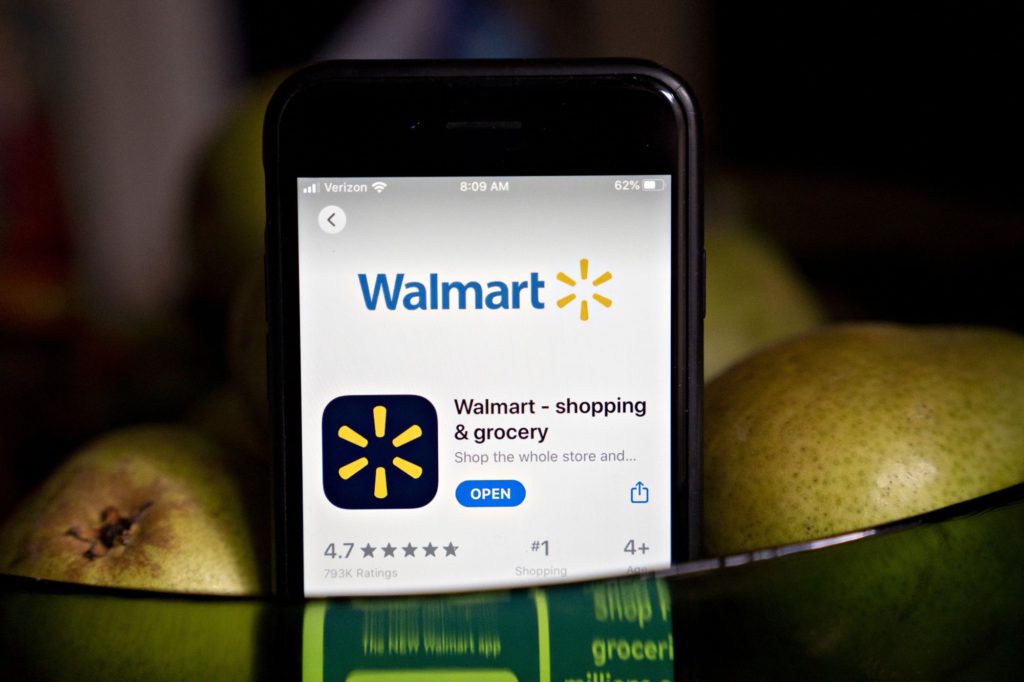
(Bloomberg) — Walmart Inc. is starting a platform for social-media influencers — a bid to get help from online content creators to sell everything from food to apparel. 

The program, called Walmart Creator and accessible via an internet browser, is designed to make it easier for influencers to recommend company products, the retailer announced in a statement Tuesday. Influencers will have access to tens of thousands of goods and can earn commissions on sales they refer. 

Walmart is looking to cash in on social media as more customers look to celebrities and content creators for cues about what to buy. Influencers can use Walmart Creator to share product links, get merchandise recommendations based on their interests and collect feedback on sales performance. 

“We are following our customers in the places where they spend their time, and increasingly people are spending more time in the social space,” said William White, chief marketing officer at Walmart’s US operation. “We have seen this rise of social influence, social discovery, where customers are inspired about what they see in those platforms.” 

Access to the program will be limited at first, as the retailer monitors its impact during the busy holiday season. A broader rollout is planned for next year, White said. 

More stories like this are available on bloomberg.com

©2022 Bloomberg L.P.
OneCoin’s Crytpoqueen Associates Face German Fraud Trial

(Bloomberg) — Some of the first people in Europe to face criminal allegations over their role in a multibillion-dollar international fraud run by founder of cryptocurrency OneCoin appeared in a German court on Tuesday. 

Three people, including a Munich lawyer who worked for cryptoqueen Ruja Ignatova, are accused of money laundering, fraud and banking crime allegations in one of the industries mist infamous scams. The attorney allegedly transferred €20 million ($19.7 million) for Ignatova to buy two London apartments for €75 million euros to the Cayman Islands. Ignatova is on the run and wanted bu authorities in the US and Europe.

A husband and wife are also charged with handling €320 million in payments from OneCoin customers within a single year. 

OneCoin was a scam, prosecutors said in the German court reading the indictment. Ignatova defrauded her customers by falsely claiming OneCoin was a cryptocurrency and that its value was determined by market mechanisms they could monitor. At one point, they were told 50,000 new OneCoins were mined per minute, according to the indictment.  

“In reality, the ever-growing value was a fake and the mining process was only simulated by the software,” prosecutors said in court. 

The subject of a successful BBC podcast ‘The Missing Cryptoqueen’, Ignatova created OneCoin in 2014 in Sofia, Bulgaria, and headed the organization until she vanished from the public eye in October 2017.

Her brother Konstantin Ignatov took over. He was arrested in the US in 2019 and later pleaded guilty. Ruja Ignatova is being investigated in Germany and has been charged in the USwith wire fraud, securities fraud and money laundering.

OneCoin claimed to have more than 3 million members worldwide. Generating €3.4 billion euros in revenue from the fourth quarter of 2014 to the third quarter of 2016, it operated as a multilevel market network that paid commission to members worldwide for recruiting others, prosecutors told a US court in 2019.

More stories like this are available on bloomberg.com

©2022 Bloomberg L.P.

OneCoin’s Cryptoqueen Associates Face German Fraud Trial

(Bloomberg) — Some of the first people in Europe to face criminal allegations over their role in a multibillion-dollar international fraud run by founder of cryptocurrency OneCoin appeared in a German court on Tuesday. 

Three people, including a Munich lawyer who worked for cryptoqueen Ruja Ignatova, are accused of money laundering, fraud and banking crime allegations in one of the industries mist infamous scams. The attorney allegedly transferred €20 million ($19.7 million) for Ignatova to buy two London apartments for €75 million euros to the Cayman Islands. Ignatova is on the run and wanted bu authorities in the US and Europe.

A husband and wife are also charged with handling €320 million in payments from OneCoin customers within a single year. 

OneCoin was a scam, prosecutors said in the German court reading the indictment. Ignatova defrauded her customers by falsely claiming OneCoin was a cryptocurrency and that its value was determined by market mechanisms they could monitor. At one point, they were told 50,000 new OneCoins were mined per minute, according to the indictment.  

“In reality, the ever-growing value was a fake and the mining process was only simulated by the software,” prosecutors said in court. 

The subject of a successful BBC podcast ‘The Missing Cryptoqueen’, Ignatova created OneCoin in 2014 in Sofia, Bulgaria, and headed the organization until she vanished from the public eye in October 2017.

Her brother Konstantin Ignatov took over. He was arrested in the US in 2019 and later pleaded guilty. Ruja Ignatova is being investigated in Germany and has been charged in the USwith wire fraud, securities fraud and money laundering.

OneCoin claimed to have more than 3 million members worldwide. Generating €3.4 billion euros in revenue from the fourth quarter of 2014 to the third quarter of 2016, it operated as a multilevel market network that paid commission to members worldwide for recruiting others, prosecutors told a US court in 2019.

More stories like this are available on bloomberg.com

©2022 Bloomberg L.P.

Meta Ordered Again to Sell Giphy as UK Watchdog Blocks Deal

(Bloomberg) — Meta Platforms Inc.’s $315 million purchase of a GIF search engine is set to be blocked again by the UK’s antitrust watchdog bringing to an end years of uncertainty over the deal. 

The Competition and Markets Authority said Tuesday it’ll order Meta to sell Giphy Inc. for a second time after an appeals court sent the decision back to the regulator for reconsideration. An appropriate buyer will be identified at a later date. 

“We are disappointed by the CMA’s decision but accept today’s ruling as the final word on the matter,” a Meta spokesperson said. “We are grateful to the Giphy team during this uncertain time for their business, and wish them every success.”

Scrutiny of big tech companies dominance has been ramped up by the UK agency since it gained new powers post-Brexit. Its Digital Markets Unit, which will focus on policing the world’s biggest technology firms, is currently operating in shadow form, awaiting legislative approval from the government. 

The decision comes after the CMA ordered Meta to unwind the deal last year following an in-depth probe which found the tie-up could have reduced competition between social-media platforms. Meta, which called the findings “irrational,” appealed to a London court. The transaction was then sent back to the agency for a fresh look after judges found concerns with the probe process. 

“This deal would significantly reduce competition in two markets,” Stuart McIntosh, chair of the independent inquiry group carrying out the so-called remittal investigation, said in a statement. “It has already resulted in the removal of a potential challenger in the UK display ad market, while also giving Meta the ability to further increase its substantial market power in social media.”

The divestment order marked the first time a global regulator has forced a Big Tech firm to unwind a completed deal. 

It remains unclear who might be in the running to buy the GIF-maker. Giphy itself said that there was a lack of suitable interested purchasers, according to documents made public during the investigation. It said that there was a decline in the use of GIF’s since the deal was announced two years ago and they were now considered “cringe” and had “fallen out of fashion.”

More stories like this are available on bloomberg.com

©2022 Bloomberg L.P.

Black British Founders Are Looking to US for Funding

(Bloomberg) — Black British founders struggle to raise funds from investors in the UK and so seek venture capital in the US, said Sharmadean Reid, Founder of The Stack World, a social network for female entrepreneurs. 

“A lot of minority founders in my communities were already looking to America for their next round, which is a very, very bad look for British capital,” Reid said at the Bloomberg Equality Summit on Tuesday.

The underfunding of Black entrepreneurs in the United Kingdom is a persistent problem. In 2020, less than 0.25% of venture capital in the UK went to Black-led businesses and only 38 Black British founders received VC funding between 2009 and 2019, according to an analysis of 2,000 startups by Extend Ventures. 

Black founders in the UK are drawn to the US for funding because of the larger number of high-net-worth individuals and venture capitalists among America’s Black population, as well as a less risk-averse environment and potential to scale, Reid added.

As the UK deals with an economic downturn and a squeezed pound, Charmaine Hayden, Founding Partner GOODsoil VC, warned this could also have an outsized impact on Black founders. “Even when people are raising, the down rounds that everyone is facing are going to substantially lean heavier on those Black faces, because of the social nuances people don’t realize,” Hayden said.

More stories like this are available on bloomberg.com

©2022 Bloomberg L.P.

Close Bitnami banner
Bitnami