Bloomberg

Gloom Grips China Investors Like Never Before Ahead of Congress

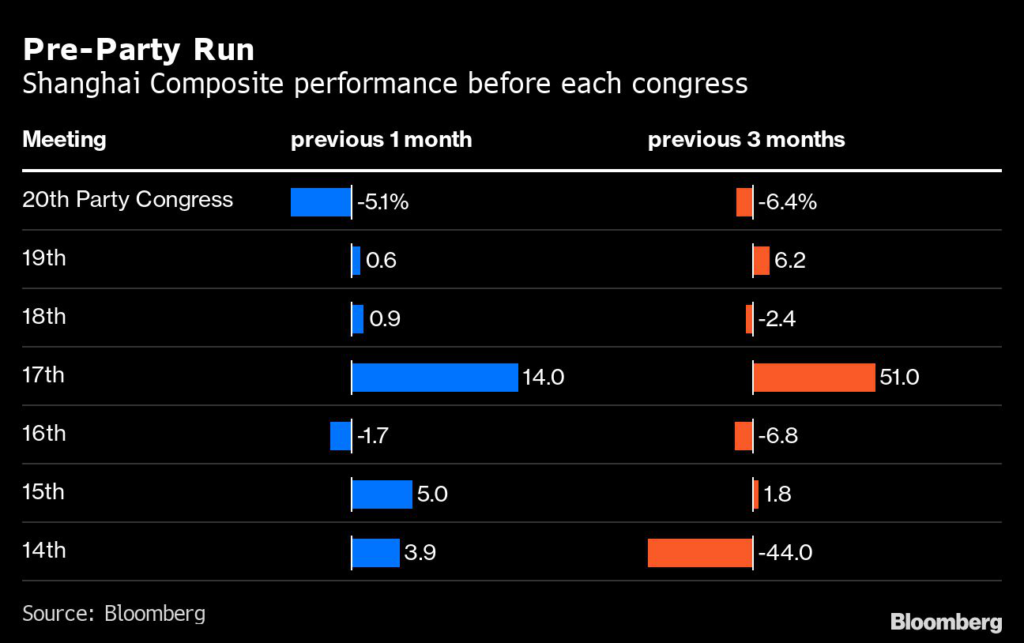
(Bloomberg) — Sunday brings a historic moment for Xi Jinping’s political legacy, but investors are far less excited about the prospects of a market turnaround: Chinese stocks have never performed so poorly in the run-up to any Communist Party Congress.

The Shanghai Composite Index lost more than 5% over the past month, its worst pre-Congress showing since the gauge’s inception in 1991. The yuan is down more than 10% this year against the dollar, heading for the worst annual performance since 1994. China’s dollar-denominated junk bonds have plunged to near record lows amid a widening fallout of a property crisis.

An escalation of Sino-American tensions and Beijing’s repeated advocacy of its staunch Covid Zero policy have sent foreign investors rushing for the exit ahead of the twice-a-decade leadership summit, offloading a net $875 million worth of onshore stocks this week, the most since July.

While the focus in President Xi’s speech will be on whether his emphasis tilts toward economic growth from risk containment, most market watchers see a clear pivot as unlikely, and expect volatility to persist in the coming months. There is little hope for the event to change the fate of the blue-chip CSI 300 Index, which is down 22% this year and headed for its first back-to-back annual loss since 2011.  

“I don’t think this is going to be a big event that will change the market’s perception of China,” said Tom Masi, a New York-based portfolio manager at GW&K Investment Management. “We are looking to see a change in direction, but I don’t think all of this will be clear in the next few days, instead it’ll unfold over the next maybe three to six months.”

Turnover in the world’s second-biggest stock market has dropped to the lowest levels this year ahead of the congress, signaling investor confidence remains low amid an uncertain outlook for the economy and markets.

‘Technical Rebound’

Dip buyers emerged this week after the CSI 300 sank to its lowest levels since April 2020. The gauge jumped more than 2% on Friday amid a rebound in Asian and US equities.

That’s done little to spur optimism among long-term investors, many of whom are opting to stay on the sidelines. 

“While a technical rebound is possible, there is a lack of drivers for a sustainable rebound as the visibility for an economic recovery is still low,” said Xiadong Bao, a fund manager at Edmond de Rothschild Asset Management, adding that Friday’s rebound in China was a technical one following a similar move in the US stock market.

Beijing’s relentless pursuit of its strict Covid policy remains the biggest bugbear for investors like Bao. Rising infections and a string of commentaries in the Communist Party’s People’s Daily newspaper defending the strategy have reinforced the worst of investor fears.

While authorities have been rolling out policies to support growth, Covid lockdowns have stifled consumption. The economy is set to expand at a slower pace than the rest of developing Asia for the first time in more than three decades.  

Any change in Covid policy may only take place after the National People’s Congress in March next year, according to Nomura Holdings Inc. analysts, when key government posts are appointed and the political reshuffle is “fully completed.”

“There is very little China can do to boost the confidence of foreign investors meaningfully when it comes to economic management and achieving better growth,” said Diana Choyleva, chief economist at Enodo Economics. “Beijing will need to go overboard with stimulative policy action to alter perceptions. This is unlikely to be forthcoming.”

‘Sick’ Market

Even if the pandemic eventually wanes, investors worry China’s heated rivalry with the US over tech and geopolitical ambitions will continue to cast clouds over its assets. 

Hao Hong, partner and chief economist at Grow Investment Group, said the market is “sick” due to a range of factors from the US ban on semiconductor-related technology exports, pandemic restrictions, and an unraveling of the property bubble.

The Biden administration unleashed sweeping restrictions to curb China’s access to US technology, a move that could deter Xi’s goal to make the nation self-sufficient in the industrial supply chain. An acceleration of tensions surrounding Taiwan is another concern. 

“The longer-term risk is actually not Zero-Covid. It will be more about the US-China tension,” Nicholas Yeo, head of China equities at abrdn plc, said on Bloomberg Television this week. 


More stories like this are available on bloomberg.com

©2022 Bloomberg L.P.

Instacart Cuts Its Valuation for a Third Time to $13 Billion

(Bloomberg) — Instacart Inc. is slashing its valuation to about $13 billion and steering clear of a highly anticipated public stock listing until market conditions improve, according to people familiar with the matter. 

The US’s largest online grocery-delivery company set a new price of $38 a share, marking the third time it has reduced the valuation this year, said the people, who asked not to be identified because the matter is private. Instacart cut its valuation in March by almost 40% to $24 billion and again in July to $15 billion. 

The new valuation was announced internally at a recurring employee meeting on Thursday where executives cited volatile market conditions as the reason for the revision. Leaders also reiterated the company’s intention of going public, stressing the business fundamentals were healthy and ready for that milestone but that it was waiting for an optimal open market window, the people said.

The San Francisco-based company, founded in 2012, filed confidentially to go public in May and intends to focus its listing on selling employee shares, allowing some of its earliest hires and other staff to cash out, the people added.

A spokeswoman for Instacart declined to comment. The Information earlier reported on the devaluation.

The latest valuation represents nearly a 67% drop from the $39 billion Instacart garnered in its most recent fundraising round in 2021, when it snagged $265 million from investors such as Andreessen Horowitz, Sequoia Capital and D1 Capital Partners, as well as Fidelity Management & Research Co. and T. Rowe Price Associates Inc. 

The internal share price revision was part of a 409A valuation. This process is conducted by an external, independent appraiser and determines the fair market value of a company’s stock, also considered the “strike price” at which employees can buy equity in a company. Companies are expected to conduct 409A valuations at least once every 12 months, but they can be as frequent as every quarter, especially if a startup is approaching an initial public offering.

(Updates with more background on Instacart in fourth paragraph.)

More stories like this are available on bloomberg.com

©2022 Bloomberg L.P.

Ukraine Latest: US to Give Another $725 Million in Security Aid

(Bloomberg) — The Pentagon on Friday announced $725 million in additional security aid for Ukraine. Russian President Vladimir Putin said he has no regrets about the invasion of Ukraine, now well into its eighth month, and that Moscow’s aim isn’t to “destroy” its neighbor. The controversial mobilization of some 300,000 reservists is almost complete, Putin told reporters in Kazakhstan. 

Putin also said a direct clash with NATO troops would be catastrophic and that no further mass strikes are planned “for now,” days after missiles hit cities across the country in retaliation for a strike on a key bridge in Crimea. Russia’s leader said he doesn’t see a “need” for talks with President Joe Biden at next month’s Group of 20 summit. 

NATO allies must press ahead with support for Ukraine while taking Russia’s threats to use nuclear weapons seriously, German Defense Minister Christine Lambrecht said. The Kremlin vowed to repair a crucial bridge from the Russian mainland to Crimea by July 2023.  

(See RSAN on the Bloomberg Terminal for the Russian Sanctions Dashboard.) 

Key Developments

  • Russia Failed to Swap Out Western Military Parts: 2021 Audit
  • Musk’s Starlink Isn’t the Only Option for Ukraine, Pentagon Says
  • Putin Says Has No Regrets About Ukraine Invasion After Reverses
  • Germany Saw No Risk in Russian Gas, Declassified Report Reveals
  • Musk Tweets Complicate US Diplomacy From Ukraine to Taiwan

On the Ground

Ukraine’s troops continue to push ahead in the Kherson region, where some 1,200 square kilometers including dozens of settlements have been liberated. Heavy fighting continues in the Bakhmut and Avdiyivka regions of Donetsk, said Serhiy Cherevatiy, spokesman of the “East” command. Russia struck the city of Zaporizhzhia with three S-300 missiles early on Friday, damaging infrastructure, regional authorities said on Telegram. Moscow’s troops are focusing on attempts to reach the administrative border of the Donetsk region and hold ground in occupied areas of the Kherson, Kharkiv, Zaporizhzhia and Mykolaiv regions, according to Ukraine’s General Staff. 

(All times CET)

Russia Failed to End Reliance on Western Parts, Audit Shows (3:20 a.m.)

Even before sanctions cut off access to vital components and technologies for Putin’s defense industry, an internal Russian government review found years of attempts to reduce reliance on imports had largely failed.

Previously unreported assessments show a program with specific targets was put in place from 2019 to slash Russia’s dependence on Western parts for its arsenal by 2025 — everything from radar to advanced submarines to anti-missile defense systems. But an internal review of the plan 10 months before Putin invaded Ukraine found it was falling short on almost every metric.

US to Give Another $725 Million in Security Aid (2:55 a.m.) 

The Biden administration on Friday announced $725 million in additional security aid for Ukraine. The package includes more ammunition for the HIMARS long-range artillery systems, which Ukraine has credited with helping its military counteroffensive in the east and south of the country by striking deep behind Russian lines.  

“In the wake of Russia’s brutal missile attacks on civilians across Ukraine, the mounting evidence of atrocities by Russia’s forces, and the firm and unequivocal rejection by 143 nations at the United Nations of Russia’s illegal attempted annexation of parts of Ukraine, the United States is offering additional military assistance to help Ukraine’s proud defenders protect their country,” Secretary of State Antony Blinken said in a statement.

“This $725 million drawdown includes additional arms, munitions, and equipment from U.S. Department of Defense inventories,” Blinken said. “This drawdown will bring the total U.S. military assistance for Ukraine to an unprecedented more than $18.3 billion since the beginning of the administration.”

Zelenskiy Speaks to Saudi Crown Prince (1:50 a.m.)

Ukrainian President Ukrainian President Volodymyr Zelenskiy said he had spoken to Mohammed bin Salman, the crown prince of Saudi Arabia, and expressed gratitude for his support of “Ukraine’s territorial integrity.”     

“We agreed to interact in the release of prisoners of war. We agreed on the provision of macro-financial aid to Ukraine,” Zelenskiy tweeted on Friday. His praise of crown prince came as the Biden administration has been engaged in an escalating and unusually public feud with the kingdom since OPEC+ announced an oil production cut. In September, the Saudis helped broker an exchange that freed 215 Ukrainian prisoners of war for an ally of Putin and others held by Ukraine.

IAEA Says Back-Up Power to Nuclear Plant Is Restored (8:04 p.m.)

The International Atomic Energy Agency said in a tweet that backup power has been restored to the Russian-seized Zaporizhzhya nuclear plant in Ukraine.

Musk’s Starlink Isn’t Only Option for Ukraine, Pentagon Says (7:52 p.m.)

The Pentagon confirmed it’s talking with Elon Musk, who has threatened to stop funding Ukraine’s access to his Starlink satellite communications system, but pointedly added that the US is also looking into other options.

“We are engaged in talking with SpaceX,” the space exploration company owned by Musk, Defense Department spokeswoman Sabrina Singh told reporters Friday. At the same time, she said, the US, Ukraine and allies are also “assessing our options” with other communications companies.

Zelenskiy Aide Praises Musk’s Starlink Contribution (5:40 p.m.)

Mykhailo Podolyak, a top aide to Ukraine’s president, praised Elon Musk in a tweet, saying that “like it or not,” the billionaire has helped the nation “survive the most critical moments of war.” 

His comments came hours after Musk threatened to cut off financial support for the Starlink satellite system that’s played a pivotal role in the war against Russia. Musk said others should step in the cover the costs incurred by SpaceX. 

Almost 40,000 Women Serve in Ukrainian Army, Official Says (5:37 p.m.)

Ukrainian troops include 40,000 women — more than 20% of the total, Serhii Nayev, commander of the United Forces of the Armed Forces of Ukraine, said on Friday, the nation’s Defenders Day holiday. 

“More than 5,000 of them are on the front lines — in areas of active hostilities,” Nayev said. According to him, among women serving in Ukraine are commanders of batteries, platoons, vehicles, leaders of unmanned aviation units, and snipers.

Ukraine Crop-Deal Talks May Hinge on Fertilizer, Extra Port (4:12 p.m.)

Russia and Ukraine are both seeking changes to their landmark grain-export deal as part of discussions to extend the initiative beyond the current deadline next month, according to the UN. 

Russia wants to see a pipeline that transports its ammonia to Ukraine’s Odesa port reopened as part of the new terms, said Amir Abdulla, UN coordinator for the Black Sea Grain Initiative. Ukraine is seeking to extend the deal by more than year, and include Mykolaiv as a fourth exporting port, he said. 

Read more: Ukraine Crop-Deal Talks May Hinge on Fertilizers and Extra Port

Putin Says No Plans to Expand Mobilization (3:10 p.m.)

Putin said he doesn’t expect to expand the mobilization of reservists beyond the 300,000 announced last month, with most of those having now been called up. 

There’s no need for further such efforts in the “foreseeable future,” Putin told reporters in Kazakhstan. The “partial mobilization” will be completed in a few weeks, with 222,000 reservists already mobilized, he said. About 16,000 of those are already fighting in Ukraine, he said.

Putin’s sudden order in September to call up the reservists — the first such move since World War II — triggered an exodus of more than 300,000 Russians from the country and widespread alarm among those who stayed. 

Read more: Putin Says Has No Regrets About Ukraine Invasion After Reverses

Putin Says Goal Isn’t to ‘Destroy’ Ukraine (3 p.m.)

Putin said he doesn’t have any regrets about the invasion of Ukraine, which is approaching the eight-month mark. Russia’s actions are “right and timely,” Putin said in a press conference in Astana, Kazakhstan, replying “No” when asked if he had any regrets.

The Russian leader said no further mass strikes on Ukraine are needed “for now” and that its aim isn’t to “destroy” its neighbor. Moscow this week unleashed a barrage of missile and drone strikes on Ukrainian cities, including many far from the front lines, after an explosion that severely damaged the key bridge link with Crimea that it blamed on Ukraine. 

Ukraine Reopens Kyiv-Kramatorsk Rail Connection (2 p.m.)

Infrastructure Minister Oleksandr Kubrakov said Ukraine’s rail service from Kyiv to Kramatorsk, a major city in the Donetsk region, was being resumed as a result of a “significantly improved” security situation. 


Ukrainian Defense Minister Sees Progress in Weapon Deliveries (1:22 p.m.)

“Talks on weapons deliveries continue and there is progress,” Ukraine Defense Minister Oleksii Reznikov said in comments on TV. Ukraine will get the German IRIS-T complex soon and its troops are training on the system, he said. Several Nasams air defense systems will be delivered this month and training is already under way. 

“Russia has around 300 Iranian drones and seeks to receive more,” while Kyiv’s troops are learning how to shoot down the drones, Resnikov said. 

NATO Nuclear Exercise to Run Through Oct. 30 (1:11 p.m.)

Air forces from across NATO will practice nuclear deterrence capabilities with dozens of aircraft over north-western Europe from Monday, the alliance said on Friday. 

The annual drills are a “routine, recurring training activity and it is not linked to any current world events,” NATO said. 

“Steadfast Noon” involves 14 countries and up to 60 aircraft of various types. Training flights will take place over Belgium, which is hosting the exercise, as well as over the North Sea and the United Kingdom.

Defense Ministry Says 1,235 Russian Missiles Fired at Ukraine (12:22 p.m.)

Russia has fired 776 Iskander-type, ground-launched missiles, 228 Kalibr sea-launched missiles, and 231 air-launched cruise missiles since the invasion started in February, Ukraine’s defense minister said on Twitter. Officials in Kyiv had called repeatedly for more help from Western allies to shore up their missile defence. 

Lithuania Gets US Battalion Deployment Through 2025 (12:03 p.m.)

A US battalion will remain in Lithuania through 2025 after approval of a rotational force plan in Washington, Lithuanian Defense Minister Arvydas Anusauskas said after talks with US Defense Secretary Lloyd Austin.

The US has been rotating a full combat battalion and reinforcement units in Lithuania since 2019. Additional US troops have been deployed there this year in response to Russia’s invasion of Ukraine.

More stories like this are available on bloomberg.com

©2022 Bloomberg L.P.

China’s EV Startups Defy Funding Slump With $6 Billion of Deals

(Bloomberg) — China’s electric vehicle startups are defying the venture capital winter.

While the country is leading a global contraction in VC investment, its auto sector has taken the top spot for funding so far this year, with more than 147 deals amounting to $5.95 billion, according to data from research firm Preqin. Much of that has been from capital flowing into EVs, with batteries and semiconductors — two other high-growth sectors in the new-energy vehicle chain — in fourth and fifth place. All three have logged more deals than last year, while fundraising for once-hot industries like internet businesses, education and real estate have fallen off a cliff. 

The biggest deals this year include Changjiang Capital’s $1.57 billion bet on a high-end electric car startup founded by Renault China CEO Soh Weiming, and a $1.17 billion Series A round for Sunwoda’s EV battery unit, driven by investors including Shenzhen Capital Group and National Green Development Fund Management, according to Preqin.

“Pretty much the only market that’s doing extremely well is the EV market,” said Jochen Siebert, managing director at JSC Automotive. “For now it’s the last game in town you can play.” Behind the boom: ample state support, not just through tax breaks and cheap loans but also through capital investment.

EV brands of legacy automakers like GAC’s Aion, SAIC’s IM Motors and Dongfeng’s Voyah have also each bagged hundreds of millions of funding. Local upstart Hozon Auto, which targets rural areas and smaller cities with more affordable electric cars, raised over 3 billion yuan ($420 million) in a Series D round in July as it eyes an initial public offering in Hong Kong.

The sector has remained buoyant because the retreat in foreign venture dollars and global investors has been offset by provincial and municipal governments taking minority stakes in EV companies, often through city-financed investment funds instead of direct holdings. Take the country’s five largest EV startups, which collectively sold 465,300 cars from January to September 2022 — all have local governments as minority investors, according to corporate records.

Changjiang Capital and Shenzhen Capital Group, the names behind some of the biggest deals this year, are funds financed by the Hubei and Shenzhen governments respectively. State-owned enterprises like Shanghai Electric Group and local governments like Changzhou also backed the two major EV-related IPOs recently: Leapmotor and CALB. Their aspiration? To replicate the success of Hefei, a city in eastern China, whose 17% stake in Nio made a return of up to 5.5 times its investment. 

“Not investing in the electric vehicle value chain right now is like not buying a house twenty years ago,” Ren Zeping, a former economist at the Development Research Center that’s overseen by China’s cabinet, told an investment conference in Changzhou at the end of last year. “It’s the opportunity of a century,” Ren told the delegates, who included top Communist Party officials in the city and CALB’s chief executive.

Yet, while more EV-related deals have been struck this year, their overall value has declined slightly despite a few blockbuster rounds, and JSC’s Siebert warns that funding could get tougher as economic realities bite.

“There’s enough money for now in China but this will dry up very soon because China is going into a balance-sheet recession,” he said. “It can still be profitable, but only for now.”

More stories like this are available on bloomberg.com

©2022 Bloomberg L.P.
Amazon Workers in Southern California Strike for $5 Hourly Raise

(Bloomberg) — Dozens of Amazon.com Inc. workers at a Southern California air hub walked off the job Friday demanding raises of $5 per hour and better working conditions, the latest sign of employee unrest for the online retailer.

The workers, carrying red signs that said “Beware Amazon Air” and chanting “living wages now,” marched in front of the facility in San Bernardino, California, about 60 miles (96 km) east of Lost Angeles. The one-day strike at the facility, which employs more than 1,500 people, followed summer protests that also raised the issues of pay and working conditions.

Workers said they gave Amazon an Oct. 10 deadline to meet their demand for raises that would increase the starting wage at the facility to about $22 per hour. Daniel Rivera, 28, who participated in the strike, said he received a $1 per hour raise in September that pushed his hourly earnings to $18.50.

“Even with the dollar raise, it’s not a livable wage for us,” he said. Many of the workers at the site load and unload cargo planes.

The Seattle-based e-commerce giant is fending off union campaigns around the country. Earlier this week, Amazon workers at a warehouse in Moreno Valley, California — about 20 miles from the San Bernardino air hub — filed paperwork to join the upstart Amazon Labor Union. Workers at a Staten Island warehouse in New York voted in April to join the union, but the company is seeking to overturn the results. On Tuesday, the National Labor Relations Board is scheduled to tally votes to determine if workers at an Amazon warehouse near Albany, New York, will form a local affiliated with the Amazon Labor Union.

Amazon said wages at its US facilities range from $16 to $26 an hour depending on position and location. Employee benefits include medical coverage and 401(k) retirement plans, the company said in a statement.

“While we are always listening and working on ways to improve the experience, we’re proud to offer compensation packages that not only include great pay, but also provide comprehensive benefits for regular full-time employees,” spokeswoman Mary Kate Paradis said.

The Inland Empire Amazon Workers United group said 100 employees participated in the strike, with more expected to join during the Friday night shift. The group hasn’t petitioned to form a union.

Amazon workers at facilities near Atlanta and Chicago staged similar protests earlier this week demanding better pay.

More stories like this are available on bloomberg.com

©2022 Bloomberg L.P.

Bankrupt Crypto Lender Celsius Receives US Grand Jury Subpoena

(Bloomberg) — US prosecutors and several federal regulators are seeking information from bankrupt crypto lender Celsius Network Ltd.  

The inquiries, which were disclosed in court filings this month, provide a glimpse into the legal headaches that Celsius faces as it seeks to restructure. The company froze customer withdrawals in June in a bid to evade a panic run by users, then filed for bankruptcy in July.

Celsius has been one of the more high-profile casualties of a steep selloff in digital assets that was fueled in part by May’s collapse of the Terra blockchain. Since declaring insolvency, Celsius has faced criticism from users over its marketing and management and is exploring a sale of some or all of its assets.

The firm, which rocketed in popularity for paying people interest on virtual token deposits, received a federal grand jury subpoena on June 15, according to a document filed last week by lawyers for Celsius in federal bankruptcy court in Manhattan. The subpoena came from the US District Court for the Southern District of New York. 

The company also received inquiries from the Commodity Futures Trading Commission, Securities and Exchange Commission, and Federal Trade Commission, according to a separate filing from the lawyers. 

One CFTC inquiry focused on trading activities related to TerraUSD and its sister token, Luna. Another one, according to the document, was titled “In the Matter of Certain Pending Persons Engaged In Fraud And Other Unlawful Conduct With Respect to Digital Asset Transactions,” the filing said. 

Celsius said in a statement that it’s “cooperating with all regulatory inquiries, and regulators are key stakeholders in our reorganization.” The company declined to comment on the specifics of any inquiries.

The SEC, CFTC, FTC didn’t immediately respond to requests for comment. The SDNY declined to comment. 

Financial Times reported on the inquiries earlier on Friday.  

More stories like this are available on bloomberg.com

©2022 Bloomberg L.P.
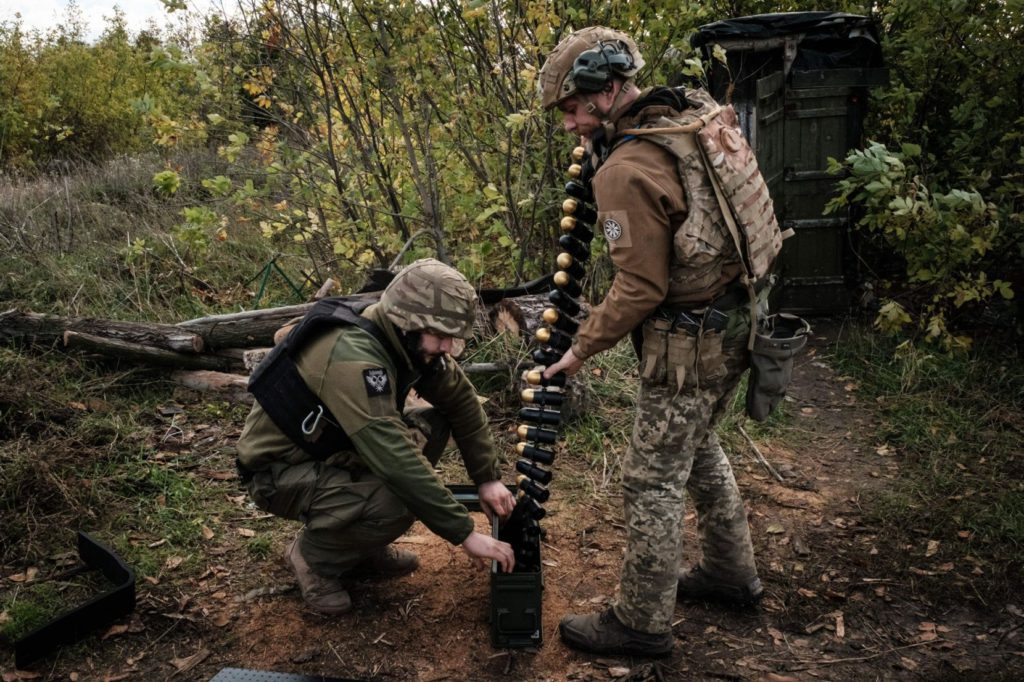
Rupert Murdoch Wants to Put His Media Empire Back Together Again

(Bloomberg) — Rupert Murdoch is exploring options to recombine his Fox Corp. and News Corp. businesses, putting back together a media empire that he split in 2013.

Both companies have set up special committees of independent directors to study a potential deal and evaluate possible terms, according to statements they put out late Friday. There’s no certainty an agreement will be reached, the companies said.

Discussions involve an all-stock merger that would require approval by a majority of the non-family shareholders, according to people familiar with the negotiations who asked not to be identified because the talks are private. Murdoch initiated the discussions, one of the people said.

A combination would involve cost savings, the people said. It could also result in more opportunities to promote new businesses, such as sports betting, across a broader array of media outlets, including print, TV and online.

Both companies have changed dramatically since their split almost a decade ago. Fox sold most of its entertainment assets to Walt Disney Co. in 2019 and is largely focused on broadcasting and cable television, led by the Fox News Channel. It also owns the Tubi streaming service. News Corp., owner of the Wall Street Journal, has diversified into new areas like online real estate services. The Journal broke the news of the deliberations earlier on Friday.

The Murdoch family has about a 39% voting stake in News Corp. and approximately 42% of Fox, filings show. Murdoch’s company was called News Corp. for decades. If the merger is successful, it’s likely the business keeps that name, one of the people said.

Murdoch, 91, is executive chairman of News Corp. and chairman of Fox. He started building the global media giant from a single newspaper in Australia. Along the way he acquired the Fox film studio and launched the Fox broadcast network. Other acquisitions included Dow Jones & Co., publisher of the Wall Street Journal, in 2007, as well as some of Britain’s most-read newspapers.

The newspaper business began to collapse in the digital age, however, with publications losing much of their advertising to online outlets. The separation of the company’s print and entertainment businesses in 2013 allowed investors to independently value the faster-growing cable-TV business, including channels such as Fox News, FX and Nat Geo. 

More recently, cable TV has been challenged by streaming services such as Netflix Inc. that are drawing away millions of viewers. After failing in an attempt to bulk up by acquiring Time Warner in 2014, Murdoch ultimately decided in 2017 to sell his entertainment assets to Disney. 

At the same time, News Corp. began to show renewed vigor, with the Wall Street Journal growing again thanks to online subscriptions. Acquisitions, such as Realtor.com, opened up new sources of profit.

Uniting the two businesses could give the Murdochs a broader portfolio of opportunities in which to invest. Fox has a market capitalization of about $16.7 billion, while News Corp. is worth about $9.14 billion.

It would also potentially consolidate power for Rupert’s son Lachlan, 51, who is News Corp.’s co-chairman. He is also executive chairman and chief executive officer of Fox.

Bloomberg News competes with News Corp.’s Dow Jones and Wall Street Journal in providing financial news and information.

News Corp. shares rose 6.5% to $16.61 in extended trading. Fox was down 1.7% to $31.

(Updates with potential deal structure, more details begining in third graph.)

More stories like this are available on bloomberg.com

©2022 Bloomberg L.P.

Nikola Founder Trevor Milton Guilty of Defrauding Investors

(Bloomberg) — Nikola Corp. founder Trevor Milton was convicted of fraud for misleading investors in the electric truck company, a stunning downfall for the door-to-door salesman turned billionaire who promised to revolutionize the auto industry. 

Milton, 40, was found guilty Friday of one count of securities fraud and two counts of wire fraud by a federal jury in Manhattan, in a boost to the US Justice Department’s efforts to crack down on corporate crime. He was acquitted of a more serious securities fraud charge but still faces as many as 20 years in prison.

Read More: Milton Described as Serial Liar, and as Victim of Distorted Case, in Closings

He briefly shook his head as the verdict was read out, raised his left hand to his face and looked back at the nearly two dozen family members and friends gathered in the benches behind him.

“I think the evidence was clear,” Juror No. 5, a woman with gray hair and glasses, said afterward. She declined to give her name.

Meteoric Rise

Milton is due to be sentenced on Jan. 27.

“I did nothing wrong,” Milton said outside the courthouse. “I was talking about the business plan.”

Asked about his plans, he said “Got to keep fighting. That’s all you can do, especially when you didn’t do anything.”

Read More: Nikola CEO Says He Learned Truck Had No Power Only After He Was Hired

It’s been a wild ride for the charismatic entrepreneur, whose fortune has declined to hundreds of millions of dollars after having once reached the billions shortly after the company listed its shares in June 2020. Milton, who remains the company’s biggest individual shareholder, founded Nikola in 2014 and built it into a company valued at $34 billion when it went public, more than Ford Motor Co. at one point. 

The meteoric rise of the startup, which had no revenue at the time, came amid a wave of electric vehicle companies going public through special-purpose acquisition companies, or SPACs, starting two years ago as investors scoured the landscape for the next Tesla Inc. Going the SPAC route allowed them to market their companies based on future projections of performance rather than actual financial results. Some of the biggest names on Wall Street poured money into the sector. 

Celebrity Endorsements

After Nikola’s listing, ordinary investors started to take notice of Milton’s vision as well, with the company much discussed online just as Elon Musk’s has been. While Nikola’s initial focus was on heavy commercial trucks, it hatched plans to branch out to power sport and consumer EVs. It was all supercharged by celebrity endorsements from the likes of the Diesel Brothers’ Heavy D, who promoted the Badger pickup, a product that never made it beyond the renderings stage.

Read More: Nikola Founder Exaggerated the Capability of His Debut Truck 

Prosecutors argued that Milton enticed retail investors to buy Nikola shares by making false statements about the company’s products and capabilities in numerous tweets, media interviews and podcasts, sharply exaggerating Nikola’s capacity to manufacture trucks powered by hydrogen fuel cells as well as its ability to produce the fuel itself. 

It was “lie after lie after lie,” Assistant US Attorney Jordan Estes told the jury in her closing argument on Thursday. “His lies may have been on social media, but make no mistake: This was an old-fashioned fraud.”

Read More: Nikola Whistleblowers Tell Their Side of the Trevor Milton Saga

Milton’s lawyers called the case a “prosecution by distortion,” contending that their client never meant to deceive potential investors and that, in any case, his statements weren’t material, or important enough to influence those investors’ decisions.

Milton was generally upbeat as he arrived at court in a suit and tie to sit with his lawyers. In his own closing, which brought Milton’s wife to tears, defense attorney Marc Mukasey asked the jurors to “imagine the nightmare it is for Trevor, at 40 years old, to have his life hang in the balance” because of an overzealous prosecution. 

There were lighter moments, too. In the tense vigil during jury deliberations on Friday, Mukasey took a few practice golf swings with a phantom club.

Nikola said it’s “pleased to close this chapter” about statements Milton made years ago and added that “neither the prosecutors nor Mr. Milton questioned the company’s promising future and unique ability to positively transform the commercial transportation industry.”

Damian Williams, US attorney for Manhattan, said the case is a “warning to anyone who plays fast and loose with the truth to get investors to part with their money.”

During the trial, which kicked off with opening statements on Sept. 13, the government called a dozen witnesses. It started with Paul Lackey, a former Nikola contractor whose allegations of fraud helped spur the criminal probe. 

Lackey, an engineer at the electric-drive systems company EVDrive, said he gave Nate Anderson’s Hindenburg Research information in exchange for a share of its profits from shorting the company. The short-seller’s September 2020 report called Nikola an “intricate fraud” that, among other allegations, overstated the capabilities of its earliest test trucks. Nikola shares tumbled.

The government called other Nikola insiders to the witness stand. Among them:

  • Brendan Babiarz, a former designer for Nikola who said a prototype of the electric vehicle startup’s planned Badger pickup truck was made partly of components from a Ford F-150 Raptor
  • Chief Executive Officer Mark Russell, who said he learned only after joining the company that its debut electric truck had neither a natural-gas-powered turbine nor a fuel cell when Milton unveiled it
  • Chief Financial Officer Kim Brady, who said Milton was so “hyper-focused” on the company’s stock price that when the shares fell $5 on their first day of trading, he thought something was wrong with the Nasdaq

The defense called Harvard Law School professor Allen Ferrell, an expert on economics and the stock market, who told the jury that traders mostly shrugged off statements Milton made between the time his company went public and the time he resigned.

The case is US v. Milton, 21-cr-478, US District Court, Southern District of New York (Manhattan).

Read More

  • Nikola Investor Lost $160,000 on Milton’s Hype, He Tells Jury
  • Nikola Saw ‘Massive’ Badger Losses But Backed Milton Anyway 
  • Trevor Milton Faces Jury in His Toughest Sales Job Yet 
  • Nikola Founder Trevor Milton Won’t Testify in Fraud Trial 

(Adds details of verdict, reactions and quotes in second through fifth paragraphs.)

More stories like this are available on bloomberg.com

©2022 Bloomberg L.P.
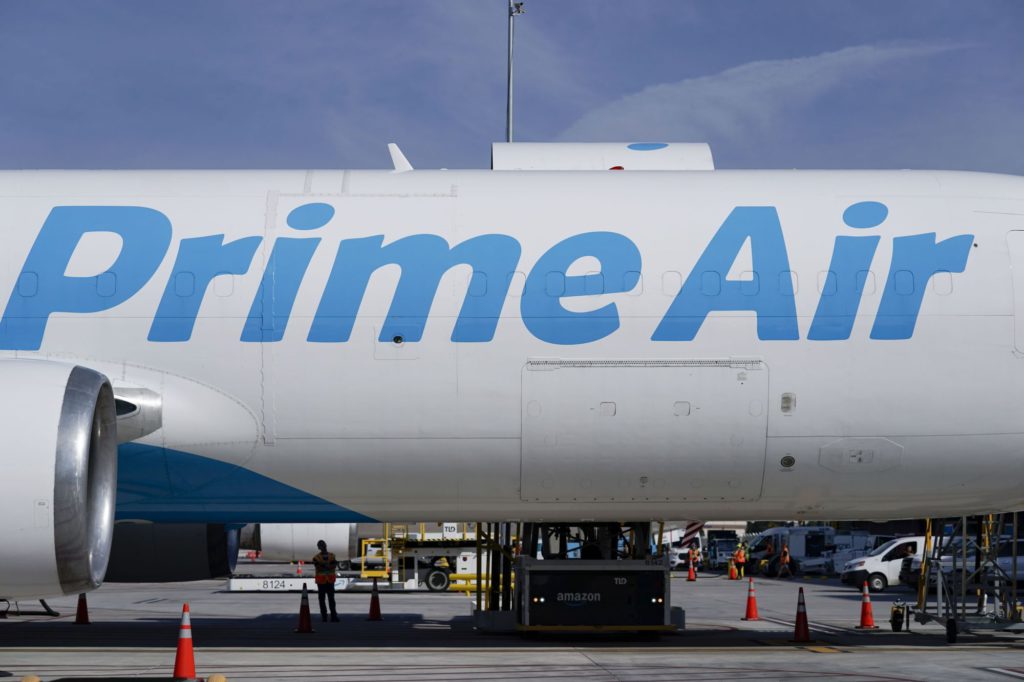
Tesla Fires After Hurricane Raise Alarm for Florida Officials

(Bloomberg Government) — A Florida senator is calling for action from the Transportation Department and automakers after a series of electric vehicle fires tied to Hurricane Ian.

The storm caused flooding and destruction across the state, and fire officials say they are still seeing its impact with EV batteries catching fire after saltwater damage. The National Highway Traffic Safety Administration is aware of multiple fires in Tesla Inc. vehicles, the agency said in a letter sent Friday to a Florida official and obtained by Bloomberg Government.

Sen. Rick Scott (R-Fla.) raised concerns about the fires to Transportation Secretary Pete Buttigieg and EV makers — including Tesla, Ford Motor Co., General Motors Co., and Stellantis NV — in letters sent Thursday, asking for guidance and whether any recalls are being considered.

“This emerging threat has forced local fire departments to divert resources away from hurricane recovery to control and contain these dangerous fires,” Scott said. “Car fires from electric vehicles have proven to be extremely dangerous and last for a prolonged period, taking in many cases up to six hours to burn out.”

The fires could represent a new area of concern as the Biden administration seeks to rapidly expand electric vehicle use across the country. The administration is aiming to have 50% of all new cars sold in the US be electric by 2030.

Scott joins Jimmy Patronis, Florida’s chief financial officer and state fire marshal, in drawing attention to the issue. Patronis said two houses burned down this week after an EV caught fire. He has asked manufacturers for help.

Patronis also wrote to NHTSA last week asking about the federal response and guidance. In its reply, NHTSA pointed to existing technical information and guidance available from the agency and from Tesla.

Tesla didn’t immediately respond to a request for comment.

“Lithium-ion vehicle battery fires have been observed both rapidly igniting and igniting several weeks after battery damage occurred,” Jack Danielson, executive director at NHTSA, wrote in the letter to Patronis.

Fires in EVs “pose unique challenges” for firefighters, NHTSA said in a separate statement to Bloomberg Government. The agency said it has been researching the effect of saltwater immersion on batteries when similar issues emerged with EVs after Superstorm Sandy in 2012.

There are more than 95,000 electric vehicle registrations in Florida, the second-most state after California, according to the Energy Department.

To contact the reporter on this story: Lillianna Byington in Washington at lbyington@bloombergindustry.com

To contact the editors responsible for this story: Sarah Babbage at sbabbage@bgov.com; Angela Greiling Keane at agreilingkeane@bloombergindustry.com

More stories like this are available on bloomberg.com

©2022 Bloomberg L.P.

Stocks Upended by Inflation Survey’s Sobering View: Markets Wrap

(Bloomberg) — US stocks fell after a report showed US year-ahead inflation expectations rose for the first time in seven months. The dollar gained and Treasuries fell.

The S&P 500 closed near lows of the day, falling more than 2%. The growth-sensitive Nasdaq 100 posted the steepest losses, dropping just over 3% as Treasury yields climbed, with the two-year rate rising back to 4.5%. Both indexes posted their first weekly declines this month.

Equity markets turned sharply lower after a University of Michigan survey showed year-ahead inflation expectations rose in early October and the long-term outlook also crept up. The uptick is potentially worrisome for the Federal Reserve’s efforts to keep views anchored. It also follows data a day earlier that showed a key measure of consumer prices accelerated in September to a 40-year high. On Thursday, however, stocks roared back from early losses in one of the biggest reversals on record.

“Yesterday you had this amazing, powerful intraday rally that was completely wrong,” said Phil Orlando, chief equity market strategist at Federated Hermes. “Then you look at the Michigan numbers this morning that’s consistent with what we’re seeing in the economy, and the stock market now is down to reflect that number. That’s correct.”

Corporate America offered some bright spots, with big banks including JPMorgan Chase & Co. and Wells Fargo & Co. rising after reporting results, while Morgan Stanley fell as equity trading revenue disappointed. UnitedHealth Group Inc. shares gained after the health-care giant beat profit forecasts in the third quarter and raised its outlook for the year.  

Read more: Main Street Beating Wall Street Still Leaves Banks Facing Pain

Earnings next week will provide clues on the strength of a swathe of companies, including Bank of America Corp., Goldman Sachs Group Inc., Johnson & Johnson, Netflix Inc., Tesla Inc. and United Airlines Holdings Inc.

In the latest Fed comments, officials suggested they’re ready to hike rates higher than previously planned. Kansas City Fed President Esther George said the terminal rate may need to be higher to cool prices. San Francisco Fed’s Mary Daly said she’s “very supportive” raising to restrictive levels and to between 4.5% and 5% “is the most likely outcome.”

Forecasts they released last month showed rates reaching 4.4% by year end and 4.6% next year, from a current target range of 3% to 3.25. Swaps traders have boosted wagers for rate hikes over the past week following strong payrolls and hot inflation readings, with the market leaning toward back-to-back jumbo hikes at the next two meetings and a high above 4.9% next year.

“A lot of investors are looking at inflation to get guidance on what the Fed is going to do, to find the bottom in the market once the Fed pivots,” Jerry Braakman, chief investment officer and president of First American Trust, said in an interview. “But looking at CPI, unemployment, there’s obviously a lot of heat in the economy. Inflation is going to take some time to come down.”

In the UK, bonds and the pound fell to end another tumultuous week. Gilts slid as Prime Minister Liz Truss confirmed speculation she will U-turn on a planned freeze on corporation tax. The Bank of England ended its emergency bond purchases on Friday, buying £1.45 billion of long-dated and inflation-linked gilts. In the wake of that, 30-year yields rose 23 basis points at 4.78%, after swinging from a drop of over 30 basis points earlier. 

Elsewhere, oil posted a weekly loss as inflation-fighting measures and muted Chinese demand soured the market’s outlook, blunting some of the sting from OPEC’s upcoming supply curtailments.

Some of the main moves in markets:

Stocks

  • The S&P 500 fell 2.4% as of 4:06 p.m. New York time
  • The Nasdaq 100 fell 3.1%
  • The Dow Jones Industrial Average fell 1.3%
  • The MSCI World index fell 1.3%

Currencies

  • The Bloomberg Dollar Spot Index rose 0.7%
  • The euro fell 0.5% to $0.9729
  • The British pound fell 1.2% to $1.1186
  • The Japanese yen fell 1% to 148.60 per dollar

Cryptocurrencies

  • Bitcoin fell 1.1% to $19,177.75
  • Ether rose 0.4% to $1,298.58

Bonds

  • The yield on 10-year Treasuries advanced seven basis points to 4.02%
  • Germany’s 10-year yield advanced six basis points to 2.35%
  • Britain’s 10-year yield advanced 14 basis points to 4.34%

Commodities

  • West Texas Intermediate crude fell 3.7% to $85.82 a barrel
  • Gold futures fell 1.7% to $1,648.80 an ounce

More stories like this are available on bloomberg.com

©2022 Bloomberg L.P.
Close Bitnami banner
Bitnami